
Above: dancers of The Polish National Ballet in MOVING ROOMS; Photo: Ewa Krasucka
Sunday June 21st, 2015 matinee – The Polish National Ballet in their New York debut performances at The Joyce with three contemporary works, bringing to New York City some two dozen dancers from their 90-member Company. While the inclusion of something more classical from their vast repertory might have given us a fuller picture of what The Polish National Ballet are about, it was nonetheless an exhilarating afternoon, thanks in no small part to the sleek energy of the dancers who brought ballet-based vitality to these modern works.
Krysztof Pastor’s ADAGIO & SCHERZO, a setting of two movements from Schubert’s C-major string quartet, introduced us to the dancers; they are first seen in a sculpted cluster, evocatively lit. To the achingly poignant themes of the adagio, we meet them as individuals, as couples, and in small units as they come and go from the space. There’s some very poised and polished pointe work from the girls, and some impressive partnering motifs from the couples as the choreographer wraps an au courant feeling around the classical ballet vocabulary.
The dancers re-form the opening cluster at the end of the adagio, then move on to fast-paced allegro dancing for the scherzo. In passages of stylized bravura, the ballet sweeps forward; we may wish to linger our gaze on certain dancers but as they sail across the stage it’s clear there isn’t a weak link anywhere: they are all exciting to watch.
A thorough change of mood as Emanuel Gat’s RITE OF SPRING unfolds before us. Performed by three women and two men in a space defined by an illuminated red carpet, this Rite is improbably set in a South American dance club. After a few initial moments of sizing one another up, the dancers go into ballroom/tango-based moves; partnerings come and go, and there’s always a woman left on her own. The work, nearly 40-minutes in length, maintained its pull on the viewer thanks to the charisma of the five dancers. It ends as one of the women slowly lets her hair down, lays down on the carpet, and falls asleep. Throughout this piece, I kept thinking of the riot caused by Stravinsky’s music when the ballet was premiered in the Nijinsky setting in Paris in 1913. The score is still provocative, but…to have caused a riot…?
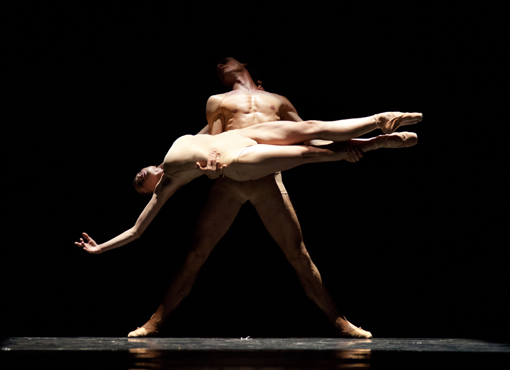
Above: from MOVING ROOMS; photo: Ewa Krasucka
Krysztof Pastor’s MOVING ROOMS gave the afternoon its powerful finale. Set to music of Alfred Schnittke and Henryk Górecki (his fascinating harpsichord concerto), this ballet opens with a solo male dancer, superbly illuminated, and soon expands to a giant light-defined chessboard on which the full complement of dancers move in mixed combinations, a dynamic structure of comings and goings that continually lures the eye in one direction, then another. In-sync ensemble passages are especially impressive to watch, filling the stage with unified movement.
Eventually the ballet goes ‘nude’ – or, more precisely, the dancers appear nude in dance belts and sheer body tights. Their taut physiques seem both vulnerable and savourable; the dancing is sexy and ecstatic.
A large audience watched the performance in attentive silence and cheered the dancers roundly during the bows. I hope The Polish National Ballet will be back in Gotham in the near future; they certainly made a vivid impression today.
 Oberon's Glade