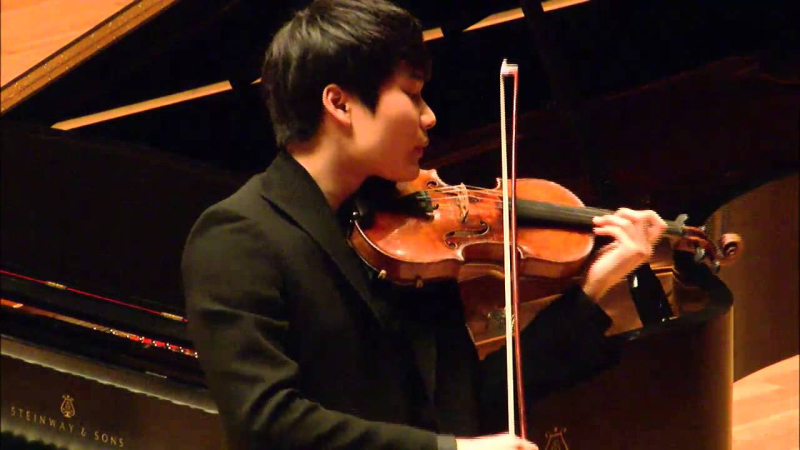
Above: violinist In Mo Yang
Tuesday September 27th, 2016 – In Mo Yang, a young violinist of Korean heritage, in recital with pianist Renana Gutman at Merkin Hall.
It’s only rarely that I do something really spontaneous; my schedule is always so full (and commitments made so far in advance) that there are seldom any opportunities to do things that haven’t been planned weeks in advance. But as I was researching something on the Merkin Hall website, I noticed a violin recital listed for this afternoon. The repertory looked very inviting and there were still a few tickets available, so I headed downtown. It was an impressive and thoroughly enjoyable concert in every regard.
In Mo Yang is the First Prize Winner of the Concert Artists Guild Competition. In 2015, he also earned First Prize at the 54th International Violin Competition “Premio Paganini” in Genoa, Italy, marking the first time since 2006 that the Paganini Competition jury has awarded the top prize.
In Mo Yong, in addition to a very impressive technique, has the gift of playing from the heart. After only a few measures of the opening Bach, I knew I was in the presence of a musician of the finest calibre; by the end of the recital, his name was hovering in my highest echelon of favorite musicians.
The forlorn beauty of the opening theme of the Adagio of Bach’s solo Violin Sonata No.1 in G minor immediately revealed the key elements of In Mo Yong’s playing: radiant and sweetly resonant tone, a mastery of dynamic finesse, innate expressiveness, and seamless phrasing. In the second movement, a minor-key dance, the violinist produced cascades of notes with admirable clarity. A sense of grace tinged with sadness marked his playing of the Siciliana, and in the final Presto, he reeled off reams of coloratura, perfectly defined and beautifully articulated, creating a magical atmosphere.
Pianist Renana Gutman then joined In Mo Yang for the violin sonata of Leoš Janáček. Ms. Gutman’s poised musicality and her attentiveness to details of phrasing were a great boon for the young violinist.
As In Mo Yang noted in his remarks, the flow of lyricism in this Janáček work is constantly interrupted by injections of turbulence or wit. There was a wondrous immediacy to the playing of the two musicians, drawing us in to the many felicities of this quite extraordinary piece. The opening Con moto found the violinist’s passion well met by the pianist’s sense of rapture, right from the outset. In the Ballada that follows, the shimmering piano sets off the singing violin. Sustained beauty of tone as the music’s passion soars, then sinks into a delicate reverie. In Mo Yang ended this movement on an exquisitely sustained, evaporating high note.
In the Allegretto, the music is agitated and pensive by turns; these the mood swings were well-captured by our two players. The concluding Adagio begins hesitantly; then an enchanting melody looms up, only to stall and then re-start. A vibrant theme over glimmering piano leads to alternating passages of agitation and calm before the piece reaches its hushed ending. Splendid playing from In Mo Yang and Ms. Gutman: a really impressive performance.
Karol Szymanowski’s setting of three ‘Paganini’ caprices followed the interval. The first, in D-major, features a high, sweet melody which gives way to an energetic passage before returning to its initial mood. In Mo Yang’s lingering final note was a moment of pure poetry. The second caprice, in A-major, begins in a state of musical density. The violin ascends to a high, aching theme which increases in passion; here In Mo Yang’s mastery of control in the stratospheric register was so evocative. The most familiar of the three caprices, the A-minor, is loaded at first with brisk, swirling motifs. Its sparkle and ironic wit suddenly go deep and mysterious, then things get playful, and then dreamy. This traversal of moods was finely differentiated by the two musicians. After some dazzlingly ping-y plucking from the violin, there’s a false ending; In Mo Yang then ascends again to the high, hazy glow of his upper range before charging on with Ms. Gutman to the grand finale.
All of the qualities that make Felix Mendelssohn one of my favorite composers were evidenced in his violin sonata in F major, written and premiered in 1838. It was not published in the composer’s lifetime, but was ‘rescued’ in 1953 by Yehudi Menuhin, who accordingly tinkered with it before having it published.
After a gallant piano introduction opens the Allegro vivace, a pulsing motif develops as the piano and violin alternately switch from melody to rhythm. Charming variants of major and minor keys – and a lovely sense of Mendelssohnian flow – gave me a lot of listening pleasure.
Ms. Gutman sounds a low song which the violin takes up as the central Adagio casts its spell. Such expressive playing here; and then the music sails forward. And yet again, the heart-rending quality of In Mo Yang’s upper-range playing was a marvel.
Joyous flights of fancy abound in the concluding Assai vivace, the players shifting effortlessly between liveliness and subtlety. With stunning dexterity, In Mo Yang reveled in high-velocity playing here that filled me with smiling admiration.
Sheer gorgeousness to end the afternoon: a Karl Schumann romance was offered as an encore: exceptional playing with a high emotional value.
 Oberon's Glade