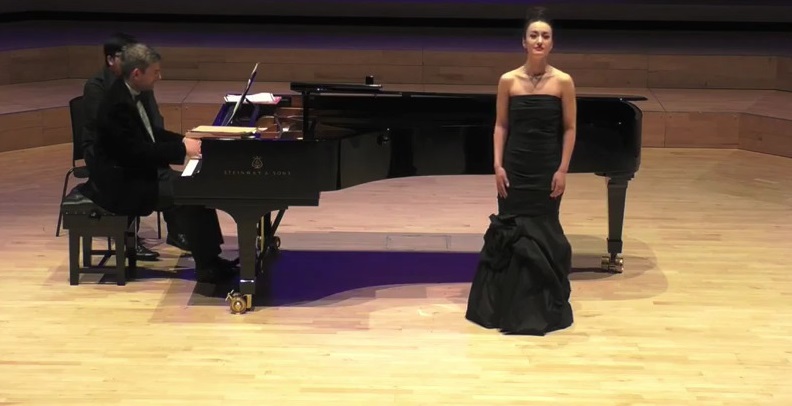
Soprano Julia Smith sings a Richard Strauss rarity, ‘Epheu’, with Jonathan Fisher at the piano, at the Elizabeth Harwood Prize Competition at The Royal Northern College of Music in March 2020.
Watch and listen here.
Soprano Julia Smith sings a Richard Strauss rarity, ‘Epheu’, with Jonathan Fisher at the piano, at the Elizabeth Harwood Prize Competition at The Royal Northern College of Music in March 2020.
Watch and listen here.

Mother and daughter meet – for the last time – in the courtyard of the palace at Mycenae in this scene from Richard Strauss’s ELEKTRA. Lisa Gasteen is Elektra and Dame Felicity Palmer is Klytemnestra.
Elektra~Klytemnestra scene – ELEKTRA – Lisa Gasteen & Dame Felicity Palmer – Tanglewood 2006

~ Author: Oberon
Patrice Chéreau’s production of Richard Strauss’s ELEKTRA originated at Aix-en-Provence in 2013, in the 1350-seat theatre there. It did not impress me when it came to The Met in 2016; though musically vivid, as a theatrical experience it got lost in the vast space of the world’s largest opera house.
The Aix performance was filmed, and released on DVD in 2014. I came upon it by chance at the library, brought it home, and was blown away by both its musical and dramatic power. It is a production that cries out to be seen up-close, and the camera work for the DVD takes us right into the action, as if from the start we are in service at the House of Atreus and watching this domestic horror-story unfold before our eyes. A brief sampling from the DVD here.
The opera’s story is absorbingly told, with some liberties taken. The shifting loyalties of the maids and other household members are cunningly delineated.
Veterans Renate Behle (visually fascinating), Franz Mazura, and Donald McIntyre make vivid impressions in smaller roles, and Chéreau’s idea of casting the beloved soprano Roberta Alexander as the sympathetic 5th Maid pays off handsomely: her singing and her portrayal are riveting, and she is hugely applauded during the bows.
Memorable portrayals in the production:

Above: Tom Randle as Aegisth is aghast at being shown the corpse of his paramour Klytämnestra.

Above, siblings reunited: Evelyn Herlitzius as Elektra and Mikhail Petrenko as Orestes; the bass-baritone makes a strong impression as the haunted son of Agamemnon.

Above, the sisters: Adrienne Pieczonka as Chrysothemis and Evelyn Herlitzius as Elektra. Ms. Pieczonka sounds fantastic in this film (of a live performance), her top notes pealing forth.
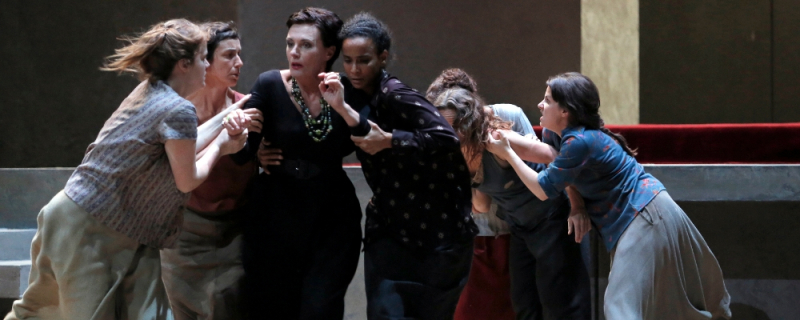
Above: Waltraud Meier as Klytämnestra. Ms. Meier’s singing, so alive with subtle inflection, did not always register at The Met, but she makes a striking impression – both vocally and visually – in the film. M. Chéreau eliminates the queen’s hysterical laughter on learning of the death of her son; I for one don’t miss it.

Above: Evelyn Herlitzius scored a great personal triumph as Elektra at Aix-en-Provence, and it is wonderful that her performance has been preserved. With a voice I would describe as “big lyric”, Ms. Herlitzius does not sing the music as we are accustomed to hearing it sung. Both in voice and in her athletic physique, the soprano seems almost youthful, though in fact she was around 50 years old when the film was made (You’d never guess it by watching her!). She powers thru the vocal demands, and shows off a secure, brightish top.
However, the pressure she has put on her instrument in such arduous music has worn the voice down over time; her 2018 Met debut performances as Kundry were disappointing, showing the effects of hard usage on her timbre, the voice sometimes ineffectual in the large space. This makes having a document of her Elektra on fine vocal form all the more valuable, for her passion and commitment are unquestionable.
You can find copies of this performance for purchase here. It’s well worth owning.
The Participants:
Elektra Evelyn Herlitzius
Klytämnestra Waltraud Meier
Chrysothemis Adrianne Pieczonka
Orest Mikhail Petrenko
Aegisth Tom Randle
Der Pfleger des Orest Franz Mazura
Ein junger Diener Florian Hoffmann
Ein alter Diener Donald McIntyre
Die Aufseherin / Die Vertraute Renate Behle
Erste Magd Bonita Hyman
Zweite Magd / Die Schleppträgerin Andrea Hill
Dritte Magd Silvia Hablowetz
Vierte Magd Marie-Eve Munger
Fünfte Magd Roberta Alexander
Coro Gulbenkian
Orchestre de Paris
Conductor: Esa-Pekka Salonen
~ Oberon
The Polish soprano Teresa Zylis-Gara sings Richard Strauss’s Vier Letze Lieder. This has long been my favorite recording of the songs, although there are many excellent contenders. Zylis-Gara’s voice is so creamy and dreamy.
I found the recording years ago by chance, in a marked-down cassette bin at the old Tower Records on Broadway & Lafayette. The first time I played it, I was amazed by the applause at the end because I had assumed it was a studio recording; it’s actually from a live radio broadcast.
The original tape unraveled years ago; I had made a copy – which is also on its last legs – from which this MP3 was made. The sound quality is not great, but the singing is.
Teresa Zylis-Gara – Four Last Songs~Strauss – Radio Hanover-Live bcast
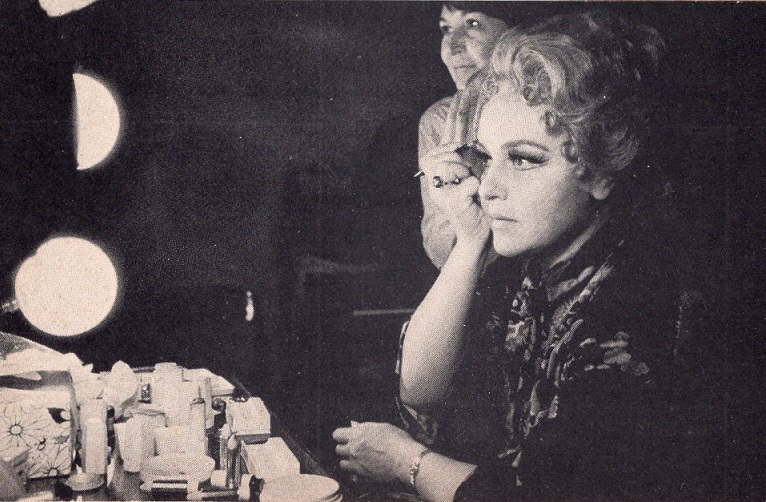
The great mezzo-soprano Irene Dalis (above) found her most memorable role as The Nurse in Richard Strauss’s DIE FRAU OHNE SCHATTEN; I was fortunate enough to have seen her in this opera twice at The Met, and both times she simply dazzled in the fiendishly difficult vocal writing whilst creating a vivid theatrical portrait of this mercurial creature.
The Nurse above all is devoted – to the point of obsession – to her charge: the half-human/half-spirit Empress, daughter of the mysterious and omniscient Keikobad. In the opera’s opening scene, the Nurse is visited by Keikobad’s messenger. The Empress has been married to the Emperor, a mere mortal, for one year, but as she still does not cast a shadow – the sign of her ability to bear children – Keikobad plans to re-claim her for the spirit world in three days. The Nurse is delighted, as she very much hates living among humans and longs to return to Keikobad’s realm.
The Nurse asks what will become of the Emperor after the Empress is taken by her father; “Er wird zu Stein!” says the Messenger: “He will be turned to stone!” This prospect gives the Nurse even greater satisfaction: “He will be turned to stone!” she repeats. “There do I recognize Keikobad, and bow before him!”
FRAU ~ opening scene – Irene Dalis & William Dooley – Bohm cond – Met bcast 1966

The great mezzo-soprano Irene Dalis (above) found her most memorable role as The Nurse in Richard Strauss’s DIE FRAU OHNE SCHATTEN; I was fortunate enough to have seen her in this opera twice at The Met, and both times she simply dazzled in the fiendishly difficult vocal writing whilst creating a vivid theatrical portrait of this mercurial creature.
The Nurse above all is devoted – to the point of obsession – to her charge: the half-human/half-spirit Empress, daughter of the mysterious and omniscient Keikobad. In the opera’s opening scene, the Nurse is visited by Keikobad’s messenger. The Empress has been married to the Emperor, a mere mortal, for one year, but as she still does not cast a shadow – the sign of her ability to bear children – Keikobad plans to re-claim her for the spirit world in three days. The Nurse is delighted, as she very much hates living among humans and longs to return to Keikobad’s realm.
The Nurse asks what will become of the Emperor after the Empress is taken by her father; “Er wird zu Stein!” says the Messenger: “He will be turned to stone!” This prospect gives the Nurse even greater satisfaction: “He will be turned to stone!” she repeats. “There do I recognize Keikobad, and bow before him!”
FRAU ~ opening scene – Irene Dalis & William Dooley – Bohm cond – Met bcast 1966

Above: baritone Donnie Ray Albert
Wednesday October 19th, 2016 = The American Symphony Orchestra presenting concert settings of operas by Ernst Krenek and Richard Strauss in their season-opening program. The timely theme of dictatorships and the eternally evasive concept of peace hung in the air at Carnegie Hall, where appreciative music lovers had gathered, skipping a pointless presidential ‘debate’ in favor of hearing some rarely-performed works.
Ernst Krenek’s Der Diktator was completed in August 1926. You can read a synopsis of the opera and find background material here, since I’m going to concentrate on the evening’s presentation.
Leon Botstein and his intrepid players gave a fine rendering of the very palatable score. The performance was dominated by Donnie Ray Albert as the Dictator. A stalwart force in the realms of opera and concert since 1976, Mr. Albert is now 66 years of age, and boasts a voice that has retained its power, along with interpretive skills that are truly impressive. Whether in bold declamation or in the music’s more lyrical passages, Mr. Albert gave a masterful performance. Another impressive voice was that of Karen Chia-Ling Ho as Maria: displaying a large, spinto sound and hall-filling top notes, the soprano also invested her singing with dramatic urgency. Ilana Davidson, a petite woman with a baby-dollish timbre, piped up boldly as Charlotte, and Mark Duffin was able to combine the power of a helden- and the verbal edge of a character-tenor. Portraying an officer blinded by poison gas while in the Dictator’s service, Mr. Duffin wore sunglasses and managed, for all his gritty vocal power, to create a moving figure.
Richard Strauss’s Friedenstag (Peace Day) was premiered at Munich in 1938, with Adolf Hitler among the audience. Set during the Thirty Years War, the story is unfolds in a city under siege; after many twists and turns of plot, the wife of the city’s Commandant intercedes with the head of the besieging force and brings about a reconciliation. With music includes many reminders of DIE FRAU OHNE SCHATTEN, FRIEDENSTAG is a good experience for an old Strauss-lover like me; however, it is somewhat weakened by an endless series of “finales”, as though Strauss did not know when to stop.
Continuing his highly successful evening, Donnie Ray Albert made a grand impression as the Commandant with his generous singing and imposing stature. I had very much been anticipating hearing Tamara Wilson as Maria, the Commandant’s wife, but when we arrived at Carnegie Hall, we found that she had canceled and was being replaced by Kirsten Chambers. A program-insert bio lists Ms. Chambers as the cover for both Isolde and Salome at The Met this season. Blonde, and clad in a bright red gown, the soprano unsparingly hurled herself into the demanding music of Maria, showing a voice of considerable thrust. If one top note was just shy of the mark, overall she managed well in a fiendish role, and saved the evening.

Bass Ricardo Lugo (above), as the opposing general, made a vibrant impression with his imposing voice and intrinsic sense of the drama. He was an excellent foil for Mr. Albert, and, between these two powerhouse voices, they kept our focus on the work keenly secured. Mr. Duffin, amplifying the forceful impression he had made in the Krenek, was back as the Burgomaster: one of his upper notes was sustained for an incredibly long time…I really don’t know how he did it!
FRIEDENSTAG has a number of small roles in which savvy interpreters are able to make their mark. I especially liked the clear sweetness of Scott Joiner’s tenor as a Piedontese soldier (he sang in Italian) and Carsten Wittmoser’s sturdy vocalism as a Musketeer. Tenor Doug Jones and baritone Steven Eddy (in a dual role) seized their chances and did very well, with baritones Steven Moore, Daniel Collins, and Benjamin Cohen contributing strongly.
In small vignettes, a number of chorus members stepped forward from time to time. One of these had a special meaning for me: Rachel Rosales, as a Woman of the People, is a soprano I heard lo! these many seasons ago as an exquisite Leila in LES PECHEURS DES PERLES at New York City Opera. I have seen her name listed among choral rosters before, and was feeling nostalgic when she intoned her brief, dramatic solo, a solo which made me think of Strauss’s writing for Die Amme in FRAU OHNE SCHATTEN. In the finale tonight (the final finale), Ms. Rosales and other chorus sopranos sent some high notes sailing into the hall.
The Participating Artists:
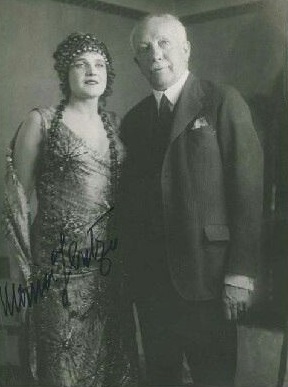
Above: Maria Jeritza, in costume for The Egyptian Helen, with Richard Strauss
Richard Strauss’s Vier letze lieder were for many years thought to have been the composer’s last completed work. But in November of 1948, the composer wrote a song entitled Malven (“Mallows”); he dedicated it to soprano Maria Jeritza and sent her the only known copy.
The manuscript turned up Mme. Jeritza’s papers following her death in 1982. Read an article about the discovery of the Malven here.
The world premiere of Malven was given at a New York Philharmonic concert (that I attended) in 1985. Dame Kiri Te Kanawa was the first to sing the song in public; as Malven had never been orchestrated, Dame Kiri was accompanied by pianist Martin Katz. The program further included the soprano’s sterling performance of the Vier letze lieder, conducted by Zubin Mehta.

Tenor Vinson Cole sings Richard Strauss’s Morgen.
Vinson Cole – Morgen – Richard Strauss
“And tomorrow the sun will shine once more, and on the path that I will take it will unite us – we fortunate ones – upon this sun-drenched Earth. And to the broad shore with its blue waves we will quietly go down; we will look into one another’s eyes, and the silence of happiness will descend upon us.”

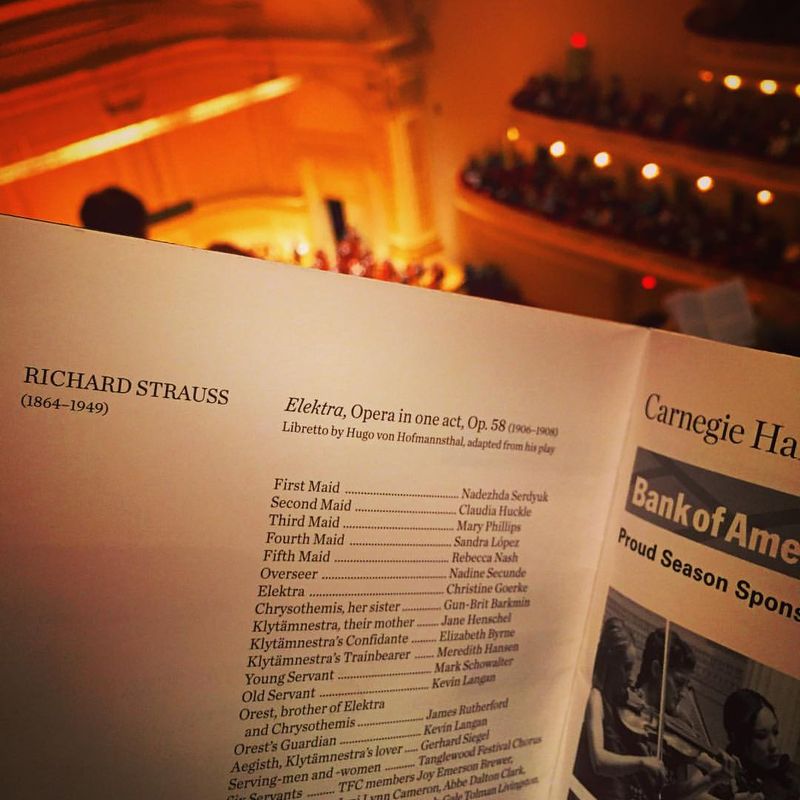
Wednesday October 21st, 2015 – Conductor Andris Nelsons (above) leading a powerful concert performance of Richard Strauss’s ELEKTRA given by the Boston Symphony Orchestra at Carnegie Hall. The evening was a great personal triumph for soprano Christine Goerke, who gave a vocally and physically super-charged rendering of one of opera’s most demanding roles.
Strauss calls for a massive orchestra for this, his most demented work; the Boston players were sprawled across the entire space of the Carnegie stage, with the chorus at the end singing from an upper tier of the hall. The musicians played their hearts out and, under Nelsons’ authoritative baton, they delivered the music with tremendous flair in all its glistening glory. There were also superbly refined stretches, notably in the Klytaemnestra scene where the maestro and musicians painted a neurotic sound setting for an amazingly nuanced performance of the role by Jane Henschel.
The large cast included some names to reckon with in the smaller roles: Nadine Secunde (Overseer), Elizabeth Byrne (Confidante), the Met’s Mark Schowalter (Young Servant) and stalwart basso Kevin Langan (Old Servant/Orestes’ Guardian).
In the opening scene, the psychopathic maids were a raucous lot; as they carried on their vile gossip session about Elektra – the royal princess reduced to the status of a caged animal in her own home – Ms. Goerke, in a striking blood-red gown, strode among the violins in a state of fevered anxiousness. At last the maids hauled off the fifth of their number to be beaten for defending Elektra, and Ms. Goerke took center stage.
She began the great monolog with sounds of deep, guttural anguish. As in her recent Met Turandot, Goerke’s voice narrowed as she ventured higher and some of the upper notes were covered by the orchestra. This necessitated an adjustment for those of us inured to the likes of Nilsson, Behrens, and Dame Gwyneth Jones in this music. Yet Goerke knew what she was doing and she went about the music on her own terms; by the scene with Klytaemnestra, the Goerke voice was firing on all cylinders and she delivered a performance on a par with her career-defining portrayal of the Dyer’s Wife at The Met in 2013.
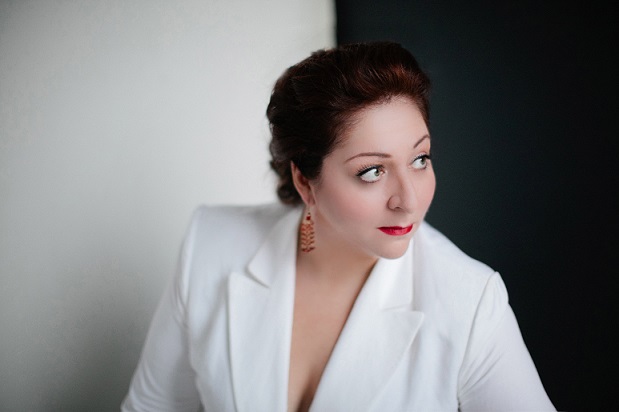
Above: Christine Goerke
The soprano’s portrayal of Elektra was so committed and intense: she entered into the physicality of the role as if in a staged performance, interacting brilliantly with her colleagues and even including a frantic, manic dance at the end. Vocally she sailed forth undaunted by the orchestra’s volume and hurling out the character’s dramatic punch lines (“Triff noch einmal!”) with force. Summoning up a colossal effort for the last sprint, Goerke packed a final punch with her ecstatic “Schweig, und tanze!” before collapsing into her chair. The ensuing ovation for the intrepid soprano was epic, and very much well-deserved.
As the hapless Chrysothemis, Gun-Brit Barkmin made a far better impression than she had as Salome in this same hall in 2014. Slender of frame and of voice, she nevertheless finds a way of projecting over the orchestra and her shining top notes made me think she might be a good SIEGFRIED Brunnhilde. Errant pitch was sometimes evident, but overall Ms. Barkmin did well and was a good foil for Ms. Goerke.

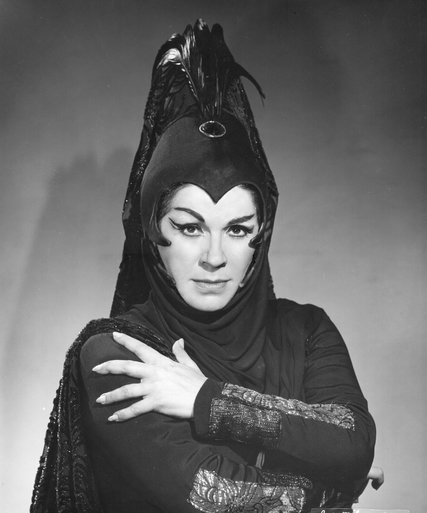
Jane Henschel (above), though the top of her voice must now be handled with care, gave such a illuminatingly subtle and detailed performance as the demented Klytaemnestra – playing off the words and using a kozmic array of vocal colours – that a few random strained notes were only of passing worry. She and Goerke made their encounter crackle with verbal vibrancy: the most dramatically engrossing passage of the evening.
James Rutherford was a sturdy-voiced but not especially imaginative Orestes. The great Recognition Scene was not persuasively staged, though Goerke’s singing after the revelation was wonderful….and deeply felt; and here the orchestra playing was sublime. Gerhard Siegel was a capital Aegisth, vividly neurotic and strongly sung: his final “Weh mir!”, voiced onstage, was a lightning bolt rather than a last gasp.
 Oberon's Glade