Tag: Richard Strauss

  • ASO Season Opens @ Carnegie Hall

    Strauss

    Above: Richard Strauss, the composer of Also sprach Zarathustra

    Friday October 16th, 2015 – The American Symphony Orchestra opened their 2015-2016 season at Carnegie Hall with a program entitled Mimesis: Musical Representations.

    Gunther Schuller’s 7 Studies on Themes of Paul Klee opened the program, and what a brilliant and highly imaginative piece it is. The seven songs are vividly differentiated in instrumentation and rhythm, becoming aural counterparts for seven paintings by the Swiss modernist Paul Klee (1879-1940). “Each of the seven pieces bears a slightly different relationship to the original Klee picture from which it stems,” Schuller wrote. “Some relate to the actual design, shape, or color scheme of the painting, while others take the general mode of the picture or its title as a point of departure.”

    In “Antique Harmonies” Schuller’s music is sombre and dense. An immediate contract comes in “Abstract Trio” with whimsical winds and a single pluck of the strings. “Little Blue Devil” is captivatingly jazzy, with thrumming bass, muted trumpet, xylophone. Insectuous sounds pervade “The Twittering Machine” with edgy woodwinds and a wood-on-wood tone block marking time. “Arab Village” is an absolute delight, with a flautist playing from offstage; her ‘voice’ inspires a magical dance for harp, viola and, as the full orchestra plays very softly. They play even softer for the opening of “An Eerie Moment” which eventually rumbles grandly before fading away. For the final “Pastorale”, the violins play a repetitive two-note figure while the winds sigh, rather mournfully.

    The Schuller really is a great piece; I’ve only encountered his music rarely over the years…I need to seek it out.
    1869781

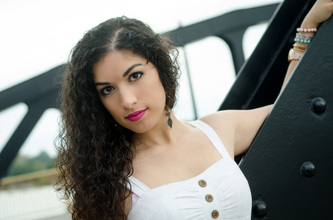
    Henri Dutilleux’s Correspondances brought forth the beauteous soprano Sophia Burgos (above). In this cycle of five songs, the composer draws on a variety of texts: poems by Rilke and Mukherjee, and letters written by Solzhenitsyn to the Rostropovichs and by Vincent van Gogh to his brother Theo.

    The singer’s agile, silvery timbre is shot thru with gem-like flecks of colour; she has an extensive range and her voice was beautifully set off by the marvelous instrumental combinations Dutilleux has employed. Countless entrancing passages for various instrumental combinations keep the ear pricked up: an especially appealing tuba outing in the Interlude, and the cunning use of accordion.

    Ms. Burgos moved with thorough vocal command from urgency to passion to evocation; the audience, very taken with her, broke in with applause during the cycle, and Maestro Botstein took it in stride, nodding approvingly. In the final song, the soprano was at her most poignantly expressive: an affecting descending vocalise is heard over the shimmering strings before things take a dramatic turn and she soars to an ecstatic concluding high note. Brava! And bravi to the players as well. 

    Following the interval, Nico Muhly’s Seeing is Believing seemed to me – and to my pianist-companion – the least interesting work on the program. A sort of tone poem for electric violin (played by virtuoso Tracy Silverman) and orchestra, the work stretched out over 25 minutes of rather ‘same-y’ sounds and repetitive motifs.

    According to the program notes, Muhly’s inspiration for the work was the practice of mapping the stars in the sky; yet I could detect no sense of the wonderment one would expect to experience is questing the heavens. Instead the music seemed earth-bound and tended to wallow in its own density. Mr. Silverman was in total command of his electrified instrument, producing some striking effects in the layered, echoing passages. Having been impressed by Muhly’s orchestrational skills in his opera. The Dark Sisters, I was disappointed with tonight’s offering. The composer was present and took a bow from his box. To me, the audience seemed to embrace the violinist without embracing the music he had just played.

    Richard Strauss’s Also Sprach Zarathustra closed the evening on an epic note. Beyond its super-familiar but always impressive opening statement, the work is a rich and royal sonic tapestry into which Strauss has woven one appealing thread after another. Abounding in solo opportunities for individual instruments, this thrilling work further features a gorgeous tutti theme for celli and violins, and some interjections for organ to Westernize its spiritual aspects; an entrancing Viennese waltz looks forward to ROSENKAVALIER in no uncertain terms.

    Overall, a grand finale for an impressively-played concert. And the American Symphony Orchestra‘s next concert, on December 17th, looks fascinating to me.  

  • First Encounter: ARIADNE AUF NAXOS

    Ariadne6263.07
    Above: Leonie Rysanek, the Met’s first Ariadne

    As the 150th anniversary of the birth (on June 11th, 1864) of Richard Strauss draws near, I was recalling the first time I heard what was to become my favorite opera – the composer’s ARIADNE AUF NAXOS. This opera had come rather late to The Met: some fifty years after its world premiere, The Met presented ARIANDE with the following cast:

    Metropolitan Opera House
    December 29, 1962
    Metropolitan Opera Premiere

    ARIADNE AUF NAXOS
    R. Strauss

    Ariadne.................Leonie Rysanek
    Bacchus.................Jess Thomas
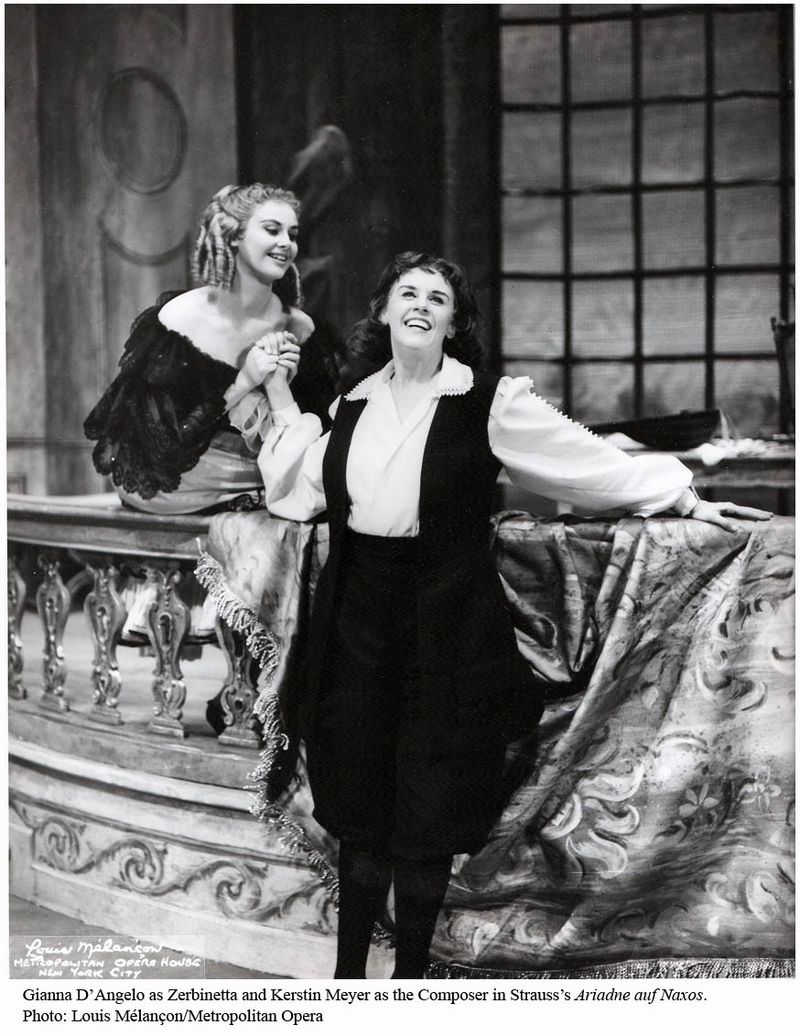
    Zerbinetta..............Gianna D'Angelo
    Composer................Kerstin Meyer
    Music Master............Walter Cassel
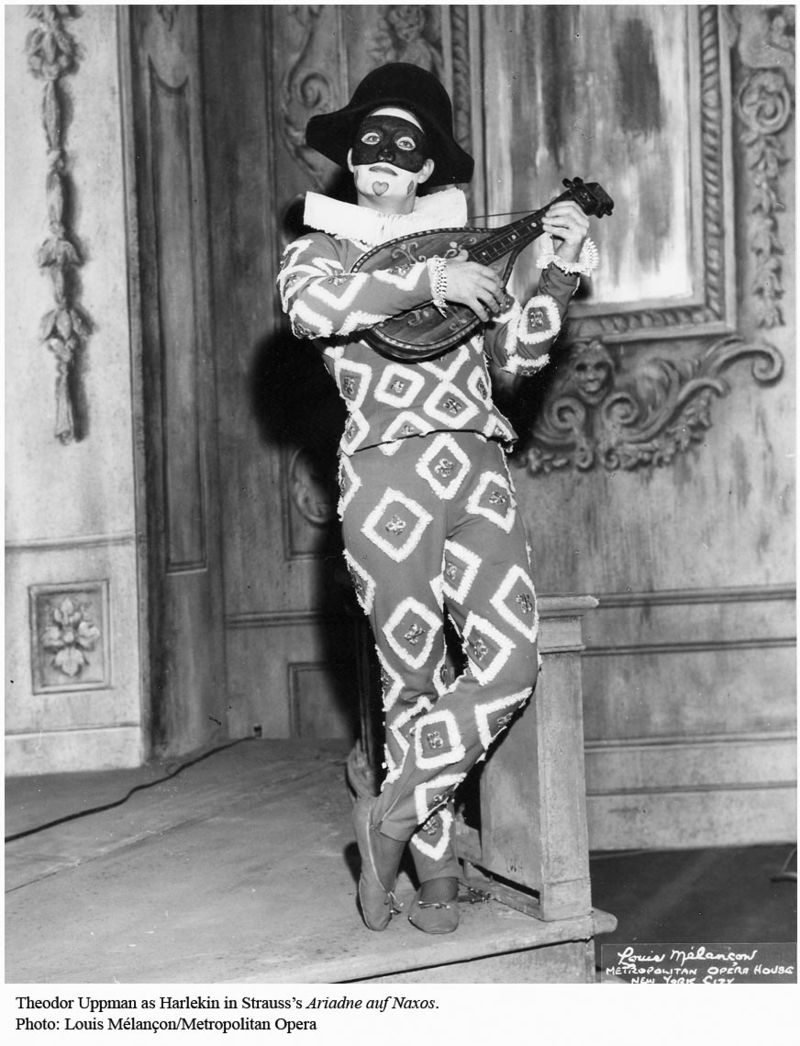
    Harlekin................Theodor Uppman
    Scaramuccio.............Andrea Velis
    Truffaldin..............Ezio Flagello
    Brighella...............Charles Anthony
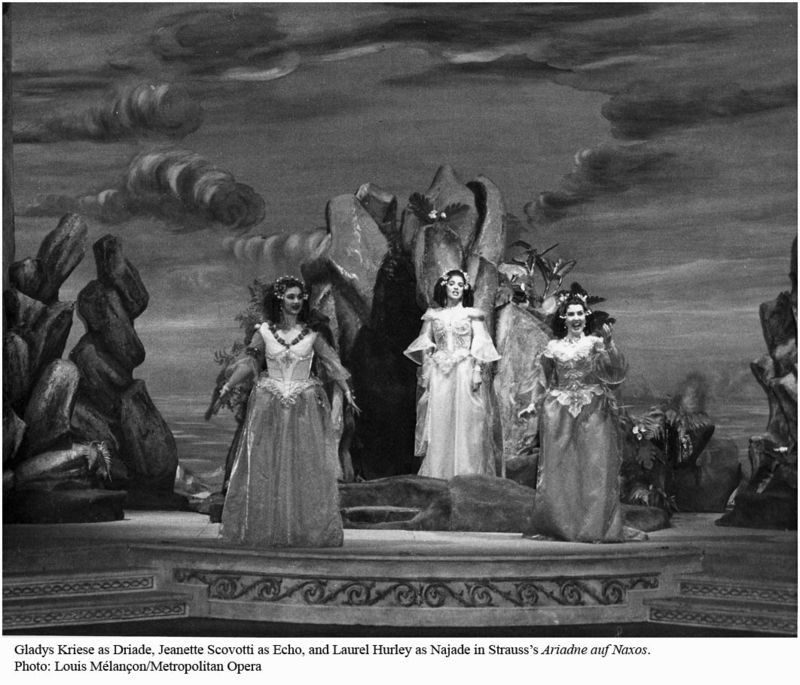
    Najade..................Laurel Hurley
    Dryade..................Gladys Kriese
    Echo....................Jeanette Scovotti
    Major-domo..............Morley Meredith
    Officer.................Robert Nagy
    Dancing Master..........Paul Franke
    Wigmaker................Roald Reitan
    Lackey..................Gerhard Pechner

    Conductor...............Karl Böhm

    The opera, with it’s almost chamber-music orchestration (only about 35 players are called for) was thought by some people to be too intimate for such a large house as The Met. But the production, revived several times over the ensuing years, continued to win new devotees to the incredible Strauss score. On March 12th, 1988 the Met production was telecast live to Europe; I was there – with Kenny and Jan – enjoying a superb cast led by Jessye Norman, Kathleen Battle, Tatiana Troyanos, and James King, with James Levine on the podium. In 1993 The Met unveiled a new and delightful production by Elijah Moshinsky with its ‘realistic’ prologue and fantasy-setting for the opera.  

    But, back to 1962: The Met’s house photographer at the time, Louis Melançon, routinely photographed each Met production as well as taking ‘portraits’ of the principal artists in costume. His photos graced Opera News for years, and I have several that were sent to me – autographed – by individual singers. Here are some of Mr. Melançon’s pictures from the Met’s premiere of ARIADNE AUF NAXOS:

    Ariadne6263.04

    Ariadne6263.24

    Ariadne6263.10

    Ariadne6263.22

    On February 2nd, 1963, Wagner’s FLIEGENDE HOLLANDER was scheduled for a Texaco/Metropolitan Opera matinee radio broadcast. Of course I was tuned in: this was my second season of Met radio broadcasts and I was thoroughly primed for my first experience of hearing HOLLANDER, with Opera News opened to the cast page and the household warned against any intrusions on my listening. Thus I was shocked when the friendly voice of Milton Cross delivered the alarming news: the opera was being changed!

    It seemed that tenor Sandor Konya, scheduled to sing Erik in HOLLANDER, was ill and so were his cover and other tenors who were in town who knew the role. It was decided to put on ARIANDE instead, since Leonie Rysanek – scheduled for Senta in the Wagner – was ready and raring to go. (ARIADNE had been scheduled for broadcast later in the season, with Lisa Della Casa the announced Ariadne; the change of opera on February 2nd thus deprived Della Casa of her chance to broadcast the role). The cast for the ‘substitution’ broadcast was the same as for the Met premiere, with the exception of Roberta Peters, replacing Gianna D’Angelo as Zerbinetta.

    Without any preparation for this ‘new’ opera, I listened and – to an extent – enjoyed ARIADNE though to be honest I was not a huge Strauss fan at that point in my operatic career. It wasn’t until 1970 that I actually saw the Met’s ARIADNE: from a front-row orchestra seat directly behind Karl Bohm’s left shoulder, I was transported by a splendid cast led by Leonie Rysanek, Reri Grist, Evelyn Lear, and James King. My love affair with ARIADNE became even more earnest a few seasons later with the New York City Opera’s beloved English/German production starring Carol Neblett/Johanna Meier, Patricia Wise, Maralin Niska, and John Alexander. But that’s a whole other story.

  • SALOME @ Carnegie Hall

    FWM_conducting_2_(credit_Roger_Mastroianni)

    Thursday May 24, 2012 – This concert performance of Richard Strauss’ SALOME by the Cleveland Orchestra under the baton of Franz Welser-Most has been on my calendar for months. Photo of the conductor above by Roger Mastroianni.  The maestro and his musicians gave a spine-tingling account of this most dazzlingly colourful of operatic scores. From the massive onslaughts of ominous themes predicting the opera’s brutal outcome to the shimmering delicacy of filagree harp or the sensuous spinning of mid-East exotica in the winds, SALOME has never sounded better. The great sway and sweep of the Dance of the Seven Veils was enthralling, and the maestro’s fingertip control of dynamics helped soprano Nina Stemme turn the arduous final scene into a personal triumph.

    One unfortunate aspect of the presentation though was that the singers were seated on raised platforms along the outer walls of the stage. This meant that for 1/3 of the audience in the hall’s upper reaches, the protagonists were simply not visible. We had a great view of the Nazarenes, Jews and Soldiers but had nary a glimpse of Ms. Stemme all evening. It seems like presenters are always trying to do something clever when giving an opera in concert form; it’s best just to line the singers up across the front of the stage and let ’em rip.

    Nina Stemme scored a huge success in the title-role. I’ve had a great run of Salomes in my years of opera-going: Rysanek, Bumbry, Niska, Marton, Behrens, Malfitano, Mattila. Ms. Stemme’s final scene was on a par with the finest of these, though earlier in the opera the tone was a bit edgy, not always in focus, and some top notes were a shade flat. There’s also not a lot of sheer beauty in the Stemme timbre although – like the immortal Behrens – she can persuade you through vocal colouring that certain notes are disturbingly lovely. But any misgivings were swept clean away by the power and expressivity of her vocalism in the opera’s magnificent closing pages. 

    Eric Owens sang with powerful commitment as Jochanaan. His tone has a somewhat covered, throaty quality and in a few spots the force of the orchestra almost overwhelmed him. He stayed the course and was clearly well-liked by the audience.  Rudolf Schasching sang with cutting power and verbal subtlety as Herod and Jane Henschel made the most of every phrase of Herodias’s neurotic music: these two singers contibuted much to the evening’s success. Jennifer Johnson Cano, a Met Rhinemaiden, sang with seductive, darkish appeal as the Page, and Garrett Sorenson was a strong Narraboth. Oddly, Mr. Sorenson remained onstage after his character’s suicide and was still there as Salome met her fate. Sturdy excellence from a trio of lower voices – Evan Boyer, Sam Hindley and Brian Keith Johnson – who doubled variously as Nazarenes and Soldiers. The Jews were a noisy, annoying lot but that’s exactly what Strauss wanted.