
Above: William Christie, photo by Richard Termine
~ Author: Lane Raffaldini Rubin
Tuesday January 28th, 2025 – Tonight, Les Arts Florissants made what has become the rare appearance of an early music ensemble on a Carnegie Hall stage.
To celebrate the eightieth birthday of its founder and co-musical director William Christie, the group presented selections from the core of its repertory, including scenes from the operas of Marc-Antoine Charpentier (1632-1704), Jean-Baptiste Lully (1632-1687), and Jean-Philippe Rameau (1683-1764). Christie has been a champion of these composers since the 1970s and it was with a 1986-87 production of Lully’s Atys – an opera that had not been staged since 1753 and whose music was excerpted at Tuesday’s performance – that Les Arts Florissants made its first big break.
Seeing the thirteen players and six vocalists take the stage of Zankel Hall’s intimate in-the-round configuration, one might get the sense that Les Arts Florissants is simply a small group of musicians dedicated to the French Baroque. Back in France, however, this group is just one component of a multifaceted institution that includes early music performance, music pedagogy, professional development for young singers and instrumentalists, a historic country house with fanciful Baroque-style gardens (themselves home to many of the group’s activities), training for gardeners, and a garden studies research center. Christie himself (an American, mind you, who left the States as an objector to the Vietnam War) is the godfather of this musical-cultural web.
Tuesday’s performance was a testament to the group’s decades-long legacy of learning and teaching, its total grasp of this body of music, and the kinship of its members, who played and sang together like family.

The chosen excerpts reveal the dramatic directness and emotional turbulence of French Baroque opera. We heard none of the repetitive music of Italian da capo arias or strophic forms. Instead, we heard through-written works that interweave recitative dialogues and monologues with airs and duets. The transitions between air and recitative were at times fitful and at times seamless, but always served a clear dramatic function. That formal range and psychological charge were on display in the excerpts from Charpentier’s 1693 Médée, where a dialogue between Médée and her confidante Nérine is interrupted by outbursts of jealousy and vengefulness. This all culminated in the aria “Quel prix de mon amour”, sung by mezzo-soprano Rebecca Leggett, a lamentation undergirded by fleeting but searing dissonances in the orchestra.
Another characteristic of this music is its emphasis on French diction. Lully, the favorite composer of Louis XIV, explicitly sought to differentiate his music from the florid and opaque sounds of Italian opera of the time. In excerpts from the later acts of Atys of 1676, the tenor Bastien Rimondi sang with clarity and shapely elegance as he communicated his character’s yearning and anguish.
The highlight of the program was Rimondi’s “Règne, Amour” from Rameau’s Pigmalion (1748). Rameau’s opera music, which dominated the evening, was presented simultaneously as a development of Lully’s legacy as well as an innovation upon and a perversion of it. In the Pigmalion excerpts we hear varied instrumental colors, free-spirited use of the recorders and reeds, heavy basso continuo inversions that drive harmonic motion, and a Handelian rhythmic motor. Rimondi sang his part with pure joy. His exquisitely crisp diction permeated ornate passages and more straightforward melodic lines, never hindering a sweet, clear tone and blooming vibrato on sustained notes.
The program concluded with two scenes from Rameau’s 1735 Les Indes galantes, the flagrantly cancelable opera-ballet featuring unrelated tales of exotic places and their inhabitants. Both scenes were drawn from the act “Les sauvages” depicting North American landscapes and natives. One might think the inclusion of the “Forêts paisibles” chorus to be pandering to the New York audience, but this scene also includes the famous dance of the savages which serves as Les Arts Florissants’s frequent sendoff at the end of their concerts. They tossed off this music with swung beats and confident restraint.

As an encore, Christie and Les Arts Florissants offered the quartet “Tendre amour” from the third act of Les Indes galantes (which Rameau cut from the opera after its first performances). Christie described this music as “one of the most beautiful pieces of the eighteenth century” and indeed it was gorgeous and pastoral with vocal lines floating high in the air. It was a birthday gift from Christie to the audience.
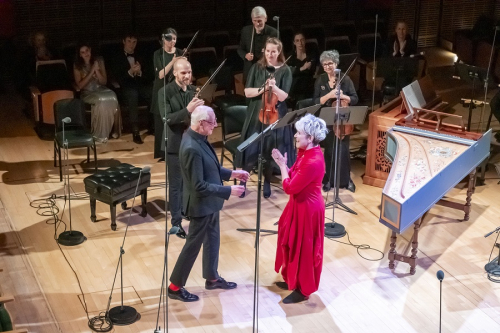
Above: Maestro Christie greets Joyce DiDonato; photo by Richard Termine
But the ensemble members had something else up their sleeve. The star mezzo-soprano Joyce DiDonato emerged onto the stage and lavished praise on Christie, whom she met while rehearsing for his 2004 production of Handel’s English-language opera Hercules. In tribute to Christie, she and the ensemble presented “As with rosy steps the morn” from the oratorio Theodora (why didn’t they choose something from Hercules?). After a full program of Charpentier, Lully, and Rameau, DiDonato’s Handel seemed monumentally scaled, possessing a different species of substance and intensity. The strophic form of this piece (repeating sections of music with new verses of text) set an obvious contrast with the French music of the main program and put the French works’ organic, dramatic, and transparent value into focus.
The program was, after all, a didactic showcase of French Baroque music and its performance techniques. Among early music groups, Les Arts Florissants is a champion of craft, forgoing the temptations to produce the highly biting, peppery sound that is so en vogue these days. Surrounding the ensemble on all sides, it was as if we the audience could simply enjoy overhearing a reading of this music being shared among friends.
Performance photos by Richard Termine, courtesy of Carnegie Hall
~ Lane Raffaldini Rubin
 Oberon's Glade