Tag: Ring Cycle

  • “Tristan!”…”Isolde!”…

    Alfred Roller - Set design for Act II - Wagner - Tristan und Isolde

    Above: Alfred Roller’s 1903 set design for Act II of TRISTAN UND ISOLDE

    Ben Weaver writes about some of his favorite recordings (and a DVD) of Wagner’s TRISTAN UND ISOLDE. Ben, a longtime TRISTAN addict, helped me to break down my resistance to this opera when we stood thru three performances of it – including Waltraud Meier’s only Met Isolde – in 2008. Prior to that, I had only seen the opera once, in 1971, with a stellar cast in a then-new production. In part, it was the magic of that performance that kept me from seeing it again for so many years: I felt nothing could compare.

    Earlier this year, I watched several video versions of the opera, becoming thoroughly immersed. The Met’s DVD, in the production that has moved me so much, is rightly hailed by Ben Weaver at the end of his article. Levine and the orchestra are splendid, and if Jane Eaglen and Ben Heppner are not physically everyone’s idea of how the lovers should look and move, to me they create all that is needed with their voices. Add Dalayman, and Pape, and the marvelous settings, and…voilà!…TRISTAN!

    Here is Ben’s article:

    Richard Wagner’s 1859 opera Tristan und Isolde was declared unplayable by orchestra musicians and un-singable by singers. Wagner spent nearly 6 years after completing it trying to get it staged. He failed repeatedly. Rio de Janiero, Strasbourg, Paris, Karlsruhe, Dresden, Weimar, Prague were all failures. Over 70 rehearsals in Vienna led to cancellation of the scheduled premiere. Finally the generosity of King Ludwig II of Bavaria – who would also pay for Wagner’s theater in Bayreuth – allowed the world premiere to take place in Munich on June 10, 1865 with the husband and wife team of Ludwig and Malvina Schnorr von Carolsfeld singing the title roles, with Hans von Bülow – with whose wife Wagner was having an affair – conducting. After only 4 performances, on July 21st, the tenor suddenly collapsed and died. Rumors began circulating that the exertion of singing the part of Tristan killed him. That’s probably not true, although the opera did additionally claim the lives of two conductors: both died in the orchestra pit during Act 2 – Felix Mottl in 1911 and Joseph Keilberth in 1968.

    Tristan is certainly one of the most challenging operas in the repertoire, and great Tristans and Isoldes do not come around very often. There are even fewer who can sing the voice-wrecking parts for long without damaging  their voices beyond repair. Some opera houses have gone decades without mounting it for lack of adequate singers. On record, the opera has fared better, in part because some singers who never attempted it in the theater agreed to sing it for a microphone.
     
    The first complete studio recording of Tristan und Isolde came in 1952 courtesy of EMI and the great Wagnerian Wilhelm Furtwängler. Furtwängler’s take on the opera is uber-Romantic. His conducting style could be traced back to von Bülow. Furtwängler’s tempos are slow, but the music never sags and never loses its pulse. His grasp of the totality of the work – the control over Wagner’s revolutionary redefining of tonality and chromaticism – is total. Sometimes the slow tempos reveal facets of the narrative that other, speedier performances don’t: for example when the sailors mock Isolde in Act 1 – the deliberateness of the tempo under Furtwängler makes their words far more threatening than the usual light mocking laughter. The Philharmonia Orchestra – at the time one of the finest ensembles in the world – plays exceptionally well. The opening Vorspiel builds magnificently, its climax washes over like an ocean wave.

    Kirsten Flagstad, who by 1952 had been singing Isolde for decades (albeit usually in heavily abridged form) and would soon retire from the stage altogether, is Furtwängler’s regal Isolde. But though her large voice is still in fine shape – warm, rich, for the most part even throughout the range – Flagstad is more of an aging Queen Isolde, not a spirited princess. And her highest notes can turn acidic and tight. (There’s a myth that Flagstad’s high C in Isolde’s Curse was actually sung by Elisabeth Schwarzkopf.) Flagstad’s exchanges with a youthful Blanche Thebom as Brangäne rather emphasize her advanced age. Tenor Ludwig Suthaus is an excellent Tristan: a true heldentenor, his voice is big, warm and rich. And he is tireless in Act 3. He has excellent grasp of the words too, doing far more word-painting than Flagstad. For all her considerable stage experience with the role Flagstad can be indifferent to details; for the big moments she always finds the necessary vocal and dramatic bite, but some of the longer monologues – her Act 1 confrontation with Tristan – can cause drowsiness. Even masterful orchestral accompaniment and Furtwängler’s genius can’t make up for a sometimes absent soprano. The young Dietrich Fischer-Dieskau is a superb Kurwenal: cocky in Act 1 and terrified for his master in Act 3.
     
    A note on the 1952 recording, produced by Walter Legge: disappointing…the mono sound, though clean and full, in the louder moments loses a lot of detail, especially where the voices are concerned. In spite of its historical significance, the chance to have a complete Isolde from Flagstad (alas, too late) and the superb musicianship of Wilhelm Furtwängler, this famous recording would not be a first choice in a collection.
     
    Nilsson

    Above: Birgit Nilsson recorded Isolde commercially twice
     
    As Flagstad retreated from the stage, legendary Swedish soprano Birgit Nilsson became the leading Isolde (and Brünnhilde) of the post-war era. Her huge, tireless, piercing Nordic soprano – soaring effortlessly over any orchestra and conductor – was known to pin listeners to their theater seats. She sang Isolde in any opera house worth its reputation. Her debut as Isolde at the Metropolitan in 1959 made the front page of the New York Times. One staffer at the Royal Opera House in London once told Gramophone magazine that everyone was always surprised to find the back wall still standing after a Nilsson performance.  But for all her vocal supremacy, Nilsson was also often criticized for being too cold and generalized in her interpretations. She was not a natural-born dramatist and in the theater the singular glory of her voice may have been enough, but how do her interpretations fare on record?  
     
    Nilsson recorded the role of Isolde on two official sets (and numerous pirates.) The earlier Nilsson recording captures her in the early stages of her stardom with conductor Georg Solti. Made in Vienna in 1960, just as he began committing his legendary Ring to disc with producer John Culshaw, Solti’s Tristan (also produced by Culshaw, but lacking the Ring’s sound-effects orgy) is very much in keeping with Solti’s general approach to music making: the fiery Hungarian could whip an orchestra into a frenzy like no one else. And “frenzy” doesn’t necessarily mean speed. Some conductors think they are achieving excitement by playing fast. The fury Solti could bring out from musicians was a combination of volume and sheer intensity of feeling. The apocalypse was never far off the page in a Solti performance. But he was not incapable of introspection and tenderness. That was one of the glories of a great Solti performance.
     
    So it is with his Tristan und Isolde. It is a great Solti performance, with the glorious Vienna Philharmonic making each note glow, seethe and sigh. The Prelude is a gorgeously executed tone poem, recorded with crystal clarity by Culshaw. The plucking strings are like hammer blows, which is dramatically apropos. Birgit Nilsson establishes her vocal supremacy right off the bat. Her steady, steely voice presents a resentful Irish princess you don’t want to mess with. At the end of Isolde’s Curse, Nilsson launches fearless and fearsome vocal daggers – perhaps unequaled by another soprano. Nilsson’s voice is in supreme shape here. But the criticisms of coldness are not invalid. While Nilsson’s fury can be second to none because of the natural power of her voice, in her interactions with the Tristan of Fritz Uhl, Nilsson hints at but never fully embraces tenderness and desperation. In many ways she’s the perfect foil for Solti. Their approaches to music and drama are on the same page. To achieve true pathos Solti needs a naturally dramatic performer and he does not have that in a young Nilsson. By focusing on Nilsson’s natural vocal strengths he does not help her bring out Isolde’s love for Tristan or true transfiguration in her Liebestod – which is magnificently sung, but cool. 
     
    Fritz Uhl, today a nearly forgotten Austrian tenor, comes much closer to true pathos as Tristan. Uhl had a warm, sturdy voice, with weight and power and easy high notes, and his transformations from a cold soldier who swore to bring his friend King Marke a beautiful bride in the first half of Act 1 – to a surprised lover after drinking the potion – to a lovesick romantic in Act 2 and finally to a tortured and abandoned lover in Act 3 – are mostly believable, even if they lack the very last ounce of conviction to be complete.

    The Brangäne of Regina Resnik is a matronly disappointment here; she sounds like Isolde’s nagging grandmother (though Resnik was actually younger than Nilsson.) Perhaps she would have been a better partner for Flagstad. Tom Krause is a fine Kurwenal and Arnold van Mill’s booming bass is perfectly acceptable and unexceptional. The great tenor Waldemar Kmentt appears in the brief role of the Young Sailor.
     
    Nilsson’s second official recording of the opera – made live in Bayreuth in 1966 with conductor Karl Böhm – is one of the great performances of any opera committed to record. Here Nilsson found a perfect foil in Böhm, whose ability to inspire singers to feel was far greater than Solti’s. Böhm’s is a less hectic reading, too; it may come as a surprise that Böhm’s tempos are actually significantly faster: he clocks in at 20 minutes under Solti. And yet, for all his speed, Böhm manages to present a warmer reading of the score, a more romantic one, with more ebbs and flows than Solti. With that, Böhm surrenders nothing on intensity in the opera’s dramatic moments. There are passages of unforgettable power: Nilsson puts to rest accusations of dramatic indifference. Her Isolde here is a complete portrait. Haughty in Act 1, shattering rage and fury in her Curse and melting tenderness after taking the potion and in the Love Duet in Act 2. The sorrow of her Liebestod is transformative. And she is in spectacular vocal shape as well, tossing off every high note effortlessly, her middle shimmering with warmth.
     
    Nilsson’s partner is Wolfgang Windgassen, the most famous Wagner tenor of the post-war era. Wolfgang Wagner once joked that “When Windgassen stops singing we might as well close the Festspielhaus.” Windgassen’s voice is an acquired taste. He was singing essentially outside of his natural vocal abilities, but sheer will power and strong technique kept him signing Wagner’s voice-wrecking roles for many years. He can sometimes sound dry and frequently at the absolute limit of his abilities. But his command of the role is undisputed. In the Love Duet, Windgassen and Nilsson sing as if truly only to one another. And in Act 3 Windgassen creates a devastating portrait of a man coming undone.
     
    518d2650910c3f555f4e118d89f3f63c
     
    Above: Christa Ludwig as Brangäne, with her potions
     
    The supporting cast could hardly be improved: Christa Ludwig’s Brangäne (her perfectly-judged fussiness in Act 1, heavenly warnings to the lovers in Act 2), Eberhard Wächter’s gruff Kurwenal and Matti Talvela’s youthful, devastated King Marke (the shimmer and sob in his voice could melt stone) are vocally and dramatically perfect. Also lovely to have a young Peter Schreier as the Young Sailor to open the opera. The Bayreuth Festival Orchestra is magnificent too, though coming from the covered pit of the Festspielhaus the recording creates a far different soundscape than Solti’s studio balanced Vienna Philharmonic. Many have commented that Böhm’s Tristan provides a great example of Bayreuth’s famed acoustic. The fully integrated sound between voices and orchestra, often imitated but never duplicated, was beautifully captured by the engineers.
     
    Karajan vickers 1967
     
    Above: Herbert von Karajan and Jon Vickers rehearsing for Karajan’s Walküre production, 1967
     
    Herbert von Karajan’s recordings of the Ring in the late 1960s surprised many listeners because Karajan took what many called the “chamber” approach to the scores. He lightened and thinned out the textures to reveal hidden layers. They are magnificent performances and fascinating recordings. If anyone expected Karajan’s Tristan to do something similar with Wagner, they were sorely disappointed. Karajan’s Tristan is like granite: heavy and humorless. This would not be a problem if only the recording’s producer, Michel Glotz (no doubt with the conductor’s approval), did not create a highly manipulated soundscape with the volume of the magnificent Berlin Philharmonic flying from extreme ‘Is anybody making a sound?’ to ‘Holy shit, my ears are bleeding.’ The extreme – very extreme – dynamic range makes the recording practically unlistenable. It is an exercise in futility to find some sort of middle ground with the volume knob. Perhaps future remastering of this recording will give listeners something more aurally reasonable. 

    When it comes to the performance itself, it is echt-Karajan as he began entering his autumn years: there’s a heaviness and a lack of flexibility, no matter how virtuosic the orchestra. Although I find this to be more true of his recordings made for EMI in the 1970s (like this Tristan, but also his Fidelio and Der fliegende Holländer) than for DG. (The one happy exception was Karajan/EMI’s stunning, lights as a summer breeze Die Meistersinger von Nürnberg with the Staatskapelle Dresden.)
     
    Karajan found the perfect Tristan to match his heavy approach: Canadian tenor Jon Vickers. Vickers’ Tristan has, frankly, never been equaled on record. His is an overwhelming, searing portrayal of a proud Knight who sacrifices his pride for love. Vickers’ Act 3 is the stuff of nightmares; his anger, rage, misery and hopelessness will send chills down a spine. No other tenor, no matter how good he is, has come close to the devastation Vickers leaves in his wake. 
     
    It’s almost unfair to the rest of the cast, but they manage to hold their own. The Isolde is Helga Dernesch and though Dernesch sang many heavy soprano roles – including Brünnhilde and Beethoven’s Leonora for Karajan – she was not a true soprano. In fact, in just a few years she transitioned to the more comfortable mezzo roles and sang for many more years. There are signs of vocal strain in her Isolde; Karajan’s leisurely tempos certainly don’t help her cope with Wagner’s demands. But Dernesch is an imaginative, sensitive actress and her shimmering, moving performance only needed a more sensitive conductor. Christa Ludwig repeats her familiar Brangäne, but everything about her performance was better for Böhm. Walter Berry is a reliably excitable and sensitive Kurwenal, and Karl Ridderbusch’s magnificently sung Marke is one of the finest on record.

    About 10 years would pass before another new Tristan would surface on record. Carlos Kleiber’s notoriously limited repertoire fortunately did include Tristan. He conducted it for several seasons in the 1970s at the Bayreuth Festival and recorded it for DG in the early 1980s with the glorious Staatskapelle Dresden. Always the meticulous musician not prone to cheap thrills, Kleiber’s performance is cerebral, fast and lean. His tempos occasionally feel rushed, but overall his performance clocks in close to Solti’s. The Staatskapelle Dresden, producing one of the most unique orchestral sounds in the world, is a balm for the ear. Not even Vienna and Berlin Philharmonics could produce such consistently gorgeous, warm sounds and they respond to Kleiber’s aristocratic view magnificently. The real uniqueness of this performance, though, are the singers, all of whom had extensive experience with Lieder. Kleiber’s is the most word-conscious and conversational Tristan on record. Every word is etched out by the cast as if writing in stone, every reaction is rooted in the words that came before. Tristan is at its core a series of dialogues and no other group of singers on record has collectively paid the kind of attention to Wagner’s text as Kleiber’s singers do. 
     
    Price M
     
    The Welsh soprano Dame Margaret Price (above) was Kleiber’s surprising choice to sing Isolde. It’s a part she never sang on stage and Wagner was not part of her repertoire. A true Mozartian, Price possessed one of the most beautiful voices in opera. Rich, pure, warm, lyrical, even throughout its extensive range, Price never produced an ugly sound. Her Isolde is the most feminine princess of all. At the most dramatic moments she is singing at capacity, but never falters. Her faithful companion Brangäne is sung by the great Brigitte Fassbaender and their conversations in Act 1 and 2 are truly conversations: there’s an intimacy and warmth between them other singers don’t replicate. Tristan is sung by the veteran heldentenor René Kollo. Kollo’s is not a traditionally beautiful tenor. (But he is a real tenor). There’s a rawness to his sound and occasional unsteadiness in the upper reaches of the voice. But he’s an intelligent enough of an artist to make Tristan truly interesting. He never approaches Vickers’ overwhelming hysteria, but this is a different type of performance. Kollo fits perfectly into Kleiber’s Lieder interpretation. Kollo’s confrontation with Isolde in Act 1 borders on the angry, but in the Love Duet (the orchestra shimmering as if stars themselves were singing) Kollo and Price are glorious. They nearly whisper their lines. Kollo’s Act 3 hallucinations expose his ravaged voice, but his commitment to the drama and the beauty of the orchestral accompaniment wash the vocal flaws away.
     
    The same is also true of Dietrich Fischer-Dieskau’s Kurwenal. Long past his vocal prime, if anyone can claim the crown of Lieder King, it’s Fischer-Dieskau. Vocally gruff, he makes every utterance count. And then there’s the Marke of Kurt Moll. Possessing one of the most extraordinary and unique voices in opera – ever – Moll is a giant among basses. He could sing the phone book and I would want to bask in the beauty of the sound. The fact that he is such a moving actor makes his Marke’s Monolog one of the most glorious things ever recorded. 

    Other notable recordings of Tristan include Leonard Bernstein’s: the conducting is stunning. Karl Böhm is said to have attended some rehearsals and declared it to be the finest Wagner conducting he’s ever heard. Bernstein is fortunate to have a deeply moving Isolde of Hildegard Behrens. But the tenor Peter Hoffman is really not to everyone’s taste – he certainly is not to mine. His mushy, core-less voice all but ruins what could have been an all-around great performance. 
     
    Daniel Barenboim’s very fine recording with the Berlin Philharmonic is beautifully conducted as well. Barenboim is one of our finest living Wagnerians. His interpretation is broad and dramatic; and it is wonderfully recorded. Waltraud Meier delivers a powerful Isolde; it became a signature role for Meier, one of the most intelligent and powerful singing actresses of our time. (Meier’s performance of Isolde’s Narrative and Curse at James Levine’s 25th Anniversary Gala at the Met is truly one of the most memorable operatic performances. Everyone watching collectively held their breath for 10 minutes.) Here she is perhaps slightly studio-bound, but the comfort of the studio also lets her sing without fear. Meier is really a high mezzo, definitely not a soprano, so her extensive forays into the soprano realm (Isolde, Sieglinde, Beethoven’s Leonora, Berg’s Marie) came with some risk and occasional concern. Not so here: she sings gloriously. Siegfried Jerusalem’s Tristan is a predictably solid interpretation: he is vocally secure and dramatically sensitive. Matti Salminen’s majestic Marke is unforgettable.

    Antonio Pappano’s studio recording boasts a unique Tristan of legendary tenor Plácido Domingo. It is a role Domingo never attempted on stage and perhaps he waited just a little too long to take on the role. He is slightly paternal to the youthful Isolde of the young Swede Nina Stemme. But Domingo sings – lord, does he sing it! The warm, rich Italianate tenor, a lifetime of singing bel canto and Verdi, truly shows. He understands the drama too, even if he doesn’t have the word-painting of Vickers and Kollo. Nina Stemme, just starting her international career, is in glorious voice as Isolde. A tad too young for Domingo, but she can sing it beautifully too. The voice is rich and steady, even throughout the range, and beautiful in its slightly icy Nordic timbre. 
     
    Christian Thielemann’s live Vienna recording of the opera is surprisingly forgettable for a conductor as good as he is. All the notes are there and Vienna Philharmonic, of course, knows their way around the score. But there’s little sympathy between conductor and his singers. The star of the set is Deborah Voigt, who sings quite movingly and beautifully. But the whole proceeding is thrown into chaos with the opera’s final note: Voigt lands on the final note way off pitch. These things happen, of course, and this is a live performance. But why would Deutsche Grammophone not fix this before releasing it commercially? Why would Voigt not insist on fixing this glaring mistake which is the last impression we have of the whole thing?
     
    24 eaglen-heppner
     
    Above: Jane Eaglen and Ben Heppner in The Met’s DVD recording of Tristan und Isolde
     
    And very much worth mentioning is the video recording of Tristan from the Metropolitan in 1999, conducted by James Levine. With these performances the Met broke a 20 year drought of Tristan – last time they staged staged the opera was in the early 1980s because they did not think anyone after that was up for the challenge … until the arrival of Jane Eaglen and Ben Heppner. Eaglen’s voice – large, rich, feminine, with a solid middle and bottom and an easy top – all effortlessly produced – was perfect for the role. And her successes singing parts like Bellini’s Norma and Mozart’s Donna Anna, Eaglen had the much needed flexibility and warmth. Because she was a very heavy woman, and not a particularly graceful one, inspiring many mean-spirited comments from nasty nobodies, people often project dullness to her dramatic involvement and musicality. That has always been simply false. Eaglen was, in fact, an extremely musical singer with a keen sense of drama and humor. I have listened to audio-only recordings of her performances (Isolde and Brunnhilde from the Met especially) and the care Eaglen puts into her reading of the text is really beyond reproach. And her singing is marvelous too. She truly was a unique Wagnerian soprano who combined a big, easy sound with a beautiful voice and stamina to sound like she could do another round at the end of every performance.
     
    Ben Heppner was a frequent partner for Eaglen. Though Tristan was perhaps just a tad too heavy for him – and I often feared that he would not make it through the performance (he almost always did) – Heppner always sang beautifully and intelligently. He and Eaglen made a glorious couple. The Met production, staged by Dieter Dorn and designed by Jürgen Rose with lights by Max Keller, was one of the most greatest things in the Met’s arsenal. Dorn staged it perfectly for Eaglen and Heppner, taking their physical limitations (especially Eaglen’s) and using them as strengths, and the stunning semi-abstract designs by Rose and magnificent lighting Keller created truly unforgettable imagery. (Magically, Eaglen and Happen sing the Love Duet in the dark.) The supporting cast of Katarina Dalayman as a superb Brangäne and a searing Marke of René Pape – with the glory that was the Met Orchestra under Levine in what we now recognize was everybody’s heyday – make this video one of the finest the Met ever produced and the finest video recording of Tristan und Isolde. What a shame that Peter Gelb threw it out – after only 20 performances – for something vastly inferior.”

    ~ Ben Weaver

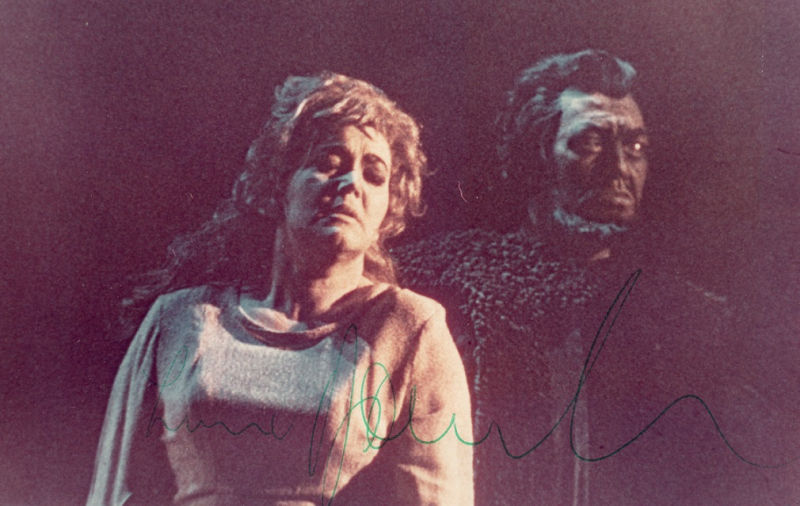
  • Leonie Rysanek as Sieglinde

    Scanned Section 6-1

    I brought this photo of Leonie Rysanek with me for her to autograph after a performance of FRAU OHNE SCHATTEN at The Met in 1971. Why she was signing photos with a green pen I am not sure…her signature is barely legible; but she loved the photo. With her in the picture is basso David Ward, as Hunding.

    I did not see Rysanek as Sieglinde until 1988, in a matinee performance that marked the last time she sang this signature role of hers at The Met. Hildegard Behrens, to whom Rysanek later left the Lotte Lehmann Ring, was Brünnhilde. The two divas took many bows together after the performance, to the delight of the huge crowd.

    Walkure6465.01

    Among the great tenors who sang Siegmund to Rysanek’s Sieglinde was Jon Vickers (Met Opera Guild photo, above).

    In 1985, Rysanek sang Sieglinde in the first act of WALKURE as part of her 25th anniversary gala celebration at The Met; Peter Hofmann was her Siegmund that afternoon. My friend Paul Reid and I were there. Rysanek had become famous for her scream at the moment Siegmund pulls the sword from the tree; this was apparently Wieland Wagner’s idea, and it became a signature moment whenever the soprano sang Sieglinde anywhere in the world. 

    As the 1985 gala was a concert performance, with the orchestra onstage and the singers in gown and tux, there was some speculation as to whether Rysanek would include the scream. “It would break the frame of the concert,” said the woman sitting behind us. “She won’t scream.” She screamed.

    As a sampling of Rysanek in the role of Sieglinde, here she is – in fabulous voice – at Bayreuth in 1967, opposite James King:

    Leonie Rysanek – Der Männer Sippe ~ WALKURE – with James King – Böhm cond – Live @ Bayreuth 1967

  • Marta Fuchs

    39235935a63d757910b3525bd1f52d09

    Above: Marta Fuchs as Kundry

    Marta Fuchs began her career as a contralto in 1923; for the first five years, she sang only concerts. In 1928, at Aachen, she began singing such operatic roles as Gluck’s Orfeo, Verdi’s Azucena, and Carmen. Then, in 1930, Fuchs made the switch to dramatic soprano, though she retained parts of her old repertoire. At the Dresden Oper, she sang the world premieres of several now-forgotten operas.

    In 1931, she debuted at the Deutschen Opernhaus, Berlin, as Octavian in Der Rosenkavalier; she had a great success. From 1935, she was associated with both Dresden Oper and Berlin’s Staatsoper. Marta Fuchs became one of her generation’s foremost interpreters of the great Wagner roles. From 1933 to 1942, at Bayreuth, she was a celebrated Isolde (1938), Kundry (1933-1937), and Brünnhilde (1938-1942).

    In 1936 she appeared as a guest with the ensemble of the Dresden State Opera at the Covent Garden Opera in London as Donna Anna in Don Giovanni, as Marschallin in Rosenkavalier, and as Ariadne in Ariadne auf Naxos; and in 1938, she sang Isolde at the Théâtre des Champs-Élysées in Paris. 1942 brought successful guest appearances at the Maggio Musicale, Florence (as Leonore in Fidelio), and the Vienna State Opera, where she continued to appear until 1944.

    An ardent Christian, Fuchs steered clear of the rising tide of National Socialism. Because Adolf Hitler was an ardent lover of Wagner, he had met Fuchs. In 1936, the soprano told Hitler: “Mr Hitler, you are going to make war!” After Hitler’s protestation, she replied, “I don’t trust you.” In May 1939 Hitler greeted her asking, “Now, have I made war?” Fuchs replied, “I still don’t trust you.”

    Marta Fuchs fled the destruction of Dresden, eventually settling in Stuttgart and appearing with the opera company there. She retired from singing in 1954, and passed away some twenty years later.

    Many years ago I had heard the Fuchs voice during a time when I was exploring singers of the past. But recently, I came back to her, and am much taken with the beauty and expressiveness of her singing in Brünnhilde’s pleading of her case to Wotan from Act III of Walkure:

    Marta Fuchs – War es so schmählich ~ WALKURE

    And here is her wonderful Liebestod from Tristan und Isolde:

    Ef7c73fe9cb47a77997a845a90adf7e1

    Marta Fuchs – Liebestod ~ Tristan und Isolde

    ~ Oberon

  • Philharmonic Ensembles|Reinecke Rules!

    Reinecke-770x470

    Above: composer Carl Reinecke (1824 – 1910)

    ~ Author: Oberon

    Sunday May 27th, 2018 – The last in this season’s Philharmonic Ensembles series at Merkin Hall. These concerts, in which artists from the New York Philharmonic perform masterpieces, rarities, and contemporary works from the chamber music repertory, are always highly enjoyable. Today’s expertly-devised program introduced me to the delightful music of Carl Reinecke, and works by Vivaldi, Penderecki, and Brahms were also superbly played.

    Harpsichordist Paolo Bordignon introduced the opening work, Vivaldi’s Trio Sonata, Op.1, No. 3, in which he was joined by Duoming Ba (violin), Peter Kenote (viola) and Satoshi Okamoto (bass). Hearing this music on a gloomy day, following a distressing week, was a perfect palliative. In this four-movement work (the third being very brief), both the playing and the communication between the musicians drew us immediately into the elegant and lively world of Vivaldi, far from the madding crowds and disconcerting headlines of daily life.

    I was particularly intrigued by the beautiful instrument Mr. Okamoto was playing with such agility and charm. You can see it, and hear him playing, in this brief film.

    In a striking contrast, we next had Krzysztof Penderecki’s Duo concertante for violin and double bass, which was composed in 2010 on a commission from violinist Anne-Sophie Mutter. It was played this afternoon by Kuan Cheng Lu, violin, and Rion Wentworth, bass. The composer devised the piece as a sort of conversation between the two instruments; Ms. Mutter described it as two voices “evading each other”: while one soloist is developing a musical theme, the other falls nearly silent.

    With their expert timing, and a clear sense of enjoyment in what they were doing, the two musicians gave a performance full of vitality, precision, and wit. Among the words I jotted down along the way: agitation, brooding, mini-scherzo, jazzy bass, plodding, shimmering, almost a march, soft and high, ultra-sustained bass note, pensive violin, a dance, tapping and stamping at the end. The audience were clearly much taken with this piece, and the playing of it: loud, enthusiastic applause followed.

    The afternoon provided an opportunity to make the acquaintance of a composer new to me, Carl Reinecke. How his music has eluded me until now is inexplicable. He was a prolific composer of operas, symphonies, concertos, and chamber music, as well as a highly regarded conductor, pianist, and pedagogue. Franz Liszt hired Reinecke as piano teacher for his daughter, Cosima, who later married Richard Wagner. In 1904, at the age of 80, Reinecke made recordings of seven works playing on a piano roll; thus he was the earliest-born pianist to have his playing preserved in any format.

    Reinecke’s Trio for oboe, horn, and piano was composed in 1886. The Philharmonic’s principal oboist Liang Wang was joined by Howard Wall, horn, with Zhen Chen at the piano for today’s performance of this work, steeped in the Romantic spirit. This is music that’s terrifically appealing. 

    The piece also moved me on a personal level, for my sister played oboe and I the horn back in our youthful years in the little town. The sounds of these two instruments today, played with such tonal richness and impeccable musicality by Mssrs. Wang and Wall today, pleased me deeply.

    The composer’s cordial theme for the opening Allegro moderato must have greatly pleased the composer, for he repeats it over and over. Gorgeously played by Mr. Wang, the melody has an exotic feel. The horn joins and the music expands. A romance-tinged piano solo brings Mr. Zhen into the mix, his playing colourful and alert. A great horn theme, abundantly toneful in Mr. Wall’s ‘singing’ of it, leads to a grand passage. The voices entwine, and after a martial bit, melodies flow on with increased drama. A da capo develops a sense of urgency, which eventually subsides.

    The Scherzo, Molto vivace has charm of its own; it’s witty and bubbly, and gets a five-start rating as scherzi go. The players relished every turn of phrase, with the pianist having a lot to do. This scherzo has a sudden end; you could almost hear the audience smiling.  

    The melodic warmth of the cavatina-like Adagio brought forth a rich horn theme upon which Mr. Wall lavished the kind of tonal plushness that turned a frustrated horn player like me green with envy. And he has such prodigious reserves of breath at his command. When Mr. Wang joined, a fabulous tone-fest filled the hall. More sonic glamour from Mr. Wall in a glorious mix with the piano followed; sumptuous harmonies abounded as the movement came to its conclusion.  

    In the opening passages of the Rondo finale, Mr. Zhen had just the right feeling for what sounds like a forerunner of the piano rag. The music, full of mirth and magic, gave all three players abundant opportunity to shine, singly and as a collective. The audience response was heartfelt, as the music and playing merited. This was one of the great musical treats of the season which is now nearing its end.

    Sustaining the Romantic aura of the Reinecke, the concert concluded with the Piano Trio No. 1 of Johannes Brahms, played by Hannah Choi, violin, Patrick Jee, cello, and Steven Beck, piano. Mr. Jee spoke with great affection of this music, which clearly means so much to him. When the performance ended, he seemed in a highly emotional state – a state reflected in his rich, resonant playing. 

    The work begins pensively. After a brief piano introduction comes the marvelous cello solo theme of which Mr. Jee had spoken. His playing of it reflected what the music means to him: sheer beauty. Ms. Choi and Mr. Back prolonged the atmosphere which the cellist had established, savouring the themes and reveling in the the blendings of their voices. This long first movement, with its achingly lovely melodies and modulations, gave a great deal of pleasure.

    The Scherzo made me think of hunters on the chase; it becomes exuberant before being overtaken by an almost pastoral theme which becomes quite grand before a da capo takes us back to the hunt.

    The Adagio is like a meditative dream from which we don’t want to awaken. Woven in are luminous solo passages for each of the three instruments whilst in blended passages their tonal appeal was most affecting.

    The final Allegro is waltzy and minorish, a perfect opportunity to cease note-taking and just enjoy watching Ms. Choi and Mssrs. Jee and Beck playing their way thru this melodious music. How can we thank such artists? Only by standing and cheering.

    Emerging from the hall, the wind had kicked up – brisk and refreshing. The afterglow of this concert is strong and lasting.

    ~ Oberon

  • Wagner’s 205th

    7290---base_image_5.1424268049

    May 22nd, 2018, marked the 205th birthday of Richard Wagner. His operas remain – for me – the most absorbing in the repertoire. 

    Here are some highlights to celebrate his unique genius:

    Anja Silja – Dich teure halle – TANNHAUSER – Cologne Radio 1968

    Bernd Weikl as Amfortas – w Jan-Hendrick Rootering – Levine cond – Met bcast 1992

    Gertrud Bindernagel sings Isolde’s Liebestod 

    Nicolai Gedda – In fernem land ~LOHENGRIN – Stockholm 1966

    Wagner led a fascinating life. It is said that more books have been written about him than any other historical figure except Jesus.

  • Wagner’s 205th

    7290---base_image_5.1424268049

    May 22nd, 2018, marked the 205th birthday of Richard Wagner. His operas remain – for me – the most absorbing in the repertoire. 

    Here are some highlights to celebrate his unique genius:

    Anja Silja – Dich teure halle – TANNHAUSER – Cologne Radio 1968

    Bernd Weikl as Amfortas – w Jan-Hendrick Rootering – Levine cond – Met bcast 1992

    Gertrud Bindernagel sings Isolde’s Liebestod 

    Nicolai Gedda – In fernem land ~LOHENGRIN – Stockholm 1966

    Wagner led a fascinating life. It is said that more books have been written about him than any other historical figure except Jesus.

  • PARSIFAL @ The Met

    Parsifal1213.11

    Above: the Grail revealed: Peter Mattei as Amfortas and Rene Pape as Gurnemanz in Wagner’s PARSIFAL; a Ken Howard/Met Opera photo

    ~ Author: Oberon

    Saturday February 17th, 2018 matinee – A powerful and thoroughly absorbing matinee performance of PARSIFAL, the only Wagner in the Metropolitan Opera’s repertory this season. This dark, barren, and brooding production premiered in 2013, at which time the total absence of a Grail temple from the scenic narrative seemed truly off-putting. All of the action of the outer acts takes place out-of-doors, whilst the second act – as we were told by someone who worked on the production at the time it was new – is set inside Amfortas’s wound.

    Not everything in the production works, and the desolate landscape of the final act – with its open graves – is dreary indeed. But the devotional rites of the Grail brothers in Act I and the stylized movements of the Flowermaidens in the blood-drenched ‘magic garden’ of Act II are engrossing – especially today, where I found a personal link to both scenes.

    Musically, it was a potent performance despite a couple of random brass blips. Since the 2013 performances, I’ve been going to a lot of symphonic and chamber music concerts and this has greatly enhanced my appreciation of the orchestra’s work whenever I am at the opera. From our perch directly over the pit today, I greatly enjoyed watching the musicians of the Met Orchestra as they played their way thru this endlessly fascinating score.

    The Met’s soon-to-be music director, Yannick Nézet-Séguin, was on the podium this afternoon, and he seemed to inspire not only the orchestra, but also the principals, chorus, dancers, and supers all of whom worked devotedly to sustain the atmosphere of the long opera. While I did not feel the depth of mystery that I have experienced in past performances of this work conducted by James Levine or Daniele Gatti, in Maestro Nézet-Séguin’s interpretation the humanity of the music seemed to be to the fore. This meshes well with the physical aspects of the production, which strongly and movingly depicts the fraternity of the Grail and the desperate suffering of Amfortas. The orchestra’s poetic playing as Gurnemanz sings of the slaying of the swan was but one passage of many where I felt the music so deeply. And the transformation music of Act I was particularly thrilling to hear today.

    The singing all afternoon was at a very high level, with the unfortunate exception of the Kundry of Evelyn Herlitzius. We’d previously heard her as Marie in WOZZECK, but Kundry’s music – especially in Act II – needs singing that has more seductive beauty than Ms. Herlitzius delivered. The soprano’s one spectacular vocal  moment – “Ich sah Ihn – Ihn – und…lachte!“, where she tells how she had seen Christ on the cross and laughed – was truly thrilling, but not enough to compensate for her tremulous, throaty singing elsewhere.
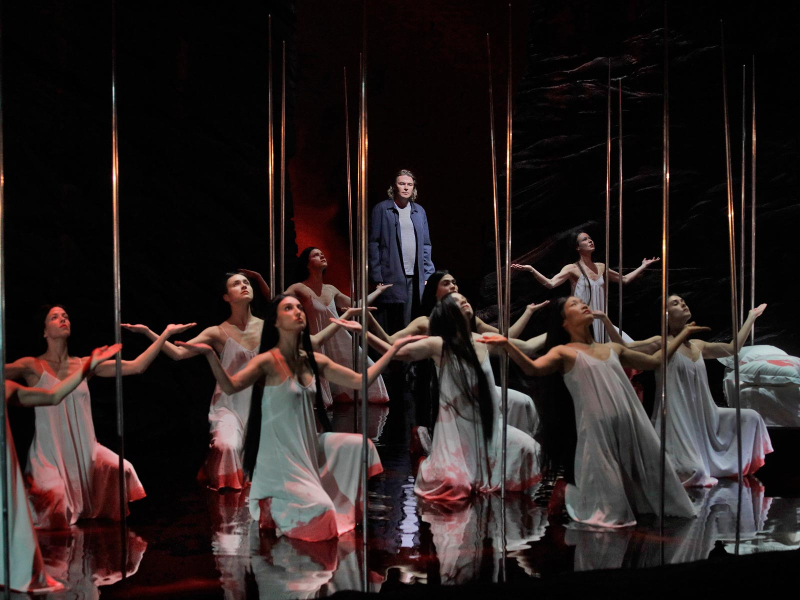
    1600x1200_parsifal3

    Above: In Klingsor’s Magic Garden, tenor Klaus Florian Vogt as Parsifal; a Met Opera photo

    In 2006, Klaus Florian Vogt made an unforgettable Met debut as Lohengrin, and this afternoon as Parsifal the tenor again sang lyrically in a role that is normally sung by tenors of the more helden- type. The almost juvenile sound Vogt’s voice underscored Parsifal’s innocence; this worked especially well in Act I, and also  brought us some beautiful vocalism in Act II. As Kundry’s efforts to seduce become more urgent, Vogt’s singing took on a more passionate colour. In his struggle between steadfastness and capitulation, the tenor’s cry of “Erlöse, rette mich, aus schuldbefleckten Händen!” (‘Redeem me, rescue me from hands defiled by sin!’) pierced the heart with his dynamic mastery. 

    Kundry’s wiles fail her, and with an upraised hand, Parsifal fends off Klingsor’s spear-wielding assault. Seizing the weapon that wounded Amfortas, the young man cries out “Mit diesem Zeichen bann’ ich deinen Zauber!” (‘With this Sign I banish your magic!’); the bloody back-lighting dissolves to white and Klingsor is cast down. Turning to Kundry, Mr. Vogt’s Parsifal has the act’s final line of premonition: “Du weisst, wo du mich wiederfinden kannst!” (‘You know where you can find me again’) and he strides out into the world  to commence his long, labored journey back to the realm of the Grail. In the final act, Mr. Vogt’s expressive singing was a balm to the ear, lovingly supported by the conductor and orchestra.

    Parsifal

    Above: Rene Pape as Gurnemanz, in a Ken Howard/Met Opera photo

    Repeating the roles they created when this production premiered in 2013, Rene Pape (Gurnemanz) and Peter Mattei (Amfortas) were again superb. Mr. Pape now measures out his singing of this very long part more judiciously than he has in the past, at times allowing the orchestra to cover him rather than attempting to power thru. But in the long Act I monolog, “Titurel, der fromme Held…”, the basso’s tone flowed like honey; and later, at “Vor dem verwaisten Heiligtum, in brünst’gem Beten lag Amfortas...” (‘Before the looted sanctuary, Amfortas lay in fervent prayer’) Mr. Pape’s emotion-filled delivery struck at the heart of the matter. Throughout Act III, leading to the consecrational baptism of Parsifal, Mr. Pape was at his finest.

    Parsifal1213.40

    Peter Mattei’s Amfortas (in a Ken Howard/Met Opera photo above) is truly one of the great operatic interpretations I have ever experienced, for it is not only magnificently sung but acted with matchless physicality and commitment. The guilt and suffering Mr. Mattei conveys both with his voice and his body is almost unbearable to experience in its intensity and sense of reality.

    After a desperate show of resistance to calls for the Grail to be revealed in Act I, Amfortas – in abject anguish – performs the rite; his strength spent, he staggers offstage and as he does so, he locks eyes with Parsifal, the man who will succeed him as keeper of the Grail: one of the production’s most telling moments. And in the final act, Mr. Mattei throws himself into the open grave of his father, Titurel, as he begs for death to release him from his eternal suffering; this horrifies the assembled Grail knights. Such moments make for an unforgettable interpretation, yet in the end it’s the Mattei voice that sets his Amfortas in such a high echelon.

    P015nkzb

    Evgeny Nikitin’s Klingsor (above), creepy and thrilling in 2013, incredibly was even better in this revival. The voice was flung into the House with chilling command, and the bass-baritone’s physical domination of his bloody realm and his hapless female slaves was conveyed with grim authority. His demise was epic.

    Alfred Walker sang splendidly as the unseen Titurel, and I was very glad that he appeared onstage for the bows so I could bravo him for his wonderful outpourings of tone. Another offstage Voice, that of Karolina Pilou – who repeats the prophetic line “Durch Mitleid wissend…der reine Tor!” (‘Enlightened through compassion, the innocent fool…’) to end Act I – had beauty of tone, though the amplification was less successful here.

    The Squires ( Katherine Whyte, Sarah Larsen, Scott Scully, and Ian Koziara) were excellent, especially as they harmonized on the emblematic “Durch Mitleid wissend…” theme, and the Flowermaidens sounded lovely, led with ethereal vocal grace by Haeran Hong. Mark Schowalter and Richard Bernstein were capital Knights, and I must again mention Mr. Bernstein’s terrific voice and physical presence as a singer underutilized by the Met these days. His lines ths afternoon were few, yet always on the mark; and in Act III, helping to bear the shrouded body of his late lord Titurel to its grave, Mr. Bernstein seemed to carry the weight of the world on his shoulder.

    What gave the performance a deep personal dimension for me today was finding two dancers I have known for some time – David Gonsier and Nicole Corea – onstage in Acts I and II respectively. By focusing on them – Mr. Gonsier as a young Grail knight and Ms. Corea as a delicious Blumenmädchen – the ‘choreography’ given to these two groups became wonderfully clear and meaningful.

    I first spotted Mr. Gonsier seated in the circle of knights; my imagination was immediately seized by the rapture evident in his eyes. For long, long stretches of the first act, I could not tear my gaze away from him as his mastery of the reverential gestural language and the deep radiance of his facial expressions spoke truly of what it means to be a knight of the Holy Grail. Amazingly, out of all the men I might have zeroed in on among the brotherhood, Mr. Gonsier was the last of the knights to leave the stage as Act I drew to an end: he received a personal blessing from Gurnemanz and their eyes met ever-so-briefly. So deeply moving.

    Ms. Corea is beloved in the Gotham danceworld for her work with Lar Lubovitch; I ran into her on the Plaza before the performance today and she assured me I’d be seeing her this Spring at The Joyce as Mr. Lubovitch celebrates his 50th anniversary of making dances. Incredibly, within two seconds of the Act II curtain’s rise on the identically clad and be-wigged Flowermaidens standing in a pool of blood, I found Nicole right in my line of vision. Both in her compelling movement and her captivating face, Nicole became the icon of this band of bewitching beauties.

    Whilst hailing some of the unsung cast members of the afternoon, mention must be made of the two heroic supers who literally keep Amfortas alive and mobile, frequently taking the full weight of the ailing man as he struggles to fulfill his dreaded duties as Lord of the Grail. Great work, gentlemen!

    Much of the libretto of PARSIFAL‘s outer acts today seems like religious mumbo-jumbo. It’s the music – especially the ending of Act I – that most clearly speaks to us (and even to an old atheist like me) of the possibility of God’s existence. Perhaps He has simply given up on mankind, as His name – and his word – have been sullied in recent years by those very people who claim to revere him. Wagner may have foreseen all this, as he once wrote: “Where religion becomes artificial, it is reserved for Art to save the spirit of religion.”

    At the end of Act I of today’s PARSIFAL, I momentarily questioned my disbelief. But then the applause – which I’ve always hated to hear after such a spiritual scene – pulled me back to reality. I’d much rather have stayed there, in Montsalvat.

    Metropolitan Opera House
    Saturday February 17th, 2018 matinee

    PARSIFAL
    Richard Wagner

    Parsifal................Klaus Florian Vogt
    Kundry..................Evelyn Herlitzius
    Amfortas................Peter Mattei
    Gurnemanz...............René Pape
    Klingsor................Evgeny Nikitin
    Titurel.................Alfred Walker
    Voice...................Karolina Pilou
    First Esquire...........Katherine Whyte
    Second Esquire..........Sarah Larsen
    Third Esquire...........Scott Scully
    Fourth Esquire..........Ian Koziara
    First Knight............Mark Schowalter
    Second Knight...........Richard Bernstein
    Flower Maidens: Haeran Hong, Deanna Breiwick, Renée Tatum, Disella Lårusdóttir, Katherine Whyte, Augusta Caso

    Conductor...............Yannick Nézet-Séguin

    ~ Oberon
  • WALKURE: Act I @ The New York Philharmonic

    Simon _oneill

    Above: tenor Simon O’Neill

    ~ Author: Oberon

    Thursday February 15th, 2018 – We’ve been starved for Wagner of late, but now – in the course of a single week – we’ve had Dorothea Röschmann singing the Wesendonck Lieder, The New York Philharmonic offering Act I of DIE WALKURE (tonight), and, coming up: a matinee of PARSIFAL at The Met.

    This evening’s Philharmonic program opened with Pulitzer Prize-winner John Luther Adams’s Dark Waves, music which readily brings to mind the opening of Wagner’s DAS RHEINGOLD. Long, deep notes are the sustaining quality throughout the piece’s twelve-minute span. Beyond that, horn calls on fifths and the brief tweeting of the piccolo emerge thru the murky, at times almost mechanical, layers of sound. The volume ebbs and flows, at times becoming massive. This is music that surely casts a spell, though one patron was apparently not pleased and expressed himself with high, hooting boos that became comical after a bit.

    The Philharmonic’s new music director, Jaap van Zweden, yet again proved himself a Wagnerian of great skill and commitment. His presentation of the WALKURE Act I tonight was so alive – right from the rather fast tempo he chose for the score’s opening pages depicting Siegmund being tracked by his enemies – and the orchestra played superbly.

    Six harps are onstage, and, as the Act progressed, we had marvelous solo moments from Carter Brey (cello), Anthony McGill (clarinet), Amy Zoloto (bass clarinet), and Liang Wang (oboe) as well as some noble calls from the horns.

    As Hunding, John Relyea’s dark, menacing tone poured forth, full of irony and vitriol: this courteous host will likely stick a knife in your ribs given the opportunity. As with his magnificent Bartok Bluebeard at Carnegie Hall a year ago, Mr. Relyea proved himself yet again to be a singer of great vocal and physical command. One moment summarized the brilliance of Mr. Relyea’s portrayal: after Siegmund has told his history to Sieglinde, ending tenderly with “Nun weißt du, fragende Frau,warum ich Friedmund nicht heiße!” (‘Now you know, gentle wife, why I can never be called Peaceful.’), Hunding/Relyea interrupts the twins’ mutual attraction, singing venomously: “Ich weiß ein wildes Geschlecht!” (‘I know of your riotous race!’). Hunding’s denunciation of his guest, and his promise to slay him at dawn, drew black-toned vocalism from the basso.

    Ten years have passed since I first heard Simon O’Neill’s Siegmund at a matinee performance at The Met. Both in voice and interpretation, Simon has kept things fresh in this arduous role: his singing – by turns helden or lyrical – is wonderfully present, and his diction and colourings are impressively utilized in the long narrative passages. For Siegmund’s story is a sad tale indeed, and although on this night – when he’s stumbled into Hunding’s hut as a hunted man – he will experience happiness ever so briefly, within hours  he will be betrayed to his death by his own father.

    Mr. O’Neill makes these stories of loneliness and woe truly poignant; both here and in those passages when heroic tones are called for, he shows himself the equal of any Siegmund of my experience. His cries of “Wälse! Wälse!” in the Sword monolog were excitingly sustained. The cresting, poetic beauty of Simon’s “Winterstürme” and his powerful summoning of Nothung from the tree were highlights of the evening. And then, with van Zweden’s orchestra pulsing away with relentless vitality towards the finish line, Simon latched onto a clarion, hall-filling top-A at “Wälsungen blut!…” to cap the evening.

    In 2012, Heidi Melton’s singing of the 3rd Norn in GOTTERDAMMERUNG at The Met gave me reason to believe she could be the next great Wagnerian soprano. But since then, in subsequent encounters, I have found her disappointing. This evening, her physical presence and the voice’s limitations in the upper range drew a blank with me.

    So tonight, it was the excellence of the male singers, the thrilling playing of the orchestra, and Maestro van Zweden’s feel for this music that gave Wagner his due.  

    ~ Oberon

  • Dorothea Röschmann @ Zankel Hall

    Dorothea-Roschmann

    Above: soprano Dorothea Röschmann

    ~ Author: Oberon

    Tuesday February 13th, 2018 – Soprano Dorothea Röschmann in recital at Zankel Hall, with Malcolm Martineau at the piano. This was an evening of music-making of the highest order, for both soprano and pianist are masters of their art, and communicators sans pareil.

    Ms. Röschmann made her Metropolitan Opera debut in 2003 as Susanna in NOZZE DI FIGARO and subsequently performed three more Mozart roles there: Pamina, Ilia, and Donna Elvira. She last sang at The Met in 2008. Elsewhere, of late, she has ventured into heavier repertoire including the roles of the Marschallin and Desdemona. I had not heard her live since the Met IDOMENEO, and was very much hoping I would enjoy this re-connection as much as I did hearing her then. She surpassed my highest hopes.

    What I loved most about Ms. Röschmann’s singing this evening was her fascinating employment of her vibrato as a means of expression. Within a given phrase, she could mete out the vibrancy, hone it down to straight tone, or unfurl it to full dramatic effect; this gave her singing a panoramic emotional range, from vulnerable or pensive to unstinting grandeur. It’s a wonderfully feminine voice, and her diction and her shading of the texts drew us deeply into each song.

    Commencing with Schubert, the soprano’s vibrato in “Heiss mich nicht reden” as the very first seemed a bit  prominent; yet by mid-song, Ms. Röschmann’s intuitive manipulation of it was already making its effect. “So lasst mich scheinen” with its gentle start, was lovingly sung. Mr. Martineau’s introduction to “Nur wer die Sehnsucht kennt” set the mood for Ms. Röschmann’s singing: so poignant, with the passing anxiety at separation from her beloved fading back to melancholy. The familiar “Kennst du das Land” was magnificent in every way, expressive of the poem’s varying moods, with delicious lower notes and the words so clear and finely-coloured; and Mr. Martineau here was divine.
     
    Singer and pianist left the stage briefly before returning for the final Schubert, “Nachtstück“. This night-song, sung by an old man wandering the woods as Death hovers about him, took on an operatic aspect with Mr. Martineau’s atmospheric playing of the introduction, and the sense of mystery in the soprano’s haunting – and then expansive – singing. The piano evokes the sound of the old man’s harp as the song winds thru major/minor modulations: such moving music to experience.
     
    1024
    Above: pianist Malcolm Martineau, photographed by Thomas Oliemans 
     
    In Mahler’s Rückert Lieder, Ms. Röschmann’s gifts as a storyteller were abundantly evident. From the playful “Blicke mir nicht in die Lieder” and the gently magical, Springlike joy of “Ich atmet’ einen linden Durftt“, with Mr. Martineau’s sweet postlude, soprano and pianist moved to the drama of “Um mitternacht“. This was  profoundly delivered, Ms. Röschmann summoning rich tone for a great outpouring of sound, all the while keeping us under her spell with varying degrees of vibrato; Mr. Martineau’s playing matched the singing in all its glory.
     
    In “Liebst Du Um Schönheit“, the soprano chose to linger slightly from time to time, giving the song a delicious individuality of expression. Then, with the final Mahler, “Ich bin der Welt abhanden gekommen“, the intrinsic and somewhat unusual beauty of Ms. Röschmann’s voice made this beloved, meaningful poem utterly personal. A touch of lightness here and there was enchanting, her singing so thoughtful and womanly. The end of this song can sometimes be shaded with resignation, but in Ms. Röschmann’s moving singing of the final lines, we instead feel her sense of deep contentment. Mr. Martineau beautifully sustained the poetry with his transportive playing of the postlude.   
     
    The second half of the program was given over to songs with words written by women. Robert Schumann’s Gedichte der Königin Maria Stuart, Op. 135. are settings to texts drawn from the letters of Mary, Queen of Scots, written at significant points in her tragic life. Presage of disaster seems a constant force in the Queen’s story, right from her birth. In these Schumann settings, we move from a wistful farewell to France and a hopeful prayer marking the birth of her son, to a dramatic letter Mary wrote to her cousin, Elizabeth I – the cousin who would eventually betray Mary Stuart to her death. This very dramatic song was vividly rendered by Ms. Röschmann and Mr. Martineau, who then progressed to the scene of Mary’s impending execution: in “Abschied von der Welt” – the Queen’s farewell to the world – the pianist’s colourings of reflection and resignation were ideal. The final “Gebet” is a prayer for her own soul: eighteen years a prisoner, Mary Stuart is at last set free by Death. Ms. Röschmann really lived these songs, so deeply that in the end she truly seemed in a trance.       
     
    To hear Ms. Röschmann and Mr. Martineau performing Richard Wagner’s Wesendonck Lieder was an experience to cherish. At a point in time when the Metropolitan Opera seems to be so stinting with their Wagner offerings (only PARSIFAL this season), we are always eager to hear the Master’s music where- and when-ever possible.
     
    Just now I am reading Judith Cabaud’s lovely/sad biography of Mathilde Wesendonck, the beautiful young poetess whose relationship with Wagner – whether physical or spiritual – hastened the demise of the composer’s first marriage and, in a way, set the stage for Wagner’s finding his soulmate in Cosima Von Bülow.
     
    Whilst Wagner was living in a small house on the Wesendonck’s Swiss estate, the lives of the composer and Fray Wesendonck became entwined. Mathilde was the inspiration for TRISTAN UND ISOLDE; each day, Wagner would send her a page or two of this opera which he was writing with such feverish diligence. This inspired Mathilde to write a series of poems, which she sent to Wagner, one by one, and which he instantaneously set to music. Then one day, a note from Wagner to his muse was intercepted by Minna Wagner’s servant and that was the beginning of the end – of both the Wagners’ marriage and of his living as the Herr Wesendonck’s guest.
     
    And so we are left with this set of five songs, so marvelously moving in their atmosphere of romantic longing. They were eventually orchestrated, and that is how they are most often heard these days. But my very first exposure to the Wesendonck Lieder came in 1970 when I attended a recital by Dame Janet Baker at Syracuse, New York. Martin Isepp was the pianist. It was a performance I’ll never forget, and hearing this music live again tonight had a “full-circle” feeling, nearly fifty years on.  
     
    Ms. Röschmann and Mr. Martineau put us deeply under a Wagnerian spell, commencing with “Der Engel” in which the Röschmann voice entranced with its flickering vibrato, its velvety lower tones, and her expressive power of the poetic. The agitation of “Stehe still!” commenced some sensational playing from Mr. Martineau, and, as the music turned more lyrically yearning, Ms. Röschmann’s singing took on a very personal intimacy, her lower tones having a sensuous smoulder. Mr. Martineau, at the song’s end, was so evocative.
     
    With “Im Triebhaus” we are suddenly borne away to Castle Kareol, the wounded Tristan’s lonely childhood home, where he now awaits his Isolde. The musical introduction to this song was lifted by Wagner directly into the prelude of TRISTAN‘s third act. Here, yet again, the blessings of Ms. Röschmann’s way with words were invaluable. The piano’s harmonic modulations and voice’s gradations of both vibrancy and dynamic created a whole world, with the pianist incredibly poignant. The Röschmann lower notes continued to strike a particularly sensitive spot in my spine, producing tremblings of emotion. And Mr. Martineau’s finishing notes were to die for.
     
    With the passions of “Schmerzen“, Ms. Röschmann’s deeper tones literally tore at the heart, whilst ecstatic playing from Mr. Martineau left the soprano beaming radiantly as the song drew to its close. She lingered in a dreamlike state as the pianist set forth the opening bars of “Träume“. By this point I was breathless, drunk on the sheer beauty of the music, Ms. Röschmann’s heavenly singing, and the tenderness of Mr. Martineau’s playing. Could I not now stay here in their world, in this realm where Wagner and his Mathilde found sanctuary?
     
    My return to reality was blessedly buffered as the deep, very cordial applause of the crowd drew the singer and pianist back for three encores – Liszt, Schumann, and (I believe) Schubert – each lovelier than the last. That we have such music in the world, and such musicians to bring it to us, counts for so much in this day and age.
     
    ~ Oberon

  • Gatti/Royal Concertgebouw: Wagner & Bruckner

    Daniele Gatti

    Above: conductor Daniele Gatti

    Author: Oberon

    Wednesday January 17th, 2018 – This long-awaited Carnegie Hall concert by the Royal Concertgebouw under the baton of Daniele Gatti paired two of my favorite composers – Wagner and Bruckner – and my expectations for the performance were very high indeed. Wagner-starved as my friend Dmitry and I have been in recent seasons, hearing the Prelude to Act III and Good Friday Spell from PARSIFAL was alone reason to anticipate this concert for months in advance. That Bruckner’s 9th Symphony would complete the program gave reason to feel this was destined to be a thrilling evening. Both works were played magnificently by this great orchestra, and Maestro Gatti again upheld our esteem for him as one of the greatest conductors of our time.

    But in practice – as opposed to in theory – I felt, as the evening progressed, that putting these two masterpieces on the same program didn’t work out nearly as well as I’d expected. About midway thru the Bruckner, I felt my interest waning. In attempting to reason it out, I came to this conclusion: Wagner is a great composer, and Bruckner is a very good one. This certainly does not mean that Bruckner’s music isn’t wonderful, and meaningful. But there’s a depth of feeling in Wagner’s writing that – for me – eludes Bruckner.   

    Wagner’s two ‘Grail’ operas – one about the father (PARSIFAL) and the other about the son (LOHENGRIN) – both contain music of other-worldly beauty. The composer wrote: “It is reserved for Art to save the spirit of religion.” [“Religion and Art” (1880)]. In these two operas, Wagner’s music expresses the inexpressible in ways that make non-believers like myself wonder if we’ve got it right…or not.

    Maestro Gatti’s gift for evoking mythic times and places (his Metropolitan Opera AIDAs in 2009 were fascinating in this regard) meant that the music from PARSIFAL performed tonight was truly transportive. As with his Met performances of the Wagner opera in 2013, Gatti’s pacing seemed ideal. The gorgeously integrated sound of the Concertgebouw, with its velvety-resonant basses, leads us to Monsalvat, where – with Parsifal’s return – the long Winter gives way to Spring. For a blessèd time, we are far from the dismal present, watching the flowers bloom is that legendary realm, as Kundry weeps. Poetry without words.  

    Bruckner’s unfinished 9th symphony impressed me deeply when I first heard it performed live in 2014, and I expected the same reaction tonight. For much of the first movement, I was thoroughly engaged and experiencing the tingles of appreciation that Bruckner’s music usually produces. I confess that I like the ‘purple’ parts of Bruckner’s music best, and perhaps my eventual zone-out began with the Scherzo.

    In the Adagio, I grew restless; the repetitions became tiresome. A few people got up and left, and others had fallen asleep. I continued to attempt to re-engage with the superb playing and Maestro Gatti’s interpretation, but honestly I could not wait for the symphony to end; and I made a mental note to skip an upcoming performance of it.

    The irony of tonight’s situation struck me as I was pondering the experience on the train going home. How is it that Wagner, a non-believer, is able to put us in touch with the divine whereas the pious Bruckner, a devout Catholic who dedicated the 9th symphony “To God”, seems only to be knocking on heaven’s door?

    Now, more than ever, I look forward to the upcoming PARSIFAL performances at The Met.

    ~ Oberon