Tag: Ring Cycle

  • Bartok & Bruckner @ The NY Philharmonic

    Medium_071220_bronfman

    Above: Yefim Bronfman

    Friday October 24th, 2014 – After experiencing Yefim Bronfman’s magnificent renderings of all the Beethoven piano concertos (and the triple concerto!) in a series of New York Philharmonic concerts last season, my friend Dmitry and I were keen to hear the pianist live again. Tonight, Mr. Bronfman’s playing of the Bartok 3rd marked the first of two concerts we’ll be attending this season which feature the pianist, the second being his performance of the Brahms 2nd concerto with the Chicago Symphony under Riccardo Muti at Carnegie Hall on January 31st, 2015.

    Bela Bartok, who had fled Europe for America in 1940 to escape the rise of National Socialism, composed his third piano concerto as a birthday gift for his pianist-wife Ditta Pasztory-Bartok, working on it during the summer of 1945 at Saranac Lake, New York. Already in the final stages of lukemia, the composer returned to New York City where he died on September 26th, 1945, leaving the concerto unfinished. The task of orchestrating the final 17-measures, drawing from Bartók’s notes, eventually fell to the composer’s friend Tibor Serly.

    Tonight’s performance found Mr. Bronfman at his finest, his fleetness of technique to the fore as his hands rippled up and down the keyboard, summoning forth one Bartokian marvel after another. He and Maestro Alan Gilbert formed a very simpatico union over this music, and the orchestra were at their best also: their many colourful eddies of sound swirling around the solo piano line. Mr. Bronfman’s dynamic range, his delightful dexterity, and his wonderfully genial personality combined to make this a truly enjoyable half-hour of music-making. The pianist, basking in enthusiastic applause at the end, bowed graciously to his fellow musicians, celebrating their mutual admiration.

    Following the intermission, a genuinely thrilling experience for me: hearing the Bruckner 8th live for the first time. Everyone who follows my blog knows that, after decades of devoting myself to opera and dance, I’m now exploring the symphonic and chamber repertories; works that are thrice-familiar to most  classical music lovers are new discoveries for me. Of course, having worked at Tower Records for almost a decade before they closed up shop, I did hear a lot of symphonic music day in and day out, some of it subconsciously absorbed; but there was no opportunity to stop and savor anything. So despite the familiarity of many thematic passages in the Bruckner tonight, it was all fresh and fantastic to me.

    At a time when performances of Wagner’s music here in New York seem increasingly rare (The Met has only MEISTERSINGER to offer us this season, following on their ‘No Wagner’ season of 2013-2014) tonight’s Bruckner, with its Wagnerian sonorities, was a welcome treat.

    Bruckner’s 8th opens murmuringly, but soon the composer begins to expand into marvelous arches of sound. The huge orchestra, resonating in the dense textures of intermingling voices of strings and winds, maintained clarity under Alan Gilbert’s steady baton. The 8th’s opening movement has been described as “simply shattering, destroying every attempt at criticism.” And Bruckner himself referred to the passage where the brass ring out the main theme repeatedly as “the announcement of Death…” This is followed by a surprising silence and the gentle, faltering heartbeat of the timpani.

    In the scherzo, a big familiar theme dances forth; and then its in the adagio where I finally lost my heart to this symphony. This incredibe movement, marked in the score as  “Solemn and slow, but not dragging”, opens up great vistas of panoramic sonic-painting. The harps are evocative indeed, and the massive waves of sound wash over us, suddenly to evaporate in a delicate waltz-like theme. The horns then blaze forth majestically; the overall sensation is life-encompassing.

    Throughout this cinematic symphony, the ear and the soul are equally gratified. In the culminating fourth movement Bruckner’s architecture evokes a great cathedral wherein the listener is alternately overwhelmed by epic grandeur or sinks into a state of reverent contemplation.

    In the end, this performance of this massive symphony – surely Wagnerian in its looming grandeur but also at times making me think of Tchaikovsky – gave so much pure satisfaction. I found myself wishing that Bruckner had written operas: what a thrill it would be to hear huge, dramatic voices soaring over his glorious orchestral soundscapes.

  • At Home With Wagner VI

    Richard-wagner-1351529175-view-0

    Wagnerian afternoons in the Summer: from the Bayreuth Festival 1961 comes the prologue and first act of GOTTERDAMMERUNG featuring Birgit Nilsson at her most marvelous. Conducted by Rudolf Kempe, the performance generates tremendous excitement, most notably in the thrilling build-up to the Dawn Duet. Nilsson unleashes her patented lightning-bolt top notes, and hearing her on this form reminds me of my first encounters with her live at The Met where in 1966 she sang a series of Turandots that were simply electrifying.

    Elisabeth Schärtel

    The performance is very fine all around, opening with a thoroughly absorbing Norn Scene which begins with the richly expressive singing of contralto Elisabeth Schärtel (above) followed soon after by the equally impressive Grace Hoffman. It’s rather surprising to find Regine Crespin singing the Third Norn. She had made a huge success at Bayreuth in 1958 as Kundry, and had repeated that role at the next two festivals. In 1961 she was invited back to the Green Hill for Sieglinde, and thus she was able to take on the Norn as part of her summer engagement. She sings beautifully, with her distinctive timbre, though there is a trace of tension in her highest notes.

    317372_340994792689362_1142580761_n

    Above: Birgit Nilsson; we used to refer to her as “The Great White Goddess” or simply “The Big B”. The thrilling accuracy and power of her singing here, as well as her ability to create a character thru vocal means, is breath-taking.

    Hans Hopf is a fine match for Nilsson in the Dawn Duet; he is less persuasive later on when his singing seems a bit casual. Wilma Schmidt (Gutrune) and the always-excellent Thomas Stewart (Gunther) make vocally strong Gibichungs, and the great Wagnerian basso Gottlob Frick is a dark-toned Hagen with vivid sense of duplicity and menace. Rudolf Kempe again shows why he must be rated very high among the all-time great Wagner conductors: his sense of grandeur and ideal pacing set him in the highest echelon.

    ~~~~~~~~~~~~~~~~~~~~~~~~~~~~~~~~~~~~~~~~~~~~~~~~~~~~~~~~~~~~~~~~~~~~~~~~~~~~~~~~~~~~~~~~~~~ 

    Gerhard Stolze

    Gerhard Stolze (above) is the Loge in a RHEINGOLD from the Bayreuth Festival 1964; I have a special love for Mr. Stolze in this role as he was my first Loge – at The Met on February 22, 1968, a broadcast performance conducted by Herbert von Karajan and my first experience of a RING opera live. Here at Bayreuth, as later at The Met, Stolze brings a wonderfully debauched, almost greasy vocal quality to the vain, spoiled demi-god. The voice is large and effortlessly penetrating, but he can also be tremendously subtle: after screaming “Durch raub!’ (‘By theft!”) when Wotan asks Loge how the Rhinegold might be acquired, Stoltze goes all lyrical as he says: “What a thief stole may be stolen from the thief…” this is but one of Stotze’s countless brilliant passages in the course of his portrayal. At Nibelheim and later, as Loge taunts the captured Alberich, Stolze is simply superb.

    Two other singers who appeared in my Met/Karajan RHEINGOLD are also heard in this Bayreuth performance: Theo Adam has a big, burly voice and sings imposingly if not always with a lot of tonal allure. His Wotan builds steadily throughout the opera to an imposing rendering of Wotan’s greeting to Valhalla and the entire final scene. Zoltán Kelemen is a splendid Alberich; his handsome baritone sound sometimes shines thru in what is essentially a dramatic character role. Power and calculation mark his traversal of the first scene; later, in Nibelheim, Kelemen is wonderfully subtle. Having been tricked by Loge and kidnapped, he’s truly fabulous as he summons his slaves to bring the treasure up as ransom for his freedom. Later, having lost everything, his crushing sense of vulnerability gives way to a violent hurling of the curse at Wotan.

    Z Keleman

    Above: Zoltán Kelemen as Alberich

    Grace Hoffman is a capital Fricka, bringing verbal urgency and vocal attractiveness to her every line, most expressive as she draws Wotan back to her after Erda’s intervention. Jutta Meyfarth, a very interesting Sieglinde on the 1963 Bayreuth WALKURE conducted by Rudolf Kempe, is too stentorian and overpowering as Freia, a role which – for all its desperation – needs lyricism to really convince. Hans Hopf, ever a stalwart heldentenor, probably should not have tried Froh at this point in his career: he sounds too mature. Marcel Cordes is a muscular-sounding Donner; there is an enormous thunderclap to punctuate Donner’s “Heda! Hedo!”

    The estimable contralto Marga Höffgen brings a real sense of mystery to Erda’s warning. Gottlob Frick is a vocally impressive Fasolt, his scene of despair at giving up Freia is genuinely awesome. Peter Roth-Ehrang (Fafner) and Erich Klaus (Mime) are names quite unknown to me; the basso is a bit blustery but has the right feeling of loutishness. Herr Klaus is a first-class Mime, with his doleful singing in the Nibelheim scene giving way to a fine mix of dreamy dementia and raw power as he tells Loga and Wotan of his dwarvish despair. Barbara Holt as Woglinde plucks some high notes out of the air; Elisabeth Schwarzenberg and the excellent Sieglinde Wagner as her sister Rhinemaidens.

    Klobucar

    Berislav Klobucar (above), who conducted 21 Wagner performances at The Met in 1968 (including taking over WALKURE from Herbert von Karajan when the latter withdrew from his half-finished RING Cycle for The Met) opens this RHEINGOLD with a turbulent prelude. Klobucar has an excellent feel for the span of the opera, for the intimacy of the conversational scenes, and for the sheer splendour of the opera’s finale.

    ~~~~~~~~~~~~~~~~~~~~~~~~~~~~~~~~~~~~~~~~~~~~~~~~~~~~~~~~~~~~~~~~~~~~~~~~~~~~~~~~~~~~~~~~~~~

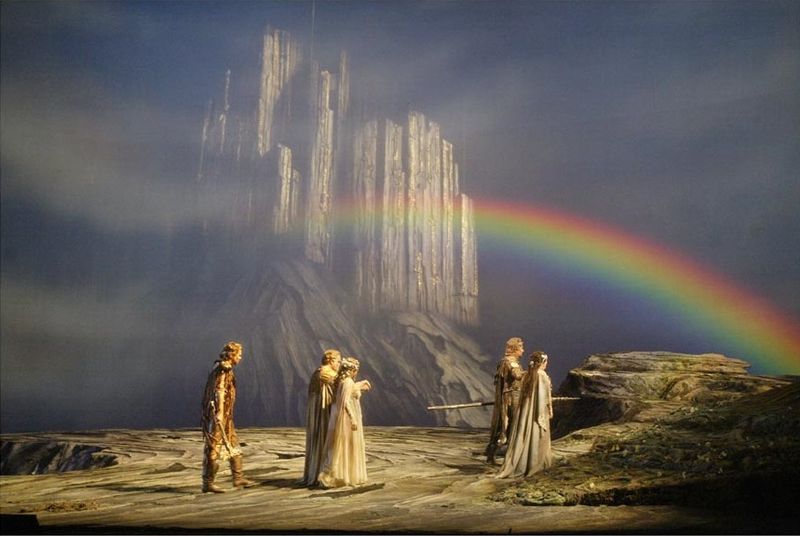
    1967-rheingold-salzburg-easter-festival-karajan-1967

    Above: a Günther Schneider-Siemssen design for the Herbert von Karajan Salzburg Festival production of the RING Cycle, 1967.

    Thinking of my Karajan/RHEINGOLD introduction to the RING at The Met in 1968 caused me to next take up the conductor-director’s complete WALKURE and GOTTERDAMMERUNG from the 1967 Salzburg Festival where his production of the Cycle originated. Of course, he only ended up conducting RHEINGOLD and WALKURE at The Met though the two remaining operas were staged there in his absence, with the productions credited to him. The settings remained in use at The Met thru 1981, and then the Otto Schenk production commenced in 1986.

    I must admit to never having listened to Karajan’s commercial RING Cycle (maybe a few random scenes but never any of the complete operas); it’s simply one of those inexplicable sins of omission which all opera lovers must eventually confess to. Maybe someday I will get around to it, though I’m so taken up with all these live RING recordings that Opera Depot keep tempting us with.

    At any rate, I must say I don’t much care for Karajan’s first act of WALKURE, at least not as it was performed at Salzburg in 1967. It feels to me terribly slow and overly polite. Gundula Janowitz and Jon Vickers seem much of the time to be vocally walking on eggshells: they whisper and croon gently to one another and the lifeblood seems to drain out of the music. Martti Talvela is his usual excellent self as Hunding; once he has gone to bed, Vickers commences a properly reflective sword monologue (the first orchestral interjection of the Sword motif ends on a cracked note). The tenor is stunning in his prolonged cries of “Wälse! Wälse!”, and then comes Janowitz’s ” Der Männer Sippe” which is verbally alert but there’s a slight tension in her upper notes and a feeling of being a bit over-parted. They sing very successfully thru the familiar “Winterstürme” and “Du bust der Lenz” all filled with attractive vocalism but Karajan maintains a rather stately pacing thru to end end of the act: there’s no impetus, no sense of being overwhelmed by sexual desire. Actually I found it all somewhat boring, and my mind tended to wander.

    A complete volte face for Act II, one of the finest renderings of this long and powerful act that I have ever encountered. Karajan launches the prelude, weaving together the various motifs, and Thomas Stewart unfurls Wotan’s opening lines commandingly. Regine Crespin’s sings a spirited “Ho-Jo-To-Ho!” and then Fricka arrives on the scene…

    16 Ludwig Fricka Walkure Melancon 1967

    …in the marvelous person of Christa Ludwig (Louis Melançon photo, above). When people ask me, “Who was the greatest singer you ever heard?” I invariably reply “Christa Ludwig” even though on a given day the memory of some other voice might seem to rival her. But in everything I have heard from her, both live and on recordings, Ludwig seems to have the ideal combination of a highly personal timbre, natural and effortless technical command, a remarkably even range, phenomenal abilities as a word-colorist, and overwhelming warmth and beauty of sound. Her Fricka here is magnificent in every way, and so supremely Christa

    6a00d8341c4e3853ef01901e20b373970b-800wi

    The scene between Fricka and Wotan is so impressive, yet incredibly Thomas Stewart (above, with Karajan) goes on to surpass himself with one of the most thrilling and spine-tingling renderings of Wotan’s monolog that I have ever experienced. Stewart vocally displays every nuance of the god’s emotional state as he confides in his daughter, first in his long ‘historical’ narrative which grumbles and whispers its way into our consciousness. Crespin is an ideal listener, her beauteously sung queries lead her father to divulge more and more. Soon Stewart is pouring out both his vanity and despair; the temperature is at the boiling point when he reaches “Das ende! Das ende!”, overcome by tears of anguish. Instructing Brunnhilde to honor Fricka’s cause and defend Hunding in the impending fight, Stewart crushes Crespin’s protests with a furiously yelled “Siegmund falle!” (“Siegmund must die! That is the Valkyrie’s task!”) and he storms away. I had to stop at this point; Stewart’s performance had both moved and shaken me and I wanted to pause and reflect.

    As beautifully as Crespin and Vickers sing the ‘Todesverkundigung’ (Annunciation of Death), the scene does not quite generate the mysterious atmosphere that I want to experience here. Thomas Stewart’s snarling “Geh!” as he send Hunding to his fate is a fabulous exclamation mark to end the act.

    Act III opens and there is some very erractic singing from the Valkyries in terms of pitch and verbal clarity. Crespin’s top betrays a sense of effort in her scene with Sieglinde, and Janowitz’s voice doesn’t really bloom in Sieglinde’s ecstatic cry ” O hehrstes Wunder!”  Thomas Stewart hurls bold vocal thunderbolts about as he lets his anger pour out on Brunnhilde and her sisters.

    And then at last the stage is cleared for the great father-daughter final scene. Crespin is at her very best here, singing mid-range for the most part and with some really exquisite, expressive piano passages. Only near the end, when the music takes her higher, does the tendency to flatness on the upper notes seem  to intrude. Stewart is impressive throughout. Karajan takes the scene a bit on the slow side, but it works quite well.

    It should be noted that the voice of the prompter sometimes is heard on this recording, especially in Act I.

    ~~~~~~~~~~~~~~~~~~~~~~~~~~~~~~~~~~~~~~~~~~~~~~~~~~~~~~~~~~~~~~~~~~~~~~~~~~~~~~~~~~~~~~~~~~~

    Ridderbusch

    Above: Karl Ridderbusch, who sang Hagen in the 1967 Salzburg Festival RING Cycle.

    Herbert von Karajan’s GOTERDAMMERUNG, from the Salzburg Festival 1970, starts off with a very fine Norn Scene. Lili Chookasian – after a few warm-up measures – and Caterina Ligendza are authetically Wagnerian as the first and third sisters, with the resplendent Christa Ludwig luxuriously cast as the 2nd Norn. Her superb vocalism is marked by a great lieder-singer’s colourings of the text.

    Helga Dernesch and Jess Thomas give a sturdily-sung rendition of the Dawn duet. Though Dernesch’s highest notes seem somewhat tense, she does sustain a solid high-C at the duet’s conclusion. Karl Ridderbusch is a potent Hagen, able to bring out a softer grain to the tone when he wants to. His sound is somewhat baritonal, but he still hits the lowest notes with authority. Thomas Stewart is an outstanding Gunther, a role that often loses face as the opera progresses. Gundula Janowitz  is not my idea of a good Gutune: she sound mature and a bit tired.

    Christa Ludwig’s Waltraute is a performance of the highest calibre; her superb musicality wedded to her acute attentiveness to the words make this scene the highlight of the performance. Dernesch is good here also, but both she and Jess Thomas seem to flag a bit in vocal energy in the rape scene.

    Act II opens with another of my favorite RING scenes: Alberich (Zoltán Kelemen) appears to his son Hagen (Karl Ridderbusch). Kelemen, so musical in the 1964 Klobucar RHEINGOLD reviewed above, here resorts to sprechstimme and all manner of vocal ‘effects’: I wonder if this is what Karajan wanted, or is this simply what the baritone came up with. Ridderbush sings much of Hagen’s music here in an appropriately dreamy half-voice. A bit later he turns on the power with his “Hoi ho!”, summoning the vassals; the men’s chorus lung it lustily in response. Despite the continued feeling of effort behind Helga Dernesch’s high notes, she hits them and holds them fair and square. Jess Thomas sounds a bit tired as Siegfried; though he manages everything without any slip-ups, the voice just seems rather weary. Gundula Janowitz’s Gutrune is much better in Act II than earlier in Act I, and Thomas Stewart’s Gunther transforms what is sometimes viewed as a ‘secondary’ role into a major vocal force in this performance.

    I had high hopes for the opening scene of Act III: the Rhinemaidens – Liselotte Rebmann, Edda Moser, and Anna Reynolds are all fine singers. Yet they don’t quite achieve a pleasing blend. Jess Thomas sounds brassy and one keeps thinking he might have a vocal collapse, but he stays the course. It is left to Dernesch to be the performance’s saving grace and she nearly accomplishes it: the sense of vocal strain is successfully masked for the most part and she hits and sustains the high notes successfully though it’s clear she is happier singing lower down; she did in fact become a highly successful dramatic mezzo in time. Dernesch gives the Immolation Scene a tragic dimension, and then Karajan sweeps thru the long orchestral postlude with a sense of epic grandeur.

    Overall, Karajan’s GOTTERDAMMERUNG is impressive to hear. Were Helga Dernesch and Jess Thomas thoroughly at ease vocally the overall performance would have been quite spectacular. As it is, it’s Christa Ludwig, Thomas Stewart, and Karl Ridderbusch who make this a memorable Twilight of the Gods.

  • My First RING Cycle: WALKURE

    Jones-Gwyneth-04

    Above: Dame Gwyneth Jones

    A week-long RING Cycle invariably involves RHEINGOLD on Monday night followed immediately by WALKURE on Tuesday. This places heavy demands on the gentleman singing Wotan; he has a lot of singing to do on Monday and even more (much more) on Tuesday. Fricka also appears in both operas, but her role in RHEINGOLD – though major – is not especially demanding, and in WALKURE she has only one scene: quite a strenuous one vocally, but once it’s over she is finished for the night. Fortunately the Wotan in my first Cycle, Hans Sotin, managed the back-to-back operas superbly. And Helga Dernesch’s Fricka was a thrilling interpretation.

    WALKURE brings four new characters to the drama: Brunnhilde, Sieglinde, Siegmund and Hunding. With Dame Gwyneth Jones’s first appearance as Brunnhilde in Act II, this RING Cycle – already off to such an impressive start – soared into the stratosphere.

    Here’s my diary entry from the second night of the Cycle:

    WALKURE – excellent despite some audience distractions. Levine and the orchestra do wonders with this score. The cast was really fabulous, though I had mixed feelings about the Siegmund of Robert Schunk. He looked well, sang and phrased in a musicianly manner; he had the right feel for the role and – for the most part – more than enough volume. He tended, however, to sing just a shade flat much of the time. Too bad…he tried hard and he did have his moments.

    Everyone else was on peak form. Matti Salminen gave a tremendous Hunding, rolling out the tone with tremendous force and simply smacking of evil…really menacing sound and thoroughly convincing as an actor: his long, deadly stare at Siegmund after man-handling his wife was such a provocation (Siegmund, weaponless at this point, is in no posotion to respond). Salminen continues my great line of Hundings – Rundgren, Haugland, Moll, Macurdy – and he’s such a fascinating artist.

    Gessendorf_Portrait

    We have a wonderful new Wagnerian soprano in Mechthild Gessendorf (above) who, if this performance is any indication of her abilities, is a fine addition to the operatic gallery. Her bright, almost girlish tone has a clear middle range with top notes that can be clean-attacked or slightly scooped-up to: they are exciting!  Oddly, she reminds me a bit of Mara Zampieri though I can’t put my finger on why! She gave a glorious Sieglinde, full of feminine warmth and real emotional commitment; I look forward to her Kaiserin and Senta.

    Helga Dernesch’s Fricka proved spellbinding, sung with great authority and vocal power; the slight peril in the upper range was overcome by force and she simply did a magnificent job. The drama of her plea was put across with an awesome balance of of security and desperation: really engrossing. And she looked gorgeous…a splendid assumption of the role.

    Hans Sotin’s Wotan was given with great vocal command and heartrending dramatic sureness. He was in excellent voice, giving a truly impressive monolog and ending Act II with a furious “Geh!” to Hunding who crashed to the ground at the god’s irate command. Singing gloriously, Sotin came thru with much moving and beautfully modulated vocalism in the third act, and he triumphantly sustained the top notes of his final phrase to majestc effect…bravississimo!!!!

    It was a great pleasure to see Dame Gwyneth Jones on the Met stage again: still unsure of how she would sound, she nevertheless is an arresting physical presence. But as soon as she began to sing, it was clear we were in for a thrilling Brunnhilde: her great personal and vocal radiance set its stamp on the entire evening. She is a very different Brunnhilde from Behrens, more feminine and less complicated. She offered a spectacular battle cry, sustaining the clear-attack high-C and thereafter she simply went at it vocally all evening, with powerful and moving singing in the ‘Todesverkundigung where she well portrayed Brunnhilde’s increasing embarrassment at the deceitful way Wotan has treated Siegmund. Jones’s third act was wonderful in every regard, with a movingly intoned “War es so schmählich” and increasing desperation as she begs Wotan to spare her degradation. Her final plea – to surround her slumbering place with magic fire – literally tore at the heart. The sheer size of Dame Gwyneth’s voice is such a treat at The Met, and her occassional wooziness and a couple of oddly pronounced words (“Siegfried” in her Act III address to Sieglinde somehow became “Augfried”) were just trifles compared to the great flood of warm, emotional power she generates. Simply great!! And she looks marvelous…great legs! So, a really remarkable evening with huge ovations for all and a particular hurricane of applause for Dame Gwyneth. A grand night!!!”

    Metropolitan Opera House
    May 2, 1989

    DIE WALKÜRE
    Wagner

    Brünnhilde..............Gwyneth Jones
    Siegmund................Robert Schunk
    Sieglinde...............Mechthild Gessendorf
    Wotan...................Hans Sotin
    Fricka..................Helga Dernesch
    Hunding.................Matti Salminen
    Gerhilde................Pyramid Sellers
    Grimgerde...............Wendy Hillhouse
    Helmwige................Marita Napier
    Ortlinde................Adriana La Ganke
    Rossweisse..............Judith Christin
    Schwertleite............Sondra Kelly
    Siegrune................Diane Kesling
    Waltraute...............Joyce Castle

    Conductor...............James Levine

  • My First RING Cycle: RHEINGOLD

    Rheingold0304.08

    Above: A scene from DAS RHEINGOLD, in the Met’s classic Otto Schenk production; photo by Ken Howard

    A quarter-century has passed since I first experienced a complete performance of Wagner’s RING DES NIBELUNGEN as the composer intended it to be seen: over the course of a single week. In fact, though I had seen all the RING operas previously and would see them many times again since, this 1989 Cycle has been the only time to date that I attended a “RING Week”.

    I was living in Hartford, Connecticut at that point in time, frequently spending long weekends in NYC to attend opera and ballet performances. My friend Paul Reid and I had decided to attended a Met RING Cycle at the end of the 1988-1989 season. There would be a Saturday matinee Cycle plus two week-long Cycles; we were determined to do a RING Week. So when the casting came out, we quickly decided on the ‘second cast’: we had seen the Hildegard Behrens/James Morris combination in previous performances of the individual operas and they were slated for the first weekly Cycle (as well as the Saturday matinee broadcast Cycle). The second weekly Cycle boasted not only a different Brunnhilde (Eva Marton) and Wotan (Hans Sotin) but ‘new’ and different casting of several prominent roles: William Johns (Siegfried), Franz Mazura (Alberich), Helga Dernesch (Fricka/Waltraute), Mechthild Gessendorf (Sieglinde), and Gweneth Bean (Erda). James Levine of course was conducting every Cycle.

    We ordered our tickets, and then a cast change was announced: Eva Marton had withdrawn and would be replaced by Deborah Polaski. This gave us pause, since at the time neither of us were admirers of Ms. Polaski. We fretted a bit, but it was too late to switch to another Cycle (they had all sold out very quickly). Then came another announcement: Ms. Polaski had withdrawn and the Brunnhilde would now be Dame Gwyneth Jones. We were not thrilled with this announcement either, since Dame Gwyneth had at that time something of a reputation for wobbling vocally. It wasn’t until she appeared onstage for Act II of WALKURE that our concerns were allayed: she was magnificent in every regard.

    In the days leading up to our Cycle, anticipation built and built. Concerns about leaving my young lover Kenny on his own for a week were swept aside as the idea of seeing the RING in toto was about to become reality. Paul and I had booked (separate) rooms at the Colonial House on West 22nd. I had stayed there several times in recent seasons: a very comfortable and affordable gay guest house. I was leading a promiscuous life then (despite being in a relationship) and the wonderful thing about the Colonial House was: it was hook-up heaven. There was no need to go to a bar or club: there were always men who were ready, willing and able staying at the House. The roof deck, which offered nude sun-bathing, was especially conducive to socializing.

    May 1st finally arrived; Paul and I checked in at the Colonial and geared up for our big operatic adventure.

    Here’s what I wrote about the RHEINGOLD in my diary:

    “I am finally seeing the complete RING Cycle in the course of a single week which fulfills a long-held operatic desire. The opening RHEINGOLD was a wonderful evening and set forth high expectations for the evenings to come. Levine’s skillful conducting and the excellent playing of the Met orchestra were a major factor in this magnificent Wagnerian evening. The production is visually engrossing, especially the opening scene in the murky depths of the Rhine. Casting was strong all down the line, with a very fine trio of Rhinemaidens (Diane Kesling stood out, and Kaaren Erickson and Meredith Parsons were both very good…though I did feel they gave a bit too much vibrato at times).

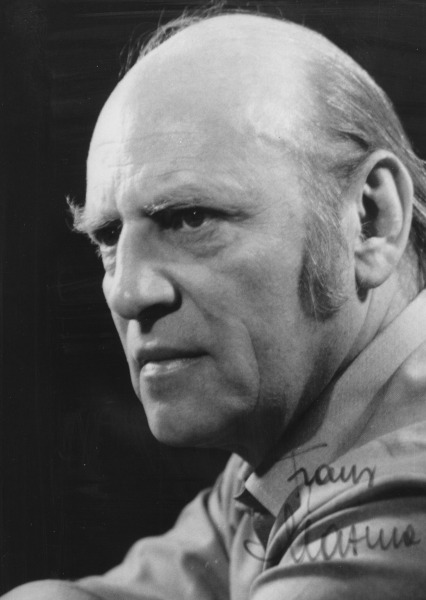
    Franz_Mazura

    Franz Mazura (above) as Alberich arrived on the scene and seized our imagination with his huge, thrustingly creepy voice, full of darkest intent. He was a fabulous Alberich, tireless in his vocal and dramatic commitment. Could this bizarre creature be more powerfully portrayed? Mazura’s generous artistry assured his huge success in the role: he made the character seem so real.

    Sotin_hans200x304

    Above: the Lord of This RING: Hans Sotin. He was in top form for a really impressive Wotan, immediately showing his vocal authority in his opening conversation with Fricka. His voice – large and steady and even from top notes down to the depths – created a real sense of majesty. [Sotin, as it turns out, sang his final Met Wotans in these performances].

    Dernesch_Isolde1Sa72PG

    Helga Dernesch (above): her fascinating voice and truly intense emotional involvement brought Fricka to life – incredibly powerful, with her deep lower voice and somewhat insecure top which curiously adds to her appeal.

    Her siblings were Gary Bachlund as Froh, revealing an embryonic heldentenor of some warmth; James Courtney as a sturdy Donner; and Mari-Anne Häggander, who made a great deal out of Freia’s brief role with her vulnerable appearance and full, clear lyric soprano.

    The giants were especially good: John Macurdy’s voice (Fasolt) sounded huge, and Matti Salminen (Fafner) let his oily tones roll out with great dramatic force – super!  Horst Hiestermann was a vivid Mime, but I found Graham Clark’s Loge did a bit too much prancing physically; and I guess I prefer more heldentenorish sound in the role, though Clark surely did sing musically and with clarity and good carrying power. Gweneth Bean’s large, rich voice created a really glorious impression as Erda – she just poured the tone out!

    At the end, a very enthusiastic reception for everyone – especially Bean, Dernesch, and Levine. Very exciting inaugural night of my RING! There were many moments when chills passed thru me: a sensation that is not often experienced at the opera these days. Mazura in particular thrilled me in this way with his theft of the gold and again as he placed his curse on the Ring. So exciting!”

    Metropolitan Opera House
    May 1, 1989

    DAS RHEINGOLD

    Wotan...................Hans Sotin
    Fricka..................Helga Dernesch
    Alberich................Franz Mazura
    Loge....................Graham Clark
    Erda....................Gweneth Bean
    Fasolt..................John Macurdy
    Fafner..................Matti Salminen
    Freia...................Mari-Anne Häggander
    Froh....................Gary Bachlund
    Donner..................James Courtney
    Mime....................Horst Hiestermann
    Woglinde................Kaaren Erickson
    Wellgunde...............Diane Kesling
    Flosshilde..............Meredith Parsons

    Conductor...............James Levine

  • At Home With Wagner V

    Richard Wagner

    These days I hardly listen to anything but Wagner at home, and invariably it’s one of the RING Cycle operas. Thanks to my friend Dmitry I have a stack of CDs as yet un-listened-to. Today I’ve set out on a 1963 Bayreuth WALKURE, led with distinction by Rudolf Kempe, which starts with a truly urgent rendering of the ‘chase’ music that serves as the opera’s prelude. Although the sound quality is erratic, with some over-load and distortion, it’s certainly more than tolerable.

    Jutta_Mayfarth_Gutrune

    Pictured above, soprano Jutta Meyfarth – yet another ‘forgotten’ voice – may not have an ideally warm or expansive voice for Sieglinde’s music: her timbre is a bit hard. But she has a great way with words and she constantly is alert to the dramatic nuances of the music and words. I listened to the last scene of Act I, starting with Meyfarth’s whispered “Schläfst du Gast?”, several times, liking her more and more with each hearing. 

    Anita_iso

    The Finnish soprano Anita Välkki (above) tosses off one of the most brilliant renderings of “Ho-Jo-To-Ho!” that I ever heard. This under-rated soprano, her career overshadowed by the more famous Nilsson, Rysanek, Bjoner and Lindholm, has a bright and at times girlish vocal quality. In the Todesverkündigung” – the great scene in which Brunnhilde announces to Siegmund his imminent death – Välkki shows clarity of expression and considerable beauty of tone.

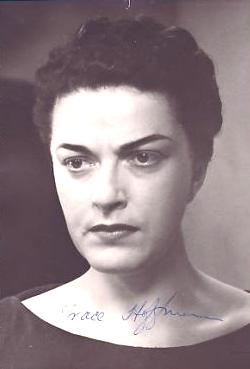
    Hoffman-Grace-08

    Mezzo-soprano Grace Hoffman (above) rounds out a strong trio of female leads in this WALKURE.  Her wide-ranging voice, her intense sense of Fricka’s wronged dignity, and her verbal and dynamic alertness make a capital effect.

    Hans Hotter was in his mid-fifties at the time of this performance, and he had been singing Wotan for a quarter-century. If vocally he is a bit less fresh than in the 1953 Keilberth/Bayreuth performance, he is remarkably authoritative and relishes both the powerful and subtle moments of this great role.  

    Hans Hotter was vehemently anti-Hitler and when he was queried during the de-Nazification interviews following the end of the war as to why Hitler would have kept his recordings in his private collection, Hotter replied that the Pope had some of them, too.

    Gottlob Frick again fills me with admiration here, singing Hunding. A somewhat less-than-stellar Siegmund – Fritz Uhl – still has his moments, but though I don’t pretend to speak German, some of his diction seemed rather odd.

    The third act is strong, with Meyfarth convincing in Sieglinde’s distress and Välkki doing some warm, espressive singing from “War es so schmälich…” to her final plea with her father to ring the Valkyrie Rock with fire. Hotter is Wotan – yet again – with the power of his wrath slowly subsiding into the tenderness of a father bidding farewell to his beloved child. Perhaps no other singer has such an innate quality of heartbreak in the voice.

    ~~~~~~~~~~~~~~~~~~~~~~~~~~~~~~~~~~~~~~~~~~~~~~~~~~~~~~~~~~~~~~~~~~~~~~~~~~~~~~~~~~~~~~~~~~~~~~~~~

    KONIECZNY_web Lang_Petra

    Above:
    Tomasz Konieczny and Petra Lang

    The Polish bass-baritone Tomasz Konieczny made a magnificent vocal impression when he sang Jochanaan in Strauss’s SALOME in a concert performance by the Vienna State Opera at Carnegie Hall in March 2014. Konieczny is the Wotan in the recently released WALKURE on the Penta Tone label, part of a complete RING Cycle conducted by Marek Janowski and recorded in a series of live concert performances in Berlin starting in 2012.

    Very curious to hear Konieczny’s voice again, but not wanting to delve into the full WALKURE until I’d first had a chance to hear the RHEINGOLD, I listened to the final scene of the WALKURE as a free-standing excerpt. The bass-baritone sings powerfully and is a vibrant, dramatic presence especially as he takes his errant daughter Brunnhilde to task for having disobeyed his direct orders. Konieczny is quite splendid while letting off steam, though the poetry of the later scene where his bids farewell to Brunnhilde and puts her to sleep on the Valkyrie Rock is not quite yet in the singer’s expressive realm. He will doubtless attain that depth of understanding and an ability to communicate it as he sings the role in coming years. Marek Janowski’s conducting is alert and vivid, and Petra Lang – who has given some striking performances as a mezzo-soprano – now sings Brunnhilde. And if she does not seem destined to achieve the exalted echelon occupied by such great Wangeriennes as Nilsson, Behrens and Dame Gwyneth, Lang nonetheless makes a wonderful impression is her moving rendering of “War es so schmählich…” and is perfectly satisfying in the rest of the act.

    **********************************************************************************************************************************

    I acquired the first two acts of a Stockholm WALKURE from 1975 mainly to hear Barbro Ericson’s Fricka and to have a sampling of another voice that had eluded me til now: soprano  Siv Wennberg. Rudolf Kempe’s conducting again seems ideal. 

    Kempe has this music in his blood and gives yet another great reading of the score. Ms. Ericson, one errant top note aside, is a passionate and exciting Fricka. Neither Ms. Wennberg nor her Siegmund, Helge Brilioth, are likely to displace other favorite interpreters of these roles in the Völsungen sweepstakes, but both are very good story-tellers. Thru dynamic and verbal shadings, the soprano gives us quite an intriguing “Der Männer Sippe“, and – earlier – the tenor does likewise as he tells the story of how he came to be under Hunding’s roof. Mr. Brilioth will later have some pitch issues, and his cries of “Wälse!’ Wälse!’” suffer from very bad audio overload. Ms. Wennberg holds steady throughout the first two acts.

    As Brunnhilde, Berit Lindholm lauches a pert, eager “Ho-Jo-To-Ho“, and she makes a good impression in the Todesverkundigung: the very heart of the opera. David Ward, whose Wotan I so thoroughly enjoyed in the 1965 Covent Garden performance conducted by Solti, is understandably a bit less fresh vocally here in Stockholm ten years on, but he is still very impressive and expressive in his long monolog (so well-supportedby Kempe) and he gives a violently dismissive “Geh!” as he dispatches Hunding to his fate at the very end of Act II.

    R_Cederlof_Hunding

    The most surprising aspect of this performance is a superbly sung Hunding from basso Rolf Cederlöf (above). This is a voice I’d never heard before, and even as a name he was unknown to me. It’s a beautiful, deep, voluminous sound, and from his entrance the vocal ‘temperature’ of the first act rises: he seems to inspire Wennberg and Brilioth in their narratives…and in turn they are all inspired by Kempe.

    ~~~~~~~~~~~~~~~~~~~~~~~~~~~~~~~~~~~~~~~~~~~~~~~~~~~~~~~~~~~~~~~~~~~~~~~~~~~~~~~~~~~~~~~~~~~

    Bampton-glam-701475

    Continuing in WALKURE mode, I recently took from the library the 1947 discs of Toscanini rehearsing the first act of the opera for a concert perfomance. This issue is a favorite among collectors as it gives an aural portrait of the fiery conductor at work. The Sieglinde is Rose Bampton (above) and I was very much taken with her interpretation. Wanting to hear more of Bampton, I turned to a 1944 Met broadcast of WALKURE conducted by George Szell. This seventy-year-old performance begins with a breathlessly-paced prelude depicting Siegmund’s rush thru the forest; Szell brings the first act full circle with an equally speedy burst of energy in the postlude as brother and sister rush off to their unknown fate. 

    Lauritz Melchior, that tireless Wagner-machine, is Siegmund. The paragon of heldentenors, Melchior sang over 500 performances at The Met alone; his career there lasted nearly a quarter-century (debut in 1926). Like Toscanini – who keeps admonishing the orchestra players “piano! piano!” during the rehearsal – Szell draws out some remarkably intimate passages from both musicians and singers in Act I. Melchior is able to sing some beautifully supported piano passages, and also to cut loose with sustained powerhouse cries of “Wälse! Wälse!“. Alexander Kipnis growls darkly as an authoritative Hunding.

    Ms. Bampton’s singing sets her firmly alongside my favorite Sieglinde of all time: Johanna Meier. Bampton shares with Ms. Meier a deeply feminine sensibility as well as a feeling of great dignity, despite the hardships she has endured: married off against her will, and ill-treated by her abusive husband. Bampton’s wonderfully vivid diction, her ability to move the voice from subtle inflection to generous outpouring in the twinkling of an eye, and the overall appeal of her sound make for a winning combination in this role.

    One added sonic element is the subtle use of a wind machine during the prelude; and it cunningly is heard again when the doors to Hunding’s hut blow open just before the “Winterstürme”.

    K-Szell-w-manuscript-LR1

    I found myself being drawn deeper and deeper into this performance as Act II unfolded. Szell (above) seems, perhaps more than any other conductor I’ve experienced in the opera, to summon forth the various leitfmotifs and weave them ideally into the sonic tapestry. Thus the introduction to Act II presents the brass heralding the impending presence of Wotan and Brunnhilde whilst the strings yearningly deliver the theme of Sieglinde’s “Du bist der Lenz” (in a minor key) forecasting the theme of the entire act: the fate of the Völsung and his sister/bride; later, as Wotan and Fricka heatedly debate the issue, Szell brilliantly manages to support both sides of their argument thru orchestral underlining.

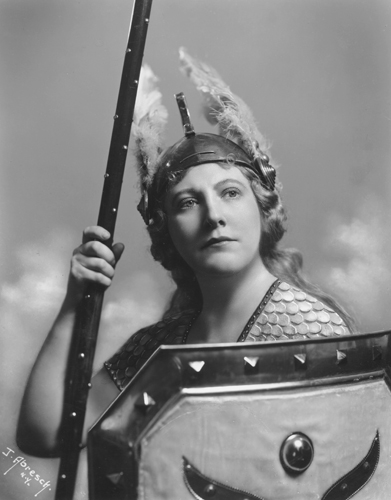
    07 Traubel in Walkure 1941

    Helen Traubel’s Brunnhilde (above) rings true with rich, warm tone: a lone clapper greets her appearance – a few other audience members gingerly join in (applause during a Wagner opera is pretty much frowned upon) – and she has a fine success with “Ho-Jo-To-Ho” despite a hint of shortness at the top of the range. The sound of her voice at times reminds me, curiously, of Eleanor Steber’s.

    Herbert Janssen’s Wotan is of the baritonal rather than basso persuasion: some of the roles lower notes are a bit of stretch for him. But he’s so completely at home in the role both verbally and vocally that it doesn’t matter. It’s not one of those grandiose Wagnerian voices, but has instead a dimension of the humanity that will eventually be the god’s undoing. Wotan’s monolog has some internal cuts, but Janssen sings it impressively and Traubel’s interjections are beautifully rendered.

    Thorborgfricka

    Kerstin Thorborg’s imperial Fricka (above) is vocally opulent, and she deals from strength in her confrontation with Wotan, thoroughly dismantling his every argument as their scene progresses; a wonderfully sung Wagnerian exchange by two seasoned interpreters. Melchior and Bampton arrive at the mountain pass, fleeing from Hunding. Their scene is vividly urgent and again Szell and his orchestra continually project the dramatic situation; Melchior’s Siegmund is finally able to calm his desparate sister-bride, setting the stage for the heart of the opera: the ‘Todesverkündigung’ (the Annunciation of Death).

    The Todesverkündigung is my favorite scene of WALKURE and my initial reaction on listening to the scene in this performance was of a slight letdown from all that had gone before. Szell and his orchestra did not seem to evoke the dreamlike quality needed (and there are a few bad notes among the brass players) and Melchior’s singing seemed factual and lacking in reverence to the demi-goddess who has appeared before him. I played the scene again a few hours later and found it far more impressive, especially as Traubel is so tonally secure and noble-sounding – at least until her cold façade begins to crumble in the face of Siegmund’s queries and his growing bitterness towards the deception he has been dealt. When the warrior tells Brunnhilde that he carries an invincible sword – Nothung – the Valkyrie replies: “He who bestowed it sends thee now death: for the spell he now takes from the sword!” her warning ricochets back at her when Siegmund cries: “This sword, given by a false man to a true one…!” The atmosphere is palpable, the scene as heart-breakingly beautiful as ever.

    The end of the second act in this performance is somewhat undermined by the voices of Hunding, Brunnhilde and Wotan being too far off-mike to make the needed impact.

    The third act opens with an exciting Ride of the Valkyries and an emotional rendering of the scene where Brunnhilde tells Sieglinde that Siegmund’s death was not in vain: she presents the unhappy widow with the pieces of the shattered Nothung and declares that Sieglinde, miraculously pregnant after only meeting her husband one day earlier, will give birth to the greatest of heroes: Siegfried. Mmes. Traubel and Bampton are very dramatically involved here, and both sing very well. 

    Traubel remains steady and impressive throughout the final scene with Herbert Janssen; the baritone’s voice has a steady beat to the tone – a kind of slow tremelo – that gives his singing of the opera’s heart-rending farewell of Wotan to his favorite daughter a wonderfully human dimension.

    Harshaw

    Among  the Valkyries, the name Margaret Harshaw (above) stands out. She is Schwertleite here, as she was on many a Met evening over the years. In 1949 she moved on to Fricka and in 1954 she took on Sieglinde for the first time. And later in 1954 she assumed the role of Brunnhilde. It was in this last-named role that Harshaw sang in a Met WALKURE for the last time, in 1962. She took over the opera’s title-role that night in place of an ailing Birgit Nilsson. It was quite a night, as this descriptive review attests:

    Soprano Birgit Nilsson, scheduled to sing the role of Brünnhilde, had to bow out the evening before the performance. General Manager Rudolf Bing gave the role to soprano Margaret Harshaw, who was to have sung Sieglinde; into the Sieglinde role went soprano Gladys Kuchta. One of the Valkyries, mezzo Gladys Kriese, was ill with tracheitis: her part went to mezzo Ethel Greene, regularly a member of the chorus.
    Somehow, the opera got started on time. But in Act II, just when baritone Otto Edelmann seemed to be booming along comfortably in the role of Wotan, his voice began to fail. Edelmann withdrew at the end of Act II. He was replaced by baritone Randolph Symonette, who lasted on stage for only four minutes. 'It seemed to me like four hours,' said shaken conductor Erich Leinsdorf, later. It was apparent to Leinsdorf that Symonette 'could not get any music out of his throat.' When Symonette finally croaked out the line 'Aus meinem Angesicht bist du verbannt'('From my presence you are banished'), Leinsdorf ordered the curtain rung down.

    Conductor Leinsdorf started again after a jump of ten pages in the score to cut out some of the more tortuous vocal passages, and baritone Edelmann came on again as Wotan, in brighter voice after his rest. Happily, they all made it to the final curtain.

    "I felt like the pilot who decides on a crash landing," said Leinsdorf. "We made it without the plane going up in flames."

  • Nelida

    Index

    Above: detail from the tomb of Marie D’Agoult at Pere-Lachaise Cemetery in Paris

    Nelida in an anagram for Daniel, and Daniel Stern was the nom de plume of Marie D’Agoult, the mistress of Franz Liszt and the mother of Cosima Wagner. Nelida is also the title of D’Agoult’s 1846 novel, drawing upon her tempestuous relationship with Liszt; ironically, the composer (they were long since estranged) seems to have sent her a congratulatory letter when the novel was published.

    Marie D’Agoult was the only one among Liszt’s lovers to bear him children: Blandine, Cosima, and  Daniel. Liszt met Marie in 1832 or 1833 and they became lovers in 1834, though d’Agoult was not divorced from her husband Comte D’Agoult until 1835. The affair between Marie and Franz was a stormy one; she deplored the composer/pianist’s long absences on his performance tours. These absences – and Liszt’s philandering – led to a final break in their relationship in 1844. Marie then took up the name Daniel Stern; she became a journalist. She died in 1876.  Though a less prolific and skilled writer than George Sand, D’Agoult is sometimes compared with her better-known compatriot; the two women shared the distinction of being the respective lovers of a pair of musical geniuses.

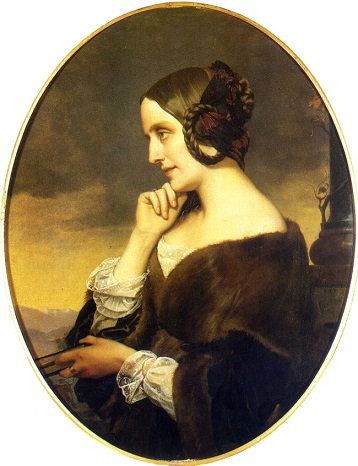
    Marie_d'Agoult
    Above: portrait of Marie D’Agoult

    Out of curiousity, I took up a copy of Nelida (in an English translation, to be sure) and enjoyed the story, and D’Agoult’s romantic style. In the novel, Liszt is transformed into the painter Guermann Régnier whilst Marie appears in the guise of Nelida.

    First published in 1846 (under the pen name Daniel Stern), Nelida tells the story of a beautiful young French heiress who was plucked from a convent school – where she had expressed a fervent desire to become a nun – to make a socially advantageous marriage to one Timoleon de Kervaens. Almost at once, Nelida’s husband proves himself unworthy of her. And then, re-connecting with a childhood friend who is now a rising painter – Guermann Régnier – Nelida surrenders everything (her marriage, reputation, and an affluent lifestyle) to dedicate herself to Guermann.

    Marie d’Agoult, in fictionalizing her ten-year affair with Liszt, may have written the novel as an act of revenge against the pianist-composer whose frequent absence while touring combined with his numerous amorous adventures slowly destroyed their love, despite the successive births of their three children. In the novel, Guermann/Liszt falls into decline and illness without Nelida/Marie; she visits him on his death-bed where he begs her forgiveness for having treated her so indifferently: “From the day I left you, I left – and never found again – my virtue, my rest, my happiness, my genius,” he tells her.

    The reality for D’Agoult/Liszt was very different, for after leaving Marie, Liszt went on to his greatest achievements. But the fictional resolution of the love affair must have brought needed closure for D’Agoult and she went on to a distinguised career as a woman of letters whose works included a major history of the 1848 revolution in Paris.

    In Nelida, Marie D’Agoult reveals the personal story behind her public life as Liszt’s lover and the mother of his children. Summoning forth the social mores and artistic and religious atmosphere of the era, the novel reveals a woman seeking to be at once faithful to her genius/beloved while at the same time vindicating herself and claiming her own destiny.

  • First Encounter: ARIADNE AUF NAXOS

    Ariadne6263.07
    Above: Leonie Rysanek, the Met’s first Ariadne

    As the 150th anniversary of the birth (on June 11th, 1864) of Richard Strauss draws near, I was recalling the first time I heard what was to become my favorite opera – the composer’s ARIADNE AUF NAXOS. This opera had come rather late to The Met: some fifty years after its world premiere, The Met presented ARIANDE with the following cast:

    Metropolitan Opera House
    December 29, 1962
    Metropolitan Opera Premiere

    ARIADNE AUF NAXOS
    R. Strauss

    Ariadne.................Leonie Rysanek
    Bacchus.................Jess Thomas
    Zerbinetta..............Gianna D'Angelo
    Composer................Kerstin Meyer
    Music Master............Walter Cassel
    Harlekin................Theodor Uppman
    Scaramuccio.............Andrea Velis
    Truffaldin..............Ezio Flagello
    Brighella...............Charles Anthony
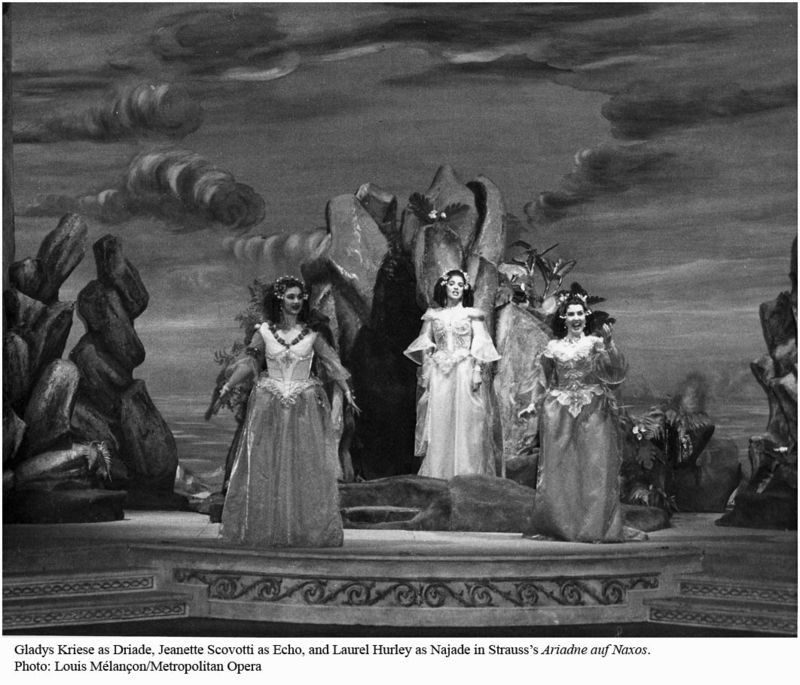
    Najade..................Laurel Hurley
    Dryade..................Gladys Kriese
    Echo....................Jeanette Scovotti
    Major-domo..............Morley Meredith
    Officer.................Robert Nagy
    Dancing Master..........Paul Franke
    Wigmaker................Roald Reitan
    Lackey..................Gerhard Pechner

    Conductor...............Karl Böhm

    The opera, with it’s almost chamber-music orchestration (only about 35 players are called for) was thought by some people to be too intimate for such a large house as The Met. But the production, revived several times over the ensuing years, continued to win new devotees to the incredible Strauss score. On March 12th, 1988 the Met production was telecast live to Europe; I was there – with Kenny and Jan – enjoying a superb cast led by Jessye Norman, Kathleen Battle, Tatiana Troyanos, and James King, with James Levine on the podium. In 1993 The Met unveiled a new and delightful production by Elijah Moshinsky with its ‘realistic’ prologue and fantasy-setting for the opera.  

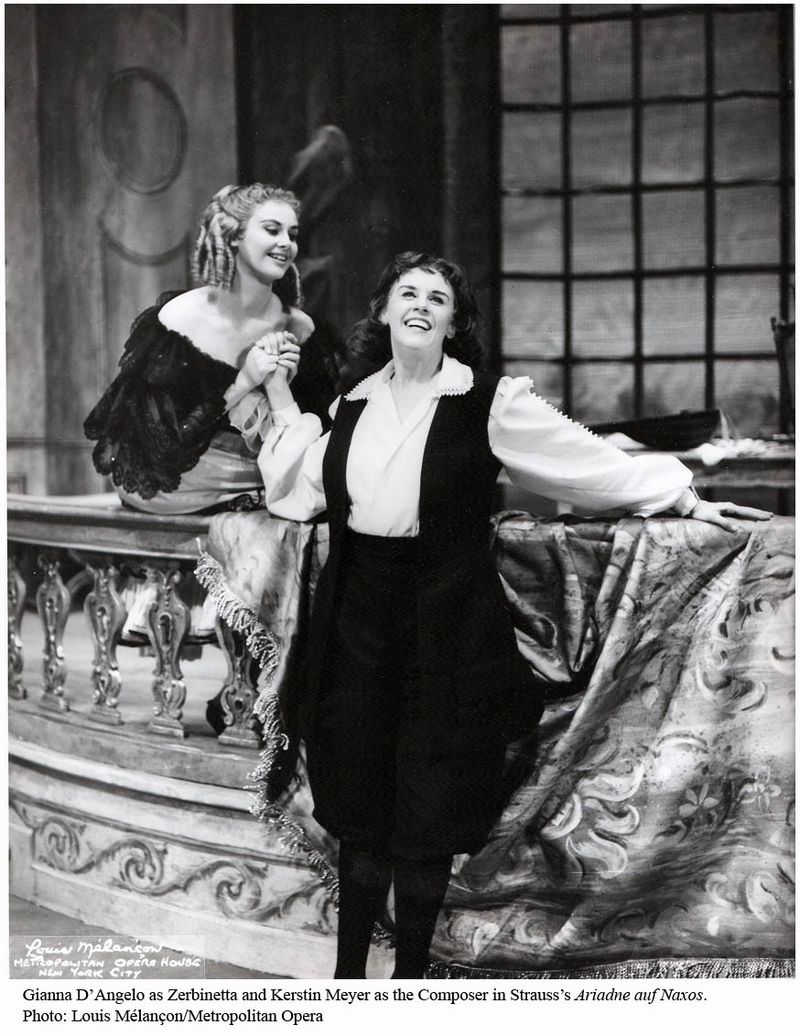
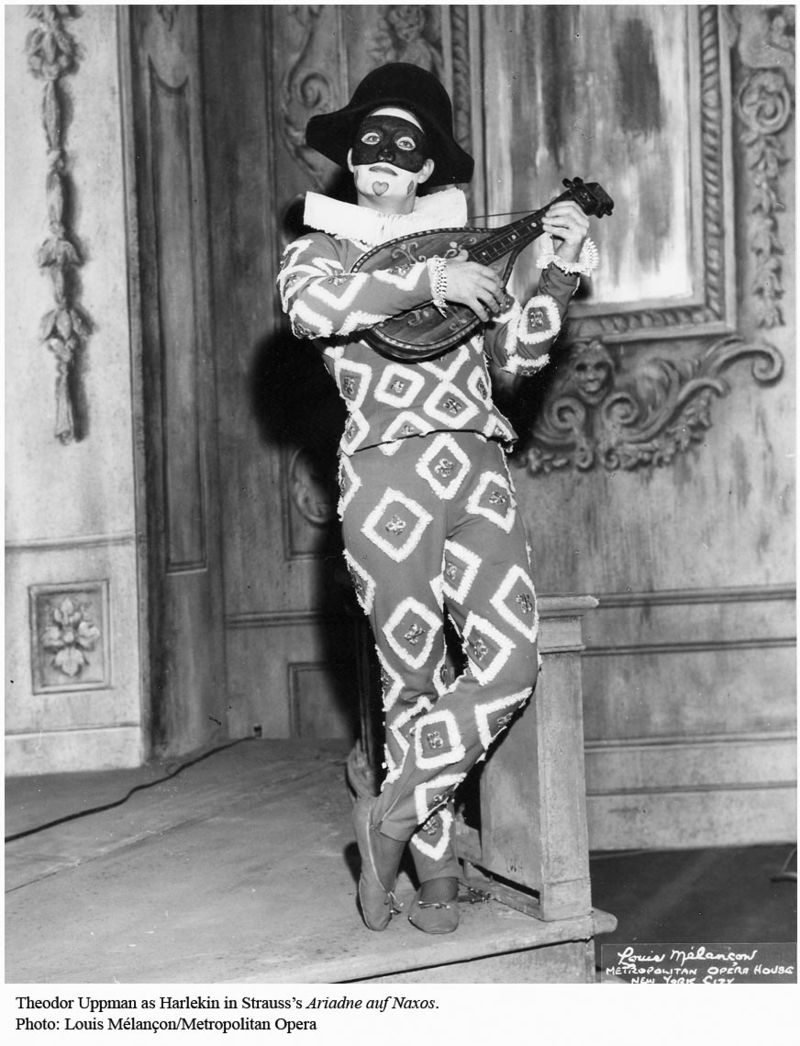
    But, back to 1962: The Met’s house photographer at the time, Louis Melançon, routinely photographed each Met production as well as taking ‘portraits’ of the principal artists in costume. His photos graced Opera News for years, and I have several that were sent to me – autographed – by individual singers. Here are some of Mr. Melançon’s pictures from the Met’s premiere of ARIADNE AUF NAXOS:

    Ariadne6263.04

    Ariadne6263.24

    Ariadne6263.10

    Ariadne6263.22

    On February 2nd, 1963, Wagner’s FLIEGENDE HOLLANDER was scheduled for a Texaco/Metropolitan Opera matinee radio broadcast. Of course I was tuned in: this was my second season of Met radio broadcasts and I was thoroughly primed for my first experience of hearing HOLLANDER, with Opera News opened to the cast page and the household warned against any intrusions on my listening. Thus I was shocked when the friendly voice of Milton Cross delivered the alarming news: the opera was being changed!

    It seemed that tenor Sandor Konya, scheduled to sing Erik in HOLLANDER, was ill and so were his cover and other tenors who were in town who knew the role. It was decided to put on ARIANDE instead, since Leonie Rysanek – scheduled for Senta in the Wagner – was ready and raring to go. (ARIADNE had been scheduled for broadcast later in the season, with Lisa Della Casa the announced Ariadne; the change of opera on February 2nd thus deprived Della Casa of her chance to broadcast the role). The cast for the ‘substitution’ broadcast was the same as for the Met premiere, with the exception of Roberta Peters, replacing Gianna D’Angelo as Zerbinetta.

    Without any preparation for this ‘new’ opera, I listened and – to an extent – enjoyed ARIADNE though to be honest I was not a huge Strauss fan at that point in my operatic career. It wasn’t until 1970 that I actually saw the Met’s ARIADNE: from a front-row orchestra seat directly behind Karl Bohm’s left shoulder, I was transported by a splendid cast led by Leonie Rysanek, Reri Grist, Evelyn Lear, and James King. My love affair with ARIADNE became even more earnest a few seasons later with the New York City Opera’s beloved English/German production starring Carol Neblett/Johanna Meier, Patricia Wise, Maralin Niska, and John Alexander. But that’s a whole other story.

  • At Home With Wagner IV

    Richard+Wagner+02

    Note: this article has been written over the course of several months

    Four recordings of live performances of Wagner’s LOHENGRIN have come my way, courtesy of my friend Dmitry. Despite being rather busier during this Summer of 2013 than I’d anticipated, I found time on these hot afternoons to start listening to these performances, an act at a time. Invariably I’ll listen to the same act two or three times, so as not to miss anything.

    LOHENGRIN might be considered Wagner’s most beautiful opera; from the ethereal opening bars of the prelude, it weaves a spell of mystery, romance, and deceit all under-scored by the Dark Arts. Marvelous stretches of melodic splendor – Elsa’s Song to the Breezes (“Euch luften“), the bridal procession to the cathedral, Lohengrin’s tragically tender “In fernam land” – mix with ‘greatest hits’  like the über-familiar Wedding March and the thrilling Act III prelude. Three prolonged duets are the setting for major dramatic developments in the narrative: Ortrud and the banished Telramund outside the city walls; Elsa meeting with and being beguiled by Ortrud; and Elsa and Lohengrin on their bridal night where the hapless girl asks the fatal question. King Henry has his orotund prayer “Mein Herr und Gott!” whilst Ortrud calls upon the forsaken pagan gods in her great invocation “Entweihte Götter!” The conflict between darkness and light is manifested in the great confrontation between Ortrud and Elsa on the cathedral steps, the violins churning away feverishly as the two voices vie for the upper hand; Ortrud has the last word.

    So it’s an opera that is easy to listen to repeatedly; and the more you listen, the more you hear…yes, even after 50+ years of getting drunk on Wagner, I still discover new things in his operas.  

    Jess+Thomas

    Jess Thomas (above) is the Lohengrin on two of these recordings, the first from Munich 1964 and the second from Vienna 1965. I listened to the Munich first, conducted by Joseph Keilberth, and found it a strong, extroverted performance. None of the principal singers go in for much subtlety, instead flexing their Wagnerian vocal muscles in generous style.

    Keilberth’s conducting has sweep and intensity, though perhaps lacking a bit of the dreamlike quality that can illuminate the more spiritual passages of the opera. This accords well with the singing, since neither Jess Thomas nor his Elsa, Ingrid Bjoner, use much dynamic contrast (though when they do it works wonders). Both have big, generous voices and they are on fine form for this performance.

    Jess Thomas was my first Calaf (at the Old Met), Siegfried, Tristan and Parsifal. He was a mainstay at The Met in the helden roles from 1962 to 1982, returning in 1983 to sing part of Act I of WALKURE with Jessye Norman for the Met’s 100th birthday gala. His is not the most gorgeous sound imaginable but his power and security are amply in evidence in this Munich performance.

    Cox Bjoner

    Above photo: Ingrid Bjoner in GOTTERDAMMERUNG, with tenor Jean Cox

    I’ve always liked Ingrid Bjoner; her rather metallic sound and steely top served her well in a long Wagnerian career. I only saw her onstage onceas Turandot, a memorable performance both from a vocal and dramatic standpoint. In this Munich LOHENGRIN, Bjoner sails thru the music with exciting vocal security. If only rarely does she engage in the floating piani that many sopranos like to display in this music (the end of Bjoner’s ‘Euch luften’ is ravishing!), hers is an impressive reading of the music.

    In a thrilling performance, Hans Günther Nöcker turns the sometimes-overshadowed role of Telramund into a star part. His narration of the shame and degradation he feels at having been bested in the duel and then exiled is a powerful opening for the opera’s second act.
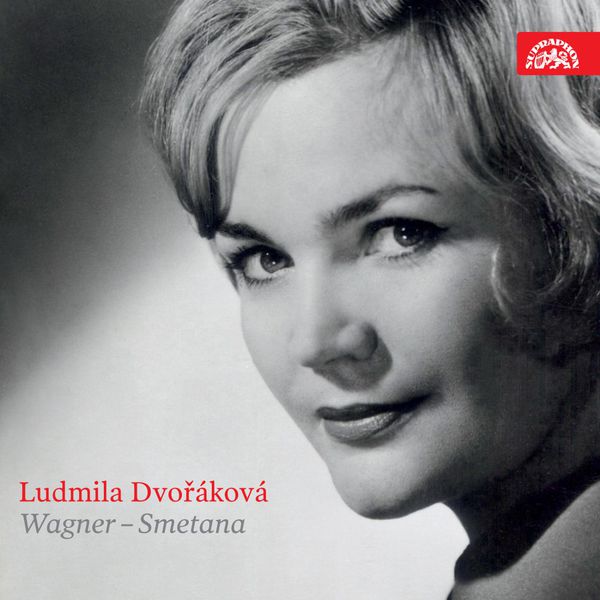
    0099925413729_600

    Ludmila Dvorakova’s large, somewhat unwieldy voice has ample thrusting power for Ortrud’s great invocation in Act II, though she tends to leave off clear enunciation of the text in favor of simply pouring out the sound. Dvorakova (above) – who sang Isolde, Leonore and Ortrud at the Met in the 1960s – was known for her magnetic stage presence.

    Gottlob Frick is a powerful Henry, but there’s a question as to whether it’s Josef Metternich or Gerd Neinstedt as the Herald in this performance – whoever it is, he is not having his happiest night vocally.

    ~~~~~~~~~~~~~~~~~~~~~~~~~~~~~~~~~~~~~~~~~~~~~~~~~~~~~~~~~~~~~~~~~~~~~~~~~~~~~~~~~~~~~~~~~~~~~~~~

    Geddanc

    When in 1966 tenor Nicolai Gedda was announced for performances of Lohengrin in Stockholm, there was some hand-wringing among the fans. Gedda was known for his stylish lyricism and easy top in the bel canto and French repertoire; he had tackled such high-flying roles as Arturo in PURITANI and Raoul in HUGUENOTS with striking command. By venturing into Wagner, Gedda was thought to be putting his instrument at risk. But he sang Lohengrin on his own terms, with true-tenor (rather than baritonal) timbre, producing one beautiful phrase after another. The recording, which I owned on reel-to-reel at the time it was first available, is a valuable document since Gedda never again sang the role, nor any other Wagnerian role, onstage.

    Gedda in fact is one of the most pleasing Lohengrins to hear; as in another mythic/heroic role he tackled only once – Aeneas in TROYENS – the tenor’s clarity of both tone and diction – and his complete ease when the vocal line goes upward – mark his performances in these operas as ideal, even though they both quickly fell out of his active repertory.

    Gedda was my first Nemorino (at the Old Met) and I saw him many times over the ensuing years (as Don Jose, Don Ottavio, Elvino, Edgardo, Faust and  Lensky), always impressive in his artistry and vocal security. Far from ruining his voice, the Lohengrin simply served as a vocal adventure for the tenor; he went on singing for another 20 years after portraying the mysterious knight. His Met career spanned 25 years and nearly 375 performances, including singing the final trio from FAUST at the very last performance at the Old Met.

    Aside from Gedda, this Stockholm LOHENGRIN is very enjoyable in many ways though not quite reaching the mystical heights that some performances of this opera have attained. Conductor Silvio Varviso has a fine sense of pacing and if the orchestral playing is not world-class, a lyrical atmosphere develops nicely right from the start.

    Aase N-L

    I’m particularly taken with the performances by the two female leads: the Norwegian soprano Aase Nordmo Løvberg (above) makes a distinctive impression as Elsa; her voice, rather Mozartean in heft and feeling, has clear lyrical power and expresses the character’s vulnerability well. The soprano appeared at The Met 1959-60 as Elsa, Eva, Sieglinde and Leonore; she passed away earlier this year, one of those ‘forgotten’ voices still held dear by a diminishing group of aficianados who listen to older recordings.
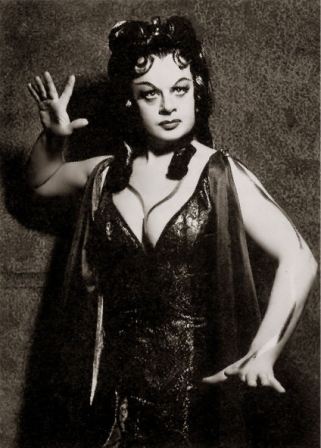
    Ericson

    As Ortrud, Barbro Ericson (above) gives a blazing performance. Like Nordmo Løvberg, Ericson did sing at The Met (1967-68): she was Siegrune in the ‘Karajan’ WALKURE performances, and stepped in once as Fricka; she returned a decade later to sing Herodias in SALOME with Grace Bumbry as her daughter. Ericson was a fearless singer with a rich chest voice and some stunningly easy top notes.

    As King Henry, Aage Haugland’s sturdy and humane bass sound is a big asset in the Stockholm LOHENGRIN; Rolf Jupither is a solid Telramund and Ingvar Wixell – who went on to be a major Verdi baritone (he was a wonderful Boccanegra at the Met in 1973-74) – already shows vocal distinction as the Herald.

    in the third act, this performance is particularly gratifying, for Ms. Nordmo Løvberg and Mr. Gedda sing one of the most lyrical and polished versions of the Bridal Chamber duet that I’ve ever heard. And the tenor is absolutely splendid in the long narrative “In fernem land” and his tender farewell address to his wife; with poetic expression tinged in sadness, he presents Elsa with the horn, sword and ring that are meant for her lost brother, Gottfried. Gedda’s anguished “Leb wohl!” to his distraught bride is like an arrow to the heart. This document of Gedda’s performance, capped by his magnificent vocalism in the opera’s final twenty minutes, can be considered a treasured rarity in the annals of great Wagner singing.

    ~~~~~~~~~~~~~~~~~~~~~~~~~~~~~~~~~~~~~~~~~~~~~~~~~~~~~~~~~~~~~~~~~~~~~~~~~~~~~~~~~~~~~~~~~~~~~~~~

    Rene-maison

    Above: tenor René Maison

    As Summer 2013 ended and the performance season started up, I had less time to devote to listening at home; and so it wasn’t until the dark, chilled days of February 2014 that I took up a rarity:  1936 LOHENGRIN from Buenos Aires which features René Maison, Germaine Hoerner, Marjorie Lawrence, Fred Destal, Alexander Kipnis, and Fritz Krenn, with Fritz Busch on the podium. Of the singers, Hoerner, Destal, and Krenn were names I’d never even heard of prior to settling down with this recording.
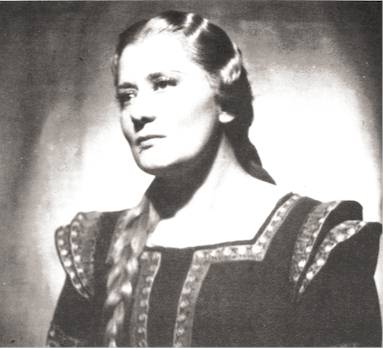
    Gorrhoernersenta

    Germaine Hoerner was born in Strasbourg in 1905, made her debut at L’Opera de Paris in 1929 and sang such roles as Elsa, Gutrune, Senta (photo above), Aida, Desdemona, the Marschallin, and Beethoven’s Leonore during her career which lasted thirty years. How strange that I’d never encountered her voice before.

    Fred Destal began his career as a choirboy in Liegnitz and sang professionally at the Deutsches Theater in Brünn, before joining the Deutsches Opernhaus (later the Städtisches Oper) in Berlin. In 1933 he left Germany for the Zurich Opera. He sang at the Vienna State Opera from 1936–1938, and emigrated to the United States in 1938. He made many guest appearances in Europe and frequently performed at the Colón in Buenos Aires where he essayed several Wagnerian roles as well as singing in operas by Mozart and Strauss, and in operetta.

    Fritz Krenn debuted in 1917, singing with the Vienna State Opera from 1920-1925 and the State Opera, Berlin, from 1927 til 1943. He became celebrated for his Baron Ochs, singing the role over 400 times including seven performances at The Met in 1950. He died in 1963.

    The three other leading artists in this 1936 Buenos Aires LOHENGRIN all had major careers – Marjorie Lawrence’s unfortunately much altered by the onset of polio in 1941. Though her legs were paralyzed, she returned to the stage in 1943, singing performances of Venus and Isolde at The Met from a seated position; but the wife of a Metropolitan Opera board member was put off by the sight of the disabled soprano onstage and her Met career ended. Lawrence’s life was the subject of a 1955 film, Interrupted Melody.

    The sound quality on this 1936 performance – needless to say – is very uneven; yet not enough so to deter the adventuruous listener. Passages where the volume fades come and go, and these sometimes occur at exactly the “wrong” moment. But there’s enough acceptable sonic accessability to have a pretty good idea of what the performance was like.

    Fritz Busch conducts and, though the orchestra playing (and the recording of it) leave something to be desired, the conductor establishes the dramatic atmosphere right from the start of the celestial prelude – a prelude which draws unexpected and sustained applause from the audience.

    Alexander Kipnis sounds somewhat unsettled in this performance as King Henry: his career had already lasted 20 years and The Met was still in his future. He may have suffered from the recording techniques employed or simply have been having an off-night. Here are no serious flaws in his singing, but surely he’s not as his best. Germaine Hoerner has a brightish voice with a slight flutter that gives her singing an almost girlish attractiveness and a vulnerable appeal – quite nice for this role. There are some vague pitch issues but she does make an impression right from her opening line. René Maison sings expressively as Lohengrin, with a good feel for the other-worldly yet heroic quality the music calls for; he shows impressive dynamic control from the start. Fritz Krenn begins rather anonymously as the Herald but gains ground as Act I progresses. Fred Destal’s Telramund is dramatically vivid in the opening act – his greatest moments lie ahead – and Ms. Lawrence makes only the briefest vocal appearance in Act I. 

    Despite the lack of immediacy in the sound quality, Busch opens Act II with a good sense of impending doom; in the duet for Ortrud and Telramund, Lawrence and Destal are appropriately gloomy. Later Ms. Lawrence is ever-so-slighly taxed by some of Ortrud’s highest notes but she’s very exciting at “Zurück, Elsa!” and the whole of their confrontation is well done. Destal’s attempt to incite the knights is another good passage, and Fritz Krenn’s singing as the Herald is more vivid than in Act I. Busch takes the wedding procession music rather faster than we often hear it, and the chorus sound a bit daunted at this point. What sets this second act on a higher plane is the singing of Hoerner and Maison: the soprano’s voice, now at full sail, is full of lyrical grace; her pitch is now steady and the voice takes on a silvery gleam in the upper range. Maison’s tenderness towards Elsa is lovingly expressed, and Ms. Hoerner responds to his reassurance with a finely-turned rendering of the marvelous passage “Mein Retter, der mir Heil gebracht! Mein Held, in dem ich muss vergehn, hoch über alles Zweifels Macht soll meine Liebe stehn.” (“My deliverer, who brought me salvation! My knight, in whom I must melt away! High above the force of all doubt shall my love stand.”)

    After a brisk prelude, Act III begins with the chorus of the bridal party approaching; the antique sound quality gives the voices a ghostly air, and as they recede I was struck by the fact that it’s unlikely anyone who was at this performance is still alive today, and struck yet again that it has come to us from across a three-quarter-century span of time.

    Ms. Hoerner and Mr. Maison achieve poetic vocal distinction in the Bridal Chamber duet; the tenor’s gentle ardor is movingly expressed with some lovely soft nuances and the soprano sounds girlishly enraptured; of course, their joy is short-lived as Elsa’s gnawing curiosity overwhelms her. As the opera moves to its inexorable end, Mr. Maison sings ‘In fernem land’ so movingly. Ms. Hoerner reacts to the imminent departure of her knight with frantic despair; but Ms. Lawrence is not comfortable in Ortrud’s final vengeful utterances: she sounds taxed and rather desperate. Mr. Maison then delivers the most extraordinary singing of the entire performance: at ‘Mein lieber schwan’ he pares down the voice to a mystic thread of tone, coloured with an amazing sense of weeping. I’ve never heard anything like it; it literally gave me the chills.

    ~~~~~~~~~~~~~~~~~~~~~~~~~~~~~~~~~~~~~~~~~~~~~~~~~~~~~~~~~~~~~~~~~~~~~~~~~~~~~~~~~~~~~~~~~~~~~~~

    0

    Then back to Jess Thomas for the Vienna 1965 performance. The tenor is perhaps a shade less commanding vocally than in the Munich/Keilberth performance, but impressive nevertheless.

    For the Vienna ’65, Karl Bohm is on the podium, giving a refined delicacy to the prelude and showing a near-ideal sense of pacing and of the architecture of the work. Bohm underscores a sense of impending doom when – initially – no champion answers the calls to defend Elsa’s honor.

    C Watson

    Claire Watson, the American soprano who never sang at The Met but was a beloved star at Munich for several years, sings Elsa with a nice aristocratic feel. The voice is clear and steady, with just a slight touch of remoteness that suits the character.

    Walter Berry (Telramund) and Eberhard Waechter (the Herald), two of Vienna’s most beloved baritones at this point in time, are very fine in Act I; Martti Talvela’s sing as King Henry is at once powerful and humane. Talvela’s voice has a trace of a sob, and there are passing moments of off-pitch singing here and there but overall he is impressive.

     And then we come to Act II…

    Christa

    Above: Christa Ludwig

    From the moment of curtain-rise, the second act of this LOHENGRIN is simply thrilling. Not only is the singing of the principals at a very high level throughout, but the dramatic atmosphere that is generated raises the temperature to the boiling point very early on in the act and sustains it til the final omnious re-sounding of the Ortrud motif as Elsa and Lohengrin enter the cathedral.

    It’s the divine Christa Ludwig and her then-husband Walter Berry who set this act on its magnificent trajectory. Outside the city walls, Mr. Berry, as Telramund, having been defeated in single combat by Elsa’s mysterious knight in shining armor, prepares to face his fate in exile: “Arise, companion of my shame!” he tells his wife. But Ortrud, as if in a trance, cannot comprehend their banishment. In his monolog of defeat, Telramund blames his wife for his predicament, ending his tirade with “Mein Ehr hab ich verloren!” (“I have lost my honor!”) Having sung this whole passage thrillingly, Mr. Berry dissolves in anguished sobbing. I’ve never heard this passage so powerfully delivered.

    In the ensuing dialogue, as Ortrud tells Telramund how his fate can be reversed, both singers are incredibly alive to ever nuance of the music and text. In a searing moment, Telramund/Berry states that his defeat was an act of God; to this, Ortrud/Ludwig replies with a blistering, sustained “Gott????!!!!!” and then emits a ghastly laugh. Mr. Berry’s rejoinder marks another high point for the baritone; indeed both he and Ms. Ludwig continue throughout this scene to match one another in intensity and vocal splendour. Singing in doom-ladened unison, they conjure up a vision of revenge in “Der Rache Werk…”

    Then Elsa appears on the high castle balcony: Miss Watson in fine lyric form for the Song to the Breezes. But Ortrud calls to her from out of the darkness and after a bit of servile groveling on Ortrud’s part, Elsa agrees to come down and speak with her wounded nemesis. Ms. Ludwig then lauches her hair-raising invocation of the ancient gods:

    “Ye gods profaned! Help me now in my endeavor!
    Punish the ignominy that you have suffered here!
    Strengthen me in the service of your holy cause!
    Destroy the vile delusions of those who deny you!
    Wotan! I call on you, O god of strength!
    Freia! Hear me, O exalted one!
    Bless my deceit and hypocrisy,
    that I may be successful in my revenge!”

    This brilliant passage, delivered with stunning amplitude and soaring top notes by the inimitable Christa Ludwig, literally stops the show. The audience bursts into frantic appplause, a mid-act rarity in Wagner performances, and Maestro Bohm must wait several seconds to continue. 

    In their ensuing duet, Christa Ludwig uses the subtle finesse of a great lieder singer to worm her way into Elsa’s trust. Both Ludwig and Ms. Watson sing superbly here, with a perfect blend as their voices entwine. Elsa’s overwhelming goodness seems to have converted Ortrud: the orchestral melody of forgiveness and sisterhood – my favorite moment in the opera – signals false hope. In a devastating passage as Elsa draws Ortrud into the castle, Telramund emerges from the shadows and again Mr. Berry is pure magnificence in his closing statement: 

    “Thus misfortune enters that house!
    Fulfil, O wife, what your cunning mind has devised;
    I feel powerless to stop your work!
    The misfortune began with my defeat,
    now shall she fall who brought me to it!
    Only one thing do I see before me, urging me on:
    that he who robbed me of my honour shall die!”

    As the scene ended I was literally stunned. It took me a couple of days before I could go on with the recording; I just wanted to savour what I’d heard. It’s such a great feeling to experience the pure exaltation of a genuinely exciting operatic performance – a feeling that is quite rare in this day and age – and know that the emotions are still there, waiting to rise to the surface.

    But when I did take up the recording again, there were still more thrills in the second act: for one thing, Mr. Wachter as the Herald is on top form, and Mr. Berry continues his exciting performance as he tries to shore up support from some disgruntled comrades. The bridal procession commences, and Dr. Bohm begins the steady build-up to the fiery confrontation beween Elsa and Ortrud. As their vocal duel is engaged, the steadfast and true Ms. Watson sails confidently thru her phrases, bolstered by the populace. Cresting to a splendidly sustained top note, Elsa seems to be the victor but it’s Ortrud who has the final word: Christa Ludwig delivering a vocal knockout punch with dazzling self-assurance.

    So: what a lot I have written about this second act! It’s truly one of the most fascinating listening experiences in my long operatic career. The opera goes on, of course, and the final act is perfectly pleasing in every regard. Claire Watson and Jess Thomas manifest their lyrical selves in the Bridal Chamber duet while the slow rise of panic is well under-lined by Dr. Bohm. Martti Talvela sings superbly in the opera’s final scene by the river bank, and Mr. Thomas has plenty in reserve for ‘In fernem land’, showing expert vocal control. Christa Ludwig is at her full and imperious best in Ortrud’s final vocal victory lap…but then she’s undone when Lohengrin magically produces Gottfried: Ms. Ludwig emits a devastating moan.

    So, nearly nine months after I started writing this article, I’ve run out of LOHENGRINs to write about…at least for the moment.

  • Vivier & Bruckner @ The NY Philharmonic

    L1016697_(2)

    Above: conductor Manfred Honeck, photographed by Felix Broede

    Saturday March 29, 2014 – Tonight at The New York Philharmonic, Claude Vivier‘s ORION and Anton Bruckner’s Symphony #9 were played without intermission.  Manfred Honeck, music director of the Pittsburgh Symphony Orchestra, was on the podium; Maestro Honeck was replacing the originally-announced Gustavo Dudamel, who withdrew from these concerts due to illness.

    Claude Vivier, the Canadian composer of ORION, was murdered in 1983, having had a macabre premonition of his own death. This from the program notes:

    “When Claude Vivier was fatally stabbed in his apartment on the night of March 8, 1983, an unfinished manuscript for a choral work lay on his worktable: Crois-tu en l’immortalité de l’âme? (Do You Believe in the Immortality of the Soul?), which, according to The Guardian, is a dramatized monologue in which the composer describes a journey on the Metro during which he becomes attracted to a young man. The music breaks off abruptly after the line: ‘Then he removed a dagger from his jacket and stabbed me through the heart.’ “

    ORION, dating from 1979, drew inspiration from the composer’s journey from Asia to the Middle East in 1976, where he absorbed the sounds of the cultures thru which he passed. This dense and fantastical work, so sumptuously played by the Philharmonic, ranges from thunderous proclamations to arching melodic forays; gongs evoke distant temples and – truly unique – there are two vocal interjections (performed by a percussionist) which might be the cries of a muezzin or the calls of the starry hunter for whom the piece was named. As Vivier concluded his original program note for ORION: “Go and find out for yourself!”

    Vivier’s untimely and violent death finds a link – and a counter-poise – in the Bruckner 9th, the unfinished symphony on which Bruckner was at work on the day he died. He is said to have spent the morning at his Bösendorfer, going over sketches for the symphony’s finale. After taking a walk, he had a cup of tea and then took a nap from which he never awoke. What a nice, peaceful way to take leave…the very opposite of Vivier’s violent fate.

    “It will be my last symphony,” Bruckner had told a guest earlier in the creative process. At the time of his death, three movements were complete, and Bruckner had been working on the finale for months, leaving a large accumulation of sketches and thematic fragments. It’s a grand and glorious work, even without a ‘proper’ ending.

    The fervor of Bruckner’s religiosity is apparent from the start of the 9th symphony: both solemn and uplifting, the music ranges from broad statements to intimate vignettes – especially from the wind instruments; a passage of pizzicato strings one moment will give way to burnished, expansive themes the next. Climaxes build and evaporate, and chorale-like passages take on a spiritual glow.

    Over the course of the three movements, we will sometimes be reminded of such disparate composers as Wagner and Mendelssohn. The symphony as it stands ends on a note of serenity, leaving us to wonder what might have been if Bruckner had lived to complete a fourth movement.

    It goes without saying that the Philharmonic artists gave a performance of remarkably mellow beauty and rhythmic clarity; Maestro Honeck – tall and somewhat formal in demeanor – became wonderfully involved in the music; his conducting style is both passionate and animated, and devoid of melodrama. The audience saluted him with great warmth as he was called out for extra bows to a standing ovation. Let’s hope he’ll be back on the Avery Fisher podium soon.

  • Max Bruch’s MOSES @ Carnegie Hall

    Moses

    Thursday March 27th, 2014 – The American Symphony Orchestra and The Collegiate Chorale joined forces for a presentation of Max Bruch’s 1895 oratorio MOSES at Carnegie Hall tonight.

    Oratorios – basically operas without sets, costumes and with little or no dramatic inter-action between participants – became extremely popular in early 17th-century Italy; opera-lovers embraced the genre because of the Catholic Church’s prohibition of spectacles during Lent. Oratorio reached its apex during the time of Handel. In the late 19th century, Bruch was one of a handful of composers to continue working in this field and though it now seems a bit passé, oratorio remained viable throughout the 20th century, with works by such diverse composers as Stravinsky, Honegger, Penderecki, Golijov, and Sir Paul McCartney coming to fruition. In the 21st century, to date, Einhorn and Satoh have written oratorios.

    Bruch’s MOSES seems in part to have been written – with the encouragement of Johannes Brahms – as a rallying cry against the flood-tide of Wagnerism. Although Wagner had been dead for twelve years (and thus the music of the future was already in the past) when MOSES had its premiere (in 1895), music was already veering off in exciting new directions. To put Bruch’s work in a bit of context, Mahler’s 2nd symphony also premiered in 1895, and Claude Debussy had already written L‘après-midi dun faune (1894) and was at work on PELLEAS ET MELISANDE.

    That oratorio still appeals to audiences today was testified by the large, attentive and enthusiastic crowd at Carnegie Hall tonight. Bruch’s ‘conservative’ music shone beautifully in a finely-paced performance led by Leon Botstein. The American Symphony Orchestra and Collegiate Chorale lovingly embraced the work, and the three vocal soloists seized on the many opportunities for expressive singing which Bruch provided for them.

    Bruch draws upon four chronological events from the life of Moses to form the four parts of the oratorio. In the first, Moses is seen as the spiritual leader of his people receiving the Ten Commandments (which are nowadays considered the Ten Suggestions) on Mount Sinai. The second part revolves around the worship of the golden calf by Aaron, with the angry Moses lashing out at his brother and his renegade people.

    Following an intermission, we have the particularly impressive ‘Return of the Scouts from Canaan’ where the chorus and the male soloists did some truly impressive work. In the final part, commencing with a long funereal address by the Angel of the Lord, we witness the death of Moses who, having brought his people to the Promised Land, gives a final blessing to his followers; the oratorio ends with a choral lament.

    There are three soloists: Moses (bass-baritone), Aaron (tenor), and the Angel of the Lord (soprano). The libretto (in German, natürlich) is a mixture of paraphrase from the Old Testament and quotations from the Psalms. The chorus, in the role of the people of Israel, hold forth in much the same style developed in Mendelssohn’s great oratorio ELIJAH. The organ plays a prominent role, both as a solo instrument for recitatives or woven into the orchestral tapestry. The overall effect is rich, soul-stirring, and falls ever-so-pleasantly on the ear.

    Sidney Outlaw as Moses sang with dignity and increasing emotional power as the evening progressed; his baritone voice was able to successfully encompass the music which spans a wide range, including some resonant low notes. As the Angel of the Lord, soprano Tamara Wilson’s strong, vibrant soprano proved also capable of some shining piano notes in the upper range. She was especially moving in the solo which opens the oratorio’s final movement where she tells Moses of his impending death. Ms. Wilson’s performance made me think she might be a wonderful Ariadne in the Strauss opera.

    Tenor Kirk Dougherty made a particularly appealing vocal impression as Aaron; his voice is clear, warm and steady, filling the hall with expressive lyricism. He is able to generate considerable power without forcing and to develop a nice ping to the tone as the music rises higher. His big aria (“I go to the gates of Hell”) in the oratorio’s third part was the vocal highlight of the evening; as the text turns to pleading with Moses for forgiveness, Mr. Dougherty found a wonderful melancholy colour in his tonal palette, making me think what a very fine Lenski he might be. The aria even has a little ‘cabaletta‘ which the tenor dispatched with élan.

    Overall this was a very impressive evening: an opportunity to experience a rare work from out of the pages of musical history and to find its heart still beating and its drama still meaningful. In one ironic touch, despite the alleged ‘antidote-to-Wagner’ intent of the composer, I unmistakably heard a glimmer of a theme from – of all things – the Venusberg music from TANNHAUSERtwice. This little ambiguity somehow gave me a secret smile.