Tag: Ring Cycle

  • The Angel

    Myrrha01
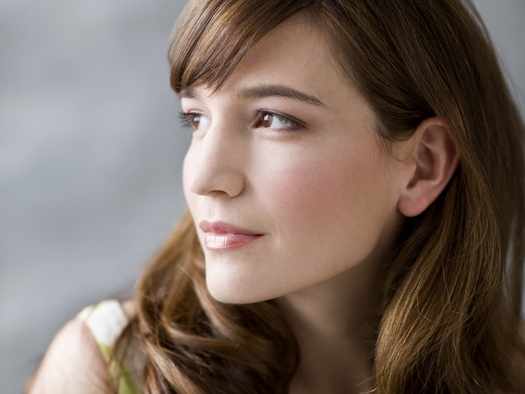
    December 23, 2011 – Today is the birthday of Mathilde Wesendonck (above) who wrote five poems which Richard Wagner set to music in 1857-1858; the cycle became known as the Wesendonck Lieder. At the time, Wagner and his wife Minna lived together in the Asyl, a small cottage on the estate of Otto Wesendonck, Mathilde’s husband. It is unclear whether Wagner and Mathilde actually had an intimate physical relationship but the composer certainly was infatuated with her, causing his mentally unstable wife to erupt in jealous fits.

    The poems themselves are wistful and dreamlike; their language reflects the emotional intensity of the Romantic style which by that time was highly developed. Wagner called two of the songs in the cycle “studies” for TRISTAN UND ISOLDE: in Träume we hear the roots of the love duet from the opera’s second act, and Im Treibhaus uses themes later developed in the prelude to Act 3. The chromatic-harmonic style of TRISTAN suffuses all five songs and creates the musical unity of the cycle.

    Wagner initially wrote the songs for female voice and piano alone, but later produced a fully orchestrated version of Träume, which was performed by a chamber orchestra under Mathilde’s window on the occasion of her birthday in 1857. The orchestration of the whole cycle was later completed by Felix Mottl, the famed Wagnerian conductor.

    Tiana Lemnitz sings the cycle’s opening song, Der Engel here.

    “An angel came down to me   
    on shining wings  
    and bore my spirit  heavenward.”

  • HANSEL & GRETEL at The Met

    KLsideshot

    Wednesday December 21, 2011 – The presence of a number of intriguing names in the cast (led by Kate Lindsey, above, as Hansel) drew me back to the Met’s dark and not very pleasing production of HANSEL & GRETEL which is playing during the holiday season. It’s a far cry from the Met’s older production with its fanciful gingerbread house and jolly, green-tongued witch, Rosina Daintymouth. In the current incarnation the characterizations of both the witch and the parents are based on infamous British serial killers. There’s little magic to be found visually…

    Met_Opera_Hansel_Gretel_31_medium

    …though a couple of nice images crop up here and there, like the phalanx of chefs (above) who serve a feast to the starving children. But for the most part the production is earthbound and lacking in fantasy.

    What drew us to see it again – in addition to the singers – was the music itself (Humperdinck greatly admired Wagner), as well as a conductor new to the Met podium: Robin Tacciati . He provided appealing orchestral textures all evening and his interpretation brimmed over with emotionally satisfying colours. Unfortunately, his first act seemed rushed and he often let the large orchestra overwhelm the voices.

    HanselGretel1112.06

    As the two children, Alexandra Kurzak and Kate Lindsey (above) entered fully into the demanding staging of the work which calls for lots of physicality, dancing and mime…and getting plastered from head to toe with foodstuffs from the witch’s kitchen. Kate was virtually slathered in pudding and jam, then plentifully dusted with cocoa and powdered sugar. Alexandra staggered around the set with a huge platter of melting chocolate cookies and a bowl of custard. She continues to sing while stuffing various sweets into her mouth. Sticky fingers? Who needs Mick Jagger? 

    Despite all the things they are called on to do and eat, both Alexandra and Kate managed to sing very well into the bargain. Alexandra’s voice has girlish, lyrical appeal and even though the orchestral volume forced her to push the voice in a couple of spots, her Gretel was very prettily sung, especially in her exquisite vocalizing of the famous prayer. Kate has one of the truly distinctive voices in the opera business these days and her singing is impeccably tailored, warm and clear. As hansel, she is a truly convincing boy onstage, expanding her repertory of trouser roles: her Cherubino and Nicklausse were perfect, her Siebel’s coming up, and I’m longing for her Octavian. But she shouldn’t spend her whole life in pants, she’s far too pretty: so I hope we will have her Rosina and Dorabella soon, and I’d love to see her as Berlioz’s Beatrice.
    HanselGretel1112.09

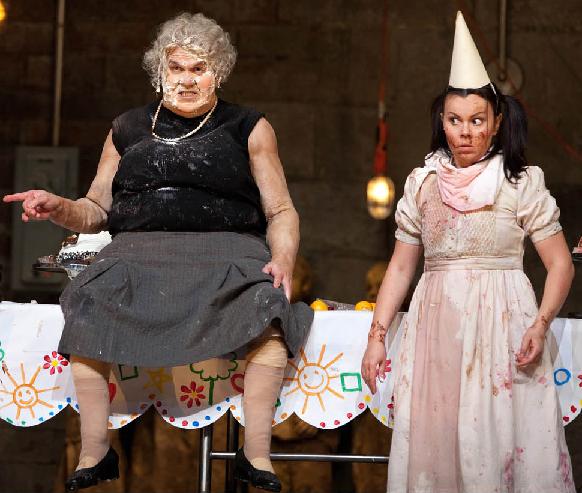
    Robert Brubaker, a teriffic Mime in SIEGFRIED at the Met a couple of seasons back, was a huge-voiced and creepy Witch. It’s so eerie to hear his voluminous character-tenor sound emanating from the frumpy old biddy in a fat-suit. Robert was superb and, like Kate and Alexandra, simply threw himself into the production’s food fantasy. Photo above: Robert Brubaker and Alexandra Kurzak.

    HanselGretel1112.02

    As the parents Peter and Gertrude, Dwayne Croft and Michaela Martens (above) excelled. They have authentic Met-size voices and took the waves of sound coming up from the pit in their stride. I’ve always loved Dwayne Croft’s voice since I first heard him as Puccini’s Marcello at Glimmerglass many moons ago. He sounded fabulous tonight. Dmitry and I are very fond of Ms. Martens and she sang with power and attractive tone as the desperate mother. If the Met management had any imagination, Michaela would be doing roles like Fricka, Venus, Brangaene and the Berlioz Cassandra here. I could even imagine her as a very fine Sieglinde.

    HanselGretel1112.07

    Ashley Emerson (above) was a delicious Dew Fairy, a petite elfin maiden with tiny Sylphide wings. Her singing was bright and light-filled, a perfect wake-up call. She carries on a tradition – both in-house and on recordings – of casting wonderful singers in the opera’s two cameo solo roles. Her evening counter-part was the Sandman of Jennifer Johnson Cano who sang very nicely indeed.

    The musical pleasures of the evening were offset by the overall drabness of the production. There were lots of empty seats throughout The Met so word must have gotten out that this is not a festive holiday treat with an underlying moral message but rather a grotesque take on a story and score which should be heart-warming but instead leaves us slightly nauseous.

    A major failure of stagecraft comes hear the end when the many children who had been under the witch’s spell are set free. The director apparently couldn’t think of any better way to handle this than to lower the curtain on an empty set and then bring it up again 30 seconds later on a stage filled with two dozen urchins. Then the uplifting melodic benediction launched by Peter as the work comes to an end failed to resonate because there was no context of religiosity anywhere else in the production.

    Act I takes place in a desolate kitchen where Hansel and Gretel seem like manic-depressives and where Gertrude is on the verge of committing suicide. The scene in the forest is instead set in a large empty hall with green-leaf wallpaper. It’s too dim, and nothing seems to be happening til the old Sandman and  – later – the chefs arrive. The witch’s kitchen is drably industrial and she is played like an over-the-top drag version of Julia Child, flingling flour and powdered chocolate all over the place. Candy, pudding and strawberry preserves are smeared on Hansel and Gretel, and Hansel is trussed up for roasting. The scene is vulgar and not funny in the least though it is broadly played. 

    The English translation is very Brit-oriented and, thanks largely to the over-enthusiastic conducting, much of it didn’t register. I’d like to see the Met dump this production and give us a more attractive, kid-friendly look at this opera. It should cast a Christmastime spell of hope and familial love; instead it only reminds us of the American knack for wasting food while children right here in Gotham don’t have enough to eat.

    Production photos: Mary Sohl/Metropolitan Opera.

    Metropolitan Opera House
    December 21, 2011
    In English

    HANSEL UND GRETEL
    Humperdinck

    Hansel..................Kate Lindsey
    Gretel..................Aleksandra Kurzak
    Gertrud.................Michaela Martens
    Peter...................Dwayne Croft
    Witch...................Robert Brubaker
    Sandman.................Jennifer Johnson Cano
    Dew Fairy...............Ashley Emerson

    Conductor...............Robin Ticciati

    The evening ended on a sweet note when I went backstage to see Kate and Ashley; I met both of them when they were in the Lindemann Young Artists Development Program at the Met and I’m very pleased to be following their successful careers. It was also nice to wish happy holidays to Michaela Martens and Dwayne Croft.

  • Gertrude Grob-Prandl

    Gertrude grob-prandl

    While I was working at Tower, I got into a discussion one day with my boss and a couple of the other ‘opera people’ who worked there. We were naming favorite singers and in one breath I mentioned Nilsson, Rysanek, Behrens and Dame Gwyneth Jones. “Oh, so you’re a size queen!”, Bryan laughed. Well, not really…since I also loved people like Reri Grist, Patricia Brooks, Lucia Popp and Kathleen Battle. But if you want to stereotype me, go right ahead: because I do love big voices.

    The four ‘loud ladies’ I mentioned above were among the largest voices I ever heard live. I guess Dame Gwyneth’s was the biggest of all though I’d also have to mention Angeles Gulin who, in a concert performance of LES HUGUENOTS at Carnegie Hall (1969) unleashed an enormous voice in Valentine’s music. But there was one voice, often described as the largest of all operatic voices in living memory, that for some reason I had never heard: that of the soprano Gertrude Grob-Prandl.

    Of course I’d heard people talking about her, and I read the article about her in Lanfranco Rasponi’s excellent book The Last Prima Donnas. But I’d never heard her sing a note until about a week ago when I was sampling different versions of Ortrud’s Invocation from LOHENGRIN on YouTube. Grob-Prandl’s rendition blew me away both in terms of the dimensions of the voice and the easy top.

    So I ordered a Myto recital disc by the soprano on which she sings music of Weber, Halevy, Meyerbeer, Wagner and Strauss and it’s all pretty glorious. Now I’m trying to locate her complete recording of TURANDOT. The voice does tend to go off-pitch slightly here and there, and a few notes take a split second to tonalize after she hits them – an endearing quality she shared with Leonie Rysanek.

    Grob-Prandl sings Isolde’s Narrative and Curse here.

  • Miro Magloire/New Chamber Ballet

    Copy of 12-2

    Friday June 24, 2011 – Miro Magloire and his New Chamber Ballet hold a unique place on the New York City dance scene. Performing works deeply rooted in classical ballet technique, NCB use an intimate studio setting to bring the viewer as close to dance as one can get. As a composer and musician, Miro puts an equal value on the music we experience at his performances: performed live by excellent musicians, we frequently hear works by contemporary composers that we might not otherwise get to know. 

    Miro’s troupe of ballerinas allow us not only to enjoy their individual dance-personalities up close but also to observe the technique of dancing on pointe in a way that can’t be grasped in the large venues where ABT and New York City Ballet perform. 

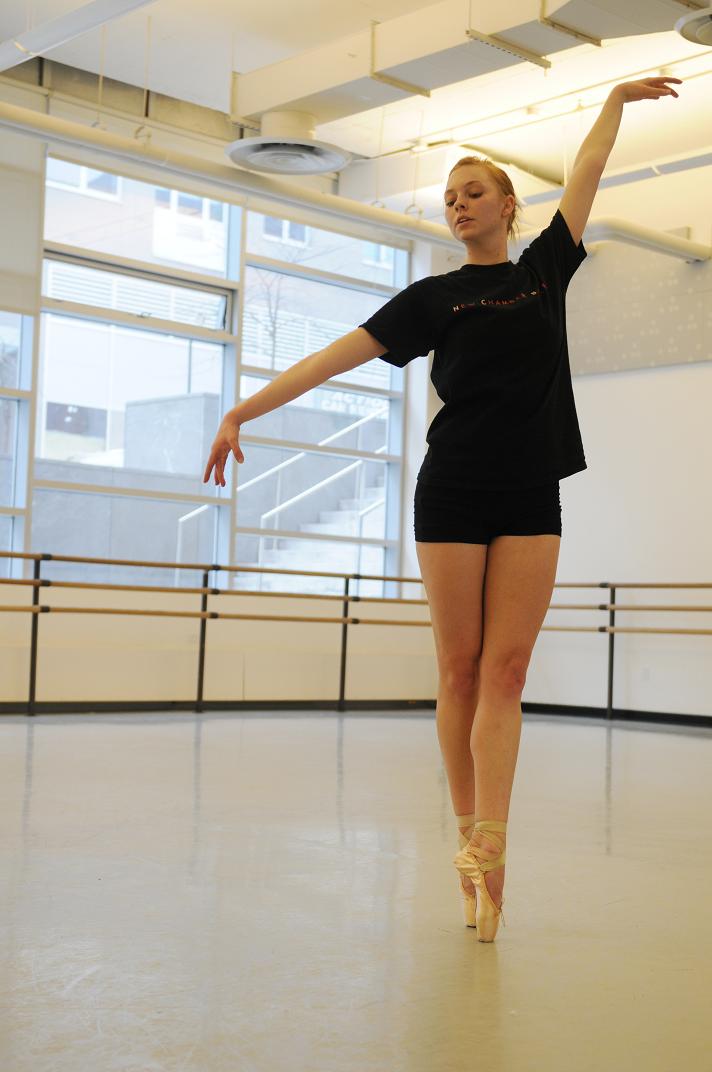
    Miro Magloire frequently re-visits his earlier works and brings them back with fresh details. Tonight’s opening THE GAME was originally developed under the title TABLE. Much of the piece looks as it did in the earlier version, but a deck of cards has been added giving a focus to the subtle combat between the two seated women. Madeline Deavenport and Katie Gibson (top photo by Kokyat) each periodically skitters away from the table to dance in jaggedly expressive phrases. Violinist Erik Carlson’s mastery of the Brian Ferneyhough score underlines the tension between the two players; Katie wins the game as the cards go flying across the studio space.

    Miro’s working on a new piece to Lucio Berio which will be shown in the Fall, In the meantime, pianist Melody Fader gave us a musical preview tonight, playing Leaf from Six Encores as a solo interlude.

    Lieder by Schubert, Schumann, Brahms and Wagner inspired LOVE SONG SOLOS, which premiered tonight. However, there is no singing involved. Instead Miro used the songs as a map, transcribing them for maracas (!) which he skilfully played himself. Who but Miro would imagine such a musical departure? But it works. Three dancers – Katie Gibson, Alexandra Blacker and Elizabeth Brown – each have a solo. They wear mossy green tunics by costumier Candice Thompson. Devoid of a literal story line, the dances nonetheless echo the emotional aspects of the original songs: passion, serenity, agitation and longing are conjured in movement. This unusual work gives each dancer ample expressive opportunity.

    Choreographer Emery LeCrone calls for sustained energy levels from three dancers – Lauren Toole, Victoria North and Maddie Deavenport – in CHAMBER DANCES. This three-movement work set to John Adams’ Road Movies propels the dancers thru in-sync trio passages with relesntless pacing. A calmer central movement gives way to more bursts of movement in the finale. Each girl has a solo in which Emery builds on individual attributes to give us a personal look at each dancer while never stinting on technical demands.

    A real workout for the threesome, CHAMBER DANCES signals Emery LeCrone’s ongoing ascent in the choreographic sphere. Earlier in the day, I got to watch another work that Emery is developing for the Guggenheim’s Work & Process series. More about that – with Matt Murphy photos – coming soon.

    Copy of 6-3

    Alexandra Blacker is a dancer Kokyat and I have really admired in her performances with New Chamber Ballet. This past January we just happened upon Alexandra working in the studio with Emery LeCrone and Deborah Wingert on the solo VIRTUOSA for New Chamber Ballet; that’s where Kokyat took the above photo. Alexandra will now be moving back to California; it’s been lovely getting to watch her in several works with NCB during this past season.

  • A Winter Sunday At the Met Museum

    P1170650

    Sunday January 30, 2011 – Met Kokyat at the Met Museum today. For some reason, depite huge crowds in general, certain galleries were rather quiet. We saw lots of things we hadn’t seen before. Above: Sleeping Muse (bronze 1910 by Constantine Brancusi).

    P1170557

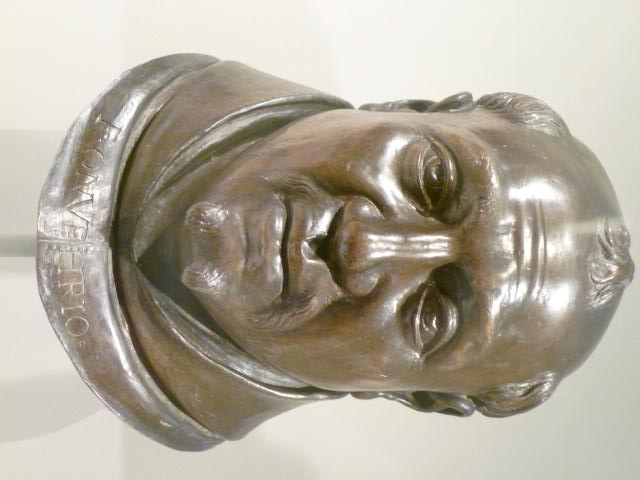
    Head of Brother Onufrio by Girolamo Campagna c. 1615-1620

    P1170560

    Madonna (detail from larger canvas) by Ettore Crivelli, late 15th century

    P1170563

    Back panel for a church choir stall, Mainz 1723-1736. This piece was a gift to the Met in 1952 from the great Wagnerian tenor Lauritz Melchior.

    P1170566

    Saint Mark, gilt wood Germany mid-18th century

    P1170575

    Winter, or La Frileuse, bronze by Jean-Antoine Houdon 1789.

    P1170581

    Lucretia by Philippe Bertrand c. 1700

    P1170602

    Portrait of a Woman, marble medallion by Henri, Baron de Triquenti 1850.

    I’ve put several images from today’s Met visit in a Facebook photo album here.