Tag: Ring Cycle

  • ASO ~ Gurre-Lieder @ Carnegie Hall

    Gurre 4

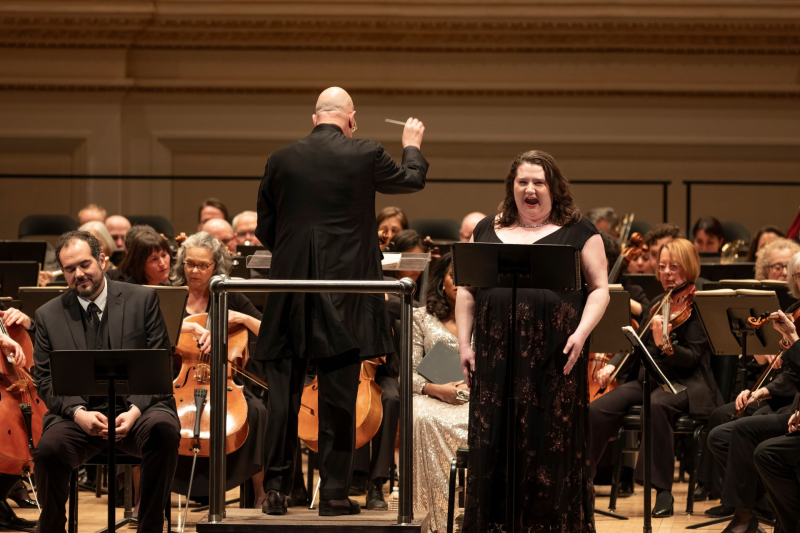
    Above: tenor Dominic Armstrong (seated), conductor Leon Botstein, and soprano Felicia Moore onstage at Carnegie Hall; photo by Matt Dine

    ~ Author: Ben Weaver

    Friday March 22nd, 2024 – Arnold Schoenberg’s gargantuan Gurre-Lieder, composed in 1900-03 (revised 1910-11), is unlike anything else in his catalog. With this lush and highly melodic work – for soloists, chorus and orchestra – he reached the ceiling of Romanticism and the only way out was to shatter it to smithereens. For Schoenberg, a mix of musical philosophy and observing the ravages of WWI signaled that music could not continue on the path laid out by his predecessors (Bach, Haydn, Mozart, Beethoven, Brahms, Wagner, etc. etc.) Schoenberg may have overreacted quite a bit, but, at a least with Gurre-Lieder, he left us with a grand finale of sorts to the excesses of 19th century music.

    Gurre-Lieder’s libretto is adapted from Jens Peter Jacobsen’s dramatic poem Gurresange, written in 1868. It tells the story of King Waldemar and his love for the beautiful Tove, who is murdered by Waldemar’s jealous wife. Enraged, Waldemar curses God and is condemned to roam every night on wild hunts with his ghostly vassals. Waldemar is redeemed with arrival of Spring, and he and Tove are reunited as they become one with nature. Performances of this work are extremely rare, no doubt because Schoenberg calls for more than 150 musicians, an extravagance few organizations can afford, and none can afford frequently.

    Part I opens with what Gabriel Adorno called “fairy land” music, a shimmering tapestry of harps, celesta, flutes, piccolo and some strings. Waldemar and Tove exchange declarations of love in extended monologues, set to ravishing Wagnerian and Straussian sounds.

    Tenor Dominic Armstrong (above) took on the – let’s face it – impossible role of Waldemar. Schoenberg wrote the part for at least three different voices; not many singers have been able to possess them all. This is a Tristan/Parsifal/Tannhäuser part, with Tamino thrown in for good measure. I honestly don’t know who can really sing all this in a live performance. Dominic Armstrong is a lyrical tenor with a strong top, but sadly the voice disappears in the lower registers. And conductor Leon Botstein was not very kind, allowing the orchestra to cover Mr. Armstrong all evening. Armstrong’s strongest moments were in the lighter passages; his best singing came late in Part 3, in his final aria “Mit Toves Stimme flüstert der Wald”, when Schoenberg’s orchestration relaxed, allowing Waldemar to finally emerge.

    Soprano Felicia Moore (above) possesses a large, blooming voice, that managed to break through the orchestral cacophony, in spite of an insensitive conductor. Her Tove was exotic and warm.

    Gurre 2

    Mezzo-soprano Krysty Swann (above, in a Matt Dine photo), as the Wood-Dove who describes the terrifying details of Tove’s murder, was exciting in her long monologue. The voice is large and steely, the vibrato a bit loose at the top, but Ms. Swann possessed an excellent sense of drama, managing to build to thrilling and hair-raising final moments of the Wood-Dove’s narrative.
    Gurre 3

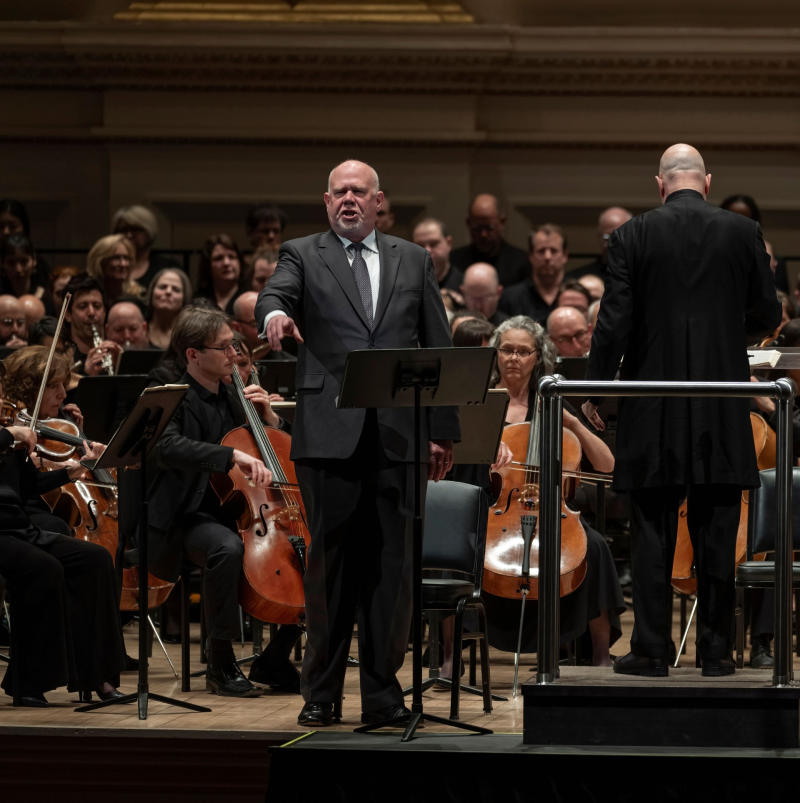
    Bass-baritone Alan Held (above, photo by Matt Dine) has been a favorite of mine for many years. Though it seemed like James Levine always kept Mr. Held back at the Metropolitan Opera, where he should have been singing Wotan among many other roles, I still vividly recall a searing Wozzeck Mr. Held sang at the Met in 2011. It was wonderful to hear him once again, his large voice easily filling Carnegie Hall as the Peasant who is terrified by Waldemar and his men’s nightly processions.

    Gurre

    Tenor Brenton Ryan (photo above by Matt Dine) was a very memorable Klaus the Jester, starting his long monologue from the house floor, then jumping on to the stage. Mr. Ryan possesses a strong, characterful tenor that made me think he might have been a better choice to sing Waldemar.

    And German bass-baritone Carsten Wittmoser was a magnificent Narrator, his crystal clear diction perfect for the sprechstimme part, which is usually given to older singers nearing retirement or even non-singer actors (Karl Maria Brandauer and Barbara Sukowa, for example.) So it was nice to hear a singer still in his prime take on this role.

    The American Symphony Orchestra was founded by Leopold Stokowski – who conducted the US Premiere of Gurre-Lieder in 1932, so it has a direct connection to this work, and they played quite beautifully, and certainly loudly. Here I must fault Leon Botstein for not being more considerate of his singers. Even the Bard Festival Chorale found itself drowned out by the orchestra, occasionally becoming just a mass of garbled sounds coming from somewhere at the back of the stage.

    Still, any live performance – flaws aside – of this supremely difficult work is was a special treat to be able to experience. How long before another performance is organized in New York City?

    ~ Ben Weaver

    Performance photos by Matt Dine, courtesy of Carnegie Hall

  • Ewa Podleś Has Passed Away

    Podles jpg

    The magnificent Polish contralto Ewa Podleś (above) passed away on January 19, 2024, at the age of 71. Hers was one of the most remarkable voices I ever heard, but ironically I only saw her live one time: she sang Mahler’s Kindertotenlieder with the American Symphony Orchestra under Leon Botstein’s baton at a concert given at Alice Tully Hall in 1999. 

    That evening, the Mahler cycle was the last thing on the program. Ms. Podleś walked onstage, a short and rather plump woman. She took a stance on the stage and, as, the music commenced, she tipped her head back slightly and began to pour the music forth as if from the depths of her soul. The richness of the voice, with its cavernous lower register, was like nothing else I had ever heard. For one magical half-hour, she had the audience completely under her spell. A the end, she took a couple of bows, nodding to us slightly.

    Back in those days, Alice Tully Hall still had its cozy greenroom, and I went there to greet Maestro Botstein and the evening’s two soloists: soprano Edith Wiens, and Ms. Podleś. Of course, I was too shy to say anything, so Ms. Podleś signed my program, and nodded to me with a slight smile. I will always recall that evening as one of the most profound musical experiences of my life.

    Aso 1999-1 jpg

    You can read all about the Podleś career here, and listen to her unique voice in Wagner…

    The Norns~GOTTERDAMMERUNG – Eva Podles – Stephanie Blythe – Margaret Jane Wray – Seattle 2006

    …and Rossini: 

    Ewa Podles – scena d’Arsace – SEMIRAMIDE

    And her monumental rendering of “Cara sposa” from Handel’s RINALDO can be savored here.

    Spoczywaj w pokoju, beloved Ewa.

  • My 1st Time Hearing DIE WALKURE

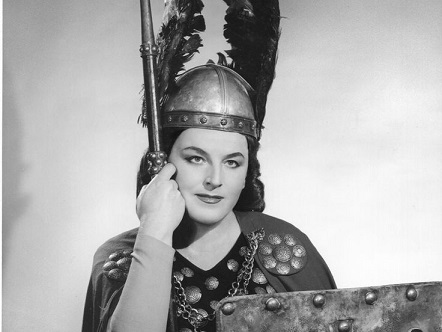
    Nilsson

    Above: Birgit Nilsson as Brunnhilde

    The Met’s 1961 broadcast of Wagner’s DIE WALKURE marked the first time I ever heard this opera which became, over time, my favorite of the composer’s operas. A recording of the broadcast was recently posted on YouTube. Listen here.

    I remember that some scenes seemed endless to me, and that while the music was at times very exciting, it was the story that most intrigued me…especially the ending, where Brunnhilde was left sleeping in the middle of a ring of magic fire.

    We had had a substantial snowfall the night before, and I went out to the field behind our house with the sound of the feuerzauber alive in my head. I made a circle of all the empty packing boxes and other trash from my father’s drugstore and set it afire. It was then that I realized I was in the center of the circle and would have to wait until the flames died down before I could escape. At supper, my mother scolded me for bringing a smokey smell into the house. It took a few days for the odor to dissipate.

    Metropolitan Opera House ~ December 23,1961

    Cast: Brünnhilde: Birgit Nilsson; Siegmund: Jon Vickers; Sieglinde: Gladys Kuchta; Wotan: Otto Edelmannl Fricka: Irene Dalis; Hunding: Ernst Wiemann; Gerhilde: Carlotta Ordassy; Grimgerde: Mary MacKenzie; Helmwige: Heidi Krall; Ortlinde: Martina Arroyo; Rossweisse: Margaret Roggero; Schwertleite: Gladys Kriese; Siegrune: Helen Vanni; Waltraute: Mignon Dunn

    Conductor: Erich Leinsdorf

  • Stephen Gould Has Passed Away

    Stephen gould

    It is very sad to read of the death of the American tenor Stephen Gould. Earlier in the summer, he had been diagnosed with bile duct cancer, and his demise was swift. 

    Born in 1962 in Virginia, Mr. Gould graduated from Olivet Nazarene University with a Bachelor of Arts in 1984.

    He first made a name for himself in music theatre, singing some 3,000 performances in Andrew Lloyd Webber’s musical, PHANTOM OF THE OPERA. Turning to opera, he developed into a formidable heldentenor.

    Among his signature Wagnerian roles were Siegfried, Tristan, Tannhäuser, and Parsifal; he also took on the arduous roles of Florestan, the Emperor in FRAU OHNE SCHATTEN, Bacchus, and Otello.

    Mr. Gould performed at the major opera houses of the world, including the the Wiener Staatsoper, the Bayreuth Festival, Bayerische Staatsoper, Teatro Massimo di Palermo, Berlin State Opera, and the Teatro dell’Opera di Roma.

    I first heard Stephen Gould on a radio broadcast of Wagner’s RING Cycle from the 2006 Bayreuth Festival. He was truly impressive, and his was the outstanding performance in the Cycle, conducted by Christian Thielemann.

    Finally, in November 2019, I had the chance to experience Mr. Gould’s singing live, when the National Symphony Orchestra offered a concert performance of Act II of TRISTAN UND ISOLDE under the baton of Gianandrea Noseda at Devid Geffen Hall. This was my reaction:

    “Veteran heldentenor Stephen Gould, now 57 years old and with years of singing opera’s most demanding tenor parts behind him, displayed a voice of prodigious power and tonal steadiness. He knows Tristan’s music so well, and he lives it fully. While his clarion singing rang amply thru the hall, he also has the tenderness of expression for “O sink hernieder, nacht der liebe…”  And as the act moves towards its devastating ending, Mr. Gould’s magnificent singing of the moving passage “Wohin nun Tristan scheidet,willst du, Isold’, ihm folgen?” (“Where Tristan now shall go, will you, Isolde, follow?”) carried us to that exalted place where a great Wagnerian singer can take us.”

    My friends who were at that performance with me were equally thrilled by Mr. Gould’s performance, and in the ensuing years his name would come up when we spoke of great performances we had witnessed. It speaks volumes when a singer can make such a memorable impression in a concert setting of single act of an opera.

    Listen to Stephen Gould in the final minutes of Act II of TRISTAN UND ISOLDE here.

    ~ Ruhe jetzt, geliebter Held.

  • TRISTAN UND ISOLDE ~ Chicago 1979

    Knie vickers

    Above: Roberta Knie as Isolde & Jon Vickers as Tristan; photo by Tony Romano

    A performance of Wagner’s TRISTAN UND ISOLDE given by Lyric Opera of Chicago in 1979. Franz-Paul Decker conducts, with the following cast:

    Tristan – Jon Vickers
    Isolde – Roberta Knie
    Brangaene – Mignon Dunn
    Marke – Hans Sotin
    Kurwenal – Siegmund Nimsgern
    Melot – Richard Versalle
    Shepherd – Gregory Kunde
    Steersman – Daniel McConnell
    Voice of a Young Sailor – William Mitchell

    Listen here.

  • Haitink Conducts DIE WALKURE ~ Act I

    Snapshot haitink

    Sir Bernard Haitink (above) conducts the first act of Wagner’s DIE WALKURE at a concert given by the Royal Concertgebouw Orchestra at Amsterdam on February 24th, 2008. The soloists are Eva-Maria Westbroek, Clifton Forbis, and Sir John Tomlinson.

    Watch and listen here.

  • Eve Gigliotti ~ Waltraute’s Narrative

    Eve g

    Mezzo-soprano Eve Gigliotti sings Waltraute’s Narrative from Wagner’s GOTTERDAMMERUNG with Kevin Korth, pianist.

    Watch and listen here.

    Ms. Gigliotti’s YouTube page includes several interesting items from her wide-ranging repertoire.

  • FLIEGENDE HOLLANDER ~ NYCO 1977

    Sarabia

    Above: Guillermo Sarabia as the Dutchman

    Audio-only performance of Wagner’s Der Fliegende Holländer performed at The New York City Opera in 1977, conducted by Julius Rudel, with the following cast:

    Holländer – Guillermo Sarabia
    Senta – Johanna Meier
    Daland – Ara Berberian
    Erik – Richard Taylor
    Mary – Diane Curry
    Steuermann – Jerold Siena

    Listen here.

    Ms. Meier, Ms. Curry, and Mr. Berberian were all great favorites of mine, and I saw Mr. Sarabia’s Dutchman twice: once in Houston and later in Springfield, Massachusetts. Mr. Siena sings the Steersman beautifully.

  • A New LOHENGRIN @ The Met

    Screenshot 2023-02-24 at 12-49-51 Videos

    Above: Piotr Beczala and Tamara Wilson in LOHENGRIN at The Met

    Author: Oberon

    Sunday February 26th, 2023 matinee – The premiere of a new production of Wagner’s LOHENGRIN at The Met; this marks the fourth production of this magnificent opera that I have experienced at The Met. My first encounter with the opera was in Wieland Wagner’s production in 1967 – a performance that featured the Met debut of the marvelous soprano Elisabeth Grümmer. In 1976, August Everding’s production – with designs by the great Ming Cho Lee – was first given; I saw it several times, with incredible singers like Rene Kollo, Placido Domingo, Pilar Lorengar, Mignon Dunn, Anna Tomowa-Sintow, Eva Marton, and Leonie Rysanek in the leading roles.

    In 1998, Ben Heppner and Deborah Voigt headlined the cast of Robert Wilson’s fascinating, stylized production; Karita Mattila and Rene Pape later sang Elsa and King Henry respectively in this production, and two very sharply contrasted but equally exciting tenors made their Met debuts in the title-role of the Wilson production: Johan Botha and Klaus Florian Vogt.

    This afternoon, director François Girard followed up his fascinating Met debut production of PARSIFAL with a LOHENGRIN that follows Parsifal’s son to the banks of the River Scheldt to protect the virtuous Elsa. With stunning sets by Tim Yip, this afternoon’s performance gathered together a strong cast whose hard work was sometimes nullified by Yannick Nézet-Séguin’s brassy conducting.

    In a large underground bunker in the ruins of a haunted castle near Antwerp, we find the people of Brabant huddled among the tree roots. Aside from the threat of the invading Hungarian forces, they are a community struggling with the disappearance of young Gottfried, whose sister Elsa is alleged to have killed the boy. In opposition to Elsa are Count Telramund and his sorceress-wife, Ortrud. The divided populace all wear black hooded cloaks which we soon find have colour-coded linings: green for the good guys, red for the baddies, and white for supporters of Elsa, who is either a murderess or a blameless virgin/victim. Throughout the opera, the populace open their capes to show where their loyalties lie; this unison ‘flashing’ gesture grew tiresome – even hilarious – over time.

    Joining the large Met chorus – who sang splendidly all afternoon – were a group of dance artists who performed in-sync stylized movements; among them, my beautiful friend Willy Laury brought his own personal magnetism to every gesture.

    LOHENGRIN is a big sing for the six principal artists; they need a very thoughtful and alert conductor at the helm to make the most of their magnificent music. But today, the singers were frequently jinxed by the blasts of sound coming up from the pit. In those climactic passages where the voices need cushioning support, the singers instead found themselves having to force their tone in order to stay afloat. This trend of ramping up the orchestral volume has been in frequent evidence this season where conductors like Armiliato, Rizzi, and Scapucci have sometimes seemed to have been on a joyride, using decibels to make the music more superficially “exciting”. In a Wagner opera, the balance between voices and orchestra is even more crucial; Nézet-Séguin should have learned this by now.

    Despite this imbalance, the orchestra played gorgeously, most especially in Elsa’s Procession to the Cathedral in Act II, where the featured wind soloists were especially lovely to hear. The prelude to Act III – where the orchestra has the music all to itself – was suitably grand; the director used this music for a solo pantomime for Christine Goerke’s vividly over-the-top (in a good way) Ortrud.

    Brian Mulligan’s noble, calming presence and expressive face, aligned to his warm and attractive voice, made the role of the Herald more prominent than is often the case. In this production, the character is not just an ‘announcer’ but also a confidante of the king. Mr. Mulligan was first-rate, despite having to cope with the onslaughts from the pit at times. 

    Günther Groissböck’s dignified King Henry was an excellent portrait of a leader who has come to this land with a purpose, only to find himself playing judge and jury in a local conflict. Mr. Groissböck is not a helden-basso, possessed, as he is, of a handsome lyrical timbre of ample power for this music…under normal circumstances. The brassy blasts arising from the pit did him no favors, but he held to his own, with much impressive vocalism.

    Yevgeny Nikitin as the sinister Telramund managed to out-shout the orchestra in a couple of spots, but it should not have been necessary; beyond that, he offered many creepily subtle passages. Sparks flew in his scene with Ortrud at the start of Act II, which was one of the highlights of the afternoon…in part because the orchestra playing here was thoroughly supportive. Later in the act, as the wedding procession began to move onward, Nikitin’s Telramund stepped out of the crowd and menaced Elsa to striking effect.

    Having seen several marvelous Elsas in my day – in addition to those named above, there were Sabine Hass and Arlene Saunders – this afternoon I was happy to add Tamara Wilson to the list. This soprano, whose Met debut as Aida in 2014 was superb, should be singing here far more frequently. She has a house-filling sound, grounded in lyricism, with an appealing vulnerable streak to her timbre, and high notes that can soar or float at will. Her ‘dream’ aria in Act I and her Song to the Breezes in Act II were vocal highlights of the afternoon, and in her Act II confrontation with Ortrud, Ms. Wilson and Christine Goerke made sparks fly. Ms. Goerke first backed her victim all the way across the stage, taunting the would-be bride menacingly. But Ms. Wilson summoned Elsa’s courage, and turned the tables: soon it was Goerke who was retreating as Wilson advanced. The agitated strings that provide the undercurrent for this encounter gave perfect support. Tamara Wilson went on to sing thrillingly in the bridal chamber scene, and she was given a spirited ovation at her bows. 

    Goerke ortrud

    You’ve got to love Christine Goerke’s Ortrud. Although in recent seasons her top register has become unreliable, the sheer force of her personality and the inherent power of her singing can work wonders. In the span of a few weeks, she has given us an incredibly touching Madame Lidoine in DIALOGUES DES CARMELITES and has now turned in an epic Ortrud, suitably grand-scale theatrically, and vocally firing on all cylinders, despite the random stray note.

    In this production, Ortrud appears during the prelude: a silent and imposing figure with red hair, clad all in blood-red and gold. The character has little to sing in Act I, but Goerke made Act II all about Ortrud. First comes the tremendous duet with Telramund, in which the Goerke voice simply dripped with evil intent and conniving insinuation; this is followed soon enough by her deceitful, servile plea to Elsa to grant her amnesty. Waiting for Elsa to descend from her balcony, Goerke launches Ortrud’s diabolical invocation to the pagan gods. Sung with blistering passion and commitment, Goerke made a meal out of it, sustaining the climatic passage with fierce intensity. In the ensuing duet, Ortrud eventually wins Elsa over, and they harmonize in an almost bel canto passage, leaving the orchestra to take up the gorgeous melody (my favorite part of the entire score) as they enter the castle. In the later confrontation between the two women before the wedding ceremony, mentioned above, Goerke showed off some chesty resonances.

    Ms. Goerke entered spiritedly into M. Girard’s somewhat hokey mime scene for Ortrud at the start of Act III: preening herself whilst casting spells to destroy the marriage of Elsa and Lohengrin, Goerke seemed larger than life.

    Enjoying a huge and well-deserved triumph, the Polish tenor Piotr Beczala was everything you want in a Lohengrin, and more. As if arriving out of a time warp, the character is clad in contemporary style: white shirt and black trousers. From note one, Mr. Beczala’s expressive singing seemed made for role of the mysterious visitor. Hauntingly lyrical, with refined piano turns of phrase woven in, he put me in mind of Nicolai Gedda’s only Wagnerian excursion. Every word and note seemed to mean something to the tenor, and his handsome presence made him as appealing to watch as to hear. Especially pleasing was his singing in the bridal chamber scene, blending timbres luminously with Ms. Wilson. Mr. Beczala then rose beautifully to the demands of the opera’s finale, where “In fernem land” and the poignant tenderness of “Mein lieber Schwan!” were so beautifully voiced. It was a thrill to hear (and to be part of) the massive wave of applause and cheers that greeted the tenor’s solo bow.

    As the ovation continued, there were boos for the production team; this was understandable – even inevitable – I suppose, yet overall it was an inoffensive and at times engaging take on the opera.

    Watch the final ovation and curtain calls here.

    ~ Oberon

  • Stutzmann/Weilerstein/NY Philharmonic

    Stutzmann

    Author: Ben Weaver

    Thursday February 23rd, 2023 – For many years,  Nathalie Stutzmann (photo above) has been a highly accomplished singer, with numerous operatic and lieder recordings under her belt, and many awards, too. In recent years she has begun to spend more time on the conductor’s podium. I am always skeptical of performers transitioning to conducting because these are all highly specialized crafts. There have, certainly, been many extremely successful switch-overs, but mostly coming from the instrumentalist sides (people like Vladimir Ashkenazy and Christoph Eschenbach come to mind). It’s rare for singers to make the jump, and while someone like Plácido Domingo has conducted many operas over decades, he has never become more than passable in the pit. Which brings me back to Nathalie Stutzmann, who made her New York Philharmonic debut with these concerts, conducting a varied program of Wagner, Prokofiev, and Dvořák. Based on what I heard, Maestro Stutzmann is a phenomenal musician and she would have been a far more interesting new Artistic Director for the Philharmonic than the flashy but vapid Gustavo Dudamel.

    The concert opened with a superb overture to Wagner’s Tannhäuser – an opera Stutzmann will conduct at the Bayreuth Festival this summer. The mournful strings that open the work were lovingly molded as the drama built, the Philharmonic’s wonderful string section matching Stutzmann’s passion at every step. The rock solid wall of horns, trombones, and tuba was heavenly. Appearance of Venus had a magical, light sound that – perhaps for the first time for me – sounded like a Mendelssohn fairy got lost in Wagnerland. The explosive, thrilling climax of the work brought down the house. I suspect Maestro Stutzmann’s Tannhäuser in Bayreuth will be very special indeed.

    Weilerstein jpg

    Above: Alisa Weilerstein

    One of my favorite musicians, cellist Alisa Weilerstein (in a glorious red pantsuit) played Prokofiev’s Sinfonia concertante, Op. 125. Composed for (and with the help of) a very young Mstislav Rostropovich, this is a supremely difficult piece, which posed no difficulties for Weilerstein. The playful opening – like a ticking clock – is echt Prokofiev, and the cello enters almost immediately. Weilerstein’s gorgeous, mellow, glowing tone is always a balm to the ear. Even the crazed, breathless opening of the second movement sounded like the most romantic love song. Weilerstein’s passion and commitment never wavered; even when not playing, she gently swayed to the music. Prokofiev’s kaleidoscopic music – sweepingly romantic one moment, mockingly blowzy the next – can be tricky to navigate, but Weilerstein and Stutzmann had a deep connection and made everything whole. Stutzmann’s history of singing for conductors no doubt make her deeply sensitive to her soloists. She was careful to let Weilerstein room to breathe and to never let the orchestra overpower the cello. I hope Weilerstein and Stutzmann enjoyed working together because they make wonderful, deeply sympathetic music together; may their partnership continue and grow.

    Antonin Dvořák’s Symphony No. 9 in E-minor, Op. 95 (subtitled hastily by the composer “From the New World” as he handed the score off to be copied for the world premiere performance by the NY Philharmonic in 1893) is easily one of the most standard works in the classical repertoire: a warhorse as popular as Beethoven’s  5th and Tchaikovsky’s Nutcracker. It’s easy to get jaded and cynical, and roll our eyes when another performance is on the program. These works can be played by any orchestra with their eyes closed, and the audience will dutifully applaud. But sometimes you hear a performance that makes you sit up and rethink your cynicism, and reevaluate why these works are warhorses in the first place. It’s not pure chance that some of these compositions have been played more than others, and will continue to be played.

    This evening’s performance of Dvořák’s 9th was such a performance: Maestro Stutzmann led a revelatory, fresh, thrilling interpretation of a work we’ve all heard countless times. She struck a perfect balance between embracing the familiarity of the melodies while not lingering on them for their own sake. Harking back to Mendelssohn’s fairies dropping in on Wagner’s Tannhäuser, many moments of Dvořák symphony sounded like his beloved Slavonic Dances of decades earlier, effortlessly swirling and swaying. The second movement was perhaps the most wonderful music making of the evening from all involved. It’s chamber music-like orchestration, with small sections of the orchestra handing off music to one another, was wondrously coordinated. I was reminded of that famous speech Salieri delivers in Peter Shaffer’s “Amadeus” about Mozart’s Serenade for Thirteen Wind Instruments: “A single note, hanging there, unwavering. Until a clarinet took it over, sweetened it into a phrase of such delight!” That’s what the entire Largo felt like tonight: every note being sweetened into phrases of delight. The opening notes of the final movement have never sounded more like the theme from “Jaws” (wouldn’t be even a little bit surprised if that’s where John Williams got the idea considering how many of his ideas were directly lifted from existing works). The swirling rhythms and melodies have seldom sounded this fresh and exhilarating.

    The ovation that greeted the performance was huge, people leaving the theater were buzzing about the debuting conductor. I hope we see and hear much more of Maestro Stutzmann at David Geffen Hall.

    ~ Ben Weaver