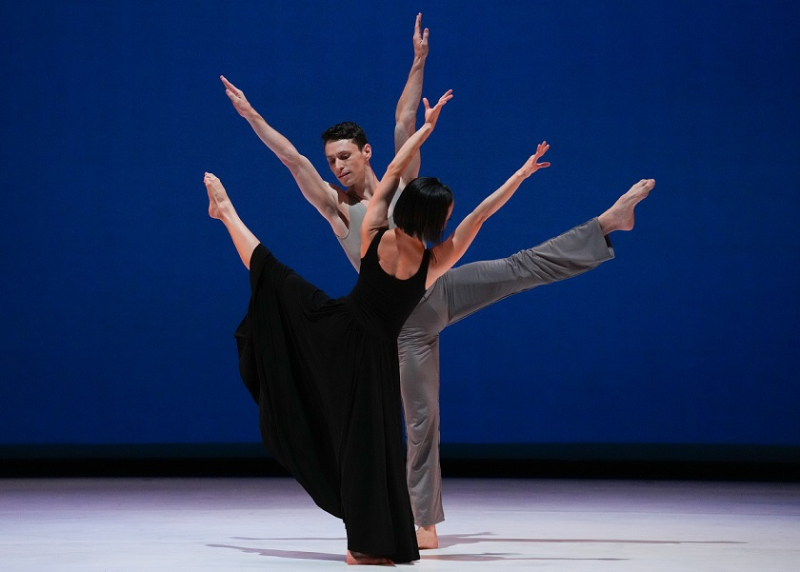
Above: John Harnage and Madelyn Ho in Paul Taylor’s Roses; photo by Steven Pisano
~ Author: Oberon
(Click on each image to enlarge…)
Wednesday March 24th, 2022 – Opening night of the Paul Taylor Dance Company‘s 2022 season at City Center. Two Taylor masterworks book-ended the program, with a premiere by the Company’s recently-designated Resident Choreographer, former New York City Ballet principal ballerina Lauren Lovette, in between.
This was my first time seeing the Company since several popular Taylor stars left, starting with Michael Trusnovec and followed by Laura Halzack, Parisa Khobdeh, Michelle Fleet, Jamie Rae Walker, Heather McGinley, James Samson, Robert Kleinendorst, and Sean Mahoney. Incoming new dancers were just getting their feet wet two years ago when the pandemic caused a prolonged pause in their progress. So, for me, tonight was a reunion and a re-discovery.
As an ardent admirer of the music of Richard Wagner, Paul Taylor’s Roses is one of my favorites among his numerous masterworks. It moves me so deeply each time I see it…and hear it. The story of the first performance of Wagner’s Siegfried Idyll, played on the staircase at Villa Tribschen on the morning of December 25, 1870, by a small chamber orchestra, is one of my favorite tales out of musical history. It was the composer’s birthday and Christmas gift to his beloved Cosima, and marked one of the happiest days of their life together. You can read about it here.
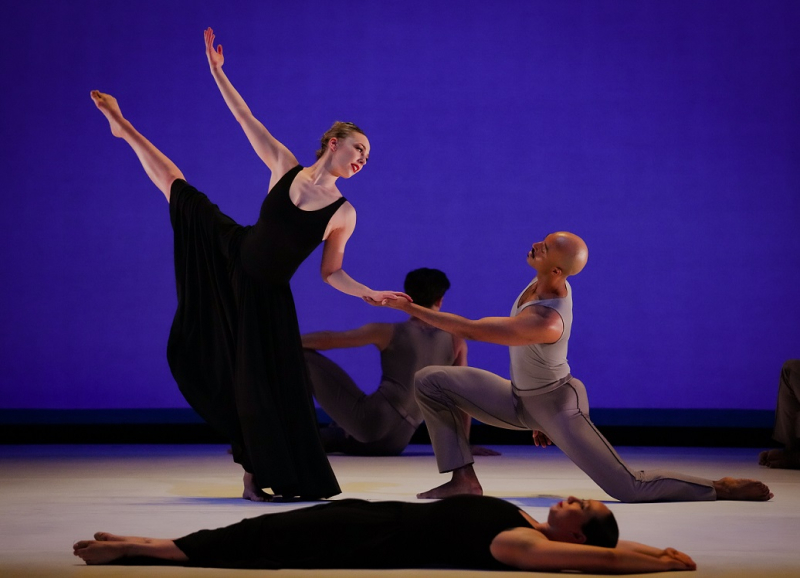
Above: Jessica Ferretti and Shawn Lesniak in Roses; photo by Steven Pisano
Roses opens with five couples onstage, the women in long black gowns. The pairings tonight were: Jessica Ferretti with Shawn Lesniak, Christina Lynch Markham with Jake Vincent, Raechelle Manalo with Alex Clayton, Madelyn Ho with John Harnage, and Kristin Draucker with Michael Apuzzo. Watching these beautiful creatures in a series of duets summoned many emotions in me – all of them warm and reassuring – for they are the future of the Paul Taylor Dance Company, and that future is in good hands. All these dancers radiated confidence, and their performances were suffused with poetry and light. The audience took a special liking to Ms. Ho and Mr. Harnage…understandably: they were superb.
As the Siegfried Idyll reaches its end, we have found a place of tranquility in an ever-darkening world; the music and dancing have nourished the spirit, and one cannot imagine that anything more beautiful and poignant could possibly follow it. But then Jada Pearman and Lee Duveneck, clad in pristine white, appear to dance one of the most entrancing of Paul Taylor’s duets. Set to a score by Heinrich Baermann which features a clarinet solo played sublimely by the Orchestra of St. Luke’s inimitable Jon Manasse, this pas de deux had a particularly hypnotic effect tonight. Mr. Duveneck towers over the petite and radiant Ms. Pearman, his partnering so protective and tender, and her dancing a vision of grace. The five couples remain seated on the floor at the rear of the stage during this duet, keeping echoes of the Siegfried Idyll in our consciousness. A genuine “Taylor ovation” greeted the dancers during their bows.
Anticipating Ms. Lovette’s new work, I was pleased to read of her choice of music, and intrigued by the piece’s title: Pentimento. I first discovered the music of the Argentine composer Alberto Ginastera many years ago when a pianist I was dating played some of it for me on his baby grand, which took up most of the space in his little studio apartment. “Pentimento” is an Italian word meaning repentance; in the art world, it refers to a painter’s regret when a piece he is working on does not come out quite as he wanted it to; he paints over and re-uses the canvas, but with the passing of time, the original picture may bleed thru, causing a ghostly image.

Above: Lee Duveneck and the ensemble in Lauren Lovette’s Pentimento; photo by Whitney Brown
My expectations for the Lovette work were high, and the opening moments, with the dancers in silhouette against a glowing backdrop, boded well. Christina Lynch Markham, her hair down, has a dramatic solo passage which finds her in a state of worry and agitation; she clutches a red scarf as she dances…and finally collapses. Now the scarf will be passed from dancer to dancer, each one having a featured solo amidst the ensemble. Thus we watched the lively Lisa Borres, a tormented Jada Pearman (who emits a scream at one point), the willowly and wonderful Maria Ambrose, the pale and somewhat mysterious Lee Duveneck, and the bold and beautiful Devon Louis being put thru their paces.
Clad in dreary costumes that might have come off the racks at Old Navy, the community perform athletic combinations, with Tayloresque gestures; they roll about on the floor, form brief alliances, strike quirky poses, and gather – with expressions of care and concern – to watch their colleagues go thru the motions. Meanwhile, the Ginastera music, not his best by far, has become sort of an after-thought. My mind started to wander; the audience, so engrossed by Roses, began to get restive.
Pentimento was well-received, but during the intermission I could not sense the sort of buzz that usually follows a premiere. I suppose having your new work debuted between two classics by one of the great choreographers of all time would be somewhat daunting. We shall see where this collaboration goes in the future.
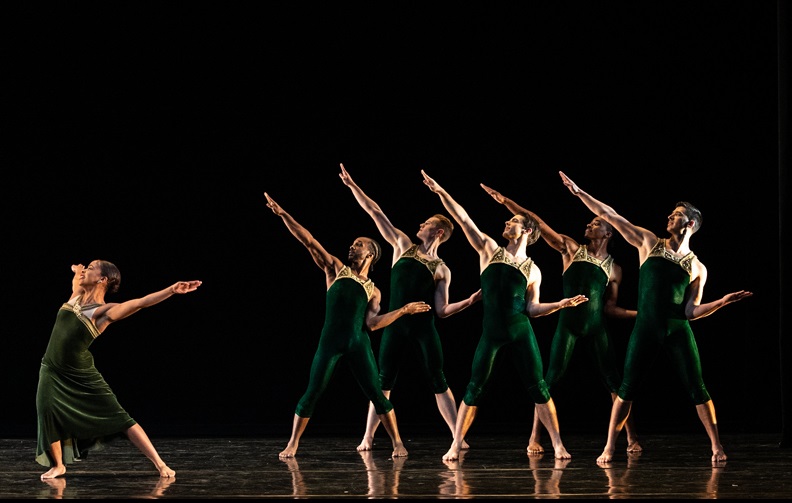
Above: Jada Pearman and the Taylor men in Brandenburgs; photo by Ron Thiele
Paul Taylor’s festive Brandenburgs, to the immortal music of Johann Sebastian Bach, made for a perfect end to the evening. Tonight, the ballet looked as fresh and vibrant as it ever has…and that music! The magnificent Taylor dancers soar on the wings of Bach’s score; they inspire and uplift us at a time when hope and joy are in short supply.

Above: John Harnage and Maria Ambrose in Brandenburgs with Madelyn Ho and Jada Pearman kneeling; photo by Ron Thiele
The male ensemble – Lee Duveneck, Alex Clayton, Devon Louis, Adam Dickerson, and Jake Vincent – race about the stage in trademark Taylor patterns. Blindingly handsome and charismatic, John Harnage held the audience in the palm of his hand simply by being there. His dancing is so clear and so poetic. And later – standing stock still as he watches his three muses (Maria Ambrose, Jada Pearman, and Madelyn Ho) dance solos to dazzle him – he looked like a young god. Mr. Harnage’s adagio pas seul, was a portrait of masculine beauty. Then Brandenburgs sweeps onward to its final pose: an uplifting celebration of music and dance, and of the human spirit.
Danceworld luminaries among the audience included Justin Peck, Troy Schumacher, Damian Woetzel, and Edward Villella.
All photos by the credited photographers, courtesy of Paul Taylor Dance Company. Many thanks to the Company’s wonderful press liaison de luxe, Lisa Labrado.
~ Oberon







 Oberon's Glade