
Above: tenor Alex Kim
I like this Korean tenor’s lyrical rendering of the Prize Song from Wagner’s DIE MEISTERSINGER.
Above: tenor Alex Kim
I like this Korean tenor’s lyrical rendering of the Prize Song from Wagner’s DIE MEISTERSINGER.
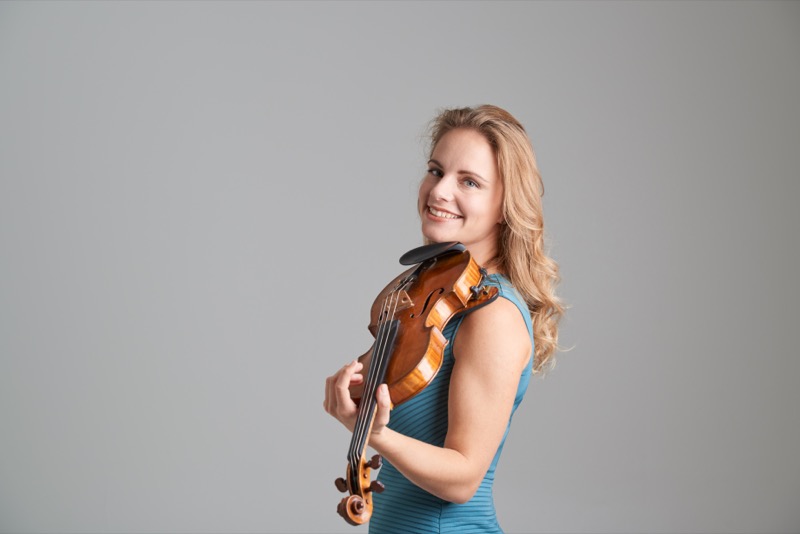
Above: violinist Julia Fischer
~ Author: Oberon
Wednesday October 30th, 2019 – Philippe Jordan was on the podium at Geffen Hall this evening as The New York Philharmonic presented their program of Prokofiev, Mendelssohn, and Beethoven: an ideal mix, in my opinion. The comely and compelling violinist Julia Fischer was the guest soloist for Mendelssohn’s violin concerto, the orchestra’s stellar woodwind soloists were all present and accounted for, and the entire evening had a special glow about it.
Prokofiev’s Symphony No. 1, Classical, strikes me as a perfect piece of music. At a running time of just 15 minutes, the symphony is a compact delight, abounding in rhythmic variety and appealing themes. The opening Allegro con brio is in the traditional sonata form, but the composer keeps throwing us curve balls: witty bits crop up out of nowhere. Maestro Jordan and the Philharmonic artists seemed truly to enjoy playing this music, which, in the flashing leaps and zesty grace notes of the second theme made me smile to myself.
A gentle melody on high for the violins is the key feature of the Larghetto, with pizzicati, treading basses, and colourful bassoons all part of the composer’s scheme. The Gavotte makes me think of the composer’s ROMEO AND JULIET, while the ebullient finale sounded wonderfully clear and alive. Throughout, flautist Robert Langevin, clarinetists Anthony McGill and Pascual Martínez-Forteza, oboist Sherry Sylar, bassoonist Judith LeClair, and their woodwind-section colleagues charmed the ear with their polished playing; when Maestro Jordan asked them to stand for a bow, the audience responded warmly.
Violinist Julia Fischer then joined the orchestra for Mendelssohn’s Violin Concerto in E-minor. This was my first opportunity to hear Ms. Fischer playing live; she sounded marvelous and looked fetching is a deep grey gown shot thru with glimmering silver. There’s shining silver in her sleek tone as well.
The first movement’s marking of Allegro molto appassionato derives from the composer’s premonition of writing “…[A concerto] in E-minor running through my head, the beginning of which gives me no peace.” With splendid support from the orchestra, Ms. Fischer displayed her expressive gifts, lovely feeling for dynamics, and exquisite control of pianissimo. In the cadenza, her soft playing in the stratosphere was remarkable; this she followed with a rocking motif as the ensemble take up the theme. The music becomes very animated as the Allegro moves to its finish.
A sustained bassoon tone carries the music directly into the Andante wherein the glowing melody is given a tender, haunting quality as Ms. Fischer’s playing moves serenely from piano to pianissimo: simply breathtaking
Following a brief interlude, the violinist embarks on festoons of fiorature – played with sparkling surety – in the concerto’s concluding movement. Passages of Mendessohnian ‘faerie music’ are heard, and then Ms. Fischer revels in the rapid-bowing of the effervescent finale. With the final note of the concerto still hanging on the air, the audience unleashed a tumultuous applause, and everyone stood up to cheer. Ms. Fischer and Maestro Jordan are clearly simpatico, and their performance was thrilling. The crowd clearly wanted an encore, but none was forthcoming.

Above: Maestro Philippe Jordan
The concluding work, Beethoven’s 7th symphony, was magnificently shaped by the Maestro, who dips and bends into the music, eliciting splendid playing from the orchestra. This symphony has a dance-like sense of forward momentum upon which Mssr Jordan built his interpretation. His pacing – on the fast side – was so vital, and the textures of the music so lovingly layered, with the wind soloists again producing magical effects.
Swept along by the music, I put away my pen and indulged myself in forty minutes of pure selfish enjoyment. One small and intriguing motif in this symphony that always captures my imagination is a seeming “preview” of six-note passage from the Grail knights’ march in Wagner’s PARSIFAL music. Did Wagner openly borrow this from Beethoven, or is it a subconscious association? Either way, it played over and over in my mind during the train ride home.
This has so far been a particularly impressive and satisfying season for classical music here in Gotham, and tonight’s concert was yet another edifying experience.
~ Oberon

Above, the Miró Quartet: Daniel Ching and William Fedkenheuer (violins), Joshua Grindele (cello), and John Largess (viola). Photo by Naova Ikegami.
~ Author: Oberon
Thursday October 25th, 2019 – For their concert at Weill Hall this evening, the Miró Quartet honored the history of string quartet performance in America by replicating a program performed by the country’s first professional touring string quartet – the Kneisel Quartet – over a hundred years ago.
Franz Kneisel, then concertmaster of the Boston Symphony Orchestra, founded his quartet in 1885. The program offered tonight by the Miró was first performed by the Kneisel in 1910 during the Kneisel Quartet’s 25th anniversary season. The Miró Quartet are celebrating their own 25th anniversary this season, so the connection has layers of meaning.
The first half of tonight’s concert was beset with extraneous distractions; following an over-long interval, the Miró took the chill off a hall that had become frigid due to A/C overload with their sizzling performance of Schubert’s Death and the Maiden.
Mozart’s “Hunt” quartet, K.458, opened the evening. The Miró’s violinists faced one another, with the cellist and violist in the middle. Right from the music’s joyous start, a wonderful vitality could be felt in the quartet’s music-making. Daniel Ching’s trill tickled the ear, and a five-note motif was passed from player to player with wit and sparkle. A gracious interlude and a paragraph in the minor key were so persuasively delivered.
The cordial mood the Miró had established was then spoilt by late seating. It took a while for things to re-settle in the hall. There were more latecomers allowed in later. Very distracting.
The Menuetto: Moderato profited from lovely depth of tone from each player. The ensuing Adagio has the feel of a melancholy bel canto aria, with a tender melody sung first by the violin and then taken up by the cello. As the movement continued, with exquisite playing from Mr. Ching, the sound of quiet snoring crept into our collective consciousness. I could not tell if the players could hear it or not. At any rate, they carried on with the sprightly start of the final Allegro assai, the cellist reveling in his rich tone, everything lively and appealing.

The opening Allegro drew vibrant playing from the Miró. The individuality of the players’ respective timbres achieves a surprisingly coherent, compelling blend: they make this familiar music sound fresh – and what more can we ask? Their rhythmic surety and variety of dynamics make their playing irresistible.
The sublime Andante con moto, which introduces the doleful “Death” theme, moved me deeply with its air of hushed lamenting. The emotional ebb and flow of this movement seemed to well up from Mr. Gindele’s richly resonant cello, suffusing the whole with a spiritual glow.
The Scherzo is quite brief; we don’t know if Wagner intentionally lifted one rhythmic motif here to serve as a leitmotif for Nibelheim in his opera DAS RHEINGOLD, but it always gives me a smile.
Now the finale is reached, with Mr. Ching festooning the music with precise filigree over the passion and drive of his colleagues’ playing. A high-velocity rush suddenly shifts into hyper-gear as the music careens almost recklessly to its end.
Playing at the peak of their powers, the dazzling Miró artists turned the concluding Presto into the crowning glory of this outstanding musical experience. Though “death’ is in the work’s title, the word I kept scrawling in my notes about the Miró’s playing was: “…alive..!”
~ Oberon
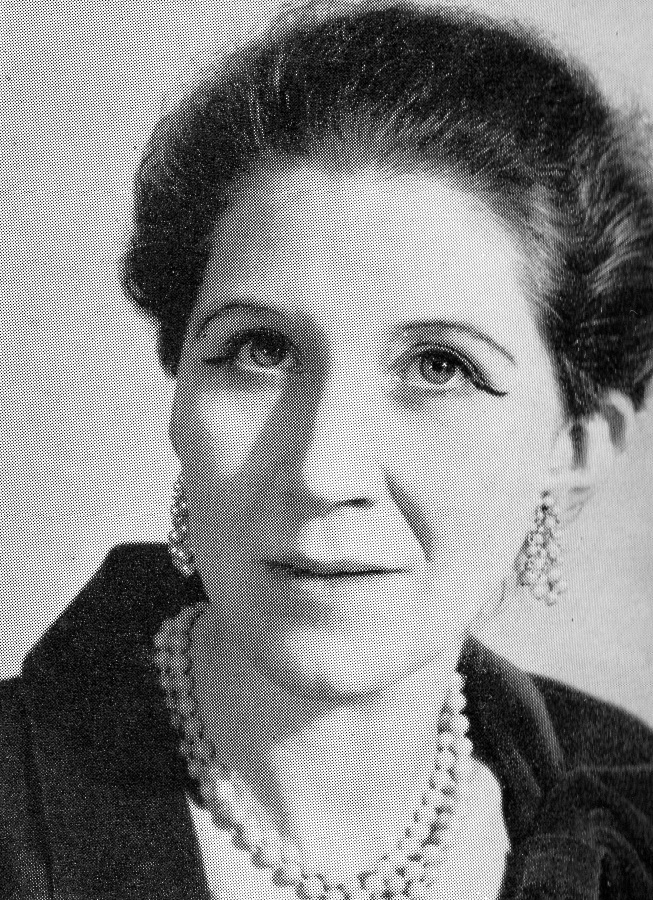
Penelope Turing (above) was an Englishwoman who attended the second post-war Bayreuth Festival in 1952, returning to the Green Hill for many seasons thereafter. She continued to attend performances thru the Summer of 2009, and she passed away in 2010.
Turing’s book, New Bayreuth, was first published in 1969. It is full of detailed writing about both the scenic and the musical aspects of the productions she saw there over her first seventeen years of attending the Festival, commencing – in 1952 – with DAS RHEINGOLD, in Wieland Wagner’s ground-breaking production which had premiered the Summer before.
Turing’s writing about the voices and characterizations of the eminent singers who appeared in those first post-war festivals is fascinating to read.
Her descriptions are so evocative. Of curtain-rise for the Wieland Wagner PARSIFAL, which had been introduced in 1951, Turing writes: “According to the score, the scene is a glade in a solemn, shady forest in the domain of the Grail. In what we saw, however, there was no forest definable, nor even a tree. We felt the forest rather than saw it: a legendary forest that was of no time and no place, and one, moreover, over which mystery and sorrow and pain seemed to have brooded long.”
After reading that, on page 6, I was hooked on Turing’s book, and have been barely able to put it down. Turing’s writing is free of ‘intellectual’ blather, theories, and nit-picking. She writes about what she saw and what she heard, and how she felt about it all.

The book contains many black-and-white photos from those years: of the iconic productions, and of the fabled singers who appeared in them; of the Festspielhaus, and of the town of Bayreuth. These produce a feeling of nostalgia for a place I’ve – unfortunately – never been.
But there’s another reason I’m so captivated by the book. As I so often do, I bought New Bayreuth in a used, hardcover edition via Alibris. Used books invariably have a life of their own, and, opening it for the first time, I found this inscription:
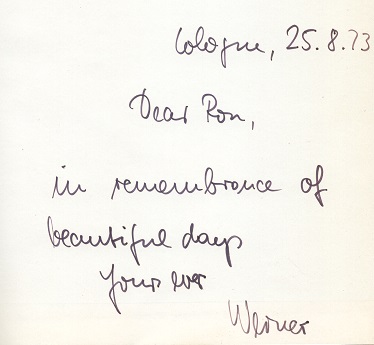
Who were Ron and Werner? Were they lovers? Had they gone to Bayreuth together, or did they perhaps meet one another there? Are they still alive? My guess would be: probably not.
But now their book has come down to me, and it is intriguing in so many ways.
~ Oberon

Tatiana Troyanos made her Met debut as Octavian in DER ROSENKAVALIER in 1977. But I had had the incredible opportunity to see her on the Met stage ten years earlier, when she sang Baba the Turk in a remarkable performance of Stravinsky’s THE RAKE’S PROGRESS given by the visiting Hamburg State Opera for the Lincoln Center Festival in 1967. I was 19 years old and obsessed with opera.

A few days after the performance, I sent Tatiana Troyanos a fan letter in care of the Hamburg State Opera. Soon after, an envelope arrived in our family mailbox in Hannibal, New York:
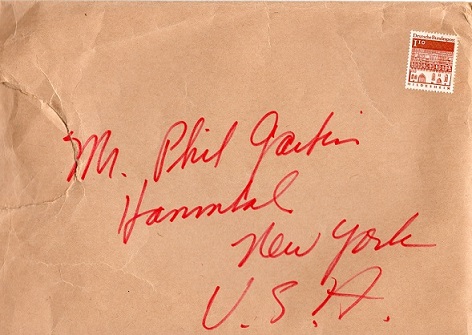
This was in the pre-zip code era; there was no return address, but the German postage stamp (with no cancellation) provided a clue. Inside was the signed photo from Troyanos that appears at the top of this article. Scanning these beautiful souvenirs was genuinely moving to me: these were things Tatiana held in her hands, and undoubtedly she signed, sealed, and delivered this to the post office herself. (So cute that she ran out of space when signing her name!)
Troyanos had sung in the chorus of nuns in THE SOUND OF MUSIC on Broadway before spending two seasons with New York City Opera. Then, in 1965, she traveled to Europe, auditioned successfully for three companies, and chose to join the Hamburg State Opera, where she remained (first as an ensemble member, later as a guest artist) for ten years, singing a variety of roles and honing her stagecraft.
Then came the debut at The Met, where she was to become a beloved star, giving over 275 performances there and making an indelible mark on such roles as Octavian, the Composer in ARIADNE AUF NAXOS, Mozart’s Tito, Princess Eboli, and Wagner’s Venus and Kundry. I saw Troyanos many times, in these roles and others, and she always thrilled me as few other singers consistently did. Yet whenever her name comes up, it’s that first experience of her Baba that immediately springs to mind.
Tatiana Troyanos passed away after a long battle with cancer. She continued to sing to the end of her life, including – reportedly – for fellow patients at Lenox Hill Hospital on the day she died: August 21, 1993.
Here, from her Hamburg years, is Troyanos singing the Composer’s great aria in praise of music from a 1968 performance:
Tatiana Troyanos – ARIADNE AUF NAXOS ~ finale of the Prologue – Hamburg 1968
~ Oberon

Above: soprano Aase Nordmo-Løvberg
Ms. Nordmo-Løvberg spent most of her career at Oslo and Stockholm. She was a highly-regarded soprano who worked with top conductors (such as Karajan and Solti). She sang at the Vienna State Opera, and gave a dozen performances at The Met in 1959-1960 singing Elsa, Eva, Sieglinde, and Beethoven’s Leonore.

Above: the Norwegian tenor Kolbjørn Høiseth
Mr. Høiseth’s career took him to London, Berlin, Stockholm, Lyon, and Bordeaux as well as numerous German houses. He specialized in Wagner and Verdi, also appearing in WOZZECK, FIDELIO, and ELEKTRA.
In 1975, the tenor sang Froh in RHEINGOLD (in which role I saw him twice) at The Metropolitan Opera, where he also appeared as Siegmund in a single performance of WALKURE. His voice had a lyric quality, but also ample power when needed.
Aase Nordmo Løvberg & Kolbjørn Høiseth – WALKURE – ACT I scene – Stockholm 1963

Above: Giorgio Tozzi as Hans Sachs and Richard Cassilly as Walther von Stoltzing
Author: Oberon
I plucked a DVD of Wagner’s Die Meistersinger off the shelf at the Library of the Performing Arts; it was described as a “studio production from the Hamburg State Opera, 1970”. I had no idea what to expect, but I ended up really loving it.
Purists will kvetch over the fact that about 25 minutes of music has been cut, including parts of David’s long monolog in Act I and the Apprentices Dance in Act III. The cuts were apparently made so as to conform to the four hours allotted for a television presentation. Since the David is very fine, and since the overall performance is excellent, it’s too bad that the cuts had to be made. They did not, however, affect my great enjoyment of the performance.
Sets are ‘suggested’ rather than built. The opera is fully staged, in appropriate costumes; the singers appear to be lip-syncing to a pre-made recording, and they all do a splendid job of it…so good, in fact, that you can’t really tell.
Leopold Ludwig leads a stylish reading of the overture; throughout the performance, he sets perfect tempi and ideally balances the comedy and chaos against the intimacy, passion, and humanity that pervade this marvelous opera.
The filming makes us part of the action. In Act I, the lively apprentices tease David whilst setting up for the meeting of the Masters: we are part of their work and their play. The apprentices, by the way, are a handsome bunch of boys, each with his own personality. In live performances, petite women from the chorus are sometimes pressed into service in this ensemble group, so as to sing the higher-lying phrases. Here, the boys seem to tackle those lines in falsetto.
Once the masters have convened, we are right in the thick of their debates: the camera sweeps and zooms in as opinions are expressed and reactions are caught on film. An expert bunch of singing-actors, we get a vivid feeling of each Master as an individual. And later, we even go inside the Marker’s curtained booth as Walther von Stoltzing sings his heart out in his trial song…to no avail.
The conversations, comings and goings, furtive lovers’ meetings, and Beckmesser’s silly serenade (mistaking ‘Lene for Eva) in Act II lead up to a convincingly bumptious “riot”. In Act III, the intimate scene of Sachs urging Stolzing onward in the composing of the “Prize Song”, and of Beckmesser’s pilfering of said song, and of the blessèd joy of the great quintet, gives way to the meadow on St. John’s Day – a vast space with only a gallery for the Masters, a chair for Eva, and the platform from which the “Prize Song” becomes an immortal melody. The triumph of true love is celebrated by all.
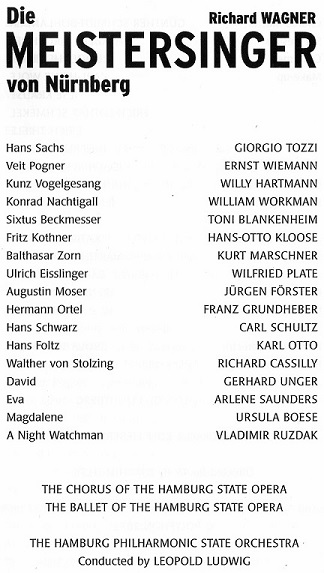
The cast is superb in every regard. Each singer has the measure of his or her role, both vocally and in characterization. There’s little in terms of theatricality to come between us and these folks as real townspeople, and the story unfolds with complete naturalness.
Giorgio Tozzi is for me simply a perfect Hans Sachs; he was, in fact, the very first singer I saw in this role at The Met in 1968. More than that, Tozzi played a huge part in my developing passion for opera: the first basso voice I came to love, his arias from NABUCCO and SIMON BOCCANEGRA were on the first operatic LP set I every acquired; he was Don Giovanni in the first opera I attended at the (Old) Met, and later he was my first Daland and Jacopo Fiesco. I saw Tozzi onstage for the last time as Oroveso in NORMA at Hartford, CT, in 1978; he was so vivid as the almost deranged high priest of the Druids.
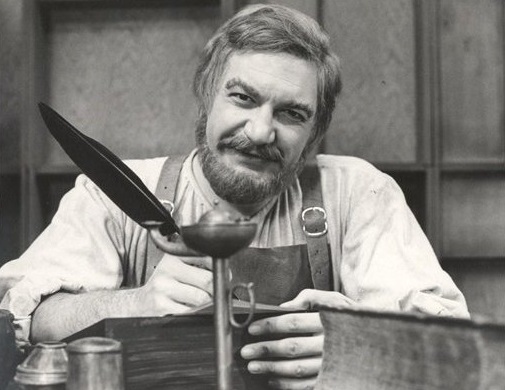
Here in this MEISTERSINGER film, Tozzi (above) is everything I want in a Sachs: vocally at ease in every aspect of the wide-ranging music, his singing warm, his portrayal so human and so rich in detail. His two monologs (Flieder– and Wahn-) are beautifully sung and deeply felt, and his impassioned final address to the citizens of Nuremberg – a warning against the intrusion of foreign powers on their daily lives – rings true today. It is so pleasing to have Tozzi’s magnificent Sachs preserved for the ages.

Arlene Saunders (above, as Eva) is another singer to whom I feel a strong attachment, as well as a sense of gratitude: over a span of time, I saw Ms. Saunders singing four vastly different roles, making a memorable impression in each. First was her Anne Trulove when the Hamburg Opera brought THE RAKE’S PROGRESS came to The Met in 1967; Ms. Saunders’ pealing lyricism in her aria and ‘cabaletta‘ left such a lovely impression. Later, she was a surprisingly thrilling Minnie in FANCIULLA DEL WEST at New York City Opera, a movingly vulnerable and hopeful Elsa in LOHENGRIN at Hartford’s Bushnell Auditorium, and strikingly beautiful, touching, and wonderfully-sung Marschallin at Boston.
In this Hamburg MEISTERSINGER, we first see Saunders’ adorable face looking up from her prayer-book in church, secretly thrilled by the attention of the tall knight who is captivated by her. From there to the end, Ms. Saunders endears and charms us in every moment of the role of Eva.

Richard Cassilly (above, with Ms. Saunders as Eva) is an imposing and big-voiced Stolzing; he towers over his beloved Ev’chen, and indeed over most everyone in the film. Often seeming stiff and dour, the tenor blossoms into smiles whenever Eva is near. The knight’s pride, insecurity, and hopefulness are all expressed in Mr. Cassilly’s acting; as to his singing, it is big, warm, and winning. The scene of the ‘birth’ of the “Prize Song” – and of Eva’s hearing it for the first time – is very moving to an old romantic like myself.

Toni Blankenheim (above, with Giorgio Tozzi as Sachs at the end of Act I) scores in one of his greatest roles, Beckmesser. In the hands of such an imaginative singing-actor, this annoyingly vain character finally moves us in Blankenheim’s portrayal of his defeat. The baritone also convinces us that he is actually playing the lute. (There is apparently a similar filmed production from Hamburg of Berg’s WOZZECK with Blankenheim in the title-role and Sena Jurinac as Marie; I want to see it!)

Above: Gerhard Unger and Ursula Boese as David and Magdalene
Petite of build, tenor Gerhard Unger with his boyish face does not seem out of place among the apprentices. Unger is a first-rate, “voicey” character singer and an impetuous actor. As his slightly older betrothed, Magdalene, Ursula Boese is wise and warm-hearted whilst also being a sly conspirator in getting everything to go well for Eva and Stolzing. Both Unger and Boese sing very well indeed.
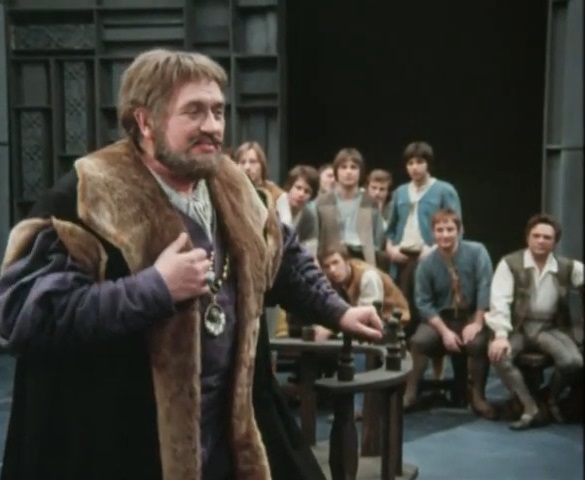
Basso Ernst Wiemann (above) sang nearly 75 performances at The Met from 1961 to 1969, including the roles of Fafner, Hunding, Hagen, the Commendatore, Rocco, King Henry, and Daland in broadcasts of these operas that I was hearing for the very first time. As Pogner in this film of MEISTERSINGER, Wiemann displays his ample, seasoned basso tones in a warmly paternal portrayal.

The one singer in a major role with whom I was totally unfamiliar is Hans-Otto Kloose (above), who plays an upbeat, gregarious Kothner. In both his portrayal and his singing, Mr. Kloose excels. He was a beloved member of the Hamburg State Opera ensemble for thirty years, starting in 1960, giving more than 1,800 performances with the Company. For all that, I cannot seem to find other samples of his singing.
The Meistersingers include both veterans and jünglings: among the latter, Franz Grundheber is an extremely handsome Hermann Ortel. As a final link among the singers in this film to some of my earliest operatic memories, Vladimir Ruzdak, who sang Valentin in my first FAUST at the Old Met, appears here as a baritonal Nightwatchman.

“All’s well as ends better,” as they say in The Shire. Sachs is crowned with a laurel wreath by Eva at the feast of St. John’s Day in Olde Nürnberg.
~ Oberon

Above: pianist Beatrice Rana
~ Author: Ben Weaver
Friday June 7th, 2019 – Yannick Nézet-Séguin – music director of the Metropolitan Opera – led his other ensemble, The Philadelphia Orchestra – in an exciting Carnegie Hall concert tonight. The all-Russian program opened with a recently discovered curiosity: Stravinsky’s Funeral Song, Op. 5, written for the memorial of his teacher, Nikolai Rimsky-Korsakov, in 1908. The 12 minute work, in which Stravinsky has different sections of the orchestra take turns “laying down its own melody as its wreath against a deep background of tremolo murmurings,” was lost until 2015 when a St. Petersburg Conservatory’s librarian discovered the complete orchestral parts in the mess of the Conservatory’s renovations. Musicologists long lamented the lost manuscript as the link between Stravinsky’s early works and The Firebird. Its discovery revealed not only the links in Stravinsky’s own development, but his links to Rimsky-Korsakov’s late compositional style, which Stravinsky, late in life, tried to downplay.
Sergei Prokofiev’s popular Piano Concerto No. 3 came next on the program with the exciting pianist Beatrice Rana at the piano. This was my first time hearing Ms. Rana in a live performance, but I have admired several of her recordings for some time. What struck me about her recorded performances – and what was confirmed live – is her deeply felt, yet honest and unaffected musicality. Prokofiev’s “devilishly difficult” (Prokofiev’s own words) writing presented no technical challenge to Rana’s nimble finger work. The often spiky writing can easily become a “pound on the keyboard” type of evening. That is not Rana: her light – but never weak – touch made the pounding Prokofiev requires sound effortless and graceful. Both of those words were also true about the encore: Chopin’s Etude in A-flat major, Op. 25, No. 1 showed off the more lyrical side of Rana’s artistry.

Above: the young Sergei Rachmaninoff
The premiere of Sergei Rachmaninoff’s Symphony No. 1, Op. 13 in 1897 is one of the most famous musical disasters in Western art music. Composer and conductor Alexander Glazunov appears to have been drunk on the podium and unprepared to conduct the difficult score. The reaction from the public and the critics was savage: composer and critic César Cui wrote that the symphony “would have delighted the inhabitants of Hell” and that the “music leaves an evil impression.” The young composer was so devastated by the reception that he quit composing and needed a therapist (and hypnosis) to recover from the trauma. When he fled Russia during the 1917 Revolution, the score of the symphony was lost in the chaos. Interestingly, although the symphony caused him a lot of pain, it appears to have been on Rachmaninoff’s mind for the rest of his life: he quoted its dark opening theme in the first movement of his last work, the Symphonic Dances, in 1940. Since the score of the symphony was lost and no one had heard it in more than 40 years, Rachmaninoff knew the quote would be unknown to anyone but himself. He died in 1943 and two years later orchestral parts of the symphony were discovered after all, in the St. Petersburg Conservatory (again), presumably as everyone returned home after the War. A performance was quickly arranged in Moscow (US premiere was given by The Philadelphia Orchestra and Eugene Ormandy) and finally the public was able to judge this extraordinary composition. We can safely say that César Cui’s deranged opinion was garbage; indeed, history itself has given its verdict on Cui vs. Rachmaninoff’s Symphony No. 1. Cui is nothing but footnote.
One thing that may have confused so many listeners in 1897 was the dark and violent tone of the work; Rachmaninoff’s vivid quotations of the Dies irae may have upset some sensitive constitutions. But the Dies irae would become a common motif in all of Rachmaninoff’s major orchestral works. In the 1st Symphony, even the haunting slow movement is more sinister than calming. Cui may have been correct that the work “would have delighted the inhabitants of Hell,” except any person of taste would have seen that as a positive. Rachmaninoff’s most famous works, Piano Concerto No. 2 and Symphony No. 2, are steeped in romanticism, their flowing, endless melodies unrolling with shameless abandon. The very different tone of the 1st Symphony, however, reveals fascinating depths.
There are few orchestras with a stronger personal and professional connection to a major composer than Philadelphia Orchestra’s is to Rachmaninoff. For a few decades Rachmaninoff played with and conducted them regularly, and he chose them when he recorded his own orchestral works. His last composition, the Symphonic Dances, were dedicated to the Philadelphia Orchestra and Eugene Ormandy led the world premiere performance. This is music they have in their blood the way Bayreuth Orchestra has Wagner and the NY Philharmonic has Mahler. With Maestro Nézet-Séguin on the podium, this Carnegie Hall performance of Rachmaninoff’s 1st Symphony was perhaps the most thrilling and hair-raising I’ve ever heard. Nézet-Séguin’s unflagging energy perhaps a taste for the macabre was the perfect approach to this dark and sprawling work. The Philadelphians responded with a fearlessness that shook the concert hall to the rafters. Is César Cui heard this performance, he might have had a heart-attack.
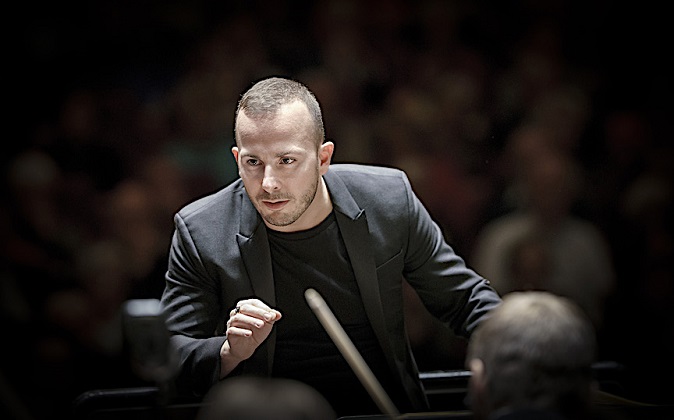
Maestro Nézet-Séguin (above, in a Hans Van Der Woerd photo) is currently recording Rachmaninoff’s complete piano concertos with Daniil Trifonov and the Philadelphia Orchestra. Based on this coruscating performance of the 1st Symphony, it may be time for this group to record Rachmaninoff’s complete orchestral works. The Concertgebouw seems to do a complete Mahler traversal every few years (though the last one, with Daniele Gatti, was abandoned part-way for stupid reasons). Surely the Philadelphians and Rachmaninoff have earned a similar right? Deutsche Grammophon, are you paying attention?
~ Ben Weaver

Above: mezzo-soprano Elīna Garanča
~ Author: Oberon
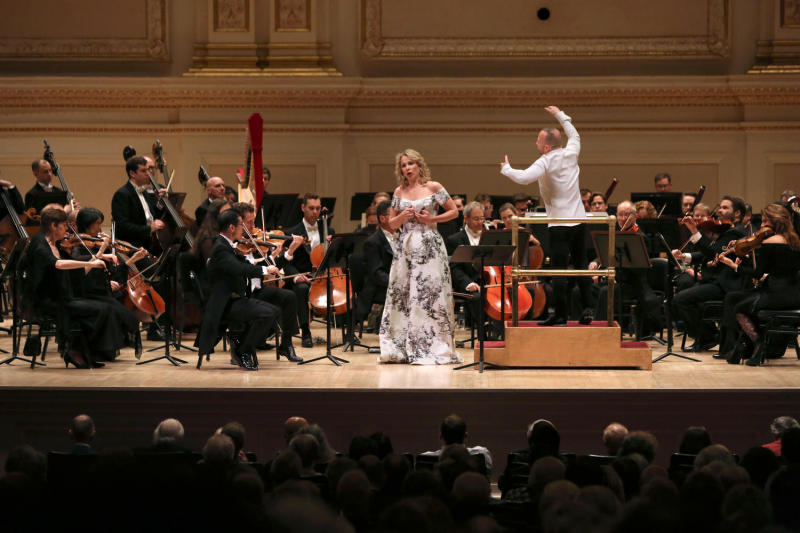
Friday June 14th, 2019 – This evening, The MET Orchestra paired Mahler’s marvelous Rückert Lieder with Anton Bruckner’s sprawling 7th symphony. Yannick Nézet-Séguin was on the podium, and the soloist for the Mahler was Elīna Garanča.
As Ms. Garanča, in a strikingly Spring-like white gown, and the conductor made their way center-stage, the mezzo towered over the maestro. M. Nézet-Séguin wore a clingy white shirt that seemed calculated to show off his physique; it looked kind of silly.
The German Romantic poet Friedrich Rückert (1788-1866) was one of Gustav Mahler’s favorite poets, and he set a number of his poems to music, including the Kindertotenlieder (“Songs on the Death of Children”).
Mahler composed four of the five Rückert Lieder in 1901, initially to be sung with piano accompaniment; very soon after, he orchestrated them. The fifth of the Rückert Lieder, “Liebst du um Schönheit?” (‘If you love for beauty…’) was composed a bit later, and orchestrated by Mahler’s publisher. The songs do not constitute a formal song-cycle, nor is there any prescribed order of performing them.
Ms. Garanča began with “Blicke mir nicht in die Lieder” (“Do not look at my songs…”), in which poet and composer seem to be warning the listener not to be too inquisitive about the song-writing process: it’s the finished product that matters. This light and almost playful song was deliciously voiced by Ms. Garanča, whilst the woodwind players of The MET Orchestra buzzed charmingly about, like busy bees.
In “Ich atmet’ einen linden Duft” (“I breathed a gentle fragrance…”) the mezzo-soprano brought an intriguing mix of calm and intensity. Her use of dynamics and her lovely sustaining of the vocal line were beautifully supported by the oboe, horn, and flute. The singer’s lower range has a special warmth and glow: rich without seeming over-burdened.
A change of mood comes with “Um Mitternacht” (“At midnight”) which tells of the poet’s battle with darkness (both in the literal and and the poetic sense) until he finally leaves it all in God’s hands. Ms. Garanča brought profound beauty of tone to the song, giving it an almost operatic dimension. Her use of straight tone at times was beguiling, whilst throughout her expressive, passionate colouring of the words kept us engrossed. It seemed that the conductor allowed a passing trace of vulgarity in some of the wind playing, and he allowed the orchestra to cover the voice in the closing passages of the song.
“Liebst du um Schönheit” (“If you love for beauty…”) was the first Mahler song I ever heard, sung at a 1972 recital by the delectable Frederica von Stade. A few years later, the unique voice of Patricia Brooks gave the song a different feeling. And it’s a song I very much associate with my late friend, the Japanese contralto Makiko Narumi. The words, in translation, could have been the theme song of my long career as a promiscuous romantIc:
Following the interval, Maestro Nézet-Séguin returned for the Bruckner 7th. This was my first live experience of this work, which begins so magically with a string tremolo from which the glorious main theme arises. Throughout most of the first movement, I felt as engaged – and even exalted – as I had expected to feel, since I like Bruckner’s music in general.
But in the ensuing Adagio, I found the performance drifting away from me. There were some iffy moments from the horns, the music seemed periodically to lose its shape, and the movement began to feel endless. The Scherzo which follows was singularly lacking in wit and sparkle, and while its tranquil – almost wistful – trio section is pleasant enough to hear, pleasant music tends to get boring after a while.
At last, the Finale is reached; I hoped that Bruckner would take the driver’s seat and careen madly to the finish line. Instead, the music came in fits and starts, seeming to fold in on itself and retreat periodically into modestly attractive wind interludes. At last: a big statement. But this was soon replaced by more dawdling. Frankly, it couldn’t end soon enough. I found myself craving Bizet’s Symphony in C.
Afterwards, I asked myself why the Bruckner 7th had seemed like such a disappointment this evening. My friend Ben Weaver suggested that perhaps it was the performance, rather than the music, that had let me down. But it’s something deeper.
In search of answers, I read some on-line articles by music-lovers who stated that Bruckner’s music often eluded them. One common theme in many of these writings was Bruckner’s seeming lack of a sex life: simplistic perhaps, but on the other hand we know that Mozart, Liszt, Wagner, Debussy, Puccini, and Mahler were men of passion, and it comes thru in their music. Bruckner’s passion seems to have been for God, and some writers went so far as to say that Bruckner probably lived and died a virgin. This may account for a feeling of sterility in some of his music, and why it doesn’t reach me. Oddly, reading about Bruckner and looking at some pictures of the man, I began thinking of Mike Pence.
Speaking of people’s sex lives, in tonight’s Playbill note about The MET Orchestra, the name of James Levine – the man universally credited with turning the opera house’s orchestra into a world-class concert ensemble – is conspicuously absent. This gloss seems so childish, but I suppose in an age when slavery in America and the Holocaust in Europe are being written out of text books, anything is possible.
~ Oberon
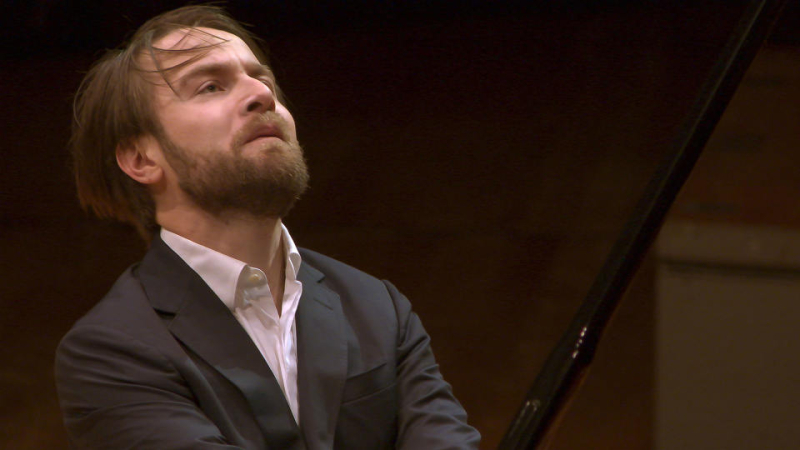
Above: pianist Daniil Trifonov
~ Author: Ben Weaver
Saturday May 18th, 2019 – The MET Orchestra made its way over to Carnegie Hall for one of its popular annual orchestral concerts. Former principal guest conductor Valery Gergiev – director of the Mariinsky Theater of St. Petersburg, and a regular presence on the Met podium – led the performances (without a podium, which seems to be his preferred method; one of his many eccentricities that also include conducting with what appears to be a toothpick.)
For the the first half of the concert Maestro Gergiev was joined by the star pianist Daniil Trifonov for Robert Schumann’s ever-green Piano Concerto in A minor. Mr. Trifonov is an excellent pianist, perhaps even a great one, even at his relatively young age. But as demonstrated by this particular performance (and not for the first time) he often displays his own eccentricities with music-making. He played the introduction to the concerto extremely slow (remarkably, one could hear some early echoes of Rachmaninoff in the piano and orchestra) – and then at the first sign of a something faster, Trifonov sped up like a runaway train. These extremes in the tempos – dragging slow and demonic fast – dominated the entire performance, but felt like an affectation, not organic music-making. This is not a new thing for Mr. Trifonov; his Carnegie Hall debut in 2011 (with Tchaikovsky’s 1st Piano Concerto, conducted by Gergiev) was criticized by the New York Times for similar behavior: “…he tended to offset extremely fast playing with extremely slow, more maundering than meditative: a manic-depressive approach…”
Needless to say, the fast playing was dazzlingly note-perfect. Trifonov does not attempt more than he can actually accomplish. And in the slow sections he frequently displayed extraordinary sensitivity and beauty. But on the whole the performance was, alas, mostly frustrating and even boring. I have little doubt that maestro Gergiev supported all of Trifonov’s choices: Gergiev himself frequently takes similar liberties with the tempo, especially in non-Russian repertoire. Sometimes it works (his Wagner is often thrilling for it), but only sometimes.
The audience greeted Trifonov’s performance warmly (to say the least) and he played a lovely, beautifully articulated and, dare I say, perfectly-paced encore – Schumann’s “Nicht schnell, mit Innigkeit” from Bunte Blätter, Op. 99, No. 1.
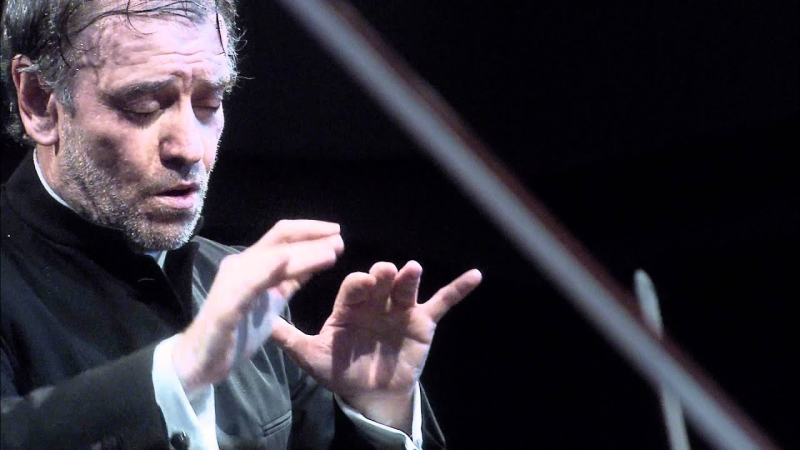
For the second half of the concert the MET Orchestra and Maestro Gergiev (above) took center stage for Franz Schubert’s last symphony, Symphony No. 9 in C major, completed in 1828, the year of his death. The manuscript collected dust in Schubert’s brother’s possession until 1837 when Robert Schumann, passing through Vienna, paid a visit to Ferdinand’s home and was rewarded with a “hoard of riches” of Schubert’s never-before seen manuscripts, including the final symphony. Schumann and his friend Felix Mendelssohn finally arranged the work’s premiere in 1839 under Mendelssohn’s baton. The premiere was not a success with the audiences and it took many years for the symphony to finally gain acceptance for the masterpiece it is. The work’s length, which Schumann called “heavenly,” was a big stumbling block. In due time composers like Anton Bruckner and Gustav Mahler out-composed Schubert’s 9th for time and the work finally did ascend to warhorse status.
The symphony opens with a call from a horn, played beautifully by (probably) MET’s principal hornist John Anderer. The orchestra, under Gergiev’s toothpick, sounded superb. Gergiev has been burnishing his German music credential as the new principal conductor of the Munich Philharmonic. The nicely articulated rhythm were clean and sharp. This work was far more consistently paced than the opening Schumann concerto. Gergiev kept the symphony moving at a clip that never felt rushed. Many solo instruments were given a chance to shine, particularly the woodwinds in the second movement. The Scherzo was graceful and the once controversial final movement – where in the 1830s Mendelssohn found London musicians laughing at the second theme of the movement and refusing to play it – was thrillingly played. But something was missing from the whole: perhaps a little variety of rhythm and dynamics. Gergiev conducting was extremely consistent, but in a work faulted by some for being too repetitive, consistency turned out to be something of a negative.
An extended ovation followed; the audience wanted an encore, but with an imperial wave Maestro Gergiev gave the orchestra permission to disband.
~ Ben Weaver
 Oberon's Glade