Tag: Saturday February

  • Joffrey Concert Group @ Ailey Citigroup

    Jcg jpg

    ~ Author: Oberon

    Saturday February 17th, 2024 matinee – The Joffrey Concert Group offering a program of four works by three choreographers at the Ailey Citigroup Theater. The dancers were all technically adept and physically attractive, and the performance was enhanced by excellent lighting. While each ballet was enjoyable to watch individually (and to listen to, at least until someone pumped up the volume), being performed one after the other made for an afternoon lacking in contrasts.

    Chicago-born Alvin Ailey American Dance Theater principal dancer Vernard J Gilmore has created “Dawn Of Love”, which opened the show. The work’s six movements do offer some variety of pacing and atmosphere, all basically coloured by the power and intensity of the music by Prince, distinctively played by the Vitamin String Quartet and mixed by long-time collaborator, DJ April Reign.

    Dawn Of Love” gets off to a big-beat start with Not Afraid” in which four couples wend thru various ballet partnering motifs. “Neverending” begins with the women, soon joined by the men – the music has a hoedown feeling. A steady beat pulses thru Specks of Hope“, danced by a trio of women, and then there is an ethereal solo, “I Will, I Am” danced poetically by Mari Murata, with her lovely pointe work. (I should note that, throughout the evening, some of the women were on pointe and others in soft slippers). A pointy duet for Annika Davis and Sydney Williams opens “Diamonds and Pearls“, danced to an insistent beat. The other women join, and finally the men. The ballet concludes with a duet for Breeanna Palmer and Faahkir Bestman entitled “Nothing…”; the stage is bathed in a red glow, and the music has an oddly Appalachian feel. Although this duet went on a bit too long, it was very finely danced. An extra bravo to lighting designer Michael Faba.

    There were no bows after the opening work, and after a brief pause Bradley Shelver’s “Random People With Beautiful Parts” commenced. The music draws on the Hilliard Ensemble’s recordings of J S Bach; the piece is in three sections, beginning with a solemn air of ritual. Traditional ballet combinations weave into the music, and a sense of light vs darkness develops. An interesting motif of skidding on pointe is introduced, reminding me of Mauro Bigonzetti’s gorgeous “Luce Nascosta” for NYC Ballet (2010). There’s a lot happening in this opening section; the eye is constantly drawn from dancer to dancer.

    Mr. Bestman joined Yumeno Takechi for the ballet’s central pas de deux, set to a pulsing beat. Then trilling percussion opens the dramatic finale, in which several individual dancers had a chance to shine, notably Charles Klepner. The dancing is showy and gets somewhat competitive as the music accelerates.

    The Relentless Nature of Dreaming” by choreographer Eryn Renee Young, is set to music by J.S. Bach and an original score by emerging composer Heather Cook. It’s been quite a long time since I last saw Ms. Young’s work: 2014, in fact, when I saw her excellent Bartok piece “Symphonie Miroir “. From the title of Ms. Young’s ballet on offer this evening, “The Relentless Nature of Dreaming“, I was envisioning an atmosphere of Shades or Wilis; but it’s actually the word “restless” in the title that most aptly applies.

    The large cast (seemingly everyone in the Company) were clad in red (the men) and hot pink (the women), making quite a breath-taking sight as the lights came up. The women are divided into two groups: some in soft slippers and other on pointe. Neat patterns and myriad steps are skillfully choreographed. An exceptional solo, danced by one of the soft-slipper girls, was a highlight of the opening movement, but I can’t tell you her name.

    The second section of Ms. Young’s ballet is danced to “Be My Water Tonight” by Heather Cook. For some reason, this was played at a very high volume; the dancing – at times quite animated – could have been really engaging, but the music was simply earsplitting. The song eventually turns watery, as if submerged (thus the word ‘water’ in the song’s title); there is so much going on for the dancers but it all gets lost in the musical overkill. The ballet ends with an elaborate final pose.

    Closing the program is “OOF”, choreographed by Mr. Shelver. Set to music by Machito, Sunny and the Sunliners, and Balkan Beat Box, it sustained the high-energy, rather relentless feeling of the program. There were passing moments when it seemed a mood-swing might happen – one such was a male solo which commenced in a pool of light – but the idea was not developed: it simply melded into an ensemble.


    The choreography is athletic and at times quirky, with something of a gypsy tinge to it. The final duet, set to “I Only Have Eyes For You“, was danced by Joliana Canaan and Faakhir Bestman, and was beautfully done.


    What was lacking in the evening was a feeling of emotional connections between the dancers; seldom was any tenderness expressed, though in fact the extroverted nature of the ballets rarely called for it.


    As to the music, there seems to be a tradition in this performing venue that music will be played in the theatre for a half-hour before curtain time, and during the interval. This means that the scores the choreographers have chosen to set become part of a larger sound scheme, diminishing their effect.


    ~ Oberon

  • Renaud Capuçon/ORPHEUS @ Carnegie Hall

    _DSC8907

    Saturday February 21st, 2023 – Violinist Renaud Capuçon (above, performance photo by Chris Lee) joining the Orpheus Chamber Orchestra at Carnegie Hall for a program featuring works by Hanna Benn, Sergei Prokofiev, and Modest Mussorgsky.

    The East Coast premiere of Ms. Benn’s View (Un)titled, an Orpheus commission, opened the evening. The composer was inspired by artwork she had viewed at MoMA; she drew inspiration for the work’s structure from the beloved Mussorgsky piece which closed tonight’s program. Thus, View (Un)titled opens with a promenade: a walking motif set to a pacing rhythm from Orpheus’s rock-star bass player, Jordan Frazier.

    The musical exploration of the various artworks (eight of them) showed that Ms. Benn is a composer who values melody; her music has a fresh and vital feeling, and she has a gift for making a visit to a museum seem important. Which it is! 

    As the movements unfolded, my companion and i lost track of exactly where in the order of the things we were. So we simply enjoyed the work as a whole: its rhythmic variety, the rich strings, the distinctive sounds of the wind voices, and the cunning use of percussion. Cinematic one moment and intimate the next, this music continually delighted the ear…and the imagination.

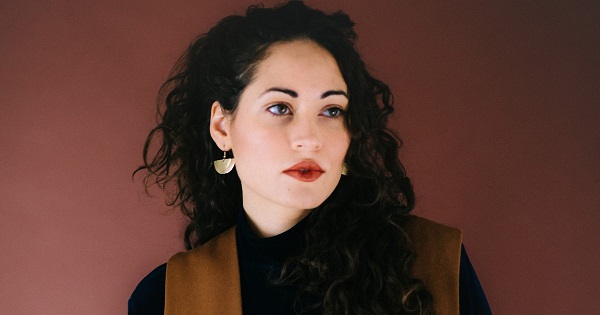
    Hanna benn

    Above: composer Hanna Benn

    Ms. Benn was called to the stage for a bow after her work was played, and she was warmly greeted by the audience; returning to her seat, Ms. Benn received another around of applause, and she made a charming curtsey to the hall. During the interval, she slowly made her way up the aisle, pausing for autographs and selfie seekers. One tiny girl wanted to meet her, but was overcome by shyness (I know how she feels!); Ms. Benn knelt and spoke to her, putting the child at ease, and then they had a photo together: really such a sweet moment. 

    M. Capuçon then took the stage for a stunning performance of Prokofiev’s Sonata in F-Minor in an arrangement by Andrei Pushkarev.

    The opening Andante assai has a doleful feeling, from which the trilling of the violin emerges. Unison strings are heard in lamenting themes as M. Capuçon’s playing becomes increasingly passionate; the celli and bass play dirge-like passage. Now the enchanting sound of the marimba comes into play. The violinist executes slithering scales – and then a plucking passage – as the music fades away.

    In the Allegro brusco which follows, a military mood is established, the celli and bass trudging along, the drums issuing a stirring summons. M. Capuçon takes up a song, the accompaniment dance-like. The pace picks up, and reaches the sizzling point. The striking of the wood block draws our attention to the orchestra’s percussionist de luxe, Maya Gunji, who at one point plays the snare and bass drum simultaneously. The violin sings forth again, and this militant movement marches to its end. 

    Now comes the sonata’s luminous Andante. The delicious sounds of the marimba create a dreamy mood, and a lyrical melody from M. Capuçon becomes a duet with cello. The sound of the violin shimmering on high and meshing with the marimba evokes thoughts of the same composer’s Opus 19/The Dreamer.  Spine-tingling pianissimo arpeggios from the violinist bring the movement to an ethereal close.

    The concluding movement has a bustling start; the percussionist is kept endlessly busy, as is the violinist. But in a surprise move, the music gradually transforms to an andante, the violin turning lyrical, a fugue developing, the marimba sounding isolated notes.  A solo passage from the bass, and then the music slithers to silence.

    _DSC8797

    Above: M. Capuçon danced and swayed throughout his performance…very engaging; photo above by Chris Lee. The violinist won a fervent ovation, the Orpheus players joining in. He was re-called to the stage for two extra bows; the crowd was clearly hoping for an encore, though I am not sure what could have followed M. Capuçon’s dazzling playing of the Prokofiev.

    _DSC0128

    Modest Mussorgsky’s Pictures at an Exhibition was given in a fresh arrangement by Jannina Norpoth, and she gets major kudos for her luxuriant, imaginative vision of the music. Ms. Norpoth took a bow at the end, winning much-deserved shouts of approval from the hall…and spirited applause from the players, too. Chris Lee captured the moment in the above photo.

     A trumpet call heralds our entrance to the galleries where the pictures are on exhibition, and our tour is underway, interrupted periodically by a revisiting of the “promenade” theme. Applause between movements was distracting tonight, though understandable given the high level of the playing.

    Gnomes, a dolorous march, is by turns bustling, eerie, and clumsy…and superbly played. The Old Castle is an evocative, very slow dance for solo cello, joined later by violin and viola. The charming Tuileries tells of a dispute between children at play in the gardens. Bassoonist Gina Cuffari took a star turn with the droll and lumbering Cattle – music which gets big by the end. The whimsical, fluttery Ballet of the Chicks in Their Shells was charmingly set forth, and then we have Samuel Goldenberg und Schmuyle, which paints a picture of two Jewish citizens – one rich and one poor. The Market at Limoges is brisk and joyous, with a fast finish; in contrast come the long, organ-like chords of The Catacombs. Next, we feel shivers of mystery in Among the Dead. Following the big and boisterous Hut on the Fowl’s Legs (based on Baba-Yaga), we at last stand before The Great Gates of Kiev: a timely reminder of the world in which we now live.

    _DSC0175

    All of this was played sumptuously by the ladies and gentlemen of Orpheus, and the Carnegie acoustic suits them to a T: a wonderful night of music-making! At the end, the players and Ms. Norpoth formed a line-up stretching across the Carnegie Hall stage – Chris Lee’s photo above – enjoying the audience’s acclaim.

    ~ Oberon

  • Stile Antico @ The Miller Theatre

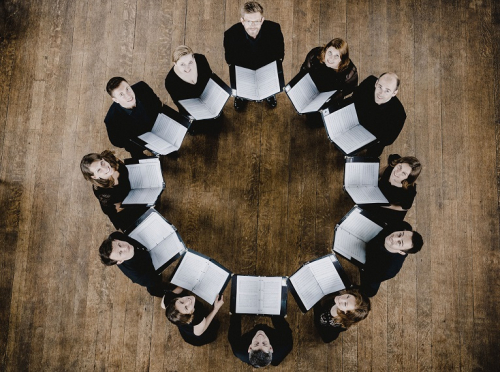
    Stile-Antico

    Above: the singers of Stile Antico, photographed by Marco Borggreve

    Saturday February 19th, 2022 – Stile Antico, the London-based Early Music vocal ensemble, gave a wonderful program this evening at Columbia University’s Miller Theater. The music – and the ensemble’s hauntingly beautiful singing of it – was a balm to the spirit in these uncertain times. 

    In this program, entitled Toward the Dawn, Stile Antico brings us works – both sacred and secular – that sing of the hours between dusk and dawn: nocturnal music of mystery and of assurance that carries us through the watches of the night.

    The twelve singers of Stile Antico stood in a semi-circle on the bare stage, all clad in black, rearranging themselves for each work. The program was devised in three sections: Evening, Nightfall, and Dawn. After the first piece of the evening – John Wilbye’s Draw on sweet night – there was a lovely silence, and then people started applauding. Although the singers seemed prepared for this intrusion – they took a bow – for me it broke the atmosphere. Thereafter, each piece was applauded and bows were taken.

    The opening Wilbye set the mood for everything that follows: dreamlike, and tinged alternately with hope and uncertainty. in Thomas Tallis’s Te lucis ante terminum, we hear a prayer for God to watch over us throughout the night. John Ward’s Come, sable night is extraordinarily beautiful, both in words and music.  From William Byrd, we heard Vigilante, a dramatic work that urges true believers to remain faithful…and aware.

    The Nightfall section of the program commenced with Orlande de Lassus’ Toutes les nuitz, which tells of the restlessness of sleeping alone. This rang true with me as I thought back on the very few nights in the past twenty years that my beloved has not been there to have and to hold. Both in music and words, and in Stile Antico‘s singing of it, this song was a highlight of the program.

    Next came the most familiar work of the evening: Gregorio Allegri’s Miserere. I first  heard this heavenly music in a movie theatre, while watching the iconic gay film, Maurice. Jonathan Hanley was the tenor soloist, and the high-spinning soprano line was beautifully woven into the sonic tapestry. An interesting program note told of the transformation of this work over the years, so that it probably is quite unlike what Allegri originally wrote. Nevertheless, its enduring enchantment is easy to understand, especially when it is as poetically sung as it was tonight.

    John Sheppard’s In manus tuas also calls for a soloist: bass James Arthur’s tone had a poetic sonority. The words, from Psalm 31:6, are wonderfully simple: “Into your hands I commend my spirit; you will redeem me, Lord, God of truth”.

    The only contemporary work on the program, Nico Muhly’s Gentle sleep, composed in 2015 to a text by Shakespeare, did not seem at all out-of-place. The bending harmonics in fact gave a pleasing contrast to the rest of the works on the program. Muhly’s score has an intriguing and somewhat anxious feeling.

    Now the dawn is heralded by Thomas Tallis’s O nata lux de lumine, which hails Christ as the “Light of the World”; this is followed by Claudio Monteverdi’s Ecco mormorar l’onde, a poem describing the morning breeze out of the Orient, stirring the ocean’s waves and bringing the world to wakefulness.

    The evening concluded with Ave Dei Patris Filia by John Taverner: a longish work of varying moods that extols the Virgin Mary. While a blend of timbres is essential in a choral ensemble like Stile Antico, I did find myself frequently listening to individual voices as the program unfolded; the altos, in particular, impressed me in the concluding Taverner.

    The concert ended with a joy-filled Amen, whereupon the singers were given a hearty and very well-deserved ovation. I’d had high expectations for this program, and they were surpassed: extraordinary music-making…bravi Stile Antico!

    The hall seemed full, and for the most part silence reigned during the music. Invariably, though, if there is one thoughtless person in an audience, that person is destined to sit next to me. This individual arrived as the lights were going down, with a suitcase, and all bundled up; he/she clambered over me, took forever to settle in, and then spent the evening flipping noisily thru the dreaded texts booklet. Yet another case of the triumph of indifference.

    Oberon

  • Schultz/Rouvali @ The NY Philharmonic

    Composer

    Above: composer Žibouklė Martinaitytė, photo by Romas Jurgaitis

    Author: Ben Weaver

    Saturday February 19th, 2022 – As we all anxiously await the reopening of David Geffen Hall (née Philharmonic Hall, then re-christened Avery Fisher Hall) at Lincoln Center in Autumn 2022 (two years ahead of schedule!), the orchestra returned to the Rose Theater at Jazz at Lincoln Center for a concert featuring Richard Strauss, Tchaikovsky and a US Premiere of a recent work by Žibouklė Martinaitytė.

    Born in St. Petersburg (then Leningrad), USSR, but raised in Lithuania and now based in NYC, Ms. Martinaitytė’s gripping 2019 work Saudade received its US Premiere in these NY Philharmonic performances. The word “saudade” is Portuguese and has no direct English equivalent, but it comes close with “longing,” (or as Madonna described it when covering Césaria Evora’s great ballad “Saudade” during her Madame X Tour: “yearning.”) To be honest, I’m not entirely certain what Ms. Martinaitytė is longing for in her Saudade, which is rather dark and ominous. But that’s not important when the music is this hypnotic. Much of the composition is played at a steady, slow pace, with strings providing the canvas on which the rest of the orchestra makes its contributions. There is something of Arvo Pärt here, though more varied in orchestration. Martinaitytė’s orchestra is huge, with numerous brass and percussion instruments (including, three trombones, tubular bells, and vibraphone), but unlike the lazy “throw in the kitchen sink ” noise of a composer like Christopher Rouse (who Albert Gilbert subjected us to for several seasons), Ms. Martinaitytė’s use of every instrument on stage is always economical and perfectly woven into the tapestry of sound, not just smashing a gong to cover up inadequate musical transitions – something numerous contemporary composers do with abandon. As she slowly builds Sodade to its climaxes and retreats, the work most reminded me of the freezing winds of Sibelius and crashing waves of John Luther Adams. Although unlike John Luther Adams (not to be confused with John Adams), Ms. Martinaitytė believes in brevity. She tells the whole story in about 15 minutes of Saudade. This is a beautiful and gripping piece. Maestro Santtu-Matias Rouvali, currently artistic director of the Philharmonia Orchestra in London, shaped it superbly, and the orchestra seemed to enjoy its challenges. They applauded Ms. Martinaitytė warmly when she came up on stage for a bow: the crowd seemed truly impressed.

    The work Saudade has been recorded by the Lithuanian State Symphony Orchestra conducted by Giedrė Šlekytė, and is available on the Ondine label. It is highly recommended.

    Richard Strauss’ Brentano-Lieder, Op. 68, were composed in 1918 following a lengthy break from lieder composition, and on the heels of completing ROSENKAVALIER, both versions of ARIADNE AUF NAXOS, and DIE FRAU OHNE SCHATTEN. This is relevant because you can hear all three of these operas in these Brentano songs, and that is perhaps the reason they are infrequently performed as a set: the style of composition is so different from song to song that it’s difficult to find as singer who can cover the full spectrum of Straussian styles in less than 25 minutes. Over the years, some of these songs have been performed at the Philharmonic, by Beverly Sills, Kathleen Battle, Barbara Bonney, and Deborah Voigt, but they did not sing the same songs.

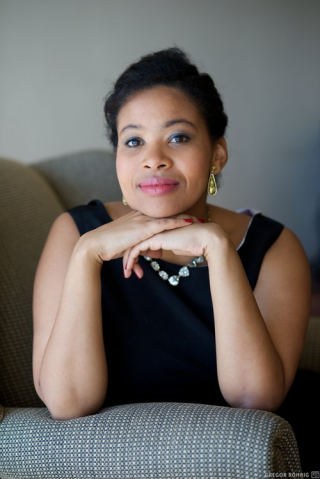
    Golda

    Above: Golda Schultz, photo by Gregor Röhrig

    Fortunately the orchestra found an interpreter who managed to not only survive the challenge, but do so with flying colors. Young South African soprano Golda Schultz, who now resides in Bavaria, made a stunning Philharmonic debut with these performances. She has a silky, beautiful voice, even throughout the range, from a secure bottom (which she wisely does not force) to a ringing and full top. “Säus’le, liebe Myrtle!” and “Amor” could be outtakes from Zerbinetta, the more thoughtful in the former and coquettish in the latter, and Ms. Schutlz managed the runs and playful coloratura with aplomb. The lyrical yearning of “An die Nacht” could be Sophie’s wedding night jitters, and wildly passionate “Als mir din Lied erklang” a desperate outburst of the Composer. Ms. Schultz already sings Sophie and I think she’d make a marvelous Composer too. (Originated by Lotte Lehmann, it’s not really supposed to be sung by mezzo-sopranos.) And finally DIE FRAU OHNE SCHATTEN comes blaring in with an Empress-inspired “Ich wolf ein Sträußlein binden” – lyrical and passionate, with some light coloratura, Ms. Schultz never pushed her voice, but showed a simple pleasure of passion and signing. The final song of the cycle, “Lied Der Frauen,” is something the Dyer’s Wife could have sung. Perhaps here Ms. Schultz was reaching the limits of her current vocal comfort, but she did not become desperate and Maestro Rouvali did not allow the orchestra (massive, echt-Strauss sound) to cover her. If the Dyer’s Wife – a vocally brutal role – would be beyond Ms. Schultz’ natural capabilities, I think the Empress is a role she should seriously consider taking on. Ms. Schultz is an exciting young singer and was greeted appreciably by the audience. (…which did applaud after each song…but what can you do?)

    Rouvali

    Santtu-Matias Rouvali (above, photo by Chris Lee) concluded the concert with Tchaikovsky’s familiar Symphony No. 5. It is a long favorite of the public, even though after the premiere Tchaikovsky – in his typical manner – declared it his worst composition and that the public only pretended to like it. Perhaps Maestro Rouvali took the slow parts a bit too slow, they began dragging from the opening pages of the score. But anything above Adagio took on a playful pep and interesting rhythms. The Valse was perhaps the most successful of the movements, a warm and well judged pacing, lovingly shaped by the orchestra. The finale, too, was thrilling. This is music the orchestra has played many times and they seem to relish it once again.

    Since NY Philharmonic music director Jaap van Zweden is leaving the Philharmonic, people are speculating that every conductor who steps on the podium is auditioning for the post. This is certainly true of Maestro Rouvali. New York could certainly do much worse. I’d argue it has.  Worth noting currently Rouvali is principal conductor of the Philharmonia Orchestra, chief conductor of the Gothenburg Symphony, and chief conductor and artistic director of the Tampere Philharmonic Orchestra.

    Another interesting note on the state of the current Covid-19 pandemic and wearing of masks. One thing that has historically been difficult not to notice is how noisy NYC audiences frequently are. Many nights – and not only in the cold season – it sounds like a consumption ward with someone hacking up a lung every moment of a concert. This was not the case at this concert. One thing the CDC has noted is that, no doubt due to wearing of masks, very few people have gotten sick with the common cold. I don’t think I heard a single cough at this concert. I think perhaps we should make the wearing of masks mandatory at all times going forward.

    ~ Ben Weaver

  • PARSIFAL @ The Met

    Parsifal1213.11

    Above: the Grail revealed: Peter Mattei as Amfortas and Rene Pape as Gurnemanz in Wagner’s PARSIFAL; a Ken Howard/Met Opera photo

    ~ Author: Oberon

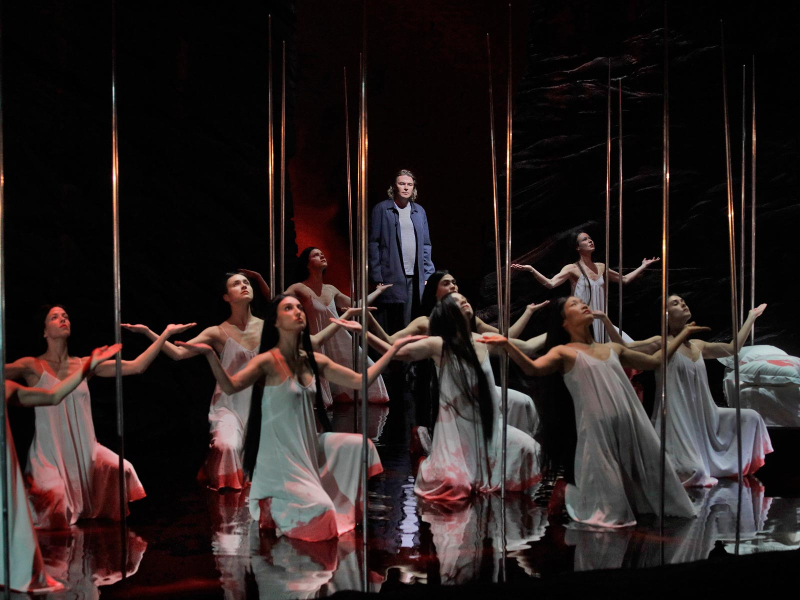
    Saturday February 17th, 2018 matinee – A powerful and thoroughly absorbing matinee performance of PARSIFAL, the only Wagner in the Metropolitan Opera’s repertory this season. This dark, barren, and brooding production premiered in 2013, at which time the total absence of a Grail temple from the scenic narrative seemed truly off-putting. All of the action of the outer acts takes place out-of-doors, whilst the second act – as we were told by someone who worked on the production at the time it was new – is set inside Amfortas’s wound.

    Not everything in the production works, and the desolate landscape of the final act – with its open graves – is dreary indeed. But the devotional rites of the Grail brothers in Act I and the stylized movements of the Flowermaidens in the blood-drenched ‘magic garden’ of Act II are engrossing – especially today, where I found a personal link to both scenes.

    Musically, it was a potent performance despite a couple of random brass blips. Since the 2013 performances, I’ve been going to a lot of symphonic and chamber music concerts and this has greatly enhanced my appreciation of the orchestra’s work whenever I am at the opera. From our perch directly over the pit today, I greatly enjoyed watching the musicians of the Met Orchestra as they played their way thru this endlessly fascinating score.

    The Met’s soon-to-be music director, Yannick Nézet-Séguin, was on the podium this afternoon, and he seemed to inspire not only the orchestra, but also the principals, chorus, dancers, and supers all of whom worked devotedly to sustain the atmosphere of the long opera. While I did not feel the depth of mystery that I have experienced in past performances of this work conducted by James Levine or Daniele Gatti, in Maestro Nézet-Séguin’s interpretation the humanity of the music seemed to be to the fore. This meshes well with the physical aspects of the production, which strongly and movingly depicts the fraternity of the Grail and the desperate suffering of Amfortas. The orchestra’s poetic playing as Gurnemanz sings of the slaying of the swan was but one passage of many where I felt the music so deeply. And the transformation music of Act I was particularly thrilling to hear today.

    The singing all afternoon was at a very high level, with the unfortunate exception of the Kundry of Evelyn Herlitzius. We’d previously heard her as Marie in WOZZECK, but Kundry’s music – especially in Act II – needs singing that has more seductive beauty than Ms. Herlitzius delivered. The soprano’s one spectacular vocal  moment – “Ich sah Ihn – Ihn – und…lachte!“, where she tells how she had seen Christ on the cross and laughed – was truly thrilling, but not enough to compensate for her tremulous, throaty singing elsewhere.
    1600x1200_parsifal3

    Above: In Klingsor’s Magic Garden, tenor Klaus Florian Vogt as Parsifal; a Met Opera photo

    In 2006, Klaus Florian Vogt made an unforgettable Met debut as Lohengrin, and this afternoon as Parsifal the tenor again sang lyrically in a role that is normally sung by tenors of the more helden- type. The almost juvenile sound Vogt’s voice underscored Parsifal’s innocence; this worked especially well in Act I, and also  brought us some beautiful vocalism in Act II. As Kundry’s efforts to seduce become more urgent, Vogt’s singing took on a more passionate colour. In his struggle between steadfastness and capitulation, the tenor’s cry of “Erlöse, rette mich, aus schuldbefleckten Händen!” (‘Redeem me, rescue me from hands defiled by sin!’) pierced the heart with his dynamic mastery. 

    Kundry’s wiles fail her, and with an upraised hand, Parsifal fends off Klingsor’s spear-wielding assault. Seizing the weapon that wounded Amfortas, the young man cries out “Mit diesem Zeichen bann’ ich deinen Zauber!” (‘With this Sign I banish your magic!’); the bloody back-lighting dissolves to white and Klingsor is cast down. Turning to Kundry, Mr. Vogt’s Parsifal has the act’s final line of premonition: “Du weisst, wo du mich wiederfinden kannst!” (‘You know where you can find me again’) and he strides out into the world  to commence his long, labored journey back to the realm of the Grail. In the final act, Mr. Vogt’s expressive singing was a balm to the ear, lovingly supported by the conductor and orchestra.

    Parsifal

    Above: Rene Pape as Gurnemanz, in a Ken Howard/Met Opera photo

    Repeating the roles they created when this production premiered in 2013, Rene Pape (Gurnemanz) and Peter Mattei (Amfortas) were again superb. Mr. Pape now measures out his singing of this very long part more judiciously than he has in the past, at times allowing the orchestra to cover him rather than attempting to power thru. But in the long Act I monolog, “Titurel, der fromme Held…”, the basso’s tone flowed like honey; and later, at “Vor dem verwaisten Heiligtum, in brünst’gem Beten lag Amfortas...” (‘Before the looted sanctuary, Amfortas lay in fervent prayer’) Mr. Pape’s emotion-filled delivery struck at the heart of the matter. Throughout Act III, leading to the consecrational baptism of Parsifal, Mr. Pape was at his finest.

    Parsifal1213.40

    Peter Mattei’s Amfortas (in a Ken Howard/Met Opera photo above) is truly one of the great operatic interpretations I have ever experienced, for it is not only magnificently sung but acted with matchless physicality and commitment. The guilt and suffering Mr. Mattei conveys both with his voice and his body is almost unbearable to experience in its intensity and sense of reality.

    After a desperate show of resistance to calls for the Grail to be revealed in Act I, Amfortas – in abject anguish – performs the rite; his strength spent, he staggers offstage and as he does so, he locks eyes with Parsifal, the man who will succeed him as keeper of the Grail: one of the production’s most telling moments. And in the final act, Mr. Mattei throws himself into the open grave of his father, Titurel, as he begs for death to release him from his eternal suffering; this horrifies the assembled Grail knights. Such moments make for an unforgettable interpretation, yet in the end it’s the Mattei voice that sets his Amfortas in such a high echelon.

    P015nkzb

    Evgeny Nikitin’s Klingsor (above), creepy and thrilling in 2013, incredibly was even better in this revival. The voice was flung into the House with chilling command, and the bass-baritone’s physical domination of his bloody realm and his hapless female slaves was conveyed with grim authority. His demise was epic.

    Alfred Walker sang splendidly as the unseen Titurel, and I was very glad that he appeared onstage for the bows so I could bravo him for his wonderful outpourings of tone. Another offstage Voice, that of Karolina Pilou – who repeats the prophetic line “Durch Mitleid wissend…der reine Tor!” (‘Enlightened through compassion, the innocent fool…’) to end Act I – had beauty of tone, though the amplification was less successful here.

    The Squires ( Katherine Whyte, Sarah Larsen, Scott Scully, and Ian Koziara) were excellent, especially as they harmonized on the emblematic “Durch Mitleid wissend…” theme, and the Flowermaidens sounded lovely, led with ethereal vocal grace by Haeran Hong. Mark Schowalter and Richard Bernstein were capital Knights, and I must again mention Mr. Bernstein’s terrific voice and physical presence as a singer underutilized by the Met these days. His lines ths afternoon were few, yet always on the mark; and in Act III, helping to bear the shrouded body of his late lord Titurel to its grave, Mr. Bernstein seemed to carry the weight of the world on his shoulder.

    What gave the performance a deep personal dimension for me today was finding two dancers I have known for some time – David Gonsier and Nicole Corea – onstage in Acts I and II respectively. By focusing on them – Mr. Gonsier as a young Grail knight and Ms. Corea as a delicious Blumenmädchen – the ‘choreography’ given to these two groups became wonderfully clear and meaningful.

    I first spotted Mr. Gonsier seated in the circle of knights; my imagination was immediately seized by the rapture evident in his eyes. For long, long stretches of the first act, I could not tear my gaze away from him as his mastery of the reverential gestural language and the deep radiance of his facial expressions spoke truly of what it means to be a knight of the Holy Grail. Amazingly, out of all the men I might have zeroed in on among the brotherhood, Mr. Gonsier was the last of the knights to leave the stage as Act I drew to an end: he received a personal blessing from Gurnemanz and their eyes met ever-so-briefly. So deeply moving.

    Ms. Corea is beloved in the Gotham danceworld for her work with Lar Lubovitch; I ran into her on the Plaza before the performance today and she assured me I’d be seeing her this Spring at The Joyce as Mr. Lubovitch celebrates his 50th anniversary of making dances. Incredibly, within two seconds of the Act II curtain’s rise on the identically clad and be-wigged Flowermaidens standing in a pool of blood, I found Nicole right in my line of vision. Both in her compelling movement and her captivating face, Nicole became the icon of this band of bewitching beauties.

    Whilst hailing some of the unsung cast members of the afternoon, mention must be made of the two heroic supers who literally keep Amfortas alive and mobile, frequently taking the full weight of the ailing man as he struggles to fulfill his dreaded duties as Lord of the Grail. Great work, gentlemen!

    Much of the libretto of PARSIFAL‘s outer acts today seems like religious mumbo-jumbo. It’s the music – especially the ending of Act I – that most clearly speaks to us (and even to an old atheist like me) of the possibility of God’s existence. Perhaps He has simply given up on mankind, as His name – and his word – have been sullied in recent years by those very people who claim to revere him. Wagner may have foreseen all this, as he once wrote: “Where religion becomes artificial, it is reserved for Art to save the spirit of religion.”

    At the end of Act I of today’s PARSIFAL, I momentarily questioned my disbelief. But then the applause – which I’ve always hated to hear after such a spiritual scene – pulled me back to reality. I’d much rather have stayed there, in Montsalvat.

    Metropolitan Opera House
    Saturday February 17th, 2018 matinee

    PARSIFAL
    Richard Wagner

    Parsifal................Klaus Florian Vogt
    Kundry..................Evelyn Herlitzius
    Amfortas................Peter Mattei
    Gurnemanz...............René Pape
    Klingsor................Evgeny Nikitin
    Titurel.................Alfred Walker
    Voice...................Karolina Pilou
    First Esquire...........Katherine Whyte
    Second Esquire..........Sarah Larsen
    Third Esquire...........Scott Scully
    Fourth Esquire..........Ian Koziara
    First Knight............Mark Schowalter
    Second Knight...........Richard Bernstein
    Flower Maidens: Haeran Hong, Deanna Breiwick, Renée Tatum, Disella Lårusdóttir, Katherine Whyte, Augusta Caso

    Conductor...............Yannick Nézet-Séguin

    ~ Oberon

  • New Ravel @ New Chamber Ballet

    L1680670

    Saturday February 27th, 2016 – Miro Magloire’s New Chamber Ballet presenting five Magloire ballets, including a premiere, at City Center Studios. Exceptional music, played live, is always on offer at NCB; then there’s the bevy of ballerinas: five distinctive dancers who bring Miro’s classically-based but sometimes quirky – and always demanding – choreography to life.

    Tonight, the house was packed; extra chairs had to be set out, and some people were standing. The program was one of Miro’s finest to date – and he’s had an awful lot of fine evenings. Two classic French violin sonatas – Debussy’s and (part of) Ravel’s – were in the mix, along with some Schoenberg (the more Schoenberg I hear, the more I like), and works by Beat Furrer and Friedrich Cerha (who just celebrated his 90th birthday). 

    The opening (premiere) work, RAVEL’D, is still “in-progress”; tonight we saw the first movement, with Miro promising the rest of it for his April performances. Doori Na and Melody Fader played beautifully, and Sarah Thea’s fringed tunics added an unusual flair to the movement. Stylized motifs – eating, praying, biting – are woven into the dance. One girl’s toe-shoed foot rests upon another girl’s head: this is one of several unexpected balancing devices. A space-filling unison trio stands out, and the closing section finds Sarah Atkins in a reverential pose as Amber Neff and Shoshana Rosenfield ‘converse’ in a series of mutually dependent balances. 

    The space was again well-utilized in GRAVITY; we were seeing the finished version of this work that Miro had started on last year. Doori Na’s expert playing of the Cerha score was something to marvel at: great subtlety and control are called for, and Doori delivered. The three dancers – Elizabeth Brown, Traci Finch, and Amber Neff – are engaged in extended paragraphs of the partnering vocabulary Miro has been exploring of late. Extremely challenging and movingly intimate, the intense physicality of these passages push the boundaries of what we expect from women dancing together. Miro’s dancers have taken to these new demands with great commitment: watching some of their improbable feats of balance and elastic strength gives us a fresh awareness of possibility. Adding yet another dimension to the work: when not actively dancing, each ballerina curls up on the floor to sleep. 

    Pianist Melody Fader evoked an air of mystery with her superb playing of Arnold Schoenberg’s Six Little Piano Pieces for the ballet QUARTET. Here Mlles. Atkins, Brown, Finch, and Neff appear in elegant, backless black gowns. They take seats at the four corners of the playing area, facing outward. With her hair down, a waif-like Shoshana Rosenfield dances in the center with a feeling of halting insecurity; her character seems dazed, perhaps drugged. Periodically, the four seated women move their chairs towards the center, slowing encroaching on Shoshana’s space. The four become aware of the lone ballerina as a potential victim: they turn and observe her intently. In the end, the four women have Shoshana trapped; as she sinks down in surrender, they caress her and run their fingers thru her hair. Eerie, and leaving us full of questions, QUARTET is as intriguing to watch as to hear.

    In VOICELESSNESS, Beat Furrer’s mystical score was performed by Melody Fader; her playing had a fine air of somber quietude. Dancers Amber Neff and Shoshana Rosenfield, in Sarah Thea’s sleek body tights, become fervently entwined and mutually dependent in a duet that develops further elements of Miro’s intense and engrossing partnering technique.

    For a revival of TWO FRIENDS, Doori Na and Melody Fader had the lovely experience of playing Claude Debussy’s violin sonata, the composer’s last completed work. Wearing black gauzy tunics and black toe shoes, Elizabeth Brown and Sarah Atkins are the eponymous duo; they partner lyrically, and all seems right with the world. Then Traci Finch appears out of nowhere and the ballet’s dynamic shifts and splinters, with fleeting pair-ups as alliances form and vanish in a trice. The subtexts of attraction and jealousy are very subtly threaded into the movement; an in-sync duet for Elizabeth and Traci is one outstanding moment, and the sonata’s final movement calls for large-scale virtuosic dancing from all three. But then Sarah impetuously rushes off. 

    True to life, TWO FRIENDS often finds multiple narratives developing at the same time, and over-lapping. There is so much to watch and to savor: I especially relished a brief passage where Elizabeth Brown, suddenly finding herself standing alone, quietly runs her hands up and down her arms in a caressive gesture. Elizabeth, a dancer who always lures the eye with her confident technique and personal mystique, turned this fleeting moment into something of deeper resonance.  

    Having followed Miro’s New Chamber Ballet for several seasons now, what I’ve come to appreciate most about him is his musical integrity. His tastes are eclectic, but always sophisticated, and he’s able to win us over to some very unusual and not always ‘easy’ music thru his own personal enthusiasm for the works he presents. The benefits of having the music played live are numerous, and greatly enhance the atmosphere at NCB‘s performances. And Miro’s excellent dancers take up each new musical and choreographic challenge that he sets for them with a wonderful mixture of strength, musicality, willingness, and grace.

    The dancers tonight were Sarah Atkins, Elizabeth Brown, Traci Finch, Amber Neff, and Shoshana Rosenfield, with the music played by Doori Na (violin) and Melody Fader (piano) and costuming by Sarah Thea. Kudos to all, and to Miro for yet another fascinating evening of dance.

    During the intermission, I really enjoyed re-connecting with Melissa Barak, the former New York City Ballet ballerina who now runs her own Los Angeles-based company Barak Ballet. Melissa is currently here in New York City as the inaugural Virginia B. Toulmin Fellow for Women Choreographers at the Center for Ballet and the Arts at NYU. We shared an awful lots of news and ideas in our 15-minute chat. I love her energy!  

  • Ballet Academy East @ Ailey Citigroup

    12729135_10102663014065261_1219830271059168853_n

    Above: from Claudia Schreier’s ballet “Charge“, a Rosalie O’Connor photo

    Saturday February 20th, 2016 – Young dancers from Ballet Academy East appeared tonight in performance at Ailey Citgroup Theatre. Ballets choreographed by Ashley Bouder, Jenna Lavin, and Claudia Schreier were on offer, as well as George Balanchine’s classic “Raymonda Variations”, staged by Darla Hoover, BAE’s artistic director and a répétiteur for the Balanchine Trust.

    Though billed as a ‘studio showing’, the presentation was fully staged, with lighting and costumes. The house was packed, with some dance-world luminaries who teach at BAE among the crowd.

    Jenna Lavin’s “Barcarolle” opened the evening; set to the beloved music of the same title from Offenbach’s CONTES D’HOFFMANN, Lavin’s charmer of a ballet was danced by the youngest group of dancers on tonight’s programme: ages 10 to 12 years. The ballet’s three boys were showing early development of the courtly style which is an essential component to classical ballet, whilst the girls – in pretty pink tutus – danced with amiable grace.

    Ashley Bouder, principal ballerina with New York City Ballet, has choreographed “Mozart’s Little Nothings“, a ballet to the great composer’s “Les petits riens” for a cast of 13 BAE dancers ranging in age from 12 to 15. The choreography is elegant and well-structured – as perfectly befits the music. The girls wear white with violet ribbon trim, and the ballet has a classic hierarchy of principal couple, pas de trois, and corps de ballet. The dancing was accomplished, the young dancers successfully imparting a sense of both balletic decorum and the joy of performing, and celebrating in a wonderful ‘big circle’ moment. Ms. Bouder, with a beautiful baby bump, was greeted warmly when she took a bow at the end of her ballet. 

    Boldly and thrillingly choreographed for 22 of the school’s most technically advanced dancers, Claudia Schreier’s premiere, “Charge” calls upon her youthful cast for both strong traditional ballet technique and an unusually supple fluency of the upper body, with correspondingly fluid port de bras. “Charge” is set to the third movement of the contemporary Dutch composer Douwe Eisenga‘s piano concerto.

    Ms. Schreier showed a clear mastery of structure in deploying her large cast with consummate skill from start to finish in this exciting ballet. Opening with a single girl onstage, the choreographer commences to build her ballet with a duo, a trio, and a quartet of dancers arriving in succession, eager to dance. By the time the full cast are onstage, the choreography and Mr. Eisenga’s sparkling, dramatic score are whisking us along on an exhilarating ride.

    Charge” unfolds with a dynamic sense of the inevitable: the music propels Ms. Schreier’s choreography at every moment, and the dancers give it their all. So many highlights along the way: a passage for six boys is echoed by six girls; a stylized pacing motif; a grand circle that rushes to form and then vanishes just as quickly; an off-kilter pas de deux; four quartets in canon; fleeting solos; unusual lifts. Ms. Schreier miraculously managed her large cast – in a limited space – so compellingly that things never seemed over-crowded or chaotic.

    In sum, “Charge” writes another vivid page in Ms. Schreier’s dance diary: a perfect follow-up to the memorable works she presented on this very stage in August 2015. Kudos to the young dancers who illuminated “Charge” with their flair and commitment.

    After the interval, Ms. Lavin turned to Schubert’s piano trio # 2 in E- flat major, Opus 100, for the premiere of “(S)EVEN”. Three girls in blue and four is pale rose comprise the cast. Ensemble moments give way to a series of short solos performed on pointe, each tailored to the specific technical gifts and personality of the seven teen-aged dancers.

    Raymonda Variations”, one of George Balanchine’s signature ballets, offers the BAE dancers a showcase for their diverse lyrical and virtuosic gifts. Darla Hoover cast the Academy’s advanced students with a keen sense of showing them off to best advantage. The level of dancing was high, and was matched by the musicality and Romantic-era sensibilities of the performers.

    Alexander Glazunov’s music, exuding the perfumed elegance of a bygone era, is captivating – and surely inspired the young BAE dancers to put forth their charming and scintillating best. It must have been a thrill to dance Balanchine at a young age, and for a very receptive audience.

    Several individual dancers in tonight’s performance could be singled out for special praise, but I don’t feel it’s really beneficial to do so at a student performance. Everyone gave of his or her best, and these young talents seem to be in very good hands at Ballet Academy East.

  • Score Desk for DONNA DEL LAGO

    Loch_Katrine

    Above: Loch Katrine, Scotland – the setting of LA DONNA DEL LAGO

    Saturday February 28th, 2015 matinee – This performance of Rossini’s LA DONNA DEL LAGO was a late addition to my opera plans for the season. The Rossini repertory no longer interests me much, but I thought it might be good to experience one of his operas again in-house, and I’ve always liked Juan Diego Florez, so…why not?

    Back in 1982, I heard Rossini’s LA DONNA DEL LAGO in a concert performance at Carnegie Hall; the principal roles were taken by Frederica von Stade, Marilyn Horne, Rockwell Blake, and Dano Raffanti. It was quite a night. Then in 2007, the New York City Opera staged it with a cast that included fine performances by mezzo-soprano Laura Vlasak Nolen, and tenors Barry Banks and Robert McPherson.

    After taking some cuts in the prelude, conductor Michele Mariotti rushed the opening chorus with some resulting disunity. Someone tried to start entrance applause for Joyce DiDonato, but it didn’t catch on; it might have been the same person who tried to get some applause going after her opening aria, but he ended up with three solo hand-claps.

    It seemed to me today that Elena (the opera’s eponymous heroine and triple love-interest) suits Ms. DiDonato much better than Donizetti’s Maria Stuarda did. She did some genuinely lovely singing – with persuasive coloratura – along the way; a slight flutter in her timbre at low-to-mid volume sometimes intrudes on complete enjoyment of her singing. But overall this is a fine role for her. 

    Juan Diego Florez sang with his usual fluency and expressiveness, tossing off added high notes and blending beautifully with Ms. DiDonato. Fleeting traces of sharpness in the tenor’s singing didn’t detract from the overall handsomeness of his vocalism, I should have stayed to hear the luminous aria “O fiamma soave” in Act II, but I didn’t.

    I can recall the favorable impression Daniela Barcellona made singing Maddalena in RIGOLETTO at a special all-Verdi concert performance which The Met offered on September 22, 2001, as a benefit for the families of 9/11 first responders. She subsequently sang Bellini’s Adalgisa twice at The Met (also in 2001), and has since had an extensive career in Europe. Her return to The Met as Rossini’s Malcolm Groeme was a main factor in my decision to go to today’s matinee, but alas her voice now shows a widening vibrato – and a quick look at her bio shows the telltale reasons: Amneris and Santuzza are not roles one would think of for her type of voice, and once ventured it is not easy to switch back to bel canto. She had some beautiful low notes today, and managed the coloratura quite well. But sustained notes revealed an unsteady quality.

    John Osborn (Rodrigo di Dhu) pricked up our ears and perked up the performance with his powerful forays to the top register and the overall conviction of his singing. It is not the most ingratiating tenor sound you will hear, but he knows what to do with it in this demanding music, Oren Gradus, though not a bel canto specialist, did what he could with the role of Duglas D’Angus.

    Musically, the opera moves in fits and starts. A ravishing melody or brilliant passages of fiorature will be followed by rum-ti-tum filler. Rossini’s idea of introducing a solo harp into the Act I finale stirs our interest, but the vocal melody that follows in pedestrian. This is followed by a jog-trot stretta to end the act.

    It it hadn’t been for the looming Gelb intermission, I would most likely have stayed on to hear that Florez cavatina in Act II. The house was reasonably full and very attentive, but I did notice several fellow-defectors after the first act.

    Metropolitan Opera House
    February 28, 2015 Matinee

    LA DONNA DEL LAGO
    Gioachino Rossini

    Elena...................Joyce DiDonato
    Giacomo V/Uberto........Juan Diego Flórez
    Malcolm Groeme..........Daniela Barcellona
    Rodrigo Di Dhu..........John Osborn
    Duglas..................Oren Gradus
    Albina..................Olga Makarina
    Serano..................Eduardo Valdes
    Bertram.................Gregory Schmidt

    Conductor...............Michele Mariotti

  • TWO BALANCHINE MASTERWORKS

    Maria

    Above: Maria Kowroski photographed by Matt Furman. Maria danced AGON this evening at New York City Ballet, winning a spectacular ovation after her pas de deux with Amar Ramasar.

    Saturday February 18, 2012 evening – I’ve been going to New York City Ballet less and less these days. The dancers and the ballets still excite and entice me but the way things are being run there is a real turn-off. I’ve had to pick and choose my programmes carefully, and I have missed some debuts that I’d love to have seen but simply couldn’t afford to attend. Meanwhile the presence of two recent disasters on the programming meant there were whole weeks when there was no cause to go.

    Tonight was my only chance to see AGON and Tchaikovsky SUITE #3 this season; it was unfortunate that the other work on the programme was INTERPLAY, one of my least-favorite ballets. Compounding the tedium of the Robbins work, we had to sit thru an ‘introduction’ to Morton Gould’s third-rate music before the ballet started. To say that it was well-danced is an under-statement but in a way the better it’s danced the sorrier I feel for the dancers strapped with this juvenile, gee-whiz drivel.

    INTERPLAY put me in a pissy mood. But the moment the curtain rose on the four men – Adrian Danchig-Waring, Amar Ramasar, Craig Hall and Sean Suozzi – at the start of AGON, the stars fell into perfect alignment and all seemed right with the world. This euphoric feeling continued through the evening’s concluding Tchaikovsky SUITE #3 as well. On the podium Clotilde Otranto (Stravinsky) and guest conductor Daniel Capps (Tchaikovsky) illuminated the music of these two geniuses, properly eradicating the insipidity of the opening Gould. 

    In AGON Maria Kowroski had one of those nights that great ballerinas sometimes have when their technique and artistry transcend the music and the steps and transport the audience to an exalted state. Magnificently partnered by Amar Ramasar, Maria was on fire from her first entrance. Moving through the sculptural poses of the pas de deux, her sensational legs and line were molded by the magnetic Amar into improbable designs that only a genius like Balanchine could have conceived. As the duet progressed the two dancers went beyond the physical into some cosmic otherworld. They slumped into their final pose and were engulfed in a tidal wave of applause and cheers; they had to step forward and bow three times and even then the audience were reluctant to let the ballet proceed. At the end of AGON, Maria and Amar were called out for an extra bow as the crowd went wild. So wonderful to hear this kind of enthusiasm. And they deserved every bit of it.

    But it was that kind of AGON…right from the start, actually. Sean Suozzi’s dynamic solo set the ballet on its marvelous trajectory; my hat is ever off to Sean for the edgy brilliance and unstinting personal commitment of his dancing. He was spectacular tonight. Amanda Hankes and Ashley Laracey remind us of how rich in ballerina treasures our corps de ballet is.  

    In a striking tour de force role debut, Megan LeCrone yet again served notice that she is one of New York City Ballet‘s most fascinating dancers. Her strength and clarity of movement underscore her distinctive look, giving her performances a compelling quality; I always feel an extra twinge of anticipation when I see her name on the casting list. Tonight she was especially impressive. Her two charismatic cavaliers were Adrian Danchig-Waring and Craig Hall; they danced their duet vividly, like young gods cavorting on Olympus. We are so lucky to have them. 

    AGON always seems like a big ballet but really there are only a dozen dancers involved; tonight’s quartet of supporting ballerinas was particularly attractive: Marika Anderson, Dana Jacobson, Gretchen Smith, and Lydia Wellington. These girls appeared again in various capacities in the concluding Tchaikovsky SUITE #3 where – in fact – the entire corps shone with individual and collective dazzle. 

    In the haunted ballroom, the pale dreamer (Ask LaCour) conjures up a luminous vision of feminine perfection (Sara Mearns). Backed by a sextette of long-haired beauties, the couple dance a hypnotic, dreamlike duet of pursuit and evasion. Sara Mearns was radiantly voluptuous and Ask LaCour questingly poetic as they moved to the heart-stopping theme of the Elegie; Ask can only fleetingly hold onto his ideal as she eludes him time and again. At the end, Sara sweeps into an iconically deep backbend as a farewell gesture before vanishing altogether from this vision of romantic rapture, leaving Ask alone in his reverie. The moment stabs me in the heart every time.

    Janie Taylor has only to step onto the stage to make my heart race; her captivating allure and mystery enslaved me yet again in the Valse Melancolique where her sylphlike figure and glorious hair were set afloat on Balanchine’s ethereal waltz. Jared Angle, ever the ideal cavalier, treated his ballerina like the treasure she is. This brief film, which I have watched a hundred times and will watch hundreds more, captures a bit of Janie Taylor’s unique magic.

    In an evening of ballerina splendors, Ana Sophia Scheller once again made me long for her Nikiya, Giselle and Aurora as she swirled thru the restless pirouettes and fouettes of the Scherzo. In a floaty, gauzy gown the Argentine beauty sailed on the music with a glamorous air: simply intoxicating. Antonio Carmena was her high-leaping cavalier; it is always a great pleasure to see Antonio onstage. Among the corps, Callie Bachman was particularly luscious. 

    After all this, something truly grand was needed to cap the evening and as the lights went up on Theme and Variations, the youthful royal couple Megan Fairchild and Joaquin de Luz stood ready. They danced superbly: who needs champagne when you have Megan and Joaquin to get you high?! Megan’s elegant pirouettes and her Aurora-like charm seemed absolutely perfect this evening while Joaquin gave a performance remarkable both in its execution and in his handsome, princely appearance. Such a pleasure to watch this celebrated partnership tonight.

    Outstanding THEME demi-solistes this evening: Gwyneth Muller, Amanda Hankes, Lauren King and Brittany Pollack – each a ballerina of unique qualities. Their cavaliers were Andrew Scordato, Christian Tworzyanski, Devin Alberda and Austin Laurent; Austin has been looking especially good ths season. The full bevy of corps beauties and handsome young danseurs filled the stage for the finale, moving in Mr. B’s gloriously structured patterns to bring the evening to a fantastic finish.    

    My special thanks to photographer Matt Furman for allowing me to use his portrait of Maria Kowroski.

  • More Paul Taylor @ City Center

    Dust 4
    Saturday February 25, 2011 evening – DUST, set to Francis Poulenc’s Concert Champetre. opened the evening at City Center as Paul Taylor Dance Company continued their exciting season there. In the collage-photo above by Tom Caravaglia, the dancers are Laura Halzack, Jeffrey Smith, Michelle Fleet and Parisa Khobdeh.

    In this work, first performed in 1977, Taylor hobbles his dancers with various physical infirmities. While the movement suggests struggle and despair, the Poulenc music with its eerily tinkling harpisichord – which the great Wanda Landowska who premiered the piece in 1929 said made her feel “insouciant and gay” – sounds in direct contrast of mood to what we are watching onstage. This is one of those cases of a choreographer going against the grain of the music and making something unique out of it.

    One of the most memorable sequences in the darkly unsettling DUST is a solo danced by the majestically lovely Laura Halzack where she is surrounded by blind people moving hesitently around her. There were extraordinary performances by Annamaria Mazzini and Amy Young as well, with the ensemble completed by James Samson, Robert Kleinendorst, Michelle Fleet, Jeffrey Smith, Eran Bugge and Jamie Rae Walker.

    Taussig-Peter-03

    One of Paul Taylor’s newest creations, THREE DUBIOUS MEMORIES, evolves around a romantic triangle. Anyone who has ever been involved in one of these three-sided relationships knows that each party will have his or her own take on the situation: how it started, how it is kept going and how it might end. Taylor, using a multi-faceted score by Peter Elyakim Taussig (photo above) entitled Five Enigmas, sets his new work so that we see the story told from each point of view: from the woman’s and from each of the two men. Each of the men – Sean Mahoney in blue and Robert Kleinendorst in green – see the other man as the interloper while the woman – Amy Young wearing a bright red dress – seems to think the men are actually attracted to one another and she is the unwitting third party. This third vignette brings a humorous vein to a basically serious and thoughtful work.

    TDM AY
    Amy Young (above in Tom Caravaglia’s photo) gave a wonderfully expressive and beautifully danced performance as the woman while the two men duked it out in stylized fist fights. When Sean and Robert were later depicted as happy and relaxed gay lovers, Amy gave a decisive portrayal of a woman scorned. To all of this a chorus of dancers led by James Samson made visual comments on the action. The work is complex and each of the three stories is set to music with a different feeling: pulsating rhythms for the man in blue, chant-like spitituality for the man in green, and minor-key jazzy for the woman’s narrative. I’m glad that I’ll get a chance to see this new work again next week; now that I know the premise and structure I will be able to savor the details. On first viewing the last minutes of the work, after the three tales have been told, seemed a bit long but maybe that will sort out in future encounters.

      Cloven Kingdom 2009

    I rate CLOVEN KINGDOM (created in 1976) very high among my favorite Taylor works, not least for its fusion score. So I had no problem seeing it two nights in a row (with a third viewing set for next week). This evening the four men in the cast gave a teriffic performance: Michael Trusnovec, Robert Kleinendorst, Francisco Graciano and Michael Novak. The four women in mirrored headwear were also superb: Amy Young and Laura Halzack – in an interrupted duet that picks up where it left off – along with Aileen Roehl who, in diagonals of spirted jumps, pursues the enigmatic Eran Bugge who is clad in lime green and balancing a silvery globe on her head. Annamaria Mazzini, Michelle Fleet, Parisa Khobdeh and Jamie Rae Walker weave beautifully in and out of this mysterious ballroom where things are not always as they seem.