Tag: Saturday January

  • Roomful of Teeth/Tambuco Percussion Ensemble

    CH11514760

    Above: performance photo by Jennifer Taylor

    ~ Author: Lili Tobias

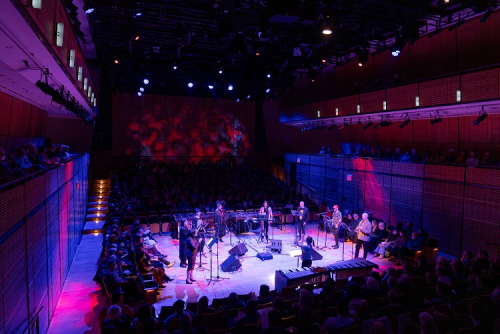
    Saturday January 25th, 2025 – Tonight, I had the joy of hearing Roomful of Teeth and Tambuco Percussion Ensemble perform at Carnegie Hall’s Zankel Hall. Between the two ensembles, I got to hear music by six different composers, from familiar favorites of mine like Caroline Shaw, to names that were completely new to me (but who I will certainly listen to again)

    Both Caroline Shaw’s and William Brittelle’s pieces were exceptionally chaotic—which is completely on brand for Roomful of Teeth! The eight singers performed a vast variety of vocal techniques and styles, including but not limited to guttural croaking sounds, throat singing, really really high notes, muttering repeated syllables, low glissandos, and speaking normally. Shaw’s piece, The Isle, in which she set text from Shakespeare’s The Tempest, also contrasted the chaos at times with more homophonous singing—hearty choral triads and flowing solo melodies—which provided a good balance so we could still hear the words.

    The text of Brittelle’s piece, Psychedelics, was very different. He explains in the program notes that the surreal collection of words in this music are “meant to form a swarm of images, not a literal, linear narrative.” And they certainly did just this! As I listened, I caught snippets of the words, such as “I watch for dogs,” and these fragments created a very joyful experience in their meaninglessness. Throughout this piece, I never knew what to expect in the best possible way!


    The bridge between the vocal portion of the concert and the percussive potion was the composer Gabriela Ortiz. Ortiz is Carnegie Hall’s composer in residence this year, and both Roomful of Teeth and Tambuco Percussion Ensemble performed a piece of hers in this concert.


    In Canta la Piedra-Tetluikan (of which this would have been a world premiere performance if not for the group of elementary school kids who got to sit in on a rehearsal), Ortiz set the words of poet Mardonio Carballo. And these words were in Nahuatl! Nahuatl is a language (sometimes considered a group of languages) spoken in Central Mexico, and I was very excited to hear it in a musical context. Ortiz’s setting of Carballo’s poem was joyously animated. The mesmerizing repetitions—“atl, atl, atl” (water, water, water), “tlitl, tlitl, tlitl” (fire, fire, fire), and more—and energetic (and very difficult!) rhythms grounded the music in the natural world. 


    I had been especially looking forward to hearing the voiceless alveolar lateral affricate (tɬ), since that sound is common in many variants of Nahuatl (and doesn’t appear whatsoever in English), but if the singers were singing it, the distinctly fricative sound didn’t come across prominently. Perhaps they were singing in a variety of this language that doesn’t include this consonant though, and no matter what, it was very exciting to hear music in Nahuatl!
     

    CH11514773


    Photo by Jennifer Taylor


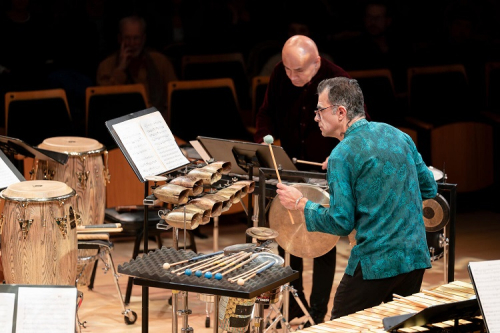
    After intermission, Tambuco Percussion Ensemble performed the movement “Liquid City,” from Ortiz’s 2014 piece, Liquid Borders. The four members of the ensemble played facing each other in a circle (the perfect set-up for the central stage!) and the blooms of sound radiated outwards into the hall. The diverse timbres of the instruments certainly reflected the diverse borders of urban and rural Mexico which Ortiz aimed to reflect in this music, the sounds mixing and shifting into unique and beautiful shapes.


    CH11514777


    Photo by Jennifer Taylor


    The other three pieces on the program were very different in that they were far more homogenous in terms of the instrumental inventory: Jorge Camiruaga’s Cuarteto en chico for four drums, Leopoldo Novoa’s Sábe cómo e’? for four guacharacas (and briefly one marímbula), and Steve Reich’s Mallet Quartet for two vibraphones and two marimbas. While these pieces were certainly reigned in the chaos compared to the first half of the program, they also proved that you could still create a wide variety of sounds and musical textures even among more similar instruments. 
     

    CH11514766


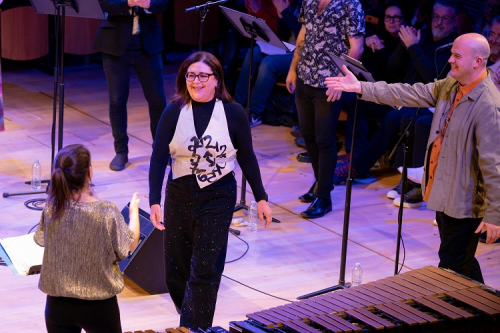
    Above: Gabriela Ortiz, photo by Jennifer Taylor


    It was especially fun to see how many of the composers on the program were in the concert hall enjoying the music alongside me and the rest of the audience! I enjoyed this concert so much, and I have a feeling they did too.

    ~ Lili Tobias

  • @ My Met Score Desk for CARMEN

    Aigul

    Above: Aigul Akhmetshina

    ~ Author: Oberon

    Saturday January 27th, 2024 matinee – Feeling no need to see a 6-ton tractor trailer on the stage of the Metropolitan Opera House, I took a score desk for today’s matinee of the Met’s new production of CARMEN. I wasn’t feeling my best this morning as I prepared to leave for Lincoln Center, and even considered staying home. But once the house lights dimmed, my spirits perked up, CARMEN is an opera I had not heard for a very long time, and the music seemed truly fresh to me today.

    The main draw of the day was Aigul Akhmetshina, the gorgeous Russian mezzo-soprano, in the title-role. I fell under she spell when she sang Maddalena in Verdi’s RIGOLETTO here last season, which I saw three times.

    Maestro Daniele Rustioni got the opera off to a fast start, setting a brisk tempo with the start of the prelude. Unlike some of the other conductors the Met favors these days, Rustioni is not a volume freak; the voices were – for the most part – clearly audible throughout the opera, and his tempi always felt right. I especially like his accelerations as each repeat of the theme of the Act II Danse Bohème sped up: exhilarating! The preludes to the four acts were beautifully played, particularly the touching music that introduces Act III. All the choral work was super as well, notably the lovely smoking chorus in Act I.

    The first solo voice we hear is that of Morales, sung very impressively today Benjamin Taylor; it’s a Met-sized voice of handsome timbre. Equally striking was the singing of Wei Wu as Zuniga. Both these gentlemen deserve more opportunities at The Met.

    Carmen’s friends – Frasquita (Sydney Mancasola), Mercedes (Briana Hunter), Dancairo (Michael Adams), and Remendado (Frederick Ballentine) – joined Ms. Akhmetshina for the quintet in Act II, excelling at the quick repartee. Ms. Mancasola popped off some bright top notes at the end of the Toreador Song and at “La Liberté!” to end the third act.  

    Micaela is the first principal character to appear, in the person of Angel Blue. This role suits Ms. Blue far better than Violetta did last season. She sounded warm and lyrical in the duet with Don José, etching in some appealing piano effects. And her aria in Act III – with its finely-played horn introduction – was a vocal highlight of the afternoon; Ms. Blue’s rich voice could be tapered smoothly to a sweet softness, making for a spine-tingling finish. Her final plea, with its stunning drop at “Ah, José!“, was beautifully handled.

    Maestro Rustioni provided a whiplash start to the famous Toreador Song; Kyle Ketelsen sang the familiar tune engagingly, and he was excellent in his ‘fight’ duet with José in Act III. Later – before the bullfight commences – he and Ms. Akhmetshina shared a lyrical moment. 

    Beczala 2

    Above: Piotr Beczala

    Piotr Beczała’s bio says he is 57 years old, but he certainly doesn’t sound it…nor look it, when I chatted him up at the stage door after the performance: he’s a very handsome guy, with an easy-going charm. His singing today as was most impressive, covering a wide dynamic range, from passionate, house-filling outpourings to ravishingly heady tones.  He and Angel Blue blended voices perfectly in their Act I duet, trading phrases persuasively, and finishing off with Piotr’s amazingly hush-toned “Souvenirs du pays…” 

    Chez Lillas Pasta, after Carmen upbraids José for abandoning her when the trumpets summon him back to the barracks, Mr. Beczala gave us his poetic Flower Song, so ardently voiced…and with a fascinating pianissimo climax to the final phrase. 

    When the music turns darker and the menacing edge of jealousy overtakes Don José, Mr, Beczala unleashed the power of his voice to thrilling effect. The character’s descent into madness was set forth in vocal terms, with a manic desperation in his singing of the final, deadly encounter with Carmen.

    Aigul Akmenshina established herself as one of the finest Carmens imaginable. Introducing herself with a sultry Habanera – the second verse sung with enticing subtlety – the comely mezzo displayed a warm, dusky timbre with a plushy low range and smooth forays to the top. Aigul’s Seguidilla put both the tenor and the audience under her spell with her creamy, gorgeous voice, topping it off with sustained final note. 

    Her singing of the the Chanson Bohème in the tavern scene veered from subtle to triumphant, but the fact that her later castanet song was not working on José as she’d expected unleashes her temper.  After listening patiently to José’s love plea, Carmen returns to enticement. Zuniga’s arrival causes José to capitulate, and he joins the smugglers. My feeling here is that Carmen already hates him.

    At the smugglers’ den, Aigul’s reading of the tarot cards was sung with doom-ladened low notes and a sense that time was running out for her. Her final meeting with Mr. Beczala’s José was fiery, their exchanges quickly descending to threats and taunts. In this production, José kills Carmen with a baseball bat, which I am glad I could not see; the audience gasped.

    Ms. Akhmetshina’s is a welcome voice and presence on the Met stage, and I will always look forward to her performances; I also hope to one day hear her in Chausson’s Poème de l’amour et de la mer, for which I think she has the perfect voice. 

    The few times I glimpsed the the stage setting today, it looked cheap and junky. A real eyesore.

    After the performance, I went to the stage door where I met Aigul and Piotr; they are such kind and lovely people.

    Carmen met-1jpg

    ~ Oberon

  • ADORATION @ The Sheen Center

    Adoration_Baranova-8660

    Photo by Maria Baranova

    Saturday January 20th, 2024 – I’m so glad I managed to get to see Adoration as part of the Prototype Festival. I haven’t seen the movie that it was based on, but would be interested in seeing it now – the story was well done but I would be curious to see how much more detail is explored in a movie version. For those who don’t know, the story is about a teenage kid (Simon) coming to terms with his parents’ death and their pasts. Simon reveals at school that his father was a terrorist and it seems that he opens up discussions with his classmates and online that are incredibly relevant at this moment in time. 

    I ended up being very focused on the storytelling and messaging of the difficult content, but want to make sure to first say that the music was amazing – Mary Kouyoumdjian’s score was beautiful – the instrumental parts often unassuming but supporting the drama, and the vocal lines soaring and satisfying. I don’t have the best ear when it comes to vocalists, but I thought they all sounded great – particularly Omar Najmi in the role of Simon. The choice to have them all mic’d was an interesting one which seemed mostly relevant for the purpose of adding reverb to certain scenes. It was a nice effect and changed up the sound a bit, though it didn’t seem necessary to me. Overall I imagine it added more control and an even sound – everyone was heard clearly throughout the show. 


    The set was simple but striking. I really liked the gradual beginning to the show – young Simon is on stage before the show starts, writing and sitting on the floor. The staging and set used live video that I’ve seen at many new opera productions recently – though in some interesting new ways, juxtaposed with recorded video, or used to project a photograph. 


    Adoration_Baranova-8840


    Photo by Maria Baranova


    Still, the most interesting part of this show was the story, for me. I was constantly asking myself questions and hoping to get clarity – which were mostly answered, though not explored in too much depth (understandable in the one act setting). I thought it was interesting that the main theme that was brought continually back was “innocence” rather than what many people might see in this type of source material: justice or justification, or motive. The real discussion of these themes comes from the actions of the character of Simon’s teacher, who is mentoring him and pushing him to explore his parents’ past. Her motives are questioned until we learn her backstory and understand her involvement in a new light. Was that the point? 


    It’s very hard to present something like this at any moment in time, but particularly now. I commend those who decided to do it anyway – and am curious what they hoped for us to get from it. I hope the piece has a long life and more people have the opportunity to ask these questions.


    ~ Shoshana Klein

  • Yuja Wang ~ Rachmaninoff @ Carnegie Hall

    Yuja wang

    Above: pianist Yuja Wang

    Author: Ben Weaver

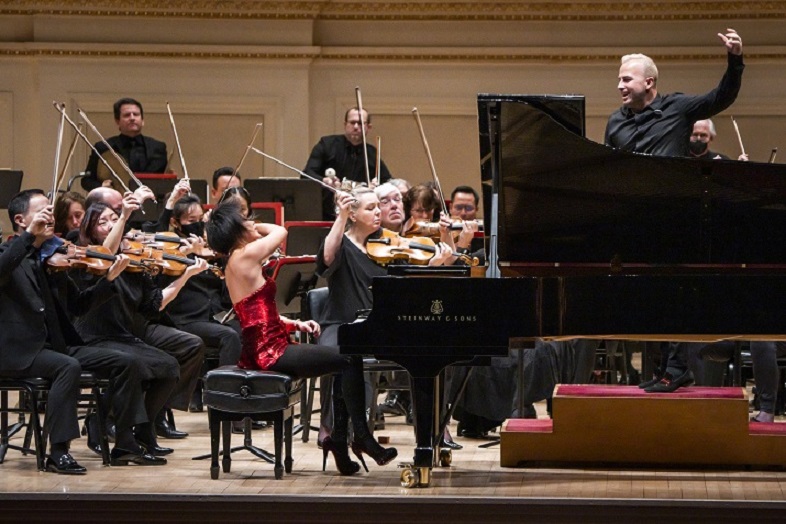
    Saturday January 28th, 2023 – Sergei Rachmaninoff’s four piano concertos are among the most challenging works in any pianist’s repertoire. Today, at Carnegie Hall, pianist Yuja Wang raised the bar for her colleagues by playing all four – plus Rhapsody on a Theme of Paganini – in one afternoon, accompanied by the Philadelphia Orchestra under the baton of Yannick Nézet-Séguin. These kinds of Olympic feats are rare; I’ve heard of the complete Beethoven Symphonies being conducted in a single day and Brahms’ two Piano Concertos in one concert, but I’m unaware of a single soloist taking on 5 concertos in one afternoon. Overall, the concert lasted nearly 5 hours, with two intermissions. Carnegie Hall was completely sold out, and, as a testimony to the artists and to the music, no one seems to have left early.

    One unscheduled extended pause was caused by a member of an audience collapsing and, apparently, dying just as the second movement of the 2nd Concerto ended. The man was revived in the hallway before the performance resumed. Maestro Nézet-Séguin informed us before performance of the 3rd Concerto that the gentleman was out of surgery and was expected to make a full recovery. That’s how long the concert lasted: a man died, was brought back to life, and was out of surgery at the 2/3 point of the afternoon!

    The marathon started with Rachmaninoff’s most enduring work and one of the most beloved works in the classical repertoire: the Piano Concerto No. 2 in C minor, Op. 18, composed in 1900-01 after an extended composers’ block Rachmaninoff suffered because of the disastrous premiere of his Symphony No. 1. After seeing a psychiatrist in France – which included hypnosis – Rachmaninoff composed this magnificent, melodic work which decades later would have pop-songs written to its tunes. (Eric Carmen’s “All By Myself” being perhaps the most successful chart-topper.) Ms. Wang’s strong, incisive solo introduction was a preview of the muscled playing that dominated the entire afternoon. She easily produced massive sounds from the Steinway, rising above Rachmaninoff’s dense orchestrations. Even on recordings, the piano sometimes gets lost in the famous melody at the beginning of Second Concerto’s Moderato movement. Not with Wang, who summoned torrents of sound that cut through the orchestra.

    Rachmaninoff was quite fond of the clarinet and wrote a number of magnificent music for it in his works, including in the Adagio sostenuto of this concerto. (The clarinet’s dark hues are also prominently featured in the contemporaneous Symphony No. 2). Clarinetist Ricardo Morales’ playing was invaluable here. I did feel the tempi in the first two movements were perhaps a bit too languorous; momentum seemed to be lost. But (after the performance resumed following the incident with the ill audience member), the closing Allegro scherzando was an exhilarating conclusion.

    Rachmaninoff’s Piano Concerto No. 1 in F-sharp minor, Op. 1 (composed 1890-91 and revised extensively in 1917) and Piano Concerto No. 4 in G minor, Op. 40 (composed in the US in 1924-26, and premiered by the composer with Leopold Stokowski and the Philadelphia Orchestra) are his least known concertos. Perhaps their melodies are not as hummable as the other works, but they are filled with melodies nonetheless, and wonderful writing for the piano. Ms. Wang met every obstacle with ease and bravura. Concerto No. 1, composed when Rachmaninoff was only 17, has all the trademarks that would define his style as he matured, including expansive, romantic melodies and dark orchestrations. And though Rachmaninoff always maintained that he was a romantic composer through-and-through (and was criticized for it by the modernists), his Concerto No. 4 sometimes echoes – intentionally or not – Ravel’s Piano Concerto and Gershwin’s Rhapsody in Blue (which Rachmaninoff heard at its 1924 world premiere performance.) So while he never became a modernist, Rachmaninoff was certainly influenced by the sounds of his contemporaries. I’ve heard Ms. Wang play a magnificent Ravel Piano Concerto live, and I was getting flashes of some of those moments as she played the Fourth here.

    The Rhapsody on a Theme of Paganini, Op. 43, composed in 1934 and premiered by the composer with Stokowski again conducting the Philadelphia Orchestra, is one of Rachmaninoff’s most brilliant works. Using the same Paganini Caprice that inspired numerous others to compose variations (Schumann, Brahms (two separate works), Liszt, Lutosławski, Schnittke), Rachmaninoff’s compact work never flags. It is a magnificent, tenacious bulldozer of invention. The original tune is shaped, reshaped, stretched in every imaginable way, and yet each variations is a beautiful thing of its own. The most famous of these, the immortal 18th Variation, is the original melody played upside down. The joy maestro Nézet-Séguin took in conducting of this section was clear: he seemed to be floating off the podium. Ms. Wang – needless to say conquered every technical challenge – but also the poetry, the beauty of her playing was unmatched.

    The concert ended with the Mount Everest of the concerto repertoire, the towering Piano Concerto No. 3 in D minor, Op. 30. Composed in 1909, while Rachmaninoff still lived in Russia, he intended it to be his calling card in the West, as he was embarking on his first American tour. And so the concerto was premiered in New York with the New York Symphony Orchestra, conducted by Walter Damrosch. (Six weeks later Raxhmaninoff played it again in New York, this time with the New York Philharmonic- the two orchestras later merged into one – under the baton of Gustav Mahler. There are stories that Mahler was not entirely happy with the collaboration.)

    I don’t know if this concerto actually drove David Helfgott to madness, but it is certainly enough to scare anyone into an asylum, and for Ms. Wang, playing it after roughly 4 hours of performing, was a brave decision. Fortunately for us her hands seem to be made of steel. This was not an example of someone crawling across the finish line: Ms. Wang crossed it at full speed. I noticed her hanging her hands down between playing, seemingly resting/stretching. But her playing did not show any sign of fatigue. Every note was crystal clear, and she – and Maestro Nézet-Séguin – did not shy away from the grandness and romanticism of Rachmaninoff’s music. And there is no better orchestra to play Rachmaninoff than his own favorite Philadelphians. They have this in their blood.

    One thing Yuja Wang is known for – outside of her extraordinary pianism – is outfits (she wore 5, one new ensemble for each work), but another is encores. She is very generous with encores: as long as the public wants more, she is happy to provide. I joked to a friend that really this concert was just a performance of the Second Concerto followed by encores of the rest of Rachmaninoff’s concertos. In the end – after such a grueling afternoon – she gave just one encore, an achingly beautiful “Dance of the Blessed Spirits” from Gluck’s Orfeo ed Euridice, transcribed by Giovanni Sgambati.

    There is so much to admire in Yuja Wang’s artistry. Some people seem to be distracted by her showmanship and outfits. I’m struck by her genuine love of performing live and love for her audience. It’s why she’s so happy to keep playing encores as long as her audience is on their feet. Another great pianist I recently saw live at Carnegie, after an extraordinary concert, offered an encore of just literally a few notes (something by Schoenberg.) Really, it was a joke, but it was also rude. Ms. Wang’s joy at being on stage is infectious. We’ve read about Liszt and Paganini’s shenanigans. Why can’t a contemporary artist do more than roll out, play, and leave? Brava, Ms. Wang, for treating this music as a living, breathing being and engaging with your audience with such generosity.

    ~ Ben Weaver

    Here’s a gallery of performance images by photographer Chris Lee documenting this unique evening:

    CH11298876

    CH11304127

    CH11304129

    CH11304132

    CH11304130

    CH11298873

    CH11298875

    Above: Maestro and soloist at the close of the evening; performance photos by Chris Lee, courtesy of Carnegie Hall

  • @ My Met Score Desk ~ BOHEME Matinee

    Agresta castronovo

    Above: Maria Agresta and Charles Castronovo in LA BOHEME; a MetOpera photo

    Saturday January 22md, 2022 matinee – This performance had its ups and downs, The conducting of Carlo Rizzi was hit-or-miss; he sometimes allowed the orchestra to swamp the singers. But I did like his speedy take on the first several minutes of the Cafe Momus scene.

    Charles Castronovo repeated his very persuasive Rodolfo from the November run. His singing is emotional without straying from the notes, and he has both power and subtlety in perfect measure. His Mimi this afternoon, Maria Agresta, sounded sadly out-of-sorts, her vibrato prominent, and her highest notes not entirely comfortable. Offsetting these reservations was her congenial phrasing and some lovely piano effects.

    Lucas_meachem

    Lucas Meachem (above) was a magnificent Marcello, making every phrase count. The voice is large and warm, and he handily dominated the ensemble ‘reprise’ of the “Musetta Waltz” theme in Act II. His duet with Ms. Agresta in Act III was impressively sung. Gabriella Reyes screeched and shrilled Musetta’s lines at first, but settled in for a nice rendering of the Waltz; I feel that she might be better cast as Mimi.

    Alexander Birch Elliott was a fine Schaunard, despite having to cope with lacklustre conducting from Mr. Rizzi. I liked Peter Kellner’s Colline very much, too, but the thought of enduring a second Gelb intermission caused me to head home without hearing his “Vecchia zimara“.

    The House was substantially full, and there was surprise applause after the Bohemians dismissed Benoit in Act I. Lots of noisy chatter from the ceiling lighting bay during Act I was distracting, and the interminable first intermission simply killed whatever dramatic impetus the opera had going.

    Metropolitan Opera House
    Janaury 22nd, 2022 matinee

    LA BOHÈME
    Giacomo Puccini

    Mimì....................Maria Agresta
    Rodolfo.................Charles Castronovo
    Musetta.................Gabriella Reyes
    Marcello................Lucas Meachem
    Schaunard...............Alexander Birch Elliot
    Colline.................Peter Kellner
    Benoit..................Donald Maxwell
    Alcindoro...............Donald Maxwell
    Parpignol...............Gregory Warren
    Sergeant................Jonathan Scott
    Officer.................Ned Hanlon

    Conductor...............Carlo Rizzi

    ~ Oberon

  • Shanghai Ballet’s SWAN LAKE

    AatgRM6U

    ~ Author: Oberon

    Saturday January 18th, 2020 – Billed as the “Grand SWAN LAKE“, Shanghai Ballet’s production of the Tchaikovsky classic arrived at Lincoln Center for four performances, of which we saw he third. In this very traditional setting, the Derek Deane Petipa-based choreography offers no surprises, aside from the sheer number of swans to be seen: I guess that’s what makes it “grand”.

    The production is mostly pleasing visually, but the scene in the palace ballroom has a very ugly mish-mash of a set in which the vision of Odette seems like an afterthought, thus missing a key dramatic point. Garish costumes for the national dances added to the cheesy effect.

    NpBsJKht

    But the lakeside scenes were fine, and the 48 swans were wonderfully in-sync choreographically, making the stage seem full but not over-crowded. Mr. Deane deploys them skillfully as they form pleasing patterns and make smooth entrances and exits throughout the White Swan act. Zhu Haibo, a Rothbart with expansive wings dripping with seaweed, menaced Odette and her prince as Rothbarts have ever been wont to do.

    There’s no Jester in this production, nor does the prince have any friends to join him on his hunting expedition. There is a Tutor, who is thankfully not given much to do.

    DI8YdXbF

    At the heart of the matter, Qi Bingxue as Odette/Odile and Wu Husheng as Siegfried (above) danced expressively and with technical polish. Their love, doomed from the start, played out in the moving tenderness of their partnering, in their effortless brilliance in the feats of the Black Swan pas de deux, and in the jolt of betrayal. But the production ends rather weakly, as the lovers float over the stage on a large swan-boat while Rothbart lay dying. Once you’ve experienced the final moments of the Peter Martins SWAN LAKE, nothing else compares. 

    The New York City Ballet orchestra played the familiar score with some very nice solo parts shining thru, and Charles Barker conducted, keeping a firm rein on things whilst also admirably supporting the principal couple thru both the poignant and the showy passages.

    Late seating, and ushers wandering the aisles to admonish viewers about cellphones during the music, were serious distractions, as were the constant babbling of the two Russian women seated next to us, and of the two silly queens sitting behind us. But we stayed until the end, because Wei was enjoying it.

    Production photos by North American Photography Associates, courtesy of Michelle Tabnick PR

    ~ Oberon

  • Shanghai Ballet’s SWAN LAKE

    AatgRM6U

    ~ Author: Oberon

    Saturday January 18th, 2020 – Billed as the “Grand SWAN LAKE“, Shanghai Ballet’s production of the Tchaikovsky classic arrived at Lincoln Center for four performances, of which we saw he third. In this very traditional setting, the Derek Deane Petipa-based choreography offers no surprises, aside from the sheer number of swans to be seen: I guess that’s what makes it “grand”.

    The production is mostly pleasing visually, but the scene in the palace ballroom has a very ugly mish-mash of a set in which the vision of Odette seems like an afterthought, thus missing a key dramatic point. Garish costumes for the national dances added to the cheesy effect.

    NpBsJKht

    But the lakeside scenes were fine, and the 48 swans were wonderfully in-sync choreographically, making the stage seem full but not over-crowded. Mr. Deane deploys them skillfully as they form pleasing patterns and make smooth entrances and exits throughout the White Swan act. Zhu Haibo, a Rothbart with expansive wings dripping with seaweed, menaced Odette and her prince as Rothbarts have ever been wont to do.

    There’s no Jester in this production, nor does the prince have any friends to join him on his hunting expedition. There is a Tutor, who is thankfully not given much to do.

    DI8YdXbF

    At the heart of the matter, Qi Bingxue as Odette/Odile and Wu Husheng as Siegfried (above) danced expressively and with technical polish. Their love, doomed from the start, played out in the moving tenderness of their partnering, in their effortless brilliance in the feats of the Black Swan pas de deux, and in the jolt of betrayal. But the production ends rather weakly, as the lovers float over the stage on a large swan-boat while Rothbart lay dying. Once you’ve experienced the final moments of the Peter Martins SWAN LAKE, nothing else compares. 

    The New York City Ballet orchestra played the familiar score with some very nice solo parts shining thru, and Charles Barker conducted, keeping a firm rein on things whilst also admirably supporting the principal couple thru both the poignant and the showy passages.

    Late seating, and ushers wandering the aisles to admonish viewers about cellphones during the music, were serious distractions, as were the constant babbling of the two Russian women seated next to us, and of the two silly queens sitting behind us. But we stayed until the end, because Wei was enjoying it.

    Production photos by North American Photography Associates, courtesy of Michelle Tabnick PR

    ~ Oberon

  • Oberlin College Choir and Orchestra @ Carnegie Hall

    Oberlin-in-nyc-v3

    ~ Author: Brad S Ross

    Saturday January 19th, 2019 – The Oberlin Conservatory of Music, visiting from Ohio, began 2019 on the proverbial high-note Saturday night at Carnegie Hall’s Isaac Stern Auditorium.  The talents of students and educators alike were well-showcased in a concert bifurcated between the Oberlin College Choir and the Oberlin Orchestra.  Following brief opening remarks by Oberlin College President Twillie Ambar, things were swiftly under way in what would turn out to be a tremendously satisfying program.

    Thumbnail_RS80080_LK2_9234 copy copy

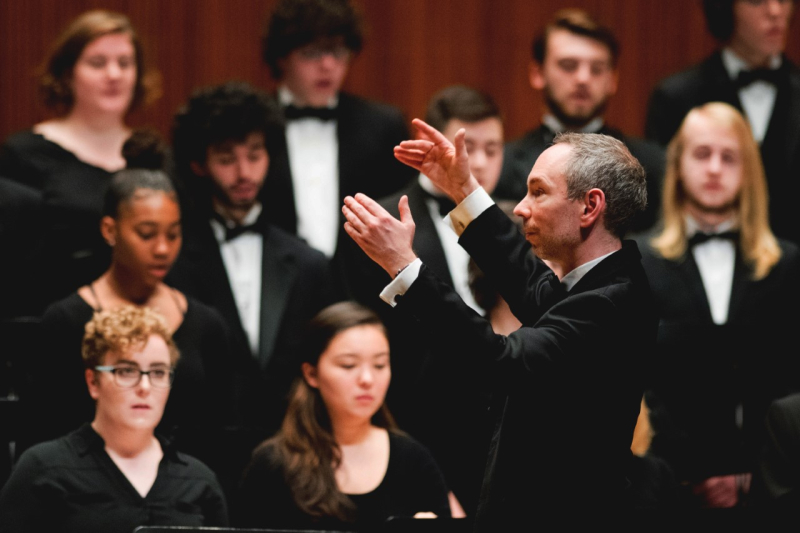
    For the first half of the concert, the Ronald O. Perelman Stage belonged to the Oberlin College Choir under the baton of Gregory Ristow (photo, above).  They began with Triptych, a mostly tonal choral composition written in 2005 by the British-American composer Tarik O’Regan.  Though originally cast for chorus and orchestra (and what a sight to behold that would’ve been!), it was presented here in a more manageable arrangement for percussion and chorus by the percussionist and composer Dave Alcorn.  It featured an eclectic text culled from such myriad sources as William Blake, John Milton, William Wordsworth, Muhammad Rajab al-Bayoumi, and the Book of Psalms, among others.

    The first movement, “Threnody,” opened on a gripping a cappella statement set to an epigram by William Penn, “When death takes off the mask, we will know one another.”  A driving percussion line soon entered and pushed the work forward as languid, otherworldly phrases meandered in call and answer throughout the chorus.  The effect was almost primal.

    Following a short percussion interlude, the second movement “As We Remember Them” opened on a haunting soprano solo set to the words of the rabbi Roland B. Gittelsohn, “In the rising of the sun and at its going down, we remember them.”  This was performed with remarkable precision by Risa Beddie, whose voice would be featured occasionally throughout the remainder of the piece.  This elegy seemed in many ways the heart and soul of O’Regan’s Triptych, however, as the combined, yet subdued forces of Beddie, chorus, and percussion achieved a hypnotic beauty.

    Another short interlude followed and the work was propelled energetically forward into the third and final movement, “From Heaven Distilled a Clemency.” O’Regan’s choral writing here was its most exuberant as the choir toned the words of the great Persian poet Rumi, “So why then should I be afraid?  I shall die once again to rise an angel blest.”  Beddie’s haunting soprano then returned for one last quiet utterance before the work rose to its climactic finale.  Every force was well-utilized in Triptych and it made for excellent way to put the evening into motion.

    Next up was Igor Stravinsky’s ballet Les noces (“The Wedding”) for four pianists, percussion, vocal soloists, and chorus from 1923.  Like O’Regan’s Triptych, Les noces was also originally conceived for a much larger ensemble, but Stravinsky himself made the decision to scale back its herculean forces to a mere four solo vocalists, chorus, percussion, and four pianos.  Indeed, even with this “reduced” compliment, the sight of so many musicians, instruments, and four Steinway pianos gave the stage impressively cluttered look.  Its libretto, penned by the composer himself from traditional Russian wedding songs, describes the marriage rite of a young bride and groom.

    Les noces begins frighteningly on a solo soprano line accompanied by piano, cymbals, and xylophone effecting somber bell tones.  Other unholy voices soon joined the proceedings as the mother and bridesmaids console the young bride-to-be.  While the libretto features a deceptively melodramatic narrative, musically Stravinsky seemed to be describing a wedding straight from the gates of hell.  There was no hint of saccharine or sentiment to be found amongst the composer’s numerous parallel lines, violent dynamic shifts, and strikingly dissonant harmonies—so much the better.

    Les noces followed the marriage of its protagonists right up to the wedding night and showcased exhilarating performances by the soprano Katherine Lerner Lee, mezzo-soprano Perri Di Christina, tenor Nicholas Music, baritone Kyle Miller, and bass Evan Tiapula as various members of the ceremony.  Its final eerie bell tone—open octaves throughout the instrumental accompaniments—reverberated for what seemed an eternity before Ristow finally lowered his baton.  This was an electrifying way to conclude the first half of the program.

    Thumbnail_RS16976_IMG_7691 copy copy

    After intermission came a high-point in what had already proved to be an exhilarating evening.  The conductor Raphael Jiménez (photo, above) and the Oberlin Orchestra next took the stage for the New York premiere of Elizabeth Ogonek’s All These Lighted Things—a set, as the work’s subtitle notes, of “three little dances for orchestra.”  It was originally commissioned and premiered by the Chicago Symphony Orchestra in 2017 while Ogonek served as the ensemble’s composer-in-residence.  Ogonek, who teaches composition at Oberlin, has quickly earned a reputation as one of the finest young composers in the United States.  Based on All These Lighted Things, I would be hard-pressed to disagree.

    The first movement began with quiet textures emanating from the percussion and high strings.  A broad sonic spectrum swiftly unfolded from Ogonek’s musical prism, with such varied colors as muted brass, dissonant woodwind runs, and violent strikes in the strings, among many other extended techniques I couldn’t quite decipher from a single hearing.  The etherial sound of a rainstick opened and continued to be featured throughout the second movement, soon joined by a full high-voice descending glissandi and a stirring violin solo by concertmaster Jerry Zheyang Xiong.

    Animated pizzicato runs in the bass and celli signaled the start of the third movement.  Aided with light percussion, swift woodwind runs allude to a growing musical menace.  A sumptuous flute line emerged with building woodwind accomplices.  Finally, a great, full-ensemble crescendo swelled to a tremendous crash and a few fleeting quiet percussion voices sang the piece to its silent conclusion.

    Like many contemporary pieces, All These Lighted Things seemed to be more about shifting sonic textures than any strict adherence to musical form.  This will no doubt exhaust some listeners who long for structure, but they should at least take comfort that none of Ogonek’s sonorities ever outstay their welcome, as modern compositions so often do.  I, for one, found it a lively and vibrant piece—one that will surely warrant many further hearings.

    The evening concluded with a performance of Claude Debussy’s La Mer.  Its performance was solid, if not quite on par with what New York audiences have been spoiled to expect of late (the New York Philharmonic programmed it twice last year alone, both times to tremendous effect).  Apart from the occasionally muddy entrance and one conspicuously fracked trumpet note, the Oberlin Orchestra played with delicate grace, offering a decidedly above-average rendition of Debussy’s great orchestral tome.  For his part, Jiménez’s interpretation was lingering and dynamic, never rushing its dramatic moments.  This worked well in its first and second movements where Debussy’s colors should be allowed to frolic and breathe freely.  By the third movement, however, this approach seemed a touch overwrought and unfortunately robbed some essential energy from the grand brass chords that announce the work’s finale.

    But I quibble.  A critic knows he’s heard something truly good when there are only minor details he would change.  All in all, this was a successful finale to an indisputably successful concert program—one that will surely signal a prosperous new year for the Oberlin Conservatory’s faculty and students.  If the sustained standing ovation that night was any indication, New York audiences will welcome them back as often as they’ll come.

    ~ Brad S Ross

  • @ My Met Score Desk for TOSCA

    E874b757ab6d27cdce90e262524cf12e

    ~ Author: Oberon

    Saturday January 27th, 2018 matinee – The Met have fortunately replaced their unsightly and theatrically tedious Luc Bondy production of TOSCA with a traditional setting of the “shabby little shocker”; it opened on New Year’s Eve with a cast and conductor that had undergone changes in the run up to the prima.

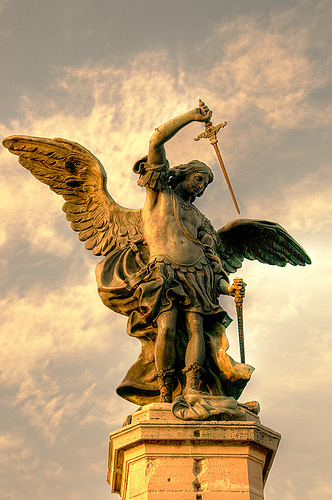
    Aside from the dramatic show curtain depicting the Archangel Michael with blood-red wings, I could not see anything of the sets and costumes from my score desk. In April, I’ll get a full-view when the ‘second cast’ takes over.

    Other than at performances of TURANDOT, this was the fullest house I have seen at The Met in the past few seasons. Apparently many in the audience found the MetTitles in Act I to be hilarious today, for there was much unbridled laughter.

    The orchestra sounded great, and I’ve always liked Emmanuel Villaume’s conducting both in the opera house and the concert hall. His TOSCA was on the grand scale, painted in broad strokes, with tempi that pressed forward; yet there were also the needed lyrical respites where orchestral detail could be savoured. Villaume also allowed his singers to cling to favorite notes, without losing the shape of the music. A volcanic eruption of orchestral sound as the ‘Scarpia Chords’ heralded the Baron’s entry was actually thrilling.

    Sonya Yoncheva has been singing her first career Toscas in the present run. My past experiences with her in the theater have been as a pleasant Mimi and a moderately attractive Desdemona. In both those roles, a rather generic timbre and a tendency to sing slightly above pitch rather frequently offset her physical appeal and pretty but unexceptional vocalism. Making a sudden leap (oops!) to Tosca seemed like an unwise move for her; but, since I’m not a fan, do I really care if she blows her voice out?

    Her Tosca was sung with unrelenting loudness; it’s a one-colour voice to begin with, and she seemed indifferent to the markings in the score, seldom if ever singing less than mezzo-forte. Being a shade sharp much of the time did not help matters. She’s pushing the lower range, and the top now tends to waver a bit. Overall there was a sense of forcing to fill the big hall.

    The “Vissi d’arte” was over-sung, without the pulling back at “Nell’ora del dolore…” that personalizes the aria. In terms of declamation, Ms. Yoncheva  melodramatically veered from ‘shrilling’ on “Tu non l’avrai stasera…giuro!” to shouting on “Sogghigno di demone!”  Overall, she often seemed fully-extended. Yet her big aria won her a big applause, and I feel she’ll be encouraged to make further forays into roles calling for a more dramatic sound than is hers by nature. I would guess in three or four years she will find herself in a similar situation vocally to the woman she replaced in these performances.

    Vittorio Grigolo’s Cavaradossi is likewise a step or two in vocal heft beyond the roles we’ve heard him sing to date. A generous singer, Grigolo pleases the crowd with his unfettered sound; he can zing out top notes that have a real spark but – unlike Ms. Yoncheva – he does on occasion throw in a piano note or turn a phrase more gently.

    In the past, Željko Lučić has sometimes annoyed me with his errant sense of pitch in the Verdi roles, but today as Scarpia that problem cropped up only in passing. Following the thundering chords that announce Scarpia’s arrival in the Church of Sant’Andrea della Valle, Mr. Lučić unleashed his own thunderbolt with “Un tal baccano in chiesa?!”, catapulting to a house-filling top note. He alone of the three principals seemed to be doing something with the the words, and his singing veered from ripe power to velvety insinuation. As Tosca fled the scene after their encounter, Mr. Lučić’s Scarpia laid the groundwork for his plot. In the ensuing Te Deum, baritone, chorus, and orchestra combined forces for genuinely exciting finale to the first act.

    Lučić continued to impress in Act II, despite the occasional flat note. Ferocious in his questioning of Cavaradossi, feigning cordiality as he drew Tosca to the bargaining table, brazenly expounding on his lechery in “Gia, mi dicon venal”, the Serbian baritone joined the ranks of my favoured Scarpias over the decades: Anselmo Colzani, Cornell MacNeil, Sherrill Milnes, Robert Hale, Frederick Burchinal, and Justino Diaz.

    It’s rare to hear a Sacristan who really sings: Patrick Carfizzi put the emphasis on the notes, and let the comedic aspects of the character take care of themselves. He sounded fantastic.

    I was planning to stay for the third act, but as so often happens at The Met, the endless intermission got on my nerves and so, after a while, I packed up and headed home.

    ~ Oberon

  • TURANDOT at The Met – 4th of 4

    Backstage

    Above: a Met TURANDOT blast-from-the-past with Birgit, Franco (Z, not C), Jimmy, Eva, Liz, and Placi

    Saturday January 30th, 2016 matinee – I took a score desk this afternoon to hear the fourth of four sopranos who have sung the role of Turandot during the current Met season. My history of Turandots at The Met goes back to the Old House, where Mary Curtis-Verna was the first soprano I heard in the role. Since then, I have witnessed almost every singer to tackle this part in New York City, from The Big B (Birgit Nilsson) to sopranos you never heard of, several of them at New York City Opera where a perfectly nice Beni Montresor production held forth for many seasons. 

    At The Met, where Franco Zeffirelli’s extravaganza (which replaced Birgit’s Cecil Beaton setting in 1987) has been home to such post-Birgit divas as Eva Marton, Dame Gwyneth Jones, Ghena Dimitrova, and Jane Eaglen, audiences still cheer – as they did today – the massive vision of the royal palace as it comes into view midway thru Act II.

    Act I today was very pleasing to hear: after a dragging tempo for the opening scene of the Mandarin’s address (grandly declaimed by David Crawford, who had the breath control to fill out the slo-mo phrases), conductor Paolo Carignani had everything just about right. The score is a marvel of orchestration: so much detail, so many textured layers of sound. I simply love listening to this music, especially passages like “O taciturna!” where Carignani drew forth such evocative colours from his players.

    Anita Hartig sang very attractively as Liu, her voice reminding me just a bit of the wonderful Teresa Zylis-Gara’s. Hartig did not do a lot of piano/pianissimo singing, which can be so very appealing in this music, but she had the power to carry easily over the first act’s concluding ensemble. The Romanian soprano’s concluding B-flat in “Signore ascolta” was first taken in straight tone; she then allowed the vibrato to seep in: quite a lovely moment.  Hartig’s voice has an unusual timbre and just a touch of flutter to bring out the vulnerability of the character.

    I was likewise very impressed and moved by the singing of Alexander Tsymbalyuk as Timur: mellow and warm of tone, and with a deep sense of humanity. 

    Whilst not holding a candle to such past Calafs as Corelli, Tucker, McCracken, Domingo, or Pav, Marco Berti did very well in Act I: his idiomatic singing carried well (though Carignani swamped him a couple of times, unnecessarily), and his piano approach to the opening phrases of “Non piangere, Liu” was finely judged. Berti firmly sustained his final call of “Turandot!” at the act’s conclusion.  

    The three ministers – Dwayne Croft, Tony Stevenson, and Eduardo Valdes – did well, especially as they reminded Berti/Calaf that La vita è così bella! These three singers, as far as I know, sang these trio roles at every performance of TURANDOT this season and made a fine job of it; but a ‘second cast’ might have been given an opportunity. Variety is the spice of operatic life, after all.

    After the ridiculously long intermission, Act II started well but then things began to unravel a bit. Mr. Croft experienced some hoarseness, and Mr. Berti didn’t sound solid in the vocally oddly-placed lines at “Figlio del cielo!” where he re-affirms to the old Emperor his desire to play Turandot’s riddle game. A silence of anticipation filled the house just as Nina Stemme was about to commence “In questa reggia“, but the moment was spoilt by voices from the lighting bay at the top of the hall shouting “Have you got her?” The chatter continued through the opening measures of the aria.

    Ms. Stemme’s now-prominent vibrato sounded squally at first; the phrasing was uneven and frankly the singing had a rather elderly quality. The top notes were rather cautiously approached and seemed a bit unstable, though she was mostly able to disguise the effort. Concerns about producing the tone seemed infringe on her diction, with some odd results. The opening challenge of the riddle scene – “Straniero! Ascolta!” – did not have the desired ring. 

    Stemme’s posing of the riddles was a mixed bag vocally – and Berti’s responses were clipped, with traces of hoarseness creeping in. By the third riddle, the soprano seemed to be gaining steadiness. In the great moment after her defeat when Turandot is called upon by Puccini to blaze forth with two high-Cs over the chorus, Stemme made no impact on the first one and was assisted by the chorus soprani for the second.  Berti responded with a skin-of-his-teeth high-C on “…ti voglio tutto ardente d’amor!” but the tenor came thru with a pleasingly tender “…all’alba morirò…” before the chorus drew the act to a close.

    I debated staying for the third act, mainly to hear Hartig and Tsymbalyuk, but the thought of another 40-minute intermission persuaded me otherwise. Returning home, I found a message from a friend: “So, who was the best of the Met’s four Turandots?” The laurel wreath would go to Lise Lindstrom. Jennifer Wilson in her one Met outing was vocally savvy but it would have been better to have heard her a few years earlier. The role didn’t seem a good fit for Goerke or Stemme, who expended considerable vocal effort to make the music work for them (Goerke more successfully, to my mind) but both would have perhaps been wiser to apply their energy to roles better suited to their gifts (namely, Wagner and Strauss). Still, it was sporting of them to give La Principessa a go.

    As with the three earlier TURANDOTs I attended this season, and the many I’ve experienced in this Zeffirelli setting over the years, the house was packed today. Even Family Circle standing room was densely populated. To me, this indicates the opera-going public’s desire for the grand operas to be grandly staged.

    There’s a rumor circulating that today’s performance marked the final time this classic production will be seen. It seems a mistake to discard it, since it originated fully-underwritten by Mrs. Donald D. Harrington, revivals have always been generously supported by major Met donors, and it obviously does well at the box office. Why put a cash cow out to pasture? It’s already been suggested that the next Met TURANDOT production will be set in Chinatown in the early 1900s and will star Anna Netrebko and Jonas Kaufmann (who will cancel), with Domingo as Altoum.

    Metropolitan Opera House
    January 30th, 2016 matinee

    Giacomo Puccini's TURANDOT

    Turandot................Nina Stemme
    Calàf...................Marco Berti
    Liù.....................Anita Hartig
    Timur...................Alexander Tsymbalyuk
    Ping....................Dwayne Croft
    Pang....................Tony Stevenson
    Pong....................Eduardo Valdes
    Emperor Altoum..........Ronald Naldi
    Mandarin................David Crawford
    Maid....................Anne Nonnemacher
    Maid....................Mary Hughes
    Prince of Persia........Sasha Semin
    Executioner.............Arthur Lazalde
    Three Masks: Elliott Reiland, Andrew Robinson, Amir Levy
    Temptresses: Jennifer Cadden, Oriada Islami Prifti, Rachel Schuette, Sarah Weber-Gallo

    Conductor...............Paolo Carignani