Tag: Saturday July

  • Shanghai Grand Theatre ~ LADY WHITE SNAKE

    White snake

    ~ Author: Oberon

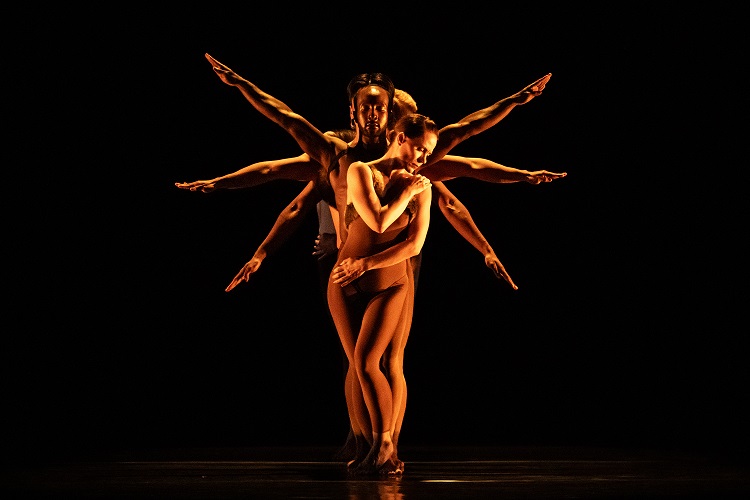
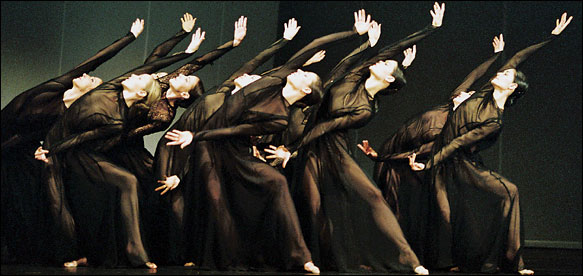
    Saturday July 26th, 2025 – Wei was with me tonight for The Shanghai Grand Theatre’s production of LADY WHITE SNAKE, playing a brief run at Lincoln Center. The program note provides this outline of the story: “The legend of the White Snake is a classic Chinese folk tale about Bai Suzhen, a snake spirit who transforms into a beautiful woman in order to experience life and love as a human. She falls in love with and marries a mortal named Xu Xian, but their relationship is threatened by a Buddhist monk named Fahaj, who recognizes Bai Suzhen’s true identity. The story explores themes of love, sacrifice, and the conflict between the mortal and supernatural worlds.”

    There’s much more to the story than that, but I chose to focus more on the choreography and the music rather than on the narrative. The Shanghai company, under the direction of the marvelous Yuanyuan Tan, a longtime star of San Francisco Ballet who I once had the opportunity to meet, is full of beauteous dancers of both sexes. 

    I guess I was expecting a more mythic approach to the story; much of the time the look and feel were quite contemporary. Most of the visuals were stunning. The musical score, by Xu Zhou, which featured passing nods to Chinese folk music, was – in general – more redolent of Rachmaninoff and Borodin: grand, cinematic, and a bit glossy. The choreography, by Wang Peixian, is mainly rooted in classical ballet, with some acrobatic passages for the men woven in. Sets, lighting, and video designs were all strikingly impressive, especially the presence of an enormous bell hovering over the scene.  

    It’s been a while since I took notes in the House of Balanchine; I’d forgotten that it’s nearly as pitch-black as The Joyce. I soon found that I’d over-written existing comments with newer ones. 

    The storytelling was quite clear in Act I; Act II was less compelling, with some scenes feeling over-extended. The choreography lost some of its potency as the ballet progressed, though the level of dancing never faltered. The principals in the cast danced and acted to perfection: Liu Sirui as the White Snake and Wang Nianci as the Green Snake are beauties: my husband referred to them as sisters. Both women danced and acted with finesse and deep commitment. Sun Jiayong as Xu Xian, husband of the White Snake, was poetic, elegant of movement, and an attentive partner. As the rather sinister Psychologist, Fa Hai, Su Hailu gave a stunning performance, his acrobatic feats dazzling to behold. 

    Though losing some momentum after the interval, the production continued to be visually engrossing. The audience seemed thoroughly tuned in to the story-telling, though I began to think the tale of Lady White Snake might be more persuasively told as an opera rather than a ballet. A bit of research revealed that there is indeed an operatic setting of the story: Madame White Snake, composed by Zhou Long and premiered in Boston in 2010; two friends of mine – Ying Huang and Michael Maniaci – were in the cast. 

    The evening ended with a tumultuous ovation and a set of staged curtain calls that sustained the applause for several minutes. One delightful aspect of the performance for me was running into my long-time fellow NYC Ballet fan, Lynne Goldberg, and two of my beloved Graham divas: Xin Ying and Natasha Diamond-Walker.

    ~ Oberon

  • Chamber Music Society ~ Summer Finale 2024

    Alice-Tully-Hall-at-The-Juliard-School-Photo-14

    ~ Author: Oberon

    Saturday July 27th, 2024 – The final offering of Chamber Music Society of Lincoln Center’s 2024 Summer Evenings series took place tonight at Alice Tully Hall. After a long lunch with friends, where some very serious topics were discussed, I was in a pensive mood when we arrived at the hall. The light, decorative music of Ludwig van Beethoven’s Serenade in D-major for Flute, Violin, and Viola, Op. 25, written in 1801, was not a good match for me today, feeling a need for something darker and more soulful.

    Nevertheless, the playing was charming and, as the piece progressed, there was much to admire. It kicks off with a reveille, only it’s Tara Helen O’Connor’s flute that’s sending out a wake-up call rather than a bugle. Ms. O’Connor’s playing was at its most limpid throughout the suite. ln the songlike second movement, a minuet, her playing was elegant, whilst violinist Aaron Boyd and violist James Thompson provided echo effects. The Allegro molto  shifts between major and minor modes.

    Sweet harmonies fill the Andante, with its contrasting animated interlude, following by a scurrying Allegro scherzando. The final movement begins as an Adagio but soon transforms into an Allegro vivace, with lively playing from the three artists.

    Franz Schubert’s Rondo in A-major for Violin and String Quartet, D. 438, dating from 1816, did not provide a contrast to the pleasantness of the Beethoven, though again it was beautifully played by soloist Sean Lee and a quartet made up of Cho-Liang Lin, Aaron Boyd, James Thompson, and Nicholas Canellakis.

    Sean Lee’s playing was spot-on, with touches of rubato, and the ensemble cushioned his playing perfectly, grounded by Nick Canellakis’s ever-velvety tone.

    Following the interval, Heinrich Wilhelm Ernst‘s demanding Grand Caprice on Schubert’s “Erlkönig” for Violin, Op. 26, was given a spirited rendering by Sean Lee, though perfect clarity was sometimes missing.

    The concert ended with Wolfgang Amadeus Mozart’s Quintet in C- major for Two Violins, Two Violas, and Cello, K. 515, dating from 1787; it was here that I found my center with music more weighted and suitable to my mood. Cho-Liang Lin’s silvery, shining tone was exquisite, his phrasing thoughtful and so polished. Nick Canellakis savoured every phrase of the cello part, as the opening Allegro progressed with a rich blend of voices in the melodic flow, over a rhythmic pulse.

    In the Minuetto, Mssrs. Thompson and Boyd engaged in a friendly duel with their violas, and the music at times had a curiously brooding feeling. The cello patterns bring a restless feeling into play, enhanced by the heartfelt Canellakis timbre.

    The Andante is classic Mozart: achingly lovely, with James Thompson’s viola prominent and Mr. Lin spinning out a sweet theme, and  – later – a mini-cadenza. This music is so engaging. The final Allegro, with Mr. Lin’s playing in high relief, brought the evening to a spirited ending, thanks to the enduring grace of Mozart.

    So ended an unusual experience for me, wherein I strove to adjust my own state of mind to the program on offer; this had only happened to me a few times over the years – and mainly at the opera – where you have a ticket for ELISIR D’AMORE but are really in the mood for WOZZECK…or vice versa.

    ~ Oberon

  • Extreme Taylor @ The Joyce ~ 2024

    5_Runes_photo by Steven Pisano

    Above: Alex Clayton in Runes; photo by Steven Pisano

    ~ Author: Oberon

    Saturday July 29th, 2024 matinee – In the days leading up to this afternoon’s Paul Taylor Dance Company performance, I was trying to recall my first-ever experience of seeing the Company live. I knew it was at Jacob’s Pillow, but was it 40 years ago…or earlier?

    I went thru my archives (I save everything) and discovered that it was in the summer of 1983, though the exact date is not on the cast page. The program opened with Esplanade…is it any wonder I was hooked?  In fact, my old pal Richard and I loved the Company so much (and especially David Parsons and Christopher Gillis) that we went to the box office during intermission and got tickets for the following weekend.

    1st taylor-1 jpg

    But…zooming back via time-warp to today’s matinee, it opened with Taylor’s Post Meridian, dating from 1965, set to a score by Evelyn Lohoefer de Boeck. This was my first encounter with this ballet, and I loved everything about it.

    Post Meridian_photo by Steven Pisano

    Above: from Post Meridian, photo by Steven Pisano

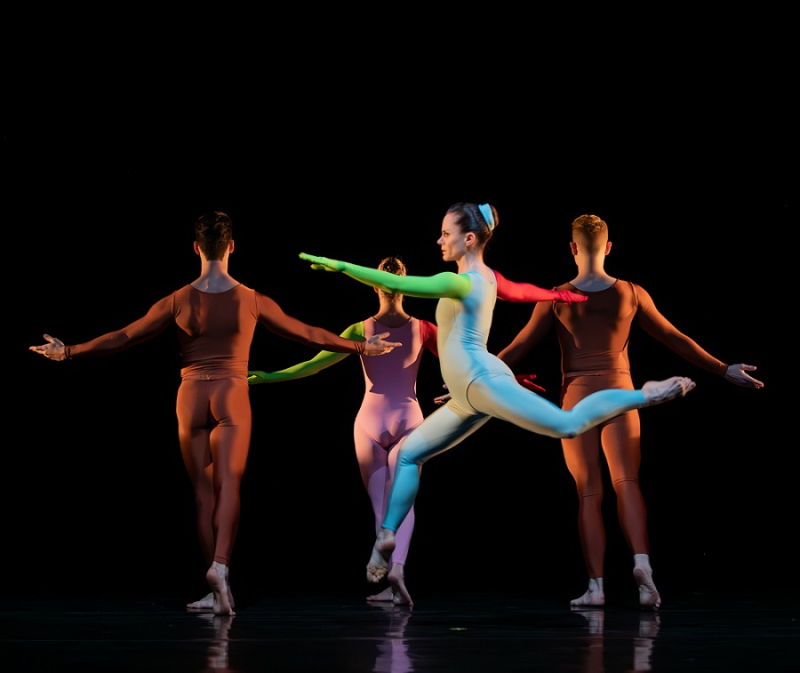
    Somehow the Alex Katz costumes and Jennifer Tipton’s lighting created an impression of the dancers glowing from within. The music, described as “for magnetic tape”, is a delightful conglomeration of noises. The piece starts with thunder, or perhaps it’s the sound of a helicopter landing. Bizarre passages of spoken word, bang-on-a-can type percussive intrusions, a jazzy string bass rhythm, a trilling clarinet, music from a carnival funhouse: all this provides impetus to the dancers.

    In an opening segment of walk-ons and gestural moves, we first meet Eran Bugge, Lisa Borres, and Jada Pearman. The men join – Lee Duveneck and Kenny Corrigan – along with Jessica Ferretti. Kristen Draucker has a featured solo, beautifully danced. A striking segment of two parallel pas de trois is truly original, with Mssrs. Duveneck and Corrigan handling the partnering elements with aplomb. Ms. Bugge dances a solo, and as the music turns whimsical, she spins blithely about the space. Devon Louis is fantastic in a jazz-based solo..simply superb.

    Some images from Post Meridian:

    PTDC_Joyce_6.26.24_PostMeridian_Draucker_Thiele_002

    Kristin Draucker, photo by Ron Thiele

    PTDC_Joyce_6.26.24_PostMeridian_Louis_Thiele_004

    Devon Louis, photo by Ron Thiele

    Paul Taylor’s Brandenburgs (1988) is normally a closing piece, but this afternoon it fit neatly between the quirkiness of Post Meridian and the mythic bleakness of Runes. Brandenburgs is quintessential Taylor. It has a cast of nine, but somehow feels ‘larger’, whilst the iconic Bach score lends a sense of grandeur.

    3_Brandenburgs_Maria Ambrose  John Harnage_photo by Ron Thiele

    Above: Maria Ambrose and John Harnage in Brandenburgs; photo by Ron Thiele

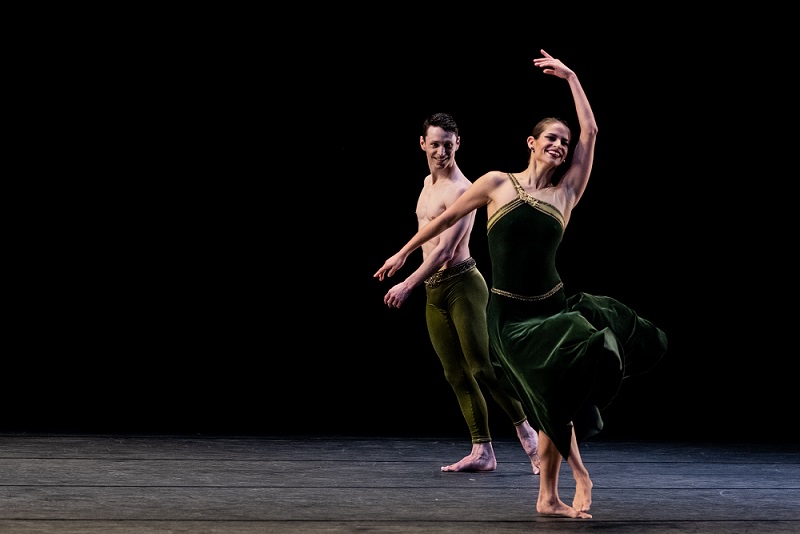
    From its opening pose of the six men and three women, Brandenburgs is a nonstop dance feast: each of the women – Maria Ambrose, Eran Bugge, and Lisa Borres – has a flirtatious segment with the five men of the ensemble: Lee Duveneck, Alex Clayton, Shawn Lesniak, Austin Kelly, and Jake Vincent. The men are given demanding Taylor moves as they come and go throughout, crossing the stage in leaping combinations.

    1_Brandenburgs_John Harnage_photo by Whitney Browne

    The charismatic John Harnage (above, photo by Whitney Browne) holds the audience under a spell in the lyrical adagio, partnering Mlles. Bugge, Ambrose, and Borres in turn. In the succeeding faster movement, John admiringly observes solos by Maria, Eran, and Lisa, and then had a mesmerizing solo of his own. The animated finale brings us back to the ballet’s opening pose.

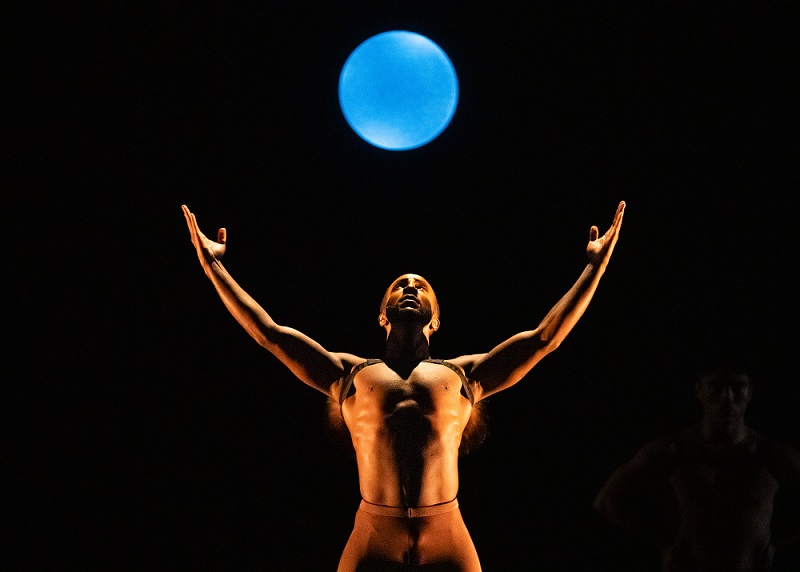
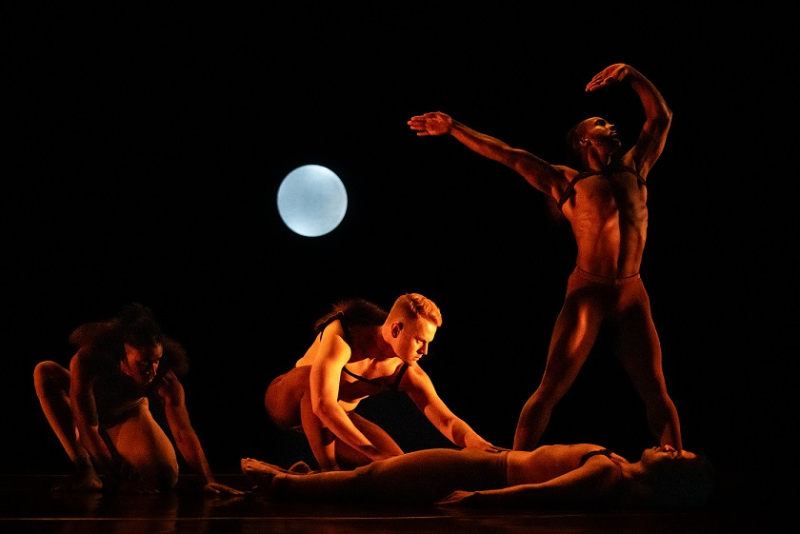
    Closing the program was Runes, choreographed by Paul Taylor in 1975 to piano music by Gerald Busby. The ballet opens with a blue moon in the sky and a corpse onstage. Jennifer Tipton’s perfect lighting creates a timeless feeling as an ancient tribe gather to perform their sacred rituals. Their stylized movement has an air of Martha Graham about it.

    2_Runes_photo by Steven Pisano

    Above: Patches of fur on the men’s costumes evoke images of the Druids…dancers Lee Duveneck and Alex Clayton; photo by Steven Pisano

    3_Runes_photo by Steven Pisano

    Eran Bugge (above, in a Steven Pisano photo) and Lee Duveneck have an intimate duet. They are joined by the captivating Ms. Draucker – as magnetic here as in Post Meridian; she and Devon Louis engage in a duet of their own, engrossing to watch.

    Christina Lynch Markham’s solo stood out as the centerpiece of the ballet; she is perhaps the high priestess of the community, dancing powerfully whilst exuding a spiritual glow. Alex Clayton’s magnetism dominated the stage in a solo danced before a semi-circle of seated women; both here and in the ensuing duet with the radiant Madelyn Ho, Mr. Clayton once again affirmed his esteemed place in the Company. Runes ends with the corpse again in its place as the mysterious rites come to a close.

    Lisa-Borres-770x433

    Above: Lisa Borres; portrait by Bill Wadman

    Throughout the afternoon, I kept my eye on Lisa Borres, a dancer I have known for some time thru her performances with Lydia Johnson Dance and Damage Dance. Lisa’s dancing and presence have always stood out, and it’s so wonderful to find her so thoroughly at home in the Taylor repertoire. 

    The afternoon marked the last time I will see Eran Bugge and Christina Lynch Markham dancing with the Taylor Company. Thru the years, they have each provided me with many wonderful memories, and their distinctive – and very different – personalities have always put a personal stamp on whatever role they are dancing. 

    Screenshot 2024-06-30 at 08-17-41 Steven Pisano Eran Bugge in Paul Taylor's Runes at the Joyce Theater his week. (Photo by Steven Pisano) @thejoycetheater @paultaylordance @eranbugge… Instagram

    Above: Eran Bugge in Runes, photo by Seven Pisano

    Christina_Lynch_Markham-1-936x1170

    Above: Christina Lynch Markham; portrait by Bill Wadman

    ~ Oberon

  • Kuusisto/Sundquist ~ A Little Night Music

    Hp-little-night-music

    Above: the Stanley H. Kaplan Penthouse at Lincoln Center

    Author: Ben Weaver

    Saturday July 27th, 2019 – Finnish violinist Pekka Kuusisto and Swedish double-bassist Knut Erik Sundquist had a long evening at the Mostly Mozart Festival: first they performed a full concert of Bartok and Vivaldi with the Mostly Mozart Festival Orchestra, conducted by Andrew Manze, followed by a special appearance at the Stanley H. Kaplan Penthouse for a series called A Little Night Music, an intimate one-hour program of music and wine.

    Pekka Kuusisto is not your traditional classical violinist. Although classically trained and a winner (first place) of the Jean Sibelius Violin Competition (Kuusisto was the first Finn to win there, in 1995), he spends as much time performing non-classical music as classical. “Crossover” would not be the right word; he’s not necessarily playing arrangements from Cats. But his dedication to playing many different types of music and his improvisational skills place him in a somewhat different category from most other concert violinists. When he does venture into the strictly classical repertoire – as he did last year with a recording of J.S. Bach’s complete Sonatas and Partitas for Solo Violin – the results are unpredictable and often electrifying. 


    Kuusisto is a dynamic stage personality; encountering him in a small space like the Kaplan Penthouse is a singular experience. With the night-time NYC skyline shining behind the stage, Kuusisto and his frequent stage partner, the great double-bassist Knut Erik Sundquist, easily filled the hour with a wide range of music, hilarious banter (like a vaudeville act, the ease of their interactions can only be perfected over many years of friendship) and sound life advice (after a night of drinking, make sure you go home before you go to bed.)


    The duo broke up the musical selections into aptly titled Minuet Section, Sad Section, and Happy Section. The Minuets were courtesy of Bach and traditional Finnish folk dance, played and improvised seamlessly. The middle Sad Section was launched by a mysterious Austrian tune Kuusisto once heard on TV while watching a weather report at the Ischgl ski resort and transcribed for posterity. (Since Kuusisto has never been able to figure out the source of the tune, he simply calls it Memories from Ischgl.) Occasionally he hummed while playing this lovely, orphaned tune. And the final Happy Section of cheerful traditional melodies from Finland and Sweden, and – of all things – a Spanish tango from Poland that’s especially beloved in Finland. (Here I was reminded of a famous line from Edith Wharton’s The Age of Innocence about the opening night of the (Old) Met: “She sang, of course, ‘M’ama!‘ and not ‘he loves me,’ since an unalterable and unquestioned law of the musical world required that the German text of French operas sung by Swedish artists should be translated into Italian for the clearer understanding of English-speaking audiences.”)


    The beauty of all this music and the intimacy of the presentation made for a fascinating evening. Kuusisto’s command of his instrument, the ease of the playing, his ability to transform the sound from a “serious violin” to a “dancing fiddle” were extraordinary. The dreamy expression on his face when playing Bach and a Finnish folk tune reveal a deep love and appreciation for music, the source is secondary.


    Sometimes classical music lovers can get too hung up on purity. Truth is that music from any source can trigger the deepest feelings and memories: from Traditional to Bach to Cole Porter to Madonna. As the only truly universal language on Earth, music of all kind can bring out every imaginable emotion. This ability to communicate in different musical languages – and helping the audience embrace the differences – may be Kuusisto’s greatest gift to his audience.


    ~ Ben Weaver


    Note: Oberon has written about the July 26th performance of the Suusisto/Lundquist/Manze Four Seasons here.

  • POB: Orpheus and Eurydice

    Orpheus

    Saturday July 21, 2012 – The Paris Opera Ballet concluded their 2012 guest-season at Lincoln Center with Pina Bausch’s staging of Gluck’s immortal opera based on the myth of the singer Orpheus, a man who braves the furies of hell to bring his beloved wife back from the dead. Bausch created her version of the opera in 1975 at Wuppertal and it entered the repertoire of the Paris Opera Ballet in 2005.

    Ms. Bausch eschews Gluck’s plan for the opera to end happily; the composer has the gods taking pity on Orpheus after he has caused Eurydice’s ‘second death’ and she is restored to him. In her setting, Ms. Bausch follows the course of the myth: by disobeying the decree that he not look at his wife until they have left the Underworld, Orpheus loses Eurydice forever. He is condemned to wander the Earth, lonely and tormented, until he his torn to shreds by the Maenads. This gruesome conclusion is not depicted onstage; we simply see the dead Eurydice and her distraught husband in a final tableau as the light fades.

    The Paris Opera Ballet‘s production, vivid in its simplicity and superbly performed by dancers and musicians alike, made for an absorbing evening. A packed house seemed to be keenly attentive to the narrative; the silence in the theatre was palpable. The only slight drawback in the presentation was the need for two rather long set-changing pauses during the first half of the evening; the house lights were brought to quarter and the audience began to chatter. Fortunately, order was quickly restored once the music started up again. The second act, with its unbroken spell of impending doom and its heart-breaking rendering of the great lament “J’ai perdu mon Eurydice” by the superb mezzo-soprano Maria Riccarda Wesseling – the audience seemed scarcely to draw breath while she spun out a miraculous thread of sound in the aria’s final verse – was as fine a half-hour as I have ever spent in the theatre.

    The opera was sung in German, with the chorus seated in the orchestra pit. Each of the three principal roles in the opera is doubled by a dancer and a singer. The three singers, clad in simple black gowns, move about the stage and sometimes participate in the action. So fine were the musical aspects of the performance that the opera could well have stood alone, even without the excellent choreography.

    151

    Ms. Wesseling (above) was a revelation; her timbre reminded me at times of the younger days of Waltraud Meier and she shares with that great artist an intensity and personal commitment that make her singing resonate on an emotional level. Ms. Wesseling’s sustained and superbly coloured rendering of  “J’ai perdu mon Eurydice” – with remarkable dynamic gradations – was so poignant; how I wish we could have her at The Met, as Gluck’s Iphigenie perhaps. The two sopranos, Yun Jung Choi (Eurydice) and Zoe Nicolaidou (Amour), gave lovely performances. Conductor Manlio Benzi wrought the score with clarity and dramatic nuance, wonderfully carried out by the musicians and singers of the Balthasar-Neumann Ensemble

    In this powerful musical setting, Ms. Bausch moves her dancers with dignity and grace; the ritualistic passages for female ensemble evoked thoughts of Martha Graham, and reminded Kokyat of Lydia Johnson’s stylishly flowing images of sisterhood. As Orfeo, Nicolas Paul looked spectacular in flesh-tone briefs, his torso god-like and his anguish expressed by every centimeter of his physique. Tall and radiant, Alice Renavand looked tres chic in her red gown as Eurydice. Charlotte Ranson was a lively angel in white as Amour. 

    It was in the second half of the evening where Ms. Bausch’s vision transcended theatricality and took on a deeply personal aspect. Nicolas Paul as Orpheus strove movingly to ignore his wife’s pleas to look her in the face; when at last he could no longer withstand her torment, the fatal moment comes. Ms Renavand collapses on her singer-counterpart’s body and remains prone and absolutely still as Ms. Wesseling sings the great lament. Mr. Paul kneels, facing upstage, in a pool of light which accentuates the gleaming sweat on his back. In this simple tableau, so much is expressed without movement of any kind. The voice of Orpheus in his grief fills the space and the soul.

    The Dancers:

    Alice Renavand (Eurydice), Nicolas Paul (Orphée), Charlotte Ranson (Amour)

    The Singers:

    Orpheus: Maria Riccarda Wesseling
    Eurydice: Yun Jung Choi
    Amore: Zoe Nicolaidou