Tag: Saturday March

  • The Composers are Present at the New York Philharmonic

    Geffen-Hall-1

    ~ Author: Lane Raffaldini Rubin

    Saturday March 29th, 2025 – Not one but two composers were present at David Geffen Hall tonight to receive enthusiastic ovations for their music performed by Leonard Slatkin and the New York Philharmonic. It was, in a sense, a family affair. The composer John Corigliano has been a friend of Slatkin’s and the Philharmonic for half a century, while the other composer, Cindy McTee, is Slatkin’s wife. While the third composer of the evening—Dmitri Shostakovich—was not on hand, this evening’s concert was a testament to the vitality of music of the present era.

    Cindy McTee’s 2010 piece Double Play is a two-movement fantasia on Charles Ives’s 1908 composition The Unanswered Question. More than just an exercise in Ivesian orchestral writing, the piece is a sonic lava lamp of shifting ambiguities and cinematic episodes. A low drone in the double basses unifies the fragmentary material in the woodwinds while hushed string chords oscillate between gorgeous dissonance and consonance.

    The second movement, entitled “Tempus Fugit”, begins with the ingenious tick-tocking of an ensemble of mallets, sounding like a cupboardful of disagreeing clocks and metronomes. The Ivesian writing of the first movement returns under this misaligned timekeeping, establishing an fascinating non-relationship between the disparate concepts of the two movements.

    This juxtaposition is muddied in the second movement by the inclusion of passages of chase-scene-style music and Gershwin-like big-band flourishes (although played brilliantly crisply by the Philharmonic brass). McTee’s piece was intricately orchestrated and finely crafted but went on a bit longer than it needed to and wouldn’t have suffered from cuts in the second movement.

    A1A06759

    Above: Cindy McTee and Leonard Slatkin take a bow; photo by Chris Lee. 

    For John Corigliano’s 2020 piece Triathlon the soloist Timothy McAllister brought three saxophones to the stage. In writing the piece, Corigliano asked himself “what would happen if I wrote a concerto for saxophonist and orchestra, not saxophone and orchestra.” McAllister, the preeminent classical saxophonist for whom the concerto was written, is, after all, a skilled player of the soprano, alto, and baritone saxophones. Corigliano exploits the unique qualities of all three in Triathlon.

    The first movement, “Leaps” for soprano saxophone, bursts right out of the gate with slinking high and low figures, bustling orchestral sounds, and swaggering bravura material for the soloist. McAllister’s playing is assured and confident while maintaining a chamber music sensibility, which suits well the elaborate dialogues that Corigliano writes between the soloist and various voices in the woodwinds and brass. One notable section of this movement appears to quote Ravel’s children’s opera L’enfant et les sortilèges with ravishingly mysterious textures in the woodwinds, providing a fluttering backdrop for lyrical solos in the soprano saxophone.

    The second movement, entitled “Lines”, hews close to its name by eschewing rhythmic figuration in favor of “linear” melodic material. This movement for alto saxophone occupies a hybrid sound-world somewhere between the hazy atmosphere of Coltrane and the broad horizons of Copland’s A Lincoln Portrait.

    Things get wilder in the third movement, which begins with a baritone saxophone cadenza of key clicks, slap tonguing, and other extended techniques up and down the range of the instrument. “Licks”, the title of this movement, has multiple meanings as the soloist seems to riff and improvise and produce very physical sounds from the tongue itself. The entire movement is a rollicking pseudo-improvisatory accompanied recitative. In a fun plot twist at the very end of the piece, McAllister picks up the soprano sax for one last picaresque lick.

    A1A07046

    Above: Timothy McAllster and Maestro Slatkin playing the Corigliano; photo by Chris Lee

    In the second half of the program, Slatkin led the Philharmonic in Shostakovich’s Symphony No. 5 of 1937. It’s a piece that is, as Slatkin writes, “a bit more familiar for both musicians and audience”. Indeed, it was an admirable if conventional performance, with thrilling—booming—climaxes, flawless details across the woodwinds, and propulsive treatment of dramatic transitions.

    A1A08985

    Throughout the concert, Slatkin (above, photo by Chris Lee) frequently put down his baton to conduct with his hands, only to pick the baton back up within the same movement. Slatkin holds the baton from the end of its long handle, rather than gripping it, which means that he relies on his left hand to communicate finer-grain detail to the players. His conducting was at its best when he put down the baton (as in the first movement of McTee’s piece and the sublime Largo of Shostakovich), allowing him to be expressively geometric—an impressively effective semaphore for the musicians. During the Shostakovich Largo, which he conducted from memory, I wondered where his baton had gone, since there was no music stand on the podium for him to rest it on. When the movement was over, he reached behind the folder on the first desk of the violas to retrieve his baton from where he had stashed it. Meant to be invisible, it was just one of the many clever details that added up to this superbly crafted concert.

    ~ Lane Raffaldini Rubin 

    Performance photos by Chris Lee, courtesy of the New York Philharmonic

  • The Met’s Newest Aida (+ A Cast Change!)

    nilsson

    ~ Author: Oberon

    Saturday March 22nd, 2025 matinee – In 1883, a Swedish soprano named Christina Nilsson sang Marguerite in FAUST for the opening of the then-new Metropolitan Opera House. Last week, another Swedish soprano named Christina Nilsson (photo above) made her Met debut as Aida. This afternoon, I went to hear my second AIDA of the current season to see how she fared in the daunting role.

    Alejandro-Roy

    Another singer new to me, tenor Alejandro Roy (above), stepped in today as Radames; he had made a short-notice Met debut in TURANDOT in 2019 opposite Christine Goerke…

    Burdenko

    …and the Amonasro, Roman Burdenko (above), had just made his Met debut a few days ago.

    Alexander Soddy was on the podium, and while he has good ideas about tempi and the alternating currents of grandeur and intimacy that run thru the score, he (like so many opera conductors today) tends to let the orchestra get the better of the singers all too frequently. Despite this, the score seemed extremely beautiful today, and I often felt moved.

    The Messenger and the Priestess – Yongzhao Yu and Ann-Kathrin Niemczyk – made the most of their moments. The two bassos were both super: Alexander Vinogradov (Ramfis) and Krzysztof Bączyk (the King) have powerful voices and they sounded assured throughout their range. So many phrases from these two gentlemen impressed me today. In the ensemble in the opening scene – and again in the Triumphal Scene – where both bassos have great moments, they created a sonic energy that was so pleasing to experience.

    Mr. Burdenko likewise made a vivid impression, his opening “Suo padre!” immediately established his dignity and fierce pride. Capable of both power and subtlety, Mr. Burdenko made every phrase come to life; a feeling of steadfastness emerged in his plea “Ma tu, Re…“. In the Nile Scene duet with Ms. Nilsson, the baritone veered from venomous (“…tu sei la schiava!“) to tenderness (“…pensa che un popolo…vinto…straziata…”) Bravo!!

    Mr. Roy’s voice exudes masculine confidence; it’s tinged with baritonal shadings at times but he also had the top notes for the music when needed. Following with my score, he seemed to heed all the dynamic markings, though he took the end of the “Celeste Aida” full voice. Joining in the trio with Ms. Nilsson and Judit Kutasi (Amneris), the three were sometimes covered by the orchestra. Again, in the Temple Scene, the sturdy voices of Mssrs. Roy and Vinogradov had to combat the orchestra’s volume..

    Having only one intermission, after the Triumphal Scene (wherein Mr. Roy blasted an epic B-flat at one point), the tenor must sing in succession the demanding Nile Scene and the dramatic confrontation with Amneris, and then bring forth lyricism for the tender final duet, “O terra addio…”). He handled this marathon quite impressively. I thought he might run out of steam near the end, but the final “…si schiude il ciel…” with Ms. Nilsson was handsomely clear and sustained. 

    Ms. Kutasi, whose Amneris was disappointing at my earlier performance this season, fared little better today, though her B-flats in the repeated phrase “…dal ciel si compira...” in the Judgement Scene were her best notes of the day. I really don’t know what is going on with her; there are exciting clips of her on YouTube, but the voice now is very erratic. The audience cheered her enthusiastically.

    I grew up on such plushy spinto Aidas as Leontyne Price, Martina Arroyo, Leona Mitchell, Gilda Cruz-Romo, and Anna Tomowa-Sintow. Ms. Nilsson today curiously put me in mind of Lucine Amara, an under-appreciated ‘big lyric’ soprano who could float lovely piani on high; Ms. Nilsson’s style is not as Italianate as Lucine’s, but their vocal heft is similar. 

    A ravishing clarinet solo introduces Aida, and the Nilsson voice has immediate appeal; she sounds young – even girlish at times. In the cantabile passages of the trio and ensemble of the opening scene, her singing is very persuasive; but Mr. Soddy lets that ensemble get too brassy…and there was an added drum rhythm I’d never noticed before.

    Ms. Nilsson got to show her stuff with “Ritorna vincitor“, her singing reflective, her phrasing having a lyrical glow; she gave the aria a lovely, poignant finish. In the boudoir scene, the soprano’s tone sometimes lacked richness, but she fared well in the Triumphal Scene, with a gleaming top-C to cap the ensemble’s first half.

    On the banks of the Nile, Ms. Nilsson shaped “O patria mia…” perfectly, though more colours could have been introduced along the way. Her sweet high-C lingered long on the air, and her sustained phrases at the aria’s finish were gorgeous. Mr. Burdenko’s raging “…tu sei la Schiava!” elicited a blistering top-A from the soprano. She later got enticingly floaty and provocative with “…la, tra le foreste vergini...” in the duet with Radames, before spinning out a magical “…fuggiam…fuggiam.....” The stretta, with Mr. Roy, was excitingly sung.

    The tenor commenced the final scene expressively, and Ms. Nilsson’s lyricism glows, lit by beaming high notes along the way; here she really reminded me of Amara. Mr. Roy sang valiantly as the opera moved towards its solemn ending, his voice well-matched to Ms. NIlsson’s. They took a joint bow, to a warm salute from the crowd. Mr. Roy had saved the day, and Ms. Nilsson had won new admirers. 

    Notably, it was the all-male ballet in the Triumphal Scene that roused the audience to the afternoon’s most enthusiastic cheers.

    ~ Oberon

  • @ My Met Score Desk for FIDELIO

    Fidelio tk and ld

    Above: Tomasz Konieczny and Lise Davidsen in Act II of FIDELIO; a MET Opera photo

    ~ Author: Oberon

    Saturday March 15th, 2025 matinee – I’ve never really been drawn to Beethoven’s FIDELIO. I’ve only seen it a few times; my first Leonore was Shirley Verrett (!), later followed by Hildegard Behrens, Karita Mattila, and  Waltraud Meier in the title-role. I love the drama of Leonore’s rescue of her beloved Florestan, but I don’t like the ‘operetta’ couple who are quite silly; they hold up the action in what could otherwise be a potent drama.

    This afternoon’s performance of the Beethoven opera was sold out, and overall it was a good FIDELIO. Susanna Mälkki’s conducting seemed on the fast side, and at times she seemed to succumb to the current Met trend of swamping the singers. The orchestra were on peak form, with excellent work from the horns. The chorus likewise excelled.

    In the briefest roles, tenor Jonghyun Park’s sweet lyricism made his mark as the First Prisoner; Jeongcheol Cha was equally fine as the Second Prisoner, though he has less to sing. Ying Fang as Marzelline and Magnus Dietrich as Jaquino both sang beautifully, but their characters are cardboard…and if they were absent from the narrative, it wouldn’t matter. 

    Milling fidelio

    The impressive Danish basso Stephen Milling (above, in a MET Opera photo) is ever welcome at The Met. Today he had the brief but pivotal role of Don Fernando, and he sang with authority; I look forward to his Sarastro later in the season.

    Rene Pape, who turned 60 last Autumn, retains the power and firmness of his cherished voice; he has given me so many wonderful memories in my opera-filled lifetime, and he sang handsomely and effortlessly today. His Act I aria, and his scene with Leonore as they prepare for their gruesome task, were highlights of the afternoon.

    Tomasz Konieczny was a vivid Don Pizarro; his first spoken lines had a sense of urgency, and he displayed the meanness of the character in his sinister inflections. Joining Mr. Pape in duet, the sheer amplitude of their sound defined the description “Met-sized…”. Later, Mr. Konieczny’s taunting of the hapless Florestan was unsettling. 

    Following a superb prelude to Act II from the MET Musicians under Ms. Mälkki’s baton, tenor David Butt Philip emitted an uncanny, sustained tone with his opening “Gott!” The intensity of Florestan’s suffering was strikingly voiced by the English tenor, who has an impressive list of European achievements to his credit. His trio with Ms. Davidsen and Mr. Pape had a palpable feeling of terror. Rescued by his wife’s cry “Töd’ erst sein Weib!” as she holds Pizarro at gunpoint, Florestan joins Leonore in the blazing “O namenlose Freude!”  But I did miss hearing Florestan’s haunting spoken line, “Was hast du für mich getan?” 

    Lise Davidsen was the star of the afternoon, just as Leonore is the heroine of the story. The tall Norwegian soprano is pregnant with twins, and this run of FIDELIO at the Met will be her last performances until after the babies arrive. She was in excellent voice today, and her strikingly clear and shining top notes seemed truly to stun the audience. Her singing of the great aria “Abscheulicher!” had remarkable power but also some incredible subtleties, and the prayerful passage “Komm, Hoffnung” moved me deeply.  The soprano then went on to a blazing, prolonged top B at the aria’s climax, drawing cries of brava! from the Hall. In the opera’s finale, more of the soprano’s high notes lit up the afternoon. 

    Following a benedictive passage from Mr. Milling’s Don Fernando, the minister then asks Leonore to remove her husband’s shackles. In this moving moment, I glanced up at the sculpture that hangs over the Met’s proscenium; created by American sculptor Mary Callery, it was described at the time the House opened in 1966 as having been inspired by the opened shackles of Florestan, rescued by his devoted wife. 

    ~ Oberon

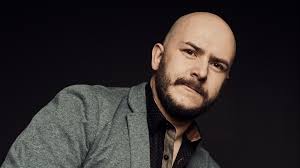
  • Gihoon Kim at The Met

    Gihoon & sophia

    Above: Korean baritone Gihoon Kim with Met Opera fan Sophia Cerovsek

    ~ Author: Oberon

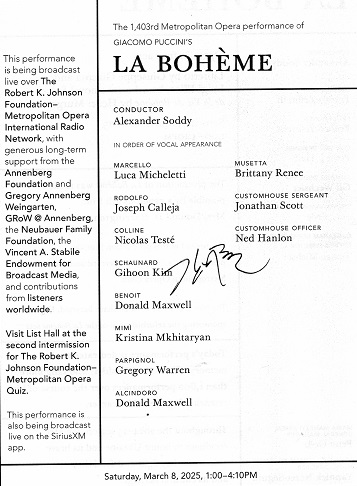
    Saturday March 8th, 2025 matinee – I wanted to catch Gihoon Kim’s Schaunard in the Met’s BOHEME a second time. Since watching the Korean baritone take the title Cardiff Singer of the World at the 2021 competition, where his Tanzlied from Korngold’s DIE TOTE STADT brought the beloved soprano Roberta Alexander (one of the judges) to tears, I have followed Gihoon’s career, and even befriended him on Facebook. He has a wonderful voice and a sunny, life-embracing personality.

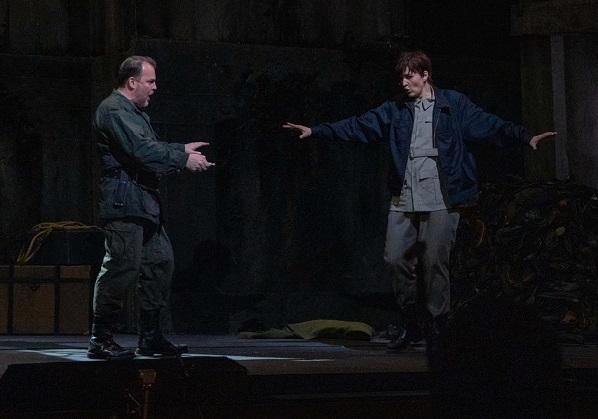
    Although I was at a score desk, I’d heard about Gihoon’s dance routine (and the ensuing duel) in Act IV, so this time I stood up and took in all the action. Hilarious! Later in the act, it is Schaunard who first realizes that Mimi has breathed her last: “…è spirata…” , which Gihoon spoke in a hushed voice. After the performance, I went to say hello to him at the stage door.

    Gihoon-1 jpg

    Aside from Gihoon, the only singers in the cast whose work I was familiar with were Joseph Calleja (Rodolfo) and Kristina Mkhitaryan (Mimi, who I’d previously seen as Musetta). Brittany Renee (Musetta), Luca Micheletti (Marcello), and Nicolas Testé (Colline) took the other leads today, and the British conductor Alexander Soddy was on the podium.

    Although there was sometimes a feeling that the cast was under-rehearsed, overall the performance came off quite well; Maestro Soddy did cover the voices at times (a trend at the Met these days), but his tempi were nice, and I liked the energy he developed as the military parade passes by the Café Momus.

    I had not heard Joseph Calleja (Rodolfo) in the House since his 2019 Pollione. The voice has always had a fast but fascinating vibrato, and that was in play today; for me, it adds a special appeal to his singing. Today, his highest range seemed somewhat compromised; he may have been ill, or perhaps this is how he sounds now, after having sung, in recent years, some roles that stretched his essentially lyrical voice. Whatever the trouble, he managed to find a work-around, keeping the higher notes brief, or trying a headier resonance. At the end of the love duet, he at first harmonized with the soprano, but then went for the concluding top note which was a bit husky but which his Mimi’s clear note helped to masque. Thereafter, Mr. Calleja was a truly poetic Rodolfo; his singing has a vulnerable trace that is most appealing. His most magical moment came at the end of Act III when he produced a gorgeous falsetto tone on “…la stagione dei fiori…”  Really exquisite. Earlier, at the end of “Che gelida manina…” he had created the same intimate atmosphere with his delicate “Via piaccia dir?“, sustained down to a whisper.  

    Today’s two sopranos both have vibrant voices, capable of filling the Met (so long as the Maestro kept the orchestra’s volume agreeable). Both Kristina Mkhitaryan and Brittany Renee have a bit more vibrato in their tone than I could wish, but other opera friends of mine feel this is a trend nowadays, and they are not bothered by it.

    Ms. Mkhitaryan’s Mimi made her entrance after a lovely flute solo; oddly, for the first time, I sensed that a shadow of doom lies over the seamstress right from her hesitant “Scusi…”. As her narrative-aria unfolded, the vibrato became less intrusive; her singing was poetic. The orchestra slowed a bit, so she could make the most of the lyrical Ma, quando vien lo sgelo...”; and in the lingering phrases that follow, the soprano was most persuasive. In their classic duet, she and Mr. Calleja beautifully expressed their blooming love. The tenor’s haunting “Che m’ami, di...” was met by the soprano’s delicate “Io t’amo!“.  Nothing in the world compares to falling in love at first sight; I’ve done it hundreds of time thru the years…usually in vain.

    Ms. Mkhitaryan’s singing in the Act III duet with Marcello was tinged with desperation, and her Donde lieta usci...” was truly touching, especially her hushed “Bada, sotto il guanciale c’è la cuffietta rosa…” which made me choke back tears. The aria had a ravishing, sustained ending. In the final minutes of Mimi’s life, Ms. Mkhitaryan summoned a lovely palette of vocal pastels; she even introduced a touch of playfulness as she and Rodolfo recalled their first meeting. But then the fatal cough sets in, her final lines trailing off into eternity.

    Ms. Renee’s Musetta, like most takes on this role, is an extrovert. Her noisy disruption of the Momus party was laced with moments of shrill shrieking, but she settled in for the Waltz, especially nice in the insinuating subtleties of the second verse, and then capping off the ensemble with a bright top note. At the end of the third act, Musetta again gets shrewish as she and Marcello indulge in name-calling. Ms. Renee was at her most compelling when we see the other side of her as she prays for Mimi’s recovery, and she and Marcello comprehend the depth of their love for one another.

    From note one, Luca Micheletti was a superb Marcello; this can really be a star role – when it’s truly well sung and acted – and that’s what this baritone made it. Every note and line counted for something, so that even the big moments – like leading the Act II ensemble, singing the melody of Musetta’s waltz – are part of a grander scheme. In his Act III duet with Ms. Mkhitaryan, and again in his Act IV duet with Mr. Calleja, the singer sounded just the way you want an Italian baritone to sound: passionate, expressive, and assured. I will look for him in the future…bravissimo!

    No less impressive than his painter/colleague, Nicolas Testé as the philosopher Colline excelled. Taking every opportunity to make his mark, the French basso highlighted such moments as joining Micheletti/Marcello in a commanding “Abbasso, abbasso l’autore!” as they dismiss Rodolfo’s feeble effort to get a fire going in the stove of their frigid garret. His observations of the two ‘loving’ couples at Momus were spot on. But of course it was in the Coat Aria of Act IV that M. Testé (abetted by excellent horn playing from the pit) struck vocal gold. Really beautifully done…grand merci!! 

    It was not a perfect performance, but it was extremely moving; and sometimes that is all that matters. I found myself thinking of my sister’s passing last July; like Mimi, she slipped away quietly – with loved ones watching over her – at the end of her battle with cancer. Ironically, LA BOHEME was one of only two operas my sister ever saw – at the Old Met in her college days. I was always jealous that the cast she had seen included Dorothy Kirsten, Carlo Bergonzi, and Anneliese Rothenberger.

    Sitting at my score desk, people often come up to talk to me during intermission; they’ve spotted me from Family Circle, with my reading lamp on, my score open, and taking notes. Today, three young engineering students from Columbia University stopped by, each wearing a necktie and all looking very dapper. They were all seeing their first opera; they asked me many questions, and I found my usually-reticent self babbling away about how wonderful opera is, and how it changed my life (literally!). Once I get started on the topic, it’s impossible to shut me up.

    Earlier, I’d been chatting with the young woman seated in front of me; she was seeing her second opera this afternoon, and she asked for suggestions of what other operas she should try. In the course of our chat, she apologized for mispronouncing the names of the great operas, and of the characters in them. I assured her that all opera lovers start out that way; you can only imagine how I mangled the title of Leonora’s great aria “Pace! Pace, mio dio!” for several weeks before I heard the correct pronunciation. To this day, I still blush to myself when I think of it. 

    ~ Oberon

  • @ My Met Score Desk for Roméo et Juliette

    Snapshot

    Above: tenor Benjamin Bernheim as Romeo

    ~ Author: Oberon

    Saturday March 30th, 2024 matinee – Earlier this season, I renewed my acquaintance with Bizet’s CARMEN at The Met, an opera I had not seen for many years. Musically, I enjoyed it thoroughly, and so this afternoon I was hoping for a similar experience with Gounod’s ROMEO & JULIETTE.

    My first encounter with the Gounod opera was an unforgettable matinee in October of 1967, when Jeannette Pilou made a last-minute Met debut as Juliette opposite Franco Corelli’s matinee idol Romeo. I fell in love with Ms. Pilou that afternoon, and made many trips to New York from the little town specifically to see her in her many Met roles in the ensuing seasons. I saw Jeannette as Juliette a second time, and since then I have seen only Colette Boky and Hei-Kyung Hong in the role.

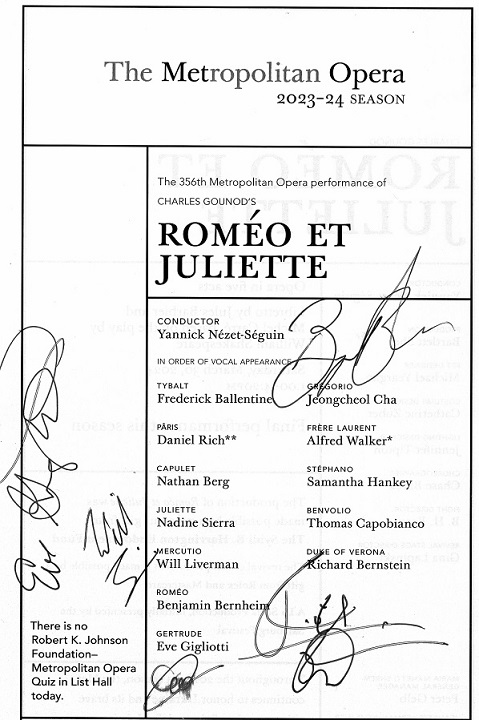
    Today’s matinee started the same way as my first-ever ROMEO in 1967: the news that Nadine Sierra had canceled and was being replaced by So Young Park, whose Met credentials to date have been a handful of recitals with piano in the NY Parks, and a single Queen of the Night in 2019. 

    The Met Orchestra played with its accustomed polish, and the chorus has a lot to do in this opera…and they did it very well. For the most part, Yannick Nézet-Séguin resisted his usual temptation to have the orchestra play too loudly…though there were moments…

    The orchestral opening was heavy-handed, followed by a chorale, and then the poignant love theme sounds from the strings. The first solo voices to be heard are those of Frederick Ballentine as Tybalt and Daniel Rich as Paris; Mr. Ballentine would have more to do later, in the duel scene…and he made a strong impression there.

    Nathan Berg was a fine Capulet; his ‘aria’ at the ball was subtly done, and his scene with Juliet prior to her taking the potion was excellent, as was his expression of remorse over her supposed death. Eve Gigliotti was an impressive Gertrude, making the most of her part in the wedding quartet, and in her scene with the the characterful Grigorio of Jeongcheol Cha. Richard Bernstein’s Duke of Verona made his anger at the dueling factions palpable, and his sentencing of Romeo to exile is a pivotal moment in the story.

    Alfred Walker’s Frère Laurent brought the basso’s warmth of timbre and eloquence of feeling to the scene of the wedding, and his consoling singing gives Juliette the courage to take the sleeping potion. Will Liverman delivered Mercutio’s tricky Queen Mab aria with complete assurance – a highlight of the evening for sure. Will’s handsome timbre is always so appealing, and his delivery was light and lively in the aria’s swift phrases, turning more lyrical in the central, more reflective passages. Bravo! Samantha Hankey’s singing of Stephano’s “Que fais tu blanche tourterelle” was a vocal treat. Melodious in the opening tune, the page chides the Capulet men with her insouciant teasing at “Gardez bien la belle”, finishing off with a mini-cadenza up to a perfectly placed top note which she sustained to brilliant effect. This aria was an early-career success for the great Frederica von Stade; may it bring Ms. Hankey similar good fortune!

    So Young Park has a girlish, clear voice which captured the innocence of the teen-aged Juliette right from her opening lines. At first, the voice was a bit tremulous, but she bravely shimmered up to a sprightly top note in her cadenza. Soon after, she was breezing thru the delectable waltz, in which she had all the coloratura well in-hand; the lovely pensive passage “Loin de l”Hiver morose…” was beautifully sung, and then the soprano sailed up to neat top-C, and lingered there.

    She and Mr. Bernheim were sweetly playful in their first encounter, Mr. Bernheim so persuasive in his gentle flirtation which is dressed up as poetry. Ms. Park’s delight at being so charmed by the handsome stranger vanished into sadness when she learns who he is: an enemy of her family. 

    The balcony duet was alive with the fascination of young love;  Ms. Park, now settled-in vocally, brought sweet lyricism to her lines – and the voice bloomed lovingly in response to the tenor’s ardent “O nuit divine…”. Then they harmonized to ravishing effect with “De cet adieu si douce e la tristesse“, and then Mr. Bernheim melted all hearts with his hushed, gorgeous “Va, repose en paix…” For me, die-hard romantic that I am, this entire scene was enthralling.

    Ms. Park’s voice sailed over the wedding scene quartet, where Ms. Gigliotti and Mssrs. Bernheim and Walker were all vocally aglow. The spine-tingling prelude to the bridal night duet was magically played by the Met Orchestra, and then Ms. Park and Mr. Bernheim gave us some of the most captivating singing imaginable with “Nuit d’hyménée! Ô douce nuit d’amour!”, their voices entwining in quiet rapture. The call of the lark – “the harbinger of the dawn” – draws them out of their reverie: thrillingly, they bid each other farewell. Romeo rushes to his fate, as Juliette sings a quiet blessing. This is the end of their happiness, though they do not know it.

    Ms. Park sang the dramatic Potion Aria effectively, though the conductor’s sudden need to pump up the volume elicited a rather brassy climactic top note from the soprano: so predictable with him on the podium. But such things only matter to a handful of listeners. The soprano finished the opera with her touching farewell to her beloved as they ask god to forgive them.

    The afternoon was a total triumph for Benjamin Bernheim. It is a great pleasure to hear this voice, which is both elegant and passionate. Following the sublime ‘lullaby” of the entr’acte leading up to the balcony scene, the tenor’s “O nuit!” marked the start of Bernheim’s dreamy recitative which carries us to a gorgeous clarinet solo before he takes up greatest love song in all opera: “Ah! Lèvetoi, soleil!” I have heard many 
    superb interpretations of his aria – from the likes of Franco Corelli, Alfredo Kraus, and Neil Shicoff – but none has moved me quite as deeply as M. Bernheim’s. Sung with deep tenderness, and ending with a  thrilling B-flat, the tenor was vociferously hailed by the audience. Listen to a brief clip here.

    Following his anguish at being exiled, the Bernheim Romeo capped the duel scene’s final ensemble with a bold top-C. Yet, for all the excitement of hearing a tenor deploy such golden high notes, it was in the quiet despair of the final scene that Bernheim achingly conveyed the pain of a broken heart: the sublime tenderness of his pianissimo farewell to Juliet, which was followed by the heart-rending echo of “No, ce n’est pas le jour…”, recalling the lovers’ moments of their brief happiness.

    Benjamin Bernheim’s Romeo brought some of the finest tenor singing I’ve heard at The Met in the last half-century. His voice has an innate poetic quality that cannot be taught; it is a voice that touches my heart. Thru the years, I have sometimes felt my deeply romantic soul to be a curse, but today I realized that it’s a gift.

    Now I have rambled on long enough. I went to the stage door after the curtain calls and met Eve, Benjamin, Will, and Richard. They were so kind…I love them all. What intrigues me so much about opera singers is that they can do things we mere mortals can only dream of. I admire their devotion and their courage, putting themselves on the line night after night so that we can bask in the glory of the greatest art form ever. 

    Romeo 2024-1 jpg

    And here are the curtain calls!

    ~ Oberon

  • Bach’s Matthäus-Passion @ The NY Philharmonic

    Bach

    Author: Ben Weaver

    Saturday March 25th, 2023 – J.S. Bach’s Matthäus-Passion, composed around 1724-27 (and revised through 1742), is arguably Bach’s greatest composition. Personally, I’d place it in the top ten greatest works of Western music. The NY Philharmonic performs it infrequently; the last time was in 2008 under the baton of Kurt Masur. Running at roughly 2:45 hours, the Matthäus-Passion is a work filled with passion and drama…more drama than most church music. Anyone mocking Verdi’s Requiem as being more opera than mass perhaps should take a closer look Bach’s greatest work. Verdi was following in Bach’s mighty footsteps. I was very glad to see it on the program this year, finally! I quite literally got chills as the work started and the chorus (Musica Sacra) sang the opening words: “Kommt, ihr Töchter, helft mir klagen.” Alas, the thrills did not last; I was sadly disappointed with tonight’s performance.

    Tenor Nicholas Phan sang the very difficult part of the Evangelist, who narrates the story of Jesus’ arrest, the debate over what his fate should be, his execution, and its immediate aftermath (the Passion ends before the resurrection.) Much of the drama of the work flows through the Evangelist’s words. Mr. Phan managed the difficult music very admirably, but the part can be a trap dramatically: there are many proclamations like “And Jesus said unto him.” How does one make each one sound fresh? I don’t have a clear answer. I suppose if it was easy, anyone would be able to do it. 

    Bass-baritone Davóne Tines’ Jesus (Mr. Tines was the only person on stage wearing a costume: a white, sleeveless robe) possesses a large voice; but it’s a voice with a guttural quality, which seldom opens or blooms.

    Mezzo-soprano Tamara Mumford, a favorite at the Metropolitan Opera across the Plaza, sang nicely. “Buß und Reu” in Part I was vocally steady and clear. But in Part II, Maestro Jaap van Zweden robbed Ms. Mumford and concertmaster Frank Huang of an opportunity to give their all in “Erbarme dich”, perhaps  the Passion’s most famous aria; certainly its most emotional and devastating piece. Written for solo voice, solo violin, and orchestra, this breathtaking music has the ability to stop time. Alas, Maestro van Zweden took it at a preposterous Allegro tempo; he absolutely wrecked it by turning it into a cabaletta. If your tempo is faster than John Eliot Gardiner’s, Nikolaus Harnoncourt’s, Trevor Pinnock’s, and Gustav Leonhard’s – you may consider looking at the score again.

    Amanda forsythe

    Soprano Amanda Forsythe (above), making her Philharmonic subscription concert debut with these performances, was sublime. Her ability to float pianissimi high notes was indeed spine-tingling. The aria “Aus Liebe will mein Heiland sterben,” which also includes a flute solo by Robert Langevin, was the highlight of the evening. 

    The Philharmonic’s Principal Associate Concertmaster, Sheryl Staples, had a chance to shine in “Gebt mir meinen Jesum wieder,” with a difficult solo. Unfortunately, bass Philippe Sly, making his Philharmonic debut with these performances, had pitch difficulties which offset Ms. Staples fine playing. Tenor Paul Appleby was superb all evening, the high tessitura of the aria “Geduld” presenting no difficulties for him.

    The Choral group Musica Sacra was in excellent form all evening, from the Chorales to dramatic exchanges representing specific characters. The Brooklyn Youth Chorus sang the opening and closing choruses of Part I, but did not return for Part II. Can’t say if that was intentional or if something kept them from returning.

    I do hope the Matthäus-Passion returns to the Philharmonic again soon – under a more caring conductor.

    ~ Ben Weaver

  • Bach’s Matthäus-Passion @ The NY Philharmonic

    Bach

    Author: Ben Weaver

    Saturday March 25th, 2023 – J.S. Bach’s Matthäus-Passion, composed around 1724-27 (and revised through 1742), is arguably Bach’s greatest composition. Personally, I’d place it in the top ten greatest works of Western music. The NY Philharmonic performs it infrequently; the last time was in 2008 under the baton of Kurt Masur. Running at roughly 2:45 hours, the Matthäus-Passion is a work filled with passion and drama…more drama than most church music. Anyone mocking Verdi’s Requiem as being more opera than mass perhaps should take a closer look Bach’s greatest work. Verdi was following in Bach’s mighty footsteps. I was very glad to see it on the program this year, finally! I quite literally got chills as the work started and the chorus (Musica Sacra) sang the opening words: “Kommt, ihr Töchter, helft mir klagen.” Alas, the thrills did not last; I was sadly disappointed with tonight’s performance.

    Tenor Nicholas Phan sang the very difficult part of the Evangelist, who narrates the story of Jesus’ arrest, the debate over what his fate should be, his execution, and its immediate aftermath (the Passion ends before the resurrection.) Much of the drama of the work flows through the Evangelist’s words. Mr. Phan managed the difficult music very admirably, but the part can be a trap dramatically: there are many proclamations like “And Jesus said unto him.” How does one make each one sound fresh? I don’t have a clear answer. I suppose if it was easy, anyone would be able to do it. 

    Bass-baritone Davóne Tines’ Jesus (Mr. Tines was the only person on stage wearing a costume: a white, sleeveless robe) possesses a large voice; but it’s a voice with a guttural quality, which seldom opens or blooms.

    Mezzo-soprano Tamara Mumford, a favorite at the Metropolitan Opera across the Plaza, sang nicely. “Buß und Reu” in Part I was vocally steady and clear. But in Part II, Maestro Jaap van Zweden robbed Ms. Mumford and concertmaster Frank Huang of an opportunity to give their all in “Erbarme dich”, perhaps  the Passion’s most famous aria; certainly its most emotional and devastating piece. Written for solo voice, solo violin, and orchestra, this breathtaking music has the ability to stop time. Alas, Maestro van Zweden took it at a preposterous Allegro tempo; he absolutely wrecked it by turning it into a cabaletta. If your tempo is faster than John Eliot Gardiner’s, Nikolaus Harnoncourt’s, Trevor Pinnock’s, and Gustav Leonhard’s – you may consider looking at the score again.

    Amanda forsythe

    Soprano Amanda Forsythe (above), making her Philharmonic subscription concert debut with these performances, was sublime. Her ability to float pianissimi high notes was indeed spine-tingling. The aria “Aus Liebe will mein Heiland sterben,” which also includes a flute solo by Robert Langevin, was the highlight of the evening. 

    The Philharmonic’s Principal Associate Concertmaster, Sheryl Staples, had a chance to shine in “Gebt mir meinen Jesum wieder,” with a difficult solo. Unfortunately, bass Philippe Sly, making his Philharmonic debut with these performances, had pitch difficulties which offset Ms. Staples fine playing. Tenor Paul Appleby was superb all evening, the high tessitura of the aria “Geduld” presenting no difficulties for him.

    The Choral group Musica Sacra was in excellent form all evening, from the Chorales to dramatic exchanges representing specific characters. The Brooklyn Youth Chorus sang the opening and closing choruses of Part I, but did not return for Part II. Can’t say if that was intentional or if something kept them from returning.

    I do hope the Matthäus-Passion returns to the Philharmonic again soon – under a more caring conductor.

    ~ Ben Weaver

  • Ensemble Intercontemporain @ Zankel Hall

    Ec
     
    Above: the players of Ensemble Interconterporain
     
    Author: Shoshana W. Klein
     
    Saturday March 25th, 2023 – If you’re a contemporary music performer or aficionado, chances are you’ve come across the Ensemble Intercontemporain – they are one of the quintessential contemporary music ensembles and they have a ton of recordings and videos on YouTube. The ensemble was created by Pierre Boulez in 1976, and I’d say that makes it one of the oldest of its kind, but in a lot of ways it’s actually still one of the only of its kind. The members are full-time, and while they’re based in Paris, the group’s performances are mostly on tour all over. Despite groups like Alarm Will Sound, the Boston Modern Orchestra Project, and others, the US certainly doesn’t have an analogous ensemble – all those that come to mind are different instrumentation, different focus, and certainly not full-time for 31 members. Of course, that’s probably partially due to funding structure differences – Ensemble Intercontemporain is funded by the French government as well as by touring. The ensemble defines contemporary as 20th and 21st century pieces – though surely not all 20th century work, remembering that Rachmaninoff and Respighi were composing far into the 20th century that this group certainly wouldn’t consider in their wheelhouse. 
     
    The concert started with Arnold Schoenberg’s 5 Pieces arranged for this size ensemble. The short, extremely lyrical, and fully engaging movements were a good start to a concert in which the other two pieces were 45 minutes each. The ensemble works incredibly well together – I felt that particularly the woodwinds had a huge range of timbres and dynamics. 
     
    Next was Matthias Pintscher’s sonic eclipse, a kind of double concerto. The premise is very interesting, in which the first and second movements are each “celestial bodies” and the third is called “occultation” and describes the eclipse. The first movement has a trumpet soloist (Clément Saunier), the second a horn soloist (Jean-Christophe Vervoitte), and both in the third. While I’m not sure I heard the intended sonic eclipse, I was able to appreciate a lot of the sonic textures – the timbral flexibility of all of the players combined with the writing meant that I often could barely tell where a sound was coming from – they were able to match each others’ sounds so well. At one point the string tremolo was matching the trumpet soloist flutter tongue in a way that I would not have thought possible beforehand.
     
    Boulez
     
    Above: Pierre Boulez
     
    The last piece – Boulez’s Dérive 2 – had such a sustained energy throughout the 45 minutes that it made me think again about how many ensembles and how many players in the world can play this music, not to mention exceptionally. It’s not played live often, understandably.
     
    This program was very much the ensemble’s traditional repertoire – significant pieces by their founder, current music director (Pintscher, also conducting), and Schoenberg. There’s definitely something to be said about a contemporary ensemble that has such a canon of its own – is it a little bit of a contradiction? Or a difference in defining “contemporary”? It might be worth noting that while they have plenty of newer members – much of the ensemble seemed on the younger side – the group of around 20 people performing seemed to have three women, and of the full 31 members listed on the website, I saw five. 
     
    Despite the difficulty of the whole concert, the ensemble consistently seemed to be enjoying themselves, as did the audience – the almost full house called Pintscher back on stage something like 5 times with a long standing ovation.
     
    ~ Shoshana W. Klein

  • Helena Dix in Bellini’s NORMA @ The Met

    Dix norma

    Above: Helena Dix, costumed as Norma, in her Met dressing room; I borrowed this image from the soprano’s Facebook page

    Author: Oberon

    Saturday March 25th, 2023 matinee – The three great peaks of the bel canto repertoire are – for me – Donizetti’s LUCIA DI LAMMERMOOR, Rossini’s SEMIRAMIDE, and Bellini’s NORMA. This afternoon I was at The Met to see the season’s final performance of the Bellini. The casting of Sonya Yoncheva in the title-role turned out to be pretty controversial, and the soprano took to social media to complain that people were comparing her Norma to recordings and remembered performances from decades ago.

    I guess she is unaware that this has always been a favorite pastime of serious opera-lovers…something that I learned early on in my opera-going career. Examples: during the enormous ovation after the Mad Scene of Beverly Sllls’ first New York Lucia, Maria Grimaldi waltzed up behind me and growled in my ear: “Not as good as Lily Pons!”. And while I was yelling “brava” at the Met for Birgit Nilsson’s 1971 Isolde triumph, the fellow next to me, who was applauding feebly, said: “I guess you are too young to have heard Flagstad!” 

    Anyway, the problem became moot when Ms. Yoncheva (who was wonderful as Giordano’s Fedora earlier this season) took ill and withdrew from the final three NORMAs, one by one. Angela Meade was called in for the first Yoncheva cancellation, and the cover – Helena Dix – stepped in for the second. Everyone was waiting to see if Yoncheva would come back with a vengeance for today’s final NORMA, which was being broadcast.

    In truth, I was hoping for a cast change, and that Ms. Dix would be singing today. I’d started following the plucky Aussie soprano on Facebook a few weeks ago when I began to see her postings about what it’s like to cover a major role at The Met. She had covered Norma here in 2017, and had also covered Alice Ford in FALSTAFF in 2019, going on at one performance for her Met debut.

    This year, as it happened, she ended up singing quite a few of the NORMA rehearsals. But Ms. Yoncheva sang the prima, and the next two performances. When she became ill, Peter Gelb applied his frequent tactic: he located a “star” to step in rather than relying on the cover. Thus, Ms. Meade returned to a production in which she has previously appeared.

    This morning, as I was getting ready to leave for the noontime matinee, an e-mail from a soprano/friend of mine popped up: “Helena Dix is singing Norma today!” This elevated my mood considerably.

    The house was nearly full as Maurizio Benini took his place on the podium. Benini has frustrated me in the past with his eccentric tempi in operas like LUCIA DI LAMMERMOOR, MARIA STUARDA, and MANON. As the afternoon progressed, he upheld his reputation as a routinier. 

    Christian van Horn as Oroveso was simply superb in the opera’s opening scene, and he remained so throughout the afternoon: a potent vocal force and an imposing stage figure. His “Ah, del Tebro” later in the evening was gorgeously sung, and his shock at Norma’s revelation of her motherhood was a lightning bolt. Together with Ms. Dix and Mr. Spyres, Mr. van Horn made the opera’s poignantly dramatic finale, “Deh! Non volerli vittime…” heart-rendingly moving.

    Meanwhile, back in Act I, as the Druids withdraw from the forest clearing, the Romans appear: Michael Spyres as Pollione and Yongzhao Yu as Flavio. The latter showed a fine voice and was an alert actor, whilst Mr. Spyres – a marvelous Met Idomeneo earlier this season – was sounding more baritonal today. The Spyres voice has great immediacy and, despite a hoarse high-C in “Meco all’ altar di Venere” his singing and dramatic engagement (all afternoon, really) was a potent experience. The tenor was having a rousing go at the cabaletta “Me protegge, me difende“, reaching the final phrase with a penultimate A-flat which he then elevated to the more customary B-flat, at which moment Benini decided to amp up the orchestra, ruining the effect.

    When Ekaterina Gubanova was announced as Adalgisa, I admit I had misgivings; her Act II Brangaene at Geffen Hall at 2019 showed some unease in the music’s upper reaches, and Adalgisa is quite demanding in that regard. But Ms. Gubanova seemed today to have solved (for the most part) that problem. She was wonderfully expressive in her opening monologue, and she matched Mr. Spyres in passion and tonal appeal in their long duet where Adalgisa finally succumbs to Pollione’s pleadings.

    The opera’s sixth character, Norma’s confidante Clothilde, was the excellent Brittany Olivia Logan, who we need to hear in larger roles.

    Ms. Dix appeared onstage as the chorus hailed the coming of their high priestess. The soprano carefully mounted the pointless platform from which she must sing opera’s most demanding entrance aria, the immortal “Casta diva”. The Dix voice is not large, but it’s well-projected. Her opening address was authoritatively declaimed, ending with a shimmering softness at “Il sacro vischio io mieto…

    Benini set a slow pace for the “Casta diva…” which Ms. Dix sang as a spellbound invocation. As her soft tones flowed thru the vocal line, a hush fell over the house; in the second verse, a tiny embellishment on the phrase “Che regnar tu fai nel ciel” sent a frisson thru me…a delightful feeling that would be experienced several times as the opera progressed. For this is Ms. Dix’s signature vocal attribute: these delicate pianissimi that are woven into phrases at just the right moment, putting an individual stamp on the music. I came to anticipate them, and she never let me down.

    But we were jarred out of reverie when Benini set up a tempo for the cabaletta, “Ah! bello a me ritorna” that only a Sills or a Bartoli could have coped with. Ms. Dix went at it gamely, but to little avail.

    Things settled in after that, and the soprano’s confidence increased – though through no help from the conductor. Mlles. Dix and Gubanova formed a sisterly duetting society, and Mr. Spyres’ bristling anger at finding that his secret love had unwittingly betrayed him stirred up a fiery finish to the first act, polished off with a Dix top-D. 

    Ms. Dix’s contemplating the murder of her children was effectively done, and then Ms. Gubanova appeared and the two women got to the heart of the matter with a finely-matched “Mira O Norma” filled with lovely, expressive singing from both. Benini then luckily set a perfect tempo for “Sì, fino all’ore estreme” wherein the singers indulged in a bit of rubato, harmonized the scale passages to fine effect, and Adalgisa took her leave in a fit of optimism, unaware that they will never see each other again.

    The final scene of NORMA is a masterpiece all on its own: Norma’s hopes are dashed, but when she has Pollione in her power, she cannot kill him. Ms. Dix and Mr. Spyres excelled in a super-charged “In mia man alfin tu sei” but despite his defiance, she still cannot bring herself to slit his throat. About to reveal Adalgisa’s crime of breaking her sacred vows, Norma is overcome with guilt and names herself instead. Ms. Dix spins out more delicate suspended tones at “Io son la rea!“, and, later, at “O padre!” as she prepares to beg her father to spare her children. The tragedy moves towards its end with the devastating “Deh! Non volerli vittime” and a last haunting piano plea from Ms. Dix: “Ah! Padre, abbi di lor pietà!“.  Norma and Pollione go to their deaths, scorned and spat upon by the Druids.

    I went to the stage door to greet Mr. van Horn, and to meet Ms. Dix, who is a delightful person. A sizeable crowd had gathered; people, intrigued by her “cover” story, wanted to meet her. She gave me a special autograph before joining the young boys who had portrayed her sons, Axel and Magnus Newville, to pose for photos.

    Norma - helena  jpg

    You can get an idea of what makes Helena Dix an intriguing singer in this brief clip from the Verdi REQUIEM.

    ~ Oberon

  • @ My Met Score Desk for WALKURE

    54727491_10161727100955533_4208711738377371648_n

    Above: Stuart Skelton and Eva-Maria Westbroek as Siegmund and Sieglinde/a Met Opera photo

    ~ Author: Oberon

    Saturday March 30th, 2019 matinee – I admit that I am not feeling excited about the Met’s current RING Cycle performances. Much as I have been starved for Wagner in recent Met seasons, and despite the RING being very high on my list of favorite works, a lot of the casting this time around is uninspiring. And, if the free-standing RHEINGOLD I saw recently was any indication, Philippe Jordan’s Wagner conducting doesn’t really send me. So I went to this afternoon’s WALKURE simply because it’s WALKURE.

    En route to the theater, I encountered Michael Volle, the alternate Wotan, heading for the Met’s stage door in the passageway under Lincoln Center. I wondered if there would be a cast change, but – after a delayed start of fifteen minutes – the performance commenced with the announced cast.

    I did not stay for the third act; after debating with myself, I decided to leave before enduring another prolonged intermission. Then on the train going home, I thought: “What if that was your last WALKURE…ever?”

    Blasts of frigid air (common up in the Family Circle boxes) continued throughout the performance; whilst waiting for the House to go dark, we heard a gorgeous cacophony of Wagnerian leitmotifs from the musicians warming up.

    The singers today ranged from stellar to acceptable, but Maestro Jordan seemed far more impressive here than in the RHEINGOLD, and the orchestra playing was – for the most part – thrilling, both in its overall resonance and in the many featured opportunities; the cello (especially before “Kühlende Labung gab mir der Quell“), the clarinet (as the mead is tasted, and later in the prelude to the Todesverkundigung ), the somber horns and heartbeat timpani in that magnificent Annunciation of Death…and countless other phrases.

    Stuart Skelton’s Siegmund seemed to me to stand firmly in the top echelon of the role’s interpreters of the last half-century, alongside Jon Vickers and James King. Both musically and as a character, this role suits Mr. Skelton far better than Otello. His Siegmund has both power and poetry. The son of a god, he is deeper and more thoughtful than he might seem on the surface; for, in his own way, Siegmund has great nobility…and great humanity. In finding and liberating Sieglinde, he finds a joy and purpose in life hitherto denied him; that it will last less than a day makes him all the more poignant. His overwhelming tenderness towards his sister-bride, his awe in encountering Brunnhilde, and his helpless rage at his father’s deceit are all vividly expressed in his music. And Mr. Skelton took all of this to heart: with generous lyricism, warmth of tone, and vivid declamation, he brought Siegmund palpably to life, making him the central figure of the opera.

    Mr. Skelton’s Sword Monolog in Act I was among the very finest I have ever heard. But even before that, he had so many wonderful passages of clear-voiced, expressive singing: ” Kühlende Labung…”, and the great subtlety and feeling of resignation he brought to “Nun weißt du, fragende Frau, warum ich Friedmund nicht heiße!” 

    The mysterious, uneasy orchestral prelude to the Monolog set the mood for our tenor, who caught every nuance of the text and brought vocal colors into play with masterful modulations of dynamic. Sublime tenderness at “…ein Weib sah’ ich, wonnig und hehr...” was followed moments later by Mr. Skelton’s phenomenal sustaining of the cries of ” Wälse! Wälse!“, so tonally steady and true, whilst the orchestra generated white heat. The trumpet then rang out with the Sword Motif. Magnificent moments! 

    The tenor’s energy seemed to flag momentarily after these arduous pages of dramatic singing, but he quickly attained peak level again with a beautifully poetic “Winterstürme“.  From thence, Mr. Skelton and his Sieglinde, Eva-Maria Westbroek, gave a strikingly passionate account of the final pages of Act I, from the growing excitement as they begin to realize who they are, (Skelton’s “Du bist das bild das ich in mir barg” – “Yours is the image I held in my heart!”…yet another perfect moment) thru the drawing of the sword from the tree, and their escape into the night.

    Ms. Westbroek’s singing overcame the distractions of a widening vibrato and insecurity at the top of her range by sheer willpower: her passionate commitment to the music and to the character made her vocal flaws seem irrelevant. The soprano’s rendering of the narrative “Der Männer Sippe” had its vocal ups and downs, but underlying her singing was this deep raging fire: a hope for freedom…and love. This more than compensated for a lack of ‘ring’ in her upper notes. “Du bist der Lenz” likewise had many lovely touches along the way: and then the A-flat loomed. She got it.

    Sieglinde describes the sensation of having heard Siegmund’s voice before, as a child; and then, at “Doch nein! Ich hörte sie neulich” (“But no, I heard it of late…”) Ms. Westbroek suddenly cut loose vocally, as if liberated. This launched a magnificent outpouring of emotion and song from both singers as the sibling-lovers surrendered to the inevitable. The soprano staked out a long, resounding top-A as she named Siegmund. And the music rolled on, in an unstoppable flood of hope and desire. 

    A titanic ovation rocked the house and, as has long been a tradition at this point, the two singers – Ms. Westbroek and Mr. Skelton – stepped out for a bow as the crowd went wild. Günther Groissböck, our excellent Hunding, joined them and the applause re-doubled. It seemed like old times.

    G groissbock

    Mr. Groissböck (above) is not a cavernous-toned basso in the manner of Martti Talvela or Matti Salminen; the Groissböck Hunding is leaner and meaner. His voice has power, authority, and insinuation. Having patiently listened to Siegmund’s tale of woe, the basso kicks out the blocks with “Ich weiß ein wildes Geschlecht!” and delivers a knockout punch with “Mein Haus hütet, Wölfing, dich heute…”  Bravissimo! 

    Jamie Barton’s Fricka was prodigiously sung; the top notes sometimes have a slightly desperate feel, and to me her over-use of chest voice runs counter to the character: she is the queen of the gods, not a desperate, ex-communicated Sicilian peasant. Barton’s parting lines to Brunnhilde were more to the point: a self-righteous woman calmly dealing from a position of power; a wife who has the upper hand.  

    Greer Grimsley’s voice is now rather time-worn, but he knows the role of Wotan inside-out and makes a vibrant impression through his deep understanding of the character, using the words as a dramatic springboard, and hurling vocal thunderbolts at just the right moments. His long monolog in Act II was rich in detail and feeling, and his dismissal of Hunding was a memorable moment: “Geh!” first as a quiet command, then in a snarling fit of rage.

    A lot of water has flowed under the bridge of time since Christine Goerke gave her revelatory performances of the Dyer’s Wife in FRAU OHNE SCHATTEN at The Met in 2013. At that time, the huge Met contract she was offered following her triumph seemed both exciting and amply justified. But the ensuing seasons, during which Goerke has put her voice to unstinting use in the most demanding repertory, have taken a toll: notes above the staff are thinned out and approximated now, the power of the voice has lessened, and today there were passing pitch difficulties in the mid-range. Perhaps to compensate, the soprano seemed to be over-enunciating the text, spitting out and biting off her words.

    The soprano got off to a rocky start with a helter-skelter Battle Cry. But Ms. Goerke settled in for the opera’s heart and soul: the Todesverkundigung (Annunciation of Death), where the music lies very much in her comfort zone. Maestro Jordan took this scene a bit faster than I’d have liked, and sometimes let the voices be covered. The music is full of foreboding as Brunnhilde tells Siegmund he will die in the coming fight against Hunding, after which she will bear him to Valhalla; there, as Ms. Goerke beautifully tells him, he will be greeted by Wish-Maidens who will serve and delight him.

    When Siegmund asks if Sieglinde can come with him into the afterlife, Brunnhilde/Goerke replies – meltingly lovely of tone – “Erdenluft muß sie noch athmen” (“Earthly air must she keep breathing…”). Siegmund then rejects the bliss of Valhalla. When Brunnhilde chides him for placing his love for this “poor, ailing woman” above the glory of immortality, Siegmund’s reply is one of the great crushing dismissals in all opera:

    “So young and fair you shine before me,
    yet how cold and hard is your heart!
    If you can only mock me,
    then take yourself hence,
    you cruel, merciless maid!
    Or if you hunger for my distress,
    then freely feast on my woe;
    let my grief quicken your envious heart:
    But of Valhalla’s loveless raptures
    speak no more to me!”

    No mortal has ever answered Brunnhilde thus; now, moved by Siegmund’s plight and her eyes opened to her father’s deceit, Brunnhilde vows that Siegmund shall win the coming fight.

    This leaves the stage now to Mr. Skelton’s Siegmund. Gearing up for the battle, he looks upon the sleeping Sieglinde and sings – with infinite tenderness: “So slumber on, till the fight be fought, and we find our  peace and joy!”

    The ominous blaring of Hunding’s hunting horns is heard. And the fight is on! The voices of Skelton and Groissböck – so alive in the House – threaten one another. The orchestra storms wildly. Brunnhilde shields Siegmund, but Wotan suddenly appears out of nowhere, shatters Siegmund’s sword, and Hunding slays his enemy with a spear thrust. Pausing only to dispatch Hunding, Wotan/Grimsley turns his wrath on his disobedient daughter, who has fled with Sieglinde and the pieces of the shattered sword:

    “But Brünnhilde! Woe to that traitor!
    Dearly shall she pay for her crime,
    if my steed o’ertakes her in flight!” 

    Metropolitan Opera House
    March 30th, 2019 matinee

    DIE WALKÜRE
    Richard Wagner

    Brünnhilde..............Christine Goerke
    Siegmund................Stuart Skelton
    Sieglinde...............Eva-Maria Westbroek
    Wotan...................Greer Grimsley
    Fricka..................Jamie Barton
    Hunding.................Günther Groissböck
    Gerhilde................Kelly Cae Hogan
    Grimgerde...............Maya Lahyani
    Helmwige................Jessica Faselt
    Ortlinde................Wendy Bryn-Harmer
    Rossweisse..............Mary Phillips
    Schwertleite............Daryl Freedman
    Siegrune................Eve Gigliotti
    Waltraute...............Renée Tatum

    Conductor...............Philippe Jordan

    ~ Oberon