Tag: Shoshana Klein

  • SOLOperas at The Tank

    Tank

    ~ Author: Shoshana Klein

    Thursday March 20th, 2025 – This evening, I went to The Tank in Midtown (close to my office!) for a showing of solo operas in a small black box theater. Two operas were performed, both in impressive solo performances with varied skills and stories compellingly set forth forth. Other than that, they were very different experiences! 
    Shoshana 2


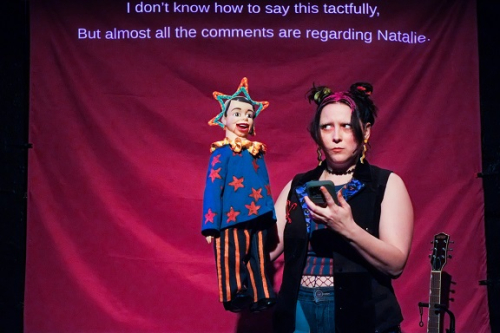
    This is not about Natalie ~ Jason Cady


    The first opera followed an unsuccessful musician feeling bad about her ex-music partner who became successful and moved on from their band. The story was told by way of daily vlogs that included conversations with a puppet – performer Sarah Daniels (photo above by Reuben Radding) did a great job, singing varied types of music, sometimes accompanying herself on electric guitar, and interacting with the ventriloquist puppet (whose voice had been pre-recorded, along with some accompaniment music, which was mostly kind of synth-pop). I thought it was interesting and pretty fun that the texture of the music – including songs performed as if they were kind of indie pop or rock – were being sung operatically, which somehow on the whole worked pretty well. The piece was clever, though transparent, and well executed.


    INcomplete Cosmicomics ~ Anna Heflin 


    After intermission, we settled in for a piece twice the length of the first. This piece was different in most ways. Based off of/inspired by/in conversation with Calvino’s Cosmicomics (Which I came in knowing almost nothing about), the character Qwfwq spends the hour in verbal and musical conversation with the audience. There was no operatic style singing – just one performer with a cello, voice, and looper with some effects. The music often made use of the looper, with stories being told intermittently – stories that often felt like folk tales, but sometimes involved ruminations, and other times explanations. Qwfwq was in conversation with his author, and those who have written about him – Ursula K Le Guin, and some others I didn’t know – he responds in a very human way to the criticisms given to him.


    Qwfwq spoke to us as the audience, directly, wearing an altered blue jumpsuit (photo above by  with patches and doodles sewn on, and wool socks. The character often had a kind of self-deprecating self awareness that was very engaging, as well as feeling friendly and approachable, though presented as fragments, or a set of thoughts.


    The music used a lot of looping – including with singing and speaking voice, as well as the cello, sometimes in complicated counterpoint. The piece went through many creative sound worlds that I liked – including making use of a tray of beads with contact microphone, and lots of breathing sounds that molded from the voice to the cello almost seamlessly. 


    Soshana


    I should have known this piece would have been great, since Anna wrote a somewhat similar solo piece for a friend of mine based on Alice and Wonderland – using voice and various effects to create something impressively textured and evocative. Prepared or not, I thoroughly enjoyed the performance, and Aaron Wolff (photo above by Reuben Radding) was an impressive interpreter – as an actor, cellist, and communicator. 

    ~ Shoshana Klein

    (Performance photos by Reuben Radding)

  • Alisa Weilerstein ~ FRAGMENTS 2

    CH11513997

    Above, Alisa Weilerstein/FRAGMENTS 2 ~ performance photo by Fadi Kheir

    ~ Author: Shoshana Klein

    Tuesday January 21st, 2025 – This evening at Zankel Hall, Alisa Weilerstein’s’ Fragments project continued with its the second installation. You may remember the first one, last April.


    Like last time, there was no program given until the end – a practice I still find interesting, though slightly frustrating. I had a bit of a conclusion that the ideal listener either knows the Bach suites by heart, or doesn’t know them at all; someone like me (knowing them but certainly not well versed on the particular movements, etc) ends up a little stuck on which is which and where we are. 


    For the staging, the same light boxes that were set up for the first installment are set up spread around the stage rather than in a circle around the cellist like they were last time. She entered in full darkness – though during that moment, someone’s phone went off and said clearly “calling emergency services” and everyone laughed, which was a fun communal moment.


    This setting struck me as more theatrical than the last – it started with a bang and bright lights, and Weilerstein was wearing fishnets, a bright fuchsia short dress, and dramatic stage makeup with her hair curled and all over the place. It seemed to evoke a sort of dramatization and maybe a teenage emotionality.


    The way that she played the Bach suite movements were sweeping, very light even though much of the suite is in minor. Her playing of the fast passages is very elegant – bringing out the vocal and conversational qualities of these multi-line pieces written for one instrument.


    CH11513956


    Performance photo by Fadi Kheir


    For the first couple movements there were really smooth transitions and stark lighting changes. The new pieces were lit with green and the Bach was a warmer white/yellow. I wondered if it would continue like that the whole time with the lighting just indicating whether or not we were hearing a new piece, but as it went on the changes became less stark, and the movements had different types of lighting. Maybe adding to this, or reflected by it, particularly in the beginning of the set, the Bach had a more veiled angstyness while the newer pieces had more brash emotionality in the forefront, as if the newer compositions were unearthing the meanings of the Bach and saying them more plainly.


    One standout movement near the end had only pizzicati and required Weilerstein to sing along with her playing. It was simple sounding and also grounding, particularly because this person who is at the highest levels of cello playing was singing like a normal person. Not to say it was bad, it just humanized her in a way that brought reality back in a really sweet way.


    ~ Shoshana Klein

  • American Composers Orchestra @ Zankel Hall

    PXL_20241031_001633210

    Above: Curtis Stewart & Kebra-Seyoun Charles

    ~ Author: Shoshana Klein

    Wednesday October 30th, 2024 – I’ve had a thing about the concept of borders since the US border patrol incinerated my innocent house plants at the US Canada border in 2022. The name of this concert by the American Composer’s Orchestra was “The New Virtuoso: Borders” and at the beginning, Curtis Stewart framed the concert in a way that sounded really great. He talked about using virtuosity in new ways, rethinking the way the instruments work, and considering the use of borders. This included the concept of good borders (like healthy boundaries) versus harmful borders – like those used to start wars, and those that mark our identities without causing harm. I really wondered if the music would live up to this deep description. 

    The program:

    Michael Abels: Borders 

    Kebra-Seyoun Charles: New Work (ACO Commission, developed via EarShot CoLABoratory/World Premiere)

    Curtis Stewart, Embrace (ACO Commission)

    Paul Novak, Forest Migrations (ACO Commission/World Premiere)

    Victoria Polevá, The Bell

    The first piece was by Michael Abels, who has written the music to a bunch of blockbuster movies. The description of the piece and the inspirations for it that was printed in the program was beautiful – the idea was that in the first movement, the guitar is within the borders of the bar lines and in the second movement it’s not. The second movement also depicts a child running – sometimes in joy and sometimes in fear. It was a little hard to hear all of that in the music but in the second movement the guitar was definitely leading more and there were complicated rhythmic sections where the guitar and orchestra were definitely in different meters, which was a cool effect.


    The Paul Novak piece “Forest Migrations” was about trees and ecological borders – he used the orchestra of the metaphor for forest and forest migration caused by climate change. He described how the movement of the piece would be slow – each player playing one at a time, and also mentioned that musicians owe a debt to the trees that their instruments are made of, which I thought was really interesting. I really liked the concept but I was not convinced that the effect was going to be unique. In reality, it was really well done but not what I expected from the description – there was a lot more movement and melody than I was expecting. I like the way the concept of borders were explored and discussed in this new way, but once again, I was not sure I heard it in the music the way it was described. 


    Before the start of Kebra-Seyoun Charles‘ piece, Curtis Stewart asked if they wanted to say anything else about it and they said “have fun.” The piece was all about blending musical styles – so mostly genre borders were those being addressed. There was harpsichord in the orchestration, which was really cool juxtaposed against some of the other musical styles that were played, and in the first movement the piece kept falling into a sort of Bach sound. The idea of the first movement was walking down the street in New York and catching snippets of lots of different things and I think it achieved that relatively well. The whole piece was very virtuosic and seemed really technically difficult for the bass soloist (though it was the composer, so they did a great job and obviously knew what they were getting into!). The second movement started very schmaltzy and almost sounded like a quote from something. Charles seemed to be having fun and they actually got the orchestra to sound kind of raucous in a way that you don’t hear often in a concert hall, which was refreshing.


    The Victoria Poleva piece had dark and interesting sound worlds – it definitely explored the concept of a bell and the concept of war, though in reality a lot of the peace was actually really uplifting and bright. Another thing that was bright was the soloists dress which was right yellow and sparkly! This piece felt a lot more cinematic than Michael Abel’s piece, ironically. One movement was almost entirely an ascending major scale with various harmony changes. There were some really cool whistling wind whistling sounds going along with string string sounds that were like ghost noises. It was kind of interesting that this Ukrainian composer who mentioned Ukraine and mentioned the war didn’t really mention borders, though maybe it’s just implicit enough that it wasn’t necessary.


    PXL_20241031_014727965


    The last piece was by Curtis Stewart (above), who is also the artistic director of the ACO. This was probably the most involved piece of the program. There was a video and there was audio recording and there was audience participation! I’m always impressed when a composer tries to incorporate audience participation. In this context it worked pretty well, we basically sang chords in a progression. I wasn’t that much of a fan of the video but having the audio was nice. It was a compilation of his mother’s voice talking about music, interspersed with the composers from the concert and school kids from the ACO’s young composer program answering the same questions that she had. One of those questions that he mentioned before he started stuck with me was “how does music carry you through the changes in your life.” The piece was less full of electronics than I was expecting given his setup, but I did really like the music.


    Conductor Mei-Ann Chen, who I’ve heard great things about, seemed like a dynamic, clear, and energetic leader who would be fun to play under. Overall, I suppose the theme of the concert for me was something along the lines of “great thoughts and concepts that don’t always come through in the music” but in some ways that’s par for the course in new music, and honestly I still prefer it to a lack of contextualization or tying things together – I love a concert that ties ideas together and brings up relevant issues. Many things were tried and many of them were successful.

    ~ Shoshana Klein

  • Alarm Will Sound @ Zankel Hall

    Alarm will sound


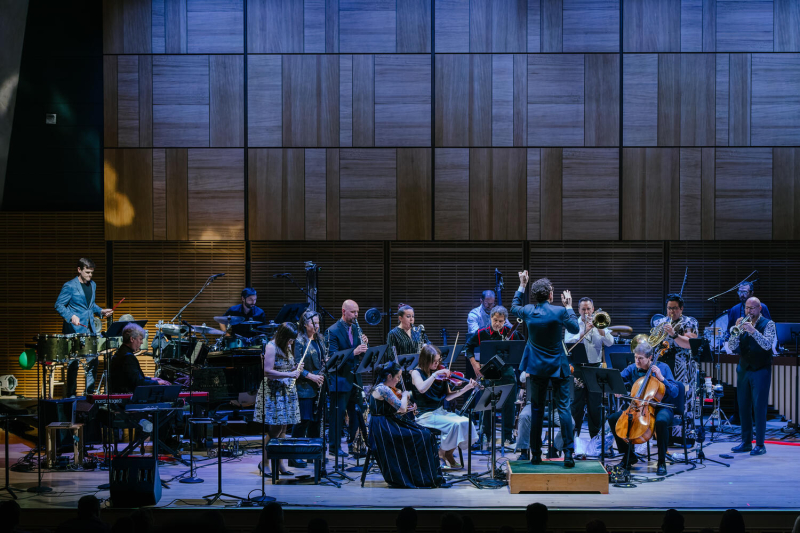
    Above: concert photo by Fadi Kheir


    ~  Author: Shoshana Klein


    Tuesday March 26th, 2024 – Though this concert started with slight technical difficulties, after  about 3 minutes, the whole rest of the show went on without a hitch. The pieces were played with minimal breaks and the show could have gone on with no applause, except that everyone was so excited about the pieces that there was a lot of excitement in between.


    There were audio introductions from each composer, and sometimes they even overlapped with the beginnings of the pieces. This created a really good flow that made the concert seem a little more connected and seamless than a normal program. This was actually my first official Alarm Will Sound concert despite being a fan of them for years. I’ve seen them in other contexts but not a fully programmed concert – it was a real treat! 


    The concert started with a piece by Tania León, who curated the concert in her capacity as the Richard and Barbara Debs Composer’s Chair of Carnegie Hall. Her piece was cool, groovy and fun, scored for small ensemble. 


    The second piece, by Chris P. Thompson, had some basis in drum corps, as explained by his introduction. It was really cool to hear about marching band in the context of “classical music”. I think it often gets ignored as an art form or a rigorous type of music when it’s actually pretty difficult in a way that was contextualized really well by the introduction to this piece, which was also really fun. The piece had a lot of rhythmic complexity and was really upbeat. One effect that was used was these tubes that are swung around by various musicians to create a pitch (and the pitch changes based on how quickly you swing the tube). I’ve been seeing this used in new music spaces more often recently and in this particular instance it did evoke the marching band – the coordination and visual aspects, or maybe more specifically the color guard spinning flags around on the field.


    The next piece was by Christian Quiñones (who I worked with a couple of years ago but we’d never met in person!) His piece was really cool and also had lighting effects attached to the electronic sounds, which was an interesting though slightly jarring experience. The sounds were a little glitchy but rhythmic in a way that sounded really cool. The piece was based on the sound of hearing loss – sounds becoming obscured and distorted throughout. 


    The last piece on the first half, in my opinion, was definitely the show stealer. It was an excerpt of an opera by Damon Davis and he called it in his introduction a “black rap space opera”. I had moments of feeling like some of the music was familiar to the point where I wondered if I’d heard it before – but I think it was just that type of music, kind of magical in its familiarity as well as its novelty. It was well orchestrated, interesting in the way it used members of the ensemble as characters or kind of as set pieces. The songs were beautiful but also definitely post-genre, almost more similar to musical theater than anything. The music and the story were optimistic in a mythological way, almost like Disney or Miyazaki. Everybody seemed to want to hear the whole thing. This was a fragment of a larger work that will hopefully be performed soon!


    The second half started with a piece by Elijah Daniel Smith which had a different tone – more subdued and introspective than the first half. It had a lot of really interesting sound worlds accompanying a narration that was interesting and impactful.


    Next was a piece by Texu Kim that was rhythmic and upbeat and ended a frenzy of rhythm that was perhaps intentionally impossible to keep completely together, which was a nicely unconventional end to the piece.


    Next was a five movement piece by Bora Yoon that was eclectic. There were moments of poetry, moments that felt conversational, and really interesting sound worlds including a prepared piano and an instrument she seemed to have made out of bicycle bells. The last movement particularly struck me – it was really really beautiful around an ocean theme. I wish I had more to say about this piece – it was delightful and brought us through many emotional spaces in a short time.


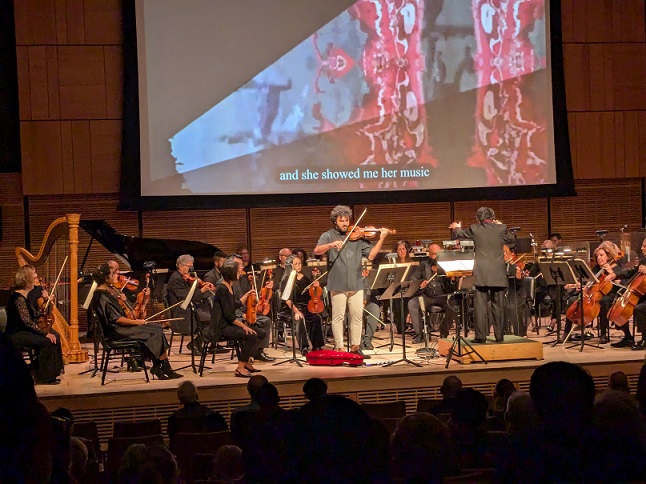
    Tania and alan pierson


    Above: Tania León and Alan Pierson; photo by Fadi Kheir
     
    Before the last piece, we heard a little bit from Ms. León. She, with the help of Alarm Will Sound‘s Alan Pierson, framed the concert within the context of this question that her father had asked her right before he died. In this conversation she showed him some of her music and he’d asked her where she was in it. Every explanation by the composers in this concert told where they as a human were in their music. It really tied the whole thing together in addition to the fact that after this conversation, The ensemble played the León from the beginning but arranged for the full ensemble. Bringing back the piece from the beginning was a really cool effect. Unfortunately, I didn’t really remember it that well but I still liked the symmetry of it. All in all, it was a little bit of a long concert but everything was so good that I don’t know what I would have been able to leave out!
     
    ~ Shoshana Klein

  • Angel of Many Signs @ Gerald Lynch Theater

    A

    Above: performance photo by Alan Barnett

    Author: Shoshana Klein

    Saturday November 18th, 2023 – The New York Choral Society gave a concert on Saturday afternoon at the Gerald Lynch Theater, joined by the new-music focused Bergamot Quartet and composer/conductor/vocalist Raquel Acevedo Klein. The premise had to do with Hildegard von Bingen, and most of the repertoire was arrangements of her music for choir.

    I love a continuous performance, but for this one, I never really had in idea of where we were in the program, even though there was supposedly a multi-movement work sharing the title of the concert in the middle – at some points it was clear that the choir was singing in English and I suppose that was the giveaway, but the setup and video never really changed, so it was a little hard to tell. 


    The concert began with Raquel Acevedo Klein only, singing with some electronic manipulations, as everyone else gathered on stage. It was a sizeable group, so it was effective to have something going on instead of just having the audience watch while people found their spots onstage.


    B


    The electronic element was interesting: Ms. Acevedo Klein (above, photo by Alan Barnett) is able to make some very cool things happen. She and the quartet mostly acted as sort of interludes between the choral pieces, sometimes with some overlap. It was a nice juxtaposition to have the older and newer, but didn’t feel like it had a lot of direction.


    The video element was somewhat engaging as well, with one big screen behind the ensemble and two smaller ones flanking the stage. There were busy animations happening throughout the production, definitely tied to the music but only in instrumentation – usually when the quartet only was playing, the visuals would be sparser, one specific animation that recurred and tied things together a bit. When the whole choir was active, there would be many visuals that would come back to create a busy landscape, sometimes involving “angel” imagery, but usually not in a typical Christian imagining (which I did kind of appreciate, but this was never really explored as far as I could tell).


    The pieces were certainly not bad – I’ll definitely admit I’m not much of a choir person and surely missed plenty of nuance. Overall, the performance was interesting but repetitive, and I just didn’t have a sense of the structure, narrative, or takeaway, which – given all of the extra elements – it seemed like there was going to be.


    ~ Shoshana Klein

  • John Cage’s Ryoanji at the Japan Society

    John cage

    Above: John Cage in Japan; photo by Yasuhiro Yoshioka, Courtesy of Sogetsu Foundation

    Author: Shoshana Klein

    Sunday October 22nd, 2023 – The Japan Society is doing a John Cage’s Japan series, of which this was the second installment. It was directed by Tomomi Adachi and played by members of the International Contemporary Ensemble.

    The premise is very interesting – the performers play John Cage’s Ryoanji, and there is a video with reactive elements. After intermission, the video is played back and the performers use it as a score to perform again. I was left with many questions – though I read most of the program, I think it could have benefited from explanations of some sort.


    First of all, some musicians were here, and some were in Japan, supposedly. There was a vocalist and a Hichiriki (according to the program) coming from speakers, but we never saw these performers or were introduced to them. It was also 300 AM in Japan, so I’m not sure how likely it was that they were performing live in this performance. They were not present for the second half. Instead, Adachi (I think) performed with the original trio. 


    It was unclear to me how the video was reactive to the musicians – it was a sort of constellation visual with points of light moving around, and brightly colored lines and shapes would appear, connecting these star-like dots. If the lines and shapes were related to the audio being played, I couldn’t figure out how – my best guess for the video reactivity had to do with the perspective and the amount of movement. For instance, for a while it seemed like the perspective, zoom, and amount of movement of the start may be affected by the musicians, but if so, it seemed to change throughout the performance. It was interesting to try to figure out and they were cool visuals, but relatively static throughout the 20 or 30 minute performance.


    The piece, musically, was pretty sparse and I had trouble finding structure or latching on to anything, but the musicians obviously played well together and there were moments of responsiveness that were nice. Reading about the score is helpful – it’s not really notated and the performers are basically playing graphic scores of drawings of rocks. It should be noted that I do like John Cage, at least theoretically – I think his ideas and philosophical concepts are very interesting, but sometimes I find it hard to translate that to an enjoyable auditory experience.


    The second half had significantly more musical movement, though it wasn’t clear how they were using the video as a score, and it appeared that they were also reading music (maybe the original score in combination?). It seemed shorter than the first half but I’m not sure that it was, it could have been my perception since there was so much more to listen for. All in all, an interesting experience that I would have liked to know more about. 


    ~ Shoshana Klein

  • John Cage’s Ryoanji at the Japan Society

    John cage

    Above: John Cage in Japan; photo by Yasuhiro Yoshioka, Courtesy of Sogetsu Foundation

    Author: Shoshana Klein

    Sunday October 22nd, 2023 – The Japan Society is doing a John Cage’s Japan series, of which this was the second installment. It was directed by Tomomi Adachi and played by members of the International Contemporary Ensemble.

    The premise is very interesting – the performers play John Cage’s Ryoanji, and there is a video with reactive elements. After intermission, the video is played back and the performers use it as a score to perform again. I was left with many questions – though I read most of the program, I think it could have benefited from explanations of some sort.


    First of all, some musicians were here, and some were in Japan, supposedly. There was a vocalist and a Hichiriki (according to the program) coming from speakers, but we never saw these performers or were introduced to them. It was also 300 AM in Japan, so I’m not sure how likely it was that they were performing live in this performance. They were not present for the second half. Instead, Adachi (I think) performed with the original trio. 


    It was unclear to me how the video was reactive to the musicians – it was a sort of constellation visual with points of light moving around, and brightly colored lines and shapes would appear, connecting these star-like dots. If the lines and shapes were related to the audio being played, I couldn’t figure out how – my best guess for the video reactivity had to do with the perspective and the amount of movement. For instance, for a while it seemed like the perspective, zoom, and amount of movement of the start may be affected by the musicians, but if so, it seemed to change throughout the performance. It was interesting to try to figure out and they were cool visuals, but relatively static throughout the 20 or 30 minute performance.


    The piece, musically, was pretty sparse and I had trouble finding structure or latching on to anything, but the musicians obviously played well together and there were moments of responsiveness that were nice. Reading about the score is helpful – it’s not really notated and the performers are basically playing graphic scores of drawings of rocks. It should be noted that I do like John Cage, at least theoretically – I think his ideas and philosophical concepts are very interesting, but sometimes I find it hard to translate that to an enjoyable auditory experience.


    The second half had significantly more musical movement, though it wasn’t clear how they were using the video as a score, and it appeared that they were also reading music (maybe the original score in combination?). It seemed shorter than the first half but I’m not sure that it was, it could have been my perception since there was so much more to listen for. All in all, an interesting experience that I would have liked to know more about. 


    ~ Shoshana Klein

  • Claire Chase ~ Density 2036 @ Zankel Hall

    Claire chase

    Above: Claire Chase

    Author: Shoshana Klein

    Thursday May 25th, 2023 – Claire Chase’s Density 2036 project is long and ambitious: a 24-year long project of new commissions, inspired by Varèse’s famous flute piece Density 21.5. Each year, she performs an entire new program of works. This year, she’s 10 years into the project, so the 10 days leading up to this concert have been a recap of all of these new pieces, culminating in Thursday’s world premiere of a 50-minute chamber piece by Anna Thorvaldsdottir named Ubique. For this evening’s piece, the ensemble was composed of Claire Chase, flutes; Katinka Kleijn and Seth Parker Woods, cellos; Cory Smythe, piano; and Levy Lorenzo, live sound. The concert started with a conversation between Ara Guzelimian and Thorvaldsdottir, who described a blank page at the beginning of a composition as freeing – that composing a piece “starts with a sensation – finding something that doesn’t exist yet”

    The introduction – which turned out to be a recurring theme – was a deep, low rumbling (not unlike the sound the subway makes in Zankel Hall, begging the question if that was an intentional move by the composer writing for the hall). There was striking low lighting around the ensemble, really creating a space that brought you into the beginning of the performance. The lighting changed throughout the piece in a way that was engaging and followed the different sections – adding some literal color changes to the musical color changes, very tastefully.


    The piece seemed to have many movements (though if so, they weren’t indicated in the program) – some quite short and full of quick gestures and handoffs, others more slow-moving. There were more sections and honestly more tonality than I was expecting from Thorvaldsdottir. There were a few parts where bass flute and the two cellos mixed in really interesting ways – Thorvaldsdottir is always one for unique texture and sound, and this piece was no exception.


    At about 40 minutes into the 50-minute piece, Chase finally picked up a C flute, as opposed to the Contrabass flute (named Bertha, as we were told in the pre-concert conversation) and the regular bass flute (whose name I do not know) that she’d been playing so far. The “regular” flute at this point in the piece was strangely light and really felt like a different world – a change from the usual where the lower flutes have the otherworldly feeling.


    I didn’t feel like I got a good sense of the structure of the piece, but I still enjoyed it, and the recurring rumbling theme gave it some sense of unity. I imagine it would be interesting to be keeping up with the entire project of new flute works and really get to know Chase’s playing – undoubtedly her style influences all of these new commissions, and her explicit goal is for the new pieces to “expand the boundaries of the instrument”. It’s also worth mentioning that as ambitious as it sounds that Claire Chase played a full length recital every night for 10 nights this month, the plan for the final concert of Density 2036 is for her to put on a 24-hour long concert with all of the new music commissioned throughout the project. 


    ~ Shoshana Klein

  • Dallas Symphony @ Carnegie Hall

    Luisi

    Above: Maestro Fabio Luisi

    Author: Shoshana Klein

    Sunday March 26th, 2023 – I have to admit to not knowing much about the Dallas Symphony Orchestra before tonight. I’ve seen Fabio Luisi guest conduct before but not work with his home orchestra. As it turns out, they put on a great concert – they played with energy, focus, and dynamic range, and Luisi does a great job of keeping things interesting and restrained to keep the music interesting later on. Despite, or maybe because of this, somehow the concert still had more people dropping things in the audience than any other concert I’ve ever been to.

    Negron jpg


    What keeps me awake by Angélica Negrón (above, photo by Quique Cabanillas) started the concert – a short 7-minute piece, but a very nice introduction to the concert. Negrón created a distinctive but not completely unfamiliar sound world – though this might have something to do with the fact that I listen to her band, Balún – which seriously, you should check out if you haven’t heard them. Negrón is the Composer in residence at the DSO and I’m looking forward to hearing more pieces that come out of that collaboration.


    The piece evokes uncertainty and wandering like her program note explains – navigating moving from Puerto Rico to New York City as a Latina composer trying to fit into spaces that historically excluded people who look like her.

    G o jpeg


    Rachmaninoff’s second piano concerto with Garrick Ohlsson (above) was very enjoyable. I’m usually in the balcony, and being on the orchestra level so close to the stage, I could actually feel the sounds through my feet when the brass let loose. The orchestra was super sensitive under Luisi, the piano sections drawing us all in and the louder sections contrasting well. Ohlsson played the 3rd movement with some extra snappiness, which was just enough to keep my full attention for a piece many of us have heard… somewhat frequently. Near the middle/end of the third movement, I think the piece loses steam a bit compositionally, but it almost makes the end more exciting – right around the time you start to be ready for it to be over, it gets into it again and heads for the hyper-romantic finish.


    Ohlsson did an encore that he announced from the stage, though it wasn’t really necessary – Chopin’s op 9 no 2, probably the most well-known of the nocturnes. Near the end, he had a little fun with it, adding some whimsy in places.


    The Tchaikovsky, (which started at almost 10pm, the joys of an 8:30 start time) was really well paced, restrained just enough more than usual to be noticeable. Some tempi choices in the second movement caught my ear, the bassoon solo section – while sounding great – was a little slow to me, and the horn solo also sounded good but a little fast. However, overall I chose to trust the plan as the whole piece came together really well. The wind soloists were all fantastic, and more soloistic than their counterparts in the first half of the concert.


    It’s played so much, but this is one of those pieces to me that if you put it away for long enough, it regains most of its charm. It turns out I hadn’t heard it in long enough that it felt fresh and new, at least with this exciting performance.


    ~ Shoshana Klein