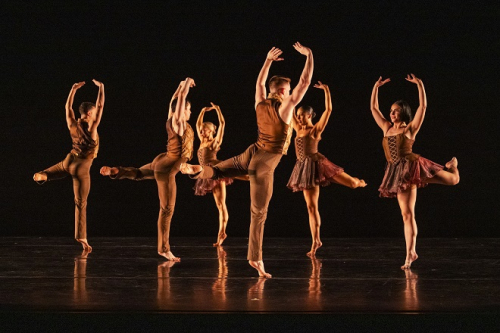
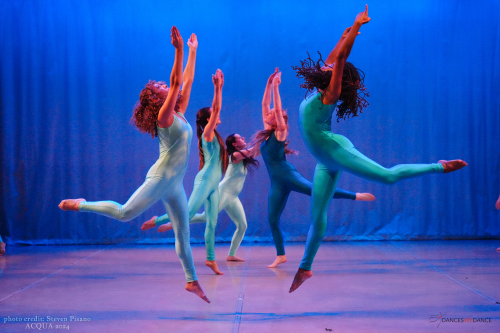
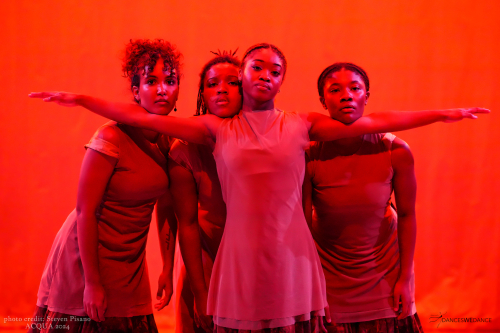
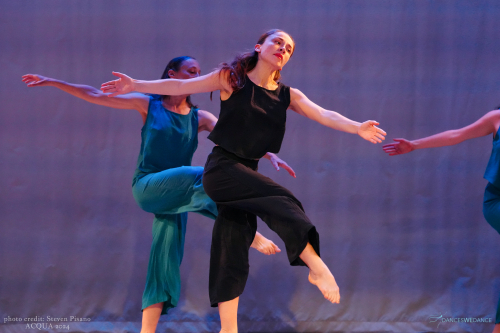
Tag: Steven Pisano

  • Teatro Nuovo’s MACBETH @ City Center

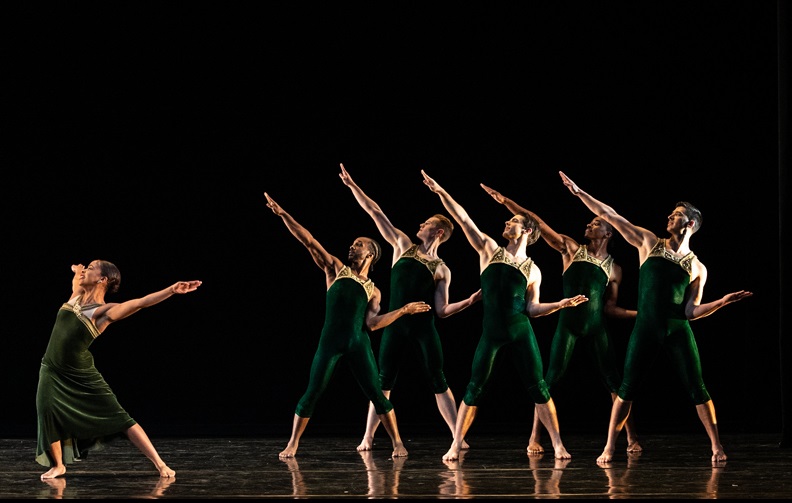
    Teatro Nuovo 2025 Macbeth - Chorus of Scottish Exiles (Act Four)_Photo by Steven Pisano

    Above: the chorus of Scottish exiles; photo by Steven Pisano

    (Note: click on each image to enlarge)

    ~ Author: Ryan Vasquez

    Wednesday July 23rd, 2025 – This year, Teatro Nuovo staged both Verdi’s Macbeth (the 1874 edition) and Donizetti’s La Sonnambula. Verdi’s Macbeth is a relatively faithful adaptation of Shakespeare’s classic, but the opera could just as well have been titled Lady Macbeth, both because of the impressive music Verdi wrote for the character and because of Alexandra Loutsion’s commanding performance as the (almost) titular villain. The entire principal cast sang beautifully, but the night undoubtedly belonged to Loutsion.

    Teatro Nuovo is a summer festival where young singers and budding professionals spend the season working on two bel canto operas. Although Verdi is not typically categorized as a bel canto composer, his early works, Macbeth among them,clearly sit at the tail end of that stylistic era.

    The performance took place at New York City Center, just a block from Carnegie Hall. It was my first time attending a show at the venue, and it was fantastic, beautiful and acoustically quite pleasing. I was also glad to see a diverse audience that truly reflected the breadth of NYC’s population and age demographics.

    The full orchestra was positioned directly in front of the stage and served as a formidable counterpoint to the otherwise completely bare stage. I was surprised to find there were no set pieces at all, but I chose to be patient and see how things would unfold.
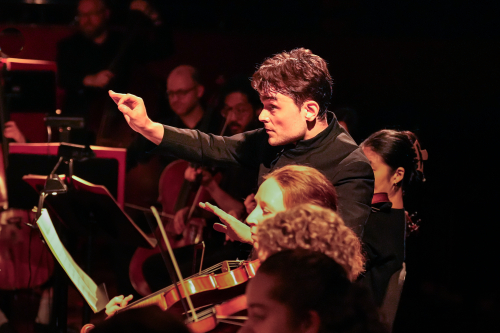
    Teatro Nuovo 2025 Macbeth_Jakob Lehmann conducting the Teatro Nuovo Orchestra_Photo by Steven Pisano

    Conductor Jakob Lehmann (photo above by Steven Pisano) walked out and began the overture. The orchestra displayed masterful control, delivering Verdi’s score with both power and delicacy. Their ability to handle the softer passages was especially noteworthy: opera orchestras aren’t always known for subtlety, but this one maintained finesse throughout the entire evening.

    I noticed the overture featured prominent use of brass, which I loved for its tone-painting quality. Brass instruments have long been associated with death, and Verdi’s thick brass textures effectively foreshadowed the bloodshed to come.

    Teatro Nuovo 2025 Macbeth_witchs chorus_Photo by Steven Pisano

    Above: the chorus of witches; photo by Steven Pisano

    The back wall of the stage lit up with a beautiful projection of Scotland, setting the scene for the witches’ chorus. Shakespeare’s version begins with three witches who famously chant, “Double, double, toil and trouble,” but this adaptation featured three groups of singing witches. All dressed in black, these choristers were young artists covering the main roles and performing comprimario parts.

    They sang well, and several performers fully embraced their witchy characters. However, a number of them seemed to lack fully developed characterizations. Overall, it was an effective, if slightly static, opening.

    Shortly after the choral number concluded, Macbeth, played by Ricardo José Rivera, and Banco, played by Cumhur Görgün, entered. Both were dressed in formal black attire, a costume choice shared by the rest of the male cast.

    They sang the duet “Due vaticini compiuti or sono” beautifully. I was particularly struck by Rivera’s smooth legato line. Görgün’s voice had a rich color, and I noted that the upper part of his range had more heft, making me wonder if he might actually be a bass-baritone. Regardless, the duet was a strong introduction to both characters and their voices.

    Teatro Nuovo 2025 Macbeth_Alexandra Loutsion as Lady Macbeth_Sleepwalking_2_Photo by Steven Pisano

    Above: Alexandra Loutsion as Lady Macbeth; photo by Steven Pisano

    After the stage cleared, a new projection depicted Macbeth’s castle. Lady Macbeth, portrayed by Ms. Loutsion, entered and delivered lines in wonderful Italian. I was surprised the passage wasn’t sung in recitative form, but soon she transitioned into the recitative section of her aria, “Nel dì della vittoria.

    Ms. Loutsion’s voice initially sounded like a mezzo’s, but given the heights her voice achieved, she was clearly a soprano. She commanded the stage and fully embodied the ambitious Lady Macbeth. The crowd adored her. Her coloratura rang with crystal-clear pitch, an impressive technical feat, and her intonation was impeccable. When she finished her aria, the audience erupted into applause. Well deserved cries of “Brava!” rang out. Loutsion stood in place until the cheers subsided, then exited the stage.

    Teatro Nuovo 2025 Macbeth_Ricardo José Rivera and Alexandra Loutsion as the Macbeths 3_Photo by Steven Pisano

    Above, the Macbeths: Mr. Rivera and Ms. Loutsion, photo by Steven Pisano

    Rivera’s characterization of Macbeth in the first scene leaned heavily into “anxious,” which worked initially but grew somewhat one-note. Fortunately, more nuance emerged during his duet with Lady Macbeth. The two had excellent chemistry, and Ms. Loutsion appeared more relaxed. If the shift in tone was an intentional choice to reflect Macbeth’s comfort in his wife’s presence, it was an effective one.

    They sang well, but I realized midway through their duet that I didn’t fully understand what had just happened to prompt the number. This moment highlighted the production’s biggest weakness: the acting and staging were secondary to the music.

    The motivation behind the duet was that Macbeth had just murdered the king and was now panicking over the bloodied dagger. However, the murder itself wasn’t shown. While the libretto indeed places the murder offstage, the production did little to make that event clear. The action often felt like an inconvenient hurdle rather than a driving force for the music.

    This lack of clarity recurred throughout the show. Events that should have been staged were either skipped entirely or summarized in supertitles. The most jarring example came at the end, when Macbeth and Macduff left the stage to fight. A supertitle then informed us that “Macbeth was fatally wounded.” After which the two returned. Macbeth proceeded to lie on the floor. And then die. 

    Returning to the earlier moment: after the Macbeth/Lady Macbeth duet, the chorus launched into a rousing Verdi finale. It had all the signature hallmarks of Verdi’s brilliance, even in this early work. I was particularly impressed by Martin Luther Clark, who sang the role of Macduff. Though Macduff doesn’t do much until the final act, Clark’s sterling tenor soared clearly above the orchestra.
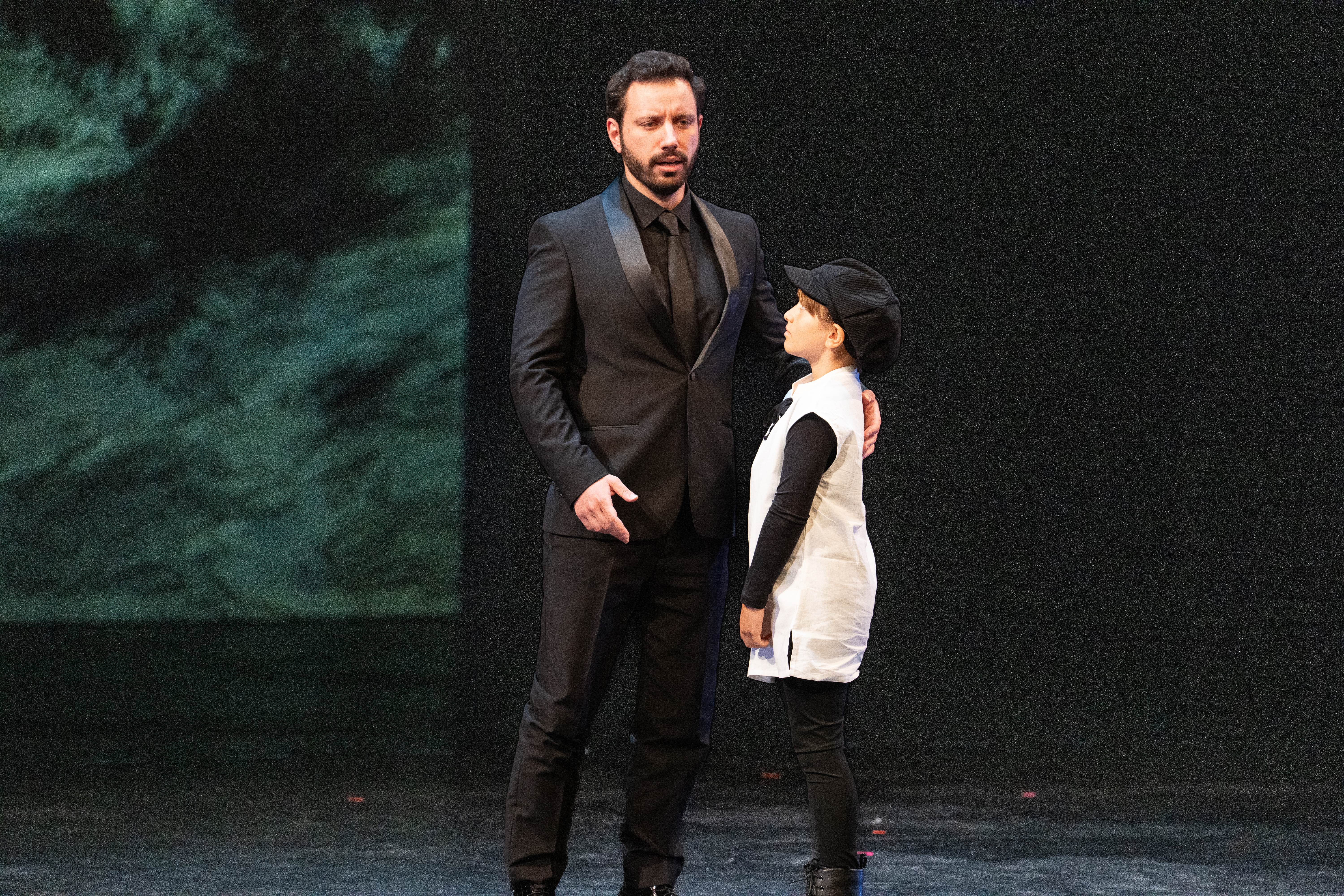
    Teatro Nuovo 2025 Macbeth_Cumhur Görgün as Banco  Olivia Trinchera Citterio as Fleanzio_Photo by Steven Pisano

    Above: Cumhur Görgün as Banquo and Olivia Trinchera Citterio as Fleance; photo by Steven Pisano

    In the next act, Banco and his child were outside the palace, unaware of the events unfolding within. Görgün sang Banco’s aria beautifully, again showing off his warm tone. Banco then exited the stage and was murdered (again offstage), and the scene shifted back to Macbeth’s castle.

    Teatro Nuovo 2025 Macbeth_Ricardo José Rivera as Macbeth_6_Photo by Steven Pisano

    Above: Ricardo José Rivera as Macbeth is haunted by Banquo’s ghost; photo by Steven Pisano

    Act II featured more beautiful singing, and Rivera seemed more animated and confident. During the finale, Banco’s ghost appears, visible only to Macbeth, but the staging failed to indicate he was a ghost. Since we never actually saw Banco die, the moment felt muddled. Simple makeup or lighting could have clarified things. Still, the ghost was soon forgotten as the act closed.

    Once again, the orchestra impressed. Their dynamic sensitivity, likely thanks to Lehmann’s direction, was a rare treat in opera.

    I thoroughly enjoyed the sprite scene in Act 3, where the female chorus returned as witches. The choral numbers throughout were well executed. The staging in this act was more dynamic, with some choreographed movement that added interest.

    Macbeth’s aria following the sprites was Rivera’s best of the night. His soft passages were beautifully rendered, showcasing his technique. He ended with a rousing cabaletta and held an extended final note that had the audience in raptures, particularly in the balcony, where the applause outlasted that of the orchestra level.

    The scene turned back to Macbeth’s castle. Although I had never seen this opera in person, I knew about the most famous scene that was Verdi’s take on Shakespeare’s famous lines for Lady Macbeth, “Out, damned spot! Out, I say!” Lady Macbeth’s attendants stood on stage giving the background details on why Lady Macbeth had seemed to have lost her mind. Once the preamble was finished, Ms.  Loutsion walked out as if in a trance and started to sing the famous aria Una macchia è qui tuttora.”  As the soprano mimed out washing her hands the audience was transfixed, for the entire scene, waiting with bated breath for the next moment to happen. And as Ms. Loutsion finished she walked off the stage with applause.

    Next came a scene featuring Macduff and Malcolm, the prince destined to take the throne Macbeth killed (offstage) to acquire. Romeo Lopez, who sang Malcolm, had a sweet voice but was overpowered by the orchestra. As a young artist, he has time to develop his voice, but for now, he struggled to be heard.
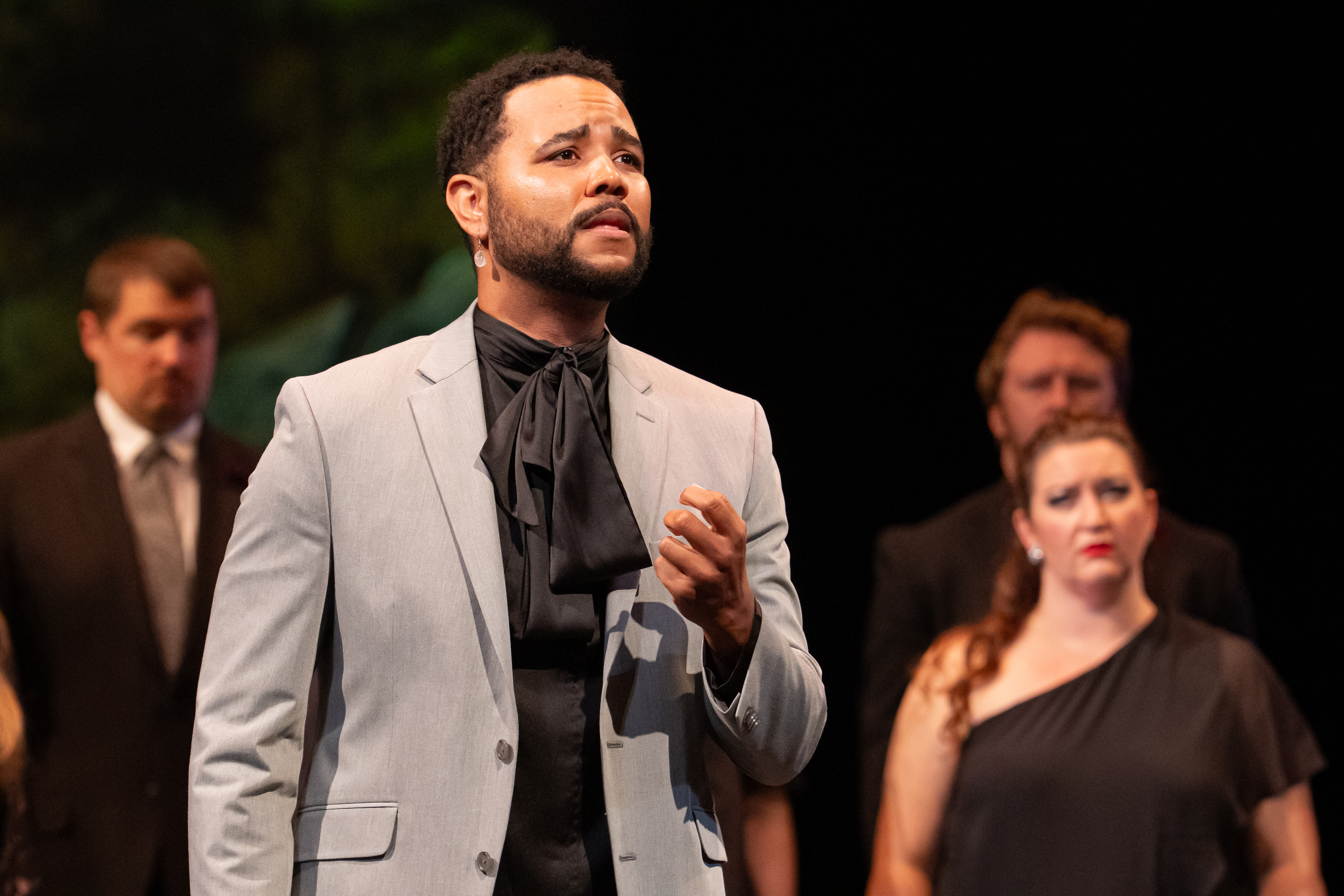
    Teatro Nuovo 2025 Macbeth_Martin Luther Clark as Macduff_2_Photo by Steven Pisano

    Above: Martin Luther Clark as Macduff; photo by Steven Pisano

    Clark’s rendition of Macduff’s aria “Ah, la paterna mano” was a standout moment. Macduff is one of those roles where you don’t have too much to do and learn, but you get a wonderful song that everyone remembers after the show. Clark performed it with tenderness and grief rather than anger, revealing the piece’s emotional depth. His pianissimi were particularly moving, making me appreciate the aria in a new light. The ovation was well earned.

    In the final scene, Macbeth and Macduff faced off. Macbeth, emboldened by the witches’ prophecy that no man born of woman could kill him, is shocked when Macduff reveals he was born via cesarean section. They leave the stage, Macbeth is mortally wounded, they walk back onstage, and the show ends.

    Musically, this Macbeth was executed beautifully. The orchestra was superb, and the singers brought Verdi’s music to life with skill and passion, thankfully, onstage.

    ~ Ryan Vasquez

    (Performance photos by Steven Pisano)
  • Paul Taylor @ The Joyce ~ 2025

    Shawn lesniak

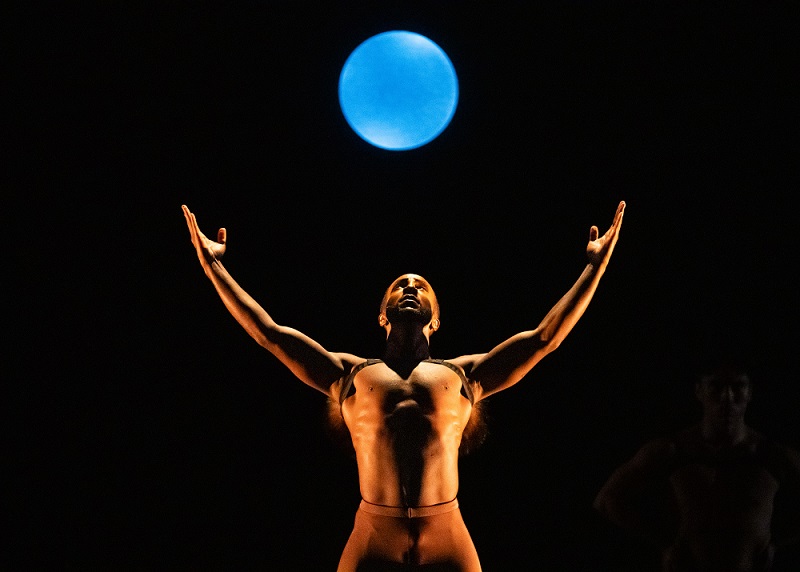
    Above: Shawn Lesniak in Paul Taylor’s Runes; photo by Steven Pisano

    ~ Author: Oberon

    Sunday June 22nd, 2025 matinee – Three works were on the bill at The Joyce this afternoon, as the Paul Taylor Dance Company concluded their season at the iconic venue. The matinee marked the farewell Taylor performance of Shawn Lesniak, who joined the Company in 2019. 

    Paul Taylor’s opus 64 – Polarisis set to a commissioned score by Donald York; it premiered in 1976. This work is unique in that it presents the same choreography twice, in different musical settings and with different dancers performing in and around a metallic cube; Jennifer Taylor’s lighting design, always so impactful, is also altered in the repeat. 

    In the cast of the first setting of the work were Gabrielle Barnes, Emmy Wildermuth, Payton Primer, John Harnage, and Jake Vincent. Of the women, Mlles. Barnes and Primer were new to me. Ms. Wildermuth had dazzled me in 2024, dancing Jody Sperling’s Clair de Lune, inspired by Loïe Fuller; today, in Polaris, her solo was vividly danced. John Harnage and Jake Vincent looked like young gods, and they danced handsomely.

    Donald York’s score develops a lilting theme, the choreography is stylized as the dancers move about the space creating shapes and striking poses; one dancer replaces another as if by magic.  The music is increasingly cinematic, the dancing full of wit, irony, athleticism, and grace. Ms. Primer and Mr. Harnage have an intriguing duet, and then Ms. Barnes made a gorgeous impression in a long solo passage where she moved about the space like a goddess. 

    One by one, the dancers of the first setting depart, their spots being taken over by Lisa Borres Casey, Jada Pearman, Jessica Ferretti, Lee Duveneck, and Alex Clayton. The music here felt more dramatic…more theatrical; at times, it became suspenseful, even creepy. The lighting seemed to take on a unique glow, with Jada Pearman charming us in her solo. Ms. Borres Casey and Mr. Clayton matched up to fine effect in their duet, and Jessica Ferretti was stunning and sublime in the long solo. Lee Duveneck towered over his colleagues, always a compelling advocate of the Taylor style. The finale of the ‘second’ score was especially evocative. 

    Following the interval, we saw Tablet (Taylor’s opus 24), set to a commissioned score by David Hollister, premiered in 1960. This playful, nine-minute duet was once danced by the choreographer and Akiko Kanda (photo below by Helga Gilbert): 

    Tablet-Taylor-Kanda-by-Helga-Gilbert 2

    Today, Tablet was danced by Kristin Draucker and Devon Louis, below in a Steven Pisano photo:

    Taylor tablet pisano

    Tablet’s score is quirky, the atmosphere that of a playful courting duet. The dancers were ideally paired, their shapes and port de bras having a natural flow. Each has a solo passage, but it is in their entwined partnering that the relationship – and the mutual trust between the two – is most palpable. During the interval, former Taylor star Richard Chen-See stopped by to chat; I understand that Richard was very much involved in getting Tablet back into the repertoire, and that’s surely why it felt so perfect. Ms. Draucker and Mr. Louis were the ideal choices for this revival. I hope Tablet will continue to be danced for us in seasons to come.   

    Cloven Kingdom has long been one of my favorites in the Taylor repertoire; it was the choreographer’s opus 63. With music by Arcangelo Corelli, Henry Cowell, and Malloy Miller, the work premiered in 1976. I first saw it at Jacob’s Pillow in 1982, and it was love at first sight…and first hearing. The music casts a spell: the elegance of Baroque is mixed with sexy percussive rhythms and sounds from an exotic jungle to captivating effect. Having seen it numerous times since that Pillow showing, the piece today was as marvelous as ever.

    “Man is a social animal…” as the Spinoza quote tells us. And what a delightful bunch of humans danced for us this afternoon: Jessica Ferretti, Gabrielle Barnes, Emmy Wildermuth, Elizabeth Chapo, Kristin Draucker, Lisa Borres Casey, Jada Pearman, and Payton Primer swept about the stage in their swirling gowns, leapt swiftly along diagonals, and found new ways of walking (and cart-wheeling) that gave their moves added vibrancy. Their mirrored head-gear cast shards of light into the Hall.  

    The male quartet – a Taylor classic if ever there was one – was dazzlingly done by Devon Louis, John Harnage, Austin Kelly, and Mr. Lesniak. It seemed to me that, in the course of this number – which ends with a stunningly-lit statue-pose – and indeed on into the ballet’s finale, the dancers were subtly messaging their affection and admiration to their retiring colleague as they passed him in the course of their dancing.

    The matinee ended with a rousing ovation from the packed house; cries of “Shawnie! Shawnie!” rang out, and Mr. Lesniak then took a solo bow, to wild applause. Flowers were pelted onto the stage as his colleagues surrounded him in a massive love-in. Bravo!! Bravissimo!!!  

    ~ Oberon

  • Parsons Dance @ The Joyce ~ 2025

    Her-Gifts-Photo-by-Steven-Pisano1-1024x683

    Above: the one and only Zoey Anderson in David Parsons’ new solo, Her Gifts; photo by Steven Pisano

    Sunday May 18th, 2025 matinee – Parsons Dance at The Joyce with a program of works by Rena Butler, Robert Battle, and the founding choreographer himself: David Parsons.

    The program opened with Parsons’ 2005 work Wolfgang, to music of Mozart. Hints of Paul Taylor as well as nods to the classical ballet world are woven into the choreography. Howell Binkley’s emblematic lighting designs – both here and later, in Caught and In The End – are so atmospheric. 

    Wolfgang  Photo by Paula Lobo

    Wolfgang (photo above by Paula Lobo) has a beautiful, flowing feeling, with a series of duets giving the dancers ample opportunity to shine (the “either/or” listing of the dancers left me wondering who was who at times). For a while, the dancers lounge on the floor. The adagio brought finely-lit poses, laced with touches of humor. There were vanishing acts, where the dancers disappeared into the upstage darkness. In the light and bright finale, Parsons makes canny use of the music; a series of turns elicited a burst of applause.

    A brand new – and stunning – solo, Her Gifts, choreographed by David Parsons to Roberta Flack’s immortal classic ‘The First Time Ever I Saw Your Face’, was a gift from David to the radiant Zoey Anderson. In a striking Judy Wirkula gown, glowingly bathed in golden light, Zoey took complete command of the stage with her hypnotic way of moving: her every step and gesture held the audience under a spell.

    The Hunt (2010), is choreographed by Robert Battle to a tumultuous score by the French percussion band Les Tambours du Bronx. I seem to recall being at the studio one afternoon early on in this work’s creative process. Of course, it was a whole different set of dancers in those days. 

    The Hunt can be danced by either men or women, and today it was a female quartet – Téa Pérez, Megan Garcia Ziminski, Justine Delius, and Joanne Hwang – who took us on this wild ride. Burke J. Wilmore’s lighting bathes the quartet in bloody light; later, saturated colors illuminate the back panel. The dancing is provocative, ritualistic, ecstatic. Pairing off, bodies are dragged about. The pace is relentless, the women so compelling in their moves. The crowd responded with unbridled enthusiasm.  

    Sheep_s-Gothic-Paula-Lobo

    Above: from Rena Butler’s Sheep’s Gothic; photo by Paula Lobo

    Sheep’s Gothic, a 2025 creation by Rena Butler opened the evening’s second half. Moody lighting by Christopher Chambers showed us seven dancers costumed by Asha Ama in athletic gear, including knee pads. The “either/or” cast listing (and a prevailing darkness) again kept me from figuring out who was who, but the dancing was impressive throughout.

    A cappella choral works by Felix Mendelssohn have an oddly nationalistic air. Offsetting these, music by Darryl J Hoffman creates a sonic tapestry; things speed up, echo effects entice, whimsical elements are introduced as this darkish dancework evolves. The chorale resumes, with some mechanical noises further deepening the nocturnal mood. Hymn-like music and spoken words sustain the atmosphere, but after a while, a feeling of longueurs creeps in. A relaxed beat underpins a spacious ensemble as this enigmatic dance moves to its end.   

    I cannot count the times I’ve seen David’s signature masterpiece Caught; I first saw this solo danced by the choreographer at Jacob’s Pillow many years ago. Since then, it’s been performed by both male and female dancers, and it never fails to elicit a delirious response from the audience. This afternoon, Joseph Cyranski wowed the crowd with his magnetic presence and dazzling dancing, perfectly timed to give Caught the visual magic this iconic dancework demands.    

    In The End  Photo by Steven Pisano

    Above: Joseph Cyranski in In The End; photo by Steven Pisano

    David Parsons created In The End – to the music of the Dave Matthews Band – in 2005. It makes a perfect closing number, as all ten of the Company’s dancers join in. Again, Howell Binkley’s lighting is a key element to the work’s appeal. The dancers move thru the Parsons choreography with a mix of lyricism and athletic poise, evoking a celebratory ovation at the end as each dancer rushes on for a solo bow.  

    ~ Oberon

  • Dances We Dance @ Graham Studio Theatre

    DWD_FS-20241121-DSC00027

    Above: dancer Kathleen Caragine in Water Study, photo by Steven Pisano

    ~ Author: Oberon

    Sunday November 24th, 2024 matinee – Francesca Todesco’s company Dances We Dance presenting ACQUA, a program of danceworks inspired by water. This evening’s afternoon’s was a performance that celebrated sisterhood and helped ease the after-effects of a painful recent election, in which women’s causes that seemed set to flourish under a Harris administration now seem destined for setbacks in the years ahead.

    DWD_FS-20241121-DSC00973

    Above: the ensemble in Water Study, photo by Steven Pisano

    The program presented a set of dances inspired by or alluding to themes relating to water, which – since the earliest beginnings of dance –  have evoked or reveled in this essential element. From the rain dances of the ancient tribes to Chris Wheeldon’s After The Rain… and Caterina Rago’s Alta Marea, water has been a constant source of inspiration in the dance community.

    As part of this exploration, the audience today experienced the re-staging of Doris Humphrey’s renowned 1928 choreography Water Study, performed by a cast of 11 dancers under the direction of master teacher Gail Corbin. This was preceded by a showing of Isadora Duncan’s 1905 piece Water Study, which has an improvisational feeling. As staged by Francesca Todesco, this opens to the sound of dripping water.

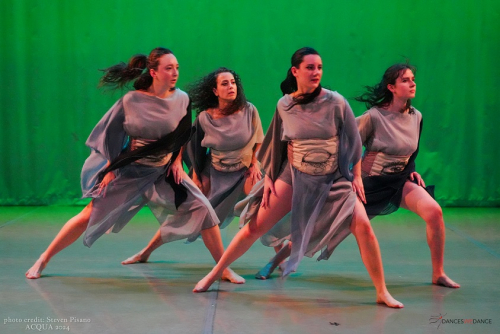
    As music of Schubert sounds, the lights slowly come up to reveal the dancers prone on the floor. Wearing blue/green costumes, they slowly rise and – as projections of the sea appear on screen – they come and go, executing fleeting steps and creating waves of movement suggesting the ebb and flow of the sea. A Schubert waltz sounds, and the dancers assume an ecstatic pose.

    DWD_FS-20241121-DSC01346

    Above: the dancers in Doris Humphrey’s Water Study; photo by Steven Pisano

    Silence falls as the Humphrey piece commences: the kneeling dancers awaken, the sound of their breathing hangs gently on the air. One by one they rise. Forming opposing lines, they race towards each other like tempest-tossed waves converging. They run en masse from corner to corner, as if crashing against sea walls. Standing, they sway from side to side to the sounds of their own breath. Then they fold into kneeling poses and the ballet ends as it began. Kudos to Ms. Corbin for bringing the fascinating work to currency. 

    DWD_FS-20241121-DSC01850

    Above: from Catherine Gallant’s Wave; the dancers are Colleen Edwards, Rosey Gentle, and Kathleen Caragine; photo by Steven Pisano

    The next three works were finely contrasted but they had one thing in common: each was so visually and musically enjoyable that they felt too short!     

    Wave, a 2001 work choreographed by Catherine Gallant, is an homage to Isadora with a contemporary touch. Three dancers – Kathleen Caragine, Colleen Edwards, and Rosy Gentle – are posed in a pool of light at the start. To the sounds of a Chopin mazurka, these beauties dance nobly and expressively in tunic-like costumes. They collapse and rise, evoking visions of Wagner’s Rhinemaidens, their faces are at once youthful and ancient: a sisterhood of goddesses. As the light fades, they return to their opening pose.

    Gallant

    Above: choreographer Catherine Gallant in an iconic photo

    I was ever so happy to see Catherine this evening; I felt reassured after speaking with her: now more than ever we must be there for one another. I told Catherine of the beautiful “Isadora” photo I have of her on my bookcase shelf (above); I can look up from my desk all thru the day and see her in that ecstatic pose.

    DWD_FS-20241121-DSC02476

    Above: from Crosscurrents; the dancers are Jada Alfred, Marley Poku-Kankam, Autumn Rodrigue, and Alana Averett; photo by Steven Pisano

    Crosscurrents, choreographed by Hannah Howell, brought forth four lovely young ladies, each with a distinctive personality. To a wonderfully weird and quirky score by Angel Bat David, the dancers create movement patterns and dance in diagonal formations. The sound of the clarinet takes over – I love it! – and standing in a line up, each dancer has a brief solo. The music is incredibly evocative, it sings of solidarity. The stage becomes sun-drenched as the dancers fall and then resume their initial pose. 

    DWD_FS-20241121-DSC03010

    Above: Lana Hankinson in Tidal Pool; photo by Steven Pisano

    Tidal Pool, set to deeply lyrical music by Yumira and choreographed by Rae Ballard, was danced by a quintet that featured Mlles. Caragine, Edwards, and Gentle joined by guest dancers Lana Hankinson and Lauren Naslund. The gentle flow of the dance created a sense of quiet serenity whilst the music evokes a luxuriant feeling of peace. Nearing the end, Ms. Naslund walks slowly forward center-stage while one by one the other dancer cross her path and depart, leaving her alone onstage with an expression of quiet wonderment. I’ve always been an admirer of Ms. Naslund, more so today than ever. Her calm beauty has the enviable gift of timeless grace. 

    DWD_FS-20241121-DSC03607

    Following the interval, Francesca Todesco’s brand new Cherchez La Femme (above photo by Steven Pisano) was danced by Mlles. Edwards, Gentle, and Caragine.These three women have developed into artists of high quality, thoroughly comfortable and assured onstage. Each has something personal to say, making their dancing really fascinating to watch.
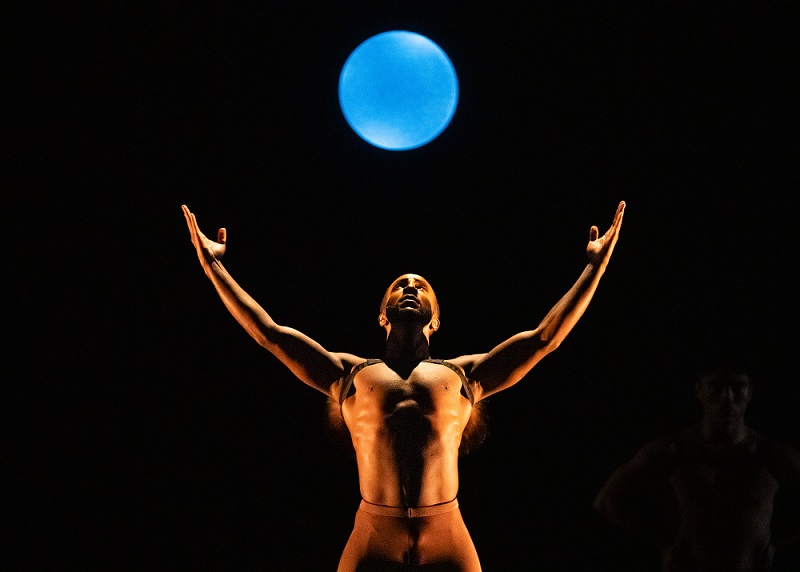
    DWD_FS-20241121-DSC04519

    Colleen Edwards (above, photo by Steven Pisano), so impressive in the Gallant piece earlier in the program, was riveting here. As the Todesco trio commenced against a golden backdrop, the white-clad Ms. Edwards stood in the light, casting her shadow. She is joined by the other two, and shadow-play becomes a part of their movement.

    Ms. Edwards has the first solo: each character has a name, and she is Simonetta. To softly cascading piano motifs, her dancing is truly mesmerizing. She rushes about the space and finally withdraws as Ms. Gentle, clad in red as Camille, enters frantically, as if being pursued…she immediately collapses. A questing search and a plea reveal her desperation. Rising, she appears hesitant, as if seeking something…or someone. To music of Chopin, the search becomes a plea. Ms. Gentle’s dancing seemed to reveal her heart and soul to us.

    Now we meet Artemisia: fair of face, Ms. Caragine’s black hair sets off her expressive eyes; she moves beautifully, with a ballerina’s poise, as the steps and gestures flow on the music. The trio re-unite, Ms. Gentle now back in her white frock, as the dance moves to its finish.

    Here are more images from Cherchez la femme, photos by Steven Pisano:

    DWD_FS-20241121-DSC04747

    Rosy Gentle

    DWD_FS-20241121-DSC05113

    Kathleen Caragine

    DWD_FS-20241121-DSC03930

    Mlles. Edwards, Gentle, and Caragine in Cherchez La Femme 

    DWD_FS-20241121-DSC05679

    Above: Francesca Todesco in Memories; photo by Steven Pisano

    Ms. Todesco then took the stage alone to premiere a new solo choreographed by Rae Ballard to the always welcome music of Astor Piazzolla. Entitled Memories, this solo finds the dancer clad in severe black with black pumps; she seems like a widow, alone in her grief, recalling happier times The music has a lamenting feeling and becomes quite lush; a hint of a tango is woven in. Francesca’s innate musicality, with her expressive hands and face, creates a mood of longing. At times, she seemed to be dancing just for me.

    DWD_FS-20241121-DSC06615

    Above, the sirens of Haunted Echoes: Colleen Edwards, Margherita Tisato, Kathleen Caragine, and Rosy Gentle; photo by Steven Pisano

    Closing the program was a newly commissioned work choreographed by the beloved former Paul Taylor star Annmaria Mazzini. This is Haunted Echoes, set to musical collage which propels a dance of the sirens – bewitching creatures all in sea-green. Drifting about the space, they pause to sing their alluring song. A big beat springs up and the dancing turns wild. And then the music becomes a bluesy lullaby, and the dancers drift off, a sisterhood lost at sea.

    On an evening that meant a lot to me, it was especially nice to greet the inimitable Jim May, who I’d only met once before, many, many moons ago at a Sokolow rehearsal. Tonight, it felt like a reunion of long-lost brothers.

    Performance photos by Steven Pisano.

    ~ Oberon

  • Extreme Taylor @ The Joyce ~ 2024

    5_Runes_photo by Steven Pisano

    Above: Alex Clayton in Runes; photo by Steven Pisano

    ~ Author: Oberon

    Saturday July 29th, 2024 matinee – In the days leading up to this afternoon’s Paul Taylor Dance Company performance, I was trying to recall my first-ever experience of seeing the Company live. I knew it was at Jacob’s Pillow, but was it 40 years ago…or earlier?

    I went thru my archives (I save everything) and discovered that it was in the summer of 1983, though the exact date is not on the cast page. The program opened with Esplanade…is it any wonder I was hooked?  In fact, my old pal Richard and I loved the Company so much (and especially David Parsons and Christopher Gillis) that we went to the box office during intermission and got tickets for the following weekend.

    1st taylor-1 jpg

    But…zooming back via time-warp to today’s matinee, it opened with Taylor’s Post Meridian, dating from 1965, set to a score by Evelyn Lohoefer de Boeck. This was my first encounter with this ballet, and I loved everything about it.

    Post Meridian_photo by Steven Pisano

    Above: from Post Meridian, photo by Steven Pisano

    Somehow the Alex Katz costumes and Jennifer Tipton’s lighting created an impression of the dancers glowing from within. The music, described as “for magnetic tape”, is a delightful conglomeration of noises. The piece starts with thunder, or perhaps it’s the sound of a helicopter landing. Bizarre passages of spoken word, bang-on-a-can type percussive intrusions, a jazzy string bass rhythm, a trilling clarinet, music from a carnival funhouse: all this provides impetus to the dancers.

    In an opening segment of walk-ons and gestural moves, we first meet Eran Bugge, Lisa Borres, and Jada Pearman. The men join – Lee Duveneck and Kenny Corrigan – along with Jessica Ferretti. Kristen Draucker has a featured solo, beautifully danced. A striking segment of two parallel pas de trois is truly original, with Mssrs. Duveneck and Corrigan handling the partnering elements with aplomb. Ms. Bugge dances a solo, and as the music turns whimsical, she spins blithely about the space. Devon Louis is fantastic in a jazz-based solo..simply superb.

    Some images from Post Meridian:

    PTDC_Joyce_6.26.24_PostMeridian_Draucker_Thiele_002

    Kristin Draucker, photo by Ron Thiele

    PTDC_Joyce_6.26.24_PostMeridian_Louis_Thiele_004

    Devon Louis, photo by Ron Thiele

    Paul Taylor’s Brandenburgs (1988) is normally a closing piece, but this afternoon it fit neatly between the quirkiness of Post Meridian and the mythic bleakness of Runes. Brandenburgs is quintessential Taylor. It has a cast of nine, but somehow feels ‘larger’, whilst the iconic Bach score lends a sense of grandeur.

    3_Brandenburgs_Maria Ambrose  John Harnage_photo by Ron Thiele

    Above: Maria Ambrose and John Harnage in Brandenburgs; photo by Ron Thiele

    From its opening pose of the six men and three women, Brandenburgs is a nonstop dance feast: each of the women – Maria Ambrose, Eran Bugge, and Lisa Borres – has a flirtatious segment with the five men of the ensemble: Lee Duveneck, Alex Clayton, Shawn Lesniak, Austin Kelly, and Jake Vincent. The men are given demanding Taylor moves as they come and go throughout, crossing the stage in leaping combinations.

    1_Brandenburgs_John Harnage_photo by Whitney Browne

    The charismatic John Harnage (above, photo by Whitney Browne) holds the audience under a spell in the lyrical adagio, partnering Mlles. Bugge, Ambrose, and Borres in turn. In the succeeding faster movement, John admiringly observes solos by Maria, Eran, and Lisa, and then had a mesmerizing solo of his own. The animated finale brings us back to the ballet’s opening pose.

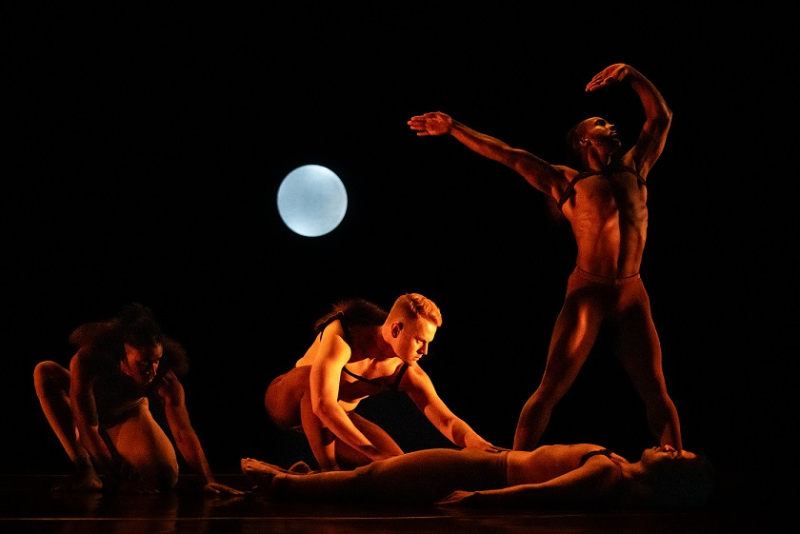
    Closing the program was Runes, choreographed by Paul Taylor in 1975 to piano music by Gerald Busby. The ballet opens with a blue moon in the sky and a corpse onstage. Jennifer Tipton’s perfect lighting creates a timeless feeling as an ancient tribe gather to perform their sacred rituals. Their stylized movement has an air of Martha Graham about it.

    2_Runes_photo by Steven Pisano

    Above: Patches of fur on the men’s costumes evoke images of the Druids…dancers Lee Duveneck and Alex Clayton; photo by Steven Pisano

    3_Runes_photo by Steven Pisano

    Eran Bugge (above, in a Steven Pisano photo) and Lee Duveneck have an intimate duet. They are joined by the captivating Ms. Draucker – as magnetic here as in Post Meridian; she and Devon Louis engage in a duet of their own, engrossing to watch.

    Christina Lynch Markham’s solo stood out as the centerpiece of the ballet; she is perhaps the high priestess of the community, dancing powerfully whilst exuding a spiritual glow. Alex Clayton’s magnetism dominated the stage in a solo danced before a semi-circle of seated women; both here and in the ensuing duet with the radiant Madelyn Ho, Mr. Clayton once again affirmed his esteemed place in the Company. Runes ends with the corpse again in its place as the mysterious rites come to a close.

    Lisa-Borres-770x433

    Above: Lisa Borres; portrait by Bill Wadman

    Throughout the afternoon, I kept my eye on Lisa Borres, a dancer I have known for some time thru her performances with Lydia Johnson Dance and Damage Dance. Lisa’s dancing and presence have always stood out, and it’s so wonderful to find her so thoroughly at home in the Taylor repertoire. 

    The afternoon marked the last time I will see Eran Bugge and Christina Lynch Markham dancing with the Taylor Company. Thru the years, they have each provided me with many wonderful memories, and their distinctive – and very different – personalities have always put a personal stamp on whatever role they are dancing. 

    Screenshot 2024-06-30 at 08-17-41 Steven Pisano Eran Bugge in Paul Taylor's Runes at the Joyce Theater his week. (Photo by Steven Pisano) @thejoycetheater @paultaylordance @eranbugge… Instagram

    Above: Eran Bugge in Runes, photo by Seven Pisano

    Christina_Lynch_Markham-1-936x1170

    Above: Christina Lynch Markham; portrait by Bill Wadman

    ~ Oberon

  • Dancing With Glass @ The Joyce

    MakiNamekawa_Photo by Steven Pisano

    Above: pianist Maki Namekawa, photo by Steven Pisano

    ~ Author: Oberon

    Tuesday November 28th, 2023 – The long-awaited opening of Dancing With Glass at The Joyce: a program wherein several of Philip Glass’s études were performed by pianist Maki Namekawa; five of the études had been choreographed by prominent artists in the danceworld: Lucinda Childs, Chanon Judson of Urban Bush Women, Justin Peck of the New York City Ballet, Brazilian tap artist Leonardo Sandoval, and Los Angeles-based choreographers Bobbi Jene Smith and Or Schraiber.

    A packed house, which included some luminaries of the NYC dance scene, seemed mesmerized both by the music and the dancing. Ms. Namekawa is a pianist with a special affinity for the works of contemporary composers; she played eleven of the études in the course of the evening, commencing with the spellbinding Etude #1. Her playing was remarkably clear, committed, and soul-filling.

    OrlandoHernandez_LeonardoSandoval_LucasSantana_AnaTomioshi_Photo by Steven Pisano

    The dancing commenced with a fabulous tap-dance setting of the 7th étude, choreographed by Leonardo Sandoval, who was tapping along with his mates Ana Tomioshi, Orlando Hernandez, and Lucas Santana (photo above by Steven Pisano). Noé Kains was onstage with the quartet, and he was dancing along when suddenly he stepped to the edge of the stage and eased his way down to the pit where he took over the keyboard and played the 7th étude to perfection. Meanwhile, his fellow tapsters – such gorgeous humans – continued to dance in sync, with brilliant solo moves etched into the choreography. An exhilarating start to the evening’s dancing.

    BobbiJeneSmith_Photo by Steven Pisano

    Above: Bobbi Jene Smith, photo by Steven Pisano

    Bobbi Jene Smith (co-choreographer of the memorable DEO for the Martha Graham Dance Company in 2019) and her husband Or Schraiber both choreographed and performed the familiar Etude #8. On a dusky, hazy stage, an anxious man and a moody woman take us thru various states of a romantic relationship. Each dressed all in black, with Ms. Smith’s luxuriant hair playing its own role, the dancers are hypnotic movers and shapers of phrase. Passion underscores everything: the wounded man is rejected, but – true to life – within seconds the couple are kissing again. Touches of humor are subtly woven in…and at the end, aggression turns to peace in the twinkling of an eye. The piece, marvelous in every way, made me think of so many evenings spent at home with my partner. 

    ChanonJudson_Photo by Steven Pisano

    Tall, lithe, and elegant in a sky-blue Josie Natori frock, Chanon Judson of Urban Bush Women (above, photo by Steven Pisano) took the stage for Etude #11. John Torres’ lighting – a major contribution to the evening’s pleasures – was especially perfect here. Ms. Judson danced with compelling authority and grace to the vividly dramatic music. Veering from madness to repose, this long-limbed goddess filled the space with her magnetic presence and riveting moves. Overcome by trembling, she is finally becalmed as the pulsating music fades to silence.

    Patricia Delgado_Photo by Steven Pisano

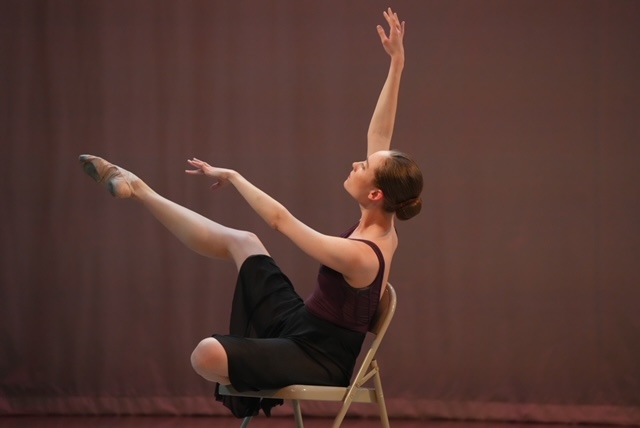
    Justin Peck’s setting of Etude #6 brought a stunning performance from Patricia Delgado (above, photo by Steven Pisano); I had only seen Ms. Delgado once previously, when she appeared in a 2009 gala here in New York featuring many alumni from the School of American Ballet. In her Glass solo tonight, she was fascinating to watch. Clad in a black trouser outfit, she is seated in a chair at curtain-rise. The music’s fast staccati underscore her restlessness. She at times ventures a few steps from her chair, but always returns to this safe haven. As the music turns grand, her mental instability becomes palpable. Ms. Delgado is both a gorgeous mover and a subtle actress. At the end, unable to cope, the woman seeks to hide herself from the world under her chair.

    CaitlinScranton_KyleGerry_Photo by Steven Pisano

    Clad in white and looking like angels, dancers Caitlin Scranton and Kyle Gerry (above, photo by Steven Pisano) reveled in the flow of Lucinda Childs’ luminous choreography in Etude #18. Sometimes dancing side-by-side and at other times moving about the space with a sense of other-worldly beauty, the dancers perfectly embodied the lyricism of this particular Glass piece. 
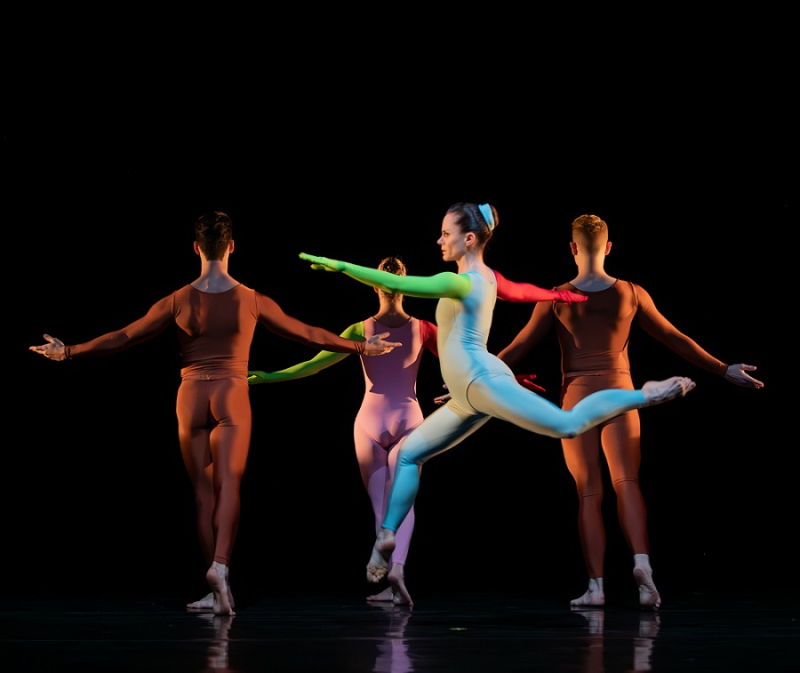
    Bringing the evening full circle, Ms. Namekawa played the last of the études: #20. This rather long work gave us a chance to reflect on the evening, whilst savouring the pianist’s poised musicality. As the applause commenced, all of the dancers appeared onstage to receive the audience’s wholehearted accolades. Ms. Namekawa then drew Philip Glass from his seat to the side of the piano, while the standing crowd hailed him with a joyous ovation.

    All photos by Steven Pisano.

    ~ Oberon

  • Lydia Johnson Dance @ Westbeth 2023 ~ Gallery

    Thumbnail_Laura Michael Chapters Graham Steven P.

    Above: Michael Miles and Laura DiOrio in CHAPTERS; photo by Steven Pisano

    A gallery of performance photos by Steven Pisano from Lydia Johnson Dance‘s November 12th, 2023 matinee at Westbeth. Read about the afternoon here.

    The following photos are from FOR ELI, a ballet dedicated to the memory of a young pianist:

    Thumbnail_Catherine For Eli ( chair section) Steven Pisano

    Catherine Gurr

    Thumbnail_Mchael ( back) MaliQ holding hin For Eli Steven P.

    MaliQ Williams and Michael Miles

    Thumbnail_Michael held by MaliQ For Eli Graham Steven P.

    MaliQ and Michael

    Thumbnail_MaliQ w Michael Portrain diff angle For Eli Steven P.

    Michael and MaliQ

    Thumbnail_Emily Skkirt end of section 1 For Eli GRaham Steven P.

    Emily Sarkissian and MaliQ Williams

    The following images are from Lydia Johnson’s newest work, CHAPTERS, having its premiere performances:

    Thumbnail_Laura and Michael Graham Steven P.

    Laura DiOrio and Michael Miles

    Thumbnail_Min & Arieh Chapters Graham Steven P

    MinSeon Kim and Arieh Bates Vinueza 

    Thumbnail_Cara & MaliQ 2 Graham Steven P.

    Cara McManus and MaliQ Williams

    Thumbnail_Michael Chapters Graham Steven P

    Michael Miles and Arieh Bates-Vinueza

    Thumbnail_Cara & MaliQ Graham (Steven P.)

    Cara McManus and MaliQ Williams

    The program ended with a revival of Lydia’s NIGHT OF THE FLYING HORSES (premiered in 2013):

    Thumbnail_Min & Quinton FH Skirt Graham Steven P.

    MinSeon Kim and Quinton Guthier

    Thumbnail_Min and Cara FH arm gesture opening Graham Steven P

    MinSeon Kim and Cara McManus

    ~ All photos by Steven Pisano

  • Paul Taylor Dance Company/City Center/2022

    ROSESHarnage Ho by Steven Pisano

    Above: John Harnage and Madelyn Ho in Paul Taylor’s Roses; photo by Steven Pisano 

    ~ Author: Oberon

    (Click on each image to enlarge…)

    Wednesday March 24th, 2022 – Opening night of the Paul Taylor Dance Company‘s 2022 season at City Center. Two Taylor masterworks book-ended the program, with a premiere by the Company’s recently-designated Resident Choreographer, former New York City Ballet principal ballerina Lauren Lovette, in between.

    This was my first time seeing the Company since several popular Taylor stars left, starting with Michael Trusnovec and followed by Laura Halzack, Parisa Khobdeh, Michelle Fleet, Jamie Rae Walker, Heather McGinley, James Samson, Robert Kleinendorst, and Sean Mahoney. Incoming new dancers were just getting their feet wet two years ago when the pandemic caused a prolonged pause in their progress. So, for me, tonight was a reunion and a re-discovery.

    As an ardent admirer of the music of Richard Wagner, Paul Taylor’s Roses is one of my favorites among his numerous masterworks. It moves me so deeply each time I see it…and hear it. The story of the first performance of Wagner’s Siegfried Idyll, played on the staircase at Villa Tribschen on the morning of December 25, 1870, by a small chamber orchestra, is one of my favorite tales out of musical history. It was the composer’s birthday and Christmas gift to his beloved Cosima, and marked one of the happiest days of their life together. You can read about it here.

    Roses - Jessica Ferretti  Shawn Lesniak and Company_photo by Steven Pisano

    Above: Jessica Ferretti and Shawn Lesniak in Roses; photo by Steven Pisano

    Roses opens with five couples onstage, the women in long black gowns. The pairings tonight were: Jessica Ferretti with Shawn Lesniak, Christina Lynch Markham with Jake Vincent, Raechelle Manalo with Alex Clayton, Madelyn Ho with John Harnage, and Kristin Draucker with Michael Apuzzo. Watching these beautiful creatures in a series of duets summoned many emotions in me – all of them warm and reassuring – for they are the future of the Paul Taylor Dance Company, and that future is in good hands. All these dancers radiated confidence, and their performances were suffused with poetry and light. The audience took a special liking to Ms. Ho and Mr. Harnage…understandably: they were superb. 

    As the Siegfried Idyll reaches its end, we have found a place of tranquility in an ever-darkening world; the music and dancing have nourished the spirit, and one cannot imagine that anything more beautiful and poignant could possibly follow it. But then Jada Pearman and Lee Duveneck, clad in pristine white, appear to dance one of the most entrancing of Paul Taylor’s duets. Set to a score by Heinrich Baermann which features a clarinet solo played sublimely by the Orchestra of St. Luke’s inimitable Jon Manasse, this pas de deux had a particularly hypnotic effect tonight. Mr. Duveneck towers over the petite and radiant Ms. Pearman, his partnering so protective and tender, and her dancing a vision of grace. The five couples remain seated on the floor at the rear of the stage during this duet, keeping echoes of the Siegfried Idyll in our consciousness. A genuine “Taylor ovation” greeted the dancers during their bows.

    Anticipating Ms. Lovette’s new work, I was pleased to read of her choice of music, and intrigued by the piece’s title: Pentimento. I first discovered the music of the Argentine composer Alberto Ginastera many years ago when a pianist I was dating played some of it for me on his baby grand, which took up most of the space in his little studio apartment. “Pentimento” is an Italian word meaning repentance; in the art world, it refers to a painter’s regret when a piece he is working on does not come out quite as he wanted it to; he paints over and re-uses the canvas, but with the passing of time, the original picture may bleed thru, causing a ghostly image.

    Pentimento (Lovette) - Lee Duveneck and Company_photo by Whitney Browne

    Above: Lee Duveneck and the ensemble in Lauren Lovette’s Pentimento; photo by Whitney Brown

    My expectations for the Lovette work were high, and the opening moments, with the dancers in silhouette against a glowing backdrop, boded well. Christina Lynch Markham, her hair down, has a dramatic solo passage which finds her in a state of worry and agitation; she clutches a red scarf as she dances…and finally collapses. Now the scarf will be passed from dancer to dancer, each one having a featured solo amidst the ensemble. Thus we watched the lively Lisa Borres, a tormented Jada Pearman (who emits a scream at one point), the willowly and wonderful Maria Ambrose, the pale and somewhat mysterious Lee Duveneck, and the bold and beautiful Devon Louis being put thru their paces.

    Clad in dreary costumes that might have come off the racks at Old Navy, the community perform athletic combinations, with Tayloresque gestures; they roll about on the floor, form brief alliances, strike quirky poses, and gather – with expressions of care and concern – to watch their colleagues go thru the motions. Meanwhile, the Ginastera music, not his best by far, has become sort of an after-thought. My mind started to wander; the audience, so engrossed by Roses, began to get restive.

    Pentimento was well-received, but during the intermission I could not sense the sort of buzz that usually follows a premiere. I suppose having your new work debuted between two classics by one of the great choreographers of all time would be somewhat daunting. We shall see where this collaboration goes in the future.     

    Brandenburgs - Jada Peaman and Company - photo by Ron Thiele

    Above: Jada Pearman and the Taylor men in Brandenburgs; photo by Ron Thiele

    Paul Taylor’s festive Brandenburgs, to the immortal music of Johann Sebastian Bach, made for a perfect end to the evening. Tonight, the ballet looked as fresh and vibrant as it ever has…and that music!  The magnificent Taylor dancers soar on the wings of Bach’s score; they inspire and uplift us at a time when hope and joy are in short supply.

    Brandenburgs - Madelyn Ho  John Harnage  Maria Ambrose  Jada Pearman - photo by Ron Thiele

    Above: John Harnage and Maria Ambrose in Brandenburgs with Madelyn Ho and Jada Pearman kneeling; photo by Ron Thiele

    The male ensemble – Lee Duveneck, Alex Clayton, Devon Louis, Adam Dickerson, and Jake Vincent – race about the stage in trademark Taylor patterns. Blindingly handsome and charismatic, John Harnage held the audience in the palm of his hand simply by being there. His dancing is so clear and so poetic. And later – standing stock still as he watches his three muses  (Maria Ambrose, Jada Pearman, and Madelyn Ho) dance solos to dazzle him – he looked like a young god. Mr. Harnage’s adagio pas seul, was a portrait of masculine beauty. Then Brandenburgs sweeps onward to its final pose: an uplifting celebration of music and dance, and of the human spirit.

    Danceworld luminaries among the audience included Justin Peck, Troy Schumacher, Damian Woetzel, and Edward Villella.

    All photos by the credited photographers, courtesy of Paul Taylor Dance Company. Many thanks to the Company’s wonderful press liaison de luxe, Lisa Labrado. 

    ~ Oberon