Tag: Sunday July

  • Dorrance Dance @ The Joyce ~ SHIFT

    Dorrance_Dance

    Above: Michelle Dorrance

    ~ Author: Oberon

    Sunday July 21st, 2024 matinee – Michelle Dorrance’s SHIFT was another hit in the Joyce Theater’s mostly marvelous 2023-2024 season, which is now drawing to a close. The hour-long work was ideally lit by Kathy Kaufmann, with sound design by Christopher Marc, and casual costuming organized by Amy Page. Ms. Dorrance’s choreographic designs are a collaborative venture with her dancers, extending to improv.

    To say that the dancing was sensational and thoroughly captivating is an understatement; adding to the vibrancy of the show were segments when some of the dancers took up musical instruments and regaled us with their impressive playing…to say nothing of a couple top-notch vocalists.

    Before the house lights went down, the dancers appeared on the bare stage and began warming up – randomly at first, but then forming a circle and delivering individual tap motifs in turn as the others kept rhythm. This drew the audience deeply into the world of tap.

    Once the house lights are out, it’s a hopeless task to take notes at The Joyce. But I’ve done my best to salvage what I could from my over-written pages.

    The ‘formal’ program began with the first of six sections, entitled Dedicated To You, after the Sammy Cahn song, which was performed live by Ms. Dorrance (ukelele), Claudia Rahardjanoto (bass), with vocals by Ms. Rahardjanoto and Addi Loving, and danced by the Company’s male dancers – Sterling Harris, Luke Hickey, and Leonardo Sandoval – along with Elizabeth Burke and Ash Griffith is a smooth, swaying style. One of the singers soon joined the dancers whilst the other began whistling…such a fresh feeling, meshing music and dance in an imaginative union.

    There followed the little glass ii and the little glass ii remix, which sort of flowed together into one continuous number. An especially intriguing segment was a male solo in which the dancer was followed about by a wheeled spotlight; after a bit, the dancer and the light-man switched places. The music takes on a psychedelic aspect; the lighting turns blood-red. Phrases are passed about, from dancer to dancer. Michelle Dorrance has a solo, which the other dancers observed from chairs ranged around the space. Michelle resumes playing her ukelele, but the music turns into a deep rumbling. 

    I Don’t Want To Set The World On Fire, with Ms. Dorrance singing lead to her ukelele accompaniment, backed by Ms. Loving, Asha Grffith, and Elisabeth Burke; their harmonizing was terrific. The male dancers have a trio which morphs into an octet, danced in a pool of light. Competition and camaraderie vie, to rhythmic clapping.

    Elizabeth Burke seated herself at the grand piano for Moon, with Ms. Rahardjanoto on bass and Ms. Loving doubling piano/percussion. This followed by Ymir, to recorded music by Dawn of Midi. But I’d been forced to abandon note-taking in the dark, and so I just sat back and watched as the dancing continued – by turns subtle and sensational – from which I derived great pleasure. I began to feel a blessèd assurance in an uncertain world. 

    I’d expected a grand finale, a veritable tempest of tapping, but instead the performance  ended on a purely musical note, with a song that hit me like a tsunami: That’s The Way It Is, by Alex Kramer and Joan Whitney; it just happened to perfectly reflect the emotional state I’ve been in of late. I have to include some of the lyrics here, so that I’ll always know where to find them:

    “I tremble at your touch
    I know I shouldn’t
    But that’s the way it is
     
    I want you oh-so much
    I know I shouldn’t
    But that’s the way it is
     
    I can see so clearly
    That we are worlds apart
    But when you are near me
    I can’t see beyond my heart
     
    I worship at your shrine
    You said I shouldn’t
    But that’s the way it is
     
    I begged you to be mine
    I said I wouldn’t
    But that’s the way it is
     
    I love you forever
    Though it may never be
    But that’s the way it is
    With a guy like me”

    In the playbill, Ms. Dorrance offered the following note, in which she hit several nails on the head, reminding us of what’s at stake for our country in the weeks to come. I felt compelled to scan it and share it here:

    Dorrance jpg

    There were no curtain calls, and as the lights came up I realized what a sense of community had enveloped us during the show. I could easily have watched it again…immediately.

    ~ Oberon
  • 2nd Summer Evening @ CMS ~ 2019

    Artist_2237

    Above: pianist Juho Pohjonen

    ~ Author: Oberon

    Sunday July 14th, 2019 – The second of three concerts in Chamber Music Society of Lincoln Center‘s annual Summer Evenings series brought together a trio of esteemed CMS artists joined by The New York Philharmonic’s beloved principal clarinetist Anthony McGill. No French music on this Bastille Day program; Austria, Germany, and Russia were represented. The playing was superb.

    Bella-Hristova-FI

    Above: violinist Bella Hristova, photo by Lisa-Marie Mazzucco

    With Mr. Pohjonen at the Steinway, Ms. Hristova opened the concert with Mozart’s Sonata in B-flat major for Violin and Piano, K. 454, which dates from 1784. Fittingly enough, this sonata was composed for a female violinist: Mozart wrote it for the Viennese debut of Regina Strinasacchi, and he himself was the pianist on that occasion. Female violinists were quite rare in those days. Signorina Strinasacchi had studied at the famous Ospedale della Pietà in Venice where Antonio Vivaldi had once served as music director. She was 21 years old at the time of her Vienna debut, and was said to be a dazzling violin virtuoso who had also trained as an opera singer.

    Ms. Hristova, who in March of this year gave a dazzling recital at Merkin Hall, looked fetching in a dusty rose à la Grecque frock. After a courtly – almost regal – introduction, Ms. Hristova’s playing of the affecting first melody set the mood. She and Mr. Pohjonen traded melodic statements, making it clear from the start that they are ideal colleagues. The music gets lively, with little hesitations and subtleties woven in; abundant charm and sweet lyricism prevail.

    A tender theme commences the Andante; the musicians take turns playing melody and rhythmic figurations. Ms. Hristova’s phrasing is so appealing here. The music turns a bit melancholy, with a sense of passion restrained. A sustained note from the violinist leads on to a sort of coda and a gentle finish.

    The sonata’s concluding Allegretto is a lot of fun; violinist and pianist sometimes play in unison and sometimes harmonize. The pacing and dynamics offer pleasing contrasts along the way to a virtuosic finale.

    IMG_7629-e1350511246980-1024x748

    Anthony McGill (above) then joined Nicholas Canellakis and Mr. Pohjonen for Johannes Brahms Trio in A-minor for Clarinet, Cello, and Piano, Op. 114. This was composed in 1891, after Brahms had heard the great clarinetist Richard Mühlfeld and was much taken with the sound of the instrument.

    Mr. Canellakis has the trio’s opening statement – a rich melodic passage – and soon Mr. McGill’s clarinet makes its sublime entrance. From the Steinway, Mr. Pohjonen pulses up and the music takes off, calming for a cello solo in which Mr. Canellakis’s depth of tone makes a marvelous impression. Cello and clarinet bring incredible subtlety to a scale passage, and there’s a trace of gypsy lilt in the music. Following more scalework, the Allegro fades away.

    At the start of the Andante, Mr McGill’s lambent tone is beautifully matched to Mr. Canellakis’s, producing a spellbinding blend: ‘phrasing is all’ here as the voices entwine. To their mix, Mr. Pohjonen adds his poetic playing. The Andantino grazioso begins like a serenade: the clarinet sings while the cello provides a plucked accompaniment. This lighthearted movement transforms itself into a waltz, which proceeds lyrically.

    Mr. Canellakis’s cello digs into the final Allegro, with the piano urgent and the clarinet vibrant. The music is broad, with a folkish feel. Descending phrases are heard, and the trio finds a brisk ending.   

    N C

    Following the interval, Nick Canellakis (above) along with Ms. Hristova and Mr. Pohjonen, offered Anton Arensky’s Trio No. 1 in D-minor for Piano, Violin, and Cello, Op. 32. Whenever I hear Mr. Canellakis playing, I find myself thinking back to his magnificent performance of Leon Kirchner’s Music for Cello and Orchestra at Carnegie Hall in 2015.

    Images

    Arensky (above) is something of a forgotten composer – unfairly, in my view. You can read about him, and hear some of his music, here. Listening to his music, you can see where Scriabin and Rachmaninoff profited from having been Arensky’s students.

    Bella Hristova’s gorgeous violin solo plays over restless patterns from the Steinway; the cello then takes up the melody. Mr. Pohjonen relishes the con moto sweep of the virtuoso writing for piano.  “This is fabulous music!”, I scrawled across my notes.  The string players exchange bits of melody, the pianist deftly dispatches phrase after lovely phrase. A soft, sustained violin note ends the Allegro moderato.

    The second movement is a sprightly Scherzo, with plucked strings and high trills from the piano: at times the instruments sound almost like toys. Mr. Pohjonen’s tone shimmers throughout. An engaging waltz gets quite grand, and, after some wry hesitations, the Scherzo‘s end is lighthearted.

    A tender, reflective cello solo opens the Elegia; the music seems to recall happier times that have been left behind. Ms. Hristova’s violin climbs poignantly higher and higher, whilst Mr. Canellakis’s cello again sounds from the depths. 

    From a turbulent start, the cello and then the violin carry the melody of the concluding Allegro non troppo: this music is very much à la Russe. As passion ebbs and flows thru the melodies, the shining piano and soft strings lend an ethereal air. The composer then crafts a lively finale for his trio.

    Ms. Hristova and Mssrs. Canellakis and Pohjonen were greeted with great enthusiasm at the program’s end, and insistent applause brought them out for a second bow.

    ~ Oberon

  • CMS Summer Evenings ~ 2018 – Concert 3

    Se_news

    ~ Author: Oberon

    Sunday July 15th, 2018 – The last of Chamber Music Society of Lincoln Center‘s Summer Evening concerts for 2018: perfect playing from a quintet of wonderful artists in music of Mozart, Weber, and Schubert.

    Nothing sets an evening of chamber music on its way to finer effect than Mozart: his Quartet in C-major for Flute, Violin, Viola, and Cello, K. 285b dates from the 1780s and was the last of three quartets Mozart wrote for the amateur flautist Ferdinand De Jean.

    The quartet is in two movements: the opening Allegro finds the sound of Sooyun Kim’s flute floating on the air over an elegant string accompaniment; her tone is delicious, her ruby-red gown a delight. Her colleagues – Erin Keefe (violin), Paul Neubauer (viola), and David Requiro (cello) – have a lovely feel for the pacing of the music, which occasionally veers into the minor…and back.

    The first movement comes to a pretty end, then the Andantino begins with the players harmonizing to fine effect. The music has a gentle pulse, and we can savour the velvety texture of Mr. Requiro’s cello sound. Ms. Keefe commences a theme, echoed by Mr. Neubauer’s viola and then the cello launches a fresh idea. Following a cadenza for Ms. Kim, the strings pulse gently as the flautist sends forth a sweet song which she repeats before the quartet reaches a light and charming finish.

    Carl Maria von Weber’s Trio in G-minor for Flute, Cello, and Piano, Op. 63 (composed 1818-19) – a gem of a piece – was superbly played by Ms. Kim, Mr. Requiro, and pianist Orion Weiss. von Weber is best-remembered today for the overture to his opera OBERON and for the irresistible Invitation to the Dance which inspired Fokine’s romantic ballet Le Spectre de la Rose. Weber’s music abounds in melody, and his music often seems like German bel canto.

    The opening Allegro moderato begins with a somewhat mysterious piano passage, then Mr. Requiro’s gorgeous-toned cello enters, followed by Ms. Kim’s flute, weaving together in a lovely mix. The three voices dovetail perfectly in a da capo, and the movement ends on a sustained flute tone.

    After a dramatic start, the Scherzo turns Spring-like, with the flute spinning out a tune accompanied by waltz figurations. In the Andante, entitled ‘Schäfers Klage’ (‘Shepherd’s Lament’), piano and cello seem to imitate a guitar; then each voice takes the melody in turn. Shifts from major to minor are intriguing, and – after a brief flute cadenza – comes a calm finish. Mr. Weiss commences the Finale quietly. As the pace builds, the flute takes up a tune: Ms. Kim and the pianist really sparkle here, and the music is fast and fun. After a lull, the three musicians take a da capo and sail on to a lively ending. The audience lavished them with enthusiastic applause, and deservedly so.

    Franz Schubert’s 1827 Trio No. 1 in B-flat major for Piano, Violin, and Cello, D. 898, Op. 99, filled the program’s second half. As chamber works go, it is quite long; the composer makes numerous repeats of themes throughout the four movements, and to me it seems his best ideas come in the first two. But, played as it was tonight, this trio became quite engrossing.

    The first movement, Allegro moderato, has an almost triumphant start; as the music calms, lovely nuances are brought forth by Ms. Keefe, Mssrs. Requiro and Weiss. The pianist, who was truly marvelous throughout the evening, plays a fresh melody over plucked strings. Another winning theme passes from cello to violin. In alternating passages of delicacy and melodrama, the three musicians display the agility and passion of their impeccable playing.

    The Andante has a peaceful opening, and Mr. Requiro shines yet again in a radiant melody that is then taken up by Ms. Keefe to ravishing effect. The gently animated Scherzo has a Mendelssohnian grace, but as it neared its end, a cellphone went off to disastrous effect. Yet the players were able to re-establish the mood in the charming, light, and brilliant Allegro vivace finale, much to the delight of the crowd.

    ~ Oberon

  • CMS Summer Evenings ~ 2018 – Concert 3

    Se_news

    ~ Author: Oberon

    Sunday July 15th, 2018 – The last of Chamber Music Society of Lincoln Center‘s Summer Evening concerts for 2018: perfect playing from a quintet of wonderful artists in music of Mozart, Weber, and Schubert.

    Nothing sets an evening of chamber music on its way to finer effect than Mozart: his Quartet in C-major for Flute, Violin, Viola, and Cello, K. 285b dates from the 1780s and was the last of three quartets Mozart wrote for the amateur flautist Ferdinand De Jean.

    The quartet is in two movements: the opening Allegro finds the sound of Sooyun Kim’s flute floating on the air over an elegant string accompaniment; her tone is delicious, her ruby-red gown a delight. Her colleagues – Erin Keefe (violin), Paul Neubauer (viola), and David Requiro (cello) – have a lovely feel for the pacing of the music, which occasionally veers into the minor…and back.

    The first movement comes to a pretty end, then the Andantino begins with the players harmonizing to fine effect. The music has a gentle pulse, and we can savour the velvety texture of Mr. Requiro’s cello sound. Ms. Keefe commences a theme, echoed by Mr. Neubauer’s viola and then the cello launches a fresh idea. Following a cadenza for Ms. Kim, the strings pulse gently as the flautist sends forth a sweet song which she repeats before the quartet reaches a light and charming finish.

    Carl Maria von Weber’s Trio in G-minor for Flute, Cello, and Piano, Op. 63 (composed 1818-19) – a gem of a piece – was superbly played by Ms. Kim, Mr. Requiro, and pianist Orion Weiss. von Weber is best-remembered today for the overture to his opera OBERON and for the irresistible Invitation to the Dance which inspired Fokine’s romantic ballet Le Spectre de la Rose. Weber’s music abounds in melody, and his music often seems like German bel canto.

    The opening Allegro moderato begins with a somewhat mysterious piano passage, then Mr. Requiro’s gorgeous-toned cello enters, followed by Ms. Kim’s flute, weaving together in a lovely mix. The three voices dovetail perfectly in a da capo, and the movement ends on a sustained flute tone.

    After a dramatic start, the Scherzo turns Spring-like, with the flute spinning out a tune accompanied by waltz figurations. In the Andante, entitled ‘Schäfers Klage’ (‘Shepherd’s Lament’), piano and cello seem to imitate a guitar; then each voice takes the melody in turn. Shifts from major to minor are intriguing, and – after a brief flute cadenza – comes a calm finish. Mr. Weiss commences the Finale quietly. As the pace builds, the flute takes up a tune: Ms. Kim and the pianist really sparkle here, and the music is fast and fun. After a lull, the three musicians take a da capo and sail on to a lively ending. The audience lavished them with enthusiastic applause, and deservedly so.

    Franz Schubert’s 1827 Trio No. 1 in B-flat major for Piano, Violin, and Cello, D. 898, Op. 99, filled the program’s second half. As chamber works go, it is quite long; the composer makes numerous repeats of themes throughout the four movements, and to me it seems his best ideas come in the first two. But, played as it was tonight, this trio became quite engrossing.

    The first movement, Allegro moderato, has an almost triumphant start; as the music calms, lovely nuances are brought forth by Ms. Keefe, Mssrs. Requiro and Weiss. The pianist, who was truly marvelous throughout the evening, plays a fresh melody over plucked strings. Another winning theme passes from cello to violin. In alternating passages of delicacy and melodrama, the three musicians display the agility and passion of their impeccable playing.

    The Andante has a peaceful opening, and Mr. Requiro shines yet again in a radiant melody that is then taken up by Ms. Keefe to ravishing effect. The gently animated Scherzo has a Mendelssohnian grace, but as it neared its end, a cellphone went off to disastrous effect. Yet the players were able to re-establish the mood in the charming, light, and brilliant Allegro vivace finale, much to the delight of the crowd.

    ~ Oberon

  • CMS ~ Summer Evenings 2017 ~ Concert 3

    Efe

    Above: cellist Efe Baltacigil

    Author: Oberon

    Sunday July 16th, 2017 – All too soon, Chamber Music Society of Lincoln Center‘s Summer Evenings series for 2017 has come to an end. Over the course of the three concerts, we heard magnificent music, played to perfection. Each summer I find myself hoping that a fourth concert might be added to the series: the packed houses indicate how successful these summertime concerts are. But perhaps it’s just a question of timing, as so many musicians are making appearances at the various summer festivals. Also, the Society is about to commence a run of concerts at Saratoga Springs. So, we can feel grateful for what we have heard this summer, whilst looking forward to the 2017-2018 CMS season

    Anticipation ran high as Alice Tully Hall was again filled to the rafters with Gotham’s music-lovers, thirsting for the classics as the doldrums of the summer lazed along. A cordial greeting to Mr. Baltacigil and his colleagues…

    Keefe-erin

    …violinist Erin Keefe (above)…

    Fullsizephoto372849

    …and violist Richard O’Neill (above), as they appeared onstage for the opening Beethoven.

    The D-major Trio opens serenely, but things soon become quite lively. It was quickly evident that our three musicians were well-matched, and as the shifting themes unfolded their playing was marked by a fine mixture of impetus and elegance.

    As is so often the case, it is in the second movement, marked Andante quasi allegretto, that we get to the heart of the matter. A nostalgic feeling pervades here, though the textures remain translucent. Mr. Baltacigil’s cello enhances the lyrical aspects of the music, and some gracious plucking maintains an active feeling so that things don’t turn dolorous. A beautiful viola passage receives loving attention from Mr. O’Neill, and Ms. Keefe’s relishing of the Andante‘s most subtle moments is a distinctive asset.

    Delicate playing in the Menuetto dances us along with courtly charm. Then, after a longish pause, the concluding Rondo is quite jolly, with the cello prominent, the viola harmonizing, and the three voices eventually in finely-timed exchanges. A passing lull into lyricism again brings subtle mastery from our expert trio before the piece reaches its happy ending.

    Kristin Lee

    A brilliant performance of the Prokofiev Violin sonata in D-major followed. While I have enjoyed the playing of Kristin Lee (above, in an Arthur Moeller potrait) on many CMS evenings in the past, I can’t recall having heard her in a sonata performance. Her Prokofiev was, in a word, spectacular. And, with their usual knack for matching up musicians of like quality, Michael Brown at the Steinway played with thrilling verve and clarity.

    Brown-Michael_credit_Jeanette_Beckman

    Above: Michael Brown, photographed by Jeanette Beckman

    Originally a flute sonata, this piece was re-worked by Prokofiev for violin as several violinists – notably David Oistrakh – took an interest in it. In the opening Moderato, the violin floats in a lyrical dream. An almost fanfare-like passage leads to some scurrying before resuming its more song-like aspect, with some piercing highs; a pensiveness evolves and a short coda concludes the movement.

    The ensuing Scherzo begins as a jig, with dance-like swirls from both violin and piano. A more tranquil interlude temporarily lulls us, but things again speed up to a big dance.

    The Andante features a soaring, romantic theme for the violin: Ms. Lee was at her most poetic here before passing the melody along to Mr. Brown, who takes it up at the piano. The music aches the heart until a quiet restlessness steals in; the violin goes high and sounds on the verge of spacing out.

    The Allegro con brio finale opens with a rollicking passage and then jogs along for a bit until Mr. Brown’s pianistic passion takes over. Things simmer down and become quite delicate; then a song wells up and a triumphant feeling builds. A increase in velocity carries the sonata to the finish line.

    Kristin Lee, a beauty in black, was so impressive in her technical command, with Mr. Brown an ideal colleague in both the passion and precision of his playing. As the duo embraced at the end of their superb performance, the audience lavished well-deserved cheers upon them.

    Yuralee1586color_608x265

    Violist Yura Lee (above) joined the ensemble after the intermission for a richly rewarding performance of Antonin Dvorák’s String Quintet in E-flat major, Opus 97.

    “Spillville is an ideal place; I would like to spend the rest of my days there,” wrote the homesick Dvorák of the Iowa town where he had gone (in 1893) to mingle with the local Bohemian community. But while he was there, something else happened: a road-show of Native American entertainments and crafts came to Spillville for two weeks. Dvorák was intrigued by the rhythms and harmonies he heard in the group’s presentations and worked some of these elements into his E-flat major Quintet.

    One of the most delightful aspects of this work is in the composer’s assigning of equal prominence to the “1st” and “2nd” violins and violas; this division of labor gives everyone a chance to shine. And underlying the melodious marvels produced by his colleagues, Mr. Baltacigil’s honey-toned cello playing gave the ensemble a pleasing depth of feeling: for both rhythmically and melodically, Mr. Baltacigil is first class.

    Dvorák himself was a viola player, and it is to that instrument that the composer gives the quintet’s opening statement, played from the heart by Richard O’Neill. Chamber Music Society is like a paradise for lovers of the viola sound (count me in!) where one is likely on a given evening to hear the likes of Paul Neubauer, Matthew Lipman, or Pierre Lapointe. In tonight’s Dvorák, Yura Lee shared the viola spotlight with Mr. O’Neill: her rich, pliant tone is always so inviting. Likewise, on the violin side, Mlles. Keefe and Kristin Lee were each heard to advantage.

    In the quintet’s first movement, Ms. Keefe’s lambent tone was particularly enhancing. As ribbons of melody pass from player to player, we can savor the unique sound of each voice as well as their combined appeal when they sang in unison in a passage with an unusual drawling quality. The two violists were having a heyday, unwrapping each phrase the composer has given them and relishing it for us to enjoy.

    For the second Allegro movement, Mr. O’Neill again takes the lead. Ms. Keefe and Yura Lee trade passages and then, to the genial plucking of her colleagues, Yura takes up a gorgeous theme which explains why she wanted to be “1st”;  Ms. Keefe, playing high and sweet, makes the same case for being “1st” violin.

    The Larghetto offers a set of variations, shifting between major and minor. Here a sad melody is given out by the lower voices with a hymn-like quality. More magic from Yura Lee, and then Ms. Keefe plays a sinuous obbligato over the choir; the opposite effect is created when Mr. Baltacigil’s animated cello is overlain by the harmonizing violins and violas. The cellist then sings forth while the higher voices take a tremelo stance. Amazing delicacy is achieved in a plucked interlude, the audience breathlessly charmed by the effect. Following a dynamic outburst, calm is restored and Kristin Lee carries the Larghetto to a fade out.

    Erin Keefe leads a dance to start the Finale: Allegro giusto. Plucking again; then Kristin Lee, Mr. Baltacigil, and Yura Lee each have their say before a broad flow of melody ensues. Ms. Keefe takes up a ‘Native’ theme and then Yura Lee has a final viola gesture which leads to a rush to the finish: an exhilarating end to a great evening of music.

    ~ Oberon

  • Lydia Johnson Dance: Returning to Newport

    L1430931

    Above: Sarah Pon and Blake Hennessy-York of Lydia Johnson Dance

    Sunday July 13th, 2014 – Lydia Johnson Dance will have a return engagement at the Great Friends Dance Festival in Newport, RI performing on July 18th, 19th, and 20th, 2014. Details of the festival here.

    For these performances, Lydia has created a new work entitled WHAT COUNTS set to two songs by The Bad Plus: ‘Seven Minute Mind‘ (danced by a trio of women) and ‘For My Eyes Only‘ (a pas de deux). Today I stopped in at Lydia’s studio where she was putting the finishing touches on what is still a work-in-progress; in fact, she is considering adding a third section…but for now, it’s a two-movement dancework that will travel to Newport.

    The music is jazz-oriented and really appealing, and Lydia has set it in her unique balletic style with a particularly pleasing stylized quality. More than anything, the ballet reminded me of Balanchine’s classic APOLLO, in part because it features a single man and three women and also because the music has a Stravinskyian tinge to it.

    L1440215

    Sarah Pon, Laura DiOrio and Katie Martin Lohiya

    L1440224

    Trio

    L1430945

    Blake and Sarah: duet

    L1430992

    L1440074

    Final pose

  • JANUSPHERE at the IATI Theater

    Janusphere

    Photo: Rachel Neville

    Sunday July 28, 2013 – JANUSPHERE at the IATI Theater down on East 4th Street. I met my friend Roberto Villanueva (of BalaSole Dance Company) there on an overcast afternoon.

    Aqura Lacey, Dora Kovac, Grace Song, Jason Jordan, Luke Manley and Matt Van appeared in KinderPlatz (Children’s
    Place
    ) which is set to a darkish, at times almost ominous score by Adyo and Deepbass. Despite its title, there’s nothing juvenile about this work. The dancers,
    clad in soft creamy outfits, perform a series of trios and duets, often changing partners and configurations. They run and slide across the smooth floor, or stand still waving their arms in
    unison windmill patterns; in these motifs the illusions of children’s
    games are expresssed, but the mood remains distinctly ‘adult’.

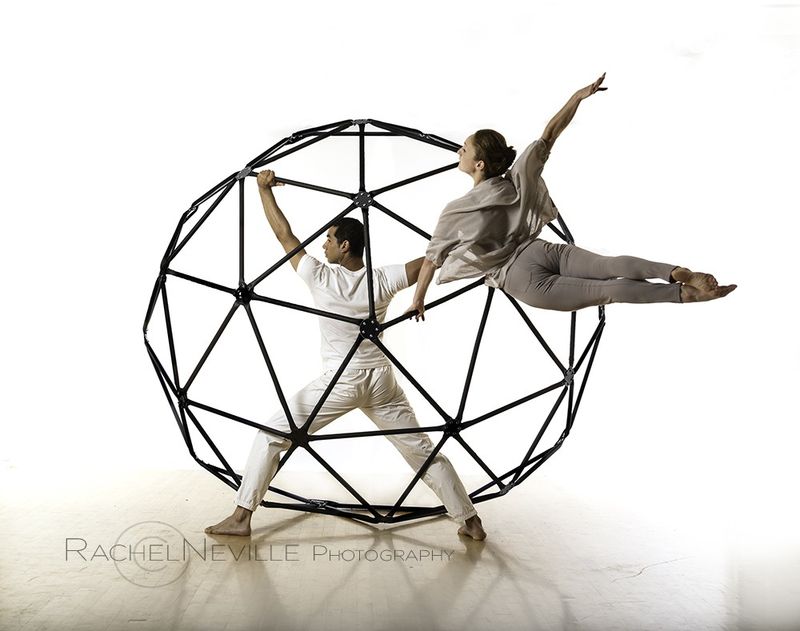
    A geodesic dome serves as a jungle gym, a cage, a bowl. At one point Ms Lacey climbs up onto the shoulders of the men, as if trying to escape thru the ceiling.  

    KinderPlatz is accompanied by original video projections created by visual artist Aleksandar
    Cosic, featuring elements of architecture and shifting perspectives. What makes the work appealing though is the movement quality and the clarity of personal expression of the six indivdual dancers.

    A Dancer’s Life opens with the diverse group of Janusphere
    dancers appearing one-by-one in practice clothes, telling their stories of “why I became a dancer”. A solemn narrator calls the group to order and they start doing classroom pliés and
    tendus, and working on partnering.

    Then the competitive spirit takes over: to the ‘Lone Ranger’ theme from Rossini’s WILLIAM TELL overture, the dancers race about the space, bumping one another off in an effort to get ahead of the pack. In an audition scene, the dancers vie
    fiercely for available work…and then comes the anguish of waiting for
    a callback. When all but one dancer are called,
    there’s relief and rejoicing, as well as a defensive narrative from the unchosen one. The work ends with the start of another day, another class.

    In A Dancer’s Life, the cast of KinderPlatz are joined by Misei Daimaru, Stephanie van Doreen, and Ashley Whitson. In the theater’s intimate space, the personalities and individual attractiveness of the dancers gave the performance a sense of direct communication.