Tag: Sunday September

  • ONOKORO ~ creations/beginnings

    Miki 2

    Author: Oberon

    Sunday September 24th, 2023 – This evening at Westbeth, dancers Miki Orihara and Ghislaine van den Heuvel joined a fantastic ensemble of musicians in a program entitled ONOKORO – creations/beginnings. The production, Tokyo to New York, is under the artistic direction of Thomas Piercy; the performance took place at the Martha Graham Studios.

    Onokoro comes from the ancient Kojiki, Japan’s oldest mythology; it was the name of the first island formed by the gods Izanagi and Izanami when they were creating Japan. The evening’s program took us on a musical and spiritual journey from “Ryoanji” (the first sounds) to “Netori, Netori” (the emergence of organized sound and music), and onward thru to “Onokoro” (which combines the Eastern and Western styles of music and movement).

    The Graham space at Westbeth was the perfect setting for this production. As the house lights went out and silence fell over the space, the studio’s large windows created a feeling of l’heure bleue, that fleeting time when day yields to night. In the darkness, the musicians took their places to perform John Cage’s 1985 work “Ryoanji”. The only source of light in the room was the tablets from which the musicians read their scores. The piece opens with a kneeling percussionist, Marina Iwao, striking a bell; this summons is repeated insistently throughout the piece. Thomas Piercy plays the hichikiri, a small double-reed Japanese instrument which seems like a cross between flute and oboe. Mr. Piercy is joined by two other hichikiri players: Lish Lindsey and James Joseph Jordan. The sound of their instruments veers from sighs and whispers to squawking and whining. The audience seemed intrigued by the music.

    Mr Piercy now took up his clarinet for Bin Li‘s clarinet concerto “Netori, Netori”. A seated Gagaku ensemble – Ms. Lindsey and Mr. Jordan joined by Harrison Hsu (sho) and Masayo Ishigure (koto) – create fascinating, otherworldly musical colours which are plucked or piped. As Mr. Piercy begin to play, dancer Maki Yamamae appears, dressed as a young warrior and carrying a ceremonial spear. The space is illuminated in golden light as the the slow ritual dance evolves in a series of poses. Mr. Piercy illuminates the music with soft trills and warblings, and the sound of escaping air; his dynamic control is uncanny. There are silent pauses in the music, and eventually the ensemble rejoins. Following the dancer’s exit, there is a quirky coda for the clarinet.

    Two works having their world premieres at these concerts came next. The first, Gilbert Galindo‘s “Primordial” for clarinet, cello, and piano, opened with a somber cello passage, introducing us to an extraordinary cellist: Daniel Hass. Mr. Piercy again took up his clarinet for this work, and Ms. Iwao was at the keyboard. Galindo’s pensive music is hauntingly beautiful, bringing us a magical mixing of timbres. Mr. Hass produced shivering tremolos while Ms. Iwao found poetic depths in the piano’s lower octaves, and Mr. Piercy’s lambent tone and dynamic variety made for an engrossing experience.

    After the briefest of pauses, the players proceeded to the second premiere, Miho Sasaki’s “黎明 – reimei – Dawn”. Here Mr. Piercy traded his clarinet for the ohichiriki. This music is intense, with threads of melody woven in amidst jarring harmonies. From this emerges high, delicate figurations from Ms. Iwao’s keyboard, while Mssrs. Piercy and Hass create a very distinctive tonal blend. The music, veering from disturbing to reassuring along the way, was very impressively served by these three musicians. And both the Galindo and the Sasaki works seemed to me ideal candidates for choreography.
    For the program’s concluding work, Masatora Goya‘s “Onokoro” Concerto for hichiriki and strings, Mr. Piercy was joined by a string ensemble: violinists Sabina Torosjan and Lara Lewison, violist Laura Thompson, bassist Pablo Aslan, with Mr. Hass’s cello  and Ms. Iwao at the piano.
    Isolated notes from Mr. Aslan’s double bass set the mood as the space becomes fully lit. Mr. Piercy’s hichiriki seems to sigh before taking up a mournful (and vaguely jazzy!) passage. To quirky rhythms, the strings vibrate and the hichiriki wails. Mr. Hass’s cello introduces the dancers: Miki Orihara and Ghislaine van den Heuvel. Gorgeous string harmonies emerge as the dancers remain still. Playing over plucked string motifs, Mr. Piercy’s hichiriki urges the women forward; Miki Orihara is wearing a cape with an extraordinarily long train (costume design by Karen Young). For a fleeting moment, Mr. Piercy veers into a bluesy phase.
    Seated on the floor, the dancers commune with flowing port de bras. The train is briefly passed to Ms. van den Heuvel but then returned to Ms. Orihara. The music takes on a chorale-like feeling; the dancers rise, as if transfixed. Mr. Hass’s cello sounds gorgeously while the women kneel and arrange the cape between them, placing on it a beautiful mask, ‘Tuskiyom‘ (on loan from the Theatre of Yugen, in San Francisco). Their ritual complete, the dancers part and slowly back away. Mr. Piercy then embarks on a grand cadenza before the music fades with tremolo strings.
    The evening ended with warm applause from the audience, who had experienced the performance in a spellbound state, as if in church. While I wished on one hand that a large crowd could see this work, it was exactly the intimacy of the presentation that made it so meaningful.
    My thanks to Miki Orihara for alerting me to this engrossing production; it reminded me at times of Miki’s fascinating  2014 solo presentation, Resonance, which created the same kind of hallowed atmosphere. And how wonderful to see Ms. van den Heuvel again, after watching her magnetic dancing in a Graham 2 performance in 2022.
    To Mr. Piercy and everyone involved in ONOKORO, my deepest thanks for a truly inspired – and inspiring – evening.
    ~ Oberon

  • Yin Yue/Jiangxi Zhongshan Dance School

    10557287_10152602223041926_5101198420257482650_n

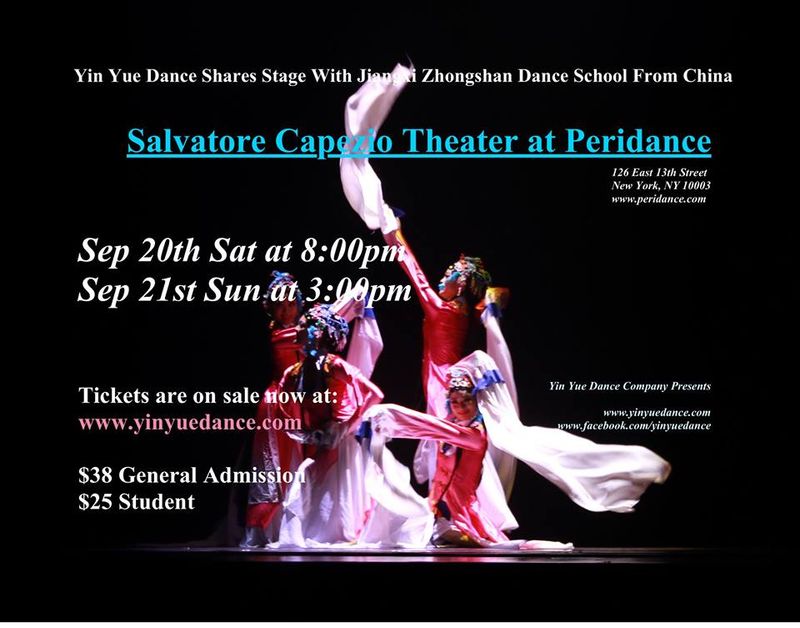
    Sunday September 21st, 2014 – Yin Yue Dance Company and students from China’s Jiangxi Zhongshan Dance School shared the stage at Peridance this afternoon in a programme that combined the contemporary with the classical in an East-Meets-West cultural dialogue.

    Yin Yue is an award-winning Shanghai-born choreographer who graduated from Tisch, New York University. For this event, she summoned a contingent of dancers from the Jiangxi Zhongshan Dance School, a private professional dance school located in Nanchang, Jiangxi Province, China, who have arrived in New York City, bringing  traditional Chinese classical/contemporary and folk dance as they meet the New York audience for the first time.

    The programme was well-devised to contrast the two styles: the young women from Nanchang performed in colourful, elaborate costumes while Yin Yue’s dancers appeared in stark settings and casual contemporary streetwear. The two companies alternated throughout the afternoon.

    The student company opened the show with a brilliant and festive piece Gan Yun You You in which elements of Chinese opera were featured. Later – in Spring Ballet – the girls danced on pointe in long pink tutus to the voice of a pop-oriented coloratura soprano. A quartet of solos – each dancer in red-highlighted costumes – went on a bit too long. Then Qinghua Rhyme was danced on pointe to a pop beat, while an Arabian Nights atmosphere pervaded Blossom: the girls all wearing red harem-style costumes and each carrying a red rose. Nuo Dance, the afternoon’s concluding work, featured the dancers wearing masks. At the end, a baby was delivered and he started to cry. Throughout their peformance, the dancers from the Jiangxi Zhongshan School showed surprising maturity of presentation and seemed thoroughly at home on the stage.

    Yin Yue and her fellow dancers – Liane Aung, Grace Whitworth, and Luke Bermingham – performed five works, ranging from quartets to a solo by Mr. Bermingham. Yin Yue’s choreography is strong and sure; she makes excellent use of space and lighting and she persuasively employs partnering and passages of dancing in-sync. Her strongest work was the solo for Mr. Bermingham – One Step Before The Exit – which seemed to express the loneliness of contemporary life and a (thwarted) desire to connect.

    Yin Yue’s undoubted gift for impressive dramatic movement is somewhat compromised by a lack of variety in her choice of music. Everything seems to be danced to a beat overlain in darkly throbbing industrial noise and/or static. The vaguely ominous atmosphere created by this type of music – so favored by many of today’s younger choreographers – becomes a cliché after a while. A bit of Chopin, alluded to in the playbill, never materialized. In taking a wider view of musical possibilities, I believe the choreographer will find ever-expanding avenues of expression.

  • Nomad Contemporary Ballet

    375941_3950873724299_1471473223_n

    Above: Eun Jung Jung and Eric Vlach in rehearsal for Nomad Contemporary Ballet.

    Sunday September 23, 2012 matinee – Nomad Contemporary Ballet, under the artistic direction of Kristen McGrew, gave their debut performances in New York City this weekend at the Alvin Ailey Studios. I attended the second of two performances; there was a full and attentive house, an unbroken progression of successful and pleasingly contrasted danceworks, a troupe of very accomplished and appealing dancers, a fine array of music, nice costume designs, effective and uncomplicated lighting. In short, it was a very satisfying afternoon of dance. 

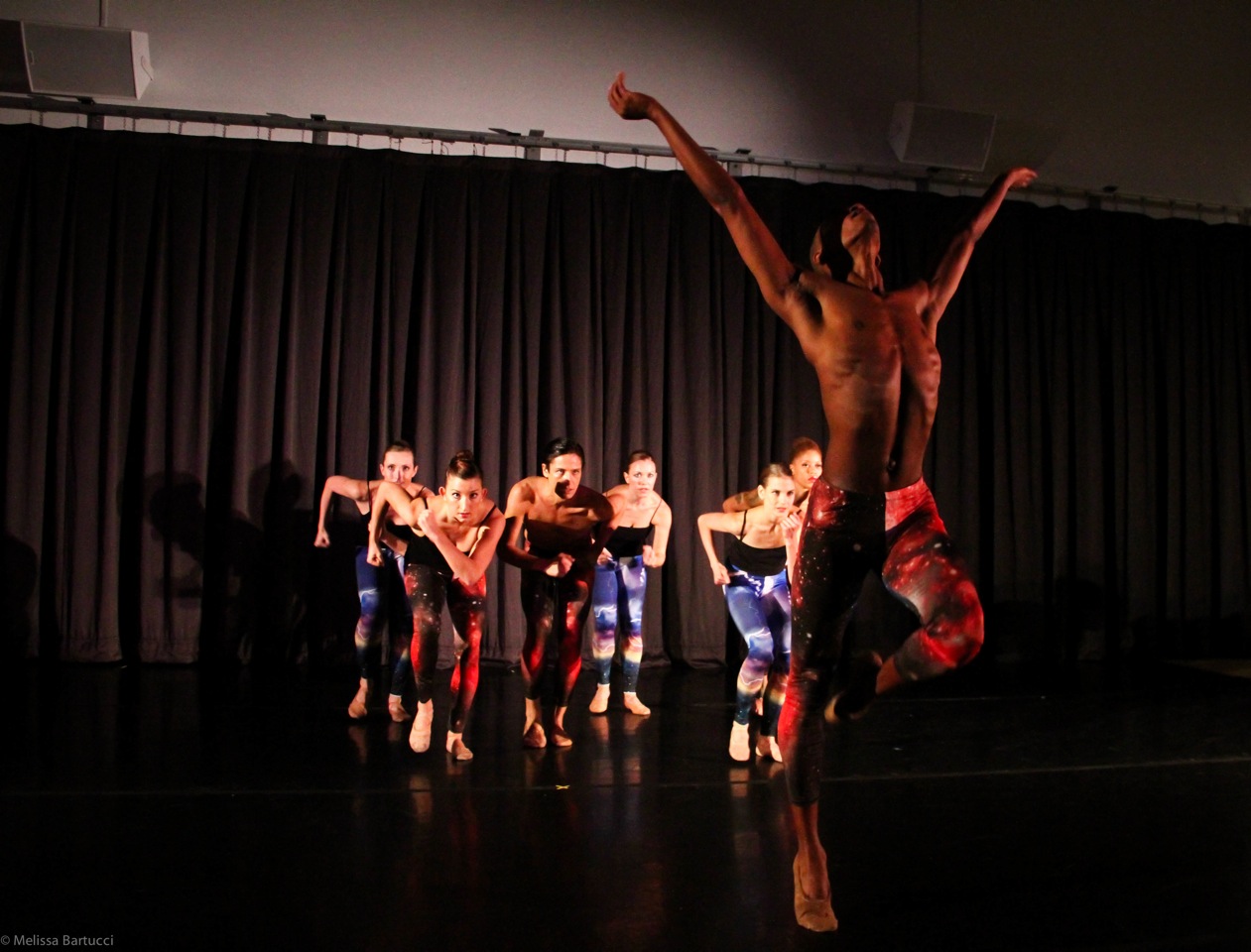
    Ursula Verduzco’s wonderfully animated THE GAME opened the performance with the dancers running in place. They wear colourful flannel tights embellished with constellations and galaxies, reminding me of a kid’s pajamas. To music by Dead Can Dance, the dancers swoop and leap about the space, forming mini-cliques and then going off on other tangents. A very good way to kick off the programme.

    It was the duet ADRIFT, choreographed by Ms. McGrew, that introduced me to Nomad when it was performed recently as part of the Latin Choreographers Festival 2012. I loved it then and loved it even more today as it took on a new resonance by virtue of this brief program note: “Two people who love one another but are not lovers, bound together to a single person who they both loved and lost: his wife, her sister.”  That single sentence threw a poignant light on the duet and it became a very moving piece to watch today…and just a bit harrowing in my current fragile state of mind. Dancing beautifully to Bach, Erin Ginn and Eric Vlach were so expressive that they left me with a lump in my throat.

    199089_491740260837359_615142581_n

    Above: dancer Shannon Maynor photographed by Melissa Bartucci.

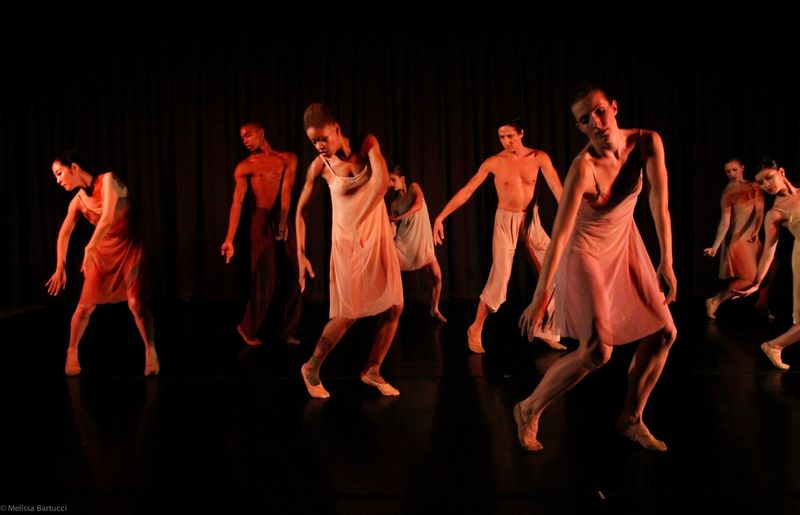
    If ADRIFT was touching, the next work MIDNIGHT ABYSS made me feel suicidal…oh, it was very well-choreographed (by Adrienne Hurd) and danced, but that song – Jacques Brel’s ‘Ne me quitte pas’ – what a stab in the heart that is!  Luckily there was no revolver or razor blade to hand. So I made myself focus on the two dancers who opened the piece: Shannon Maynor and J’Michea Walker. Excellent, both of them. The piece develops into a large work with some ritualistic unison phrases; on my playbill I scrawled ‘gorgeous ensemble’. Shannon is a really impressive dancer to watch; her dancing has both strength and beauty. It was a piece that matched my mood and thus took on a particular dark lustre of its own. I’d love to see it again.

    Choreographer Janet Atallah turned to music of Philip Glass for her work SYNAPSE; some people think Glass has been over-used for dance but I say: the more Glass the better. I’ve yet to see a work set to his music that I actively disliked. Ms. Atallah’s piece unfolded pleasingly, on pointe and with lots of classic ballet vocabulary woven into fresh sentences and paragraphs. A solo for Shannon Maynor and her duet with J’Michea Waker were among the finest passages, as was an adagio for four women.

    In a triple tour de force, Alexei Agoudine (of ABT) not only choreographed his ballet RUSTY ROMANCE but also wrote the music for it and designed the costumes. Witty and wistful, this story of the love of a spark plug for a fuel filter was a real charmer from start to finish. Joel Levy as the mechanic sets things in motion (later his own pirouettes drew a round of applause); there’s a quartet of on-pointe sparkplugs and then there’s the hapless fuel filter, played by Eric Vlach. The winsome and pretty Erin Ginn loses her heart to Eric and they have a love duet after which Erin’s energy has drained away. She pines for him as her sister-sparks make fun of her; but love conquers all and the ballet ends with a triumphant apotheosis.

    200585_491738844170834_1670898728_n

    Above: dancer Erin Ginn, photo by Melissa Bartucci.

    Kristen McGrew’s RUA (‘Red’) ended the afternoon in fine fashion, the dancers in red and black moving fluently to music of Antonio Vivaldi. The piece is very astutely structured and the combinations are woven together with a sure hand, giving the dancers ample oppportunity to shine both as individuals and as an ensemble. A particularly lovely adagio for Eun Jung Jung and Eric Vlach gave the ballet its center. Kristen’s musical choices – Bach and Vivaldi in this programme – put her in alignment with me as to setting the creative energy on music that is worthy to be danced, especially when a work is on pointe. Music for dance needn’t be classical, but it does need to be classy.

    In addition to the dancers named in the above paragraphs, Nomad Contemporary Ballet also gave us Khiara M Bridges, Alessandra Giambelli, Bethany Lange, Rebecca Ross, and Malik Warlick each of whom I was able to focus on in the course of the afternoon.

    I’m hoping these calling-card performances will be the start of a prospering time for this Company which can offer performing opportunities for dancers steeped in classical ballet, and the possibility for choreographers to create new works in that genre. I congratulate Kristen and eveyone involved for this new beginning.

    Here are some images from the actual performance; the photographer is Melissa Bartucci:

    IMG_4167

    From THE GAME with dancer J’Michea Walker in the foreground

    IMG_4378

    From ADRIFT; the dancers are Erin Ginn and Eric Vlach

    IMG_4391

    The ensemble in MIDNIGHT ABYSS

    IMG_4498

    Shannon Maynor and J’Michea Walker in SYNAPSE

    IMG_3810

    Above: dancer Eun Jung Jung

    Click on each of these images to enlarge.