
Above: the chorus of Scottish exiles; photo by Steven Pisano
(Note: click on each image to enlarge)
~ Author: Ryan Vasquez
Wednesday July 23rd, 2025 – This year, Teatro Nuovo staged both Verdi’s Macbeth (the 1874 edition) and Donizetti’s La Sonnambula. Verdi’s Macbeth is a relatively faithful adaptation of Shakespeare’s classic, but the opera could just as well have been titled Lady Macbeth, both because of the impressive music Verdi wrote for the character and because of Alexandra Loutsion’s commanding performance as the (almost) titular villain. The entire principal cast sang beautifully, but the night undoubtedly belonged to Loutsion.
Teatro Nuovo is a summer festival where young singers and budding professionals spend the season working on two bel canto operas. Although Verdi is not typically categorized as a bel canto composer, his early works, Macbeth among them,clearly sit at the tail end of that stylistic era.
The performance took place at New York City Center, just a block from Carnegie Hall. It was my first time attending a show at the venue, and it was fantastic, beautiful and acoustically quite pleasing. I was also glad to see a diverse audience that truly reflected the breadth of NYC’s population and age demographics.
The full orchestra was positioned directly in front of the stage and served as a formidable counterpoint to the otherwise completely bare stage. I was surprised to find there were no set pieces at all, but I chose to be patient and see how things would unfold.
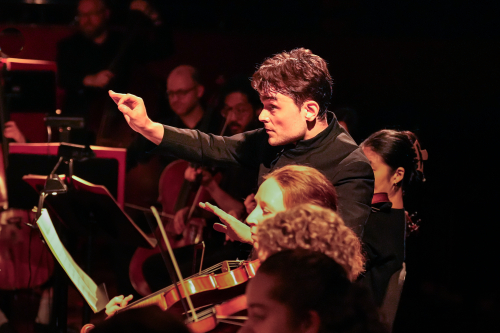
Conductor Jakob Lehmann (photo above by Steven Pisano) walked out and began the overture. The orchestra displayed masterful control, delivering Verdi’s score with both power and delicacy. Their ability to handle the softer passages was especially noteworthy: opera orchestras aren’t always known for subtlety, but this one maintained finesse throughout the entire evening.
I noticed the overture featured prominent use of brass, which I loved for its tone-painting quality. Brass instruments have long been associated with death, and Verdi’s thick brass textures effectively foreshadowed the bloodshed to come.

Above: the chorus of witches; photo by Steven Pisano
The back wall of the stage lit up with a beautiful projection of Scotland, setting the scene for the witches’ chorus. Shakespeare’s version begins with three witches who famously chant, “Double, double, toil and trouble,” but this adaptation featured three groups of singing witches. All dressed in black, these choristers were young artists covering the main roles and performing comprimario parts.
They sang well, and several performers fully embraced their witchy characters. However, a number of them seemed to lack fully developed characterizations. Overall, it was an effective, if slightly static, opening.
Shortly after the choral number concluded, Macbeth, played by Ricardo José Rivera, and Banco, played by Cumhur Görgün, entered. Both were dressed in formal black attire, a costume choice shared by the rest of the male cast.
They sang the duet “Due vaticini compiuti or sono” beautifully. I was particularly struck by Rivera’s smooth legato line. Görgün’s voice had a rich color, and I noted that the upper part of his range had more heft, making me wonder if he might actually be a bass-baritone. Regardless, the duet was a strong introduction to both characters and their voices.

Above: Alexandra Loutsion as Lady Macbeth; photo by Steven Pisano
After the stage cleared, a new projection depicted Macbeth’s castle. Lady Macbeth, portrayed by Ms. Loutsion, entered and delivered lines in wonderful Italian. I was surprised the passage wasn’t sung in recitative form, but soon she transitioned into the recitative section of her aria, “Nel dì della vittoria.”
Ms. Loutsion’s voice initially sounded like a mezzo’s, but given the heights her voice achieved, she was clearly a soprano. She commanded the stage and fully embodied the ambitious Lady Macbeth. The crowd adored her. Her coloratura rang with crystal-clear pitch, an impressive technical feat, and her intonation was impeccable. When she finished her aria, the audience erupted into applause. Well deserved cries of “Brava!” rang out. Loutsion stood in place until the cheers subsided, then exited the stage.

Above, the Macbeths: Mr. Rivera and Ms. Loutsion, photo by Steven Pisano
Rivera’s characterization of Macbeth in the first scene leaned heavily into “anxious,” which worked initially but grew somewhat one-note. Fortunately, more nuance emerged during his duet with Lady Macbeth. The two had excellent chemistry, and Ms. Loutsion appeared more relaxed. If the shift in tone was an intentional choice to reflect Macbeth’s comfort in his wife’s presence, it was an effective one.
They sang well, but I realized midway through their duet that I didn’t fully understand what had just happened to prompt the number. This moment highlighted the production’s biggest weakness: the acting and staging were secondary to the music.
The motivation behind the duet was that Macbeth had just murdered the king and was now panicking over the bloodied dagger. However, the murder itself wasn’t shown. While the libretto indeed places the murder offstage, the production did little to make that event clear. The action often felt like an inconvenient hurdle rather than a driving force for the music.
This lack of clarity recurred throughout the show. Events that should have been staged were either skipped entirely or summarized in supertitles. The most jarring example came at the end, when Macbeth and Macduff left the stage to fight. A supertitle then informed us that “Macbeth was fatally wounded.” After which the two returned. Macbeth proceeded to lie on the floor. And then die.
Returning to the earlier moment: after the Macbeth/Lady Macbeth duet, the chorus launched into a rousing Verdi finale. It had all the signature hallmarks of Verdi’s brilliance, even in this early work. I was particularly impressed by Martin Luther Clark, who sang the role of Macduff. Though Macduff doesn’t do much until the final act, Clark’s sterling tenor soared clearly above the orchestra.
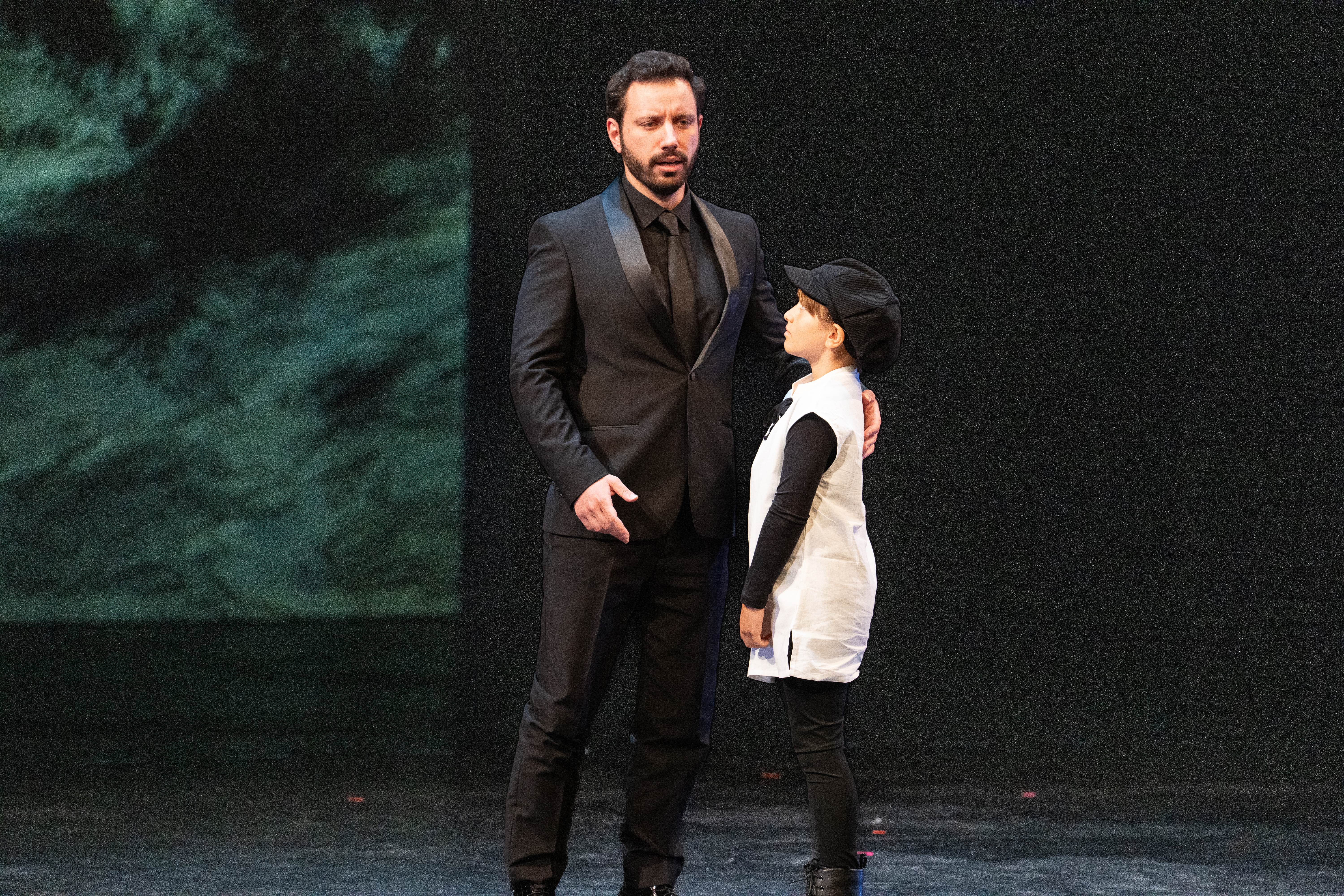
Above: Cumhur Görgün as Banquo and Olivia Trinchera Citterio as Fleance; photo by Steven Pisano
In the next act, Banco and his child were outside the palace, unaware of the events unfolding within. Görgün sang Banco’s aria beautifully, again showing off his warm tone. Banco then exited the stage and was murdered (again offstage), and the scene shifted back to Macbeth’s castle.

Above: Ricardo José Rivera as Macbeth is haunted by Banquo’s ghost; photo by Steven Pisano
Act II featured more beautiful singing, and Rivera seemed more animated and confident. During the finale, Banco’s ghost appears, visible only to Macbeth, but the staging failed to indicate he was a ghost. Since we never actually saw Banco die, the moment felt muddled. Simple makeup or lighting could have clarified things. Still, the ghost was soon forgotten as the act closed.
Once again, the orchestra impressed. Their dynamic sensitivity, likely thanks to Lehmann’s direction, was a rare treat in opera.
I thoroughly enjoyed the sprite scene in Act 3, where the female chorus returned as witches. The choral numbers throughout were well executed. The staging in this act was more dynamic, with some choreographed movement that added interest.
Macbeth’s aria following the sprites was Rivera’s best of the night. His soft passages were beautifully rendered, showcasing his technique. He ended with a rousing cabaletta and held an extended final note that had the audience in raptures, particularly in the balcony, where the applause outlasted that of the orchestra level.
The scene turned back to Macbeth’s castle. Although I had never seen this opera in person, I knew about the most famous scene that was Verdi’s take on Shakespeare’s famous lines for Lady Macbeth, “Out, damned spot! Out, I say!” Lady Macbeth’s attendants stood on stage giving the background details on why Lady Macbeth had seemed to have lost her mind. Once the preamble was finished, Ms. Loutsion walked out as if in a trance and started to sing the famous aria “Una macchia è qui tuttora.” As the soprano mimed out washing her hands the audience was transfixed, for the entire scene, waiting with bated breath for the next moment to happen. And as Ms. Loutsion finished she walked off the stage with applause.
Next came a scene featuring Macduff and Malcolm, the prince destined to take the throne Macbeth killed (offstage) to acquire. Romeo Lopez, who sang Malcolm, had a sweet voice but was overpowered by the orchestra. As a young artist, he has time to develop his voice, but for now, he struggled to be heard.
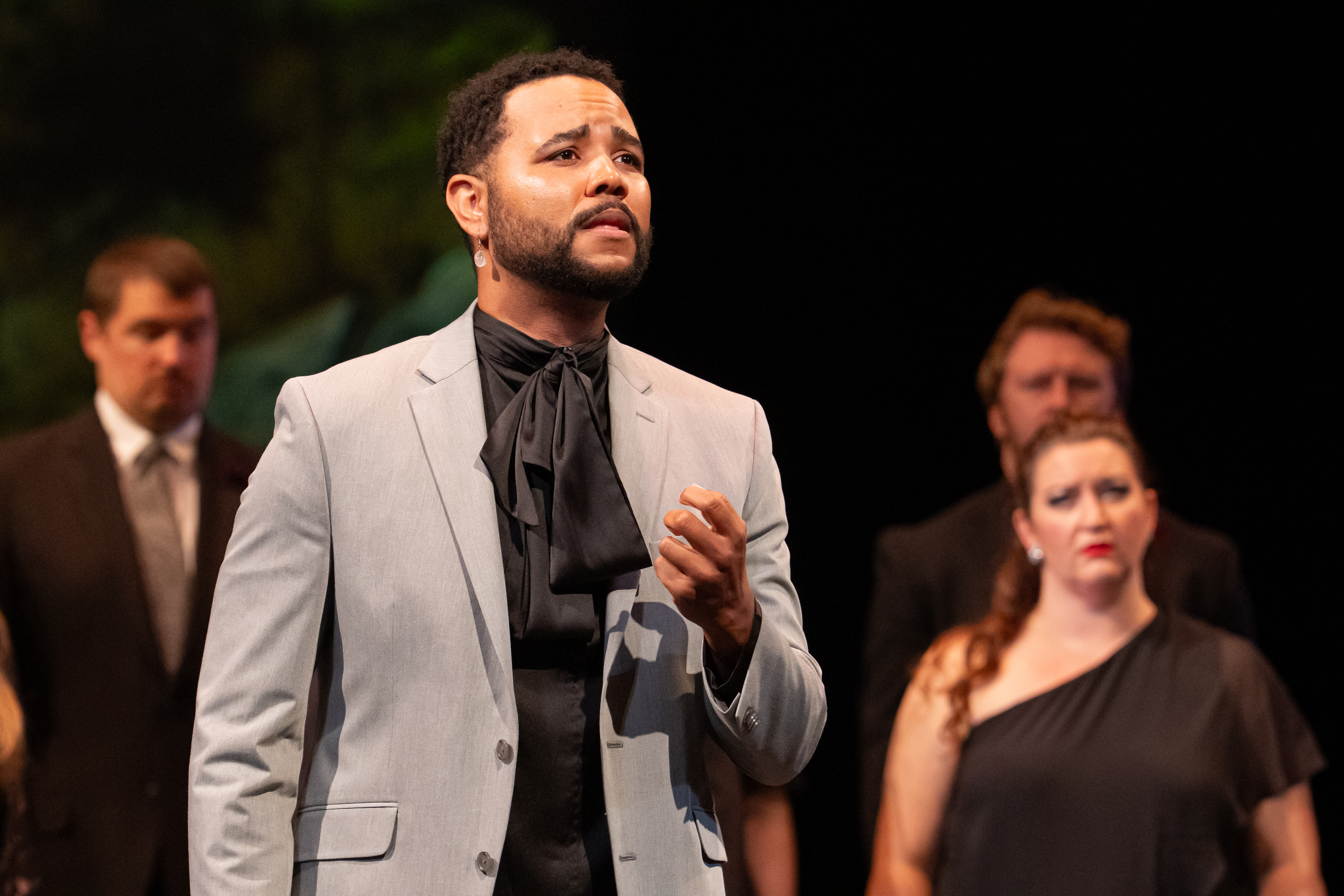
Above: Martin Luther Clark as Macduff; photo by Steven Pisano
Clark’s rendition of Macduff’s aria “Ah, la paterna mano” was a standout moment. Macduff is one of those roles where you don’t have too much to do and learn, but you get a wonderful song that everyone remembers after the show. Clark performed it with tenderness and grief rather than anger, revealing the piece’s emotional depth. His pianissimi were particularly moving, making me appreciate the aria in a new light. The ovation was well earned.
In the final scene, Macbeth and Macduff faced off. Macbeth, emboldened by the witches’ prophecy that no man born of woman could kill him, is shocked when Macduff reveals he was born via cesarean section. They leave the stage, Macbeth is mortally wounded, they walk back onstage, and the show ends.
Musically, this Macbeth was executed beautifully. The orchestra was superb, and the singers brought Verdi’s music to life with skill and passion, thankfully, onstage.
~ Ryan Vasquez
(Performance photos by Steven Pisano)

 Oberon's Glade