Tag: The Crossing

  • The Crossing: The Book of Never

    The+Crossing +Summer+2024+(credit_+Charles+Grove)+

    Above: The Crossing; photo by Charles Grove

    ~ Author: Lili Tobias

    Friday June 20th, 2025 – The Crossing, conducted by Donald Nally, presented the New York premiere of Aaron Helgeson’s The Book of Never, along with selections from Gavin Bryars’s The Last Days of Immanuel Kant—two adventurous works of music! The program was presented by the Arts and Architecture Conservancy at Saint Peter’s.

    The Last Days of Immanuel Kant began the concert, the text of which is drawn from Thomas DeQuincey’s book of the same title. Bryars set the words true to the rhythms of the original prose, with flowing sentence-shaped phrases. The lush harmonies were full of suspended notes, some resolving and others remaining in a state of lingering uncertainty. But no matter what happened eventually, the result was always beautiful!


    In the program notes for “II. Prologue,” Bryars notes “DeQuincey’s astonishing assumption: ‘I take it for granted that every person of education will acknowledge some interest in the personal history of Immanuel Kant.’ I, for one, do not have any particular interest in Immanuel Kant, but that didn’t detract from my enjoyment of the music at all. Without the historical context, the text could have been about any regular person in their final stages of life. The singers describe mundane activities like recording conversations on scrap paper in order to remember them, difficulty sleeping, visiting a friend’s garden, etc.—all things that are shared by many in the process of aging and dying, no matter if you’re a famous philosopher or ordinary person.


    04+Sam+Gehrke


    Above: Aaron Helgeson, photo by Sam Gehrke


    The text for The Book of Never also originates from an unconventional source. Composer Aaron Helgeson sets the fragmented remains of the Novgorod Codex, at the same time weaving in text from a variety of other sources (including Gertrude Stein and the Rolling Stones, to name a few). Themes of exile tie the patchwork of text and personal histories of the authors together, and the powerful vocalizations of The Crossing brought Helgeson’s musical realization to life. All proceeds from this concert were donated to Safe Passage 4 Ukraine, an organization which helps Ukrainians displaced from the war find safety and new homes.


    Helgeson describes the contents of the Novgorod Codex in part as like “the chanting of a vindictive spell,” and the music certainly embodied that. The singers recited words one after the other on the same pitches or oscillated across wide intervals. Textures like this often punctuated more polyphonic sections, inciting a sense of urgency (like the near shouting of “And you bow down” in “III. Burns I’d Like to Forget…”). The harmonies, too, were mysteriously intriguing. Helgeson upended the traditional distinctions of “consonance” and “dissonance” (which are completely relative anyway) with notes and melodies drawn from a collection of hymns associated with the Novgorod Codex. During any moment of silence within the piece, the haunting echoes of dense cluster chords lingered in the air.


    All in all, The Book of Never is true choir music. Not just because it’s written for singers, but because Helgeson achieves an assembly of notes, words, vocal expression, and meaning that only a choir can facilitate. Arranged for any other ensemble, I feel that the music would lose a significant amount of the deep emotional nuance it has in its original form. Many of the movements feature different sequences of words sung nearly simultaneously, the listener’s attention shifting from one phrase to the next and back again but absorbing the meaning of both at the same time.
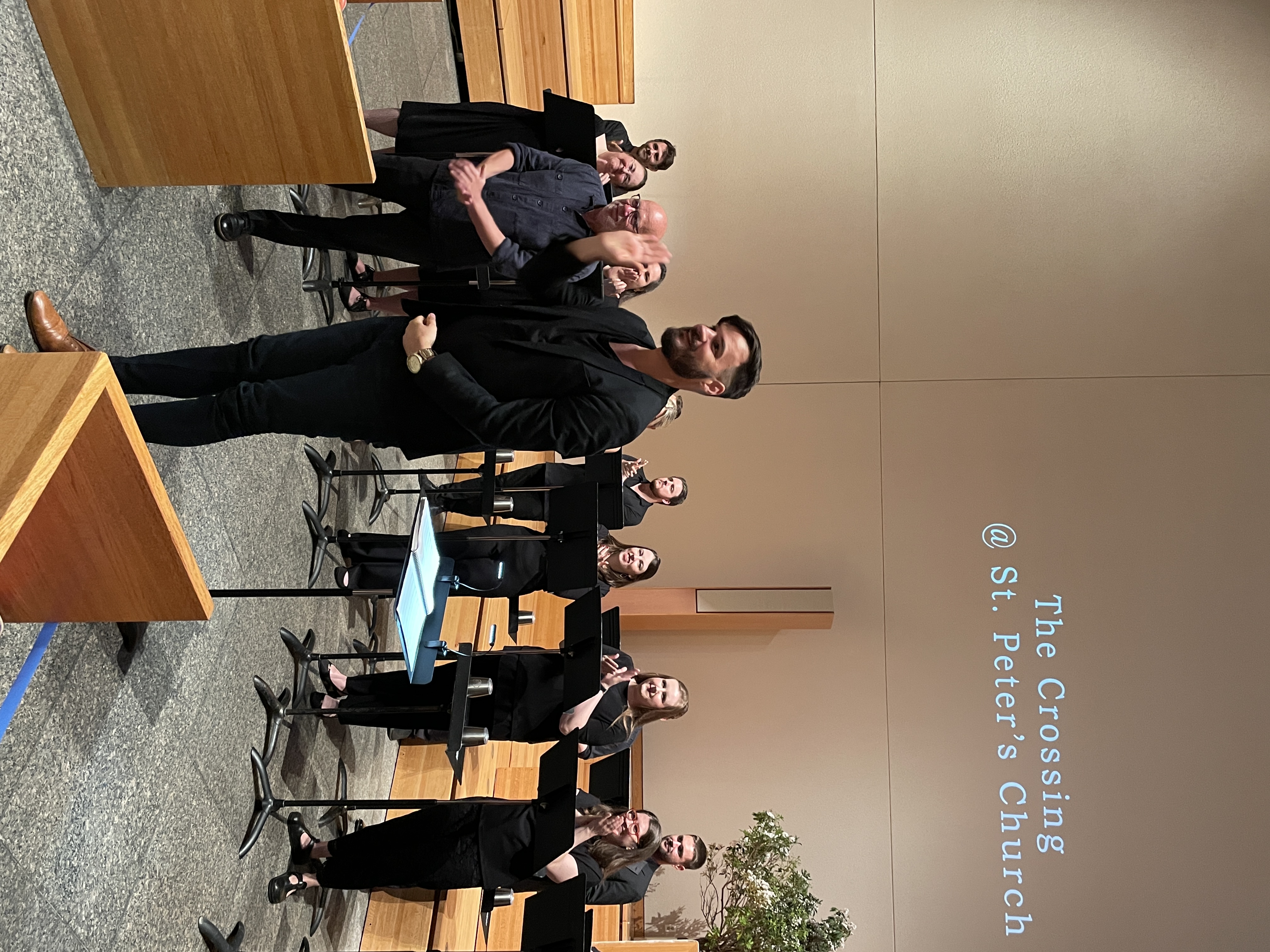
     

    A Helgeson - TBON curtain call


    Above: The Crossing and Aaron Helgeson, photo by Steven Swartz


    The final movement, “VII. Names of Things I Once Believed…,” exhibited this truly non-linear presentation of ideas to the extreme. Half the choir sustained multiple words at once (“all/always,” “why/waiting, “end/ever,” etc.) while the other half chanted longer, more descriptive phrases of resilience amidst suffering and self doubt. The intricate layers of music illuminated the complicated contradictions of existence in a world that does not value everybody’s existence. From start to finish, Helgeson’s innovative choral writing brought The Book of Never to an entirely new dimension of comprehension, and it was an absolutely exhilarating space to inhabit!

    ~ Lili Tobias

  • The Crossing: James Primosch ~ CARTHAGE

    - the crossing - carthage -

    UPDATE (4/28/21): It was sad to read today that the composer James Primosch has passed away at the age of 65. This is an article I wrote in May 2020 upon the release of CARTHAGE by The Crossing:

    ~~~ Newly released by Navona Records, CARTHAGE features works by composer James Primosch performed by the choral group The Crossing. This music came my way during the isolation of the pandemic in May of 2020. 

    From the opening phrase of the opening piece, Journey, a spell was cast over me. Listening to the men of The Crossing intoning these words drawn from the work of 13th-century monk and mystic Meister Eckhart – “There is a journey you must take. It is a journey without destination. There is no map. Your soul will lead you. And you can take nothing with you.” – was all it took to draw me in. Not just the evocative words themselves, but the particular beauty of the voices created a mood that is sustained throughout the span of the album.

    While the title track, Carthage, evokes for me visions of the lost city of Carthage, where Dido died of despair after being abandoned by Aeneas, it’s Marilynne Robinson‘s novel Housekeeping that is the source of the text. James Primosch provides wondrous harmonies which feel at once ancient and vividly of our time. Individual voices sometimes rise from the ensemble as the music veers from pensive to ecstatic. After listening, I ordered a copy of Ms. Robinson’s book. 

    Following is Mass for the Day of St. Thomas Didymus. Comprised of five movements, this work employs four soloists singing the traditional texts from the Latin mass whilst the main choir of The Crossing sing from Denise Levertov’s cycle of poems which inspired the work’s title.

    In Kyrie, the solo voices are deeply affecting, the choir’s harmonies alive with dynamic and rhythmic shifts. The Gloria is appropriately more animated and upbeat, whilst the Credo opens thoughtfully, with especially marvelous harmonies in a variety of moods. The Sanctus opens with  solo voices, each on its own trajectory and finally meshing; following a dense harmonic burst, the word “Sanctus” is repeated. The music then becomes lullaby-like. Agnus Dei, the final passage of this Mass, opens with the beloved “Lamb of God” text gently voiced; later, an emotional rise subsides into a fading finish, a quiet plea for peace.  

    The album’s notes so accurately describe this work honoring St. Thomas Didymus – known as “doubting Thomas”  – as “…plumbing the depths between unbelief and faith in which true spirituality so often resides.” That is the exact place I have dwelt for so many years.

    spiraling ecstatically has a vivid spatial sense, a drifting loveliness followed by a high-rising passage of animation to a sustained finish. Two Arms of the Harbor opens thoughtfully, the voices soft and reflective. A female voice explores some high-range coloratura, leading to a brief energy surge. The music then subsides to a gentle coda, drifting into silence. 

    The album closes with One with the Darkness, One with the Light. In this brief track, a feeling of reverent acceptance pervades. The text, from poet Wendell Berry, is so simple and heartfelt, and composer James Primosch has given it a dreamlike setting in which the voices of The Crossing quietly reach us in the depths of the soul.

    “At night make me one with the darkness
    In the morning make me one with the light
    When I rise up, let me rise joyful like a bird.
    When I fall, let me fall without regret, like a leaf.
    Let me wake in the night and hear it raining and go back to sleep.”

    ~~~~~~~~~~~~~~~~~~~~~~~~~~~~~~~~~~~~~~~~~~~~~~~~~~~~~~~~~~~~~~~~~~~~~~~~~~~~~~~~~~~~~~~~~~~~~

    Primosch

    Above: composer James Primosch; photo by Deborah Boardman

    Mr. Primosch was born in Cleveland, Ohio, in 1956. He studied at Cleveland State University, the University of Pennsylvania, and at Columbia University. Among his teachers were Mario Davidovsky, George Crumb, and Richard Wernick, In 1988, the composer joined the faculty of the University of Pennsylvania. His website is here.

    TheCrossing2017BeckyOehlersPhotog1

    The Crossing (above, in a Becky Oehlers photo) is a Grammy Award-winning chamber choir. Under the direction of Donald Nally, the ensemble have commissioned over one hundred choral works. Visit The Crossing’s website here. ~~~

    ~ Oberon