Tag: The Joffrey Ballet

  • More From The Lubovitch 50th @ The Joyce

    Othello Migdoll

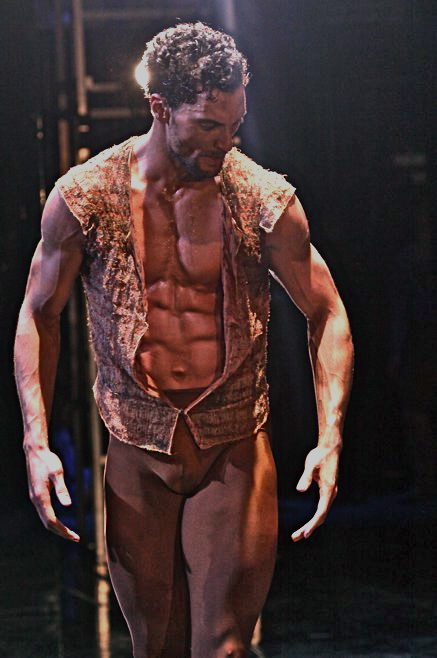
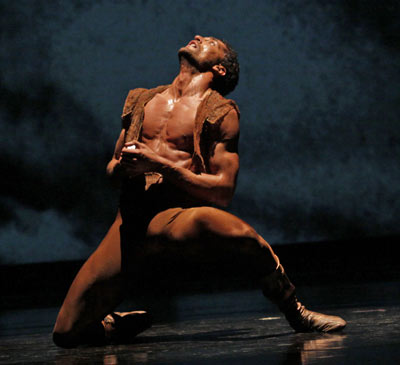
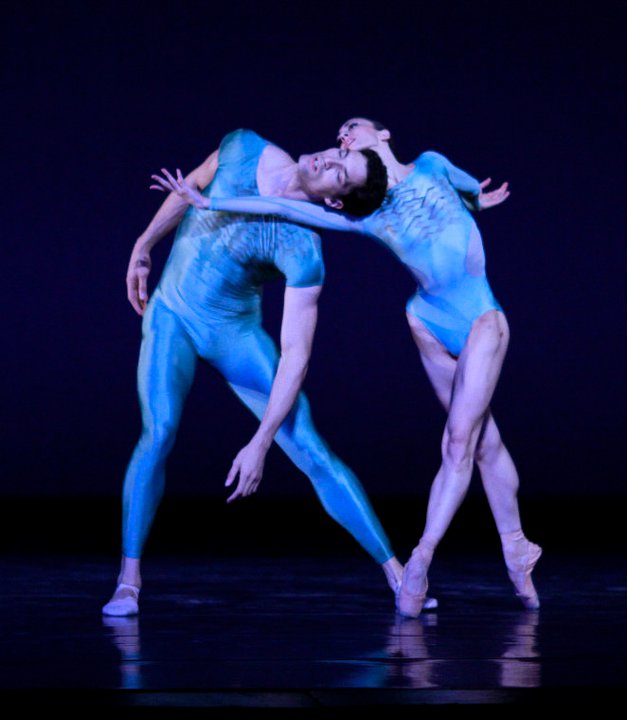
    Above: The Joffrey Ballet’s Fabrice Calmels in Lar Lubovitch’s Othello; photo by Herbert Migdoll

    ~ Author: Oberon

    Saturday April 21st matinee – Continuing the celebration of the 50th anniversary of the Lar Lubovitch Dance Company at The Joyce, four dancers from The Joffrey flew in to perform excerpts from Lar’s 1997 full-length ballet, Othello, while Lubovitch Company members offered three distinctively different works by the choreographer. It was a first-rate afternoon of dance all round.

    Little Rhapsodies (dating from 2007) is a gem of a dancework: to the delightful Symphonic Études, Opus 13, of Robert Schumann, three men – Jonathan Emanuell Alsberry, Reed Luplau, and Benjamin Holliday Wardell – trade solos and dance in unison.

    At curtain rise, the dancers are seen in silhouette. They dance together, in a folkish vein. Then the solos begin: Mr. Wardell is a gorgeous and expressive mover; the ever-brilliant Mr. Alsberry is winningly whimsical and blithely balletic; and Mr. Luplau with a lightness of touch, breezy turns, and copious charisma. Music and movement are happily meshed in a pas de trois, followed by more solos: Mr. Wardell something of a revelation; Mr. Luplau amazingly swift, sure, and supple; Mr. Alsberry effortlessly combining the dynamic and the lyrical. The trio dance on to a fun finish.

    Dance companies worldwide should snap up Little Rhapsodies: a perfect ballet to show off the male virtuosos on your roster.

    Othello: A dance in three acts is Lar Lubovitch’s 1997 full-length ballet, choreographed to a score by Elliot Goldenthal. In excerpts from Act III, guest artists Fabrice Calmels, Victoria Jaiani, Temur Suluashvili, and Rory Hohenstein of the Joffrey Ballet danced the final pages of the tragedy with a compelling sense of theatre.

    In a claustrophobic black chamber, Mr. Calmels’ downcast, glowering Moor sits on his black throne. The supplicant Cassio (Mr. Hohenstein, his hands bound) and the conniving Iago (Mr. Suluashvili) get under his skin whilst the incredibly lovely and vulnerable Ms. Jaiani as Desdemona seems unaware of her impending doom. The chilly music says it all. 

    Ms. Jaiani has a solo, her en pointe dancing a vision of grace. Mr. Calmels, his towering stature taking over the stage, displays the anguish of his mixed emotions. In a love/hate duet, he caresses his wife one moment and seems repulsed by her the next.
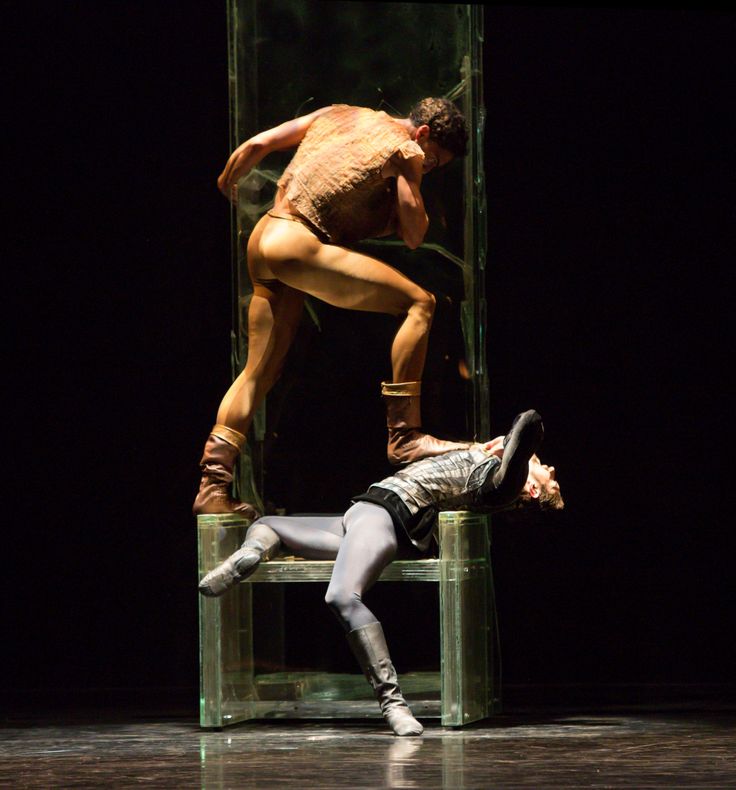
    Photo by Cheryl Mann

    Mr. Suluashvili’s handsome, conniving Iago now continues his machinations to about bring about Othello downfall: in their dramatic scene, Mr. Calmels leaps onto the arms of his throne as Suluashvili’s Iago cowers beneath the Moor’s wrath (above, in a Cheryl Mann photo). Then the fatal handkerchief is produced. In this scene, composer Elliot Goldenthal makes marvelous use of the saxophone.

    Eerie music accompanies Ms. Jaiani’s return as Desdemona. Then the composer conjures up an ominously cinematic setting for the final combat between husband and wife. Othello quickly prevails, and – true to Shakespeare’s immortal words – ‘I kissed thee ere I killed thee’ passionately kisses Desdemona as he strangles her with the handkerchief.

    As the four Joffrey dancers received resounding applause, I was recalling my only previous encounter with the Jaiani/Calmels partnership: they danced in Edwaard Liang’s Woven Dreams at Fall for Dance in 2011. They were splendid then, and splendid today.

    Something About Night, Lar’s newest creation, was premiered earlier in the week. I liked the piece a lot at its first performance but, as so often happens, a second viewing today made an even stronger impression. The gently ecstatic duet for Nicole Corea and Tobin Del Cuore really cast a spell today, and Brett Perry’s solo was nothing less than sublime. Belinda McGuire and Barton Cowperthwaite had less to do than I might have wished, but Barton still had Men’s Stories ahead of him, wherein his performance brought down the house. 

    Men's Stories  Photo by Nan Melville 7002Mens-659_preview

    Men’s Stories: A Concerto in Ruin (above, in a Nan Melville photo) closed the performance on a mighty note. The cast was the same as that of the opening night, and they all outdid themselves. Stunningly-danced solos by Reed Luplau, Jonathan Emanuell Alsberry, Anthony Bocconi, and Barton Cowperthwaite – and an epic performance from Benjamin Holliday Wardell – kept the level of excitement sky-high, whilst Colin Fuller, Matthew McLaughlin, Brett Perry, and Lukasz Zięba all looked great and danced their hearts out.

    The poignant, darkling, magically masculine world of Men’s Stories kept the audience in a rapt state of involvement, its musical mélange endlessly evocative. As waves of applause swept thru the house, the dancers took several bows before Mr. Lubovitch joined them onstage to a barrage of cheers. Happy 50th, Lar!!

    Friends and fans gathered on the lower level after the show; I loved seeing Gabrielle Lamb again, having a long chat with Nicole Corea, meeting Fabrice Calmels, and congratulating JJ, Barton, Reed, and Brett. When Mr. Lubovitch quietly walked thru the backstage door, the crowd burst into spontaneous applause. 

    ~ Oberon
  • Fall for Dance 2011 Program I

    225581_10150182199616935_21202486934_7102569_5129793_n

    Photo: Fabrice Calmels and Victoria Jaiani of The Joffrey Ballet in Edwaard Liang’s WOVEN DREAMS.

    Thursday October 27, 2011 – At the superbly renovated New York City Center, the annual Fall for Dance festival opened tonight with four companies participating:

    PROGRAM I
    Mark Morris Dance Group, All Fours, Mark Morris
    Lil Buck, The Swan, Lil Buck
    Trisha Brown Dance Company, Rogues, Trisha Brown
    The Joffrey Ballet, Woven Dreams, choreographed by Edwaard Liang

    The main reason I went tonight was to see the Edwaard Liang piece (photo at the top) and I enjoyed every second of his WOVEN DREAMS – and so, it seems, did the rest of the crowd who quietly “ooooohed” and “aaaaahed” throughout the ballet and then lavished the Joffrey dancers with sustained applause at the end. If Edwaard had taken a curtain call, that would have been the crowning touch. But he’s too modest. We did see him during intermission and he looks – if possible – handsomer and more fit than ever. I’d give anything to see him dancing again. But the life of a choreographer certainly seems to agree with him, and we need his choreography.

    But to start at the beginning of the evening, as the musicians took their seats to play the Bartok quartet #4 for Mark Morris’s ALL FOURS, I thought maybe this was a piece that would revive my admiration for the choreographer. Back in the 1980s we trekked several times to see Mark Morris at the Pillow and always loved what he was was doing; but over the years it seems to me that he’s run out of creative steam. ALL FOURS, from 2003, avoids the cliche Morris moves – fanny wiggles, pelvic thrusts, waving arms – for the most part. Much of the piece is given over to structured walking about; there’s a good duet for two guys and a nice quartet. The dancers all did well, but as the work passed by it seemed that the same motifs kept cropping up; in the end the waving arms made their appearance. The piece was politely received, but the musicians were vigorously saluted at the end: Jesse Mills and George Valtchev (violins), Jessica Troy )viola) and Wolfram Koessel (cello).

    Charles-lil-buck-riley-headshot

    In the solo THE SWAN, Lil Buck (above) performed his unique fusion choreography to Camille Saint-Saens’ classic Dying Swan: imagine morphing Michael Jackson and Maya Plisestskaya. At first there was some laughter as the street-clad dancer moved in a pool of light, but this quickly turned to admiring sighs and bursts of applause as Lil Buck rose onto the ‘pointes’ of his sneakers. With cellist Joshua Roman and harpist Rita Hequibal Printup rendering the familiar Saint-Saens melody onstage, a few feet away from the dancer, the piece made a cohesive statement of music and movement. True to Isadora Duncan’s ‘rule’ that no dance work should exceed five minutes in duration, it seemed to me that Lil Buck really had something to say. A few toffs turned their noses up but the overwhelming response was whooping enthusiasm.

    Trisha Brown’s Rogues features two men – one tall, one short – dancing mostly in sync to a whimsical score by Alvin Curran. From a frenzy of buzzing insects, the music switches to piano, then some sort of electronic pipe, and then harmonica. The two dancers, Neal Beasley and Lee Serle, were genial and moved smoothly thru the choreography of this pleasant duet.

    After a pause while the huge basket-weave drapery for the Liang piece was hung, the large contingent of Joffrey dancers took the stage for WOVEN DREAMS.

    Looking at the Playbill, my first thought that Edwaard was using too many different composers but then: the soudtrack of a dream is never predictable. Thus he was able to develop this six-movement ballet using music of Ravel, Galasso, Britten and Gorecki. Throughout the piece, Edwaard’s musicality and sense of structure – the keys to success of a large-scale work – were ever evident as was his daring sense of pushing the dancers to extremes of technique and partnering. As the work unfolded, the Joffrey dancers delivered everything Edwaard asked of them with a combination of energy and artistry that seemed perfectly aligned to both the music and the choreography.

    Central to the ballet is a radiant two-part adagio danced by Victoria Jaiani and Fabrice Calmels (photo at the top of this article). As sometimes happens in dreams, this duet is interrupted by an unrelated passage (more about that shortly) but then the couple seem to pick up where they’d left off.

    A choreographer could not ask for two more beautiful and expressive dancers than Ms. Jaiani and Mr. Calmels; the latter’s magnificent physique, long powerful arms and splendid line served as a tower of strength for his radiant partner. Together they moved thru the flowing style of Edwaard’s adagio, making the seemingly impossible partnering motifs look seamlessly grand. The underlying feeling of physical risk keeps the viewer entranced while the dancers’ sense of lyricism sustained the dreamlike atmosphere.

    Between the two pas de deux segments, Edwaard interjects what seemed to me the most brillliant scherzo: a quintet of men suddenly appear before a lime-green background to dance a remarkable pas de cinq to the pizzicato movement from Benjamin Britten’s SIMPLE SYMPHONY. Here Edwaard finds a contemporary accent to the classic ballet vocabulary which male dancers have ‘spoken’ for decades. With its choreographic freshness and touches of subtle wit, this quintet lasted just long enough to leave us craving more. The Joffrey men gave their dancing an extra splash of darkish vibrancy.

    In the larger-scale passages of the outer movements, all 20+ of the Joffrey dancers showed an intrinsic vitality and a willingness to follow Edwaard’s lead into exploring new combinations and patterns. The cumulative effect of the ballet and the way the floating woven tapestry was brought into play seemed to vastly please the packed house and there was enthusiastic applause at the end; I think if Edwaard had  appeared onstage he would have been greeted as a rockstar. Which he is, in my book. 

    Copy of 1

    Above: Kokyat’s photo of the facade of the newly-renovated New York City Center.

    On with the Festival! And thank you, Helene Davis.