Tag: The Joyce

  • Paul Taylor @ The Joyce ~ 2025

    Shawn lesniak

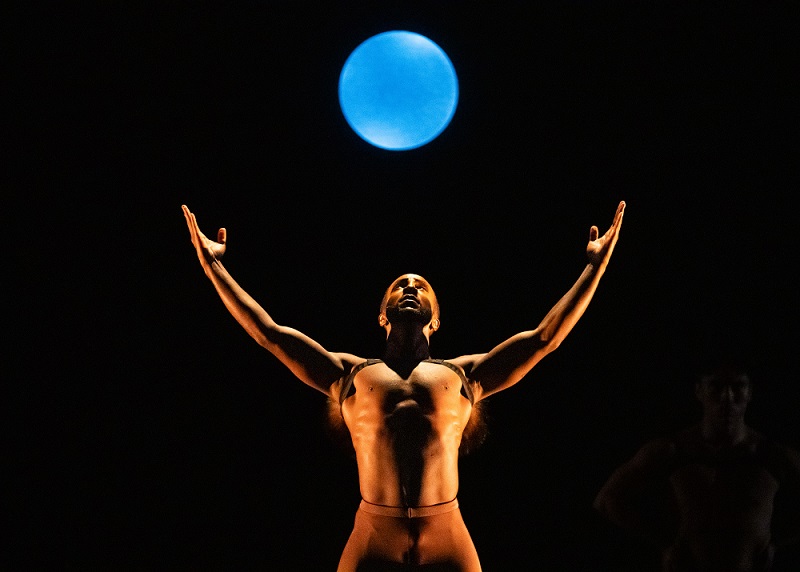
    Above: Shawn Lesniak in Paul Taylor’s Runes; photo by Steven Pisano

    ~ Author: Oberon

    Sunday June 22nd, 2025 matinee – Three works were on the bill at The Joyce this afternoon, as the Paul Taylor Dance Company concluded their season at the iconic venue. The matinee marked the farewell Taylor performance of Shawn Lesniak, who joined the Company in 2019. 

    Paul Taylor’s opus 64 – Polarisis set to a commissioned score by Donald York; it premiered in 1976. This work is unique in that it presents the same choreography twice, in different musical settings and with different dancers performing in and around a metallic cube; Jennifer Taylor’s lighting design, always so impactful, is also altered in the repeat. 

    In the cast of the first setting of the work were Gabrielle Barnes, Emmy Wildermuth, Payton Primer, John Harnage, and Jake Vincent. Of the women, Mlles. Barnes and Primer were new to me. Ms. Wildermuth had dazzled me in 2024, dancing Jody Sperling’s Clair de Lune, inspired by Loïe Fuller; today, in Polaris, her solo was vividly danced. John Harnage and Jake Vincent looked like young gods, and they danced handsomely.

    Donald York’s score develops a lilting theme, the choreography is stylized as the dancers move about the space creating shapes and striking poses; one dancer replaces another as if by magic.  The music is increasingly cinematic, the dancing full of wit, irony, athleticism, and grace. Ms. Primer and Mr. Harnage have an intriguing duet, and then Ms. Barnes made a gorgeous impression in a long solo passage where she moved about the space like a goddess. 

    One by one, the dancers of the first setting depart, their spots being taken over by Lisa Borres Casey, Jada Pearman, Jessica Ferretti, Lee Duveneck, and Alex Clayton. The music here felt more dramatic…more theatrical; at times, it became suspenseful, even creepy. The lighting seemed to take on a unique glow, with Jada Pearman charming us in her solo. Ms. Borres Casey and Mr. Clayton matched up to fine effect in their duet, and Jessica Ferretti was stunning and sublime in the long solo. Lee Duveneck towered over his colleagues, always a compelling advocate of the Taylor style. The finale of the ‘second’ score was especially evocative. 

    Following the interval, we saw Tablet (Taylor’s opus 24), set to a commissioned score by David Hollister, premiered in 1960. This playful, nine-minute duet was once danced by the choreographer and Akiko Kanda (photo below by Helga Gilbert): 

    Tablet-Taylor-Kanda-by-Helga-Gilbert 2

    Today, Tablet was danced by Kristin Draucker and Devon Louis, below in a Steven Pisano photo:

    Taylor tablet pisano

    Tablet’s score is quirky, the atmosphere that of a playful courting duet. The dancers were ideally paired, their shapes and port de bras having a natural flow. Each has a solo passage, but it is in their entwined partnering that the relationship – and the mutual trust between the two – is most palpable. During the interval, former Taylor star Richard Chen-See stopped by to chat; I understand that Richard was very much involved in getting Tablet back into the repertoire, and that’s surely why it felt so perfect. Ms. Draucker and Mr. Louis were the ideal choices for this revival. I hope Tablet will continue to be danced for us in seasons to come.   

    Cloven Kingdom has long been one of my favorites in the Taylor repertoire; it was the choreographer’s opus 63. With music by Arcangelo Corelli, Henry Cowell, and Malloy Miller, the work premiered in 1976. I first saw it at Jacob’s Pillow in 1982, and it was love at first sight…and first hearing. The music casts a spell: the elegance of Baroque is mixed with sexy percussive rhythms and sounds from an exotic jungle to captivating effect. Having seen it numerous times since that Pillow showing, the piece today was as marvelous as ever.

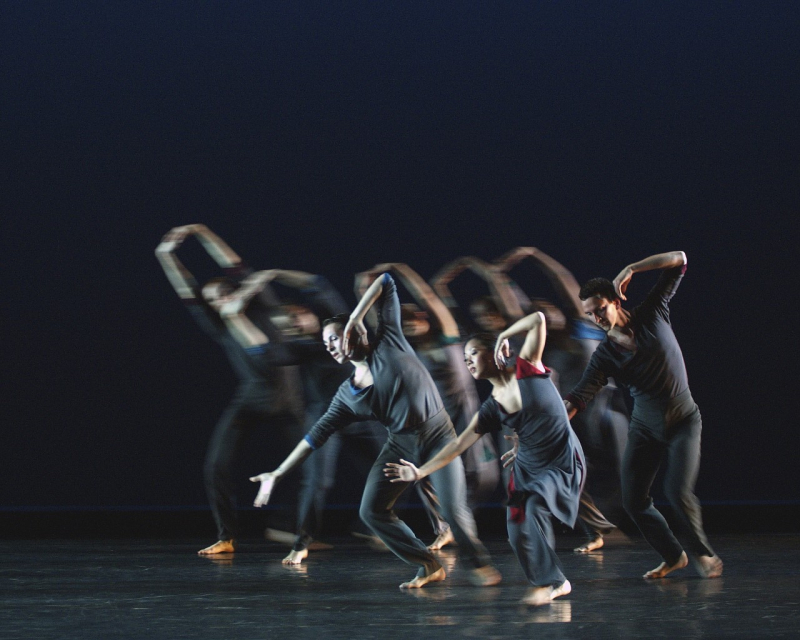
    “Man is a social animal…” as the Spinoza quote tells us. And what a delightful bunch of humans danced for us this afternoon: Jessica Ferretti, Gabrielle Barnes, Emmy Wildermuth, Elizabeth Chapo, Kristin Draucker, Lisa Borres Casey, Jada Pearman, and Payton Primer swept about the stage in their swirling gowns, leapt swiftly along diagonals, and found new ways of walking (and cart-wheeling) that gave their moves added vibrancy. Their mirrored head-gear cast shards of light into the Hall.  

    The male quartet – a Taylor classic if ever there was one – was dazzlingly done by Devon Louis, John Harnage, Austin Kelly, and Mr. Lesniak. It seemed to me that, in the course of this number – which ends with a stunningly-lit statue-pose – and indeed on into the ballet’s finale, the dancers were subtly messaging their affection and admiration to their retiring colleague as they passed him in the course of their dancing.

    The matinee ended with a rousing ovation from the packed house; cries of “Shawnie! Shawnie!” rang out, and Mr. Lesniak then took a solo bow, to wild applause. Flowers were pelted onto the stage as his colleagues surrounded him in a massive love-in. Bravo!! Bravissimo!!!  

    ~ Oberon

  • BalletX @ The Joyce ~ 2024

    20240925_BalletX-Heroes_ChristopherDuggan_853

    Above: Savannah Green in Takehiro Ueyama’s HEROES; photo by Christopher Duggan for BalletX

    ~  Author: Oberon

    Wednesday September 25th, 2024 – Philadelphia’s BalletX at The Joyce tonight, offering three New York premieres: Takehiro Ueyama’s HEROES, Jodie Gates’ BEAUTIFUL ONCE, and Loughlan Prior’s MACARONI. Over the years, this Company has commissioned nearly 130 world premieres.

    The three works presented tonight were well-contrasted, and I must immediately praise the Lighting Designer, Michael Korsch, whose work was nothing less than sensational; this gave a special glow to the evening. Of the beautiful and highly accomplished BalletX dancers, two were known to me: Savannah Green (who danced in the closing work) and Jerard Palazo, who danced in the ballets by Loughlan Prior and Takehiro Ueyama, and who generated considerable star-power.

    20240925_BalletX-BeautifulOnce_ChristopherDuggan_191

    Above: Minori Sakita and Ashley Simpson in Jodie Gates’s BEAUTIFUL ONCE; photo by Christopher Duggan for BalletX

    The evening opened with Jodie Gates’s BEAUTIFUL ONCE, set to a score by Ryan Lott performed by Son Lux and yMusic. The slurring music of the opening moments soon transforms into rhapsodic themes as the dancers meet on the gorgeously lit stage, embracing one another with genuine affection. The choreography – danced on pointe – is full of sweeping lifts and swirling movement, all gracefully executed. A series of duets, laced with fleeting solos and passages danced as trios and quartets, keeps the eye thoroughly engaged. 

    The music becomes dense and passionate, and a sense of belonging pervades the stage. When the dancers are not dancing, they remain on the sidelines, as if supporting their colleagues. A lovely quintet for the women seems to offer a perfect ending to the piece, but then the men take over and the dancing flows on. As the ballet nears its end, individual couples step forward and embrace – not passionately, but tenderly.

    The program note refers to BEAUTIFUL ONCE as “a response to the chaotic moments in life”, and reminds us of the blessèd assurance of friendship and community.

    20240925_BalletX-Macaroni_ChristopherDuggan_422

    Above: Jonathan Montepara and company in Loughlan Prior’s MACARONI; photo by Christopher Duggan for BalletX

    I hardly ever enjoy comic ballets (Jerome Robbins’ THE CONCERT being an exception) and I can’t say that I derived much pleasure from Loughlan Prior’s MACARONI, a spoof on gay manners from the powdered wig era. The music, by Claire Cowan, served the choreographer well, laced with sounds of the harpsichord to evoke the baroque.

    The cast of eight included three women en travesti, dancing on pointe. Everyone danced superbly whilst showing expert comic timing and entering fully into the campy atmosphere. But as the work progressed, I felt rather sad: yes, we have made so much progress over the years…and yes, we must be able to laugh at ourselves. But there is still rampant homophobia and plenty of anti-gay/anti-trans violence in this country. Just a week ago, I heard three Spanish boys talking about me on the subway, using their favorite slur: pato. Will it never end?

    20240925_BalletX-Heroes_ChristopherDuggan_529

    Above: Francesca Forcella and Jerard Palazo infrom Take Ueyema’s HEROES; photo by Christopher Duggan for BalletX

    After the interval, Takehiro Ueyama’s HEROES summoned up a world of poignant beauty and mystery – a world we can always access in our imaginations but which the choreographer here transforms into reality. In his program note, Take dedicates the ballet to citizens who played a crucial role in the recovery of Japan from the devastation of World War II.

    Here, Mr. Korsch’s lighting designs (in collaboration with Christopher Ham) were extraordinarily atmospheric, and Eugenia P. Stallings’ costume designs – red garments that seemed at once ancient and ultra-contemporary – evoked the priestly rites that bind the community together.

    The piece opens with a prologue: deep rumblings are heard, and the summoning sound of chimes. From the pit, Tokoshieni – composed by percussionist Kato Hideki and performed by him and violinist Ana Milosavljevic – transports us to an illusory place and time. A red-clad couple emerge from the shadows and perform a slow, stylized duet to the sound of mysterious whispers. An eerie, brooding feeling creeps in; the man performs a slow solo and and the woman responds in kind. They don red jackets and vanish into the darkness.

    The music of John Adams – The Chairman Dances – rises as the full stage becomes illuminated. A diagonal of white chairs stage right becomes a walkway as the dancers enter. They move the chairs about, establishing a place for the evolving ritual. The chairs are lined across the stage and there is a wonderful seated passage of arm and hand gestures. A unison dance and individual walkabouts are highlighted by brief solos. 

    The music turns spacious and the dance slows, only to rebound as the dancers march about. Another unison passage leads to everyone dropping to the floor…only to rise and race about in a circle. Now the jackets come off and are collected; the dancers sit in a semi-circle, with the corpse of a woman covered with a jacket.

    A new beat develops; there is an intense duet which evolves into a trio and then a wild female solo. The lighting continues to play a powerful part in the effect of the choreography. In a visual coup, there is a striking line-up across the space, and the dancers advance towards us. They then fall into single-file and proceed to cross the bridge of chairs, sure of their destiny.

    More of Christopher Duggan’s images from HEROES:

    20240925_BalletX-Heroes_ChristopherDuggan_616

    Above: dancers Skyler Lubin and Mathis Joubert

    20240925_BalletX-Heroes_ChristopherDuggan_917

    Above: dancer Itzkan Barbosa

    ~ Oberon

  • Pilobolus @ The Joyce ~ Summer 2024

    Image-asset

    ~ Author: Oberon

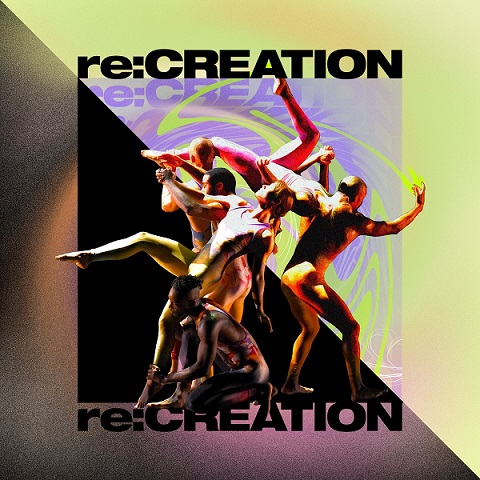
    Tuesday July 23rd, 2024 – It’s been a while since I last saw Pilobolus, and it was truly revelatory reconnecting with this unique, legendary dance company tonight at The Joyce. The season celebrates re:CREATION, a brilliant collection of works – old and new – from Pilobolus’s 50-year history which were offered on two specially-devised programs.

    Tonight’s program, entitled Dreams, featured five works; and while at times things seemed too same-y and certain passages went on too long, the cumulative force of the evening was incredibly powerful and meaningful on a personal level. Six dancers carried the entire evening, their awesome athleticism and boundless energy meshed with an innate sense of poetry and unstinting commitment to the work. 

    The program opened with Thresh|Hold, from Latinx choreographer and designer Javier De Frutos; several other names are listed in the program as collaborators. To shimmering music, the curtain rises on a closed door, which will become the epicenter of the piece. A rather haggard woman (the program tells us it’s either Marlon Feliz or Hannah Klinkman – not very helpful to someone attempting to write a review) opens the door and sits on the stoop; a male body is then thrown out onto the ground, and all hell breaks loose. The four men in the cast might be gestapo or just random trouble-makers. People chase each other about, torment the woman (or one another), whilst the door itself is the main character – spun about the stage, opened and closed at high speeds, allowing light to shine thru from varying angles. All this was handled with pinpoint timing by the dancers,

    As the piece unfolds, we hear a fractured recording of the Casta Diva from Bellini’s NORMA, merged with other noises, sometimes harsh or otherworldly. After the pitch of the aria sags and becomes incoherent, the melody resumes – now voiced by the inimitable Maria Callas, whose version has been used in numerous danceworks over the years…if you’ve never heard it, here it is.

    The dancework, nightmarish and somewhat incoherent, was engrossing to watch; the use of the door was truly clever and impressive. The woman (I believe it was Ms. Feliz) seems desperate to escape but is always thwarted, sometimes in mid-air. A men’s quartet near the end, with lifts, was oddly lyrical. The audience seemed captivated, and applauded heartily, but there were no bows.

    The New York City premiere of the duet Bloodlines followed; an epic love duet that packs a heart-rending wallop. Choreographed by the co-directors of Pilobolus, Renée Jaworski and Matt Kent, in collaboration with Ms. Feliz and Ms. Klinkman, who danced it together. The luminous ‘music-of-the-spheres’ score is attributed to five composers: Andre Heller, Michael Gordon, Elisapie Isaac, Eva Reiter, and Meredith Monk.

    Gorgeously lit by Diane Ferry Williams, Bloodlines was hypnotically danced as red rose petals fell from the sky. The two women, lovers, seem to retell the story of their love; they strike poses and move to jagged rhythms until a partnership is formed.

    To the sentimental sound of an old 78 recording for violin and piano, they become increasingly intimate, one dancer cradling the other. But something is amiss; thru age or illness, one of the women expires, leaving her beloved bereft. The two dancers brought so much beauty and poetry to this duet, making the end unbearably poignant.

    Still recovering from the emotional pull of Bloodlines, the deeply moving male quartet Gnomen sustained my intense involvement in what we were seeing and hearing. A tolling bell signals the opening of Gnomen, wherein we encounter a brotherhood of gnomes: ageless, deformed dwarves out of folklore who live in the earth.

    The four – Connor Chaparro, Quincy Ellis, Sean Langford, and Derion Loman – wear black briefs; they move hesitantly, seemingly in pain, with their bodies disfigured. They seem to be downtrodden victims of fate. Helping one another, their entwined figures struggle to walk. They appear to pray, and now the chime sounds louder: they move spastically, like contorted acrobats.

    The choreography is extremely athletic, strenuous, and demanding, and the dancers took it all in stride. Clockwork music and a dreamy harp are heard as the quartet attempt entwined tumbling. The sounds of the marimba transform to a melodious finish, with a sense of healing for the hapless creatures as the chimes sounds again. The seemingly healed gnomes kneel in prayer.

    After a longish intermission, Symbiosis – choreographed by Michael Tracy in collaboration with Renée Jaworski and Otis Cook – opens with thunder and lightning. To the music – a collage of pieces by Thomas Oboe Lee, George Crumb, Arvo Pärt, and Jack Body, played by the Kronos Quartet – dancers Marlon Fritz and Quincy Ellis, nearly nude, perform a sensuous duet. The elasticity and grace of their bodies develop an intimacy underscored by Mr. Pärt’s languid,  beguiling Spiegel im spiegel wherein the dancers tenderly see-saw in an embrace. The dancers’ athleticism takes on a poetic aspect as we surrender to the tender beauty of their entwined bodies. 

    Closing the program was Rushes, Pilobolus’s first collaboration with Israeli choreographers Inbal Pinto and Avshalom Pollak, and while it was overly-long and rather less engaging than the other works, there was an undercurrent which kept me focused.

    Circus music heralds the rise of the curtain, and we find five dancers – Mlles. Feliz and Klinkman and Mssrs. Chaparro, Ellis, and Langford – seated in wooden chairs in a circle of light. They seem to be waiting for something – a flight, perhaps? To the sound of rushing water, playful renderings of “Mary had a little lamb” and “Oh, they don’t wear pants on the sunny side of France” are fleetingly heard.

    Whimsical partnering, endless bouts of musical chairs, comic vignettes, and walkabouts come into play, but we don’t understand who these people are and what they are hanging about for. One character, played by Quincy Ellis, is an endearing elderly man with a suitcase full of dreams. In the end, the chairs are set in a row and the old man walks along them as the other dancers hastily move the seats so that his path remains endless. At the end. we again hear Arvo Pärt’s Spiegel im spiegelall of itwhich seemed to drag out the end of an otherwise engaging evening.

    ~ Oberon

  • Hubbard Street @ The Joyce

    Shota

    Above: Shota Myoshi of Hubbard Street Dance Chicago

    ~ Author: Oberon

    Wednesday March 20, 2024 – So great to see Hubbard Street Dance Chicago again! When I lived in Hartford, we’d go up to see them each Summer when they came to Jacob’s Pillow. Tonight at The Joyce, they offered a finely-devised program which was musically and stylistically varied, and superbly danced.

    Coltrane choate burnett foto michelle reid

    Above: dancers Jacqueline Burnett and Aaron Choate in Coltrane’s Favorite Things; photo by Michelle Reid

    Lar Lubovitch’s Coltrane’s Favorite Things was created in 2010 and was taken into the Hubbard Street rep in 2023. I confess that I’ve had a lifelong allergy to jazz, and while I admire John Coltrane’s inventive take on the Rogers and Hammerstein hit from The Sound of Music, I must admit that there were times when the music seemed endless. But: no worries! Mr. Lubovitch’s flowing, fleet-footed choreography filled the stage with movement, and the dancers seemed to be having a blast dancing it. 

    There may have been some cast changes from the listing in the Playbill, but one distinctive dancer stood out: Shota Myoshi (photo at the top) is a petite young man who dances large. His sheer joy at executing the technical feats of the choreography seemed to set the tone for his colleagues. Everyone danced their hearts out, winning a vociferous ovation at the end of the piece.

    On leaving the hall at the end of the show, I ran into the irrepressible JJ (aka Jonathan E Alsberry), an iconic Lubovitch dancer who is now Senior Rehearsal Director at Hubbard Street. And with him was the great man himself: Lar Lubovitch. So wonderful to see them again!

    Rena butler

    Hubbard Street’s giving the New York premiere performances of Rena Butler’s Aguas Que Van, Quieren Volver during this run; production photo above. It is a captivating work in every regard. And the first acclaim goes to lighting designer Julie E Ballard; her settings seemed to create a narrative of their own in the work, which details the shifting emotions of a ménage à trois. From some performance photos I found, it looks like this piece is sometimes danced (as tonight) by a man and two women, and other times by a woman and two men. 

    This evening, the dancers were Jacqueline Burnett, Simone Stevens, and Eliot Hammons. They were technically perfect, and emotionally powerful. Each has solos to dance – Ms. Burnett’s being particularly well-choreographed, and beautifully danced – and the partnering ranges from sexy to quirky. Ms. Stevens brought a nervous energy to her dancing, and a personal intensity, whilst the tall Mr. Hammons moved and partnered with a distinctive personal grace; he seemed to be holding the triangle together by sheer force of will and desire. The music, which often has a sexy sway, was sublime, especially the ‘title song’.

    At the end, order is restored – at least for the moment: beautiful final image of the threesome standing together. The work captivated me on a personal level, as I recalled the difficulties we faced in our own ménage à trois back in the early 1990s. Jealousy undid us.  

    Barton

    The program ended with a masterpiece: return to patience by Aszure Barton, sent to a score by Caroline Shaw that may have been inspired by Satie.  To me, this seemed to be a contemporary renewal of the tradition of ‘the white ballet’: everything is purely and wondrously white as the lights slowly come up on the entire company standing in place. Balanchine’s Serenade is cunningly given a graceful nod as the dancers in unison shift their feet into first position. Thereafter, thoughts of Swans, Wilis, Shades, and Sylphs constantiy dance thru the mind. Solos (again Ms. Burnett and Mr. Hammons stood out) are woven into passages for groups and fleeting partnering motifs. Mr. Myoshi was again entrancing.

    The group dances in sync, with lyrical arabesques and slow ‘leaning’ passages.The tempo speeds up, but only a bit, for another solo from Mr. Hammons, joined by a sextet. The movement becomes more animated, with a male quartet and a female solo observed by all in a semi-circle. There is a reverential bow, but that is not quite the end.

    Ms. Barton’s work held the audience under a spell, and then the dance seemed to recede as if we had experienced a dream that fades away. There was a moment of silence, before the audience responded with fervent applause.    

    ~ Oberon

  • Premieres @ Graham

    MGDC_Get-Up-My-Daughter_MSherwood_06

    Sunday April 23rd, 2023 – The Martha Graham Dance Company have presented two premieres during their current season at The Joyce. I saw them both on this afternoon’s program, and I found them to be engrossing (for different reasons), with fascinating musical scores, terrific lighting, and – needless to say – spectacular dancing.

    Some images have come my way, and I am posting one picture from each of the new works now, with my write-up to follow tomorrow. At the top, dancing Annie Rigney‘s GET UP, MY DAUGHTER, are Richard Villaverde and So Young An. The score, which sometimes draws on Bulgarian folk music, is by Marco Rosano.

    Below, from CORTEGE 2023, choreographed by Baye and Asa to a score by Aidan Elias, are dancers James Anthony, Anne Souder, and Richard Villaverde.

    MGDC_Cortege-2023_MSherwood_7899

    Both photos are by Melissa Sherwood, courtesy of the Martha Graham Dance Company.

  • Fouad Boussouf’s NÄSS @ The Joyce

    Nass fff

    Tuesday October 18th, 2022 – An exhilarating evening at The Joyce as choreographer Fouad Boussouf brought his handsome Company of dancers from his native Morocco to thrill us with Näss. The title is Arabic for “people”, and it’s a work where eclectic dance styles converge effortlessly, combining restless, relentless activity with a feeling of ancient masculine rituals. For an hour, the seven men danced to rhythmically wide-ranging music, with perfect timing and synchronization; though clearly carefully structured and well-rehearsed, Näss feels wonderfully and thoroughly spontaneous.

    The dancers in Näss are Sami Blond, Mathieu Bord, Maxime Cozic, Yanice Djae, Loïc Elice, Justin Gouin, and Maëlo Hernandez.

    Nass_Charlotte_Audureau4

    Above, photo by Charlotte Audureau

    The curtain rises on a totally darkened stage. Very slowly, the back panel is illuminated with the dancers ranged in a line-up, backs to the audience. Mingled with the sounds of street noise noise and garbled talking, angel voices are heard. Drumming strikes up and the men begin moving in place, stepping to the beat.

    Suddenly, they burst into movement, stomping and romping about the space. Unison moves, with gestures of supplication, are mingled with free-flowing solo passages and duets which vary in feeling from humorous to wildness. 

    Boussouf Nass_Charlotte_Audureau2

    Above photo by Charlotte Audureau

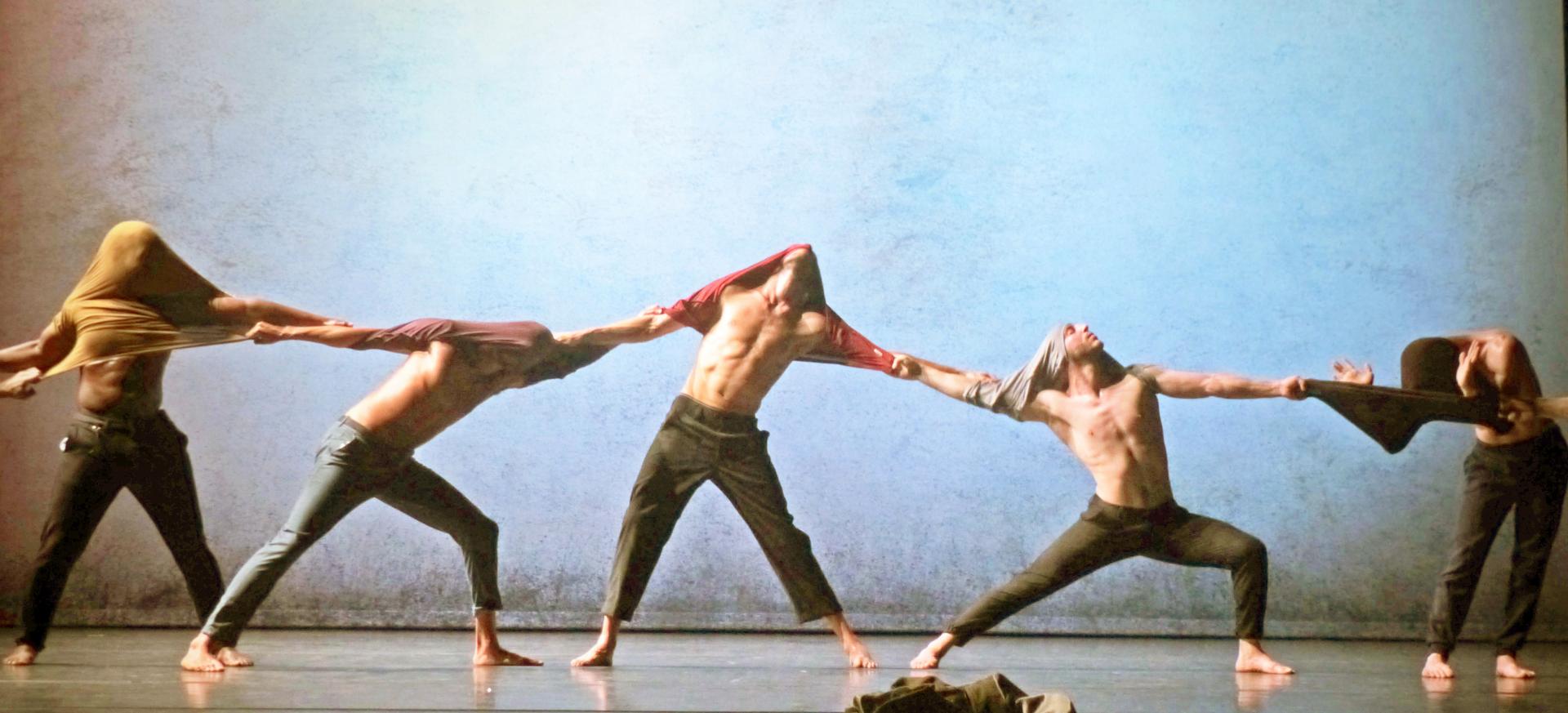
    The lighting takes on a golden hue; the men’s jackets are slowly shed and each is wearing a loose t-shirt of autumnal solour. Going into breakdance mode, they give us headstands and intricate floor motifs executed with panache. The t-shirts become part of the dance: they are pulled up to cover the men’s faces and expose their abs as the light fades a bit and a sense of calm is briefly felt. The dancers start talking.

    Then a quintet of men step-dancing in unison circle the stage in almost military precision whilst two others dance a pas de deux in their own world. The brotherhood then tramp about the space with heavy-footed accents. The lighting shifts, providing shadowplay.

    The dancers move upstage, clustered with backs to us; they become silhouettes as the music fades and the lighting is slowly extinguished until they vanish into the darkness from whence they came.   

    As silence fell there was a very brief lull before a house-wide standing ovation commenced. People screamed and shrieked as the dancers came out for their bows. Great atmosphere! Then the seven men began striking poses along the edge of the stage, and they commenced an impromptu encore, clapping their hands to set the pace. The audience picked up the rhythm, clapping and stomping. It was like being at a revival meeting where everyone has been saved. I felt high as a kite.

    Boussouf fouadcharlotteaudureau

    Photo: Charlotte Audureau

    ~ Oberon

  • Fouad Boussouf’s NÄSS @ The Joyce

    Nass fff

    Tuesday October 18th, 2022 – An exhilarating evening at The Joyce as choreographer Fouad Boussouf brought his handsome Company of dancers from his native Morocco to thrill us with Näss. The title is Arabic for “people”, and it’s a work where eclectic dance styles converge effortlessly, combining restless, relentless activity with a feeling of ancient masculine rituals. For an hour, the seven men danced to rhythmically wide-ranging music, with perfect timing and synchronization; though clearly carefully structured and well-rehearsed, Näss feels wonderfully and thoroughly spontaneous.

    The dancers in Näss are Sami Blond, Mathieu Bord, Maxime Cozic, Yanice Djae, Loïc Elice, Justin Gouin, and Maëlo Hernandez.

    Nass_Charlotte_Audureau4

    Above, photo by Charlotte Audureau

    The curtain rises on a totally darkened stage. Very slowly, the back panel is illuminated with the dancers ranged in a line-up, backs to the audience. Mingled with the sounds of street noise noise and garbled talking, angel voices are heard. Drumming strikes up and the men begin moving in place, stepping to the beat.

    Suddenly, they burst into movement, stomping and romping about the space. Unison moves, with gestures of supplication, are mingled with free-flowing solo passages and duets which vary in feeling from humorous to wildness. 

    Boussouf Nass_Charlotte_Audureau2

    Above photo by Charlotte Audureau

    The lighting takes on a golden hue; the men’s jackets are slowly shed and each is wearing a loose t-shirt of autumnal solour. Going into breakdance mode, they give us headstands and intricate floor motifs executed with panache. The t-shirts become part of the dance: they are pulled up to cover the men’s faces and expose their abs as the light fades a bit and a sense of calm is briefly felt. The dancers start talking.

    Then a quintet of men step-dancing in unison circle the stage in almost military precision whilst two others dance a pas de deux in their own world. The brotherhood then tramp about the space with heavy-footed accents. The lighting shifts, providing shadowplay.

    The dancers move upstage, clustered with backs to us; they become silhouettes as the music fades and the lighting is slowly extinguished until they vanish into the darkness from whence they came.   

    As silence fell there was a very brief lull before a house-wide standing ovation commenced. People screamed and shrieked as the dancers came out for their bows. Great atmosphere! Then the seven men began striking poses along the edge of the stage, and they commenced an impromptu encore, clapping their hands to set the pace. The audience picked up the rhythm, clapping and stomping. It was like being at a revival meeting where everyone has been saved. I felt high as a kite.

    Boussouf fouadcharlotteaudureau

    Photo: Charlotte Audureau

    ~ Oberon

  • L-E-V @ The Joyce

    L-e-v

    Tuesday February 22nd, 2022 – The Brutal Journey of the Heart, the final installment of a trilogy on love by choreographer Sharon Eyal, opened this evening at The Joyce, performed by L-E-V. With a score by Ori Lichtik, costumes by Dior creative director Maria Grazia Chiuri, and superb lighting by Alon Cohen, this dancework  explores the ways we heal from wounds of the heart. As an oft-wounded romantic living in an unromantic world, I have had much experience with these healing processes. And – I am  sorry to have to admit – I have also thoughtlessly inflicted such wounds on people who deserved better. And so, I expected The Brutal Journey of the Heart to speak to me with poignant clarity; what it ended up doing was make me want to go out dancing.

    At curtain rise, a solitary woman on the dramatically lit stage begins to move to a fascinating beat. She is soon joined by her five colleagues who show off witty ways of walking, and pausing to pose. The movement is inventive and everything feels wonderfully fresh and vivid. As one alluring song melds into another, the urge to dance is increasingly difficult to suppress. After about fifteen minutes, though, one begins to wonder what comes next: a change of lighting? Maybe a pas de deux, something slow and heart-achy?

    But, no: the dancers simply draw into a cluster, swaying and writhing in place while their arms and hands weave stylized gestures. Then they spread out again and repeat passages from earlier in the piece. Meanwhile, the music is pretty much relentless, and a feeling of ‘too much of a good thing’ starts to creep in. A male duet and a female solo are briefly eye-catching, but the ensemble keeps giving us recycled moves; it begins to feel like we’re in the purgatory of lost love.

    Maybe this is the brutal thing about the journey of the heart: it never really ends, and there’s no redemption to be found. The dancers continue on to a false ending, and though it seems that the woman who opened the performance alone onstage has now found some kind of peace, we don’t really know how, beyond the notion that dance is wonderfully therapeutic, especially to this music.

    Despite a sense of aimlessness at times, the evening was very much worthwhile for the excellence of the dancing, the atmospheric lighting, and most of all for the score.

    The dancers – Clyde Emmanuel Archer, Keren Lurie Pardes, Darren Devaney, Guido Dutilh, Dana Pajarillaga, and Edit Domoszlai – were hailed at the end with a whooping standing ovation, which they truly deserved.

    ~ Oberon

  • Compagnie Hervé KOUBI @ The Joyce ~ 2020

    F751b7faaa4d48cf814701ab186c45bf

    Above: Compagnie Hervé KOUBI, photo by Frédérique Calloch

    ~ Author: Oberon

    Thursday February 20th, 2020 – Celebrating their 20th anniversary season, Compagnie Hervé KOUBI returned to The Joyce with Les nuits barbares ou les premiers matins du monde. I loved this Company when they appeared at The Joyce in 2018, and when I saw that they were returning to Gotham, I knew I’d want to be there.

    Performed by an all-male cast of dancers from the countries along the shores of the of the Mediterranean – from Algeria, Morocco, France, Burkina Faso, Italy, Israel, and Palestine – the work explores the human desire for belonging: an idea that harks back to ancient times, before the birth of nations.

    B66a9f62ccd24199abcd0119aec4dba6

    Above: photo by Frédéric de Faverney

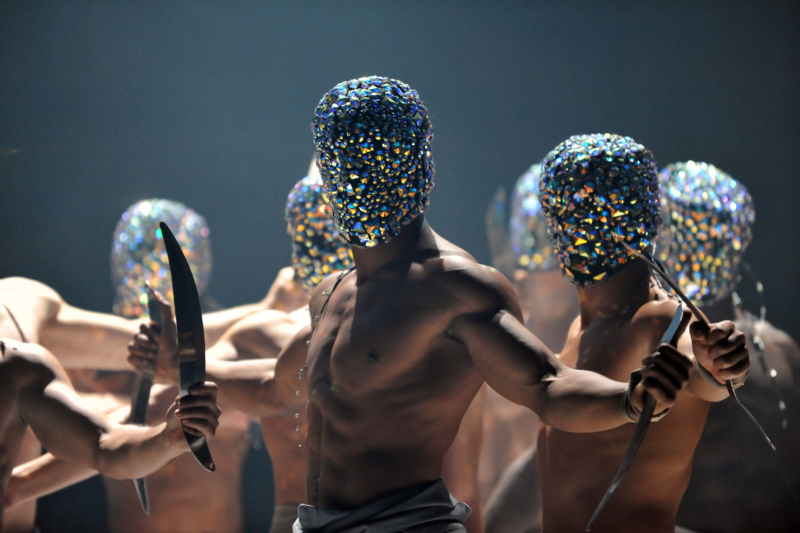
    The visually engrossing production features evocative lighting by Lionel Buzonie, and costumes by Guillaume Gabriel that include mask-like headgear adorned with Swarovski crystals which catch the light, adding to the mystique of the ballet’s darkish opening passages. The dancers appear first in long skirts, which are later shed in favor of fitted trousers. To say that these men are incredibly sexy is an understatement: they are also fearlessly committed to the work, and to the brotherhood.

    To sounds of primeval winds and waves, the dancers emerge from the shadows. They huddle together, earthbound, as the opening music of Wagner’s DAS RHEINGOLD speaks to us of beginnings. The community is restless, wary. They awaken in a brief passage of unison gestures.

    Knives are drawn, and an alarm sounds…but fades to mere tinkling sounds. There is a bathing ritual to the sounds of an antique flute, then the men take their places in a striking lineup across the rim of the stage, superbly lit.

    A tapping sound develops into vibrant drumming as the men compete in fantastic feats of tumbling, flipping, spinning on their hands or on their heads. The helmet-masks come off, the drumming gets wild. Then deep tones emerge from the sonic glow, alive with the exotic sound of finger cymbals.

    A respite, and then a whirring sound spins into a song – are the men actually singing? I was to far away to tell. Now the tribe begin tossing one another into the air; they soar with electifying bravura before being caught by their comrades. After circling in backbends, they cut loose to do more leaping and flipping: mind-boggling athleticism. The music turns metallic as the dancers again engage in uncanny break-dancing spins. Then they slowly disperse to music from the Mozart REQUIEM, only to return, engaging in ever more daring spinning and tossing.

    86734724_10218458400185321_4811273668363550720_n

    Suddenly one man is targeted and threatened with knives. Stripped of his skirt, and inverted, he performs a spectacular solo, spinning on his head as knife blades fan out from his whirling torso. The men – some on their knees like supplicants – return with metal poles; to the sound of distant voices, the poles become canes of props. Later they are tossed from man to man with amazing accuracy, and still later held aloft in cruciform.

    Now there evolves a big-beat, swirling tribal dance; the skirts have all been sheds. After more athletic feats and some spear-tossing, there is an intense run-about. To the sound of the deep chanting of Et lux perpetua, the men again line up along the edge of the stage: they seem to silently be bidding us farewell. Then they back into the shadows and begin to slowly exit – pairs or alone – heading into the unknown. As the last man vanishes from sight, one sensed the welling up of a great emotional force in the house. The audience, who have beheld this great human spectacle in awed silence, are ready to unleash a tremendous wave of applause.

    But…no: the men now return and, in a rather prolonged coda, continue to perform many of the same moves and feats we’ve already seen. As this coda brings nothing fresh to the piece, either choreographically or musically, it seemed expendable.

    At last, the packed house got their chance to hail Mssr. Koubi and his courageous dancers with waves of fervent applause and cheers.

    Efeeb7ea1079465dbd24d15aa611cea0

    Above: photo by Pierangela Flisi

    ~ Oberon

  • Limón Dance Company @ The Joyce

    Jose_limon

    Above: José Limón

    ~ Author: Oberon

    Wednesday May 29th, 2019 – The Limón Dance Company‘s program at The Joyce this evening brought us José Limón’s classic masterwork The Moor’s Pavane and his fascinating ensemble piece Psalm, along with Colin Connor’s The Weather in the Room, danced by guest artists Stephen Pier and Miki Orihara, and Radical Beasts in the Forest of Possibilities from choreographer Francesca Harper, in collaboration with composer/performer Nona Hendryx.

    Thumbnail_limonEt2DYiXo

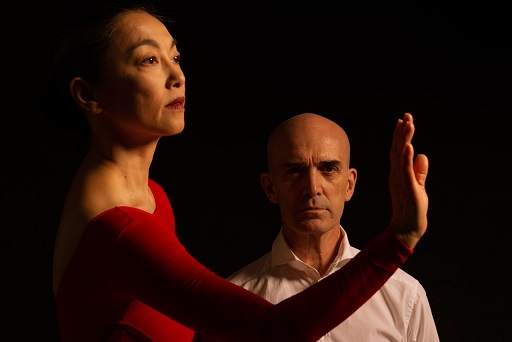
    How wonderful to see dance icons Miki Orihara and Stephen Pier (above) onstage together tonight; the husband-and-wife duo gave a vivid, touching performance in the New York premiere of Colin Connor’s The Weather In The Room, an intimate narrative work which tells us of a long-lasting domestic relationship and shows us what it takes to keep it alive thru the years.

    A couple return home from a formal party; a chair, a stool, and a rug comprise the setting. Shoes come off, and his jacket; they get comfy as what sounds like a scratchy old ’78 record begins to play. Sarah Shugarman’s score is so evocative, and soon memories are in play. Miki’s gestural language is poetry made visible, whilst Stephen looms over his petite soulmate, alternately solicitous and slightly impatient.

    As their danced conversation unfolds, six dancers in white appear, moving restlessly in the background, and running about. A chime sounds, and to a pulsing motif, an argument between the husband and wife springs up. Eventually they withdraw to opposing corners and the space becomes a small theatre where, in a series of duets, the six dancers present dances of memory: chapters from the biography of a marriage. Impetuous youthful gladness, tender moments, and passing anxiousness are depicted to expressive music.

    Thumbnail_limon2019frances  samson&terrencediableinweatherphotobychristopherjones

    Above: Terrence D.M. Diable and Frances Samson in The Weather in the Room; photo by Christopher Jones.

    Gradually, Miki and Stephen have moved closer to one another from their distant corners, and in the end, they are reconciled. But…it’s not quite the end. For the piece has a happy-music coda; the setting reverts to the quiet living room. As the music fades, Miki laughs softly. 

    There are times in an enduring relationship when you will question whether you are in the right place with the right person; it’s happened to me from time to time in recent years. At such moments, drawing from the well of memory reminds us of what we loved about our mate at the start, and makes us ask: what would life be like without him?  Mr. Connor’s thoughtful, sobering dancework resonates with meaning for me and – I am sure – for many who will watch this work. The depth of Miki and Stephen’s performance was so gratifying to experience, and the ensemble of dancers – Terence D.M. Diable, Mariah Gravelin, Gregory Hamilton, Eric Parra, Frances Samson, and Lauren Twomley – sustained the atmosphere with their articulate, committed dancing.

    José Limón’s best-known work, The Moor’s Pavane, is always as meaningful to hear as to see; the choreographer’s choice of Henry Purcell’s music underscores what I have long believed: this music is made to be danced to. Drawing on Shakespeare’s story of The Moor whose love for his faithful wife Desdemona is destroyed thru jealousy sparked by innuendo, the choreographer creates a ballet at once elegant and brutal. This evening it was splendidly danced by Mark Willis (The Moor), Savannah Spratt (His Wife), Jess Obremski (His Friend), and Jacqueline Bulnés (The Friend’s Wife), their dancing alive with nuance and musicality. 

    Over tiime, I have seen many danceworks similar to Francesca Harper’s Radical Beasts in the Forest of Possibilities wherein the dancers dwell in a desolate landscape, with drifting fog. Nora Hendryx has created a collage of electronic sounds ranging from static to sonic pulsars. Among the eight dancers, who move with vivid athleticism in choreography that has an improvisational quality, there seem to be alternating currents of connection or isolation.

    Jacqueline Bulnés (who emerges first from the darkness, as if lighting the way), Terrence Diable, Mariah Gravelin, David Glista, Jesse Obremski, Frances Samson, Lauren Twomley, and Mark Willis all showed the strength and suppleness of their dancing. The work might have ended on a rather desolate note, but then Ms. Hendryx turned from her laptop to the piano keyboard and began to play a lyrical theme. Dancers Lauren Twomley and Jesse Obremski joined in a duet that brought a sense of humanity to the proceedings; both dancers are beautiful movers. The piece ends on a question mark, as Ms. Bulnés returns with her flashlight as if seeking the couple out. Have they done something wrong? 

    Thumbnail_limonPsalmphoto_by_Douglas_Cody

    Above: from Psalm; photo by Douglas Cody

    The evening ended with a re-staging of José Limón’s 1967 ritualistic work, Psalm. Carla Maxwell had commissioned a new score for this large-scale dramatic work from composer Jon Magnussen in 2002. I had the opportunity of watching a studio rehearsal of Psalm a week prior to the Joyce performances, and was thrilled and moved by it.

    Without the program note explaining the traditional Jewish belief that all the sorrows of the world rest in thirty-six Just Men, we might have thought of the ballet’s protagonist as an Outcast, a Penitent, or a Christ Figure. In this role, dancer David Glista gave a striking performance, abounding in physical energy and passion, living out the torment of the character with unswerving commitment. Two women, Savannah Spratt and Frances Samson, had prominent roles, and the entire Company filled the space with leaps, turns, and ecstatic gestures as the music ranged from harp and chant to pounding drums, solos for male voice, syncopated Alleluias, and summoning tambourines. Throughout the work, thoughts of Martha Graham’s epic ceremonials continually came to mind.

    Psalm is perhaps a bit over-long, and parts of it are repetitive. But it is as impressive to behold as to hear, and it provides a portal to an ancient world where such rites were an essential element in the life of the community.

    ~ Oberon