Tag: The Joyce

  • ABT Studio Company @ The Joyce

    57605248_10157352309708319_238433348500848640_n

    ~ Author: Oberon

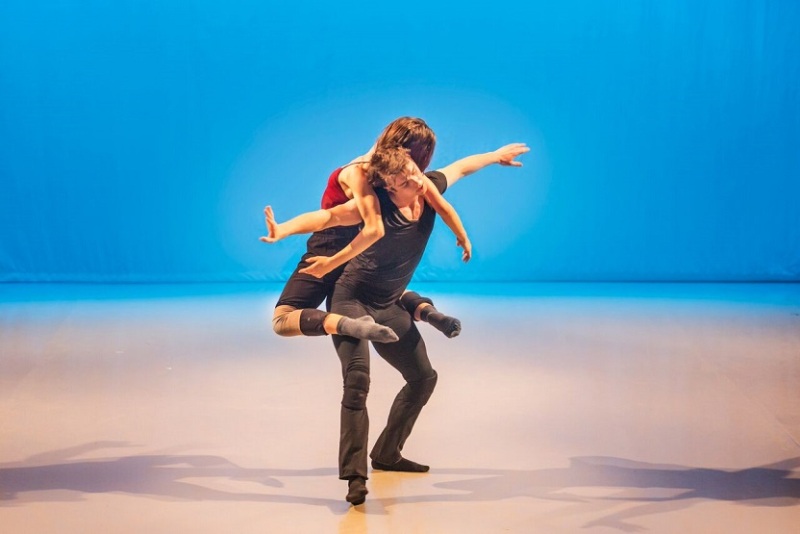
    Thursday April 25th, 2019 – The American Ballet Theatre Studio Company has three evenings at The Joyce this week; I went on the second night for a program in which a pair of well-beloved pas de deux book-ended four new (or very recent) works.

    Tarantella, George Balanchine’s Neapolitan duet set to music by Louis Moreau Gottschalk, opened the evening. When the dancers made their entrance, my first thought was that they were too tall for this ballet. They executed all the steps and went thru the motions well enough, but their dancing didn’t sparkle, and the feeling of imminent sex was missing. Perhaps it’s been toned down for the MeToo crowd.

    Neon by Claudia Schreier, having its New York premiere, is set to music by Marc Mellits. The dancers, wearing black belted in teal, look sleek and dashing. At curtain rise, two men stand in a pool of light, one behind the other, their arms in sweeping arcs seeming to depict the hands of a clock. Then the dance erupts to the propulsive Mellits music. The sometimes complex partnering motifs Ms. Schreier demands of her dancers are smoothly executed; this is a choreographer who likes to set challenges for her dancers, then rehearse them astutely so they end up looking well-polished.

    Neon’s first movement ends with all eight dancers in a circle, taking up the rotating arm gestures of the work’s opening moments. A series of departures clears the stage for a men’s trio in which the women eventually join. Sub-groups come and go, enhanced by excellent lighting. The ballet’s third section opens with a striking overheard lift, the couple commencing a luminous pas de deux, wherein Ms. Schreier’s choice of music pays off handsomely. The concluding movement, alive with musical agitation, displays the choreographer’s trademark surety of structure into which a sense of contemporary poetry has been woven.

    As with every Schreier work I have seen to date, Neon ended with the audience whooping up a storm. The choreographers should have been given a bow after their respective ballets tonight, so we could properly show our appreciation.

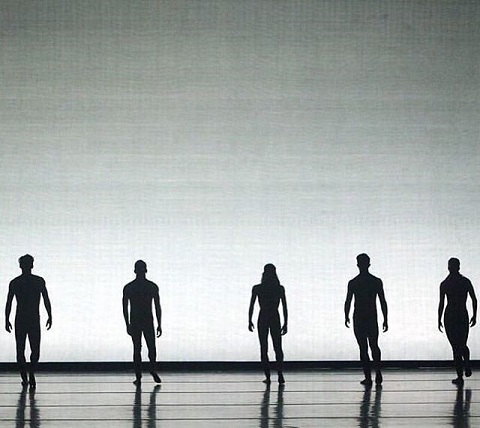
    Overture by Ethan Stiefel is a ballet that mixes – in perfect measure – gorgeousness with wit. In choosing Beethoven’s Egmont overture, Mr. Stiefel is already halfway down the road to success. And a success it was, in every respect: from the stunning opening tableau with the dancers classically arranged in silhouette, Overture is a pleasure to watch…and to hear. 

    The dancers are prettily costumed in traditional ballet style, but soon we notice contemporary touches – each man has one bare arm. The dancing also mixes old with new: a Romantic atmosphere has been established, and the choreography abounds in classic vocabulary and time-honored partnering themes; but modern modes crop up – a shoulder-shrugging motif and some quirky port de bras keep the ballet vivid. The dancers excelled here, taking their cues from the Beethoven score and bringing touches of tongue-in-cheek charm to their dancing. Overture is a winner on all counts.

    Returning to my seat after the intermission, I found the curtain already up. Soon a lone dancer ambled onto the stage and began chatting us up. The performance of Pliant by Stefanie Batten Bland, he told us, had already started…and we were to be part of it. Dancers moved up and down the aisles, supposedly ‘interviewing’ audience members. Since they did not have hand mikes, the rest of us were not privy to these conversations, so we sat there twiddling our thumbs. 

    Finally the dancers hauled themselves up onto the stage and, to nondescript music, they struck poses and did a bit of dancing (nothing strenuous). While this was going on, I was thinking that I could have been home doing my ironing, whilst one of my fellow writers seated nearby fell deeply asleep. Pliant is exactly the kind of clever, now-for-something-different “ballet” that has dampened my enthusiasm for dance in recent years. 

    Gemma Bond’s Interchangeable Text was a perfect restorative. Some people think Philip Glass has been done to death in the dance world; I disagree, and I’m glad Gemma shares my feeling that it’s ideal music for dancing. Her ballet, impeccably danced by four couples, had the benefit of atmospheric lighting.

    Interchangeable Text opens with a male dancer alone in a pool of light; the music comes from the “romantic” Glass catalog. Soon it begins to pulse, and the dance takes off. Ms. Bond shows off her gift for making classic ballet combinations look fresh. Through ever-shifting patterns, the eight dancers are fully-engaged, the music being their springboard. A chain of pas de deux commences, each couple in turn having their chance to shine. The ballet ends as it began, with the man isolated in the glowing circle.

    The Don QuixoteWedding Suite’ brought the evening to an end; danced with fine technique, lively spirit, and a dash of allure à lEspagnole by Chloe Misseldine and Joseph Markey, this gave the hardcore classical ballet fans in the audience something to cheer about. The two ‘bridesmaid’ solos were woven in, and though they were not named in this evening’s cast list, I believe the dancers were Leah Baylin and Kanon Kimura, who were dancing these solos on the other two nights.

    The ABT Studio Company has always been a place to spot stars of the future: it’s where I first saw David Hallberg dancing! Tonight, one dancer who often caught my eye was Melvin Lawovi, a native of Toulouse. It did not surprise me to read that Mr. Lawovi is the recipient of The David Hallberg Scholarship.

    ~ Oberon

  • Tero Saarinen Company @ The Joyce

    TeroSaarinenCompany1

    Above: from Tero Saarinen’s Morphed; photo by Günther Gröger

    ~ Author: Oberon

    Friday October 20th, 2017 – Tero Saarinen Company, one of Europe’s premiere contemporary dance companies, presenting Morphed, an all-male work, at The Joyce.

    With a running time of just over one hour, Morphed is performed by seven dancers of varying ages and physiques on a truly fascinating set designed by Bessie-award winner Mikki Kunttu, who also supervised the excellent lighting. Finnish fashion designer Teemu Muurimäki’s black & white costumes ideally completed the visual setting. While the eye was constantly intrigued, the ear could revel in music drawn from three works by Finnish composer Esa-Pekka Salonen. Blending all these elements into a cohesive whole made for one of the most satisfying evenings of dance I’ve encountered in the past two decades.

    The sound of the French horn (my instrument!) commenced even as the lights went down immediately seizing the imagination, conjuring visions of both the dawn and of the hunt. This gorgeous music is Salonen’s Concert étude for solo horn (composed 2000). In a space surrounded on three sides by hanging ropes, the seven dancers – all in black hoods – simply walk and walk; sometimes their walking seems casual and free, at other times more regimented. The scene brightens and the dancers appear in silhouette.

    The hoods come off, and new music takes over – from Salonen’s Foreign Bodies (2001) – which has a kozmic energy.  The hanging ropes become part of the choreography as the men walk among them, gathering them, grasping them for support, sending them flying. Solo and duet passages unfold, observed (or ignored) by the men who are not dancing at the moment. One especially powerful pas de deux climaxes with one man dragging the other about by the shirt on his back.  

    Suddenly the music goes haywire and things get wild; the dancers rush about until calm is restored and the music becomes slow and other-worldly. Then, linking arms, the men begin to swirl like a turning wheel. The hanging ropes are activated, creating a mass effect of contrasted motions in the space: really impressive!

    Silence falls, and the agitato of Salonen’s violin concerto accompanies a lighting shift to blue. A solo is danced, which morphs into a trio. Bits of clothing start to come off. Then golden light settles in, and a stylized duet, with motifs reminiscent of Nijinsky’s Faune, is yet another compelling passage. The dancers, some of them now shirtless, continue to move, to strike poses, or to repose upon the floor as the curtain falls.

    I think the highest praise I can give to Saarinen’s Morphed is that, when it ended, I was ready to sit thru it again.

    ~ Oberon

  • Prelude: Claudia Schreier & Co

    6Q5A0113

    Claudia Schreier & Co will be at The Joyce on July 21st and 22nd, 2017, as part of the theatre’s two-week ballet festival. The performances are sold out.

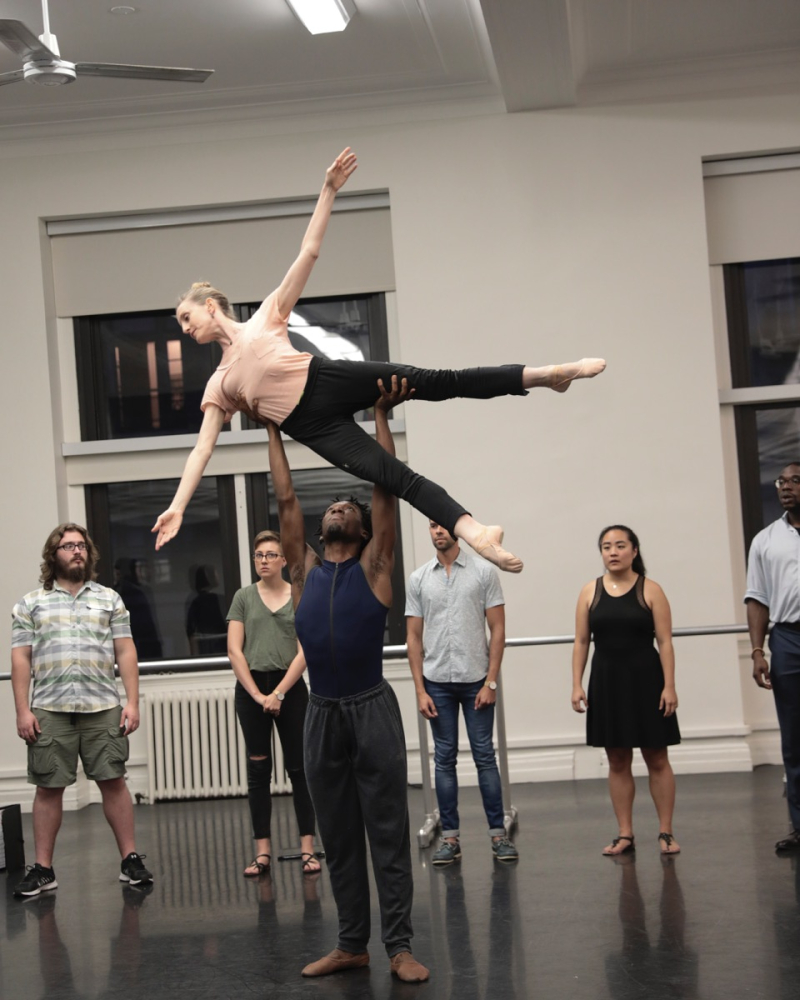
    On Wednesday evening, July 19th, photographer Travis Magee and I stopped in at the Barnard College studios where rehearsals have been taking place. The dancers were running thru CHARGE, Claudia’s large-scale ballet set to a vibrant score by the Dutch composer Douwe Eisenga. For this ensemble work, Claudia has gathered together an outstanding group of dancers; although it’s an ad hoc ensemble, they’ve already developed the feeling of a Company.

    Here are more of Travis’s images from CHARGE:

    6Q5A0203

    Elinor Hitt and Craig Wasserman

    6Q5A0319

    Elizabeth Claire Walker

    6Q5A0396

    Claudia & Company

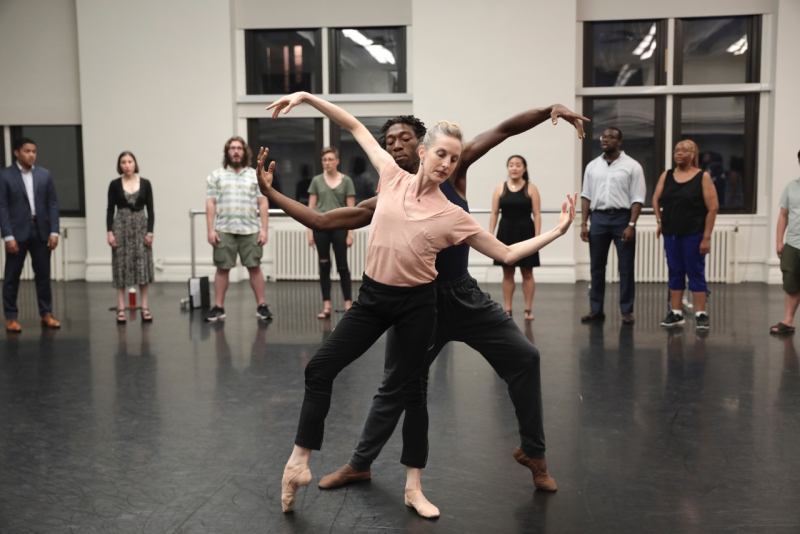
    While the dancers caught their breath after two runs of CHARGE, members of the choral group Tapestry filed into the studio and arranged themselves in a semi-circle to sing the music of Tomás Luis de Victoria and Sergei Rachmaninoff which comprise the setting of Claudia’s breathtaking pas de deux, VIGIL.

    6Q5A0482

    VIGIL is danced by guest artist Wendy Whelan and Dance Theater of Harlem’s Da’Von Doane. Working together for the first time, Wendy and Da’Von have formed a partnership based on resonant technique and spiritual affinity. Their dancing is borne up by the heartfelt, resplendent harmonies of Tapestry, making this is a dance experience sans pareil.

    More of Travis Magee’s photos from VIGIL

    6Q5A0506

    6Q5A0523

    6Q5A0558

    The Joyce performances by Claudia Schreier & Co will further feature ballets set to music of Leonard Bernstein, Marc Mellits, Dmitri Shostakovich, Alfred Schnittke, and Ellen Taafe Zwilich. Unity Phelan, Jared Angle, and Cameron Dieck – all from New York City Ballet – will appear in prominent roles.

    All photos by Travis Magee.

  • Sidi Larbi Cherkaoui @ Martha Graham Dance Co

    Unspecified4y

    Above: members of The Martha Graham Dance Company at a studio showing of MOSAIC, a new work being created for the Company by choreographer Sidi Larbi Cherkaoui; photo by Brigid Pierce. MOSAIC will premiere during the upcoming Graham season at The Joyce, which opens on February 14th. Details and tickets here.
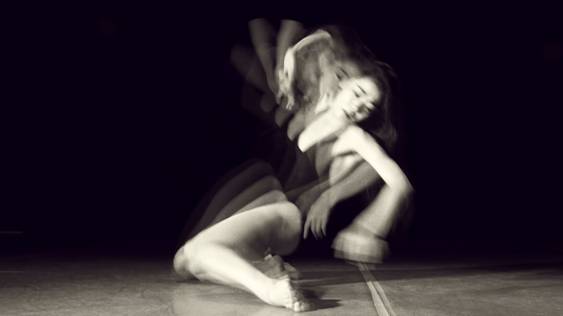
    On January 11th, 2017, friends of Graham gathered at the Company’s homespace at Westbeth on Bethune Street for a first look at the new Cherkaoui piece. This is my fourth time experiencing this choreographer’s work: in 2009, Cedar Lake Contemporary Ballet premiered Larbi’s ORBO NOVO; in 2010, his SUTRA was performed as part of the White Lights Festival; and this past Summer, HARBOR ME was performed at the Joyce by LA Dance Project. 

    MOSAIC is danced to a score by Felix Buxton; the choreography has a sultry, swaying, Middle Eastern  feel. Without giving away more than that, I will only say the Graham dancers look sexy as ever in this provocative style. It was really great seeing Jason Kittelberger, an iconic dancer with the late, lamented Cedar Lake Company; Jason is Larbi’s choreographic assistant for MOSAIC and he introduced the work this evening.

    Here are a some images from the showing of MOSAIC; the photographer is Brigid Pierce:

    Unspecified4

    Anne Souder

    Unspecified3

    Leslie Andrea Williams, Lorenzo Pagano, Anne Souder, Lloyd Mayor

    Unspecified4d

    Lorenzo Pagano

    Unspecified5

    Anne Souder, Lloyd Mayor

    Unspecified6

    Anne Souder, Lloyd Mayor

    In addition to MOSAIC, the repertoire for the upcoming Graham season at The Joyce features a premiere by Annie-B Parsons, recent works by Nacho Duato and Pontus Lidberg, a revival of Martha Graham’s PRIMITIVE MYSTERIES, as well as Graham classics MAPLE LEAF RAG, DARK MEADOW SUITE, DIVERSION OF ANGELS, and CLYTEMNESTRA Act II.

    I’m hoping to get to a studio rehearsal before the season at The Joyce begins.

  • RIOULT @ The Joyce ~ June 2016

    Nyseason_885x518

    Wednesday June 22nd, 2016 – RIOULT at The Joyce, offering a very pleasing evening of dance from Pascal Rioult’s excellent troupe, with exceptional dancing from both established Company members and relative newcomers. The program was well-varied musically, and the evening was enhanced throughout by fine lighting and canny use of visual effects.

    Tchaikovsky’s Orchestral Suite #2 in C-major is the setting for Dream Suite which opened the program; this coloristic ballet – with gorgeously distinctive lighting by Jim French – is a visual treat. The inimitable Charis Haines is the Dreamer, and her dreams veer from lyrical to witty to mystical.

    Against a backdrop which shifts from pumpkin-coloured to vivid red, ten dancers move thru Charis’s dreamworld in quirky combinations, sometimes stopping to strike amusingly ironic poses. Masked characters appear: a bull, and ancient reptilian birds. Undercurrents of sexual fantasy are woven in and, as is often the case in dreams, things seem disjointed at times.

    The choreography overall is disarmingly simple – when the dancers simply form a circle, the effect is stunning – and Charis Haines excels in her solo passages. Colour – radiant and saturated – is everything. The striking image of a woman stretched out in a flat plank and borne aloft by her partner across the upstage space seems to signal a magical end to the ballet, but there’s another movement to come; that image, though, remains fixed in the memory.

    Selected Preludes and Fugues from Bach’s Well-Tempered Clavier (seemingly the Glenn Gould recordings, as there is much extraneous vocalism along the way) are the basis of Polymorphous, a stylized dancework which opened before a gridwork backdrop against neutral colours, with costumes of the same visual texture. Four dancers – Brian Flynn, Charis Haines, Jere Hunt, and Sara Elizabeth Seger – move in sync, almost like automatons. In two duets that follow, the first is accompanied by a ghostly negative-image film of the dancers projected above while during the second, multiple shadow images appear as echoes of the choreography.

    Duets, Sacred and Profane opened the evening’s second half; here we meet pairs of the RIOULT dancers in more personalized settings. In the first duet, from Kansas City Orfeo (1996), Sabatino A Verlezza as Orfeo attempts to revive his dead wife, Euridice (Catherine Cooch), to the appropriate music from the Gluck opera; this put me very much in mind of David Grenke’s powerful duet, Vespers.

    One of the Company’s newest members, Corinna Nicholson, made a really lovely impression dancing a duet from The Great Mass (2009) with Sara Elizabeth Seger. The girls wear gossamer ‘Baroque’ dresses, and they bring an air of courtliness to this charming piece.

    Two of RIOULT‘s most vivid dancers, Jere Hunt and Michael Spencer Phillips, were magnificent in a pas de deux from Te Deum (1995). To the music of Arvo Pärt, Michael – in a dark suit and white shirt – partners Jere, clad in black briefs, in an intimate duet. Though devoid of erotic overtones, the dance is both sensual and spiritual. Various imagined scenarios might be applied – two lovers, two brothers, a father and son, a guardian angel and his charge. Jere Hunt’s muscular physique speaks powerfully in its own right; a vein of poetic vulnerability which runs thru his work as a dancer gives his performances a deeply personal resonance. Michael’s handsomeness and the strength of his movement are captivating to behold: this is a dancer who can express both courage and tenderness. Together, the two men thrilled the audience.

    Something special needed to follow this male duet, and we found it the charismatic pairing of Charis Haines and Holt Walborn in a sublime Bach duet from Views of the Fleeting World (2008). Their expressiveness and their sense of the mutual devotion of this couple created a beautiful atmosphere.

    For a remarkable finale, Pascal Rioult’s unique setting of Ravel’s Bolero sparked an eruption of cheers from the mesmerized crowd at its end. Against a backdrop by Harry Feiner – a fanciful rendering of architecture à lespagnole – eight dancers perform endless repetitions of gestural motifs while periodically moving from one formation to another. Woven into these geometric configurations are illuminated solos which are luxuriantly slow and sometimes self-caressive. The dancers – Mlles. Cooch, Haines, Nicholson, and Seger with Mssrs. Flynn, Hunt, Phillips, and Verlezza – went thru their hypnotic paces with machine-like precision, whilst basking in the more voluptuous solo moments. Brilliant!

  • New Works By Parsons and Skarpetowska

    10666241_1219331334748018_437366971_n

    Wednesday January 20th, 2016 – The opening night of the Parsons Dance 2016 season at The Joyce. New works by David Parsons and Katarzyna Skarpetowska were on offer, as well as Robert Battle’s TRAIN, a revival of David Parsons’ UNION, and two of David’s signature classics: NASCIMENTO and CAUGHT.

    It was a grand night for dancing; each of the six works presented offered ample opportunity for the vibrant Parsons Dancers to dazzle us with their strength, passion, and fearlessness. If it’s true that there’s no rest for the wicked, then these dancers must be very naughty indeed. They danced full-out, with nary a hint of pacing themselves, all evening. The vociferous screams (yes, screams) of delight from the packed house at the end of each piece said it all.

    David Parsons and I go way back, to his dancing days with Paul Taylor’s company and his earliest explorings of the choreographic terrain at Jacob’s Pillow. Read a bit about this history here.

    ParsonsDanceSarahBravermanElenadAmarioEoghanDillonOmarRomandeJesusandGeenaPacare-1

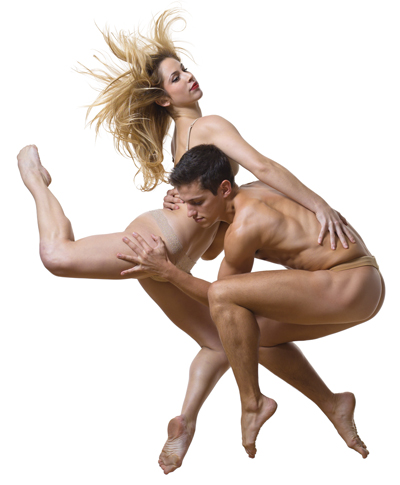
    Above: dancers of Parsons Dance in a © Lois Greenfield photo. (Check out Ms. Greenfield’s latest book, Moving Still, here). These six dancers – Ian Spring, Omar Roman de Jesus, Geena Pacareu (back row), Sarah Braverman, Eoghan Dillon, and Elena D’Amario (foreground trio) comprised the cast of tonight’s opening work: David’s newest creation, FINDING CENTER. Having its New York premiere this evening, the piece is inspired by a series of paintings created in the 1980s by artist Rita Blitt.

    FINDING CENTER is danced to a laid-back score by Thomas Newman. Throughout the work, Ms. Blitt’s oval-shaped images – in vivid, ever-changing colours – are projected behind the dancers. Howell Binkley, David Parsons’ long-time lighting collaborator, again proved his essential value to the on-going success of the Parsons repertory: his lighting is always perfect. 

    Among the many arresting choreographic elements in this new work are unusual lifts of the women in seated positions. An adagio for Elena D’Amario and Ian Spring finds Mr. Parsons’ gift for inventive partnering at full-flourish: not only are there some gorgeous lifts, but twice Ian suspends Elena in a floating plank position, her body parallel to the floor and only inches away from it. Mlles. Braverman and Pacareu, squired by Eoghan Dillon and Omar Roman de Jesus, turned what might otherwise be considered ensemble roles into beautifully expressive moments.

    Photographer Travis Magee and I watched a rehearsal of David Parsons’ UNION a couple of weeks ago. This dancework premiered at the New York State Theatre in 1993 as part of an AIDS benefit gala. It marked a collaboration between the choreographer, composer John Corigliano, and fashion designer Donna Karan. 

    The elegy from Mr. Corigliano’s Concerto for Clarinet and Orchestra creates an atmosphere of luminously pensive mystery…even before the dancing begins. The eight dancers, clad in Ms. Karan’s provocatively ‘nude’ costumes, enter in slow-motion from upstage left; they cross the diagonal and pause center-stage where they become entwined and entangled. Individual dancers rise out of the dense human hive only to inexplicably vanish again. Suddenly they begin to move faster, though the music maintains is eerie adagio tempo. As the music fades, the tribe gather their energy to continue their diagonal trajectory, moving toward some unknown fate.

    4Q5A7166

    Among the individual dancers in this work, Sarah Braverman stood out – as she had at the rehearsal (above, with Ian and Omar in Travis Magee’s photo) – for her ability to maintain a deeply feminine lyricism every moment she is onstage. Whether she’s dancing fast or slow, or being suspended upside down, Sarah is always hypnotic to watch. 

    It was also in UNION tonight that we met the two newest members of Parsons Dance

    Contemporary-Headshot

    …blonde and luscious Zoey Anderson…

    1bcb59_c1eea316b06946928d630cc7dc11189a

    …and Ahmad Simmons, a pillar of strength and a born mover.

    The evening continued: 

    IMG_7845-L

    Above: Elena D’Amario, in a Travis Magee portrait. Elena’s solo in Robert Battle’s TRAIN was simply thrilling.

    TRAIN is set to a blazing percussion score performed by Les Tambours du Bronx. It’s not about trains as a mode of transportation, but rather about training the body for rigorous sports activity. Here the dancers, whether in marching mode or sailing about the space in free-flowing passages, took on an almost animal intensity. Elena D’Amario’s solo, in which Mr. Battle makes uncanny demands on the dancer, was performed with Ellie’s trademark daring and all-out commitment, winning this beauteous dancer a forte round of cheers when she took her bows.

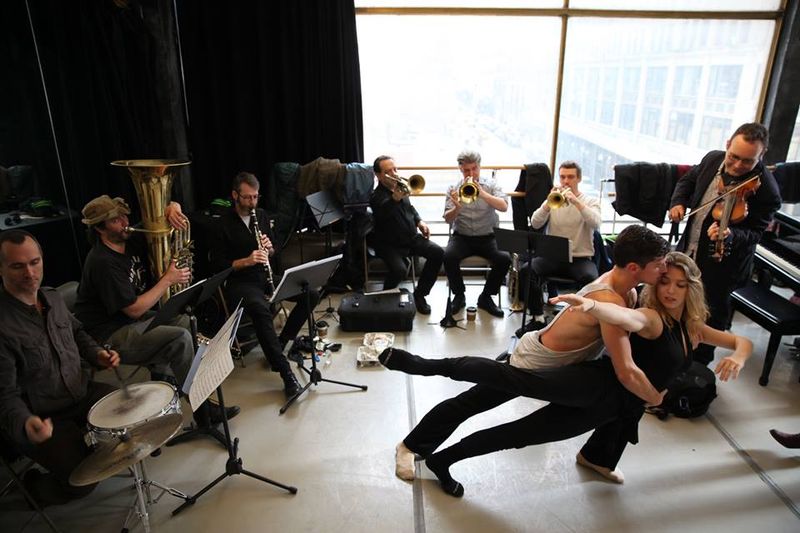
    Katarzyna Skarpetowska, a particular favorite of mine among choreographers currently on the scene, offered her latest creation, ALMAH, and added yet another feather to her cap with this finely-conceived and musically inspired work. Performing live, the musicians of Ljova dazzled us with their colourful playing. A felicitous soundscape – combining fadolin (an acoustic 6-string violin/viola/cello hybrid made by Eric Aceto), tuba, trumpet, bass clarinet, and drums – evoked beer gardens, country weddings à la LES NOCES, and visions of Russian villages and the people who live there. 

    Ms. Skarpetowska had wonderful dancers to work with – Elena D’Amario, Zoey Anderson, Eoghan Dillon, and Omar Ramon de Jesus – and she used the music as an inspiration for their rich and detailed movement, with some intriguing partnering motifs in the mix.

    12439263_10153886470290816_8879204900077223722_n

    Two pas de deux for Geena Pacareu and Ian Spring (above, rehearsing with the musicians of Ljova in a David Parsons photo) are high points in this excellent work; in the longer of the two, the voice of Inna Barmash cast a spell over the theatre with her one-word vocalise – talk about creating an atmosphere! – to which Ian and Geena responded with dancing that was truly heartfelt. 

    Ms. Skarpetowska took a bow to warmly affectionate applause at the close of this premiere of her newest piece, her silver shoes a charming touch. How I would love to see Kate working with oh-so-many dancers/dance companies…and most especially with the Martha Graham troupe. Let’s make it happen!

         Sarah1

    Above: beloved dancers Sarah Braverman and Ian Spring, in a Lois Greenfield photo 

    No Parsons Dance evening is complete without CAUGHT, the unique strobe-light solo that includes 100 jumps and leaves audiences in a stupefied state of “how-the-hell-did-he-do-that?” wonderment. I have seen it dozens of times and tonight, as always, I was thinking: “Oh…Caught…again!” and then moments later I was whooping and hollering along with the rest of the crowd.

    Ian Spring gave an astonishing performance; at first he moves slowly from one pool of light to another as Ljova intoned the opening phrases of the Robert Fripp score live. And then Ian takes off, flashing in and out of our vision in a series of perfectly timed snapshots. Like a dreamworld spirit, he pops up uncannily in various parts of the stage, seems to suspend himself above the floor, walks on air. Periodically the ‘real’ Ian materializes, as if he’d been standing still the whole time. Dazzled by the visual magic and by the dancer’s mouth-watering physique, the crowd went absolutely wild at the end while the sweat-drenched Ian – who, during his seasons with Parsons Dance, has developed into one of Gotham’s modern dance icons – basked in a standing ovation, casting a benevolent smile on the adoring throng.

    David Parsons’ sunny and seductive NASCIMENTO (1990) is always a perfect closing work. Here the dancers fill the music of Milton Nascimento – and David Parsons’ casually sexy combinations – with the effortless charisma that seems to be de rigueur for joining this elite dance family. Everyone has ample opportunity to shine – or glow, really – as they leap and sway to the tantalizing music, which includes some spine-tingly vocal passages. Meanwhile, the Binkley lighting scheme with its warm, rich colours, is an ideal setting.

    So many moments give NACSIMENTO its visual appeal: there’s a great passage when the girls race upstage and fly into Ahmad Simmons’ arms. And a simple but savorable section where Sarah Braverman wanders wonderingly among her colleagues who are hailing us from the shore with stylized arm gestures. Overall, it’s an irresistible piece performed by irresistible dancers.

    A few more images:

    Parsons-Dance-EoghanDillonCropped

    Eoghan Dillon, a young Irishman who is carving out his own niche in the Company…

    12301508_10208469285838489_3355607464700896826_n

    …and Geena Pacareu, the Spanish beauty, with Omar Ramon de Jesus, a sweetly sexy guy, and a suave mover; I borrowed this picture of them – on vacation – from Geena’s Instagram.

    4Q5A7096

    And finally…The Boss, getting everything perfect. Photo: Travis Magee.

    Parsons Dance continue their Joyce season thru January 31st. You’d better go see them!

  • Upcoming: Joshua Beamish/MOVE: the company

    JoshBeamish1

    Above: Joshua Beamish, photo by David Cooper

    Joshua Beamish/Move: the company will be at The Joyce August 4th and 5th, 2015; the performances are part of The Joyce’s Ballet Festival 2015.

    Joshua, who recently appeared as one of Wendy Whelan’s choreographer/partners for her RESTLESS CREATURE project, brings a diverse program to The Joyce. Featured works are the U.S. premiere of burrow, a duet for Royal Ballet dancers Matthew Ball and Nicol Edmonds, and the world premiere of Surface Properties, an ensemble work performed by ten dancers from American Ballet Theatre to a score by Mark Mellits and Michael Gordon. Also on the program are excerpts from Pierced, Beamish’s 2013 piece exploring the darker side of love.

    On July 30th, Joshua invited me down to the Martha Graham studios on Bethune Street where he showed me a run-thru of Surface Properties. This was only the second time that the dancers went thru the entire piece; it’s a big-scale and very active ballet, and the Mellits/Gordon score is propulsive and wonderfully danceable. Alternating full-ensemble passages with a series of fleeting solos and pas de deux, trois, et quatre, the work sustains our interest in its complex and sometimes whimsical partnering, unexpected match-ups of dancers, stylized port de bras elements, and unabashed physicality.

    The dancers, who rarely have a chance to do anything like this at ABT, leapt enthusiastically into this fresh experience, embracing the non-stop movement with technical brilliance and affording an opportunity to savor both their dancing and their personalities at close range. They are a super bunch: Zhongjing Fang, Isadora Loyola, Luciana Paris, Lauren Post, Cassandra Trenary, Stephanie Williams, Sterling Baca, Grayson Davis, Jose Sebastian, and Roman Zhurbin.

    I look forward to seeing Surface Properties, costumed and lit, on The Joyce stage.

  • Gallery: Graham @ The Joyce 2015

    001_MG_6565

    Above: Blakeley White-McGuire in Martha Graham’s CHRONICLE; photo by Brigid Pierce

    Here are some images from the Martha Graham Dance Company‘s 2015 season at The Joyce. Read about the first of three programmes the Company are presenting here.

    Click on each production photo to enlarge:

    002_MG_6695 (1)

    Above: the women’s ensemble in CHRONICLE, photo by Brigid Pierce

    001_MG_4839 (1)

    Above: Abdiel Jacobsen as Adam and Carrie Ellmore-Tallitsch as Lilith in Graham’s EMBATTLED GARDEN; photo by Brigid Pierce

    003_MG_2240

    Above: Tadej Brdnik (at the right) in Nacho Duato’s RUST; photo by Brigid Pierce

    There are new additions to the Graham company’s on-going LAMENTATION VARIATIONS project this season: 

    006_Christopher.Jones_003 (2)

    Above: from Sonya Tayeh’s LAMENTATION VARIATION, an ensemble work; photo by Christopher Jones.

    002_MG_3010

    Above: from Kyle Abraham’s LAMENTATION VARIATION, as danced by XiaoChuan Xie and Ying Xin, photographed by Brigid Pierce 

    004_MG_3037

    005_MG_3075

    Kyle’s Variation is being performed by alternating casts of two women (Ying Xin and XiaoChuanXie, above, in two more Brigid Pierce images)…

    150107_MGDC_KyleAbraham_LamenatationSeries_LLoydKnight_LloydMayor_SunyPurchase_Christopher.Jones_001

    …and two men: Lloyd Knight and Lloyd Mayor, photographed by Christopher Jones. [Note: the Lloyds are wearing shirts in this photo; in performance they danced bare-chested.]

    Peter Arnell’s marvelous photo-montage of the Graham dancers, which is being shown at every performance during the current Joyce season, may now be viewed here, at VOGUE. A couple of stills, below, will give you an idea of what this ‘moving picture’ is like:

    Image001

    Image004

    Catch these fabulous dancers thru February 22nd at The Joyce. Details here.

  • Parsons Dance at The Joyce

    Parsons-dance

    Sunday January 19th, 2014 (evening performance) – Parsons Dance are holding forth at The Joyce for a two-week season. Due to my ever-crowded calendar, this was my only chance to see them this time around. It was a typically top-flight Parsons programme, danced with the artistry and boundless verve I’ve come to expect from the Company over my long years of following them. The Company are celebrating 30 years of dancing…and I feel I’ve been with them almost from day one. 

    Introduction is a Parsons premiere and it is just what the title says: the audience is introduced to each member of the Company. David’s longtime lighting designer Howell Binkley has done the dancers proud yet again – Binkley lit all but one of the danceworks seen today. Rubin Kodheli‘s colorful score sets the stage as the Company’s luscious Italian firecracker Elena D’Amario steps forth first in a vibrant solo passage; and then we meet in turn the rest of the dancers: welcome to newcomers Geena Pacareu and Omar Roman De Jesus, and a warm welcome-back to Parsons favorites Sarah Braverman and Miguel Quinones. The lively and lyrical Christina Ilisije and those two handsome devils – Steve Vaughn and Ian Spring – are essential members of the Parsons family.

    Brothers is next: typically, Steve and Ian bounced back immediately from the opening work and were back onstage seconds later to give classic Parsons-style energy to this two boyz duet: an athletic and witty piece (co-choreographed by Parsons and Daniel Ezralow). To a quirky Stravinsky score (Concertino for 12 Instruments) the two boys nudge, flip, twist and turn their way thru this comradely duet. 

    Parsons Dance commissioned The Hunt from choreographer Robert Battle in 2001. Set to a savage, compulsive percussion score by Les Tambours du Bronx, this amazing piece is being alternately danced by the men and the women of Parsons Dance during this Joyce season. Today we had the men – Miguel Quinones, Steve Vaughn, Ian Spring, and Omar Roman de Jesus – and what a sensational performance they gave! Clad in long black skirts lined in blood red, the dancers move with fercious attack through this almost violent choreography. The audience seemed held in a state of amazement by the sheer dynamic passion of both the music and the movement and gave the guys a massive ovation at the end, so thoroughly deserved.

    Miles Davis’ “So What?” sets the stage for a jazzy quartet, Kind of Blue, danced with tenderness and a touch of seduction by Mlles. Ilisije and D’Amario along with Ian Spring and Omar Roman De Jesus. This was an interlude of near-calm in an otherwise power-packed programme, and Mr. De Jesus seems already to be developing a fan club among Parsons aficianados.   

    Steve Vaughn enjoyed a rock-star triumph in the famed Parsons solo Caught; last year I had the good fortune of watching Steve in one of his rehearsals for this challenging dancework: an iconic piece in which the dancer – caught by strobe flashes – seems to literally be walking on air. Timing and stamina are the keys to success here: the solo contains more that 100 jumps which must be perfectly coordinated with the lighting. Steve, with his boyishly beautiful torso, simply thrilled the crowd, and at the end he basked in wave after wave of applause and cheers, bowing gallantly to the adoring throng.

    Nascimento Novo is a superb Parsons closing work: the music of the Brazilian composer Milton Nascimento seems tailor-made for the Parsons style and in this (yet again) marvelously lit ensemble piece the dancers celebrate, sway, and seduce with effortless charismatic appeal. Two duets – one for Sarah and Christina, the second for Elena and Steve – are highlights in this evocative tapestry of dance which evoked sultry sunlight on a freezing Winter’s evening.

    The frosting on this delicious 30th-birthday cake was running into Abby Silva Gavezzoli, a beloved Parsons star who has taken some time off to raise her adorable son. So nice to see her, it really made my evening complete.

    I missed my usual rehearsal invite to David’s studio this year where I might have had the opportunity to bring a photographer to capture the new configuration of dancers; but perhaps there’ll be another chance at some point.

    What has maintained over the years of watching Parsons Dance is the sensation of dance at its most satisfying: no filler, no marking time or standing about; just perpetual motion and – always – remarkable dancing.

  • Jessica Lang Dance @ The Joyce

    6a00d8341c4e3853ef016761100c9b970b-800wi

    Above: dancers Clifton Brown and Kana Kimura of Jessica Lang Dance; photo by Kokyat

    Friday August 16th, 2013 – The Joyce’s Ballet V6.0 festival draws to a close with performances by Jessica Lang Dance making their Joyce debut with in a visually rich and musically inspired programme. Jessica Lang’s
    choreography has been on my A-list since I saw her Astor Piazzolla ballet Oblivion danced by the ABT Studio Company a few years ago. Jessica comes to The Joyce fresh from her operatic-directing debut at Glimmerglass (Pergolesi’s STABAT MATER) and a sold-out run for her Company at Jacob’s Pillow. Tonight’s performance at The Joyce was also a sell-out.

    The evening commenced on a high note and soared onward from there. To music of Antonio Vivaldi, Jessica’s 2010 A Solo in Nine Parts seemed to immediately captivate the audience. Her excellent company of dancers came on, all clad in summer-white, and danced their hearts out in this ballet which drew to mind Paul Taylor’s most joyous works.

    Performed against a sea-green back-panel, Jessica’s choreography looked clean and clear. and she has ideally visualized the Vivaldi score. Woven thru the ensemble passages are solos for each of the nine dancers. The central slow movement is a pas de quatre for Julie Fiorenza, Laura Mead, Kirk Henning and Milan Misko. Each dancer in the ensemble made his or her mark: Sarah Haarmann, Claudia MacPherson, Kana Kimura, Todd Burnsed, and Clifton Brown. Clifton in particular danced superbly in three of the four works shown tonight; he’s one of the most fluent and charismatic dancers of our time.

    Clifton Brown’s partnership with Kana Kimura, a striking dancer with a mystical presence, was the highlight of the second work, i.n.k. In this ballet which fuses music, dance and film to hypnotic effect, Kana and Clifton perform a remarkable adagio which ends with a thrilling slow backbend from Kana, supported in Clifton’s arms. The audience seemd to hold their collective breath as the dancers executed this unusual passage with complete control.

    i.n.k. overall is enthralling. The black-clad ensemble move before a glaring white back-panel, sometimes dancing with their shadows. Meanwhile drops or waves of dark ink splash across the screen. The crystalline score by Jakub Ciupinski, the costuming of Elena Comendador, Nicole Pearce’s lighting, and the captivating film elements (KUSHO by Shinichi Maruyama, edited by Tetsushi Wakasugi) all combine to make this poetic dancework a 21st century jewel: imaginative and beautifully executed.

    The evening’s second half kicked off excitingly with Aria, a quartet set to Zenobia’s tragic/frantic aria “Son contenta di morire” from Handel’s RADAMISTO. In this world premiere performance, three boys (Todd Burnsed, Kirk Henning and Milan Misko) in grey tights and bright red shirts sail thru the strongly musical choreography with the delicious Laura Mead the object of their attention. Laura, in a flame-red frock and dancing on pointe, gave a vivid and impetuous performance. Mr. Burnsed is her primary partner, though she often seems to want to evade contact altogether. My only slight concern here was that the singer on the chosen recording sometimes seemed slightly below pitch.

    Pianist Taka Kigawa took the keyboard to play Schumann live for the evening’s concluding work, From Foreign Lands and People; Taka’s playing was refined and beautifully supportive of the dancing. Like everything else on the programme tonight, this ballet was visually impressive. The midnight-blue-clad dancers move on, over, and under glossy black architectural pieces which they skillfully manipulate and re-arrange throughout the ballet. Pools of white light enhance the shifting landscape as the dancers clamber onto, slide down, and even partner the oblong boxes. The mood of the piece veers from playful to poetic, dictated by Taka’s playing.

    Milan Misko, a long-limbed dancer I have seen performing with TAKE Dance and the Lubovitch company, seems to have found an ideal dance-home in Jessica Lang’s style.  And Clifton Brown’s dancing – all evening – was a marvel: his solo in the concluding work was astonishing in its clarity and expressiveness. If Mlles. Mead and Kimura stood out among the other dancers by virtue of their featured roles, the entire ensemble deserve bouquets for their impressive performances in this vastly pleasing evening of dance.