Tag: The Joyce

  • Martha Graham: Myth & Transformation II

    Phaedra

    Above: Tadej Brdnik and Blakeley White-McGuire in Martha Graham’s PHAEDRA. Photo: Costas.

    Sunday matinee February 24th, 2013 – The Martha Graham Dance Company continue their season at The Joyce with a striking double bill: Graham’s PHAEDRA (not performed for a decade) and the Company’s premiere performances of Richard Move’s THE SHOW (Achilles Heels).

    I had had the good fortune to see a studio rehearsal of PHAEDRA in October; and more recently, I had a sneak peek at a segment of THE GAME at a private showing. Finally today I got to see these two sharply contrasted works in their full glory, and I brought my friend Joe along who was having his first experience of Graham. It was a great afternoon.

    In PHAEDRA, Robert Starer’s score propels the dancers as they move amidst the Noguchi-designed set pieces. This story of forbidden love – Phaedra becomes obsessed with her young step-son Hippolytus – caused the threat of a Congressional censure when it was first performed in 1962, so wildly did it offend the government’s guardians of morality. It seems far less shocking today, but still potent thanks to the remarkable performances of Blakeley White-McGuire as Phaedra, Maurizio Nardi as Hippolytus and Tadej Brdnik as Theseus. Ms. Blakeley-White is riveting to watch as she regsters the spectrum of Phaedra’s emotions: lust, tenderness, remorse, guilt. Blakeley’s body was made to dance Graham: from her expressive hands and gorgeous torsol contractions to her marvelously ‘wrapped’ feet, she makes her entire physique a vessel of communicative grace. Maurizio Nardi has the enviable combination of the sleek, smooth body to make him a believable youth with the artistic maturity to give the character of Hippolytus depth. Tadej Brdnik handsome face and strikingly muscled frame are grandly invested in his portrayal of Theseus; the only “problem” being that Tadej looks too young to be the father of a grown son.

    The beauteous Mariya Dashkina Maddux as Artemis holds a statue-like pose for minutes on end without moving a centimeter. She later bursts free, dancing dynamically whilst firing off her arrows. Xiaochuan Xie as Aphrodite emerged and retreated from her pink-cloud cocoon to meddle in the fates of the muddled mortals: her enchanting performance pleased the audience greatly. Equally lovely but playing a darker role, PeiJu Chen Potts danced Parsiphea’s solo superbly; of her character (Phaedra’s mother) Ovid  memorably said: “Pasiphaë took pleasure in becoming an adulteress with a bull.” The men of the Graham Company looked great in their decorative briefs; their ensemble dance was powerful and they wove thru the action in smaller roles, always drawing the eye with their physical attributes.

    THE SHOW (Achilles Heels) is Richard Move’s send-up of the story of the end of the Trojan War. The expected characters appear but not always as we might imagine them. A pre-recorded narrative (featuring the voices of Mikhail Baryshnikov and Deborah Harry) is lip-synced by the dancers. In this pan-sexual ballet, men wear stiletto heels and women speak in baritonal voices. Achilles, vain and unspeakably beautiful, is ideally personified by the boyishly cocky Lloyd Mayor. As a paragon of male perfection, he’s matched by his mythic love Patroclus in the person of Abdiel Jacobsen: their intmate post-workout duet is ideally handled by Mr. Move: it borders on the erotic but keeps us tantalized.

    Katherine Crockett as Helen of Troy makes the face (and form) that launched a thousand ships totally believable, her majestic figure and queenly extension entice us at her every move. Blakeley White-McGuire revels in the theatricality of playing a game-show hostess who just happens to be the goddess Athena. She also joins Mariya Dashkina Maddux and Natasha Diamond-Walker as a Andrews Sisters-like trio of commentators. Ms. Diamond-Walker’s topless solo as Xanthus (Achilles’ horse) was so artfully managed that her nudity transcended mere decorativeness. Tadej Brdnik appeared in different guises as the ballet unfolds, and Ben Schultz always drew our gaze with his godlike presence – and he should feel free to uncover his wonderful tattoos. 

    THE GAME weaves songs by Deborah Harry – notably “Beautiful Creature” which certainly is apt for Mr. Mayor’s Achilles – into a composed score by Arto Lindsay. Today the music seemed just a little too loud to be ideally savoured. The opening segment of moody darkish dancing (though finely executed) seems rather too long: let’s get into the narrative! And later there are places which might be pruned down to the overall advantage of the work. But the concept is novel and it really does work. For all the game-show glitz and zany juxtaposition of voices to characters, there are also wonderfully moving moments, most notably the death of Patroclus with its fluttering dove. The Graham dancers gave the piece their all.
  • Martha Graham: Myth & Transformation I

     ErrandMikiSideLegFnl

    Above: Miki Orihara in the original costume for Graham’s ERRAND INTO THE MAZE; photo by John Deane.

    Saturday evening February 22, 2013 – The Martha Graham Dance Company are at The Joyce thru March 3rd with three programmes centering on themes of myth and transformation, as well as a special gala. Details of the performances and ticket information here.

    Tonight’s bill consisted of three Graham masterworks, each with an iconic principal female role – and each of those roles performed by one of the Graham goddesses of the 21st century: Blakeley White-McGuire as Medea in CAVE OF THE HEART, Miki Orihara as Ariadne in ERRAND, and Katherine Crockett as Jocasta in NIGHT JOURNEY. The musical scores are by three of the 20th century’s leading composers: Samuel Barber, Gian Carlo Menotti, and William Schuman.

    In Martha Graham’s CAVE OF THE HEART, the choreographer distills the story of Medea, her betrayal by Jason, and her subsequent destruction of Jason’s young bride into a powerfully compact dancework. As Medea, Blakeley White-McGuire, a brilliant red-haired sorceress, gave a compelling performance – whether moving about the space with restless passion or laying in utter stillness waiting to play out her revenge, Blakeley is a riveting presence. Her marvelously spastic solo as the piece moves towards its inevitable denouement was something to behold. Tadej Brdnik’s boyish handsomeness underscored Jason’s ambitious heartlessness, and his striking musculature propelled him boldly thru the athletics of the choreography and the demands of the partnering. Xiaochuan Xie was a vision of loveliness as the Princess, her dancing spacious and light-filled, blissfully unaware of her impending doom. Powerful presence and physical suppleness marked the performance of Natasha Diamond-Walker as the Chorus, majestic in her black and red striped gown.

    The collaboration between Martha Graham and sculptor/designer Isamu Noguchi created the look we associate with these Graham ballets. In both CAVE OF THE HEART and NIGHT JOURNEY, Noguchi’s set pieces evoke a feeling of familiarity – of being in a space we have been in before. But the damage to the Company’s sets and costumes caused by Storm Sandy left the decor for ERRAND INTO THE MAZE beyond repair. The sets will be re-created in time, but for the current season an alternative solution for presenting this important Graham work was needed. Choreographer Luca Veggetti, working with Miki Orihara, devised a stripped-down version of the piece, now referred to as ERRAND. Martha Graham’s original choreography remains intact, but the work is presented on a bare stage, reaching to the exposed brick wall at the rear of the space. Miki, as the heroine, wears a long plain white skirt with a ‘nude’ leotard white Ben Schultz as the Minotaur wears only his tattoos and white briefs. The effect is absolutely stunning.

    Graham’s choreography feels utterfly fresh, and Miki’s vulnerable qualities have never seemed so touching as here, menaced by the ominous man-bull of Ben’s splendid physique. The illusions of near-nudity gave the piece a timeless, mythic quality. Miki was ravishing, the poetic expressiveness of her body illuminating the smallest nuances of gesture and movement. Ben stalked about the set like a gladiator awaiting his chances in the arena; even standing still, he posed a threat. At the end, having conquered the monstrous symbol of her fear, Miki’s stance of quiet victory and her feeling of wonderment were poignantly expressed.

    During the intermission I caught bits of several conversations among the crowd; people seemed to be saying that this new look at ERRAND had lifted the piece out of a somewhat dated context they’d experienced in CAVE OF THE HEART. Much as I admire Noguchi’s work – and if you haven’t been to the Noguchi museum in Queens you owe it to yourself – and the Graham-designed costumes, I have to say that Mr. Veggetti’s take on ERRAND is a revelation. I’ve often wondered how Balanchine’s ORPHEUS, for which Noguchi designed both sets and costumes, would look as an unadorned black-and-white ballet. In presenting this ERRAND, the Graham Company took a chance – and in my view it paid off handsomely.

    In its full Noguchi-Graham decor, NIGHT JOURNEY is theatrically satisfying, yet I did find myself thinking it would hold up very well in a bare-stage-and-leotard configuration. The choreography, especially for the female ensemble (led by the beauteous and triumphant Mariya Dashkina Maddux) is striking in any event. And it did cross my mind how forceful the athletic movements of the blind seer Tiresias – a marvelous role for Abdiel Cedric Jacobsen – would seem if he was to be divested of his bulky garments. But, we’re getting ahead of ourselves here: NIGHT JOURNEY is perfect as it stands, and Katherine Crockett is beyond perfect in the role of the devastated Jocasta who strangles herself on discovering she has been married to her own son, the man who killed her first husband. (“The killer of the King is a King.”) Ms. Crockett, a luminous gift to the world of dance, is thrilling to behold – as much for her beauty and intensity as for her exalting extension and the evocative flow of her arms and hands. Ben Schultz polished off his demanding, two-ballet evening with a majestically tragic portrayal of the ill-fated Oedipus, the dancer’s godlike physique taking on an assailable aspect as his world collapsed.

    And how does the Graham repertory strike a young person today who has never experienced any of it, except for tidbits on YouTube? My twenty-something dancer-friend Alejandro was quite taken with the evening, with a special affinity for ERRAND. I’ll be seeing the other two programmes of the current season, each with a “Graham virgin” as my companion. It will be interesting to see what they think.

  • Carrie & Kate

    581020_4095691624656_1371387178_n

    Carrie Ellmore-Tallitsch (above, photographed by Brian Krontz) will be dancing a solo made on her by Kate Skarpetowska during the upcoming Buglisi Dance Theatre season at The Joyce. Details of the season are here; the new Skarpetowska solo entitled Sjawa is scheduled as part of Program B.

    Kate, an outstanding dancer from Lar Lubovitch‘s company, has in the past two seasons created two very distinctive works for Parsons Dance: A Stray’s Lullabye and Black Flowers. I first encountered Carrie when she was dancing with the Martha Graham Dance Company; more recently she made a beautiful impression dancing with Martin Lofsnes’ 360° Dance Company. I’m very much looking forward to seeing what the collaboration of Kate and Carrie will produce.

  • Cedar Lake @ The Joyce: Program B

    Blog-570x380

    Tuesday May 22, 2012 – Three works, all of them new to New York City, held the stage as Cedar Lake Contemporary Ballet started their second week at The Joyce. Above, an image of the Company in Simply Marvel by Regina van Berkel.

    On a stage illuminated by huge hanging parchment-shaded lamps, Ms. van Berkel’s work commences with a solo danced by Oscar Ramos; the music, for solo piano, is ultra-slow and so is the movement. The dancers arrive one-by-one, the women in stylized tutus and toe shoes. Sculptural formations assemble and dissolve in this slow-motion universe.

    The mood then shifts to a brighter, more animated vision as solo violin music by Nicolo Paganini sets off the three women – Acacia Schachte, Ebony Williams and Soojin Choi – in a series of on-pointe vignettes, partnered by the men. Quirky, witty and jagged, the work maintains an odd sense of formality thanks to the music. Impressive dancing from the entire cast brought the work to a close, signaling the first of many ovations during the evening.

    Halfway thru the intermission, the curtain rose on the stagehands preparing for the second work: Tuplet by Alexander Ekman. As the crew busy themselves setting up, Harumi Terayama stands alone in an illuminated square, gesticulating rapidly or conducting an imaginary orchestra. As the house lights dim, five other dancers take up their own squares.

    After an introductory sequence, the work’s highlight comes with a solo brilliantly danced in silhouette by Jon Bond which he – one of Gotham’s most incredible dancers – delivered with astonishing clarity and power. Throughout this ballet, the sounds of the dancers’ movements – and even of their breathing – mesh with the musical score to create a personalized soundscape.

    The audience went wild after a wonderfully inventive passage in which the six dancers lined up across the front of the stage and danced to the sounds of their own names being spoken. This tour de force was so perfectly delivered by the dancers. Performing in Tuplet, in addition to Harumi and Jon, were Jubal Battisti, Oscar Ramos, Joaquim de Santana and Ebony Williams: an all-star cast.

    In the closing work, Necessity, Again by Jo Stromgren (World Premiere) the stage is strewn with sheets of paper; pages hang from clotheslines strung above the space, and periodically the dancers bring in more and more sheaves of pages; occassionally someone flings a fistful of papers into the air. In this messy, cluttered setting the dancers appear alternately bored, bemused or borderline manic. There is a stylized rape scene and at one point the dancers strip down to their underwear (some people go to Cedar Lake just for the bodies). Meanwhile an annoying voice lectures on the meaning of ‘necessity’; this is offset by a series of Charles Aznavour songs. Somehow out of this chaos a dancework is built, and – thanks to the individuality and dramatic capacities of the Cedar Lake dancers – it becomes a necessity to watch.

    The audience – including danceworld luminaries Miki Orihara, Stephen Pier, David Hallberg and Larry Keigwin – gave the Cedar Lakers a rousing reception at the end of the evening.

  • MORPHOSES: BACCHAE @ The Joyce

    Copy of 113

    Wednesday October 26, 2011 – MORPHOSES presents its production of Luca Veggetti’s BACCHAE at The Joyce. The work draws inspiration from – but is not a literal setting of – Euripides’ ancient Greek tragedy. Composer Paolo Aralla and flautist Erin Lesser are major forces in this creation, with lighting by Roderick Murray and costumes by Mr. Veggetti and Benjamin Briones. In the top photo: dancer Gabrielle Lamb.

    Luca Veggetti’s BACCHAE is a dancework which summons up images of both the rites of the Bacchae – those wild women driven to ecstacy in their worship of Dionysus – and the death of the Theban King Pentheus at their hands. Set in a space surrounded in black silk drapery, the ballet takes on a funereal tone as the abstracted narrative moves to its brutal climax. The sudden exposure of the rear brick wall near the end draws us back to reality, awakening from a nighmare of deception and murder.

    In a prologue, a puppet (skillfully manipulated by an actor all in black) mimes sets forth themes of the  Dionysian rituals to which the Bacchae subscribe. At the dress rehearsal this device seemed to me not to work very well, but it the performance it was surprisingly effective.

    Copy of 21

    But we have already met Dionysus by this time; as in the play, ‘he’ is the first player to appear: Euripides describes his appearance and demeanor as feminine, and Luca Veggetti casts a female – Frances Chiarverini (above) – in the role. Frances is a mistress of the Veggetti style which calls for fluid movement, maintaining a steady flow of motion through knees that are often bent, keeping the body low to the floor. Pivoting and sliding across the space as the hands and arms cut thru the air in angled gestures, the effect can be spiderlike and in this darkish setting seemed almost ominous.

    Copy of 39

    As King Pentheus, the antagonist of the disguised god and who is determined to end the Bacchic rites, Adrian Danchig-Waring (above) brought magnificent presence and powerful dancing to the role. Lured into the trap Dionysus sets for him – an invitation to witness the Bacchae at their rituals – Adrian’s Pentheus is seduced and betrayed to his death.

    Copy of 40

    The two-part pas de deux of Pentheus and his cousin Dionysus is a central aspect of BACCHAE, danced with a powerful sense of give-and-take by Adrian and Frances (above).

    Copy of 55

    The third major character in the drama is Agave, the mother of Pentheus, who unwittingly murders her son after he is caught secretly witnessing the Dionysian revels of the Bacchae. Gabrielle Lamb’s passionate sense of drama – seemingly a natural gift rather than something she’s developed – was vividly projected through both her intense facial expressiveness and her superbly limber body.

    Copy of 7

    The idea of a traditional Greek chorus is adapted here with an ensemble of excellent dancers who weave themselves into the dramatic situations, often appearing or vanishing under the hems of the silken drapes.

    Copy of 89

    As one of the Bacchae, dancer Yusha-Marie Sorzano (above) carries a stick – a reference to the first confrontation between the Bacchae and the soldiers of Pentheus who were sent to shut down their celebrations and bring order out of chaos. The women, using only sticks, were able to fend off the armed guards thru the fervour of their passionate loyalty to Dionysus. In an ensemble, the woman swipe and flourish their sticks thru the air, moving to the swooshing sounds in aggressive stances.

    Copy of 79

    In the opening scene, standing on the sounding platform which is a central element of the work, flautist Erin Lesser (above) evokes the shifting winds of time as she breathes and even speaks across the mouthpiece of her enormous contrabass flute. Throughout this long ‘aria’, Ms. Lesser’s energies and technical skills seemed to re-double from one passage to the next…

    Copy of 65

    …while in the final scene, she re-appears playing her silver flute as Agave/Gabrielle ponders her violent act.

    Luca Veggetti and his collegues have crafted a work that is unlike any other, a unique and evocative summoning of an ancient tale that speaks clearly to us of the vanity of gods and the fervor of their followers which can so often go to extremes. Very apt for today’s world.

    More of Kokyat’s images from this production appear here.

    I felt it was of tremendous benefit to my enjoyment of the evening that I took the time to read the Euripides play before attending. The ballet, which lasts a little over an hour, seemed too short in a way; I wanted more.

    So good to see Arlene Cooper, Giorgia Bovo, Emery LeCrone and Justin Peck among the audience this evening.

    Synopsis of the dancework:

    “Dionysus, the god of wine, prophecy, religious ecstasy, and fertility returns to his birthplace in Thebes in order to clear his mother’s name and punish the insolent city-state for refusing to allow people to worship him.

    King Pentheus of Thebes has declared illegal the Bacchic rituals initiated by his cousin Dionysus. As these rituals represent a threat to social order, King Pentheus orders his soldiers to violently suppress them.

    Dionysus begins the long process of trapping Pentheus, leading him to his death. He convinces the intrigued and excited king to witness the rituals and volunteers to help him clandestinely observe the highly secretive all-female gatherings.

    Dionysus, manipulating the situation, orders the Bacchic worshippers, including the king’s mother Agave, to attack the now vulnerable ruler. As he falls, Pentheus reaches for his mother’s face but Agave, driven mad by Dionysus, proceeds to rip her son limb from limb.”

    MORPHOSES dancers:

    Sarah Atkins
    Yusha-Marie Sorzano
    Brittany Fridenstine-Keefe
    Frances Chiaverini
    Gabrielle Lamb
    Emma Pfaeffle
    Christopher Bordenave
    Brandon Cournay
    Adrian Danchig-Waring
    Willy Laury
    Morgan Lugo

    Watch an brief BACCHAE video here.

    Kokyat and I have followed the creation of BACCHAE from the audition process thru a preview evening (where the mystical ‘sound platform’ was introduced) to a recent studio rehearsal. Luca Veggetti and MORPHOSES artistic director Lourdes Lopez have graciously given us an insider’s look at their creative process, and the dancers have been so kind and generous as we eavesdropped on their work.

  • Parsons Dance @ The Joyce

    Parsons Dance DSC_6633_high res small

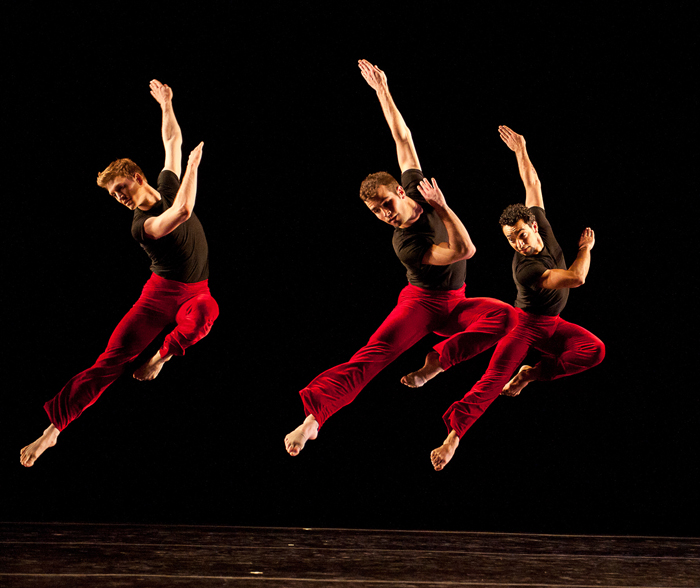
    Thursday January 27, 2011 – Great dancing from Parsons Dance at The Joyce tonight, performing five works by David Parsons and a new piece by Monica Bill Barnes. Kokyat and I recently got to watch the Company rehearsing and thus became familiar with some of the newer faces in the troupe. An enthusiastic audience saluted the dancers with applause and cheers at the end of a well-paced programme. The Company are at The Joyce thru February 6th; read about specially discounted tickets here. Top image: Abby Silva Gavezzoli, Eric Bourne and Sarah Braverman photographed by Paula Lobo.

    Parsons+Dance+2011+Joyce-567 small

    The evening began with BACHIANA, a work which I saw at its first public showing (even before its official premiere) at Jacob’s Pillow on August 29, 1992. I knew even then it would become a Parsons classic and it looks great nowadays with it’s vivid dark red costuming and excellent lighting. This piece is a great programme-opener for it immediately serves notice both of the choreographer’s freedom-of- movement style and the joy therein of the Parsons dancers. One fanciful motif is the men head-standing for quite a long time. For all its fast-paced, celebratory dancing, an outstanding highlight of the piece is the adagio duet danced by Abby Silva Gavezzoli and Miguel Quinones in which they slowly make their way across the stage together in expressive partnering combinations to the strains of the Bach Air on a G-String. Photo of Eric Bourne, Steve Vaughn and Miguel Quinones in BACHIANA by B. Docktor.

    Paula_Lobo_Dance_Photography-2 small

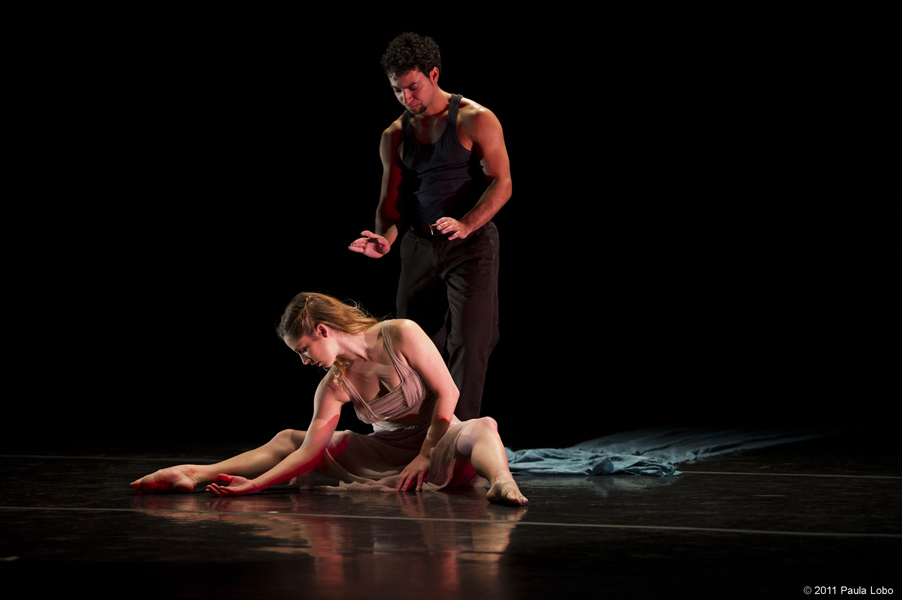
    Miguel Quinones, in my humble opinion one of Gotham’s most extraordinary male dancers, speaks about the new duet PORTINARI – which David Parsons has created for Miguel and the blonde beauty Sarah Braverman – here. The dancers are pictured above in a Paula Lobo photo. Kokyat’s images from a rehearsal of this duet may be found here.

    The duet was inspired by the life and work of the Brazilian painter Candido Portinari, best known for his panels War and Peace at the United Nations headquarters here in New York. Portinari died in 1962 from lead poisoning induced by his constant use of lead-based paints.

    For this duet, David Parsons turns to the very familiar music of Samuel Barber: the Adagio for Strings. As with his use of the Bach Air in BACHIANA, David’s choreography makes us listen to the music afresh. Miguel ‘creates’ Sarah – his Madonna and muse – with his brush. Their duet is quietly ecstatic and builds to a fantastic pose with Sarah standing on Miguel’s shoulders; from there she takes a breath-taking plunge into his arms. But the story isn’t over: the painter then descends into sickness and death, with the woman consoling him. As he expires in her arms the light fades and the dancers are drawn into shadow. The audience watched the two dancers in awed silence; Sarah and Miguel give a perfect and memorable interpretation of this duet.

    SLOW DANCE 1 small

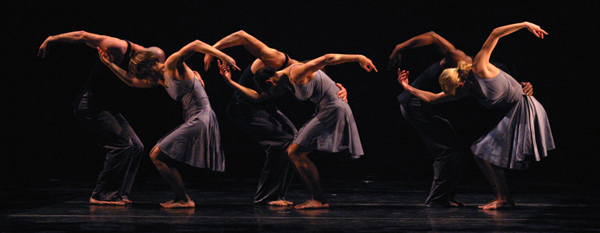
    In David Parsons’ 2003 work SLOW DANCE, three couples dance in a somewhat confined space to music of Kenji Bunch. This work is quite different from anything else in the Parsons repertoire…

    Parsons+Dance+2011+Joyce-623 small

    …the dancers looked fine and reveled in some high lifts that decorate the piece. Photo: B. Doktor.

    Parsons Dance rarely perform choreography by anyone other than David Parsons but this season they have added Monica Bill Barnes’ LOVE, OH LOVE to their repertoire. Despite being perfectly danced and ‘acted’ by the Parsons troupe, the work’s mildly amusing qualities are offset for me by the use of pop love-anthems that – while appropriate for the theme – are too loud and go on too long. I couldn’t wait for it to end. I know it’s meant to be ironic, but the musical overkill is too much. Irony and brevity must go go hand-in-hand to be really effective. Nevertheless: excellent work by the dancers.

    _DSC4925

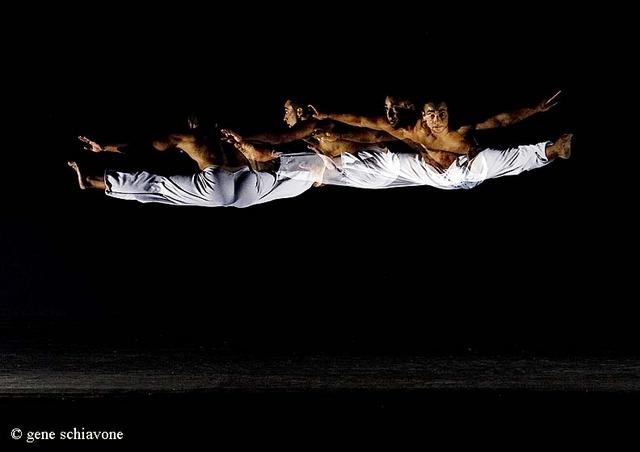
    In a tour de force, Miguel Quinones (Gene Schiavone photo, above) performed the imaginative and wildly popular solo CAUGHT in which a flashing strobe light makes the dancer appear to be literally dancing on air. Miguel, who danced in every single piece tonight and was still full of energy in the final NASCIMENTO, moved miraculously thru the over-100 jumps which constitute the choreography of CAUGHT, leaving his beautiful torso bathed in sweat as he finally ‘landed’. At the end, the crowd screamed wildly for the dancer: a demonstration of awe and affection which Miguel received with modest grace.

    L_e04af1a19ba345019ad0869823bcb7e4

    NASCIMENTO begins and ends with Abby Silva Gavezzoli (Elena Olivio portrait above) alone onstage. Abby’s sexy and lush dancing sets the pace of this colorful work in which the Parsons dancers revel in their choreographer’s signature style: witty, spacious, affectionate and vital. The music of Milton Nascimento, the appealing Santo Loquasto costumes and the excellent lighting by Howell Binkley (all evening) conspire to make this an exciting closing number.

    Now in his third decade of presenting dance, David Parsons remains at the top of his game. His newest works, PORTINARI and RUN TO YOU, seem destined to take their places among the Parsons classics that always make his New York seasons so enjoyable. And his current roster of dancers are as exciting and dynamic as any to be seen in our dancing City.

  • Cedar Lake @ The Joyce/Programme A

    31296_400062764209_7693009209_3962736_5753174_n

    Tuesday October 26, 2010 – This first of two programmes by Cedar Lake Contemporary Ballet at The Joyce provided a tremendously satisfying evening of dance:

    Week 1 (October 26 – 31)
    Sunday, Again” by Jo Strømgren
    UNIT IN REACTION” by Jacopo Godani (NY PREMIERE)
    Hubbub” by Alexander Ekman (NY PREMIERE)

    Top photo: Jon Bond & Manuel Vignoulle in rehearsal for HUBBUB. View the Company roster here.

    Makeitnew

    SUNDAY, AGAIN (Julieta Cervantes photo, above) is one of the pieces from Cedar Lake‘s repertoire that I most enjoy and admire and I’m very glad for the opportunity to see it again (twice…it’s on both Joyce programmes). This work by Jo Stromgren is set to music of J S Bach and features the entire Company dressed in tennis whites. The theme of the work is: what to do on yet another Sunday spent with the domestic partner.

    Cedar-lake

    Jason Kittelberger wants to go out and play badminton and his lover Acacia Schachte wants to stay in. This leads to the work’s tempestuous opening duet by these two magnificent dancers (above) in which the most edgy, risky aspects of dance partnering are displayed. The play of tension between the two dancers and the intensity of their individual personalities make this a thrilling start to the evening.

    From there the work evolves into an ensemble piece with the underlying idea of getting a badminton game going. This leads to shifting dynamics between men and women and to witty moments as when Harumi Tereyama draws a shuttlecock out of her mouth and teases Jubal Battisti with it. Later, Gwynenn Taylor-Young pats down Ana-Maria Lucaciu til she finds another shuttlecock. Between these and other duets, the dancers stride across the stage with racquets and nets at the ready. Finally the game begins: men vs women. But all too soon the afternoon’s over and the drapes are drawn.

    UNIT IN REACTION by Jacopo Godani is a New York premiere. Six of Cedar Lake’s ultra-powerful and fascinating dancers form the first of two alternating casts who will perform this work during the first week of the current season: Jon Bond, Jason Kittelberger, Oscar Ramos, Ana-Maria Lucaciu, Acacia Schachte and Ebony Williams. In a darkish setting, these dancers move with restless energy in a series of solos and duets which stretch the limits of physical movement. Acacia Schachte and Oscar Ramos seize their moments vibrantly and a duet for Ana-Maria and Ebony is especially potent. Jon Bond, one of the most thrillingly agile and sexy dancers ever to take the stage, is mind-boggling in his solo. Throughout this work with its pounding, fragmented percussion/industrial score, Jason Kittelberger is an ominous, forceful figure. The six dancers won screams and whoops from the packed house as each stepped forward for a bow at the end.

    2010-2109_0316_3

    The New York premiere of Alexander Ekman’s HUBUB provided a truly witty and apt finale to the evening. To the relentless clicking of that antique, obsolete apparatus – the typewriter – the dancers, stripped down to the briefest and most revealing of costumes, each have their own metal-frame podium on which they stand, sit or hide under.

    In an endless, pretentious monologue the voice of dance criticism reads from the endless sheaf of typewritten pages, telling the viewer what the dance is all about, what it means and how to react to it. In fact, the narrator is saying next-to-nothing and merely stating the obvious in dressed-up language. 

    31396_401979974209_7693009209_4013507_5489653_n

    Central to HUBBUB is a hysterically funny duet in which the thoughts of two dancers – Harumi Tereyama and Nickemil Concepcion – are heard in voice-over as they perform a pas de deux. Harumi and Nickemil danced this piece with dead-pan expressions as the audience laughed aloud. (Above: a rehearsal photo of the pair by Jubal Battisti).

    In the final movement of HUBBUB, the inner thoughts of the dancers are revealed – their mundane likes and dislikes and their secret habits. The music of Xavier Cugat had underlined the opening segments of HUBBUB but here we have one of the Chopin nocturnes, yet another imaginative stroke.

    The evening ended with a genuine standing ovation.

    20091008-143625-pic-666111519

    Is twenty-six year old Alexander Ekman the world’s cutest choreographer? He has my vote.

    So the evening was a great kickoff for the two-week Cedar Lake season. Allthough I have a special fondness for the Company’s home-theatre on 26th Street, the Joyce provides more seats – all occupied tonight – meaning that more people can see this troupe of dancers: some of the most potent and distinctive in Gotham. Ticket info here.