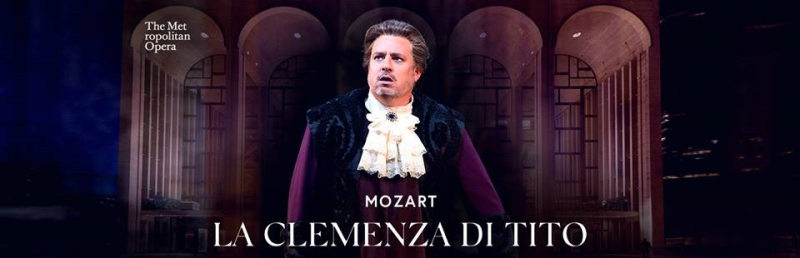
Above: Matthew Polenzani as Tito
~ Author: Oberon
Saturday April 20th, 2019 matinee – One of my favorites among the Mozart operas, LA CLEMENZA DI TITO is a melodious masterpiece. Though THE MAGIC FLUTE is considered the composer’s final opera, that work was largely complete when he set about writing CLEMENZA.
LA CLEMENZA DI TITO was something of a throw-back for Mozart: it was written in the old style of opera seria – in which a progression of set-piece (arias, duets, and small ensembles) are linked by brief passages of recitative – to celebrate the coronation of Austrian Emperor Leopold II as King of Bohemia in Prague in 1791.
This formality of structure is illuminated by some of Mozart’s most personal arias: Sesto’s “Parto, parto” and “Deh, per questo istante solo“, Tito’s “Se all’impero, amici Dei”, Annio’s “Tu fosti tradito“, Servilia’s “S’altro che lagrime“. and Vitellia’s “Non piu di fiori“, each of which ideally reflects the personality of the character singing it.
Giving the overture a nice, weighty feel, conductor Lothar Koenigs presided over a well-paced performance. A sterling continuo duo – Davis Heiss, cello, and Bryan Wagorn, harpsichord – added much to the afternoon’s pleasure, and thrilling playing from principal clarinetist Inn-Hyuck Cho (as both clarinet and basset horn soloist in “Parto, parto” and “Non piu di fiori” respectively) was a complete joy to experience.
In the title-role, Matthew Polenzani’s pliant and expressive singing flowed forth with Italianate lyricism, the voice clear and sure, etched in with detailed pianissimi along the way (most notably in “Del piu sublime soglio“) to keep the music fresh. The tenor – whose recent Zankel Hall concert was one of the highlights of the current season – showed great sensitivity in the recitatives, especially in the long scene where he weighs his feelings before passing judgement on Sesto. “Se fosse intorno al soglio” showed expert dynamic control, and the showpiece “Se all’impero, amici Dei” in Act II was triumphant.

Joyce DiDonato (above) has found a perfect role in Sesto, joining such marvels as Tatiana Troyanos , Lorraine Hunt Lieberson, and Elīna Garanča in the highest echelon of interpreters of this demanding part. Ms. DiDonato, ever alert to the words, sang with dazzling technique and a vibrant sense of dramatic urgency.
In the great aria, “Parto, parto“, Ms. DiDonato reveled in the vocal and expressive possibilities Mozart has afforded her. After displaying moving vulnerability – her hushed murmuring of “Guardami…!” was sublime – the mezzo was at her finest as she sailed thru neat-as-a-pin coloratura effortlessly (and perfectly matched by the clarinet), winning a big ovation.
Incredibly, Ms. DiDonato surpassed herself in the second act aria, “Deh, per questo istante solo” where, with touches of straight tone along the way, she sang with deep feeling, expressing the young man’s passion and remorse. In the second verse, tiny embellishments were woven in, and the aria’s fiery finish brought down the house.
Elza van den Heever is a puzzling singer: her broad repertoire – from bel canto to Strauss, Wagner and (next season), Berg – seems to indicate a soprano who has not settled on a fach. Which is fine, really, except that the varying demands of the roles she is singing seems to be affecting her tone at times, which can turn rather shrill.
As Vitellia, she was uneven in this role’s wide-ranging music, and though she touched on the high-D in Act I and successfully reached downward to the low-G in “Non piu di fiori“, the voice lacks sheer beauty and is not really all that fluent in fiorature. The highest notes – a brilliant top-B for one – popped out clearly, but seemed disconnected to the rest of the voice. I really didn’t know what to make of her performance. But for some reason, the audience – perhaps spurred on by the MetTitles – found Vitellia to be something of a comic figure; the soprano was well-received at her bows.
Emily D’Angelo as Annio seemed rather muted at first, and Ms. DiDonato simply drowned her young colleague out in their beautiful Act I duet. But Ms. D’Angelo soon made her mark on the performance, with a finely-rendered “Tu fosti tradito” capped by a nice top-A. The audience loved her.
Lovely, graceful Mozart singing from Ying Fang as Servilia, recalling Hei-Kyung Hong’s beautiful Met debut in this role. Ms. Fang, with sweet-toned lyricism, made “S’altro che lagrime” (perhaps the opera’s most attractive melody) a tender delight.
Christian van Horn was a superb vocal presence as Publio, showing the advantage of putting a stellar singer in a relatively small – but musically important – role. Bravo!
The houselights slowly came up during the opera’s finale: a celebratory touch. The singers were all warmly applauded as they took their bows on the classic Jean-Pierre Ponnelle set.
Metropolitan Opera House
April 20th, 2019 matinee
LA CLEMENZA DI TITO
Wolfgang Amadeus Mozart
Tito.......................Matthew Polenzani
Vitellia...................Elza van den Heever
Sesto......................Joyce DiDonato
Servilia...................Ying Fang
Annio......................Emily D'Angelo
Publio.....................Christian Van Horn
Berenice...................Anne Dyas
David Heiss, Cello
Bryan Wagorn, Harpsichord
Inn-Hyuck Cho, Clarinet and Basset Horn soloist
Conductor..................Lothar Koenigs

Intermissions at The Met these days can often put a damper on even the best of performances, but this afternoon’s single interval brought an unexpected treat: clarinetist Inn-Hyuck Cho (above) remained in the pit for the entire half-hour, practicing the basset horn part of “Non piu di fiori”. What a mesmerizing sound! The Met is so very fortunate to have this splendid musician in their orchestra.
~ Oberon
 Oberon's Glade