Tag: The MET Orchestra

  • Elīna Garanča ~ MET Orchestra @ Carnegie Hall

    Elina-Garanca

    Above: mezzo-soprano Elīna Garanča

    ~ Author: Oberon

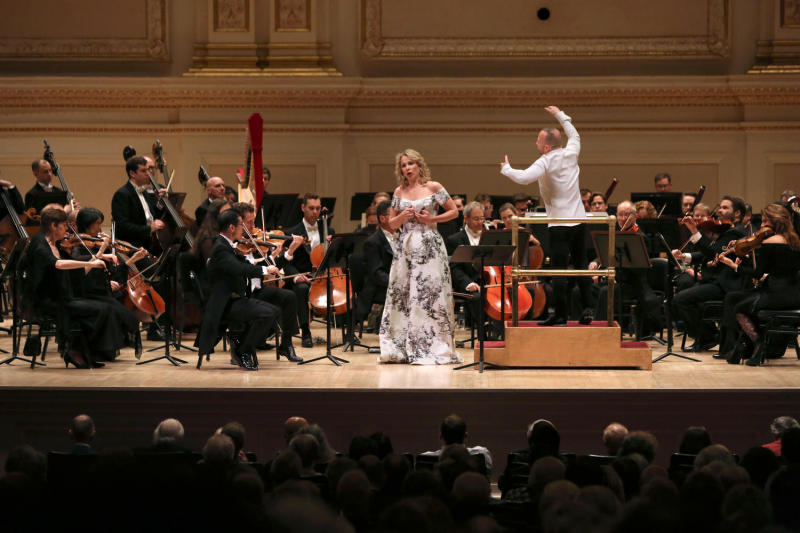
    Friday June 14th, 2019 – This evening, The MET Orchestra paired Mahler’s marvelous Rückert Lieder with Anton Bruckner’s sprawling 7th symphony. Yannick Nézet-Séguin was on the podium, and the soloist for the Mahler was Elīna Garanča.

    As Ms. Garanča, in a strikingly Spring-like white gown, and the conductor made their way center-stage, the mezzo towered over the maestro. M. Nézet-Séguin wore a clingy white shirt that seemed calculated to show off his physique; it looked kind of silly.

    The German Romantic poet Friedrich Rückert (1788-1866) was one of Gustav Mahler’s favorite poets, and he set a number of his poems to music, including the Kindertotenlieder (“Songs on the Death of Children”).

    Mahler composed four of the five Rückert Lieder in 1901, initially to be sung with piano accompaniment;  very soon after, he orchestrated them. The fifth of the Rückert Lieder, “Liebst du um Schönheit?” (‘If you love for beauty…’) was composed a bit later, and orchestrated by Mahler’s publisher. The songs do not constitute a formal song-cycle, nor is there any prescribed order of performing them.

    Ms. Garanča began with “Blicke mir nicht in die Lieder” (“Do not look at my songs…”), in which poet and composer seem to be warning the listener not to be too inquisitive about the song-writing process: it’s the finished product that matters. This light and almost playful song was deliciously voiced by Ms. Garanča, whilst the woodwind players of The MET Orchestra buzzed charmingly about, like busy bees.

    In “Ich atmet’ einen linden Duft” (“I breathed a gentle fragrance…”) the mezzo-soprano brought an intriguing mix of calm and intensity. Her use of dynamics and her lovely sustaining of the vocal line were beautifully supported by the oboe, horn, and flute. The singer’s lower range has a special warmth and glow: rich without seeming over-burdened.

    A change of mood comes with “Um Mitternacht” (“At midnight”) which tells of the poet’s battle with darkness (both in the literal and and the poetic sense) until he finally leaves it all in God’s hands. Ms. Garanča brought profound beauty of tone to the song, giving it an almost operatic dimension. Her use of straight tone at times was beguiling, whilst throughout her expressive, passionate colouring of the words kept us engrossed. It seemed that the conductor allowed a passing trace of vulgarity in some of the wind playing, and he allowed the orchestra to cover the voice in the closing passages of the song.

    Liebst du um Schönheit” (“If you love for beauty…”) was the first Mahler song I ever heard, sung at a 1972 recital by the delectable Frederica von Stade. A few years later, the unique voice of Patricia Brooks gave the song a different feeling. And it’s a song I very much associate with my late friend, the Japanese contralto Makiko Narumi. The words, in translation, could have been the theme song of my long career as a promiscuous romantIc:
    “If you love for beauty,
    Do not love me!
    Love the sun,
    with her golden hair.
    If you love for youth,
    Do not love not me!
    Love the spring,
    Which is young each year.
    If you love for riches,
    Do not love not me!
    Love the mermaid,
    she has many lustrous pearls.
    But If you love for love,
    Then…yes! Love me!
    Love me,
    And I shall always love you.”
     
    Every note and word of Ms. Garanča’s singing of this jewel of a song was simply exquisite; she seemed to savour the joy of having such a fascinating voice with which to allure us. Though once again the orchestra infringed on the voice at times, her perfect rendering of the charming “…o, ja!…” as the song neared its end gave me a shiver of delight.
     
    I’ve never understood why a singer would end this group of songs with anything but “Ich bin der Welt abhanden gekommen” (“I have been lost to the world…”), probably the single most profound lied ever written. The poem tells of the peace achieved by the poet’s withdrawal from the turmoil of the daily life. The MET’s wind players were simply gorgeous here, infusing the music with a tender sense of longing and resignation. Ms. Garanča’s singing was haunting in its range of colour and gradations of vibrato; she drew us into that place of refuge that Rückert and Mahler have created for the soul in search of hermitage: what more can we ask of a singer?
     
    The poem ends: “I live alone in my Heaven…in my love…in my song.” The touching opening theme is heard again from the English horn, fading to a whisper.
     
    CH1605499
     
    Above: Ms. Garanča and Maestro Nézet-Séguin performing the Rückert Lieder; photo by Steve Sherman
     
    An over-eager fan rather spoilt the end of the mezzo-soprano’s performance with a very loud “Brava!” before the music had completely faded away. A wave of applause and cheers then filled the august Hall, where so much glorious music has been heard thru the passing decades. Ms. Garanča basked in the glow of a prolonged standing ovation, which her luminous singing so fully deserved.

    Following the interval, Maestro Nézet-Séguin returned for the Bruckner 7th. This was my first live experience of this work, which begins so magically with a string tremolo from which the glorious main theme arises. Throughout most of the first movement, I felt as engaged – and even exalted – as I had expected to feel, since I like Bruckner’s music in general.

    But in the ensuing Adagio, I found the performance drifting away from me. There were some iffy moments from the horns, the music seemed periodically to lose its shape, and the movement began to feel endless. The Scherzo which follows was singularly lacking in wit and sparkle, and while its tranquil – almost wistful – trio section is pleasant enough to hear, pleasant music tends to get boring after a while.

    At last, the Finale is reached; I hoped that Bruckner would take the driver’s seat and careen madly to the finish line. Instead, the music came in fits and starts, seeming to fold in on itself and retreat periodically into modestly attractive wind interludes. At last: a big statement. But this was soon replaced by more dawdling. Frankly, it couldn’t end soon enough. I found myself craving Bizet’s Symphony in C.

    Afterwards, I asked myself why the Bruckner 7th had seemed like such a disappointment this evening. My friend Ben Weaver suggested that perhaps it was the performance, rather than the music, that had let me down. But it’s something deeper.

    In search of answers, I read some on-line articles by music-lovers who stated that Bruckner’s music often eluded them. One common theme in many of these writings was Bruckner’s seeming lack of a sex life: simplistic perhaps, but on the other hand we know that Mozart, Liszt, Wagner, Debussy, Puccini, and Mahler were men of passion, and it comes thru in their music. Bruckner’s passion seems to have been for God, and some writers went so far as to say that Bruckner probably lived and died a virgin. This may account for a feeling of sterility in some of his music, and why it doesn’t reach me. Oddly, reading about Bruckner and looking at some pictures of the man, I began thinking of Mike Pence.

    Speaking of people’s sex lives, in tonight’s Playbill note about The MET Orchestra, the name of James Levine – the man universally credited with turning the opera house’s orchestra into a world-class concert ensemble – is conspicuously absent. This gloss seems so childish, but I suppose in an age when slavery in America and the Holocaust in Europe are being written out of text books, anything is possible.

    ~ Oberon
  • MET Orchestra/Gergiev/Trifonov @ Carnegie Hall

    Trifonov

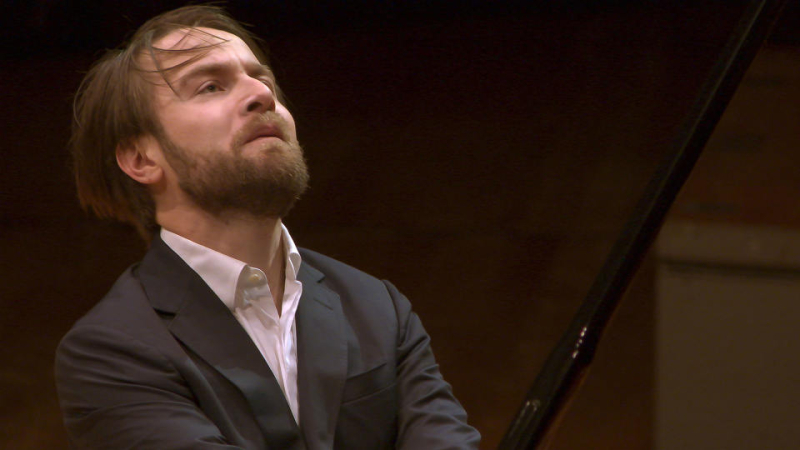
    Above: pianist Daniil Trifonov

    ~ Author: Ben Weaver

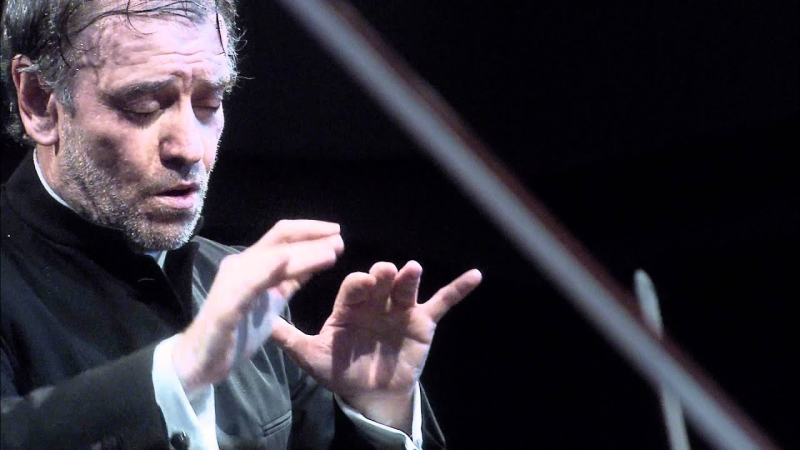
    Saturday May 18th, 2019 – The MET Orchestra made its way over to Carnegie Hall for one of its popular annual orchestral concerts. Former principal guest conductor Valery Gergiev – director of the Mariinsky Theater of St. Petersburg, and a regular presence on the Met podium – led the performances (without a podium, which seems to be his preferred method; one of his many eccentricities that also include conducting with what appears to be a toothpick.)

    For the the first half of the concert Maestro Gergiev was joined by the star pianist Daniil Trifonov for Robert Schumann’s ever-green Piano Concerto in A minor. Mr. Trifonov is an excellent pianist, perhaps even a great one, even at his relatively young age. But as demonstrated by this particular performance (and not for the first time) he often displays his own eccentricities with music-making. He played the introduction to the concerto extremely slow (remarkably, one could hear some early echoes of Rachmaninoff in the piano and orchestra) – and then at the first sign of a something faster, Trifonov sped up like a runaway train. These extremes in the tempos – dragging slow and demonic fast – dominated the entire performance, but felt like an affectation, not organic music-making. This is not a new thing for Mr. Trifonov; his Carnegie Hall debut in 2011 (with Tchaikovsky’s 1st Piano Concerto, conducted by Gergiev) was criticized by the New York Times for similar behavior: “…he tended to offset extremely fast playing with extremely slow, more maundering than meditative: a manic-depressive approach…”

    Needless to say, the fast playing was dazzlingly note-perfect. Trifonov does not attempt more than he can actually accomplish. And in the slow sections he frequently displayed extraordinary sensitivity and beauty. But on the whole the performance was, alas, mostly frustrating and even boring. I have little doubt that maestro Gergiev supported all of Trifonov’s choices: Gergiev himself frequently takes similar liberties with the tempo, especially in non-Russian repertoire. Sometimes it works (his Wagner is often thrilling for it), but only sometimes.

    The audience greeted Trifonov’s performance warmly (to say the least) and he played a lovely, beautifully articulated and, dare I say, perfectly-paced encore – Schumann’s “Nicht schnell, mit Innigkeit” from Bunte Blätter, Op. 99, No. 1.

    Maxresdefault

    For the second half of the concert the MET Orchestra and Maestro Gergiev (above) took center stage for Franz Schubert’s last symphony, Symphony No. 9 in C major, completed in 1828, the year of his death. The manuscript collected dust in Schubert’s brother’s possession until 1837 when Robert Schumann, passing through Vienna, paid a visit to Ferdinand’s home and was rewarded with a “hoard of riches” of Schubert’s never-before seen manuscripts, including the final symphony. Schumann and his friend Felix Mendelssohn finally arranged the work’s premiere in 1839 under Mendelssohn’s baton. The premiere was not a success with the audiences and it took many years for the symphony to finally gain acceptance for the masterpiece it is. The work’s length, which Schumann called “heavenly,” was a big stumbling block. In due time composers like Anton Bruckner and Gustav Mahler out-composed Schubert’s 9th for time and the work finally did ascend to warhorse status.

    The symphony opens with a call from a horn, played beautifully by (probably) MET’s principal hornist John Anderer. The orchestra, under Gergiev’s toothpick, sounded superb. Gergiev has been burnishing his German music credential as the new principal conductor of the Munich Philharmonic. The nicely articulated rhythm were clean and sharp. This work was far more consistently paced than the opening Schumann concerto. Gergiev kept the symphony moving at a clip that never felt rushed. Many solo instruments were given a chance to shine, particularly the woodwinds in the second movement. The Scherzo was graceful and the once controversial final movement – where in the 1830s Mendelssohn found London musicians laughing at the second theme of the movement and refusing to play it – was thrillingly played. But something was missing from the whole: perhaps a little variety of rhythm and dynamics. Gergiev conducting was extremely consistent, but in a work faulted by some for being too repetitive, consistency turned out to be something of a negative.

    An extended ovation followed; the audience wanted an encore, but with an imperial wave Maestro Gergiev gave the orchestra permission to disband.

    ~ Ben Weaver

  • Gražinytė-Tyla|Rachvelishvili|MET Orchestra

    AR

    Above: Anita Rachvelishvili, the stellar soloist at Carnegie Hall tonight

    ~ Author: Oberon

    Friday May 18th, 2018 – Mirga Gražinytė-Tyla conducting The MET Orchestra with mezzo-soprano soloist Anita Rachvelishvili at Carnegie Hall. Works by Debussy, Mussorgsky, and Tchaikovsky were on the bill.

    Claude Debussy’s Prélude à l’après-midi d’un faune opened the evening; this score, now beloved of ballet fans worldwide, was the setting for the controversial ballet by Vaslav Nijinsky who – at its 1912 premiere in Paris – caused a scandal with his portrayal of the exotic faun. It has since been performed in various choreographic versions, most notably that of Jerome Robbins for New York City Ballet (1953) where it remains a mainstay of the repertoire.
     
    Tonight, The MET Orchestra brought just the right glow of mystery and languid sensuality to this music.  Beautifully atmospheric playing from flautist Seth Morris was an outstanding feature of the performance; his solo bow rightfully drew bravos. Throughout, the numerous wind and harp solo passages were poetically played. At times, the pacing seemed just a shade too fast; but the overall effect was sublime. So nice to see the Met’s peerless concertmaster, David Chan, getting out of the pit and out onto the stage where his musicianship could shine the brighter.  
     
    CH1384284
     
    Ms. Rachvelishvili (above, in a Chris Lee photo from the performance) then appeared for Modest Mussorgsky’s Songs and Dances of Death (performed in the Shostakovich orchestration). The Georgian mezzo, who is making quite a name for herself these days, looked and sounded splendid, with her softer singing carrying superbly in the Hall, and producing a thrilling effect when she unleashed her full power.  

    Songs and Dances of Death, composed in the mid-1870s, is a set of four songs. In Lullabye, a mother cradles her sick child, who grows increasingly feverish. Death appears, disguised as a babysitter, and rocks the infant to eternal sleep. Here Ms. Rachvelishvili displayed a haunting use of almost straight-tone, employed as a means of lyrical expression. Her timbre is darkish, wine-coloured, with a haunting quality.

    Serenade depicts the figure of Death waiting outside the window of a dying woman, serenading her like a wooing lover. Ms. Rachvelishvili was simply magnificent here, the lushness and house-filling strength of her voice making a vivid impression. The music rises to a passionate conclusion. 

    In Trepak, a drunken peasant stumbles outside into the snow and becomes caught in a blizzard. The figure of Death invites him to dance the Trepak with him. The drunken man freezes to death, dreaming of summer fields and doves. The song starts softly, then a rhythmic figuration springs up; the bass-clarinet is prominent. Ms. Rachvelishvili’s vocal power, unleashed, was something to hear; and she brought forth some simply massive chest tones. For all the thrill of her voluminous, rich sound, she can also be extraordinarily subtle. 

    The Field Marshal is the final song, wherein the figure of Death is depicted as an officer summoning the dead troops of opposing armies after a horrific battle. As the ghostly soldiers parade before him, the Field Marshall speaks of them in remembrance. A bit of tension on some of the singer’s upper notes was swept aside by the visceral impact of her singing; in a calmer interlude, the straight-tone was again brought forth to extraordinary effect.

    Ms. Rachvelishvili received rapturous applause and was called back twice for additional bows. Someone handed flowers up to her, always nice to see. The crowd clearly wanted an encore, but perhaps the singer knew best; she left us with the echoes of the powerful Mussorgsky songs.   

    Following the interval, Ms. Gražinytė-Tyla led Tchaikovsky’s Symphony No. 4 in which the orchestra shone. Written in 1877-1878, the symphony is dedicated to the composer’s patroness and ‘dear friend,’ Nadezhda von Meck.

    Following his catastrophic marriage to his former student, Antonina Miliukova, which lasted all of two months, Tchaikovsky began writing his fourth symphony. Struggling with his sexuality and battling depression, he produced a symphony which, he is quoted as saying, is about Fate: “the fatal power which prevents one from attaining the goal of happiness”.

    The 4th is vastly pleasing in so many respects, with its titanic fanfares, its plaintive oboe solo in the Andantino, its originality in a Scherzo full of plucking strings, and the rush and plush of the final Allegro con fuoco. What is doesn’t do – for me, at any rate – is reach the depths of feeling that the composer so often evoked in other works.

    Mirga Gražinytė-Tyla’s extremely animated podium style became wearying to watch after a while. This orchestra plays so well on their own; the musicians hardly need a conductor at all. Constantly in motion, Ms.  Gražinytė-Tyla rose on her toes, hopped up and down, waved her baton overhead, and energetically gave cues. I ended up closing my eyes, to avoid this visual distraction.

    Though the 4th does not seem to me to be peak Tchaikovsky – though the composer himself thought highly of it, apparently – it did make me long to see EUGENE ONEGIN, SWAN LAKE, SLEEPING BEAUTY, and Balanchine’s SERENADE.

    There were empty seats around me, and the couple behind me remarked that the MET Orchestra series no longer seems to be the sell-out it has always been in seasons past. I wonder if the absence of James Levine has anything to do with it?

    ~ Oberon