Tag: The Met

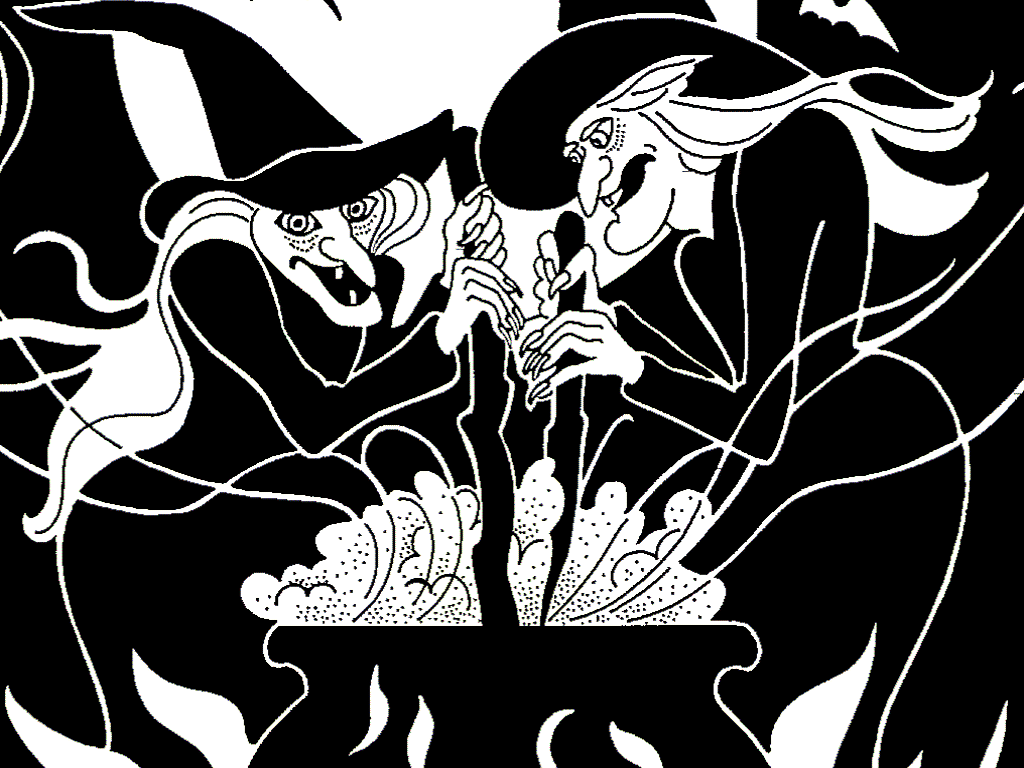
  • Bewitched? We Bitched! Met MACBETH

    Witch-brew-66170

    Tuesday March 20, 2012 – I have no one to blame but myself, really. When the Met calendar for the current season came out, I skipped easily over MACBETH even though it is an opera I love: “Not with that cast!” But then a few weeks ago I was listening to the Leinsdorf recording and decided it would be good to experience MACBETH in the opera house. Despite the currrent Met trend for unmemorable productions and often brainless casting, I decided to give it a try. 

    I’d seen this production before; I love the huge moon with the black, scudding clouds that fills the proscenium as we wait for curtain-rise. But then the opera starts with the trivialized witches in 30s housedresses, coats and purses (each purse contains lightbulbs, how clever!). They are not sinister or even mildly interesting dramatically. And thus the production is off to a ho-hum start, and proceeds on its dreary way with injections of blood and vomit meant to shock us. It doesn’t work.

    Gianandrea Noseda is often a fine helmsman at the opera, but tonight his MACBETH was workaday, and the chorus seemed uninspired. I very much liked the firm and dark-hued basso of Gunther Groissbock as Banquo; to hear his aria would have been the only reason to stay longer than we did. But not reason enough.

    Over the years I have greatly enjoyed Thomas Hampson’s performances at The Met, but although he’s been fine in the more lyrical Verdi roles of Posa and Germont he simply doesn’t have what it takes for the big-guns parts like Boccanegra or Macbeth. It’s a bit like the borderline between a Merrill and a Warren: the former never trespassed into the Nabucco/Boccanegra/Macbeth region which suited (or would have) the latter so well. It’s a matter of amplitude. The sound of the Hampson voice is still fine, steady and more resonant than I expected. But it’s not Italianate in the least, it doesn’t billow and bloom with the turns of phrase or sail grandly on the words. Verbal over-emphasis, a common gimmick for over-parted singers, was a distration in a few places, as was a tendency to be ever-so-slightly sharp pitchwise. Yet still there was a lot to admire in his vocalism.

    I’d heard Nadja Michael about ten years ago singing the mezzo part in the Verdi REQUIEM at Avery Fisher Hall. She sounded awful. Of late her name has cropped up as Salome in a European production that has made it to DVD (so many productions do these days, god knoweth why). I was expecting nothing from her vocally as Lady Macbeth, and that’s what I got. I’ve heard lots of bad, unattractive or hopeless singing in my day but usually it either has to do with a ‘beloved’ singer being past his/her prime, or a perfectly respectable singer attempting a role beyond his/her capabilities, or being indisposed but giving it a go to ‘save’ the evening. In these instances, you can usually still perceive that there is a real instrument at work but just not suited – for whatever reason – to the task at hand. There’s no such excuse to be made for Ms. Michael: this is how she sounds.

    Obviously no one at The Met these days knows or cares enough about singing to have sorted this out in advance.  Would this woman have passed an audition for the East Buttfcuk, Idaho community choir?  I dunno, but somehow she’s entrusted with a great Verdi role at The Met. Her first aria was a mess and wtf is up with giving her a repeat of the cabaletta? Once was more than enough: the voice is shallow, desperate, breathy, wobbly, harsh and grossly unpleasant. Some people have said: “At least she has the high notes!” Yeah, if ill-pitched, desperate screeching counts. Following “Vieni, t’affretta” there was one prominent ‘brava’ (husband? manager? paid goon?) and one boo from a neighboring box, plus tepid applause for an aria that should bring down the house. There was also an oddly rustling sound to be heard which I soon determined to be the joint spinning in their graves of Callas, Rysanek, Nilsson, Dimitrova and Verrett.

    The booer got up and left; I eyed my friend Alan to see if he was ready to leave but the opera was going forward and I didn’t want to cause even a slight disruption for those around us, so we stayed on thru the end of the great ensemble that marks King Duncan’s murder. Luckily no one attempted the traditional top note to crown the choral finale. I would like to have heard Mr. Groissbock’s aria but that meant listening to “La luce langue” first. No way.

    Despite the mess she made, Michael won’t be bought out. The Met can’t afford to do that anymore. So if she shows up, ready to sing, she sings and gets paid leaving the audience with the stick end of the lollipop. One might wish for her to vanish from the scene, but apparently they have her down for BLUEBEARD’S CASTLE two seasons hence. I won’t go to that, regardless of who sings the Duke.

    Alan and I staggered down to the Plaza in disbelief at what we’d just heard. There’s no excuse for it, really. A sad commentary on the state of things at The Met. And then there were all those empty seats…

  • Unenchanted Evening

    EnchIsla1112.21

    Monday January 30, 2012 – The Met’s Baroque pastiche ENCHANTED ISLAND made for a dismal night at the opera. Placido Domingo as Neptune, in a Ken Howard production photo above, gave the performance one of its few perk-up moments. His voice, though aged, remains a distinctive instrument and he brought a real personality to his relatively brief appearance, something no other singer in the cast was able to do.

    The Playbill featured a two-page synopsis. Drawing on two complex and brilliant Shakespeare masterpieces, THE TEMPEST and MIDSUMMER NIGHT’S DREAM, the plot is a mishmash of characters and situations that do not engage us emotionally, and rarely even theatrically. The libretto is cheesy and stilted; avoiding Shakesperian style, it has a contemporary feel at odds with the setting and the music. Forced humour abounds, and the characters are made to sing uncomfortably-structured sentences. Unable to understand much of the diction, I flipped on my Met Titles and regretted it because reading the script added to a sense of deflation as the first act progressed.

    The opera is much too long. The 90-minute first act seemed to have reached a pleasant climax with the Neptune scene, but then there was another prolonged slow aria for Prospero. Oddly, the house lights suddenly came on at full brightness during the postlude of this aria, then were dimmed and turned off again.

    Slow arias in fact abound; but that proved as well since none of the singers had the needed vocal facility to astonish us with their coloratura. The annoying voice of Danielle DeNiese as Ariel went in one ear and out the other; she made no vocal impression at all. Anthony Roth Costanzo, replacing David Daniels as Prospero, seemed over-parted in the big house; pushing for volume, his sustained notes sometimes took on a steady beat. At other times the voice vanished behind the orchestra. Joyce Di Donato was announced as indisposed but she had “graciously consented…blah, blah, blah.” Please singers: if you are unwell enough to need an announcement, don’t sing. We don’t pay Met prices to hear sick singers. At any rate, Di Donato only had one bad low note, but her voice – even in full health – lacks a distinctive colour, the sort of personal timbre that made singers like Teresa Berganza, Dame Janet Baker and Frederica von Stade so instantly identifiable. Luca Pisaroni tended to be over-emphatic in his fiorature which verged on barking at times. Lisette Oropesa sang attractively as Miranda as did Paul Appleby as as Demetrius. The libretto did them no favors, but they – and in fact everyone onstage – went at the words gamely enough, even if they felt foolish doing so.

    The idea of doing a Baroque pastische is not a bad one but it seemed to me that between the tedious libretto, too many ‘laments’, and the too-busy plot, ENCHANTED ISLAND was going nowhere. Two 45-minute acts with a 20-minute intermission should have sufficed; instead there were expendable arias, unnecessary da capos, and overdrawn recits as the first act stretched onward. We left at half-time and so, it seems, did lots of other people.

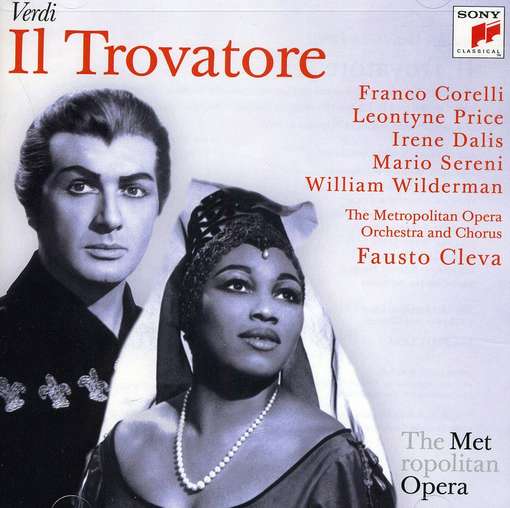
  • Met’s 1961 TROVATORE on SONY

    886979100626

    The Metropolitan Opera on SONY series recently issued the famous February 4, 1961 TROVATORE broadcast with Leontyne Price and Franco Corelli which followed by a week their wildly acclaimed joint Met debut in the Verdi opera. The 1960-61 Met broadcast season was happening without my knowledge, otherwise I would certainly have been glued to my radio. But I did not discover the Met broadcasts until the following season when the fabled Sutherland ‘debut’ LUCIA was the first time I tuned in. From then until just a couple of years ago, I hardly ever missed a broadcast.

    I heard Price and Corelli many times at The Met – Leontyne I actually heard at the Old Met as Fiordiligi in COSI FAN TUTTE (in English) and Franco sang in the first performance I saw at the New Met (as Calaf in TURANDOT). I loved them both in those golden years though I knew Franco could be sloppy at times and Leontyne, over the years, developed some annoying idiosyncrasies. I’d never heard the 1961 TROVATORE so I set aside time to concentrate on it; I must say, it is a very erratic performance.

    Fausto Cleva, a favorite conductor of Renata Tebaldi, takes much of TROVATORE at a breathless clip. For the most part the singers manage to keep up though there’s some scrambling here and there. Aside from Leontyne Price, who strives throughout for thoughtful musicality, the principal quartet of singers tend to sing TROVATORE in verismo style rather than treating it like a god-child of the bel canto era. I suppose there’s a temptation to snarl and bluster in the opera’s dramatic utterances and in a live performance there is no recourse other than to let the singers do what they will in declaiming the text. But it becomes a bit tiresome after a while.

    Corelli is the most lachrymose Manrico I ever heard; he gives the same impression on his commercial recording of the role for EMI, though that is more artfully sung. Of course there is a lot of very powerful and exciting vocalism in his interpretation, but this is somewhat compromised by his melodramatic excesses. Upon receiving news that Leonora is to take the veil, Corelli has a little mad scene which wanders right off the musical map. But despite some slight variability of pitch at times, the utterly distinctive Corelli timbre and his sheer generosity of voice make him a Manrico on the grand scale. Interestingly, Corelli only sang this opera at the Met eleven times, retiring it from his repertory at the House in 1964. A new production in 1969 was reportedly planned for Corelli but in the event Placido Domingo was the Manrico.

    Leontyne Price on the other hand kept Leonora in her repertoire for over twenty years; the great aria “D’amor sull’ali rosee” might be considered the soprano’s theme song and she sang it superbly at the gala that closed the Old Met in 1966. The warmth and shimmering beauty of her timbre provide the vocal high points of this 1961 broadcast where she manages to maintain the Verdian line while her colleagues wander into melodramatic over-accenting of certain passages. For my money, Price was not a soprano with a first-rate forte top; she was best in the floating upper phrases of a role. Corelli drowns her out on the final D-flat of Act I, and her high-C at the climax of the Act IV duet with di Luna doesn’t have any zing to it. But overall it’s wonderful to hear the soprano in all her freshness in this music. Over the ensuing years Price developed a vocal ‘style’ that could be off-putting: growling in the lower register and introducing some bluesy mannerisms that could spoil her performances for me. You don’t hear these on her commercial recordings so much, but in the House she could be very self-indulgent. Nevertheless her singing could still thrill, right to her farewell operatic performance.

    I always loved the sound of Mario Sereni’s voice, so warm and attractive. For me he was at his best in verismo: his Marcello, Carlo Gerard and Tonio (PAGLIACCI) were all very fine; he did leave behind some wonderful studio recordings too, notably his Germont with de los Angeles and his Enrico on the RCA/Moffo LUCIA. But in this TROVATORE he seems way off form. I wonder in fact if he was actually originally scheduled for this  broadcast since Robert Merrill had sung di Luna in the Price/Corelli debut performance and sang it again in the next performance following the broadcast. Whatever the case, Sereni seems unprepared. He sings the wrong entry line in the first scene of Act III and gets lost in the recitative on his entry in Act IV. Some handsome singing along the way is offset by serious pitch problems in the great aria “Il balen”. It’s sad that this particular broadcast should be chosen as a document of Sereni’s live Met performances; I know I can never listen to it again.

    Irene Dalis was a great favorite of mine. She was a powerful stage presence and a singer who could be both passionate and subtle. Her performance is exciting but I feel of all the singers she may have been most put-off by Cleva’s fast tempi. In the Act III, Scene 1 finale Irene is pushed to the limits by the conductor’s absurdly rapid pace and it seems to me that she simply stops singing during the final bars of music. Her final scene is very impressive, though, with the quiet calm of her “Ai nostri monti” and a sustained high B-flat in her last triumphant, vindictive phrase. Ten years after this broadcast, I saw Irene’s Azucena at the Met during a June Festival performance. Despite the intervening decade of singing some of opera’s most demanding roles, she was in fact far more thrilling and vocally secure than on this 1961 broadcast.

    It’s good to have a document of William Wilderman’s performance of Ferrando; his ample and darkishly dramatic singing gets the opera off to a strong start. Teresa Stratas sings the brief role of Inez and there is no mistaking her voice. She strives to make something lovely of her phrase bidding farewell to Leonora at the convent, but Price trumps her by coming in a shade early and stepping on the younger soprano’s tapering piano.

    For all its flaws, listening to this recording reminded me of how much I love this opera. Despite its improbable plot, the vast treasury of Verdi melody makes TROVATORE essential.