Tag: The Met

  • @ My Met Score Desk for Roméo et Juliette

    Snapshot

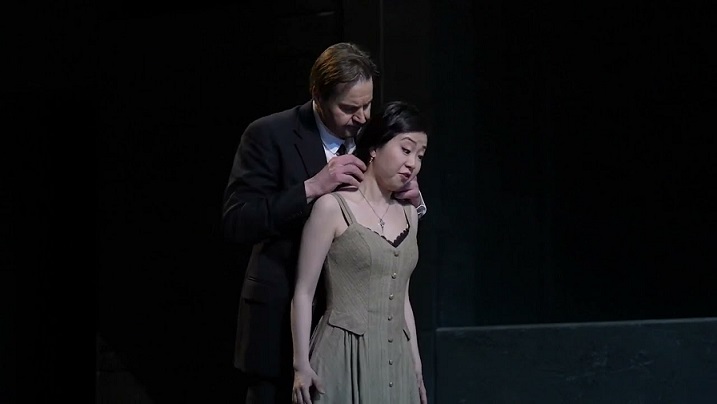
    Above: tenor Benjamin Bernheim as Romeo

    ~ Author: Oberon

    Saturday March 30th, 2024 matinee – Earlier this season, I renewed my acquaintance with Bizet’s CARMEN at The Met, an opera I had not seen for many years. Musically, I enjoyed it thoroughly, and so this afternoon I was hoping for a similar experience with Gounod’s ROMEO & JULIETTE.

    My first encounter with the Gounod opera was an unforgettable matinee in October of 1967, when Jeannette Pilou made a last-minute Met debut as Juliette opposite Franco Corelli’s matinee idol Romeo. I fell in love with Ms. Pilou that afternoon, and made many trips to New York from the little town specifically to see her in her many Met roles in the ensuing seasons. I saw Jeannette as Juliette a second time, and since then I have seen only Colette Boky and Hei-Kyung Hong in the role.

    Today’s matinee started the same way as my first-ever ROMEO in 1967: the news that Nadine Sierra had canceled and was being replaced by So Young Park, whose Met credentials to date have been a handful of recitals with piano in the NY Parks, and a single Queen of the Night in 2019. 

    The Met Orchestra played with its accustomed polish, and the chorus has a lot to do in this opera…and they did it very well. For the most part, Yannick Nézet-Séguin resisted his usual temptation to have the orchestra play too loudly…though there were moments…

    The orchestral opening was heavy-handed, followed by a chorale, and then the poignant love theme sounds from the strings. The first solo voices to be heard are those of Frederick Ballentine as Tybalt and Daniel Rich as Paris; Mr. Ballentine would have more to do later, in the duel scene…and he made a strong impression there.

    Nathan Berg was a fine Capulet; his ‘aria’ at the ball was subtly done, and his scene with Juliet prior to her taking the potion was excellent, as was his expression of remorse over her supposed death. Eve Gigliotti was an impressive Gertrude, making the most of her part in the wedding quartet, and in her scene with the the characterful Grigorio of Jeongcheol Cha. Richard Bernstein’s Duke of Verona made his anger at the dueling factions palpable, and his sentencing of Romeo to exile is a pivotal moment in the story.

    Alfred Walker’s Frère Laurent brought the basso’s warmth of timbre and eloquence of feeling to the scene of the wedding, and his consoling singing gives Juliette the courage to take the sleeping potion. Will Liverman delivered Mercutio’s tricky Queen Mab aria with complete assurance – a highlight of the evening for sure. Will’s handsome timbre is always so appealing, and his delivery was light and lively in the aria’s swift phrases, turning more lyrical in the central, more reflective passages. Bravo! Samantha Hankey’s singing of Stephano’s “Que fais tu blanche tourterelle” was a vocal treat. Melodious in the opening tune, the page chides the Capulet men with her insouciant teasing at “Gardez bien la belle”, finishing off with a mini-cadenza up to a perfectly placed top note which she sustained to brilliant effect. This aria was an early-career success for the great Frederica von Stade; may it bring Ms. Hankey similar good fortune!

    So Young Park has a girlish, clear voice which captured the innocence of the teen-aged Juliette right from her opening lines. At first, the voice was a bit tremulous, but she bravely shimmered up to a sprightly top note in her cadenza. Soon after, she was breezing thru the delectable waltz, in which she had all the coloratura well in-hand; the lovely pensive passage “Loin de l”Hiver morose…” was beautifully sung, and then the soprano sailed up to neat top-C, and lingered there.

    She and Mr. Bernheim were sweetly playful in their first encounter, Mr. Bernheim so persuasive in his gentle flirtation which is dressed up as poetry. Ms. Park’s delight at being so charmed by the handsome stranger vanished into sadness when she learns who he is: an enemy of her family. 

    The balcony duet was alive with the fascination of young love;  Ms. Park, now settled-in vocally, brought sweet lyricism to her lines – and the voice bloomed lovingly in response to the tenor’s ardent “O nuit divine…”. Then they harmonized to ravishing effect with “De cet adieu si douce e la tristesse“, and then Mr. Bernheim melted all hearts with his hushed, gorgeous “Va, repose en paix…” For me, die-hard romantic that I am, this entire scene was enthralling.

    Ms. Park’s voice sailed over the wedding scene quartet, where Ms. Gigliotti and Mssrs. Bernheim and Walker were all vocally aglow. The spine-tingling prelude to the bridal night duet was magically played by the Met Orchestra, and then Ms. Park and Mr. Bernheim gave us some of the most captivating singing imaginable with “Nuit d’hyménée! Ô douce nuit d’amour!”, their voices entwining in quiet rapture. The call of the lark – “the harbinger of the dawn” – draws them out of their reverie: thrillingly, they bid each other farewell. Romeo rushes to his fate, as Juliette sings a quiet blessing. This is the end of their happiness, though they do not know it.

    Ms. Park sang the dramatic Potion Aria effectively, though the conductor’s sudden need to pump up the volume elicited a rather brassy climactic top note from the soprano: so predictable with him on the podium. But such things only matter to a handful of listeners. The soprano finished the opera with her touching farewell to her beloved as they ask god to forgive them.

    The afternoon was a total triumph for Benjamin Bernheim. It is a great pleasure to hear this voice, which is both elegant and passionate. Following the sublime ‘lullaby” of the entr’acte leading up to the balcony scene, the tenor’s “O nuit!” marked the start of Bernheim’s dreamy recitative which carries us to a gorgeous clarinet solo before he takes up greatest love song in all opera: “Ah! Lèvetoi, soleil!” I have heard many 
    superb interpretations of his aria – from the likes of Franco Corelli, Alfredo Kraus, and Neil Shicoff – but none has moved me quite as deeply as M. Bernheim’s. Sung with deep tenderness, and ending with a  thrilling B-flat, the tenor was vociferously hailed by the audience. Listen to a brief clip here.

    Following his anguish at being exiled, the Bernheim Romeo capped the duel scene’s final ensemble with a bold top-C. Yet, for all the excitement of hearing a tenor deploy such golden high notes, it was in the quiet despair of the final scene that Bernheim achingly conveyed the pain of a broken heart: the sublime tenderness of his pianissimo farewell to Juliet, which was followed by the heart-rending echo of “No, ce n’est pas le jour…”, recalling the lovers’ moments of their brief happiness.

    Benjamin Bernheim’s Romeo brought some of the finest tenor singing I’ve heard at The Met in the last half-century. His voice has an innate poetic quality that cannot be taught; it is a voice that touches my heart. Thru the years, I have sometimes felt my deeply romantic soul to be a curse, but today I realized that it’s a gift.

    Now I have rambled on long enough. I went to the stage door after the curtain calls and met Eve, Benjamin, Will, and Richard. They were so kind…I love them all. What intrigues me so much about opera singers is that they can do things we mere mortals can only dream of. I admire their devotion and their courage, putting themselves on the line night after night so that we can bask in the glory of the greatest art form ever. 
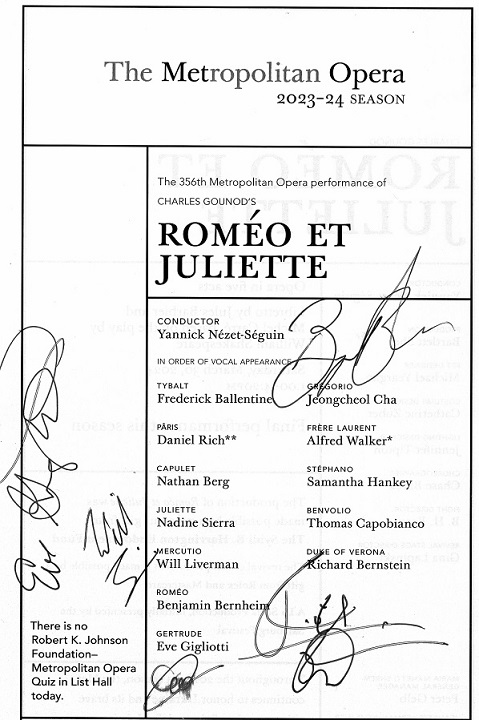
    Romeo 2024-1 jpg

    And here are the curtain calls!

    ~ Oberon
  • My 1st Time Hearing DIE WALKURE

    Nilsson

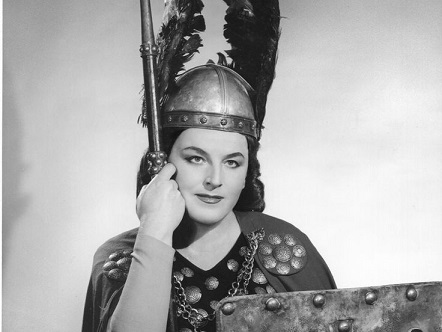
    Above: Birgit Nilsson as Brunnhilde

    The Met’s 1961 broadcast of Wagner’s DIE WALKURE marked the first time I ever heard this opera which became, over time, my favorite of the composer’s operas. A recording of the broadcast was recently posted on YouTube. Listen here.

    I remember that some scenes seemed endless to me, and that while the music was at times very exciting, it was the story that most intrigued me…especially the ending, where Brunnhilde was left sleeping in the middle of a ring of magic fire.

    We had had a substantial snowfall the night before, and I went out to the field behind our house with the sound of the feuerzauber alive in my head. I made a circle of all the empty packing boxes and other trash from my father’s drugstore and set it afire. It was then that I realized I was in the center of the circle and would have to wait until the flames died down before I could escape. At supper, my mother scolded me for bringing a smokey smell into the house. It took a few days for the odor to dissipate.

    Metropolitan Opera House ~ December 23,1961

    Cast: Brünnhilde: Birgit Nilsson; Siegmund: Jon Vickers; Sieglinde: Gladys Kuchta; Wotan: Otto Edelmannl Fricka: Irene Dalis; Hunding: Ernst Wiemann; Gerhilde: Carlotta Ordassy; Grimgerde: Mary MacKenzie; Helmwige: Heidi Krall; Ortlinde: Martina Arroyo; Rossweisse: Margaret Roggero; Schwertleite: Gladys Kriese; Siegrune: Helen Vanni; Waltraute: Mignon Dunn

    Conductor: Erich Leinsdorf

  • Gabriella Tucci ~ ‘Ave Maria’ from Verdi’s OTELLO

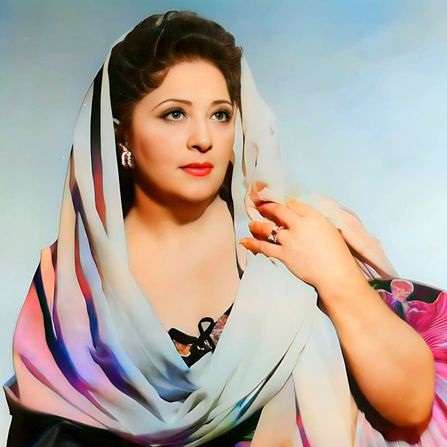
    Tucci desdemona

    Gabriella Tucci sings the Ave Maria from Verdi’s OTELLO from a 1967 performance given by The Met on tour in Atlanta. Zubin Mehta is the conductor.

    Listen here.

  • Gabriella Tucci ~ ‘Ave Maria’ from Verdi’s OTELLO

    Tucci desdemona

    Gabriella Tucci sings the Ave Maria from Verdi’s OTELLO from a 1967 performance given by The Met on tour in Atlanta. Zubin Mehta is the conductor.

    Listen here.

  • Tucci & Corelli ~ Vicino a te

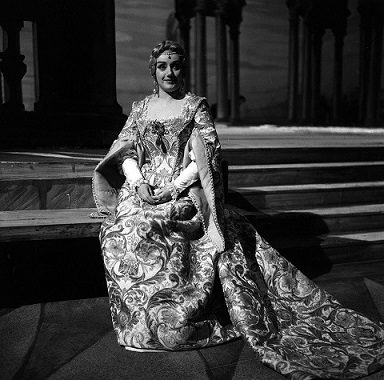
    Tucci corelli

    Gabriella Tucci and Franco Corelli sing the final duet from Giordano’s ANDREA CHENIER from a 1971 performance at The Met; Cornell MacNeil is Carlo Gerard, and Fausto Cleva conducts.

    Listen here.

  • Coming Out ~ 50 Years Ago Today

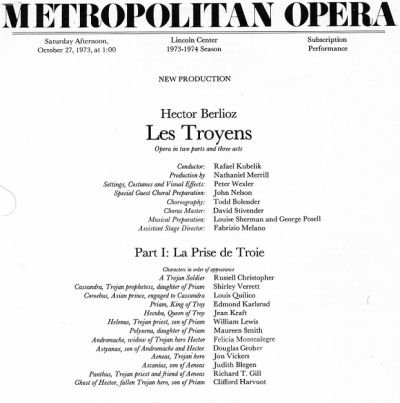
    Troyens jpg

    On October 27th, 1973, after spending a very long time in the closet, I had my first gay sexual experience. It was both thrilling and a bit frightening, but what I remember most was a great feeling of relief…and then wondering why it had taken me so long to do it.

    That day, I had spent the long afternoon with several of my opera-friends at The Met watching LES TROYENS  It was my first time seeing this monumental work, and it was unbearably exciting. Among the group was Z, the boy I had set my sights on since moving back home from Houston earlier in the year.

    Looking back, it all seemed pre-arranged, but at the time it felt spontaneous. After the Berlioz matinee, our friends all went their separate ways. But Z and I had 5th Ring tickets for an evening performance of FAUST at the New York City Opera. He sat in front of me in the single seats, whilst I was aching with desire; at this point, nothing had been said about spending the night together. 

    After Marguerite had succumbed to Faust’s poetic charms in the Garden Scene, we mutually decided it was time to leave. Z looked at his watch and announced that he’d missed the “last bus” home. Haltingly I said, “You can stay with me at the hotel.”

    We walked over to the Henry Hudson; nothing much was being said. We stayed up for a while, talking opera, and then it was time. He sat on the twin bed, undressing. “Should I sleep in the chair?” he asked. “I’ve slept in smaller beds with bigger people…” I replied. (This was a lie; I had only ever slept with my girlfriend, and always in big beds).

    So, keeping our briefs on, we got under the covers and turned out the lights. For what felt like an eternity, nothing happened. I began to think that maybe I had mis-read the situation and that we were simply going to sleep together. He had his back to me; the warmth and smell of his body were killing me. Suddenly, I put my arms around him, and several wonderful things happened. 

    After a while, we grew drowsy. “I’ve never done this before,” I said sleepily. “Me neither!” he replied. Keeping him in my arms, we drifted off.

    Waking to daylight, I got quickly out of bed and got dressed: I was meeting friends for breakfast. Z was groggy; he dressed slowly. I assumed he would head home, but – without saying anything – he tagged along to the diner.

    Our friends were obviously intrigued when we showed up together, but nothing was said. Only the quiet, bookish TJ looked at me knowingly. The conversation turned to the inevitable topic – opera – and my magical “morning after” became just another day.

    The aftermath: in the ensuing weeks, whenever I was in New York City, Z was friendly on the surface, but evasive on a personal level. He stood me up for a couple of lunch dates. I was naive enough to think that, because we had shared a sweet experience, we would become lovers. I became distraught.

    Unhappy to the core, I confided in TJ. He listened to my story patiently, then told me that Z already had a boyfriend and that he was unlikely to become the lover I was looking for. TJ and I spent more and more time together, and I became very comfortable with him as my confidante. Finally, I invited him to visit me in the little town. Our first night was awkward: I was such a novice, but he – who was four years younger than me – was already pretty experienced, starting with having been raped by his college roommate. 

    Over time, TJ and I developed a deep relationship; he invited me to spend the summer of 1974 with him on Cape Cod, working for a small-time ballet company. At summer’s end, I drove him to Sarah Lawrence where his senior year was about to begin.

    Our unspoken plan was to resume our lives – he at school and me back in the little town – and see each other whenever I came to the City. As we sat in the car saying goodbye, he suddenly started crying; it was then that I realized how strong our attachment was. Instead of leaving, I spent the night in the dorm with him. I left the next morning, but a few days later I received a letter from him, asking me to come and live with him in the dorm.

    This was the beginning of my life, really. When TJ had finished school, we moved to Hartford, where I spent the next 22 years. After a year, our domestic life faltered when I became smitten with someone else. TJ and I had a bad break-up, and he never spoke to me again. I embarked on a long and promiscuous journey, having a strange tendency to fall in love with everyone I slept with. 

    Meanwhile, my ultimate goal – to be living in New York City before my 50th birthday – loomed before me. At times, I thought it would never happen; but by a simple twist of fate, I moved to My City three months before the date I had set for myself.

    ~ Oberon

  • Anna Moffo Sings Verdi

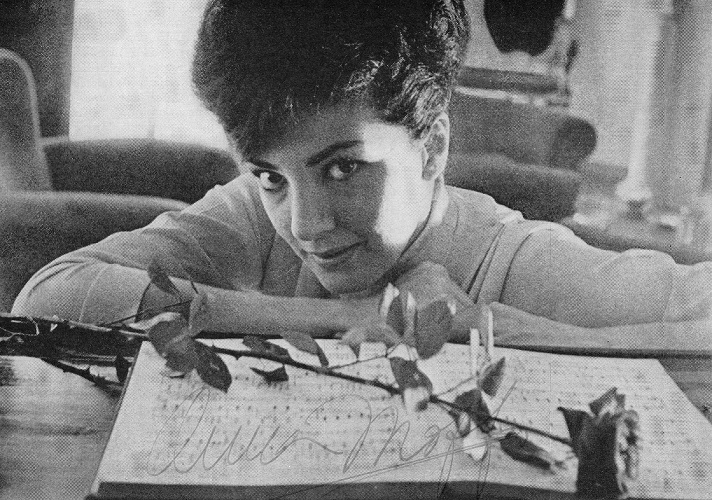
    Moffo autograph

    Anna Moffo, a beloved star at The Met in the 1960s and 1970s, made an album of Verdi arias from roles she never sang onstage. Entitled A Verdi Collaboration, the program was conducted by Franco Ferrera.

    (The photo above is autographed, though the signature has faded.)

    Here are some tracks from this wonderful and largely forgotten recording.

    Anna Moffo – ERNANI – aria

    Anna Moffo – SIMON BOCCANEGRA – aria

    Anna Moffo – VESPRI SICILIANI – aria

    Anna Moffo ~ Morró ma prima in grazia – BALLO IN MASCHERA

  • Milanov~Bergonzi~Sereni CHENIER – Atlanta 1960

    Zinka

    Above: Zinka Milanov

    A performance of Giordano’s ANDREA CHENIER given in 1960 by The Met on tour in Atlanta has just popped up on YouTube. Listen here.

    This was at the time when I was just falling in love with opera, though I had not yet discovered the Met Texaco broadcasts. Zinka was on the very first opera LP that my parents gave me; Bergonzi was Pinkerton on the first complete opera set I ever bought (the ‘second’ Tebaldi Cio-Cio-San); and not long after, I bought the de los Angeles TRAVIATA on which Sereni sang Germont.

    One of the things I loved most about finding this Atlanta CHENIER was that the cast includes three mezzo-sopranos who – over time – were to give me so many wonderful memories: Belén Amparán, Helen Vanni, and Mignon Dunn. And just look at the Met stalwarts cast in the supporting male roles:

    Atlanta, Georgia (Metropolitan Opera on tour)
    May 2nd, 1960

    ANDREA CHÉNIER

    Andrea Chénier..........Carlo Bergonzi
    Maddalena...............Zinka Milanov
    Carlo Gérard............Mario Sereni
    Bersi...................Helen Vanni
    Countess di Coigny......Mignon Dunn
    Abbé....................Gabor Carelli
    Fléville................George Cehanovsky
    L'Incredibile...........Alessio De Paolis
    Roucher.................Clifford Harvuot
    Mathieu.................Ezio Flagello
    Madelon.................Belén Amparan
    Dumas...................Osie Hawkins
    Fouquier Tinville.......Norman Scott
    Schmidt.................Louis Sgarro
    Major-domo..............Lloyd Strang

    Conductor...............Fausto Cleva

    So, despite the sometimes wonky sound quality, this recording is such a treasure to me. 

  • DON GIOVANNI @ The Met

    Mattei fang

    Above: Peter Mattei as Don Giovanni & Ying Fang as Zerlina

    Author: Oberon

    Saturday May 27th, 2023 matinee – The Met’s new DON GIOVANNI is a grey affair. Large grey architectural set pieces loom above the action; from time to time they are moved to form varying spaces as the story unfolds. The costumes are drab and muted, with the only color splash coming at the Don’s party when mannequins are wheeled in, brightly dressed in period gowns. Much of the time the singers are dressed as they might be for a rehearsal. The greyness prevails until the opera’s final sextet, when flowers, potted plants, and vari-colored domestic furnishings suddenly decorate the set.

    Aside from the Don’s killing of the Commendatore with a gun rather than in a duel, there’s nothing radical in the staging. Of course, if the production had been set in the USA, everyone would have been toting an AK-15.

    With so little to distract us visually, focus was on the singing. Adam Plachetka sounded muted in Leporello’s opening lines, but he bloomed vocally with his Catalogue Aria and was thereafter very impressive. Dmitry Belosselskiy was a strongly-sung Commendatore, responding ominously to the Don’s dinner invitation, still wearing the bloody shirt in which he was killed. In powerful voice, Mr. Belosselskiy made me look forward to his upcoming Daland.

    As the peasant couple, Masetto and his Zerlina, Alfred Walker and Ying Fang were superb. Mr. Walker is always a joy to hear, and his excellent singing today turned the oft-neglected character into a leading role. Ying Fang, with one of the most appealing voices on the current operatic scene, was exquisite in both of her arias, and she blended with Peter Mattei’s suavely-phrased singing to make “La ci darem la mano” one of the highlights of the afternoon.

    Ana Maria Martinez was a bit unsettled vocally at first, and I wasn’t sure that Donna Elvira was a role for her; but she convinced me otherwise as the opera progressed. Her “Mi tradi” was fabulously sung: in a delightful musical collaboration with conductor Nathalie Stutzmann, Ms. Martinez made the aria glow. The soprano, looking like an earnest CEO in her fitted forest-green frock and black stilettos, found the perfect mix of determination and frustration in the character.

    Federica Lombardi had a triumph in her third Mozart role at The Met: following her Countess Almaviva and Elettra (IDOMENEO), she sang brilliantly as Donna Anna today, throwing in some embellishments along the way, which Mme. Stutzmann wisely allowed. All afternoon, the Lombardi voice rang clear and true, with free-flowing coloratura, and capping the ensembles brightly. In the great aria “Non mi dir“, Ms. Lombardi was poignantly expressive in her plea for understanding, and then set off the fireworks for the aria’s fast-paced conclusion.  

    Ben Bliss as Don Ottavio gave us some of the most expressive singing of the afternoon, with lovely dynamics in the touching “Dalla sua pace” and a sure command of the dazzling demands of “Il mio tesoro“. Ben’s visible frustration when Donna Anna asked for ‘more time’ after demise of her nemesis, Don Giovanni, was much appreciated by the audience.

    Peter Mattei’s Don Giovanni made a huge impression at The Met in 2009, in another drab production, which I watched with Lisette Oropesa – the first act onscreen at List Hall and the second from a balcony box. We  were both bowled over by his vivid characterization and his mellifluous singing. This afternoon, in a production that casts the Don as a psychopath, Mattei was equally impressive…and the voice is more beautiful and subtle than ever. His “La ci darem la mano” with Ying Fang, his ‘champagne aria’ (taken by Ms. Stutzmann at lightning speed) and his ravishing serenade, “Deh, vieni alla finestra“, were perfect.

    What separated this performance from most everything else I have seen at The Met this season was the conducting: the majority of the operas have been played fast and loud, apparently in an attempt to make things more ‘exciting’. As a result, singers were often made to choose between forcing or being drowned out. As a singer, Ms. Stutzmann knows what to do on the podium; so today, every note and word was clearly audible, and no one seemed to be putting undue pressure on their voice. 

    Moreover, Ms. Stutzmann gave the music a wonderful sense of flow, often moving directly from recitative to aria without pause. There was an especially lovely trio continuo players today: John C. Kelly (fortepiano), Kari Jane Docter (cello), and John Lenti (theorbo and mandolin). It was Mr. Lenti who gave the Mattei serenade its enchanting accompaniment. I cannot say which of the Met Orchestra’s cellists was responsible for the splendid playing in Ms. Martinez’s wonderful “Mi tradi“, nor which clarinetist brought such warmth and clarity to the playing of the downhill scales in Figaro’s “Non piu andrai” as part of the Don’s dinner music.

    And so, I wanted very much to meet Nathalie Stutzmann after the performance. I went down to the stage door – after the enthusiastic ovation during the curtain calls – to find that a large crowd had gathered there. The singers came out and were greeted like rockstars, and they all lingered, chatting up the fans.

    I think all afternoon the scandale was on people’s minds – at least those people who like gossip. During the performance, there had been no hint of any tension between the pit and the podium, although the players who sit nearest the spot from which the conductor enters – and who usually start clapping loudly when Maestro X, Y, or Z first appears – didn’t do that for Ms. Stutzmann today. But the audience soon spotted her and gave her a round of bravas.

    Ar last Ms. Stutzmann came out, and after she had greeted some other fans, it was my turn. I had thought of some non-controversial things to say to her, but my shyness overwhelmed me. She signed my program, and I embraced her, and said: “I love your Alto Rhapsody!” which made her smile. Listen to it here.

    Stutzmann autograph-1jpg

    ~ Oberon

  • WALKURE ~ Bayerische Staatsoper 1977

    Behrens (2) jpg

    A 1977 performance from the Bayerische Staatsoper of Wager’s DIE WALKURE features the Sieglinde of Hildegard Behrens (above); I saw Behrens in the role twice at The Met in 1983, and she was thrilling.

    Listen here.

    Conductor: Wolfgang Sawallisch

    Siegmund – James King
    Sieglinde – Hildegard Behrens
    Hunding – Kurt Böhme
    Brünhilde – Gwyneth Jones
    Wotan – Theo Adam
    Fricka – Brigitte Fassbaender
    Gerhilde – Leonore Kirschstein
    Ortlinde – Antonie Fahberg
    Waltraute – Charlotte Berthold
    Schwertleite – Ortrun Wenkel
    Helmwige – Gertrud Freedmann
    Siegrune – Helena Jungwirth
    Grimgerde – Liliana Netschewa
    Roßweiße – Gudrun Wewezow