Tag: The Met

  • Audrey Stottler Has Passed Away

    AudreyStottler

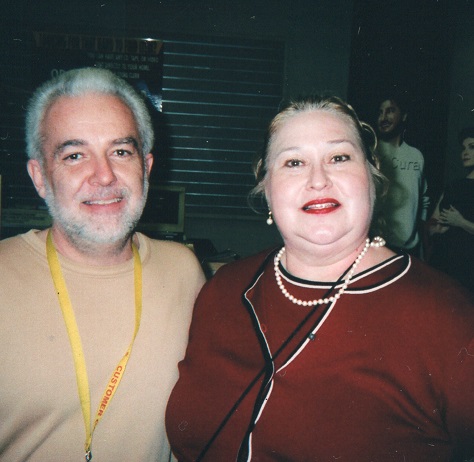
    September 15th, 2018 – I’ve learned of the death of Audrey Stottler (above), who I met in 2003 when she was in New York City to cover – and sing a single performance of – the Dyer’s Wife in FRAU OHNE SCHATTEN at The Met.

    Audrey came in the opera room at Tower Records where I was working at the time, and my boss Bryan and I chatted her up. Bryan had seen her as Turandot at Virginia Opera in 1993. and I’d seen her 2002 Met Turandot – a role she sang worldwide – and we were looking forward to the FRAU. She was most gracious during our long conversation.

    Audrey had a notable success as the Dyer’s Wife; I recall being especially impressed by her juicy upper tones, the unusual richness of her lower range, and the sense of lyricism in her singing.

    This scene from WALKURE displays her vocal attributes quite well:

    Audrey Stottler – Die Walküre ~ Der manner sippe

    And this is thrilling, grand-scale Wagner singing:

    Audrey Stottler – Tristan und Isolde ~ Isolde’s Narration & Curse

    At the time of her unexpected death, Audrey was running a popular voice studio in Minneapolis.

    Scanned Section 2-1 (3)

    Bryan took this photo of me with Audrey the day we met her. There are some lovely tributes to her on Norman Lebrecht’s blog.

    ~ Oberon

  • Leonie Rysanek as Sieglinde

    Scanned Section 6-1

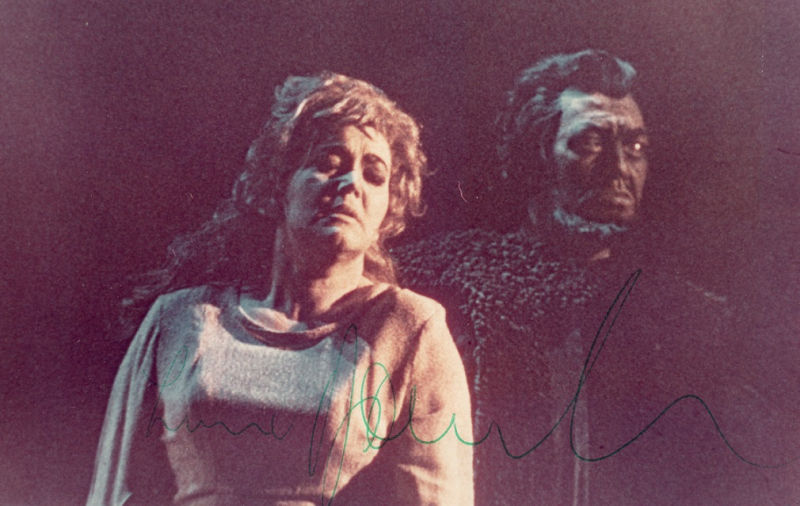
    I brought this photo of Leonie Rysanek with me for her to autograph after a performance of FRAU OHNE SCHATTEN at The Met in 1971. Why she was signing photos with a green pen I am not sure…her signature is barely legible; but she loved the photo. With her in the picture is basso David Ward, as Hunding.

    I did not see Rysanek as Sieglinde until 1988, in a matinee performance that marked the last time she sang this signature role of hers at The Met. Hildegard Behrens, to whom Rysanek later left the Lotte Lehmann Ring, was Brünnhilde. The two divas took many bows together after the performance, to the delight of the huge crowd.

    Walkure6465.01

    Among the great tenors who sang Siegmund to Rysanek’s Sieglinde was Jon Vickers (Met Opera Guild photo, above).

    In 1985, Rysanek sang Sieglinde in the first act of WALKURE as part of her 25th anniversary gala celebration at The Met; Peter Hofmann was her Siegmund that afternoon. My friend Paul Reid and I were there. Rysanek had become famous for her scream at the moment Siegmund pulls the sword from the tree; this was apparently Wieland Wagner’s idea, and it became a signature moment whenever the soprano sang Sieglinde anywhere in the world. 

    As the 1985 gala was a concert performance, with the orchestra onstage and the singers in gown and tux, there was some speculation as to whether Rysanek would include the scream. “It would break the frame of the concert,” said the woman sitting behind us. “She won’t scream.” She screamed.

    As a sampling of Rysanek in the role of Sieglinde, here she is – in fabulous voice – at Bayreuth in 1967, opposite James King:

    Leonie Rysanek – Der Männer Sippe ~ WALKURE – with James King – Böhm cond – Live @ Bayreuth 1967

  • Immortal Longings

    A + C

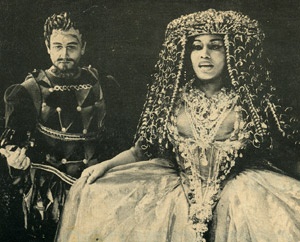
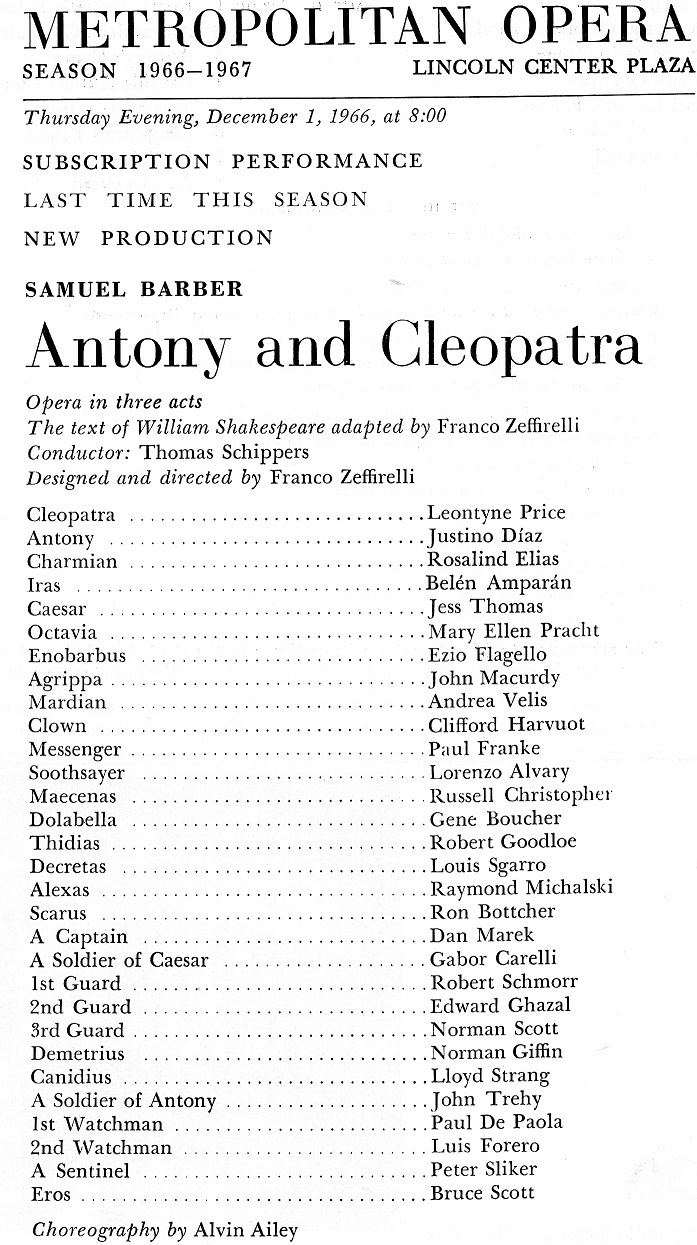
    Above: Justino Diaz and Leontyne Price in Samuel Barber’s ANTONY & CLEOPATRA at The Met, 1966

    ~ Author: Oberon

    By chance, I came upon this film of Leontyne Price singing Cleopatra’s final aria from Barber’s ANTONY & CLEOPATRA at a 1984 concert at Juilliard, conducted by Jorge Mester. Ms. Price’s singing here shows some of the vocal idiosyncrasies that crept into her performances as the 1970s progressed into the 1980s. But the sheer sound is glorious, the upper notes sustained, steady, and thrilling. What I love most about her in this brief video is her stillness – she doesn’t flail her arms about melodramatically; it’s all contained in the music – and her great sense of personal dignity.

    Scanned Section 18-1

    Barber wrote Cleopatra’s music specifically with Leontyne Price’s voice in mind. After the run of performances that opened the New Met in 1966 – of which I attended the last – the opera vanished from the Met repertoire. The composer devised a concert ending for the great final aria so that Ms. Price, and others to follow, might include it in their appearances with symphony orchestras. 

    A revised version of ANTONY & CLEOPATRA was given at Juilliard in 1975, a performance of which I attended:

    Scanned Section 8-1

    The European premiere of the opera (in concert form) took place at the Théâtre des Champs Elysées, Paris, in 1980. Chicago Lyric Opera gave the opera in 1991 with Richard Cowan and Catherine Malfitano in the title-roles. There was a telecast, which I watched – really impressive – and which you can watch here and here!

    In 2009, New York City Opera gave the opera in concert form at Carnegie Hall with Teddy Tahu Rhodes and Lauren Flanigan as Antony and Cleopatra. I was there, and the cumulative effect of the opera was powerful.

    Writing about this opera gives me an opportunity to bring forth one of the great rarities from my collection: a performance of the final aria of Cleopatra by mezzo-soprano Beverly Wolff from a concert at Cincinnati in 1971. Martina Arroyo was to have been the vocal soloist that evening, but she was taken ill and Ms. Wolff stepped in on very short notice; musical revisions were made to accommodate the switch from soprano to mezzo-soprano.

    Beverly Wolff ANTONY & CLEOPATRA aria Cincinnati 1971

    ~ Oberon

  • Huguette Tourangeau Has Passed Away

    Tourangeau

    Above: Huguette Tourangeau as Parséïs in Massenet’s ESCLARMONDE at The Met

    It’s sad to read of the death of the French-Canadian mezzo-soprano Huguette Tourangeau, a strikingly attractive woman possessed of a truly unique voice. Her sound was sensuous, her lower range incredibly resonant. I saw her at The Met as Nicklausse in CONTES D’HOFFMANN and as Parséïs in Massenet’s ESCLARMONDE in the 1970s.

    OPERA NEWS caught up with Mlle. Tourangeau in 2011: read the article here.

    A frequent colleague of Dame Joan Sutherland, Huguette Tourangeau scored a great personal triumph as Elisabetta in Donizetti’s MARIA STUARDA opposite the Australian diva at San Francisco in 1971.

    Huguette Tourangeau – scena d’Elisabetta – MARIA STUARDA~Act I – San Francisco 1971

  • @ My Met Score Desk for TOSCA

    E874b757ab6d27cdce90e262524cf12e

    ~ Author: Oberon

    Saturday January 27th, 2018 matinee – The Met have fortunately replaced their unsightly and theatrically tedious Luc Bondy production of TOSCA with a traditional setting of the “shabby little shocker”; it opened on New Year’s Eve with a cast and conductor that had undergone changes in the run up to the prima.

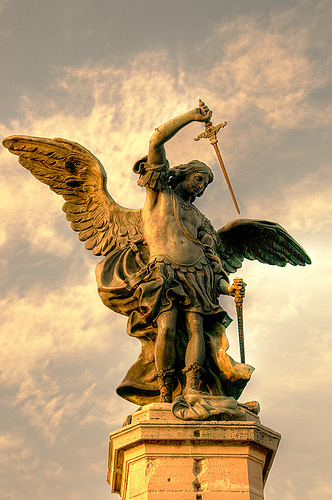
    Aside from the dramatic show curtain depicting the Archangel Michael with blood-red wings, I could not see anything of the sets and costumes from my score desk. In April, I’ll get a full-view when the ‘second cast’ takes over.

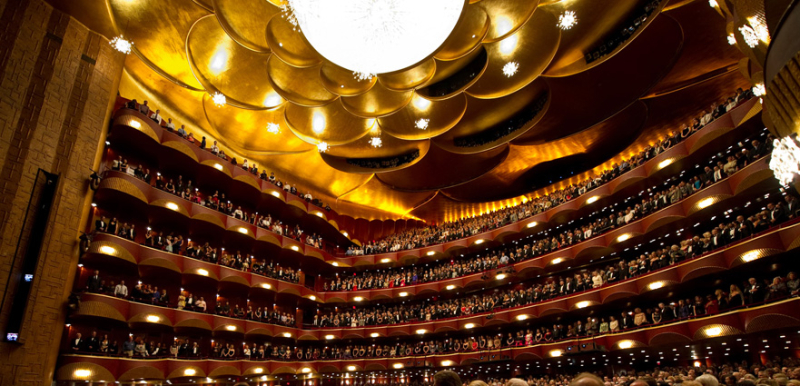
    Other than at performances of TURANDOT, this was the fullest house I have seen at The Met in the past few seasons. Apparently many in the audience found the MetTitles in Act I to be hilarious today, for there was much unbridled laughter.

    The orchestra sounded great, and I’ve always liked Emmanuel Villaume’s conducting both in the opera house and the concert hall. His TOSCA was on the grand scale, painted in broad strokes, with tempi that pressed forward; yet there were also the needed lyrical respites where orchestral detail could be savoured. Villaume also allowed his singers to cling to favorite notes, without losing the shape of the music. A volcanic eruption of orchestral sound as the ‘Scarpia Chords’ heralded the Baron’s entry was actually thrilling.

    Sonya Yoncheva has been singing her first career Toscas in the present run. My past experiences with her in the theater have been as a pleasant Mimi and a moderately attractive Desdemona. In both those roles, a rather generic timbre and a tendency to sing slightly above pitch rather frequently offset her physical appeal and pretty but unexceptional vocalism. Making a sudden leap (oops!) to Tosca seemed like an unwise move for her; but, since I’m not a fan, do I really care if she blows her voice out?

    Her Tosca was sung with unrelenting loudness; it’s a one-colour voice to begin with, and she seemed indifferent to the markings in the score, seldom if ever singing less than mezzo-forte. Being a shade sharp much of the time did not help matters. She’s pushing the lower range, and the top now tends to waver a bit. Overall there was a sense of forcing to fill the big hall.

    The “Vissi d’arte” was over-sung, without the pulling back at “Nell’ora del dolore…” that personalizes the aria. In terms of declamation, Ms. Yoncheva  melodramatically veered from ‘shrilling’ on “Tu non l’avrai stasera…giuro!” to shouting on “Sogghigno di demone!”  Overall, she often seemed fully-extended. Yet her big aria won her a big applause, and I feel she’ll be encouraged to make further forays into roles calling for a more dramatic sound than is hers by nature. I would guess in three or four years she will find herself in a similar situation vocally to the woman she replaced in these performances.

    Vittorio Grigolo’s Cavaradossi is likewise a step or two in vocal heft beyond the roles we’ve heard him sing to date. A generous singer, Grigolo pleases the crowd with his unfettered sound; he can zing out top notes that have a real spark but – unlike Ms. Yoncheva – he does on occasion throw in a piano note or turn a phrase more gently.

    In the past, Željko Lučić has sometimes annoyed me with his errant sense of pitch in the Verdi roles, but today as Scarpia that problem cropped up only in passing. Following the thundering chords that announce Scarpia’s arrival in the Church of Sant’Andrea della Valle, Mr. Lučić unleashed his own thunderbolt with “Un tal baccano in chiesa?!”, catapulting to a house-filling top note. He alone of the three principals seemed to be doing something with the the words, and his singing veered from ripe power to velvety insinuation. As Tosca fled the scene after their encounter, Mr. Lučić’s Scarpia laid the groundwork for his plot. In the ensuing Te Deum, baritone, chorus, and orchestra combined forces for genuinely exciting finale to the first act.

    Lučić continued to impress in Act II, despite the occasional flat note. Ferocious in his questioning of Cavaradossi, feigning cordiality as he drew Tosca to the bargaining table, brazenly expounding on his lechery in “Gia, mi dicon venal”, the Serbian baritone joined the ranks of my favoured Scarpias over the decades: Anselmo Colzani, Cornell MacNeil, Sherrill Milnes, Robert Hale, Frederick Burchinal, and Justino Diaz.

    It’s rare to hear a Sacristan who really sings: Patrick Carfizzi put the emphasis on the notes, and let the comedic aspects of the character take care of themselves. He sounded fantastic.

    I was planning to stay for the third act, but as so often happens at The Met, the endless intermission got on my nerves and so, after a while, I packed up and headed home.

    ~ Oberon

  • Evelyn Mandac

    Mandac

    Evelyn Mandac (above), a soprano from The Philippines, sang several performances as Lauretta in Gianni Schicchi plus a single Gretel at The Met in 1976.

    She appeared with San Francisco Opera as Susanna in Le nozze di Figaro, Despina in Cosi fan Tutte (with Frederica von Stade and Evelyn Lear), and as Ines in L’Africaine (with Shirley Verrett and Plácido Domingo). The Meyerbeer is preserved on the Gala label.

    Ms. Mandac sang in the American premieres of works by Henze, Berio, and Pasatieri, and she made a commercial recording of Orff’s Carmina Burana with The Boston Symphony, conducted by Seiji Ozawa.

    Evelyn Mandac – O mio babbino caro – GIANNI SCHICCHI – Met 1976

  • Opening Night @ The Met: NORMA

    881x425_membership_bucket

    ~ Author: Oberon

    Monday September 25th, 2017 – I took a score desk for this evening’s NORMA at The Met; if memory serves, this the first time I’ve ever attended an opening night.

    In 2013, Sondra Radvanovsky gave a sensational portrayal of Norma at the Met. She has sung a great deal since then, and in very demanding roles. One hoped very much that her success tonight might equal or even surpass her prior Met outing as Bellini’s noble and tragic priestess.

    The evening started out on a sour note: with a scheduled start-time of 6:30 PM, the hall should have been open for seating by 6:00 PM or very shortly thereafter. Instead, ticket-holders were left standing outside closed doors for nearly 25 minutes. Balcony and Family Circle patrons were packed into the hot, airless area outside the auditorium, and many elderly people found this truly unpleasant. No announcement or explanation was given.

    The house was not full as we settled in. Following the playing of the National Anthem, during which no one seemed to be kneeling but some soprano took the ‘Licia Albanese option’, there was a long pause, and at last the opera began. Then there was an immediate disruption in my area as a late-arriving patron was seated by a flashlight-wielding usher.

    As I was at score desk, I cannot report on the production, but I do want to see it at some point later in the season: a friend who had attended the dress rehearsal assured me that it’s the kind of production I will like.

    Carlo Rizzi has never been more than a routinier; he was absent from The Met for nine years (from 2007 to 2016) but now he’s back, conducting a new production on opening night. This was actually one of the better Rizzi experiences I have had over the years, though still not really inspired. There were some cuts taken, and also a couple of very weird re-arrangements of things, of which there were no signs in the score I was following. The orchestra played quite beautifully all evening – notably the flute solo that introduces “Casta diva” – and the chorus seemed at their best.   

    Michelle Bradley sang Clothilde – we’ll have to wait to hear her in something bigger to get an idea of the voice, but it seems promising – and Adam Diegel was a vocally strong and assured Flavio.
    5780b6e8cf49e

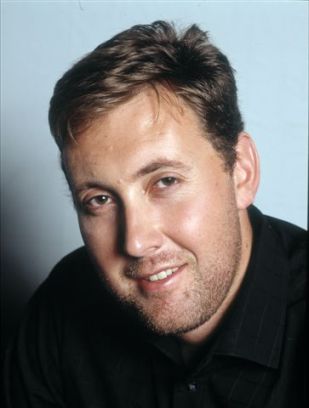
    Matthew Rose (above) was a splendid Oroveso, covering the wide range impressively and bringing the role very much to prominence. Both his great scenes – “Ite sul colle” and “Ah, del Tebro” – were vocal highlights of the evening, and in an story full of broken hearts, Mr. Rose reminded us of Oroveso’s own heartache with his expressive singing in the final pages of the opera.

    As Pollione, Joseph Calleja’s voice sounded huge in his opening phrases. I love the sound of his voice, and his phrasing, inflections, and mastery of working piano/pianissimo shadings into the vocal line were truly impressive. Unfortunately, much of his vocalism all evening was beset by a tendency to sing sharp, and this offset the positive aspects of his performance.

    I’ve always felt that Adalgisa should be sung by a soprano; despite the thrill of hearing the voice of a Simionato, Horne, or Cossotto in this music, both its range and the character’s supposed youthfulness seem to call for a lighter quality. Joyce DiDonato’s somewhat slender voice definitely has a sopranoish quality to it, and from her first soft entry, her opening monolog (it’s not really an aria) was extremely impressive both as singing and as a portrait of the character: young, hopeful, vacillating in her romantic turmoil. Ms. DiDonato was able to bring a sense of drama to everything while remaining scrupulously musical.

    Screen-Shot-2016-11-07-at-8.16.24-PM-600x400

    Above: Joyce DiDonato

    In the exciting duet for Adalgisa and Pollione that concludes the opera’s first scene there developed a remarkable atmosphere mixing desire with apprehension: Ms. Di Donato’s excellent colourings brought the young priestess’s dilemma to high relief. Stating that she must never see Pollione again draws his query: “E il nostro amor?” (“And what of our love?”) to which Ms. DiDonato replied on an exquisitely sustained top-A: “Ah…l’obbliai!” (” Let it be forgotten!”). Later, Mr. Calleja had one of his loveliest moments as he asked her, sweetly, “Abbandonarmi cosi?” (“You would abandon me, then?”). Later, Ms. DiDonato interpolated an exciting volley at “Mi lascia!” (“Leave me!”), and the end of their duet drew thunderous applause. 

    From this point forward, Adalgisa’s music is tightly meshed with Norma’s, so I will digress now to discuss Sondra Radvanovsky’s performance of the high priestess’s great opening scena. Establishing her authority at once, the soprano’s well-measured recitative “Sediziose voci” set the groundwork for all that will follow. Calming her people’s cries for war against the Romans, she assures them that Rome will perish – not thru their uprising but “like a viper self-stung…” Then comes the evening’s first great moment of Radvanovsky magic: a simply ravishing, sustained pianissimo high-A on “…io mieto.”

    Sondra’s “Casta diva” this evening was one of the most moving and fascinating musical experiences of the past two decades: not only was it beautifully phrased and enunciated: it transcended the act of singing and took us to a higher spiritual level. At first, following along with my score, I was mesmerized not only by the soprano’s unique timbre but also by her ideal turns of phrase: it’s how I’ve always imagined this aria could be sung. I became aware of the palpable hush that had fallen over the House: the entire audience seemed spellbound, afraid to even breathe lest the spell be broken. A singer with the power to hold an opera house in the palm of her hand is a rarity today; in this heartfelt and ever-so-timely prayer for peace, Sondra’s voice seemed like a beacon of hope. 

    Reassuring the populace that the Roman proconsul will fall with her stunning “Cadra! Punirlo io posso!“, Sondra now sings the cabalettaAh bello a me, ritorna” expressing her hope that she can again find joy in her love for Pollione which has of late been strained for some reason she can’t comprehend. Despite a few passing phases where her coloratura was a bit imprecise, Sondra swept thru the first verse with aplomb, then took a cadenza up to a gorgeous ppp high-C before commencing an embellished second verse; this she crowned with a massive high-C. 

    In the opera’s second scene, the reason for the perceived rift between Norma and Pollione is revealed: he has fallen in love with the younger Adalgisa. In their meeting, as Adalgisa explains her predicament to Norma, the older woman is at first sympathetic; but when it’s revealed that Adalgisa’s suitor is “a Roman”, all hell breaks loose.

    In this duet, Norma reassures Adalgisa with the phrase “Ah si, fa core” (“Take heart…!) which carries her up to a sustained top-C. Normally, Adalgisa repeats this phrase and mirrors Norma’s high note; tonight, instead, we went off on some interpolated tangent I’d never heard before. Finally, the two women blend voices in a harmonized cadenza: Radvanovsky and DiDonato matched up very well indeed.

    When Pollione shows up (drawing titters from the audience), Sondra launches Norma’s vicious “Oh, non tremare!” with its dual assaults on high-Cs that are simply ballistic. A trace of flatness intruded at “O di qual sei tu vittima” but was quickly set to rights. The ensuing trio is given the full treatment, including a sometimes-cut ‘verse’ for Adalgisa. The stretta is then thrillingly rendered, with Sondra latching on to a stupendous high-D.

    How beautifully the Met strings ‘sang’ the melody of “Teneri figli” (“Beloved children..”) at the start of Act II. In the monolog where Norma ponders killing her sons, Sondra made cunning use of chest voice. She sang the long lines of “Teneri figli” with moving inflections.

    Adagisa, awash with guilt at having hurt Norma, is shocked to hear Norma ask her to take the children to Pollione and remain with him: “Pei figli suoi…” as Sondra sings with such dazzling control: “…for the sake of his children…” Ms. Di Donato again skirted a high-C that echoes Norma’s, though she seems to have the note in her range.

    If my ears played me true, “Mira, O Norma” was sung in F; it might have been better taken down a have-tone as Ms. DiDonato’s voice seemed to be tiring just a bit (though still mighty attractive) and some of her highest notes seemed a bit opaque. Norma’s “Ah perche, perche…” found Sondra at her most marvelous, and together the two women achieved a truly sweet blend. The second verse of “Si, fino al’ora” included some appealing rubato effects. The audience showered the two singers with well-deserved cheers and applause.

    NORM_3836c-768x512

    Above: Sondra Radvanovsky as Norma in a Ken Howard/Met Opera photo

    In the final scene, Norma still has so much to sing, and here Sondra pulled out all the stops and sealed her triumph in no uncertain terms. At first hopeful that Adalgisa might persuade Pollione to come back to the mother of his children (Sondra’s spun-out ppp high-C at “…del primo amore“), such hopes are dashed: Adalgisa has been unsuccessful and Pollione has vowed kidnap his beloved from the Druid temple. Now Norma’s wrath is unleashed: Roman blood shall flow in torrents –  a titanic Radvanovsky high-C at “…sangue Romano!” as her warriors emit a surprising, lusty war cry. Rizzi takes the “Guerra” chorus at breakneck speed, but includes the “dawn” ending with Sondra’s floated final note. 

    Pollione is captured and Norma is to interrogate him. He asks only for a swift death. But in the great duet “In mia man alfin tu sei” (“Your fate is in my hands…”) she taunts him, threatening to kill his children and to reveal Adalgisa’s deceit to the people: deceit punishable by death. Using chest voice to great effect, as well as bewitching softness at “Preghi alfin?”, Sondra is simply at her peak here. Mr. Calleja’s continuing sharpness was a distraction, though.

    About to name Adalgisa as a traitor, Norma is gripped by her conscience – how can she accuse the girl of the same crime she herself has committed? When the people cry out for the name of the guilty person, Norma replies “Son io!” (“It is I!”): Sondra taking my breath away yet again. In “Qual core tradisti…”, Pollione sees Norma for the noble, honest woman she is and repents his actions. They will die together at the stake. Sondra’s remarkable piano singing in this ensemble, and her majestic top-B, can be added to the endless list of vocal jewels in her performance.

    The end is reached: Norma and Pollione face the pyre together. Then Norma remembers her children: she knows they will be executed as Roman bastards. She confesses the fact of her motherhood to her father, Oroveso, who at first shuns her.  Then, in a final overwhelming plea, “Deh, non volerli vittime” (“Do not let them be the victims of my own misdeeds..”), Norma slowly wins her father over. From her piano first pleadings to the overwhelming power of her joy when Oroveso relents, Sondra transforms this passage into the crowning glory of her magnificent performance.

    DKaw98fV4AEkdWQ.jpg large

    Above: Sondra Radvanovsky as Norma at The Met

    Catch the curtain calls here.

    ~ Oberon

  • John Osborn: A Tribute to Gilbert Duprez

    DE3532Cover-1024x1024

    Tenor John Osborn has released a new disc of operatic arias on the Delos label, and it’s a beauty. While three of the four composers represented are Italian, all of the selections are sung in French. The operas from which the arias are culled were all associated with Gilbert Duprez (1806-1896), who has always been credited with inventing the “do di petto” (the high-C from the chest).

    Mr. Osborn had an exciting success as Rodrigo di Dhu in Rossini’s LA DONNA DEL LAGO at The Met in 2015; his singing on the night I saw it really perked up a pleasing but rather staid evening. The new Delos album shows the tenor’s artistry to striking effect, and he receives admirable support from Maestro Constantine Orbelian, the Kaunas City Symphony, and – in Arnold’s great scène from GUILLAUME TELL – the Kaunas State Chorus.

    The disc begins with two arias from JERUSALEM, the adaptation of his 1843 opera I LOMBARDI that Verdi made for Paris in 1847. The first of these, “Je veux encore entendre ta voix“, is a lilting melody so familiar in its Italian setting (“La mia letizia infondere“). The opera’s hero Gaston, captured and imprisoned while on the Crusade, sings of his longing for his far-away beloved Hélène. The aria is a perfect introduction to Mr. Osborn’s singing, which is graceful, poetic, and full of affecting colors. Dynamic control is this tenor’s long suit, and his beautifully tapered phrases fall sublimely on the ear. Maestro Orbelian conspires with the singer to conjure up some lovely rubato effects, and the first Duprez-like foray to the top is really impressive. Mr. Osborn finishes off the aria with an easy ascent to a ringing high third before the final cadence. 

    The second JERUSALEM selection is less well-known: “Ô mes amis, mes frères d’armes“, in which Gaston, wrongly accused of murder, pleads with his comrades-in-arms to end his dishonored life. One again, Mr. Osborn shows a heartfelt mastery of mood, shading his singing with a sense of vulnerability. For all the drama of the situation, the tenor’s vocalism is wonderfully fragrant, most especially at the phrase “Je pleure, hélas, comme une femme…”

    The first of the disc’s four Donizetti arias is next: the poignant “Ange si pur” from LA FAVORITE. Fernand, on the eve of his marriage to his beloved Leonor, learns that she has been the mistress of the king. He seeks refuge in a monastery where he recalls his brief happiness and laments the shattering of his dream. Mr. Osborn’s rendering of this aria ranks with the best I have heard: imbuing his singing with such sweet sadness, the tenor astonishes with his ascent to the aria’s treacherous high-C. A remarkable cadenza and the singer’s spectacular mastery of the dynamic spectrum left me in a state of awe.

    LES MARTYRS was Donizetti’s French treatment of his opera POLIUTO, a story of Christian martyrdom which met with censorship just before its Italian premiere in 1838. Withdrawing from the fray, the composer moved to Paris and revised the opera specifically for Gilbert Duprez. In the aria “Oui, j’irai dans leur temple“, the Christian leader Polyeucte vows to go to the Roman temple to fulfill a vow of faith, despite the promise of martyrdom. The aria is a statement of resolve and a call to action; with God’s protection, Polyeucte will cast down the Roman idols. Mr. Osborn delivers it magnificently, reveling in the Duprez-inspired high notes and ending in thrilling fashion.

    Inexplicably, I have never listened to Hector Berlioz’s epic BENVENUTO CELLINI all the way thru; this makes no sense, as the composer’s TROYENS, BEATRICE ET BENEDICT, La Captive, and the magical Les nuits d’été are among my all-time favorite works. In the two CELLINI arias which John Osborn includes on his disc are so cordially sung that my curiosity to hear the full opera is now piqued (though finding the time will be another matter…) 

    La gloire était ma seule idole” finds the sculptor Benvenuto Cellini anticipating the arrival of his beautiful mistress Teresa. This expressive aria begins over a delicate accompaniment but soon blooms into a paean to the artist’s beloved. John Osborn brings a delicious feeling of tenderness to his singing here. The second verse is more extroverted, and ends with a prayer that heaven may protect Teresa, and protect their love. Here Mr. Osborn does some of his most affecting singing in an already-affecting program.

    The second CELLINI aria, “Sur les monts, les plus sauvages” is this disc’s ‘secret treasure’. It begins with a very Berliozian introduction leading to a pensive recitative in which we can again savour John Osborn’s gift for colour and verbal acuity. As the drama builds, Cellini rails against his destiny as an artist. When the aria proper begins, the sculptor longs for the life of a simple shepherd; herein, Mr. Osborn treats us to  beautifully sustained and reflective singing with a deliciously plaintive quality. The music becomes slightly more restless, and I am put in mind of Hylas’s lovely aria of longing for his homeland: “Vallon sonore” from LES TROYENS. In the second verse of Cellini’s aria, Mr. Osborn’s vocal control is so impressive, and the music’s rising passion brings us some superbly sustained notes and the singer’s congenial flexing of his dynamic muscles. The aria’s conclusion is superbly rendered.

    From Donizetti’s LUCIE DI LAMMERMOOR, we have Edgard’s great final aria of lament for his ill-fated love for Lucie; here given in the “Duprez/French” setting as “Bientôt l’herbe des champs croîtra“, the desolate young man awaits a duel with Lucie’s brother among the graves of his forefathers. 

    Though it may seem like an over-abundance of praise, I must again remark on Mr. Osborn’s fascinating account of this very familiar scene, for he begins the opening recitative “Tombs of my ancestors…” in an incredibly hushed piano, and his sense of exquisite grief is palpable; his despair over his thwarted love draws us in deeply. A plangent swelling of the tone marks at the recitative conclusion marks Edgard’s hapless expression of longing for death.

    The aria proper is awash with heartbreak, the tenor’s phrasing so persuasive, ravishing in its eloquence. The concluding cadenza is nothing less than fabulously passionate, yet Mr. Osborn then sinks the voice to a sustained delicacy before a final expression of hopelessness. Masterful!

    In Donizetti’s DOM SEBASTIEN, the title character is the king of Portugal. Following a devastating battle against the Moors, he stands alone on the battlefield, surrounded by the dead of both armies, and longs for the consoling sight of his beloved. With its atmospheric harp introduction, the aria is unusually lovely for it’s sad setting. Mr. Osborn’s phrasing is elegiac, and his meshing of the top note into the fabric of the melody is so skillfully handled. The cadenza here again left me in a state of true admiration for the singer.

    The program concludes with the GUILLAUME TELL scene in which Arnold summons his courage – and that of his Swiss countrymen – to throw off the yoke of the cruel Austrian governor Gessler. Constantine Orbelian and his players set the scene in the melancholy introduction, and Mr. Osborn commences the recitative’s “Do not abandon me, hope of revenge” with sublime softness. 

    A GISELLE-like motif sets the aria proper – Asile héréditaire – on its way, with John Osborn’s easy ascents to the high range impressively handled. The melody expands in breadth before a gentle reprise; the tenor’s tender coloration of the phrase “…pour le derniere fois…” is yet another moment to savour. Then comes the fiery cabaletta, “Amis! Amis, secondez ma vengeance!“, an irresistible call to arms which Mr. Osborn ends on a triumphantly sustained high-C.

    To say that this new Delos offering pleased me greatly would be an under-statement. Perhaps the highest praise I can give is to say that the disc joins my long-time favorite tenor collections – Carlo Bergonzi’s first Decca album and Luciano Pavarotti’s all-Donizetti program – to form a triumvirate of tenor trophies which I will turn to often.        

    ~~~~~~~~~~~~~~~~~~~~~~~~~~~~~~~~~~~~~~~~~~~~~~~~~~~~~~~~~~~~~~~~~~~~~~~~~~~~~~~~~~~~~~~~~~~~~

    GilbertDuprez

    Gilbert Duprez (above), the tenor who inspired the new Delos disc, was born in Paris in 1806, studied there, and made his operatic debut at the Odéon in 1825. When his career failed to develop, he sought greener pastures in Italy and was most successful there in Bellini’s IL PIRATA. In 1831, at Lucca, Duprez sang Arnold in the Italian-language premiere of Rossini’s GUGLIELMO TELL and stunned the audience by introducing a high-C from the chest (as opposed to the falsetto approach to top notes which was then the custom). Thenceforth, the tenor’s Italian career burgeoned, including the premiere of Donizetti’s LUCIA DI LAMMERMOOR in 1835.

    Duprez returned in triumph to Paris in 1837 and became a great favorite of Parisian audiences. But by 1844, his voice was beginning to decline, and by 1851 he had stopped singing. It was thought that, despite his revolutionizing of a new sound to high notes, his overall technique was insufficiently grounded.

    He lived on to the grand old age of 90.

  • Jon Crain

    J crain

    Tenor Jon Crain sang with the New York City Opera and at The Met, where his roles included Don Jose, Narraboth in SALOME, and Matteo in ARABELLA. He also participated in a studio recording of CAROUSEL with Roberta Peters, Alfred Drake, Claramae Turner, and Norman Treigle, and in an abridged English-language recording of TALES OF HOFFMANN issued by The Metropolitan Opera. Crain appeared on radio programs devoted to opera and song. 

    Following his retirement, the tenor joined the music faculty at West Virginia University. He passed away in 2003.

    Jon Crain ~ Ariadne auf Naxos – excerpt in English ~ 1958

  • From Cardiff ~ 2017: Excellent Massenet

    Kang_wang_profile

    At the fourth concert of the 2017 Cardiff Singer of the World Competition, exceptional performances of two arias from Massenet’s WERTHER were particularly gratifying. Tenor Kang Wang (above), who has sung an impressive Narraboth at The Met, delivered the poet’s lamenting Pourquoi Me Réveiller? with striking sincerity.

    Catriona-Morison

    Catriona Morison (above), from Scotland, moved me deeply with her sense of quiet desperation in Charlotte’s “Air des Lettres“. A superbly attractive woman, Ms. Morison’s voice and her emotional engagement in the character’s situation made her performance of this aria – which does not always work well out of context – as fine as any I can recall.

    UPDATE: Catriona Morison was co-winner – along with Mongolian baritone Ariunbaatar Ganbaatar – of the 2017 Cardiff Singer of the World Song Prize. Watch as Dame Kiri Te Kanawa presents the trophy here.

    Both Ms. Morison and and Kang Wang along are finalists in the competition for the Main Prize, as are Mr. Ganbaatar, England’s Louise Adler, and the American baritone Anthony Clark Evans.

    UPDATE #2: Hot off the press: Catriona Morison named Cardiff Singer of the World 2017!! Can I pick ’em or can I??