Tag: The Met

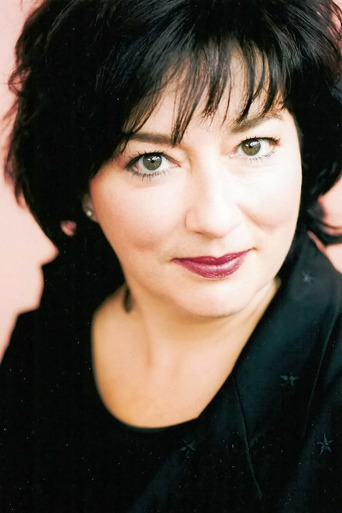
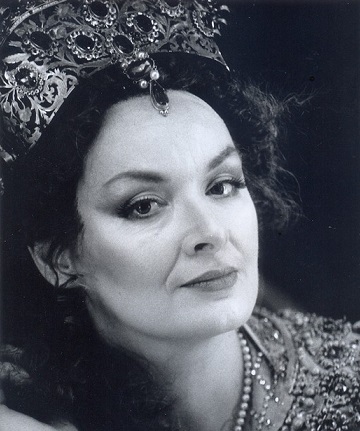
  • Yvonne Naef

    Yvonne Naef

    Yvonne Naef sang wonderful performances as Fricka and Waltraute at The Met 2004 to 2009; she also sang Amneris there, which I inexplicably missed. How I would love to hear her here in New York City again.

    Ms. Naef is an impressive Sieglinde on Simone Young’s recording of DIE WALKURE, with Stuart Skelton as Siegmund:

    Yvonne Naef – DIE WALKURE ~ Der Manner Sippe – Simone Young cond

    And here’s Yvonne Naef in a more intimate setting:

    Yvonne Naef ~ Als ihr geliebter schied – Zemlinsky

  • Nadine Denize as Geneviève

    16283512

    Currently enjoying my re-discovery of mezzo-soprano Nadine Denize, I was recalling the only time I saw her onstage: as Geneviève in Debussy’s PELLÉAS ET MÉLISANDE at The Met in October 2000.

    This was my diary entry, written the morning after the performance:

    “The Met’s PELLÉAS was a tremendous evening, the gorgeous score played with great clarity and haunting beauty by The Met orchestra. This is one of James Levine’s best operas, and he wove the marvelous sound-tapestry with superb control. The production is exceptionally atmospheric: the slow, timeless world of Allemonde is ever in shadow; unanswered questions hang over the hyper-civilized, stifling palace like a brooding cloud.

    In an outstanding cast, Dwayne Croft as Pelléas gave an outstanding performance: the warmth of his darkish sound seeped into the music, producing long stretches of incredible vocal beauty. Susanne Mentzer was not an innocent Mélisande but a young woman whose experiences have left her dazed and shell-shocked…an engrossing interpretation, exquisitely sung…so full of lyricism and vulnerability.

    It was thrilling to see José van Dam on the Met stage again. He is one of our greatest singers, and his Golaud is perfection in its sheer naturalness of vocalism and austere, haunted presence. In the unaccompanied plea to his wife for forgiveness in the opera’s final scene, the house was held enraptured as van Dam sustained a gossamer pianissimo welling up from the depths of his soul.

    As Geneviève, Nadine Denize’s wine-coloured contralto and splendid diction made her ‘letter scene’ a vocal highlight of the evening. Her dignified presence in the opera’s final scene was so moving. Sheer vocal magnificence made Robert Lloyd’s Arkel the anchor of the evening musically, his moving portrayal of the old king culminating in his wistful acceptance of Mélisande’s death and his silent departure from the bed-chamber.

    Alfred Walker sang well as the Physician, and James Danner did a fine job as Yniold. The singing all evening flowed over the orchestra with speech-like ease and natural, un-theatrical simplicity. A great evening!

    Nadine Denize – Pelléas et Mélisande ~ Voici ce qu’il écrit à son frère Pelléas

  • Renata Scotto’s “Ah! non giunge”

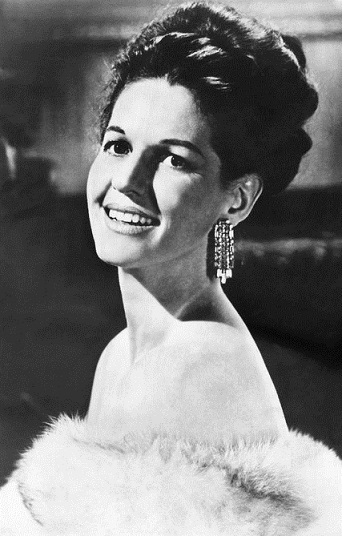
    Scotto

    At the end of October 1972, Renata Scotto was alternating performances of Amina in SONNAMBULA and the title-role of LUCIA DI LAMMERMOOR at The Met. I came down from Syracuse NY to see her as Amina on a Thursday night and her Lucia two nights later. Her tenor co-stars were Nicolai Gedda (Elvino) and Alfredo Kraus (Edgardo). The diva scored back-to-back triumphs.

    SONNAMBULA ends with Amina’s joyous cabaletta “Ah! non giunge”. Scotto, having held a rapt audience in the palm of her hand throughout the opera, now came down past the prompter’s box to the very edge of the stage and sang directly to us. As the second verse progressed, the house lights were slowly raised to full brightness; and so, in the end, singer and audience were “…uniti in una speme.

    Scotto sings ‘Ah non giunge!’ – SONNAMBULA – Met 10~28~72(1)


  • Irene Dalis: “Er wird zu Stein!”

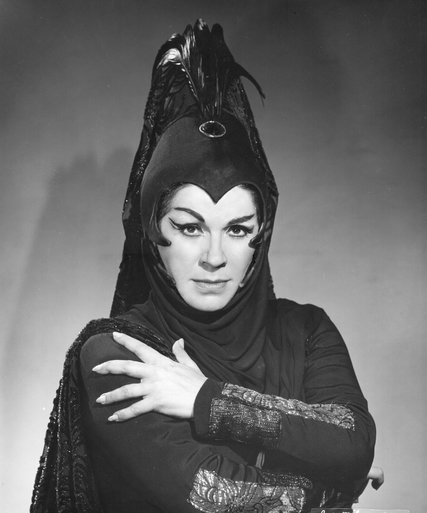
    Dalisobit-blog427

    The great mezzo-soprano Irene Dalis (above) found her most memorable role as The Nurse in Richard Strauss’s DIE FRAU OHNE SCHATTEN; I was fortunate enough to have seen her in this opera twice at The Met, and both times she simply dazzled in the fiendishly difficult vocal writing whilst creating a vivid theatrical portrait of this mercurial creature.

    The Nurse above all is devoted – to the point of obsession – to her charge: the half-human/half-spirit Empress, daughter of the mysterious and omniscient Keikobad. In the opera’s opening scene, the Nurse is visited by Keikobad’s messenger. The Empress has been married to the Emperor, a mere mortal, for one year, but as she still does not cast a shadow – the sign of her ability to bear children – Keikobad plans to re-claim her for the spirit world in three days. The Nurse is delighted, as she very much hates living among humans and longs to return to Keikobad’s realm.

    The Nurse asks what will become of the Emperor after the Empress is taken by her father; “Er wird zu Stein!” says the Messenger: “He will be turned to stone!” This prospect gives the Nurse even greater satisfaction: “He will be turned to stone!” she repeats. “There do I recognize Keikobad, and bow before him!”

    FRAU ~ opening scene – Irene Dalis & William Dooley – Bohm cond – Met bcast 1966

  • Irene Dalis: “Er wird zu Stein!”

    Dalisobit-blog427

    The great mezzo-soprano Irene Dalis (above) found her most memorable role as The Nurse in Richard Strauss’s DIE FRAU OHNE SCHATTEN; I was fortunate enough to have seen her in this opera twice at The Met, and both times she simply dazzled in the fiendishly difficult vocal writing whilst creating a vivid theatrical portrait of this mercurial creature.

    The Nurse above all is devoted – to the point of obsession – to her charge: the half-human/half-spirit Empress, daughter of the mysterious and omniscient Keikobad. In the opera’s opening scene, the Nurse is visited by Keikobad’s messenger. The Empress has been married to the Emperor, a mere mortal, for one year, but as she still does not cast a shadow – the sign of her ability to bear children – Keikobad plans to re-claim her for the spirit world in three days. The Nurse is delighted, as she very much hates living among humans and longs to return to Keikobad’s realm.

    The Nurse asks what will become of the Emperor after the Empress is taken by her father; “Er wird zu Stein!” says the Messenger: “He will be turned to stone!” This prospect gives the Nurse even greater satisfaction: “He will be turned to stone!” she repeats. “There do I recognize Keikobad, and bow before him!”

    FRAU ~ opening scene – Irene Dalis & William Dooley – Bohm cond – Met bcast 1966

  • SALOME @ The Met

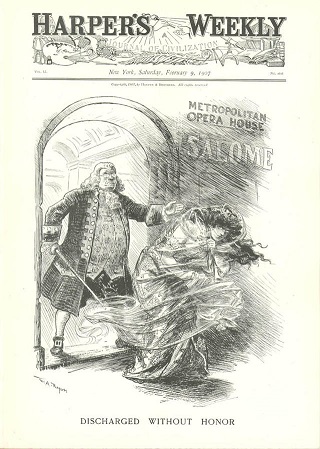
    Salome1

    “You know, there are three kinds of Salomes: those who can sing it, those who can dance it, and those who should be shot!” ~ Leonie Rysanek

    Wednesday December 28th, 2016 – My friend Dmitry and I had really been looking forward to seeing SALOME at The Met this season; it’s among our favorite scores. I bought tickets in advance for two performances, since I wanted to hear both Željko Lučić and Greer Grimsley as Jochanaan.

    Then came the news that the scheduled Salome, Catherine Naglestad, had withdrawn from the title-role, and was to be replaced by Patricia Racette. Racette used to be a particular favorite of mine, going back to her performances as Emmeline in Tobias Picker’s opera at NYCO. She was a marvelous Met Mimi, Violetta, and Ellen Orford, and I very much enjoyed her Elisabetta in DON CARLO. But as the seasons have passed, the wear-and-tear has really begun to show in Racette’s singing. Still, as recently as 2013, she gave a striking performance in Dallapiccola’s IL PRIGIONIERO with The New York Philharmonic.

    Since then, anything I have heard from her has sounded sadly worn and unpleasant. I suppose there’s something honorable about “the sword wearing out the sheath” in the service of art, but after a while the artistry and dedication no longer compensate for the sound being produced.

    I don’t want to dwell on the negative, but much of Racette’s singing was really off-putting. In the lower-to-middle-range passages, she was often covered by the orchestra. The heavy usage the soprano has subjected her voice to really shows in this music: the vibrato has spread so that in the upper range there’s no core to a sustained note; the louder the note, the wider the fluctuation.

    Salome is supposedly a teenager, but Strauss wrote the part in a way that only a mature and experienced soprano can cope with it. Thus the Dance of the Seven Veils must be handled with kid gloves; soprano and choreographer have to find ways for a woman of a certain age who is capable of singing the role to be reasonably credible in the dance-moves. For this famous scene, Racette chose an unflattering get-up: a sort of tuxedo affair with hot pants and a top hat. The choreography was duly carried out by the soprano and two men, but it was about as provocative as an after-dinner mint (to quote from the film CABARET). As the dance ended, Dmitry and I quietly left the theater.

    To briefly note the evening’s positive elements: Greer Grimsley was a powerful Jochanaan – though the amplification of his voice from the cistern was unflattering – and Gerhard Siegel was pretty much perfect as Herod. Excellent singing and portrayals from Nancy Fabiola Herrera as Herodias (great high notes!) and Kang Wang, who was vocally clear and thrilling as Narraboth. I loved seeing John Hancock onstage again, and there was fine work from Carolyn Sproule, Kathryn Day, Nicholas Brownlee, Richard Bernstein (ever the impressive stage figure, as when he kept the prophet on a long leash), Mikhail Petrenko, and Paul Corona. Allan Glassman led a strong quintet of Jews who were well-differentiated as personalities and just as annoying as one imagines Strauss intended them to be.

    The orchestra played superbly, and conductor Johannes Debus did well to highlight the myriad hues of the opera’s marvelous orchestration. Debus did not, however, always maintain an ideal union between pit and stage, sometimes drowning out the singers.

    Neither Dmitry nor I could recall the fanciful fore-curtain of angels, but perhaps we’ve suppressed the memory of it. The audience seemed pretty much captivated by the whole performance, though the woman seated in the adjoining box giggled and commented aloud during the dance. 

    Over the years and through repeated hearing, I’ve found that my favorite passage of SALOME is Jochanaan’s admonition to Salome to seek Christ at the Sea of Galilee. Tonight, Mr. Grimsley and concertmaster David Chan rendered this moment so beautifully; I suppose it’s odd that an atheist should be moved by this affirmation of faith, but to be honest, I often find expressions of deep and simple belief to be truly touching.

    Metropolitan Opera House
    December 28th, 2016

    SALOME
    Richard Strauss
    Salome..................Patricia Racette
    Herod...................Gerhard Siegel
    Herodias................Nancy Fabiola Herrera
    Jochanaan...............Greer Grimsley
    Narraboth...............Kang Wang
    Page....................Carolyn Sproule
    Jew.....................Allan Glassman
    Jew.....................Mark Schowalter
    Jew.....................Noah Baetge
    Jew.....................Alex Richardson
    Jew.....................David Crawford
    Nazarene................Mikhail Petrenko
    Nazarene................Paul Corona
    Soldier.................Nicholas Brownlee
    Soldier.................Richard Bernstein
    Cappadocian.............John Hancock
    Slave...................Kathryn Day
    Executioner.............Reginald Braithwaite

    Conductor...............Johannes Debus

  • @ My Met Score Desk: NABUCCO

    J levine

    Above: James Levine

    Tuesday December 27th, 2016 – Listening to James Levine conduct tonight’s ‘alternate cast’ performance of Verdi’s NABUCCO at The Met was something of a revelation. The venerable Maestro was greeted by a sustained roar of cheers and applause when he was spot-lighted in the pit at the start of the evening. Within moments, he and the Met musicians had set the music blazing off the page.

    The score seemed remarkably fresh…and important: one could understand immediately why this opera sent Verdi’s star on its immortal trajectory. A great sense of passion and propulsion prevailed, but the more solemn passages also rang true. Chorus and orchestra were on high form, and the opera swept forward vividly. For all the sense of urgency that Maestro Levine brought to the music, there were also wonderfully detailed moments, most notably the ‘busy’ wind playing that bubbles under the melodic line of the quintet “S’appresan gl’istanti“. Taking things into overdrive, the Maestro propelled the big ensemble/finale of Act II to an exhilarating finish.

    Following a marvelous rendering of the overture – which highlights several themes to be heard later in the opera – the chorus drew us in to the plight of the Israelites; particularly moving was the passage for female voices over a rolling harp line.

    As Zaccaria, bass Dmitry Belosselskiy’s commanding voice immediately set the tone for an evening of big-scale, unstinting singing. Although his lowest notes were not firmly settled (he even left one out), the imposing voice rang grandly into the hall – I began to think what a Wotan/Wanderer he might be.

    I’ll go to hear any singer who tackles the role of Abigaille in Verdi’s NABUCCO. Tonight, the Russian soprano Tatiana Melnychenko took on this fearsome music in her Met debut; it’s her only scheduled Met performance of the season. In looking at her bio, it seems Ms. Melnychenko is making an international career by performing two roles: Abigaille and Lady Macbeth; she has already sung the former at Verona, Montreal, Barcelona, Covent Garden, and Liege. After two acts as Abigaille, I thought she’d be interesting to hear as Tosca, Minnie, Maddalena di Coigny, or Gioconda.

    The soprano seemed a bit tentative at first: the voice showing some unsteadiness and a hesitancy to sing in full chest-voice. Soon, though, she got matters in hand, and in the trio with Fenena and Ismaele, Ms. Melnychenko did some nice – even pretty – soft singing. Nancy Fabiola Herrera, and Adam Diegel played the couple who wouldn’t let opposing religious viewpoints stand in the way of their love. The tenor sang passionately in his ungrateful role whilst Ms. Herrera brought Mediterranean warmth to her vocalism, with strong dramatic accents and a nice dynamic mix. 

    Željko Lučić can be a very frustrating singer to listen to: the instrument is impressive, he can thunder forth or sustain a piano line, and his vocalism is imbued with an innate emotional quality; but so often, he wanders off pitch and that negates all the enjoyable aspects of his work. Tonight was one of his best performances in my experience, and while passing notes went slightly awry, the overall effect of his singing made a powerful impact.

    All voices heretofore mentioned were in play during the dramatic moments where Ismaele saves Fenena from execution, Nabucco subjugates the Israelites, and their temple is set aflame; with Levine spurring them on, the first act ended excitingly.

    We then move on to the great test-piece for soprano. Abigaille’s discovery of the fact that she is in truth a slave rather than a princess is expressed in a passionate recitative spanning two octaves; the soprano dealt with this quite well, with touch of wildness here and there, and some good soft, reflective phrases thrown in. She scaled down her big, somewhat unwieldy voice to make a pleasing effect in the reflective cavatinaAnch’io dischiuso un giorno“. Forewarned by the High Priest of Baal – sung by the young Serbian basso Sava Vemić with smouldering tone – of Fenena’s treachery in betraying her faith, Ms. Melnychenko then tackled the great cabalettaSalgo già del trono aurato“, throwing in some insinuating piano phrases amid the eager, full-throttle expressions of her anticipated seizing of the throne. She handled the demands of this treacherous music successfully, if not with the total élan of Elena Souliotis on the classic Decca recording. Melnychenko spit out the words “…l’umile schiava” with venomous irony. The top C’s were approached from slightly below, but then tonalized, and she sustained the final one to round-off the scena with overall positive marks.

    Levine led the atmospheric prelude to the second scene of Act II with evident love for the music; the cellos sounded wonderful. In the great recitative “Vieni, O Levita” and the ensuing invocation “Tu sul labbro“, Mr. Belosselskiy rolled out the tone in powerful, well-modulated phrases. The voice seems now more geared to the upper than the lower range, but he did sustain the concluding low-G to fine effect. People started applauding during the quiet postlude, spoiling the moment. 

    Abigaille rushes in, demanding that Fenena give up the crown; Ms. Herrera lashes out with a big retort: “Pria morirò…!” (“I’d sooner die!”). Suddenly Nabucco appears (he was rumored to be dead) and cries “Dal capo mio la prendi!” (“You’ll have to take the crown from my head!”).

    Nabucco Lucic

    Mr. Lučić (above) was so commanding here, and throughout the quintet that follows; his proclamation of himself as “god” (with thunderbolts greeting his blasphemy) and his truly affecting soft singing in his ‘mad scene’ maintained a very high level of dramatic vocalism. Ms. Melnychenko sustained the act’s final A-flat securely.

    I’d only planned to be there for the first half tonight; the excitement of the performance almost persuaded me to stay on, but the thought of a 40-minute intermission short-circuited that idea. On the 7th of January, I’ll be at the final NABUCCO of the season and will surely stay to the end of that matinee performance.

    It’s to James Levine that true credit and thanks must go for serving up this exciting performance, reminding us yet again of Verdi’s monumental place in the pantheon of operatic composers. The conductor not only gave the music great vitality but showed a keen attention to the needs of the singers. When Ms. Melnychenko seemed to want to slow down the pace in her cavatina, the conductor skillfully nudged her along, preventing the impetus from stalling.

    The House was nearly full, and indeed two of the three remaining NABUCCO performances are sold out. In recent seasons, it’s been the big, Met-sized productions that seem to be drawing crowds: TURANDOT, BOHEME, AIDA, and now NABUCCO. There’s definitely something to be said for the atmosphere that develops when The Met is packed.
  • An Act of AIDA

    Screen-Shot-2016-02-27-at-4.31.29-PM

    Above: Latonia Moore

    Tuesday November 22nd, 2016 – It’s an odd feeling to be dreading a night at the opera because of the hyper-extended intermissions. But so many performances at The Met in recent seasons have suffered from a draining of dramatic and musical impetus as intermissions stretch beyond the 30-minute mark that it really is a concern of mine.

    However, I did want to hear at least some of Latonia Moore’s Aida tonight. Latonia was a finalist in the Met Auditions in 2000, the same year my late friend Makiko Narumi participated. I met Latonia a couple of times at patrons events, loved her voice, and her personality. Up to tonight, she had sung a single Aida and a single Butterfly at The Met, whilst having an extensive career elsewhere.

    I knew going in that I would not be able to endure two intermissions; my plan was to leave after the Triumphal Scene. Aside from Ms. Moore, the cast was nearly identical to the one I heard earlier this month.

    Marco Armiliato and the Met musicians again gave a very atmospheric rendering of the prelude.  Marco Berti as Radames was not having a good evening. At the earlier performance, he had been quite impressive in terms of sheer lung-power and some very nice softer singing in the Tomb Scene. Tonight’s “Celeste Aida” was choppily phrased and beset by pitch problems. There was only a trickle of applause after this famous aria. Ekaterina Gubanova, despite some attractive passages (“Vieni, o diletta… appressati” in particular) again seemed slightly under-powered.

    With Latonia Moore’s entrance, things perked up. Her voice is warm, with a sensuous tinge to it, and it  carries well in the big house. She sang with passion and good sense of line, leaning on but not over-working the chest voice. Her “Ritorna vincitor” was vivid both in terms of sound and dramatic inflection, and she sang quite gorgeously in her plaintive “Numi pieta…” Ms. Moore won a hearty round of applause and bravas from the sizeable audience. My only slight concern was that the very highest notes showed a trace of discomfort; the high-B in the trio was not sustained the full count, nor did she linger on the upper notes of the aria. But overall, she gave some extremely satisfying singing.

    I pulled out my copy of Gore Vidal’s KALKI and read for about 15 minutes; and then I thought: “Why am I reading a novel at the opera? Shouldn’t the unfolding of a great score like AIDA sustain me thru the evening? Why is this intermission going to last another 20 minutes?” I packed up and left.

  • Recital: Ben Bliss @ Weill Hall

    BenBliss180

    Friday November 18th, 2016 – I first encountered tenor Ben Bliss (above) while he was in the Lindemann Young Artist Development Program at The Met; he was making his Met debut as Vogelgesang in MEISTERSINGER and he stood out for three reasons: tallest man onstage, youngest of the Masters, and a voice of distinctive clarity. 

    Since then, I have enjoyed listening to several of Mr. Bliss’s YouTube offerings which display a voice capable of incredible beauty (especially in the upper range), a deep sense of poetry in his use of dynamics, and very impressive breath control.

    This evening’s program commenced with four songs by Richard Strauss; my initial feeling was that Mr. Bliss was over-singing a bit, and that the piano (even with the lid down) was sometimes too loud. As the songs progressed, the tenor and his pianist Lachlan Glen achieved a more congenial blend, and in “Morgen“, the sensitivity of both artists found truly rewarding expressiveness in a breath-taking performance.

    Turning to the French repertoire, Mr. Bliss chose songs from Lili Boulanger‘s “Clarières dans le ciel”; the composer, who died tragically young, left behind a brief catalog of work of which these mélodies hold a particular appeal. Mssrs. Bliss and Glen savoured the perfume of this music in a performance filled with spine-tingling dynamic modulations. The opening “Un poète disait” served to display the tenor’s marvelously heady tones, with an absolutely gorgeous final phrase. Remarkably sustained singing illuminated “Nous nous aimerons tant“, its dreamy quality interrupted by a “noisy” piano interlude. Mr. Bliss managed a fine mix of passion and refinement in “Vous m’avez regardé avec toute votre âme“, where Mr. Glen’s playing was particularly lovely. The pianist’s rippling motif set the mood for the concluding “Les lilas qui avaient fleuri” and the tenor here displayed an intrinsic sense of vocal nuance, with seductively floated upper tones and a final sustained note that was sheer heaven.

    Tosti’s “Marechiare” closed the rather brief first half of the program; Mr. Bliss’s voice is not really Italianate in sound, but in this outgoing celebration of a passionate infatuation, he and Mr. Glen took an almost militant stance in favor of romance. I would have liked to have heard some of Tosti’s more caressive tunes from Mr. Bliss, but that will have to wait for another opportunity.

    Returning after the interval, the tenor had changed to a white sport coat (no pink carnation, though) for an all-English-language second half. Mr. Bliss described how he came to find the two John Gruen songs – “Spring is like a perhaps hand” and “Lady will you come with me into” – which were never published. With the aid of the composer’s daughter, the manuscripts were located and copies given to the tenor. Musically whimsical, the songs border on cuteness; Mssrs. Bliss and Glen made them perfectly palatable.

    Big singing marked Lowell Liebermann’s “The Arrow and The Song” (“I shot an arrow into the air…”): an emphatic and almost grandiose setting. Ned Rorem’s haunting setting of “Stopping by Woods on a Snowy Evening” beautifully evokes the quietude of the Winter landscape, and was lovingly sung. Does Theodore Chanler’s “I rise when you enter” have a sexual connotation? It seemed so this evening.

    A tenor of Mr. Bliss’s vocal weight and range is of course going to be singing a lot of Britten. Over the years I have come to feel that the composer’s works are best represented by British singers as they seem most persuasive when sung with what we Americans refer to as a “British accent”. That said, Mr. Bliss did very well by the extroverted “The Children and Sir Nameless” whilst Mr. Glen’s introduction to “The Last Rose of Summer” was poetic indeed; as the song progresses, the familiar melody takes on a fresh feeling thru harmonic alterations. Mr. Bliss here again demonstrated his astonishing control in the upper range of his voice.

    The final Britten offering, “The Choirmaster’s Burial“, is a touching narrative on the love of music and on a life dedicated to it. Singer and pianist were at their most moving here.

    The final three numbers on the printed program – songs associated with Nat King Cole, Frank Sinatra, and Ray Charles – are pieces Mr. Bliss grew up with. While I know them well, and can even sing two of the three, they are rather outside my musical sphere. But my companion of the evening is a huge devotee of Sinatra and Charles, and she felt that Mr. Bliss’s singing – for all his efforts to the contrary – was too cultivated, and that the rendition of Ray Charles’s “Hallelujah I love Her So” was all wrong. 

    A very well-known mezzo who was in the vanguard of the crossover phenomenon once asked me why I was put off by her crossover efforts; I replied that thousands of people can sing these Broadway and cabaret numbers to fine effect, but that there are only a half-dozen great Mélisandes in the world. She understood my point, but said she and her audiences took a lot of enjoyment from her less ‘haughty’ recordings. Then I asked her how she would feel if Barbra Streisand decided to sing Idamante; she giggled and rolled her eyes. 

    At any rate, Ben Bliss was called out for two encores tonight: a sweet “Una furtiva lagrima” and that song with the catchy lyrics from WEST SIDE STORY: “Maria…”

    In December I’ll be seeing Ben Bliss as Tamino at The Met and while I wish it wasn’t the pared-down “family” version, I’m really looking forward to it.

  • Maralin as Marguerite

    M niska

    Maralin Niska (above), the American soprano who passed away on July 9th, 2016, was one of a handful of singers whose performances could induce me to travel – first from Syracuse, NY, to see her in several roles at New York City Opera, and later from Hartford, CT – where TJ and I had settled in the mid-1970s – to Lincoln Center, where she was singing at both the State Theatre and The Met.

    Once, she even came to Hartford to sing Violetta, replacing another soprano on short notice. We were so excited when we arrived at The Bushnell and saw the announcement of the cast change; we rushed to the stage door to leave her a message, and en route we found her, just thirty minutes before curtain time, banging desperately on what she thought was the stage door. She was so happy to see us, not least because we were able to lead her to the proper entrance.

    Violetta, Mimi, Tosca, Butterfly, Nedda, Countess Almaviva…these were some of the roles from the standard repertoire in which Niska thrilled me. Her triumphs in such great dramatic vehicles as Cherubini’s Medea, Strauss’s Salome, and Janacek’s Emilia Marty were the stuff of operatic legend. In roles as diverse as Yaroslavna in PRINCE IGOR, the Composer in ARIADNE AUF NAXOS, Rosalinda in FLEDERMAUS, and Elisabetta I in MARIA STUARDA, she achieved miracles of characterization and of voice.

    Yet for all that, is was – curiously enough – as Marguerite in FAUST that Maralin gave a (somewhat unexpectedly) sensational performance that has lingered so clearly in my mind over the ensuing years. In the unforgettable Frank Corsaro production – in which the devil wins – Maralin left the notion of Marguerite as a shrinking violet in the dust. Faust’s love for the girl signaled not only her romantic but also her sexual awakening.

    In the Garden Scene, on the brink of having her, Faust backs off, causing Maralin/Marguerite to burst into frantic sobs of frustration; when he reappears after Marguerite’s ecstatic invocation, there’s no going back. 

    As the opera draws to its end, Faust comes to rescue Marguerite from prison, where she awaits execution for murdering her child. The demented girl imagines they are back in the garden; she ignores Faust’s pleas to come away. When Mephistopheles appears to urge theme to hurry, Marguerite sees him for what he is and turns to fervent prayer. Faust tries one last time to persuade her to flee, but she turns on him, crying: “Pourquoi ces mains rouge de sang? Va! … tu me fais horreur!”  (“Why are your hands red with blood? Go!…you fill me with horror!”) No soprano has done that last line quite like Maralin.

    Heavenly voices declare Marguerite’s salvation; she begins to climb a steep staircase, but at the top of it, double doors fly open, and instead of an angelic host she is greeted by a towering executioner, masked and carrying an monstrous axe. Faust rushes up the steps to try to save her, but the doors are slammed shut in his face. Mephistopheles steps out of the shadows, calling Faust’s name quietly, and waving the contract with which Faust had sold away his soul to the devil in Act I.

    I’ve been able to preserve some excerpts from one of Maralin’s performances in this role at NYC Opera; the date was March 15, 1970, and her colleagues were Nicholas di Virgilio (Faust) and Norman Treigle (Mephistopheles). The original tapes are in a fragile state – I was lucky they played well enough to save them to MP3. The sound quality leaves much to be desired, but hearing these scenes brings back wonderful memories for me:

    Niska – FAUST aria – NYCO 3

    FAUST – Garden Scene exc – Niska – di Virgilio – Treigle – NYCO 3

    Maralin Niska & Norman Treigle – scene from FAUST – NYCO 3~15~70

    FAUST – finale – Niska – di Virgilio – Treigle – NYCO 3

    Photographer Beth Bergman has created a beautiful memorial in photos to Maralin Niska on her website: visit the page here.