Tag: The New York Philharmonic

  • Batiashvili|Tchaikovsky|NY Philharmonic

    Batiashvili - gilbert

    Saturday September 24th, 2016 – Lisa Batiashvili‘s appearances with The New York Philharmonic are always red-letter events; the mutual admiration society that the luminous violinist has formed with Maestro Alan Gilbert invariably results in something very special, and tonight their entente cordiale produced a magnificent rendering of the Tchaikovsky violin concerto.

    When I arrived at Geffen Hall, the atmosphere was already abuzz: “Sold Out” signs were just being posted, and a long line of music-lovers hoping for returns was forming. A packed house always creates its own sense of excitement, and when the ever-elegant Ms. Batiashvili strode onto the stage in a stunning black gown with a bejeweled bodice, the welcome was wonderfully warm. Forty minutes later, the violinist was basking in an epic full-house ovation.

    It was another female violinist, Maud Powell, who helped popularize the Tchaikovsky concerto – a concerto at first thought by some to be unplayable. Ms. Powell played the New York premiere of the piece in 1889 with the New York Symphony (which merged with the Philharmonic in 1928); tonight, Lisa Batiashvili carried the banner to new heights.

    In the concerto’s opening movement, Ms. Batiashvili combined passionate lyricism with subtle turns of phrase; her coloratura was fleet and fluent, her shaping of phrases so innately appealing. When Alan Gilbert’s full orchestra entered for the big tutti passage, visions of the grandeur of the Romanov court were evoked. Ms. Batiashvili’s cadenza sounded a bit modern (“…to old-fashioned ears…”, as Mrs. Manson Mingott would say) and her playing of it most impressive: superb control of dynamics and a stunningly sustained double trill which led to a poignant restoration of melody. After treating us to some sizzling fireworks, the violinist sailed graciously into an affecting theme before ascending to some very delicate high-register passages and thence to the movement’s final flourishes.

    Playing with a melancholy pianissimo, Ms. Batiashvili created a very poetic atmosphere of sadness as the Canzonetta/Andante began. Her tone became incredibly soft, with a lovely sheen to it, while the audience held their collective breath to savour every moment of it.

    There’s a direct path into the concerto’s finale, which commences with an intense invitation to the dance, followed by a playful second theme. Relishing these shifts of mood, Ms. Batiashvili sounded gorgeous in a deep-lyric interlude and brilliant in some decorative filigree that followed. On to the final sprint, where the fiery glow of the violinist’s passionate playing swept all before her, igniting an ovation and delighted cries of “Brava!” as the entire audience rose to acknowledge Ms. Batiashvili’s truly thrilling performance.

    Lisa was called out for a solo bow – huge din of cheers and thunderous applause – then returned again with Maestro Gilbert, who signaled the wind soloists (who had made such distinctive impressions in the final movement) to rise. The mutual affection of violinist and conductor was movingly evidenced as they embraced and walked off together. But still the ovation would not subside, and the radiant soloist re-appeared for another solo bow, with her onstage colleagues joining the tribute and the audience getting gleefully boisterous. 

    During the course of the concerto, the marvelous rapport between Ms. Batiashvili and Maestro Gilbert was as endearing to the eye as their playing to the ear: as the music wove its spell, they seemed engaged in a pas de deux which swayed on the ebb and flow of Tchaikovsky’s balletic score. Bravi!!

    Enjoy a bit of Lisa’s playing here.
  • NY Phil: THE PLANETS + Williams’ Tuba Concerto

    PJ-BW140_FIXBAG_DV_20140723162140

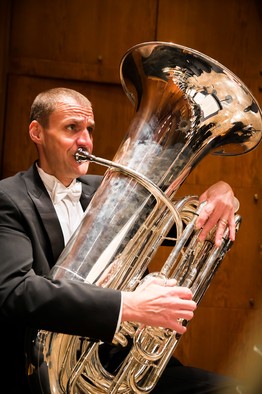
    Above: Alan Baer of The New York Philharmonic in a Chris Lee photo

    Saturday May 28th, 2016 – Aside from Mars, I am not really a fan of the famous Gustav Holst work The Planets (composed in 1914-1916). I remember many years ago tuning in to a radio broadcast of the piece and finding my interest diminishing steadily once the spaceship left Mars for Venus; I never made it back to Earth.

    Tonight, a chance to hear The Planets in concert at Geffen Hall provided an opportunity to test my earlier reaction. Under the baton of David Robertson, The New York Philharmonic‘s performance of this sprawling epic was nothing short of marvelous. But the music itself just doesn’t reach me, beyond a surface appeal – and despite the composer’s obvious skill in orchestration. And so – yet again – upon departing Mars, I felt lost in space. 

    The remaining six movements do have their very appealing passages, of course, but also their longueurs. The only time I truly connected with any of the music was when the theme of the hymn ‘I Vow To Thee My Country strikes up as Jupiter looms in the sonic heaven. The stay on Uranus seemed endless: not much going on there. I simply couldn’t wait for this trip thru the solar system to end. Maestro Robertson had the huge forces doing his bidding to fine effect, and making a splendid sound; featured violin solos from Sheryl Staples were saving graces on this journey to nowhere. 

    But enough grumbling, lest I be mistaken for Bernie Sanders; the first half of the program was indeed thoroughly enjoyable.  

    Edward Elgar’s Introduction and Allegro (composed in 1905) opened the evening; it’s a beautiful piece and would make a great ballet score (maybe it’s been done?). The composer gives a prominent role to a string quartet, setting them before the full string contingent of the orchestra. As this quartet consisted of Sheryl Staples, Lisa Kim, Cynthia Phelps, and Carter Brey, the playing was remarkable – I especially was entranced by a solo from the viola of Ms. Phelps. When the Philharmonic strings played en masse, the richness of sound was truly savorable.

    The tall and slender Alan Baer then appeared with his silver tuba for John Williams’ Tuba Concerto. This rather brief work (just over 15 minutes in length) was very pleasing from start to finish, for Mr. Baer’s sound has a warm glow and a toothsome dark-chocolate richness in the lower range.

    The opening passages made me think of a sea shanty: good-natured, a bit brusque, with fog-horn low notes along the way. Later the tuba converses with the French horn, and in the concerto’s second movement, the tuba sounds deep phrases over a horn chorale before embarking on a polished cadenza.

    The violins strike up. The oboe has a theme that is passed to the flute, and then the flute and tuba talk to one another. After another – briefer – tuba cadenza, fanfares sound and there is a cabaletta of sorts, with trumpets giving propulsion and the tuba singing some skittish coloratura. Harp and timpani have a part to play: another inventive mix on the composer’s part. Swift-rising scales for the tuba herald a jovial conclusion.

    Philharmonic audiences love it when artists from the orchestra step forward in featured roles; there was lovely enthusiasm for the string quartet after the Elgar, and Mr. Baer received hearty cheers from the crowd, as well as the admiring applause of his colleagues.

  • NY Phil: THE PLANETS + Williams’ Tuba Concerto

    PJ-BW140_FIXBAG_DV_20140723162140

    Above: Alan Baer of The New York Philharmonic in a Chris Lee photo

    Saturday May 28th, 2016 – Aside from Mars, I am not really a fan of the famous Gustav Holst work The Planets (composed in 1914-1916). I remember many years ago tuning in to a radio broadcast of the piece and finding my interest diminishing steadily once the spaceship left Mars for Venus; I never made it back to Earth.

    Tonight, a chance to hear The Planets in concert at Geffen Hall provided an opportunity to test my earlier reaction. Under the baton of David Robertson, The New York Philharmonic‘s performance of this sprawling epic was nothing short of marvelous. But the music itself just doesn’t reach me, beyond a surface appeal – and despite the composer’s obvious skill in orchestration. And so – yet again – upon departing Mars, I felt lost in space. 

    The remaining six movements do have their very appealing passages, of course, but also their longueurs. The only time I truly connected with any of the music was when the theme of the hymn ‘I Vow To Thee My Country strikes up as Jupiter looms in the sonic heaven. The stay on Uranus seemed endless: not much going on there. I simply couldn’t wait for this trip thru the solar system to end. Maestro Robertson had the huge forces doing his bidding to fine effect, and making a splendid sound; featured violin solos from Sheryl Staples were saving graces on this journey to nowhere. 

    But enough grumbling, lest I be mistaken for Bernie Sanders; the first half of the program was indeed thoroughly enjoyable.  

    Edward Elgar’s Introduction and Allegro (composed in 1905) opened the evening; it’s a beautiful piece and would make a great ballet score (maybe it’s been done?). The composer gives a prominent role to a string quartet, setting them before the full string contingent of the orchestra. As this quartet consisted of Sheryl Staples, Lisa Kim, Cynthia Phelps, and Carter Brey, the playing was remarkable – I especially was entranced by a solo from the viola of Ms. Phelps. When the Philharmonic strings played en masse, the richness of sound was truly savorable.

    The tall and slender Alan Baer then appeared with his silver tuba for John Williams’ Tuba Concerto. This rather brief work (just over 15 minutes in length) was very pleasing from start to finish, for Mr. Baer’s sound has a warm glow and a toothsome dark-chocolate richness in the lower range.

    The opening passages made me think of a sea shanty: good-natured, a bit brusque, with fog-horn low notes along the way. Later the tuba converses with the French horn, and in the concerto’s second movement, the tuba sounds deep phrases over a horn chorale before embarking on a polished cadenza.

    The violins strike up. The oboe has a theme that is passed to the flute, and then the flute and tuba talk to one another. After another – briefer – tuba cadenza, fanfares sound and there is a cabaletta of sorts, with trumpets giving propulsion and the tuba singing some skittish coloratura. Harp and timpani have a part to play: another inventive mix on the composer’s part. Swift-rising scales for the tuba herald a jovial conclusion.

    Philharmonic audiences love it when artists from the orchestra step forward in featured roles; there was lovely enthusiasm for the string quartet after the Elgar, and Mr. Baer received hearty cheers from the crowd, as well as the admiring applause of his colleagues.

  • Sibelius & Mahler @ The NY Philharmonic

    Hampson

    Above: baritone Thomas Hampson

    Friday April 22nd, 2016 matinee – A matinee performance by The New York Philharmonic pairing the Sibelius seventh symphony with Mahler’s Das Lied von der Erde. Alan Gilbert was on the podium, with soloists Stefan Vinke and Thomas Hampson singing the solo parts in the Mahler.

    The two works made an ideal pairing; the Sibelius 7th (first performed in 1925 under the title Fantasia Sinfonica) lasts only about 20 minutes and is written as a single-movement. From its opening rising scale which blooms into regal theme, the symphony compensates for its relative brevity with music of almost cinematic breadth. Abundant in melody, the piece has an Autumnal quality; though Sibelius would live until 1957, he wrote very little music after 1926. This last symphony is both serene and passionate; it leaves us wondering ‘what might have been’ if he had continued writing.

    The Sibelius was played with savourable richness by the Philharmonic artists today, and Maestro Alan Gilbert was very much in his element here; following the interval, players and conductor were joined by the two vocal soloists and a thrilling performance of Mahler’s Das Lied von der Erde commenced. 

    Still recovering from the sorrow of his daughter’s death, Mahler learned in 1907 that he was suffering from a heart condition that would, within four years, prove fatal. In The Song of the Earth, the composer’s awareness of the possibility of an approaching end prompted the composition of a great hymn to Nature and to the sheer ecstasy of living. Drawn from The Chinese Flute, a collection of ancient Chinese poems translated by Hans Bethge, the six ‘songs of the Earth’ speak of drunken defiance of impending death, of the solitary life, of the transience of youth and beauty, and of a friendship which endures beyond parting and into eternity.

    The tenor is allotted the more extroverted songs; the first, third, and fifth. Stefan Vinke’s formidable power and stamina proved equal to the fierce demands Mahler’s vocal writing places on the singer: high in tessitura and including exposed, sustained notes in the topmost range, the tenor’s muscular singing was just what’s needed. An occasional trace of pitchiness didn’t detract from Mr. Vinke’s generous singing. And I must note the lovely violin theme from Frank Huang in the fifth song, “The Drunkard in Spring“.

    (Note: it’s just been announced that Stefan Vinke will be replacing Johan Botha when James Levine and The Met Orchestra perform excerpts from Wagner’s RING Cycle at Carnegie Hall on May 26th. Christine Goerke is the soprano soloist.)

    Both mezzo-sopranos and baritones have performed the ‘other’ solo role in Das Lied von der Erde the formidable Margarete Matzenauer sang it at the NY Philharmonic premiere in 1929. Today, it was baritone Thomas Hampson whose strikingly expressive singing moved me and my companion to a tearful state as the work came to an end.

    I have admired Thomas Hampson since his Met Auditions win in 1981; among his many Met roles that have particularly impressed me have been: Count Almaviva, Billy Budd, Posa in DON CARLO, Werther, Eugene Onegin, Wolfram in TANNHAUSER, Amfortas, Iago, and – most surprisingly and most recently – Wozzeck. He walked onstage today – tall, handsome, and elegant in a tux – with an amiable self-assurance that made me think we were in for something special; Hampson delivered an intensely satisfying performance. 

    Liang Wang’s oboe solo at the start of “The Solitary One in Autumn” signaled a turn of mood from the boisterous drinking song with which Mr. Vinke had launched the cycle. As Mr. Hampson began to sing of his loneliness and weariness of spirit, his marvelous gift for poetic expression as well as the inherent beauty of his vocal timbre drew me into the music; the external world faded, and the music became the reality.

    Midway thru the fourth song, “Of Beauty“, a big dance-like theme erupts, and the baritone seemed ready to dance himself. His singing was characterful and, as the music simmers down, he did some lovely heady effects as well an plunging into basso territory briefly.

    It was in the final song, “Farewell”, that Mr. Hampson’s performance put me over the edge. Liang Wang’s oboe and Robert Langevin’s flute establish a wistful mood. The baritone’s thoughtful and sustained singing is beautifully enmeshed in some wonderful playing from the winds; oboe and harp unite; horn, cello, bassoon, and bass clarinet add poignant colours to the canvas. “All longing has become a dream,” sings the poet.

    In a spine-tingling moment, Mr. Hampson’s tone adopts a ‘dead’ emptiness, matched by plaintive flute. “I wanted to bid my friend a last farewell!” – how many of us have sadly been deprived of just such an opportunity! Mandolin and celeste are heard, as if from out of a dream of past happiness. “Where are you going, and why must it be?” asks the forlorn friend as the parting draws nigh, and they share the stirrup cup. The song ends with an affirmation of faith in life’s renewal, but even here there’s an illusive feeling. Nature holds sway with the “…luminous blue of distant space…everywhere, forever… forever and ever….”

    Alan Gilbert’s baton was suspended in air as the music faded to silence. An ovation of particular warmth ensued, with the maestro, the singers, and the musicians basking in the joy of having shared in a magnificent collaboration.

  • Kavakos Plays Sibelius @ The NY Phil

    Kavakos-Leonidas-21

    Above: violinist Leonidas Kavakos

    Saturday March 19th, 2016 – Feeling under the weather today, I was nevertheless determined to hear Leonidas Kavakos play the Sibelius violin concerto with The New York Philharmonic. I’d looked forward to this red-letter evening since the season was announced, and even though I feel strongly that people who are sick are better off staying home, I was determined to go.

    In an unusual programming move, the concerto was the opening work tonight.

    Mr. Kavakos, very tall and with the air of a mythic sorcerer, launched his inspired rendering of the concerto with a magical glow: the spine-tingling opening passage – coolly sensual – immediately drew us in. Maestro Alan Gilbert and Mr. Kavakos have formed a rich rapport over time, and the conductor and his players were at their shining best as the violinist shaped the opening movement with alternating currents of broad-toned lyricism and spiky bravura. Few violinists today can match Kavakos for power – both sonic and emotional – and his playing as the concerto unfolded continually sent chills up and down my spine.

    In the central Adagio, with its heart-fillingly gorgeous main theme, violinist and orchestra were in a particular state of grace. One of the most winning aspects of Mr. Kavakos’ playing is his marvelously sustained phrasing; Maestro Gilbert and the orchestra provided the soloist with perfect support as passage after passage fell gratifyingly in the ear, everything lovingly dove-tailed and with an acute awareness of dynamic nuance. This performance of the Adagio was a high point in a season that has been rich in musical magic. 

    Mr. Kavakos then dug into the opening dance of the concluding Allegro with gusto, and the orchestra sounded simply magnificent in the big tutti passages. Give and take between soloist and ensemble produced some dazzling effects, and the lovely ‘wandering’ passage for violin when the music briefly slows down was particularly appealing. Following an energetic rush to the finish, Mr. Kavakos enjoyed a prolonged ovation, filled with shouts of joy from his listeners. The Philharmonic players seem clearly to revel in performing with this violin-magician, and his warm greeting of concert-master Frank Huang and a lovely embrace for Sheryl Staples indicated a deeper personal connection with his colleagues than we sometimes see between soloist and orchestra. 

    After several bows, Mr. Kavakos granted us a rather long solo encore which showed a more intimate side of his artistry. And now, here’s some excellent news: Mr. Kavakos will be with us more frequently next season as he has been designated the Philharmonic’s 2016-2017 Mary and James G Wallach Artist-in-Residence. In addition to programs featuring him as soloist, he will make his NY Phil conducting debut. Find out more about this residency here

    Much as I wanted to hear the Shostakovich’s The Age of Gold Suite, I knew it was time to go home, take Advil, and rest. I now have some rare downtime: an opportunity to re-charge before this busy season continues. I have lots of wonderful music to listen to, including Mr. Kavakos’s Sony double-disc of Mendelssohn’s concerto and the piano trios, which I highly recommend; find it here.

  • New York Philharmonic: Bronfman/Valčuha

    Yefim bronfman

    Above: pianist Yefim Bronfman

    Thursday February 18th, 2016 – In recent seasons, as I’ve gradually moved away from opera and dance and into the realm of symphonic and chamber music, concerts featuring the great pianist Yefim Bronfman have consistently been outstanding events; we still talk about these evenings – and about the pianist – with great admiration and affection. To me, Mr. Bronfman is a unique musician: an artist in the highest echelon of great performers today.

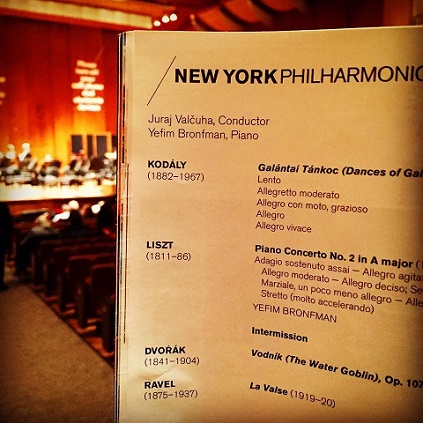
    This evening’s concert at The New York Philharmonic is something my friend Dmitry and I have been looking forward to since it was announced. Maestro Juraj Valčuha was on the podium tonight as Mr. Bronfman performed Liszt’s Piano Concerto #2 on a program that further featured works of Kodály, Dvořák, and Ravel.

    Opening the concert with Kodály’s Dances of Galánta; the Philharmonic had played this piece in 2013 and I was happy to experience this music again: it’s happy music!  Zoltán Kodály wrote his Dances of Galánta to celebrate the 80th anniversary of the Budapest Philharmonic Orchestra. Galánta is a small village in Hungary where the composer spent seven years of his childhood and where, thanks to the town’s popular gypsy band, the young Kodály became aware of of the style and motifs of gypsy music.

    Launched by a clarinet tune from the Philharmonic’s inimitable Anthony McGill, Dances of Galánta has a wonderful lilt and swagger. Flautist Robert Langevin and oboist Liang Wang pipe up charmingly, and the big, passionate main theme is irresistible. Maestro Valčuha – tall, handsome, and with an elegant baton technique – drew out all the vivid colours of the score, which ends with a romping folk dance.

    Mr. Bronfman then appeared, to a congenial welcome from the Philharmonic audience. Meticulous of technique and warmly confident in stage demeanor, the pianist’s performance of the Liszt Piano Concerto No. 2 was impressive in its virtuosic clarity and in its meshing of the piano line with the orchestra. Maestro Valčuha’s feeling for balance and pacing was spot-on. 

    The concerto, which Liszt tinkered with endlessly between 1839 and 1861, is particularly congenial to experience as it sweeps forward in one continuous movement over a span of about 20 minutes; yet it has the feel of a more traditionally structured concerto. Along the way, Liszt pairs the piano with various orchestral voices – a gorgeous piano/cello lullabye; rippling piano motifs as the oboe sings; high and delicate piano filigree over gentle violins; horns and cymbals sounding forth as the piano flourishes triumphantly. 

    Mr. Bronfman’s fluency in the rapid passages was a delight: sprightly in a high-lying scherzo passage, then swirling and cascading up and down the keyboard with joyous bravado. The concerto further alternates moments of big drama with passages of sheer melodic glow, all of which Mr. Bronfman delivered to us with his customary assurance and polish. 

    Audience and orchestra alike embraced the pianist with a prolonged ovation; an encore was given which elicited even more applause, and the affable Mr. Bronfman was called out twice again. Next season, he’s down for the Tchaikovsky 2nd with The Phil: it’s already on my calendar, circled in red. 

    Valcuha-Juraj

    Following the interval, Maestro Valčuha (above) and the Philharmonic players further displayed their cordial rapport in two well-contrasted “tone poems”:  Dvořák’s folkish and finely-orchestrated The Water Golbin (curiously enough, having its Philharmonic premiere tonight – some 120 years after it was written) and Ravel’s darkly magical La Valse, which always makes me think of Rachel Rutherford and Janie Taylor.

    While it seemed a bit odd not to have a symphony on the program, the two shorter works in the second half of the evening worked well together, were beautifully played, and allowed us to savor Maestro Valčuha‘s conducting from both a musical and visual standpoint.

    12742079_10153914529104761_5025851178161479995_n

    Photo by Dmitry.

  • Beethoven & Bruckner @ The NY Phil

    JamesEhnes_Filter630x310

    Above: James Ehnes, violinist, performing with The New York Philharmonic tonight

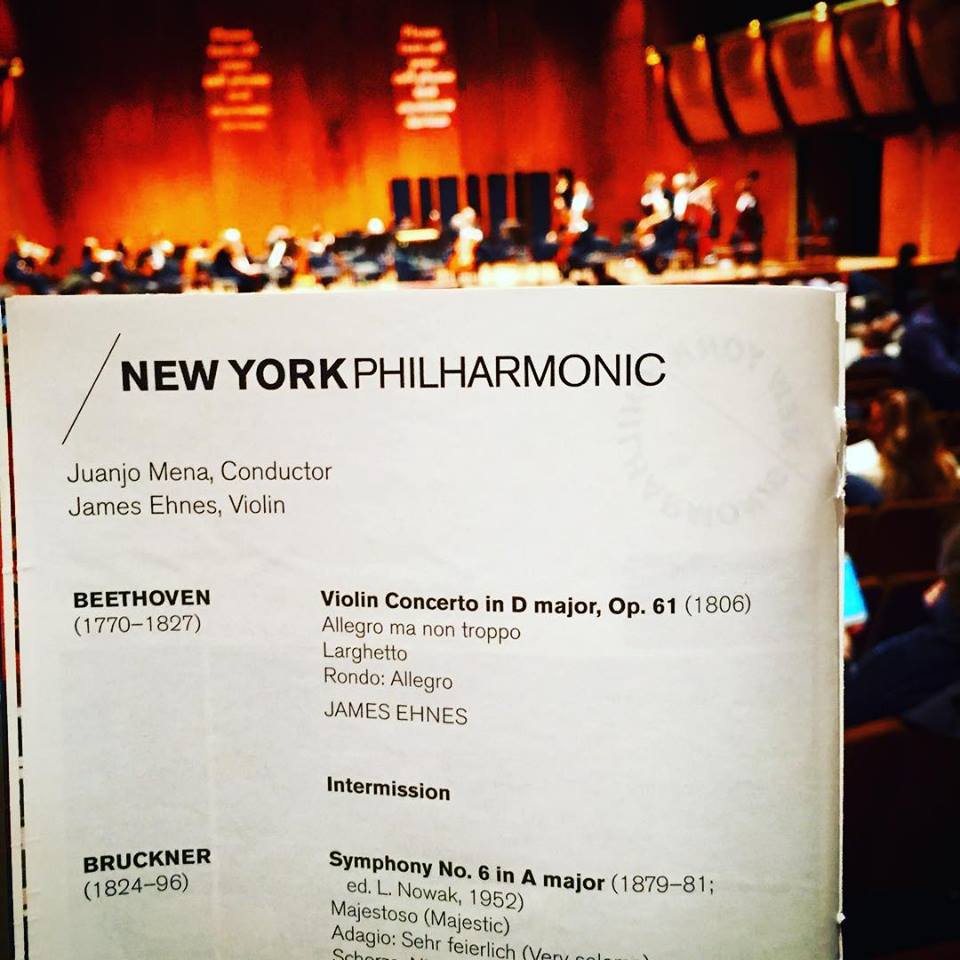
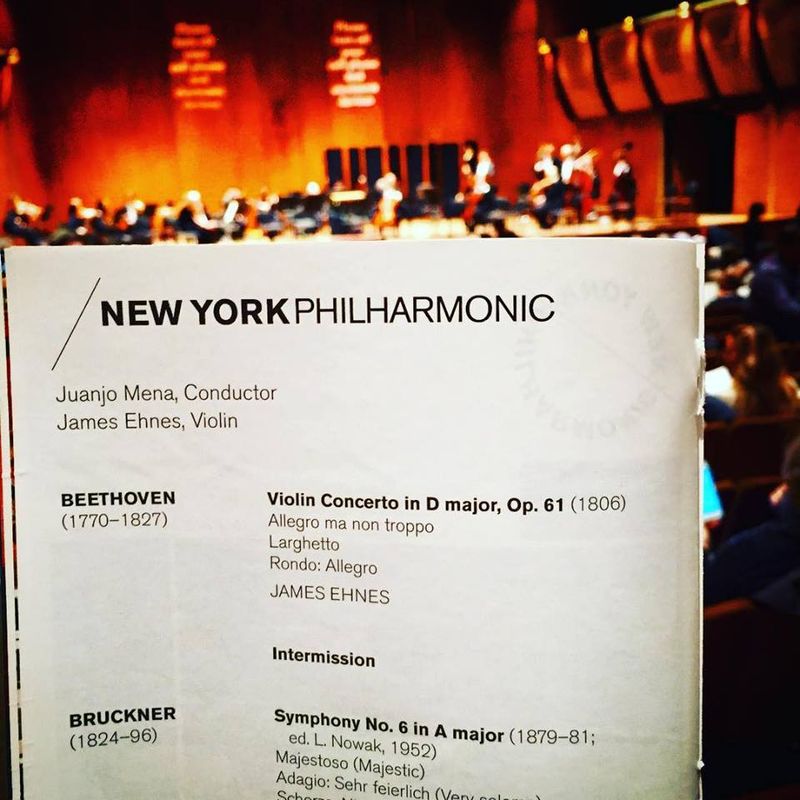
    Wednesday January 27th, 2016 – The New York Philharmonic playing masterworks by Beethoven and Bruckner under Juanjo Mena’s baton, with James Ehnes the featured soloist. 

    The Philharmonic’s been the talk of the town this week with the announcement of the appointment of Jaap van Zweden as the orchestra’s next music director; read more about the good news here.

    Tonight, Mr. Ehnes played the Beethoven violin concerto with silken tone and technical aplomb, evoking an atmosphere of hushed attentiveness in the hall and finishing to a prolonged ovation with a triple “curtain call” and with the artists of the Philharmonic joining in the applause. The tall violinist is as congenial to watch as to hear, and he and Maestro Mena formed an elegant musical affinity as the concerto progressed, sharing a warm embrace at the end.

    Beethoven’s violin concerto was written and first performed in 1806 and – after it’s premiere performance by Franz Clement, the 26-year-old principal violinist and conductor at the Theater an der Wien in Vienna – it took years for the concerto to catch on. That first performance must have been something of a nightmare: Beethoven completed the work just two days before the premiere, and the surviving autograph score is a mess of crossings-out, over-writings, and alternative ‘versions’. The soloist, having had no time to learn and rehearse the long and complex work, had to use the score for the premiere; for much of the time he was virtually sight-reading. One reviewer wrote: “Beethoven could put his undoubtedly great talents to better uses”.

    Prior to publishing the work, Beethoven modified and clarified it following the 1806 premiere. The concerto finally began to work its way into the standard repertoire after a highly-praised performance in London in 1844, conducted by Felix Mendelssohn and played by the 12-year-old prodigy Joseph Joachim. It comes down to us as one of the greatest works of the violin concerto genre.

    James Ehnes gave a lovingly detailed performance; a series of high trills in the opening movement were dazzlingly clear, and his dynamic control throughout was simply exquisite. Maestro Mena sculpted the opening passages of the central Larghetto to perfection, the violinist then joining in with playing of sweetly sustained lyricism. The ‘Kreisler’ cadenzas were spun off with serene virtuosity. At every moment – whether playing fast or slow – Mr. Ehnes maintained an enchanting sheen on his tone. Thus the audience’s grateful show of the enthusiasm at the end was eminently deserved.

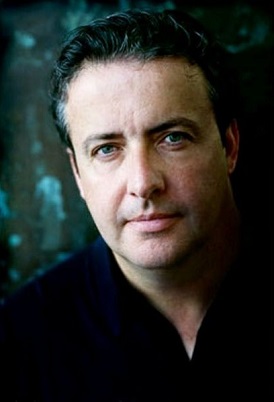
    J Mena

    Following the interval, Maestro Mena (above) and the Philharmonic musicians gave a thoroughly impressive performance of Bruckner’s 6th symphony. It’s always pleasing to have Sheryl Staples in the concertmaster’s chair, and to have Cynthia Phelps and Carter Brey leading their sections with such committed artistry. I often wish that the wind players could be seated on risers so we could better savour their individual performances: passages of wind chorale in the Bruckner were beautifully blended.

    The orchestra were at their finest in the compelling themes of the symphony’s Adagio. Both here and in the opening Majestoso, Maestro Mena was deeply involved in drawing forth the inner voices to give a full range of colour to each gorgeous passage. 

    In the third movement, a Scherzo, it seems to me that Bruckner’s imagination flags ever so slightly. The concluding movement – wonderfully played – felt over-long, almost as if the composer was unsure of how he wanted the piece to end. This ‘finale’ was not publicly performed until 1899, three years after Bruckner’s death; perhaps he would have tailored it more concisely if he’d been able to judge the effect in an actual concert performance. We’ll never know. Yet overall, the sonorous grandeur of the 6th makes a vivid impression.

    12573839_10153865541004761_6934836395217370131_n

    Pre-concert photo by my friend Dmitry.

  • Beethoven & Bruckner @ The NY Phil

    JamesEhnes_Filter630x310

    Above: James Ehnes, violinist, performing with The New York Philharmonic tonight

    Wednesday January 27th, 2016 – The New York Philharmonic playing masterworks by Beethoven and Bruckner under Juanjo Mena’s baton, with James Ehnes the featured soloist. 

    The Philharmonic’s been the talk of the town this week with the announcement of the appointment of Jaap van Zweden as the orchestra’s next music director; read more about the good news here.

    Tonight, Mr. Ehnes played the Beethoven violin concerto with silken tone and technical aplomb, evoking an atmosphere of hushed attentiveness in the hall and finishing to a prolonged ovation with a triple “curtain call” and with the artists of the Philharmonic joining in the applause. The tall violinist is as congenial to watch as to hear, and he and Maestro Mena formed an elegant musical affinity as the concerto progressed, sharing a warm embrace at the end.

    Beethoven’s violin concerto was written and first performed in 1806 and – after it’s premiere performance by Franz Clement, the 26-year-old principal violinist and conductor at the Theater an der Wien in Vienna – it took years for the concerto to catch on. That first performance must have been something of a nightmare: Beethoven completed the work just two days before the premiere, and the surviving autograph score is a mess of crossings-out, over-writings, and alternative ‘versions’. The soloist, having had no time to learn and rehearse the long and complex work, had to use the score for the premiere; for much of the time he was virtually sight-reading. One reviewer wrote: “Beethoven could put his undoubtedly great talents to better uses”.

    Prior to publishing the work, Beethoven modified and clarified it following the 1806 premiere. The concerto finally began to work its way into the standard repertoire after a highly-praised performance in London in 1844, conducted by Felix Mendelssohn and played by the 12-year-old prodigy Joseph Joachim. It comes down to us as one of the greatest works of the violin concerto genre.

    James Ehnes gave a lovingly detailed performance; a series of high trills in the opening movement were dazzlingly clear, and his dynamic control throughout was simply exquisite. Maestro Mena sculpted the opening passages of the central Larghetto to perfection, the violinist then joining in with playing of sweetly sustained lyricism. The ‘Kreisler’ cadenzas were spun off with serene virtuosity. At every moment – whether playing fast or slow – Mr. Ehnes maintained an enchanting sheen on his tone. Thus the audience’s grateful show of the enthusiasm at the end was eminently deserved.

    J Mena

    Following the interval, Maestro Mena (above) and the Philharmonic musicians gave a thoroughly impressive performance of Bruckner’s 6th symphony. It’s always pleasing to have Sheryl Staples in the concertmaster’s chair, and to have Cynthia Phelps and Carter Brey leading their sections with such committed artistry. I often wish that the wind players could be seated on risers so we could better savour their individual performances: passages of wind chorale in the Bruckner were beautifully blended.

    The orchestra were at their finest in the compelling themes of the symphony’s Adagio. Both here and in the opening Majestoso, Maestro Mena was deeply involved in drawing forth the inner voices to give a full range of colour to each gorgeous passage. 

    In the third movement, a Scherzo, it seems to me that Bruckner’s imagination flags ever so slightly. The concluding movement – wonderfully played – felt over-long, almost as if the composer was unsure of how he wanted the piece to end. This ‘finale’ was not publicly performed until 1899, three years after Bruckner’s death; perhaps he would have tailored it more concisely if he’d been able to judge the effect in an actual concert performance. We’ll never know. Yet overall, the sonorous grandeur of the 6th makes a vivid impression.

    12573839_10153865541004761_6934836395217370131_n

    Pre-concert photo by my friend Dmitry.

  • NY Philharmonic Taps Jaap van Zweden

    VAN-ZWEDEN-Jaap.323125854_std

    The New York Philharmonic have just announced that Jaap van Zweden (above) will succeed Alan Gilbert as the orchestra’s music director. van Zweden’s 5-year contract commences with the 2018-2019 season; he will be music director designate for the 2017-2018 season.

    Maestro van Zweden was my personal choice for the position. The NY Philharmonic concerts that I have attended in recent seasons when he was on the podium have been particularly gratifying; and the musicians seem to respond to him both on an artistic and a human level.

    Here’s my article about a wonderful NY Philharmonic concert van Zweden led earlier this season; at the end of it, I expressed my thoughts about him taking over the music director’s post. I am really happy that it’s come to pass, and I look forward to many more concerts under his baton.

  • Philharmonic Ensembles: In A Fishbowl

    Martinu
    Above: composer Bohuslav Martinů

    Sunday January 17th, 2016 matinee – Yet another highly enjoyable concert in the Philharmonic Ensembles series at Merkin Hall: artists from The New York Philharmonic performing chamber music in an intimate setting.

    These days, more than ever, I am looking to music to lift my spirits and help alleviate the symptoms of weltschmerz that threaten to overwhelm me. Feeling particularly low this morning, part of me wanted simply to stay home; but I headed down to Merkin and just a few moments into the opening Martinů, the dark pall began to lift. By the end of the concert, I felt fortified and ready to face another week. 

    MARTINŮ  –  Duo No. 1 for Violin and Cello, H.157
    Joo Young Oh, violin; Alexei Yupanqui Gonzales, cello

    The afternoon’s opening work was composed by Bohuslav Martinů in 1927 while he was living in Paris, studying with composer Albert Roussel. It’s a delightful two-movement piece – the first soulful, the second a lively dance. Superbly performed by violinist Joo Young Oh and cellist Alexei Yupanqui Gonzales, the slow movement impelled my rejuvenation process after just a few bars with its heartfelt melodies and lovely meshing of the two voices. In the second movement, a long cello solo was really a joy to hear; I thought the violin might have an equal opportunity, but instead the piece danced on to its ending. The two players had a fine rapport, the violinist reaching over to shift the cellist’s score as the cello ‘cadenza’ was launched. 

    John SICHEL  –  Fishbowl Diaries No. 3
    Vladimir Tsypin, violin; Blake Hinson, bass; John A. Sichel, narrator

    In something of a departure, John Sichel’s Fishbowl Diaries #3 featured a spoken narrative, delivered by the composer himself. The three short vignettes were accompanied by the Philharmonic’s Vladimir Tsypin, violin, and  Blake Hinson, bass. The first tale, entitled Heather From Card Member Services, was truly droll and had the audience laughing aloud. Juliet of The Rats, a story of thwarted infatuation in a laboratory setting, had Shakesperian allusions. The third and final setting, Dolphin Man: Mwa-ha-ha-ha-ha, struck close to home: it tells of that moment in childhood when those of us who are ‘different’ realize that people are laughing at us, either gently or cruelly. Mine happened when I was nine or ten years old, and it put a damper on my self-confidence that has stayed with me to this day. It’s kind of amazing that Mr. Sichel has hit this nail so perfectly on the head.

    DVOŘÁK  –  Piano Trio in E minor, Op. 90, Dumky
    Anna Rabinova, violin; Patrick Jee, cello; Wei-Yi Yang, piano 

    Totally engrossing, uplifting, and thought-provoking was the experience of hearing today’s playing of the Dvořák Dumky trio. “Dumka” literally means “thought”, and the word also refers to a type of Slavic folk-song that veers in mood from mournful to euphoric. Each of the six dumka that Dvořák has strung together for us in this imaginative and marvelous work is a feast in and of itself: poignant melodies abound, only to swirl unexpectedly into vigorous dance passages. 

    The music calls for both deeply emotional colours and exuberant virtuosity. Anna Rabinova’s passionately expressive playing of the violin line found a complimentary spirit in the rich piano textures of Wei-Yi Yang, whilst heart-stoppingly gorgeous tone from cellist Patrick Jee gave the music its soulful core. The three musicians moved me deeply in this fantastic performance. Bravi, bravi, bravi
         
    BEETHOVEN  –  Quintet for Piano and Winds
    Sherry Sylar, oboe; Pascual Martínez Forteza, clarinet; Kim Laskowski, bassoon; R. Allen Spanjer, horn; Yi-Fang Huang, piano

    Still more delights followed the interval with a performance of the Beethoven Quintet for Piano and Winds. Here, Yi-Fang Huang was the lyrically deft pianist, and the wind voices gave us an especially mellow blend in the Andante cantabile. R. Allen Spanger, who I met and enjoyed chatting with often while I was working at Tower (he’s an avid opera fan) produced that autumnally luminous sound that I always strove for in my horn-playing years but never achieved. The three reed players were congenially matched: Sherry Sylar (oboe), Pascual Martinez Fortenza (clarinet), and Kim Laskowski (bassoon) traded melodies and mingled their timbres in a performance rich in sonic rewards.

    We emerged from the hall into a gentle snowfall. The music had worked its magic. My sincere gratitude to all the participating artists.