Tag: Thomas Hampson

  • Jerry Hadley

    Quartet

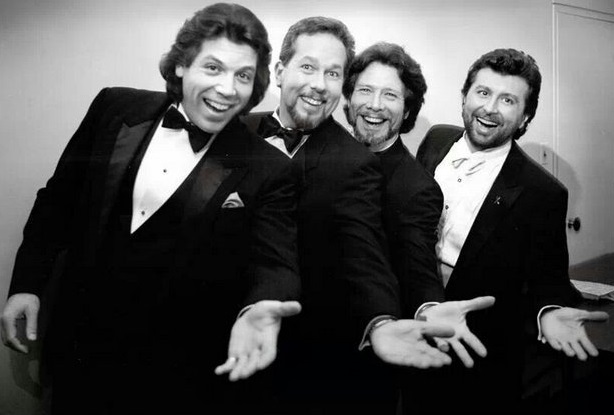
    Above, an all-star quartet: Thomas Hampson, James Morris, Samuel Ramey, and Jerry Hadley

    Back in 1980, at the New York City Opera, a young tenor singing the role of Gastone in TRAVIATA made me prick up my ears with his brief lines. It was Jerry Hadley. He is one of a four singers who captivated me initially in a small role and went on to a major career; the others were Samuel Ramey (1st Nazarene in SALOME), Kathleen Battle (Shepherd in TANNHAUSER), and Lisette Oropesa (Cretan Woman in IDOMENEO). They all became great favorites of mine.

    Hadley had a generous lyric tenor with an Italianate sense of warmth and passion. The voice was clear and ardent, and he looked good onstage. He sang quite a lot at New York City Opera – where I saw him as Alfred in FLEDERMAUS, as Faust, and Nadir in PECHEURS DES PERLES. I also was present when he sang the title-role in Mozart’s IDOMENEO (Strauss version) at the Mostly Mozart Festival.

    In 1987, Hadley made his Met debut as des Grieux in MANON and sang 125 performances there – in roles as diverse as Donizetti’s Edgardo, Mozart’s Ferrando and Don Ottavio, and Stravinsky’s Tom Rakewell. I saw him at The Met as Alfredo in TRAVIATA, Tamino in ZAUBERFLOETE, and Lensky in EUGENE ONEGIN. His final Met performances were in the title-role of Harbison’s THE GREAT GATSBY in 2002. He committed suicide in 2007, at the age of 55.

  • Sibelius & Mahler @ The NY Philharmonic

    Hampson

    Above: baritone Thomas Hampson

    Friday April 22nd, 2016 matinee – A matinee performance by The New York Philharmonic pairing the Sibelius seventh symphony with Mahler’s Das Lied von der Erde. Alan Gilbert was on the podium, with soloists Stefan Vinke and Thomas Hampson singing the solo parts in the Mahler.

    The two works made an ideal pairing; the Sibelius 7th (first performed in 1925 under the title Fantasia Sinfonica) lasts only about 20 minutes and is written as a single-movement. From its opening rising scale which blooms into regal theme, the symphony compensates for its relative brevity with music of almost cinematic breadth. Abundant in melody, the piece has an Autumnal quality; though Sibelius would live until 1957, he wrote very little music after 1926. This last symphony is both serene and passionate; it leaves us wondering ‘what might have been’ if he had continued writing.

    The Sibelius was played with savourable richness by the Philharmonic artists today, and Maestro Alan Gilbert was very much in his element here; following the interval, players and conductor were joined by the two vocal soloists and a thrilling performance of Mahler’s Das Lied von der Erde commenced. 

    Still recovering from the sorrow of his daughter’s death, Mahler learned in 1907 that he was suffering from a heart condition that would, within four years, prove fatal. In The Song of the Earth, the composer’s awareness of the possibility of an approaching end prompted the composition of a great hymn to Nature and to the sheer ecstasy of living. Drawn from The Chinese Flute, a collection of ancient Chinese poems translated by Hans Bethge, the six ‘songs of the Earth’ speak of drunken defiance of impending death, of the solitary life, of the transience of youth and beauty, and of a friendship which endures beyond parting and into eternity.

    The tenor is allotted the more extroverted songs; the first, third, and fifth. Stefan Vinke’s formidable power and stamina proved equal to the fierce demands Mahler’s vocal writing places on the singer: high in tessitura and including exposed, sustained notes in the topmost range, the tenor’s muscular singing was just what’s needed. An occasional trace of pitchiness didn’t detract from Mr. Vinke’s generous singing. And I must note the lovely violin theme from Frank Huang in the fifth song, “The Drunkard in Spring“.

    (Note: it’s just been announced that Stefan Vinke will be replacing Johan Botha when James Levine and The Met Orchestra perform excerpts from Wagner’s RING Cycle at Carnegie Hall on May 26th. Christine Goerke is the soprano soloist.)

    Both mezzo-sopranos and baritones have performed the ‘other’ solo role in Das Lied von der Erde the formidable Margarete Matzenauer sang it at the NY Philharmonic premiere in 1929. Today, it was baritone Thomas Hampson whose strikingly expressive singing moved me and my companion to a tearful state as the work came to an end.

    I have admired Thomas Hampson since his Met Auditions win in 1981; among his many Met roles that have particularly impressed me have been: Count Almaviva, Billy Budd, Posa in DON CARLO, Werther, Eugene Onegin, Wolfram in TANNHAUSER, Amfortas, Iago, and – most surprisingly and most recently – Wozzeck. He walked onstage today – tall, handsome, and elegant in a tux – with an amiable self-assurance that made me think we were in for something special; Hampson delivered an intensely satisfying performance. 

    Liang Wang’s oboe solo at the start of “The Solitary One in Autumn” signaled a turn of mood from the boisterous drinking song with which Mr. Vinke had launched the cycle. As Mr. Hampson began to sing of his loneliness and weariness of spirit, his marvelous gift for poetic expression as well as the inherent beauty of his vocal timbre drew me into the music; the external world faded, and the music became the reality.

    Midway thru the fourth song, “Of Beauty“, a big dance-like theme erupts, and the baritone seemed ready to dance himself. His singing was characterful and, as the music simmers down, he did some lovely heady effects as well an plunging into basso territory briefly.

    It was in the final song, “Farewell”, that Mr. Hampson’s performance put me over the edge. Liang Wang’s oboe and Robert Langevin’s flute establish a wistful mood. The baritone’s thoughtful and sustained singing is beautifully enmeshed in some wonderful playing from the winds; oboe and harp unite; horn, cello, bassoon, and bass clarinet add poignant colours to the canvas. “All longing has become a dream,” sings the poet.

    In a spine-tingling moment, Mr. Hampson’s tone adopts a ‘dead’ emptiness, matched by plaintive flute. “I wanted to bid my friend a last farewell!” – how many of us have sadly been deprived of just such an opportunity! Mandolin and celeste are heard, as if from out of a dream of past happiness. “Where are you going, and why must it be?” asks the forlorn friend as the parting draws nigh, and they share the stirrup cup. The song ends with an affirmation of faith in life’s renewal, but even here there’s an illusive feeling. Nature holds sway with the “…luminous blue of distant space…everywhere, forever… forever and ever….”

    Alan Gilbert’s baton was suspended in air as the music faded to silence. An ovation of particular warmth ensued, with the maestro, the singers, and the musicians basking in the joy of having shared in a magnificent collaboration.
  • Bewitched? We Bitched! Met MACBETH

    Witch-brew-66170

    Tuesday March 20, 2012 – I have no one to blame but myself, really. When the Met calendar for the current season came out, I skipped easily over MACBETH even though it is an opera I love: “Not with that cast!” But then a few weeks ago I was listening to the Leinsdorf recording and decided it would be good to experience MACBETH in the opera house. Despite the currrent Met trend for unmemorable productions and often brainless casting, I decided to give it a try. 

    I’d seen this production before; I love the huge moon with the black, scudding clouds that fills the proscenium as we wait for curtain-rise. But then the opera starts with the trivialized witches in 30s housedresses, coats and purses (each purse contains lightbulbs, how clever!). They are not sinister or even mildly interesting dramatically. And thus the production is off to a ho-hum start, and proceeds on its dreary way with injections of blood and vomit meant to shock us. It doesn’t work.

    Gianandrea Noseda is often a fine helmsman at the opera, but tonight his MACBETH was workaday, and the chorus seemed uninspired. I very much liked the firm and dark-hued basso of Gunther Groissbock as Banquo; to hear his aria would have been the only reason to stay longer than we did. But not reason enough.

    Over the years I have greatly enjoyed Thomas Hampson’s performances at The Met, but although he’s been fine in the more lyrical Verdi roles of Posa and Germont he simply doesn’t have what it takes for the big-guns parts like Boccanegra or Macbeth. It’s a bit like the borderline between a Merrill and a Warren: the former never trespassed into the Nabucco/Boccanegra/Macbeth region which suited (or would have) the latter so well. It’s a matter of amplitude. The sound of the Hampson voice is still fine, steady and more resonant than I expected. But it’s not Italianate in the least, it doesn’t billow and bloom with the turns of phrase or sail grandly on the words. Verbal over-emphasis, a common gimmick for over-parted singers, was a distration in a few places, as was a tendency to be ever-so-slightly sharp pitchwise. Yet still there was a lot to admire in his vocalism.

    I’d heard Nadja Michael about ten years ago singing the mezzo part in the Verdi REQUIEM at Avery Fisher Hall. She sounded awful. Of late her name has cropped up as Salome in a European production that has made it to DVD (so many productions do these days, god knoweth why). I was expecting nothing from her vocally as Lady Macbeth, and that’s what I got. I’ve heard lots of bad, unattractive or hopeless singing in my day but usually it either has to do with a ‘beloved’ singer being past his/her prime, or a perfectly respectable singer attempting a role beyond his/her capabilities, or being indisposed but giving it a go to ‘save’ the evening. In these instances, you can usually still perceive that there is a real instrument at work but just not suited – for whatever reason – to the task at hand. There’s no such excuse to be made for Ms. Michael: this is how she sounds.

    Obviously no one at The Met these days knows or cares enough about singing to have sorted this out in advance.  Would this woman have passed an audition for the East Buttfcuk, Idaho community choir?  I dunno, but somehow she’s entrusted with a great Verdi role at The Met. Her first aria was a mess and wtf is up with giving her a repeat of the cabaletta? Once was more than enough: the voice is shallow, desperate, breathy, wobbly, harsh and grossly unpleasant. Some people have said: “At least she has the high notes!” Yeah, if ill-pitched, desperate screeching counts. Following “Vieni, t’affretta” there was one prominent ‘brava’ (husband? manager? paid goon?) and one boo from a neighboring box, plus tepid applause for an aria that should bring down the house. There was also an oddly rustling sound to be heard which I soon determined to be the joint spinning in their graves of Callas, Rysanek, Nilsson, Dimitrova and Verrett.

    The booer got up and left; I eyed my friend Alan to see if he was ready to leave but the opera was going forward and I didn’t want to cause even a slight disruption for those around us, so we stayed on thru the end of the great ensemble that marks King Duncan’s murder. Luckily no one attempted the traditional top note to crown the choral finale. I would like to have heard Mr. Groissbock’s aria but that meant listening to “La luce langue” first. No way.

    Despite the mess she made, Michael won’t be bought out. The Met can’t afford to do that anymore. So if she shows up, ready to sing, she sings and gets paid leaving the audience with the stick end of the lollipop. One might wish for her to vanish from the scene, but apparently they have her down for BLUEBEARD’S CASTLE two seasons hence. I won’t go to that, regardless of who sings the Duke.

    Alan and I staggered down to the Plaza in disbelief at what we’d just heard. There’s no excuse for it, really. A sad commentary on the state of things at The Met. And then there were all those empty seats…