Tag: Thursday April

  • Joan Tower + Bach @ The Miller Theatre

    Joan_tower

    Above: composer Joan Tower

    Thursday April 17th, 2014 – “Bach is everything that I am not,” said Joan Tower modestly in a mid-concert interview at The Miller Theatre tonight where her works were interspersed with movements from JS Bach’s fifth Brandenburg concerto, all played live – and superbly. The programme indeed was something of a study in contrasts though also there’s also a commonality since Ms. Tower is a comtemporary composer with a heart and soul, as evinced in her music.

    This programme, part of the Miller Theatre’s Bach, Revisited series, took wing on the artistry of an assemblage of excellent players: the young musicians of Curtis 20/21, a ‘new music’ ensemble based at Philadelphia’s Curtis Institute of Music, performed In Memory, Tower’s 2002 work for string orchestra. Players from Curtis 20/21 also appeared in the Brandenburg #5, joined by flautist Patrick Williams and harpsichordist Bryan Anderson. And pianist Lisa Kaplan from eighth blackbird was joined by 20/21‘s Eunice Kim (violin) and John-Henry Crawford (cello) for Joan Tower’s 2000 trio Big Sky. Tower’s string quartet #5, White Water (2011) was performed by Joel Link and Bryan Lee (violins), Milena Pajaro van de Stadt (viola) and Camden Shaw (cello). It was first-class playing all evening, with a special nod to Ms. Kim and Mr. Crawford for swinging effortlessly from Bach to Tower (and back), and to Mr. Anderson for his polished keyboard cadenza in the Brandenburg.

    The movements of the Brandenburg #5 were played in sequence but with works by Ms. Tower alternating in the order, so that ones ear was constantly lured in different directions; the two styles really complemented each other, with the Bach seeming ever-fresh and the Tower works somehow ‘familiar’, even carressive, though I’d never heard any of them before.

    The Brandenburg, so familiar, took on a youthful glow thru the poised and affectation-free playing of the ensemble. In the central movement, the trio of Ms. Kim and Mssers. Williams and Anderson developed a nice interplay of voices. The concerto’s concluding allegro brought the evening to a melodious conclusion.

    Without reading the program note, I found Tower’s Big Sky progressing in alternating veins of mystery and of passion laced with a sense of yearning. In fact, this trio was inspired by the composer’s girlhood memories of riding her horse in the Andes-surrounded valley of La Paz, Bolivia. What an experience that must have been!

    In Memory, for large string ensemble, opens with Eunice Kim playing a plaintive violin solo; the music evolves thru buzzing motifs and darkish strains of lyricism to a poignant minor-key adagio and then to a swirling agitato. A unison rhythmic passage followed by a pensive moderato for solo viola, joined by the cello, leads into a big theme which seems on the brink of fading but then goes impulsive and driven. A heady uphill climb thru the registers brings us to a sustained concluding note: a shining aural plateau.

    The Miller Theatre’s Melissa Smey interviewed Ms. Tower briefly; the composer – subtle of wit and with a touch of self-effacement – spoke of how the current situation in classical music shows a marked change since the days when composers were also performers: now the two tasks are mostly separate careers. Ms. Tower, herself a concert pianist, reminded us of such names as Mendelssohn and Beethoven – to which I might immediately add Vivaldi, Chopin, Liszt and Mahler – as both writing and conducting or playing music. She often assigns composing tasks to her music students: a learning experience they might not enjoy but which expands their horizons, and is all to the good.

    Tower’s string quartet #5, sub-titled White Water, a twenty-minute, single-movement work, commences with solo viola in a rising theme, to be taken up by the cello and then the violins in turn. The upward motion of the music is a persistent motif. My notes, scrawled in the darkness as the quartet moved onward, include “ghostly glissade“, “dense harmonics”, “seasick lurches”, “shimmering…delicate…buzzing violins”.  A pacing unison passage is followed by up-and-down swoops in the violin’s high range. The music plunges to the depths, then rises and pushes onward to a finale where glissandos burst forth and the voices part ways at the end.

     
    So much of Joan Tower’s music seems well-suited for choreography, as Pascal Rioult showed us in 2012.

  • New York Choral Society: A SEA SYMPHONY

    Ship at sea

    Thursday April 25, 2013 – “Behold the sea!” is the ecstatic phrase intoned by the chorus at the start of Ralph Vaughan Williams’ epic A SEA SYMPHONY. This evening the New York Choral Society offered this masterpiece at Carnegie Hall, along with Beethoven’s CALM SEA AND PROSPEROUS VOYAGE.

    The Beethoven unfortunately went for naught this evening because the people seated behind us could not settle themselves during the marvelous hush of the work’s opening section; they continued to squirm and whisper throughout the 8-minute duration of the piece. Fortunately we were able to move further down our row to a quieter place for the Symphony.

    A SEA SYMPHONY, which premiered in 1910 (on Vaughan
    Williams’ 38th birthday; and he conducted the premiere himself),
    established the composer as a legitimate successor to Edward Elgar in
    the pantheon of British musical giants.

    There are four movements:

    I. A Song for All Seas, All Ships – Moderato maestoso
    II. On the Beach at Night, Alone – Largo sostenuto
    III. Scherzo: The Waves – Allegro brillante
    IV. The Explorers – Grave e molto adagio – Andante con moto

    In A Sea Symphony, Vaughan Williams evokes the days when Britain ruled the waves and her Empire spanned the planet. It is a sweepingly heroic pæan to the world’s oceans and sailors, the Walt Whitman texts summoning up visions of billowing sails and flags flying aloft: …”of dashing spray
    and the winds piping and blowing”.

    Tonight’s performance unfurled splendidly under David Hayes’ baton; the shining qualities of the Vaughan Williams score emerged through the finely-textured playing of the musicians and the rich harmonies of the choral writing. Chorus and orchestra have the symphony’s Scherzo all to themselves and delivered optimum music-making in this evocative passage.

    Actress Kathleen Turner, with her signature huskiness of voice, read the Whitman poems before each of the symphony’s four movements. Clad all in black and taking on a professorial aspect as she donned her eyeglasses, she was a lecturer whose stance and gestures took on a seasoned and theatrical expansiveness as the evening progressed.

    The raven-haired soprano Jennifer Forni appropriately chose a very pretty aquamarine gown for tonight’s concert; the singer, who recently debuted at The Met as the First Esquire in the new production of PARSIFAL, displayed an unusually rich quality in her lyric-soprano voice. She sang with clarity, warmth and an attractive upper register. Undoubtedly she’ll be asked for spinto roles thanks to the unexpected and appealing density of her timbre; I hope wisdom will prevail and that she will move carefully into the repertory, assuring herself of a sustained career. The soprano’s singing was well-matched by the baritone Jordan Shanahan; his performance managed to tread a fine line between boyish eagerness and a more mature sense of vocal dignity. His poetic rendering of “On the beach at night, alone” was a highlight of the evening. Mr. Shanahan’s vocal power and clarity were in ample evidence, and when the two singers joined in unison during the symphony’s final movement, the combined effect of their voices was particularly pleasing.

    NYCSchorus

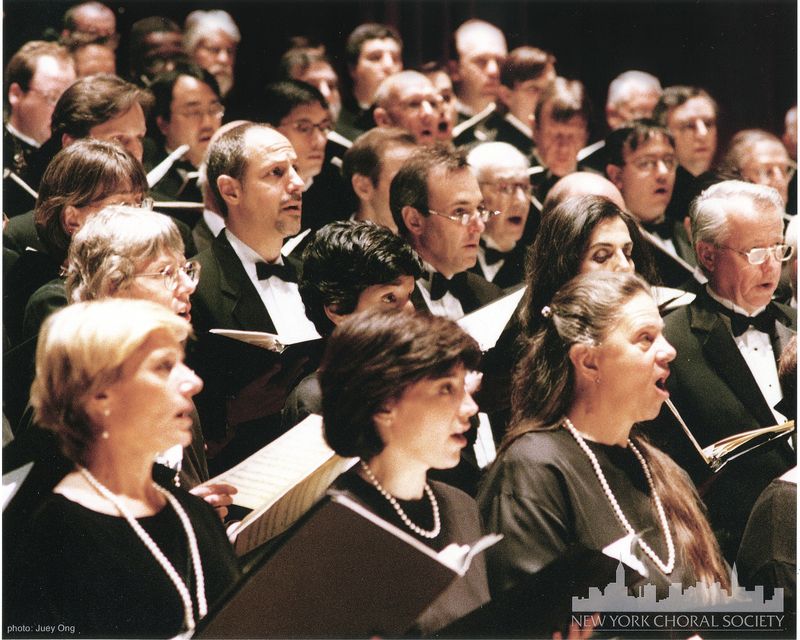
    Founded in 1958, the New York Choral Society have presented many of the masterworks in the choral genre, as well as offering eleven world premieres; and they have commissioned works by Paul
    Alan Levi, Morton Gould, Stephen Paulus, and Robert De Cormier. I love these lines from the Society’s mission statement:

    “Our passion is music.

    Our belief is that choral music lifts the human spirit. It is a language that spans borders and cultures.

    Our goal is inspiring and excellent performance.

    Our great hope is that future generations will share our passion for choral singing.”

    Dance-lovers who follow my blog will note with pleasure that the long listing of choral artists of the Society includes the name of the great ballerina Martine van Hamel. I’ll never forget a conversation I had with her one day when I was working at Tower; she was seeking some choral music on CD and explained to me that she’d been taking voice lessons and had joined the Society, pursuing a fresh aspect in her artistic career. I had to smile when I saw her name listed in the Playbill this evening, bringing back memories of that lovely encounter.

    The concert’s participating artists were:

    David Hayes, Music Director and Conductor

    Kathleen Turner, speaker

    Jennifer Forni, soprano
    Jordan Shanahan, baritone

    Chorus and orchestra of the Society

  • Rehearsal: Jennifer Muller’s LOVERS

    0H0C0639-17-L

    Thursday April 26, 2012 – It’s always a great pleasure to visit Jennifer Muller and her dancers at her unique studio space on West 24th Street. This afternoon I was invited to watch a rehearsal of LOVERS, a 1978 work that Jennifer is reviving. I asked photographer Brian Krontz to meet me at the studio; above, two of the excellent dancers of Jennifer Muller/the Works: Jen Peters and Duane Gosa.

    Inspired by the paintings of Gustave Klimt, LOVERS presents a series of four duets which trace the development of a single relationship: infatuation, lust, trust, and finally deep and committed love. The score is by Keith Jarrett. Those are the facts, but the back-story about the evolution of the piece as Jennifer related it to me is fascinating.

    She had commissioned a score from Keith Jarrett; she had the dancework completed but the composer wasn’t sending her any music. He told her he wanted to see what she’d created so it was arranged that the dancers would run thru the entire piece while Keith improvised at the piano. The session was recorded and – miraculously – Jennifer had her score in one fell swoop. And what a great score it is, bursting with colour and rhythmic vitality.

    Observing the rehearsal today, I could see how inspired Keith Jarrett must have been watching this choreography: the movement is spectacular, the partnering uncanny in its pacing and physicality. To be honest, I’ve seldom felt so blown away by the sheer dynamics of dance partnering: dancing at high-speed with incredible lifts and swirling motifs across the floor woven in, there’s no room for even the slightest error. The dancers of Jennifer Muller/The Works have mastered her complex and ultra-demanding choreography and the result is truly breath-taking.

    One of the best things about watching a studio rehearsal at Jennifer’s is: the dancers go into full-performance mode. They fling themselves full-tilt into the choreography and immerse themselves in their characters, producing the same dramatic energy you’d experience in the theater: only here they are just inches away. Unfettered by any thought of restraint, these dancers – some of Gotham’s most fascinating movers – give the viewer a sense of exhilaration.

    With an eye to upcoming performances, the duets have been double- or even triple-cast. Once I saw the complexity of the partnering I could thoroughly appreciate the energy and dedication the dancers have put into learning this work.

    A

    Buddy Valdez and Olivia Jordan (above) opened the rehearsal with a joyously expressive duet celebrating the discovery of mutual attraction; ardently flirtatious, the dancers frequently open their arms in expansive gestures that indicate their love knows no bounds. The ecstatic energy of the piece was beautifully caught by the two youthful and attractive dancers, while the choreography covered the space with the restless, questing movement. I was hooked on LOVERS within seconds.

    0H0C0471-15-L

    Olivia and Buddy, above. The rehearsal moved on, with various partnerships evolving from one duet to the next. The Jarrett score constantly matched the dance nuance for nuance, quite amazing considering the spontaniety of its creation.

    Here are some of Brian’s images from this series of duets:

    0H0C0004-5-L

    Seiko Fugita and Eric Williams

    0H0C0119-7-L

    Gen Hashimoto and Seiko Fugita

    0H0C0126-8-L

    Gen and Seiko

    0H0C0296-10-L

    Chellamar Bernard and Seiko Fugita

    0H0C0347-11-L

    Chellamar and Seiko

    0H0C0353-12-L

    Seiko and Chellamar

    0H0C0436-13-L

    Duane Gosa and Jen Peters

    0H0C0516-16-L

    Duane and Jen

    0H0C0658-19-L

    Caroline Kehoe and Pascal Rekoert

    0H0C0709-21-L

    Pascal and Caroline

    0H0C0689-20-L

    Pascal and Caroline

    LOVERS will be performed at the Katsbaan International Dance Center on May 5th, and will be in Jennifer Muller/The Works repertoire for the 2012-2013 season. I look forward to seeing (and hearing) it again.

    All photos by Brian Krontz. Click on the individual images to enhance.

  • John J Zullo’s HOW BRIEF ETERNITY

    John J Zullo Dance photo

    Thursday April 28, 2011 – A fresh choreographic voice and a new (to me) venue as John J Zullo Dance presented two works at the Theater for The New City over on 1st Avenue. Kokyat and I met John and his dancers at a rehearsal earlier this year and we liked what we saw and heard there.

    John’s HOW BRIEF ETERNITY is an eight-movement dramatic dancework set to music by Mio Morales, Maya Beiser and others. Although not a narrative, each vignette revolves around elements of prejudice and hatred that continue to thrive in modern societies thanks to the pernicious influence of racism and religion. These themes are presented in a gritty movement style with much physical contact by the dancers. There is no artifice in John’s choreographic style; his seven dancers move naturally and powerfully thru the changing partnerships and ensemble segments. Each member of the troupe makes a unique contribution to the whole and their distinctive personalities are given full range.

    There is no setting per se, though overhead on a screen homophobic slogans and anti-gay buzzwords are projected. As the dance progresses there are moments of violence, tenderness, torture, brotherhood and frustration – the last depicted by silent screams. In a gender-bending duet, the tall, beautiful and rather androgynous Brigitte Mitchell and the slender, boyish Or Sagi don matching corsets and flouncy skirts (Or wearing bright red lipstick) and dance a seductive duet to a stunning rendition of Roy Orbison’s Cryin’, sung in Spanish by Rebekah del Rio (for the film MULHOLLAND DRIVE). There is a dance for four comrades – Or, John Zullo, Ashley Linsey and Mike Hodge – where the boys slip out of their trousers and into short skirts. Jenna Liberati – a lyrical dancer with a surprising edginess – and Christina Chelette – a petite woman with an intense personal style – complete the cast. 

    HOW BRIEF ETERNITY is tightly packed with movement; John’s style isn’t like anyone else’s that I’ve seen and he plays to his dancers’ individual strengths: Or Sagi’s ballet training for example lets him show off a flourishing extension. The Theater for The New City‘s atmosphere – redolent of the dark, shabby backstage perfume of old costume trunks and forgotten shows of yesteryear – was an ideal place to present this work: we are close enough to the dancers to see individual beads of sweat.

    HOW BRIEF ETERNITY might well have stood on its own but – after a break – a second piece, a more generalized dancework about fleeting relationships entitled INSIGNIFICANT OTHERS, proved a pleasant contrast. The dreamlike echoing voice of Patsy Cline gives way to music of Peteris Vasks and Tractor’s Revenge as the dancers pair off variously in various hetero- and homosexual combinations, looking for love or someone to help them make it thru the night. The seven dancers from ETERNITY were joined by Kate Vincek.

    The second work was less engrossing than the first but it provided an additional opportunity to focus on the individual dancers.