Tag: Thursday February

  • Celebrating Alan Gilbert’s 50th Birthday

    1617_GilbertBdayFeb23_3240x1256

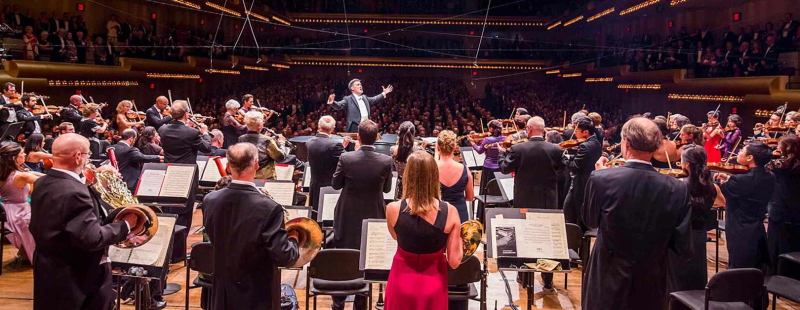
    Thursday February 23rd, 2017 – An array of stars from the classical music firmament were on hand to celebrate the 50th birthday of The New York Philharmonic‘s Music Director Alan Gilbert. Click on the above photo to enlarge.

    “Life begins at 50!”…at least it did for me: the life I’d always hoped to live, here in New York City with my beloved, with everything I enjoy – music, dance, art, food, a nearby park – at my fingertips, and good friends to share things with. Alan Gilbert’s tenure as Music Director coincides with my own embrace of The Philharmonic. I would go once in a while during the Mehta-Boulez-Masur-Maazel years, but in recent seasons I have rarely missed a program; I have become an admirer of several of the orchestra’s musicians, and of Alan’s leadership. He’ll soon be embarking on a new phase of his career, and so it was truly pleasing to be there tonight, joining with the stellar party guests onstage to salute the Maestro.

    The first half of the evening was devoted to music of the Three Bs: Bach, Beethoven, and Brahms. After welcoming speeches, Alan Gilbert strode out to a warm greeting from the packed house. Paolo Bordignon was at the harpsichord as Pamela Frank and Frank Huang took up the opening Vivace of Bach’s Concerto for Two Violins in D minor, BWV 1043, playing with festive vitality. Pamela Frank was then joined by Joshua Bell for the Largo ma non tanto, and how beautifully their timbres blended: deeply satisfying music-making. I’d hoped Alan Gilbert might play tonight, but the third movement of the Bach brought forth Lisa Batiashvili and Mr. Huang in the vivacious Allegro

    I think this was the first time I have heard this piece outside of its ballet setting: Balanchine’s masterpiece CONCERTO BAROCCO is frequently given across the Plaza. Throughout tonight’s concert rendering, the choreography danced in my head.

    Phenomenal back-to-back performances by two of the world’s great pianists followed: Emanuel Ax cast a magic spell over the music of Brahms: the Andante from the 2nd piano concerto. How gently Mr. Ax caressed this music, and how poignant was the sound of Carter Brey’s cello in his long solo passage. The cello returns near the end of the movement as Mr. Ax plays a series of delicate trills.

    Yefim Bronfman then took command of the Steinway in a thrillingly virtuosic Allegro con brio from Beethoven’s Piano Concerto No. 3. With some wonderful interjections from the Philharmonic’s wind soloists along the way, the pianist brought both passion and nuance to his playing. As his spectacular rendering of the cadenza drew to its close on a series of gossamer trills, the orchestra re-entered creating an exquisite sense of quietude. 

    Joshua Bell’s fiery playing and unbridled physicality evoked the audience’s rousing ovation for his performance of the Allegro energico from Max Bruch’s first violin concerto. Moments later, a very different aspect of Mr. Bell’s artistry was gorgeously evidenced as he joined Renée Fleming for Richard Strauss’s “Morgen!“; the warmth of the soprano’s voice and the silken serenity of Mr. Bell’s phrasing created a tranquil atmosphere, like basking in sunlight on some distant seashore.

    Ms. Fleming then gave one of her trademark arias, “Marietta’s Lied” from Erich Korngold’s DIE TOTE STADT; the song’s romance and mystery were conveyed by the soprano in the high-rising arcs of the vocal line over a dreamlike orchestration that features harp, piano, and celesta. The music becomes passionate; then the singer speaks a couple of lines, as she tries to recall the words of the second verse. Once again the haunting melody is sung, followed by an evocative postlude. Intoxicating moments.

    Lisa Batiashvili offered “Goin’ Home“, the ‘spiritual’ that was drawn from the principal theme of the Largo of Antonin Dvořák’s New World symphony, arranged by Fritz Kreisler, and adapted by T. Batiashvili. This was played with rich emotion and lovely tone by the comely Ms. Batiashvili; the only problem is that the song is quite brief, leaving us craving more Batiashvili.

    Gershwin’s An American in Paris, a favorite work of Alan Gilbert’s, was the closing work of the evening; not my cup of tea, but of course superbly played. 

    Frock watch: being a party night, the women of the Philharmonic did not all wear regulation black; Cynthia Phelps looked radiant in a “gamorous” slit-skirt emerald green number. Pamela Frank wore a black gown shot with silver, and be-jeweled shoes which would have made Cinderella envious. Lisa Batiashvili, ever the picture of elegance, wore a sleek, satiny gun-metal creation with a hint of Grecian style. And Renée Fleming looked every inch the diva in vermilion with a long golden shawl.

    Renée led us in singing ‘Happy Birthday, Dear Alan’ with the standing audience saluting the conductor and everyone singing full-voice. Maestro Gilbert basked in the embraces of the great musicians who had gathered to honor him; then they all seemed to be heading off together to continue the party into the wee hours as Alan waved goodbye to the crowd.

  • Barnatan|Honeck @ The NY Philharmonic

    Barnatan_16-500x500

    Thursday February 16th, 2017 –  Beethoven’s 1st piano concerto, with soloist Inon Barnatan (above), and Mahler’s 1st symphony were paired in tonight’s New York Philharmonic performance under the baton of Manfred Honeck.

    Beethoven’s 1st piano concerto was used by choreographer Helgi Tomasson in 2000 for his gorgeous ballet PRISM, originally danced by Maria (‘Legs’) Kowroski and Charles Askegard at New York City Ballet: that’s how I fell in love with this particular concerto. Throughout the third movement tonight, I was recalling Benjamin Millepied’s virtuoso performance of Tomasson’s demanding choreography.

    Israeli pianist Inon Barnatan, currently the first Artist-in-Association of the New York Philharmonic, has thrilled me in the past with his playing both with the Philharmonic and in frequent appearances with Chamber Music Society of Lincoln Center. And I don’t use the word ‘thrilled’ lightly. 

    Mr. Barnatan’s playing of the Beethoven this evening was remarkable as much for its subtlety as for its brio. Maintaining a sense of elegance even in the most whirlwind passages, the pianist had ideal support from Maestro Honeck and the artists of the Philharmonic. The cascading fiorature which sound soon after the soloist’s entrance were crystal-clear; with Mr. Barnatan relishing some delicious nuances of phrase along the way, we reached the elaborate cadenza where the pianist demonstrated peerless dexterity, suffusing his technique with a sense of magic.

    From the pianissimo opening of the Largo, Mr. Barnatan’s control and expressiveness created a lovely sense of reverie. He found an ideal colleague in Pascual Martinez Forteza, whose serenely singing clarinet sustained the atmosphere ideally. Maestro Honeck and the orchestra framed the soloist with playing of refined tenderness; the Largo left us with a warm after-glow.  

    The concluding Rondo: Allegro is one of the most purely enjoyable finales in all the piano concerto literature. Good humor abounds, the music is expansive, and a jaunty – almost jazzy – minor key foray adds a dash of the unexpected. Mr. Barnatan was at full-sail here, carrying the audience along on an exuberant ride and winning himself a tumult of applause and cheers. He favored us with a brisk and immaculately-played Beethoven encore, and had to bow yet again before the audience would let him go. 

    Inon Barnatan has, in the past two or three years, become a ‘red-letter’ artist for me – meaning that his appearances here in New York City will always be key dates in my concert-planning. His Gaspard de la Nuit at CMS last season was a true revelation, and tonight’s Beethoven served to re-affirm him as a major force among today’s music-makers. 

    Manfred-honeck-header

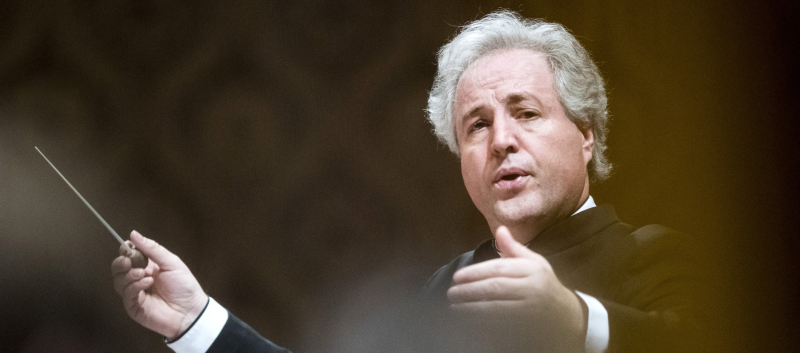
    Maestro Honeck (above) returned to the podium following the interval for the Mahler 1st. In the course of the symphony’s 50-minute span, the Maestro showed himself to be a marvelous Mahler conductor. The huge orchestra played splendidly for him, and the evening ended with yet another resounding ovation.

    From the ultra-soft opening moments of the first symphony, which Mahler described as sounds of nature, not music!”, this evening’s performance drew us in. The offstage trumpet calls seem to issue from a fairy-tale castle deep in a mysterious forest. The Philharmonic’s wind soloists – Robert Langevin, Philip Myers, and Liang Wang among them – seized upon prominent moments: Mr. Wang in fact was a key element in our pure enjoyment of the entire symphony. The pace picks up, and a melody from the composer’s Wayfarer songs shines forth; the music gets quite grand, the horns opulent, the trumpets ringing out, and so on to a triumphant climax.

    The symphony’s second movement, a folkish dance, also finds the horns and trumpets adding to the exuberance. After a false ending, a brief horn transition sends us into a waltzy phase, with winds and strings lilting us along. Then the movement’s initial dance theme returns, accelerates, and rushes to a joyful finish.

    The solemn timpani signals the ‘funeral music’ of the third movement; a doleful round on the tune of “Frère Jacques” ensues, but perhaps this is tongue-in-cheek Mahler. Mr. Wang’s oboe again lures the ear, and a Wayfarer song is heard before a return to the movement’s gloomy opening atmosphere. The unusual intrusion of a brief gypsy-dance motif melts away, and the funeral cortege slowly vanishes into the mist.

    Maestro Honeck took only the briefest of pauses before signaling the dramatic start of the finale. A march, a lyrical theme, a romance that grows passionate: Mahler sends everything our way. After several shifts of mood, it begins to feel like the composer is not quite sure how he wants his symphony to end. Various motifs are heard again, and at last Mahler finds his finish with a celebratory hymn, the horn players rising to blaze forth resoundingly.

  • Freiburg Baroque @ Alice Tully Hall

    Mozart

    Thursday February 25th, 2016 – This all-Mozart concert, performed by Freiburg Baroque at Alice Tully Hall tonight, was part of our Great Performers at Lincoln Center subscription series. Arias from the da Ponte/Mozart operas, the clarinet concerto, and the “Linz” symphony were scheduled. We were of course expecting the usual program order: the arias first, then the clarinet concerto, an intermission, and the symphony coming last. 

    Instead, in an attempt to re-create a type of concert popular in Mozart’s time, the movements of the symphony were played on the first half of the program, interspersed with arias. This may have seemed intriguing on paper, but in the event it lessened the effect of the symphony – which now seemed more like incidental music (great incidental music!) – while the arias seemed rather randomly chosen, two of them in fact being simply passages from ensembles.

    Given all this, and despite some very fine playing, the first half of the evening seemed a bit of a jumble. Gottfried von der Goltz, the ensemble’s principal violinist and director, had an ideally light touch, and he set propulsive tempi for the symphonic movements. He and the singer, Christian Gerhaher, formed a very simpatico bond: Mr. Gerhaher’s very confident stage-presence, wide-ranging voice, and winningly characterful interpretations were finely supported by conductor and ensemble. 

    Prior to playing the concerto, soloist Lorenzo Coppola introduced us to the clarinet d’amour – an unusual instrument that is longer than a standard clarinet and with a flared bell at the end. Once the concerto was underway, Mr. Coppola played with sure technique, exploring the instrument’s wide range with plenty of body language and almost comic accentuation of the lowest notes. His performance took on a more serious tone for the haunting Adagio, one of Mozart’s most sublime creations. For all Mr. Coppola’s skill and artistry, there were times when the instrument itself seemed in control.

    Mr. Gerharer then re-appeared for three of Mozart’s greatest arias for male voice: Leporello’s Catalogo, and one showpiece each from the opposing protagonists of NOZZE DI FIGARO: the valet’s “Non piu andrai” and Count Almaviva’s blazing “Hai gia vinto la causa!” In these three solos, Mr. Gerharer further displayed his impressive grasp of vocal characterization: in the Almaviva aria especially, he seemed to bring the drama most vividly to life.

    Between the two NOZZE arias, the orchestra chimed in with a brief Contredanse (K. 610) subtitled “Les filles malicieuses“, a brief charmer of a piece. Who were these “malicious girls” and what did Mozart want with them?  We’ll never know, any more than we’ll know whose cellphone went off at just the wrong moment tonight.

    The Participating Artists:

    Freiburg Baroque/Gottfried von der Goltz, violin and director

    Christian Gerhaher, baritone

    Lorenzo Coppola, clarinet d’amour

    The Repertory:

    Arias from Mozart’s Don Giovanni, Così fan tutte, and Le Nozze di Figaro

    Mozart: Clarinet Concerto

    Mozart: Symphony # 36 (“Linz”)

  • New York Philharmonic: Bronfman/Valčuha

    Yefim bronfman

    Above: pianist Yefim Bronfman

    Thursday February 18th, 2016 – In recent seasons, as I’ve gradually moved away from opera and dance and into the realm of symphonic and chamber music, concerts featuring the great pianist Yefim Bronfman have consistently been outstanding events; we still talk about these evenings – and about the pianist – with great admiration and affection. To me, Mr. Bronfman is a unique musician: an artist in the highest echelon of great performers today.

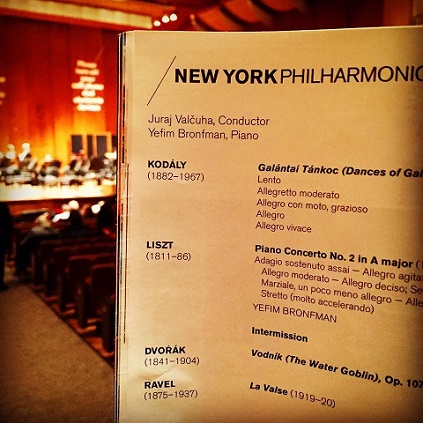
    This evening’s concert at The New York Philharmonic is something my friend Dmitry and I have been looking forward to since it was announced. Maestro Juraj Valčuha was on the podium tonight as Mr. Bronfman performed Liszt’s Piano Concerto #2 on a program that further featured works of Kodály, Dvořák, and Ravel.

    Opening the concert with Kodály’s Dances of Galánta; the Philharmonic had played this piece in 2013 and I was happy to experience this music again: it’s happy music!  Zoltán Kodály wrote his Dances of Galánta to celebrate the 80th anniversary of the Budapest Philharmonic Orchestra. Galánta is a small village in Hungary where the composer spent seven years of his childhood and where, thanks to the town’s popular gypsy band, the young Kodály became aware of of the style and motifs of gypsy music.

    Launched by a clarinet tune from the Philharmonic’s inimitable Anthony McGill, Dances of Galánta has a wonderful lilt and swagger. Flautist Robert Langevin and oboist Liang Wang pipe up charmingly, and the big, passionate main theme is irresistible. Maestro Valčuha – tall, handsome, and with an elegant baton technique – drew out all the vivid colours of the score, which ends with a romping folk dance.

    Mr. Bronfman then appeared, to a congenial welcome from the Philharmonic audience. Meticulous of technique and warmly confident in stage demeanor, the pianist’s performance of the Liszt Piano Concerto No. 2 was impressive in its virtuosic clarity and in its meshing of the piano line with the orchestra. Maestro Valčuha’s feeling for balance and pacing was spot-on. 

    The concerto, which Liszt tinkered with endlessly between 1839 and 1861, is particularly congenial to experience as it sweeps forward in one continuous movement over a span of about 20 minutes; yet it has the feel of a more traditionally structured concerto. Along the way, Liszt pairs the piano with various orchestral voices – a gorgeous piano/cello lullabye; rippling piano motifs as the oboe sings; high and delicate piano filigree over gentle violins; horns and cymbals sounding forth as the piano flourishes triumphantly. 

    Mr. Bronfman’s fluency in the rapid passages was a delight: sprightly in a high-lying scherzo passage, then swirling and cascading up and down the keyboard with joyous bravado. The concerto further alternates moments of big drama with passages of sheer melodic glow, all of which Mr. Bronfman delivered to us with his customary assurance and polish. 

    Audience and orchestra alike embraced the pianist with a prolonged ovation; an encore was given which elicited even more applause, and the affable Mr. Bronfman was called out twice again. Next season, he’s down for the Tchaikovsky 2nd with The Phil: it’s already on my calendar, circled in red. 

    Valcuha-Juraj

    Following the interval, Maestro Valčuha (above) and the Philharmonic players further displayed their cordial rapport in two well-contrasted “tone poems”:  Dvořák’s folkish and finely-orchestrated The Water Golbin (curiously enough, having its Philharmonic premiere tonight – some 120 years after it was written) and Ravel’s darkly magical La Valse, which always makes me think of Rachel Rutherford and Janie Taylor.

    While it seemed a bit odd not to have a symphony on the program, the two shorter works in the second half of the evening worked well together, were beautifully played, and allowed us to savor Maestro Valčuha‘s conducting from both a musical and visual standpoint.

    12742079_10153914529104761_5025851178161479995_n

    Photo by Dmitry.

  • Jessica Lang Dance @ The Joyce

    Jessicalang1

    Above: from Jessica Lang’s The Calling, photo by Takao Kamaru

    Thursday February 20, 2014 – Jessica Lang Dance are at The Joyce this week, presenting an exciting programme of danceworks in varied musical styles, all of it choreographed with Lang’s innate sense of sophistication and grace. And it’s all beautifully danced as well.

    Lines Cubed is a Lang work new to me and I loved every moment of it. Set to a score by composers John Metcalfe and Thomas Metcalf, the ballet takes on the aspects of a danced symphony: there’s a prelude, an andante, a scherzo, an adagio, and a finale – and each movement is colour-coded for the costuming and set decor. Throbbing mechanical rhythms and passages of lyricism allow the choreographer to explore various movement motifs: much of the ballet has a stylized, ritualistic quality with questing port de bras. The lighting (Nicole Pearce) and the use of accordian-like set pieces which the dancers open and close in passing create a shifting visual framework.

    Following a ritualistic opening movement, Black, the space glows in ruby-rich light for Red with an evocative solo danced by Kana Kimura backed by four men. Bright sun and infectious joy are expressed by a trio of women – Julie Fiorenza, Sarah Haarmann and Laura Mead – in Yellow. This gives way to a rather sombre Blue adagio, danced by Claudia MacPherson and Milan Misko. The colours are mixed and matched for the full-cast finale. Such was the cumulative effect of the setting, music and dancing that I could have immediately watched this ballet again.

    For Mendelssohn/Incomplete, Jessica Lang has turned to my favorite chamber work – the Mendelssohn piano trio #1and created an ensemble work of longing and gentle melancholy in a dusk-like setting. The women in purple dresses and the men in soft shades of grey cross the stage in a clustered formation, a community seeking something in the impending darkness. They pause to dance: here the choreographer shows us tenderness and consolation in choreography that quietly illuminates the music. In the end, the group seem to be moving on – one woman lingers in the space, but she is not left behind. This poignant ballet, so touching in its sincerity and humanity, made a fine impression and was superbly danced by Mlles. Fiorenza, MacPherson and Haarman with Clifton Brown, Milan Misko and Kirk Henning.

    In Aria, a quartet set to Zenobia’s restless-fury aria “Son contenta di morire” from Handel’s RADAMISTO, three boys (Todd Burnsed, Kirk Henning and Milan Misko) in grey tights and bright red shirts sail thru strongly musical combinations while Laura Mead – in a flame-red frock and dancing on pointe – comes and goes in a breathlessly-paced virtuoso performance. Mr. Burnsed is her primary partner; there are lifts, escapes, and swirling entrances and exits in this portrait of a woman on the brink.

    The Calling, a mind-bendingly gorgeous solo, is culled from a Lang signature work Splendid Isolation II. It was performed tonight by the radiant Kana Kimura. The dancer – in a long white gown – basically remains stationary, using port de bras and gentle shiftings of the upper body, neck and head to enthrall the viewer while music by Trio Mediaeval lends a timeless sense of rapture. This work, and Ms. Kimura’s sheer expressive elegance, enthralled the packed house tonight.

    White, a dance-on-film made in 2011 and having its New York premiere at these performances, shows six white-clad dancers against a jet-black background. The perspective makes them appear large or small as they dance across the screen, sometimes with witty inflection. Their comings and goings have a silent-movie flair, and the music of Edward Grieg makes White an especially pleasing interlude.

    i.n.k. is a Jessica Lang work that I have experienced from its earliest formative stages. Visually engrossing, the ballet features black-clad dancers moving before a snow-white back-panel, sometimes dancing with their shadows. Meanwhile drops or waves of dark ink splash across the screen. The other-worldly score by Jakub Ciupinski, the costuming of Elena Comendador, Nicole Pearce’s lighting, and the intriguing film elements (KUSHO by Shinichi Maruyama) all combine to draw the viewer into this dream-like world.

    Clifton Brown – truly one of the great dancers of our time – and the celestial Kana Kimura have a remarkable adagio in i.n.k. which ends with a mesmerizing slow backbend from Kana, supported on high in Clifton’s arms. This passage is so compelling and I felt this evening that i.n.k. should actually end here; and my companion felt the same way.

    On my dance wish-list is Jessica Lang’s production of Pergolesi’s STABAT MATER which premiered at Glimmerglass in the Summer of 2013; I’m hoping it could be brought to New York City.