Tag: Thursday January

  • Nobuyuki Tsujii @ Carnegie Hall

    Screenshot 2023-01-16 at 13-46-01 Nobuyuki Tsujii Plays Rachmaninov Seattle Symphony

    Thursday January 19th, 2023 – This evening, we welcomed the Japanese pianist Nobuyuki Tsujii back to Carnegie Hall. In 2018, I attended Nobu’s Carnegie debut with ORPHEUS: an exciting evening. In 2019, the pianist gave a solo recital in the famed venue, which I was sadly unable to attend.

    Tonight’s concert began with a transcendent musical experience. Nobu, who is blind, was led to the Steinway where he seated himself and took the measure of the keyboard; he then commenced to play Beethoven’s immortal Piano Sonata No. 14 in C-sharp Minor, Op. 27, No. 2, “Moonlight”. From the very first note, Nobu drew us deeply into the music. Playing in a whispered – but also miraculously weighted – pianissimo, he suffused the beloved melody with a spiritual resonance that is beyond rare. Sustaining this atmosphere throughout, Nobu held us under an enchantment. There was a palpable silence in the hallowed hall such as I have seldom – if ever – experienced in my six decades of concert-going.

    As the final note of the Adagio sostenuto lingered on the air, my impulse was to get up and leave, taking this perfect memory with me. But, of course, I didn’t: I stayed on, listening to Nobu’s remarkable playing of the rest of the Moonlight and joining in the eager applause that followed.

    Next came Franz Liszt’s Consolation No. 2 in E-Major; composed between 1844 and 1850 the Consolations are a set of six short pieces. The second of these has a gentle, shimmering start before turning pensive. Here, Nobu showed his gift for delicacy, and – later – for free-flowing lyricism. 

    The pianist then offered a sort of ‘Liszt encore’: Venezia e Napoli. The opening movement, Gondoliers, is evocative of a summer afternoon on the canals of Venice: mysterious at first, the music conjures up the water rippling in the sunlight. A song, such as the gondolier might sing, springs up: fanciful fiorature and tingling trills are dazzlingly set forth by the pianist. The ensuing Canzone has a lively start, but soon goes deep and dramatic; the canzone‘s finale is fantastically animated – “thousands of notes!”, I scrawled on my playbill – and was delivered by Nobu with pinpoint accuracy and unfettered joy. The pianist then further demonstrated his phenomenal dexterity in the concluding Tarantella.

    For the second half of the program, Nobu turned first to Ravel: three relatively brief works were offered, starting with Menuet sur le nom d’Haydn. While gentle and charming, one could sense a haunted feeling lurking under the surface, which Nobu captured in his appealing interpretation. He then employed his vast dynamic range to sterling effect in the familiar Pavane pour une infante défunte, giving the music a touching beauty of expression. The luminous Jeux d’eau – one of the composer’s gems – is full of high, silvery undulations which seemed magical in Nobu’s hands.

    The concert’s final work, Eight Concert Etudes by the Soviet composer Nikolai Kapustin, have an improvisational feeling, mixing classicism with elements of jazz. Composed in 1984, they are technically extremely demanding, filled as they are with torrents of notes played a supersonic speeds. Nobu dazzled us with the clarity and sureness of his technique. If the music itself began to wear a bit thin after a while, the pianist’s playing was simply remarkable. The audience was soon sighing aloud with disbelief or admiration as Nobu seemed to leap over one technical hurdle after another as he dashed to the finish line. This resulted in a boisterous standing ovation from the sold out house, and hundreds of cellphones were raised aloft to capture the excitement.

    For Nobu’s first encore, J. S. Bach’s “Jesu, Joy of Man’s Desiring“, in an arrangement by Dame Myra Hess, he returned to the purity and depth of feeling with which the concert had started. Although we knew more encores would follow, I took my leave whilst the audience was cheering. I’ll never forget this evening, with Nobu mesmerizing us in the Moonlight.

    ~ Oberon

  • Vengerov/Trpčeski @ Carnegie Hall

    CH11152281_Medium_res_comp

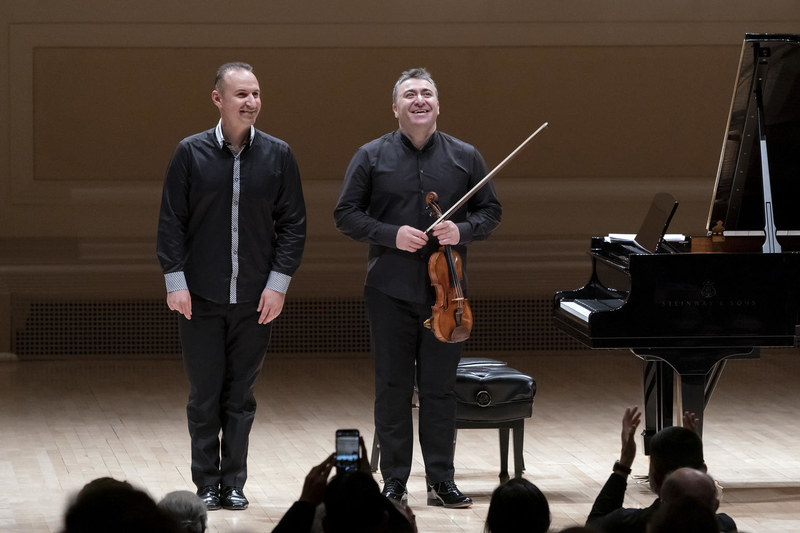
    Above: violinist Maxim Vengerov and pianist Simon Trpčeski onstage at Carnegie Hall; photo by Jennifer Taylor, courtesy of Carnegie Hall

    Thursday January 20th, 2022 – My first concert at the Stern Auditorium at Carnegie Hall since March of 2020. I was very happy to bring my friend DK to see one of his favorite artists, Maxim Vengerov, in recital. The Macedonian pianist Simon Trpčeski was at the Steinway for a wonderful program.

    The audience gave the musicians a hearty welcome as they walked out onto the stage. People are simply aching to hear great music played live again after the the long months of uncertainty. And so the opening Mozart seemed like a transfusion of peace and hope, though still tinged with darkness.

    CH11152497_Medium_res_comp

    Above: Maxim Vengerov, photo by Jennifer Taylor

    Mozart’s Violin Sonata in E-Minor, K. 304 was composed in 1778; this is the only one of Mozart’s violin sonatas written in a minor key; its underlying wistfulness might be connected to the fact that the composer’s mother had passed away while he was working on it.

    Departing from the norm, this sonata is in only two movements. The Allegro takes its character from the poignant opening theme, played in unison by violin and piano. The piano brings forth a second, more animated theme, though the mood remains restrained. A lovely dovetailing of dynamics marked the Vengerov/Trpčeski partnership’s playing, the violinist’s repeated insistent notes met by the pianist’s wonderful subtleties. 

    Mozart marks the second movement Tempo di Minuetto, but it has a forlorn quality not usually heard in a minuet. Solo piano introduces the grave yet graceful opening melody, and soon the two instruments take turns with it, their voices entwining. A major-key interlude gives us an unexpected ray of light, with sublimely soft playing from Mr. Trpčeski. The minor mode resumes, the melody flowing on to a rather sudden stop.

    CH11152391_Medium_res_comp

    Photo by Jennifer Taylor

    In direct contrast to the Mozart, Mssrs. Vengerov and Trpčeski next offered the Prokofiev Violin Sonata No.1. Prokofiev is one of my A-list composers, and this sonata encapsulates everything I love about his works: the rough-edged drama, the heartfelt lyricism, the chiaroscuro dynamics, and the subtle wit of his music always fascinates me.

    Following the four-movement structure (slow-fast-slow-fast) of the Baroque church sonatas, Prokofiev opens this sonata with a somber passage from the piano. The violin joins, edgy and buzzy, and then the two instruments blend in a unison lament. The piano’s dolorous notes draw the violin into a yearning, dramatic passage. Then the violin skitters softly on high as the pianist intones soft chords; it sounds “like the wind in a graveyard” as Prokofiev told David Oistrakh, who played the sonata’s premiere performance.

    The second movement, Allegro brusco, begins vigorously, lapses into a songful state, then turns fast and furious. Things subside briefly, but accents soon propel the piano forward again as the violin makes agitated remarks. Calming to lyricism, the music then gets grand – with a soaring melody leading to a wild finish.

    In the third movement, Andante, the Vengerov/Trpčeski transported us with their spectacular playing. An opening passage of piano filigree is taken up by the violin. A gorgeous violin melody is heard, whilst the piano sustains a magical atmosphere. This ethereal music puts us in a blissful state, with Mr. Vengerov finishing his reverie with a miraculously sustained pianissimo trill. Heavenly!

    Brilliant playing from both artists drove the sonata’s concluding Allegrissimo forward in spectacular fashion. A melodious interlude lets us again savour the warmth and serenity of Prokofian lyricism, and then some biting staccati dazzle us yet again. Another whiff of the “wind in a graveyard” motif leads on to work’s quiet closing. 

    CH11152496_Medium_res_comp

    Photo by Jennifer Taylor

    Following the interval, César Franck’s ever-popular Violin Sonata was given a thrilling performance by the Vengerov/Trpčeski duo. This sonata was inspired by the marriage of the great violinist Eugène Ysaÿe to Louise Bourdeau in 1886.  Franck’s initial idea for the sonata was to commence with a a slow and reflective opening movement, but Ysaÿe persuaded him that it worked best at a quicker tempo, so Franck marked it Allegretto, ben moderato. This movement juxtaposes rather than develops two themes, the first given almost exclusively to the violin, the second to the piano. These themes, particularly the violin’s, will return in the following movements. From note one, I fell under the spell of this music, which seemed so fresh and vivid as performed tonight. Mr. Trpčeski’s playing was positively rhapsodic, whilst Mr. Vengerov poured so much passion into the thrilling melodies the composer has given him.  

    The agitated, dramatic second movement casts its own spell, with the players again displaying their intriguing dynamic range and their peerless legato. The music is at once propulsive and poetic. Then comes the pensive Recitativo-Fantasia, wherein Mr. Vengerov’s rapturous playing in the high range is heard over the piano’s gently rolling misterioso figurations.

    The familiar and beloved themes reappear in the sonata’s final movement, which builds to a glorious finish. The inevitable reaction of the audience to the playing of Mssrs. Vengerov and Trpčeski was a fervent ovation, richly deserved. 

    Ravel’s Tzigane was a late addition to the program. Familiar to me mainly from the ballet that George Balanchine created for his muse, Suzanne Farrell, to this music, it’s a Vengerov specialty: he played it here at his February 2020 concert, just days before the pandemic shut everything down. 

    In July 1922, Maurice Ravel met the young Hungarian violinist, Jelly d’Aranyi, who was the grand-niece of famed 19th-century violinist Joseph Joachim. The composer was intrigued when he heard the violinist playing gypsy melodies at a party. Inspired, he fashioned a gypsy rhapsody, working on it over a period of two years. Ravel completed it just a few days before the premiere: on April 26, 1924, in London, Mlle. d’Aranyi and pianist Henri Gil-Marchex gave the premiere of Tzigane.

    Tzigane is a legendary showpiece, and tonight the amazing dexterity of the violinist (later joined by the pianist) kept the audience on the proverbial edge of their seats. After a giant “pre-cadenza”, the music starts to dance, by turns high and shimmering, then wildly earthy.

    CH11152444_Medium_res_comp

    At the concert’s end, Trpčeski and Vengerov were greeted with a lively ovation. They returned for three encores: two delicious Fritz Kreisler treats, and then Gabriel Fauré’s sublime Après un rêve, which was sublimely played. Bravo, gentlemen!  Bravissimo!!

    All photos by Jennifer Taylor, courtesy of Carnegie Hall.

    ~ Oberon

  • Anne-Sophie Mutter ~ Beethoven Evening

    CH1766263_Medium_res_comp

    Above: Anne-Sophie Mutter, photographed during the performance by © Jennifer Taylor.

    ~ Author: Oberon

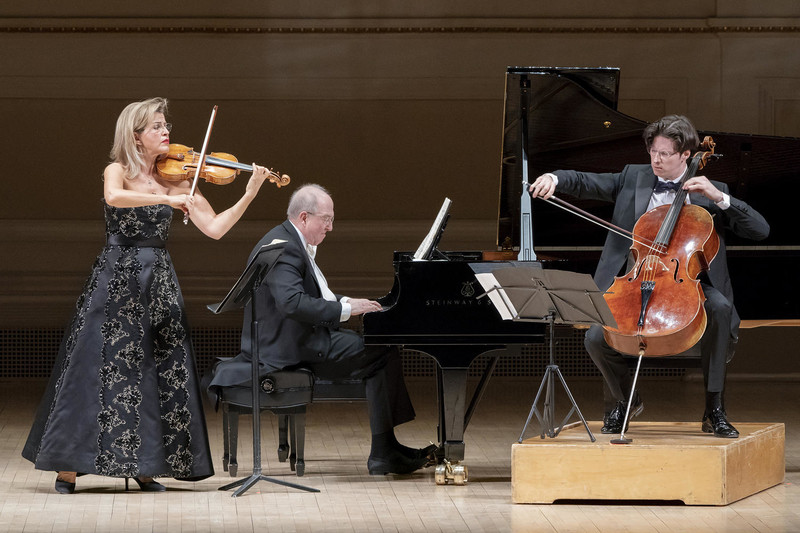
    Thursday January 30th, 2020 – As the Beethoven Celebration year kicks off, only a handful of the announced “all-Beethoven” programs that are scheduled here in Gotham are of interest to me. But I would not have missed Anne-Sophie Mutter’s performance at Carnegie Hall tonight for anything. The esteemed violinist offered a pair of sonatas book-ending the “Ghost” trio. Ms. Mutter’s longtime collaborator, Lambert Orkis, was at the Steinway, and cellist Daniel Müller-Schott joined them for the trio.

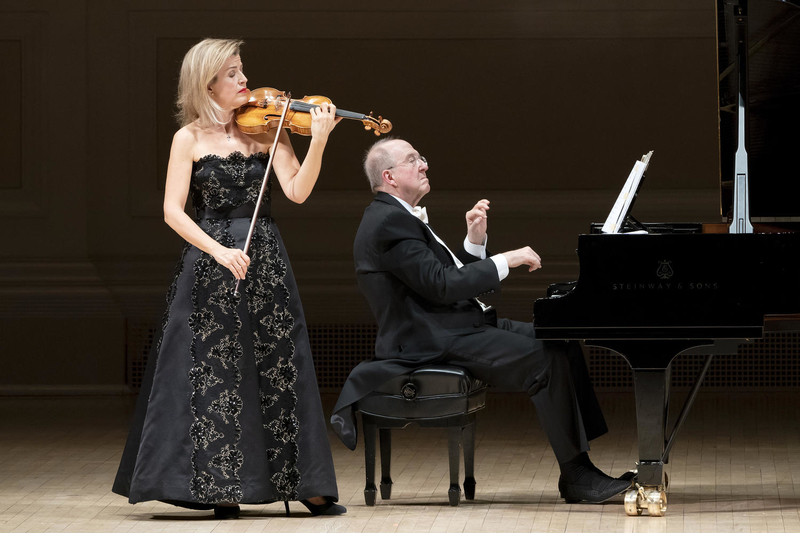
    The comely violinist, now in the 40th year of her professional career, was warmly welcomed by a packed house as she walked onto the Carnegie Hall stage in a black gown bedecked with silver appliqué. She and Mr. Orkis immediately commenced the violin sonata No. 5 in F-Major, Op. 24, fondly known as “Spring”: the blithe opening passages were played softly, at once settling the audience and drawing them in.

    This opening Allegro continues thru a series of lyrical themes in which the two players alternate roles: melodist and accompanist. Minor key intrusions sometimes imply that clouds are passing overhead, but the sunshine always returns. A unison section shows the advantages of a longtime musical partnership: simply perfect.

    In the ensuing Adagio molto espressivo, Ms. Mutter and Mr. Orkis sustained a heavenly, pensive atmosphere with playing of exquisite delicacy and spun-out legato: they seemed to cast a spell over the venerable Hall. With a charming light touch, the Scherzo is over before it starts, and we are plunged into the Rondo – Allegro ma non troppo, in which almost Mozartean pleasantries are sometimes interrupted by jolts of fast and furious playing. But all’s well as ends well, and the Springtime sun illuminates the sonata’s optimistic ending.

    CH1766260_Medium_res_comp

    Above: Ms. Mutter and Mssrs. Orkis and Müller-Schott, photo © Jennifer Taylor.

    The Piano Trio in D Major, Op. 70, No. 1, “Ghost” brought cellist Daniel Müller-Schott to the stage, joining Ms. Mutter and Mr. Orkis. 

    The energetic start of this popular trio, in which the cello quickly establishes a prominent place, leads on to a flowing lyricism with deftly rolling piano motifs which Mr. Orkis delivered with gracious sweep.

    The eerie start of the Largo heralds the movement which gives this trio its sobriquet: “Ghost.” A mournful theme from Mr. Müller-Schott’s cello is soon mingling with Ms. Muller’s bittersweet violin colorations. Again Mr. Orkis’s mastery of the piano’s softest dynamics is mesmerizing. Passion waxes and wanes as the movement approaches its finish, and Mr. Orkis plays a long and spell-binding downward scale in which every note has a quiet luminescence.

    Melancholy is swiftly dispelled by the opening of the concluding Presto. Mr. Orkis interjects flourishes of filigree as the music wends its way forward with alternating currents of vitality and delicacy. There were fleeting moments in the Trio this evening that made me feel that intonation was slightly off, but only by a hair’s breadth.

    CH1766262_Medium_res_comp

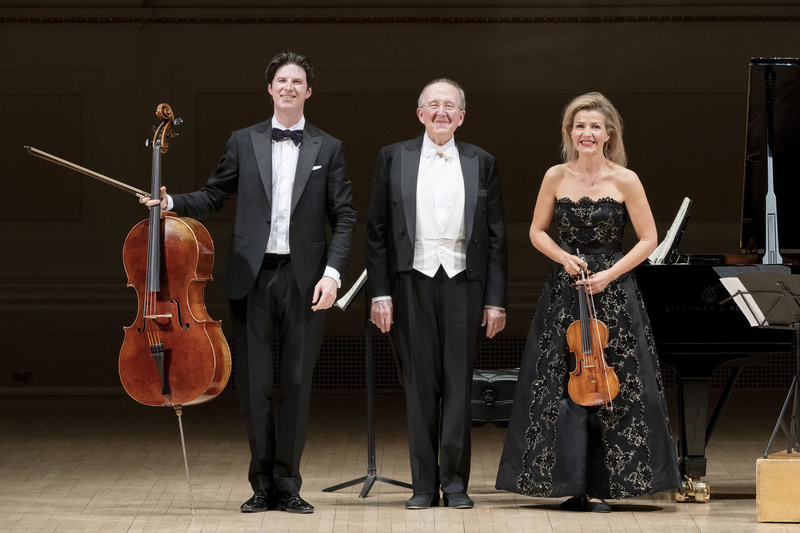
    Above: taking a bow after the “Ghost” trio, photo © Jennifer Taylor.

    During the interval, DK and I were anticipating our second “live” encounter with the Kreutzer sonata, Beethoven’s Op. 47, in the span of a month’s time. This epic work, which places so many demands on the two musicians, found the Mutter/Orkis partnership at its inimitable best.

    An intrusion at the very start almost destroyed the performance: just as the first notes were sounding, a very loud cellphone with a chiming ring tone-blared from one of the boxes. The culprit hastily fled, and for a moment I thought the musicians might pause and start over. But they moved on, leaving me to re-connect with the music as best I could. The playing was simply magnificent, with both players reveling in the bravura demands of the first movement’s Presto section. Together they brought a great sense of structure and musical coherence to the entire work.

    The “theme” of the ensuing Andante is a descending phrase which Arrigo Boito may have subconsciously lifted for the aria “Dai campi, dai prati” in his opera MEFISTOFELE. A ‘theme and variations’ setting develops, in which Ms. Mutter’s high-flying coloratura and enchanting trills ravished the ear. 

    The sonata’s Finale is exhilarating, with the irresistible impetus of a tarantella. A feeling of joy seemed to fill the house as the music sped on its way, Ms. Mutter and Mr. Orkis musically to urginge us to cast off our woes and – at least for the moment – savour the genius of Beethoven as played by two incredible artists.

    A massively enthusiastic full-house standing ovation commenced the moment the music ended. Ms. Mutter announced an encore: Beethoven’s Allegro in G-major, for mechanical clock, as arranged by Willy Hess. This little gem was delivered with tongue-in-cheek charm.

    Re-called by further waves of applause and cheers, Ms. Mutter charmingly introduced her second encore: an arrangement of ‘Nice To Be Around’ from the film Cinderella Liberty, part of her recent collaboration with composer John Williams. This beautiful tune was beautifully shaped by violinist and pianist.

    CH1766261_Medium_res_comp

    Above: Ms. Mutter and Mr. Orkis, photo © Jennifer Taylor.

    All performance photos are © Jennifer Taylor, courtesy of Carnegie Hall.

    ~ Oberon

  • Fire in my mouth @ The New York Philharmonic

    NY Phil ~ Chris Lee

    ~ Author: Brad S. Ross

    Thursday January 24th, 2019 – Thursday evening at David Geffen Hall was one to behold as music director Jaap van Zweden led The New York Philharmonic in its most exhilarating performance of recent memory and more.  The night’s all-American program included the New York premiere of a late master, an American repertory standard, and one of the most hotly anticipated world premieres of the entire U.S. concert season.  One to behold, indeed.

    The evening began with Elegy, an instrumental interlude from the oratorio August 4, 1964 by the late American composer Steven Stucky.  Stucky, who died rather unexpectedly from brain cancer three years ago at the all-too-young age of 66, was one of America’s foremost contemporary composers, having written numerous concerti, one gorgeous symphony, an impressive opera, and two concerti for orchestra, the latter of which won him a long-overdue Pulitzer Prize for Music.  As the title suggests, August 4, 1964 details one fateful day during the presidency of Lyndon B. Johnson, including fallout from the Gulf of Tonkin incident and news of the discovered bodies of the murdered civil rights activists Andrew Goodman, Michael Schwerner, and James Chaney in Mississippi.  A Dallas Symphony Orchestra commission, the work was given its world premiere under the baton of van Zweden himself in September 2008.

    Maestro van Zweden wasted no time at the podium before setting things into motion.

    Elegy opened on a great crash—one that was sure to alert the senses of even the most droopy-eyed concert attendee.  The piece then descended into more somber territory as a quiet oboe, horns, and strings set its decidedly hymn-like tone.  The work possessed an almost filmic sense for drama, often building to thundering crashes followed by slow descents into haunting suspended dissonances.  Stucky aptly captured the turmoil of his subject matter, which seemed a prophetic meditation upon much of our current political turmoil.  Nevertheless, he ended the piece on a long-held major chord—one that seemed to offer a glimmer of hope in the face of uncertainty.  van Zweden milked this finale to tremendous dramatic effect, only lowering his baton after every note had its chance to reverberate throughout the hall several times over.

    Up next was Aaron Copland’s Concerto for Clarinet, Strings, and Harp.  Originally commissioned and performed by the great jazz clarinetist Benny Goodman, the concerto was one of handful of Copland works that incorporates elements of jazz in its composition.  It was written between 1947 and 1949, and went on to become one of the most-programmed clarinet concerti of the entire orchestral repertoire.  Performing tonight was Anthony McGill, the Philharmonic’s principal clarinetist.

    The piece began on a sorrowful elegy in the strings.  Copland’s voice here was its most stubbornly tonal—his broad rhythmic intervals and warm orchestration evoking the great open spaces of North America.  A lively and showy cadenza divided the work between its slow opening and an energetic climax, which Mr. McGill played with remarkable precision and zest.  The pace was then quickened as the orchestra performed a lovely call and answer in typical Copland fashion.  A final ascending glissando in the clarinet and upward rush in the strings brought the work to an animated close.  This exuberant finale brought some much appreciated levity to an otherwise solemn musical evening.

    If the program had ended here, it still would have easily been a great night at the Philharmonic.  What followed, however, transported the merely beautiful to the realm of the sublime.  This, of course, was the long-anticipated world premiere of Fire in my mouth by the celebrated American composer Julia Wolfe.

    Ms. Wolfe, who co-founded the contemporary classical music organization Bang on a Can in 1987 with the fellow composers David Lang and her husband Michael Gordon, has steadily earned a reputation as one of the world’s finest living composers.  Among her notable works are the concerto for string quartet My Beautiful Scream, the chamber/vocal work Steel Hammer, and her Pulitzer Prize for Music-winning oratorio Anthracite FieldsFire in my mouth, a gargantuan work for girls’ choir, women’s choir, and orchestra, marks her largest composition to date.

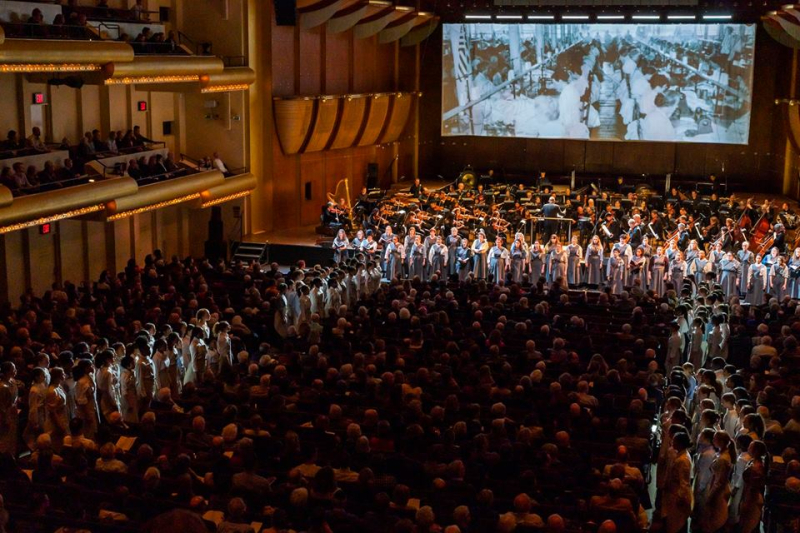
    A New York Philharmonic commission, the piece is based on the infamous Triangle Shirtwaist Factory fire that took the lives of 146 New York City garment workers, most of whom were young immigrant women, on March 25th, 1911.  The owners had locked the doors factory doors to prevent theft, leaving the workers trapped inside when the fire broke out.  They died of burns, smoke inhalation, or jumping to their deaths trying to escape the inferno.  The political fallout and public outcry for change that followed was as much an inspiration for Wolfe as the tragedy itself.  The work’s title, somewhat to my surprise, comes from a quote by the labor activist Clara Lemlich, who, reflecting on her years of activism, said, “Ah, then I had fire in my mouth.” The text of the piece was compiled from various interviews, speeches, and accounts of the event in addition to folk songs from the era.  Spanning roughly one hour, the piece is cast in four movements.

    50625251_10158453673037293_5445700866956853248_n

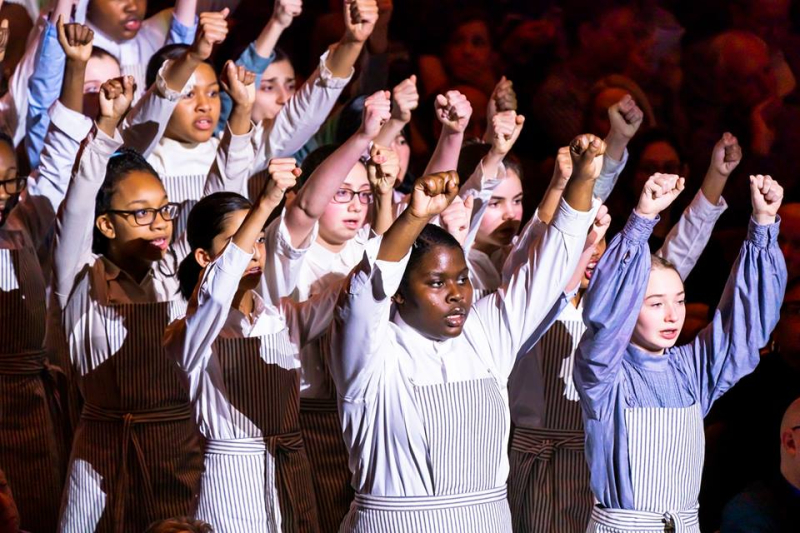
    The orchestra was joined in performance by the Philadelphia-based choral ensemble The Crossing (above) and The Young People’s Chorus of New York City (below). The photos are by Chris Lee.
    51068976_10158453669887293_5221514500502454272_n

    The text of the piece was compiled from various interviews, speeches, and accounts of the event in addition to folk songs from the era.  Spanning roughly one hour, the work is cast in four movements.

    The first movement “Immigration” began with chilling suspended high strings as the women’s chorus, decked in period regalia, began toning, “Without passports or anything we took a boat…”  Blueprints of passenger ships overlaid with footage of foaming ocean waves were projected behind the ensemble as brass swells harkened to the rolling seas of the Atlantic as these young women made their voyage to America.  Propulsive percussion and winds shifted under suspended vocal lines as familiar images of the Statue of Liberty and immigrants arriving to the United States were projected above.  This built to a great crash and silence fell throughout the hall as the first movement came to a close.

    The second movement “Factory” began to the sights and sounds of industry; images of machinery were cast on the screen above while the strings made eerie slaps that echoed the sounds of a sewing machine.  A growing menace emerged from the lower voices of the orchestra as the threat of disaster grew.  Splatting brass notes and unrelenting tremolo in the strings played on as the chorus mimed the actions of Sisyphean industrial labor.  Grainy images of factory workers punching their cards were projected overhead while dissonant vocals, driving bass, and unnerving glissandi rose to a violent and tragic crescendo—the effect was genuinely terrifying.  The chorus then used pairs of scissors to create a peculiar, yet distinct percussive beat as the work quietly transitioned into its third movement.

    The women’s choir then descended to the front of the stage for the start of the third movement “Protest,” singing, “I want to talk like an American, I want to look like an American.”  Rhythmic pulses in the strings played as newspaper headlines of protests and strikes were projected above.  Among the cacophony could be hear the whistles of policemen trying to contain the disorder.  The girls’ choir then emerged from the back of hall, marching and swaying in choreographed motion down the center aisle, as they sang in protest, “I want to say a few words.  I am a working girl.  One who is striking against intolerable conditions.”  The women’s chorus professed, “Ah—then I had fire in my mouth!” as the girls hauntingly repeated, “fire fire fire”—a harbinger of the tragedy to come.

    The girls’ choir joined the rest of the ensemble on stage as the final movement, “Fire”, began.  The string players created the haunting sound of breath by swinging their bows through the air.  Here Ms. Wolfe played up tragedy over terror as faded photographs of women interlaid with abstract images of smoke, fire, and rubble beamed overhead.  Fierce crashes, perhaps the loudest thing I’ve ever heard in David Geffen Hall, deafened the auditorium as musical hellfire consumed the ensemble (“I see them falling, see them falling…”).  A somber vocal line emerged, an indictment of social apathy, pronouncing, “I would be a traitor to those poor burned bodies if I were to speak of good fellowship.  I have tried you good people of the public and found you wanting.”  The chorus then sang the name of every soul who perished that day as Fire in my mouth quietly faded to silence; it was perhaps the greatest musical elegy since John C. Adams’s On the Transmigration of Souls.

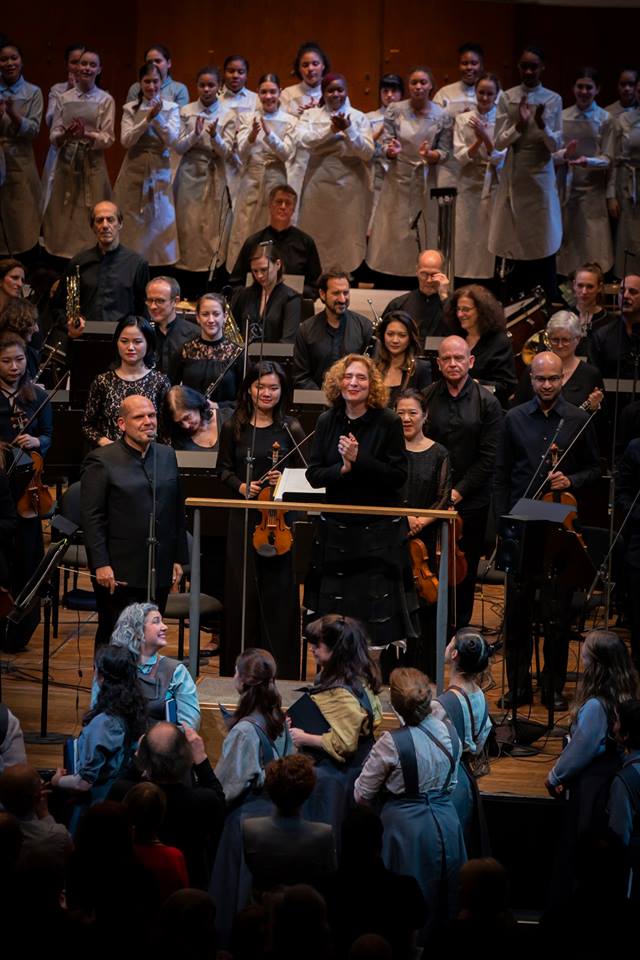
    The standing ovation that ensued lasted for several curtain calls as Ms. Wolfe, Maestro van Zweden, and company each had a chance to take their bows.  No one, save a few wheelchair-bound patrons, was still seated by the time the applause finally died out, something I’ve never seen at David Geffen Hall and don’t expect to see again for some time.  Indeed, it was the finest world premiere I’ve yet had the good fortune to attend.  I can only hope that many other metropoles may be graced with its performances in the near future.  Brava, maestro!
    50896920_10158453670227293_703449887135498240_n

    Above, the ovation: the conductor and composer onstage at the end of Fire in my Mouth. Photo by Chris Lee.

    ~ Brad S. Ross
  • Ehnes/Denève: All-Prokofiev @ The NY Phil

    James ehnes

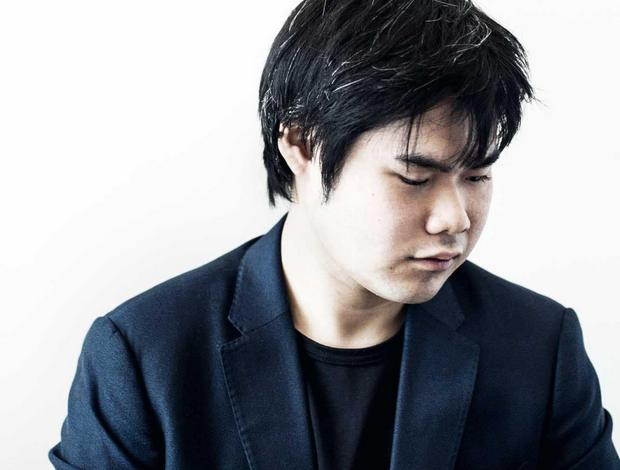
    Above: violinist James Ehnes

    ~ Author: Oberon

    Thursday January 25th, 2018 – A composer we love, an orchestra we love, a violinist we love, a conductor we love: my friend Dmitry and I had a great time at The New York Philharmonic tonight.

    For this all-Prokofiev concert, The Love for Three Oranges Suite proved an imaginative opener. I’ve seen this opera only once, in Maurice Sendak’s clever 1985 production for New York City Opera, and enjoyed it immensely. It was wonderful to encounter this music again, especially in Stéphane Denève’s witty and wonder-filled interpretation.

    The suite is in six movements, starting with Ridiculous Fellows which opens big and then gets subtle; the music is filled with a sense of irony, as is the entire opera. The Infernal Scene –  a card-game played by Tchelio and Fata Morgana – sounds ominous and develops a churning feeling. Fanfares herald the famous March, which begins softly and soon struts boldly. The xylophone and muted trumpets add a toy-like sound, and the winds play over pulsing violins; this March is droll, almost tipsy. Limpid fluting from Yoobin Son delights in the Scherzo, and there’s a really lovely viola passage for Cynthia Phelps. The violins and horns play in unison. The suite ends with Flight, an allegro with an agitated air. Maestro Denève was perfectly in his element for this coloristic music, and he gallantly drew Ms. Phelps to her feet for a solo bow, graciously kissing her hand.

    James Ehnes’s playing of the Prokofiev Violin Concerto No. 1 was truly ravishing. This concerto has become very familiar to me over time in Jerome Robbins’s balletic setting, Opus 19/The Dreamer, for New York City Ballet; it’s my favorite of all Robbins ballets.

    The music commences with a soft shivering tingle, and the violinist takes up a plaintive melody. Mr. Ehnes plays with an innate sense of rhythmic surety and delicious subtlety of dynamics. The music is dreamlike (hence the title of the Robbins ballet) with the soloist playing over soft tremolos from the violas. From this shimmering atmosphere, the flute sings while the violinist plays in his highest range. Really luminous.

    The Scherzo was taken at super speed, giving the music a wild quality. Mr. Ehnes’s superbly scrappy attacks propel things forward; the music buzzes and the violin slithers. The last movement commences with Judith LeClair’s bassoon theme, into which the solo violin insinuates itself in a melodic rise. Liang Wang’s oboe enchants, and the music grows ethereal, with an atmosphere of swooning beauty. Prokofiev brings in the high harp, and the violinst plays gliding scales. A series of delicate, jewel-like trills in the stratosphere display Mr. Ehnes’s clarity and control; the concerto ends in an iridescent glow.

    Mr. Ehnes’s sustaining of the intriguingly glistening atmosphere of the final movement held the audience under his spell; a warm ovation ensued, and Maestro Denève seated himself among the players as the violinist offered a heartfelt Bach encore. Called back for yet another bow, Mr. Ehnes was hailed by all the Philharmonic string players tapping their bows in unison: a lovely gesture of musical congeniality.

    Deneve_Stephane_PC_GenevieveCaron_e_300_preview

    Above: Stéphane Denève, in a Genevieve Caron portrait

    Selections from Romeo and Juliet completed the program. Myself, I think Cinderella is the more interesting of Prokofiev’s two full-length ballet scores. But audiences never seem to tire of the familiar tunes of the composer’s setting of the Shakespeare classic, and there was much brilliant playing in this evening’s presentation; it’s music Maestro Maestro Denève clearly savours.

    This cinematic score impresses from the start, where a violent opening gives way to tender delicacy. Prokofiev’s orchestration provides one delight after another; the solo clarinet, saxophone, and harp each summon up unique emotions, while a passage for flute and celeste and another for unison basses and celli are particularly ear-catching. The tender dawn music as the ‘balcony scene’ ends puts a lump in the throat every time. Although I could not glimpse all the solo players, special kudos to Liang Wang, Robert Langevin (flute), and Pascual Martinez Fortenza (clarinet). Artists of this calibre add so much to every New York Philharmonic concert.

    We had greatly enjoyed our first encounter with Stéphane Denève’s conducting in 2015, when he made his Philharmonic debut in a program we still talk about. I hope he will return often in future seasons.

    This evening, the orchestra welcomed the Zarin Mehta Fellows: ten young musicians from the Music Academy of the West who have spent a week in New York City participating in an immersive program covering all aspects of the life of an orchestral player. One can only imagine their excitement at being onstage and playing with the wonderful artists of the Philharmonic.

    ~ Oberon

  • Mälkki/Skride @ NY Phil

    ~ Author: Scoresby

    Thursday January 11 2018 – Last night at the New York Philharmonic was an evening that I had been looking forward to for a long time. It was conducted by Susanna Mälkki and featured violinist Baiba Skride. I had never heard Ms. Mälkki conduct the New York Philharmonic before, but had heard her during her days as music director of Ensemble intercontemporain, her debut at the Chicago Symphony a few years ago, and most recently conducting L’Amour de Loin. She is one of those conductors that I don’t necessarily agree with stylistically, but she always has an interesting and unique interpretation that is worth hearing.

    The performance began with Baiba Skride performing the Tchaikovsky Violin Concerto in D major, Op. 35, which while a warhorse is also one of the most difficult concerti in the violin repertoire. Immediately from the orchestral introduction it was clear that Ms. Mälkki had prepared the orchestra well – all of the textures were transparent and grand. Ms. Skride for her part had a warm interpretation but that didn’t indulge in large romantic gestures. Instead, she played the piece as one might play Brahms. Each of the tuttis were more memorable though as I don’t think I’ve heard an orchestral accompaniment as vibrant or full of life for a piece like this. Ms. Mälkki followed Ms. Skride’s lead in taking out extravagant gestures usually found in the concerto. In the second tutti, the orchestra felt light, brisk, with the trumpets sounding grand above the violins. Ms. Mälkki produced an almost frantic tempo in the lead up to the cadenza. Ms. Skride was at her best in the fast skittering parts of the first movement, but seemed to have trouble with some of the technical sections of the piece.

    Capture

    Above: Violinist Baiba Skride; Photo Credit: Marco Borggreve

    The second movement was the best of the concerto, in part because there was more direct interplay between Ms. Skride and the orchestra. Principal clarinet Anthony McGill’s duet with Ms. Skride was crafted beautifully; each note sounding like velvet. Ms. Skride took the third movement at a blistering pace and seemed more in her element here. She got a folksy, scraggily sound out of the violin that made the music feel more dance like.

    After intermission Ms. Mälkki led the orchestra in the NY Premiere of an older piece of Esa-Pekka Salonen’s called Helix. While not the most exciting work by Salonen, this is an enjoyable overture-style piece that builds in momentum and dynamics until the very end. It begins with low gongs beating with high flutes coming in way above them. This extreme tonal range gives an almost primordial sound that one would hear in Ives. As with all Salonen pieces, this one relies on dance-like motifs mixed with a lot of orchestral coloring – thus it made sense to pair with the Debussy that would come later. Most impressive was that as the pieces gains momentum and becomes denser, Ms. Mälkki managed to create absolute clarity with the orchestra. Every instrument could be heard near the end, evening with banging percussion and wild dancing from all the instruments. Ms. Mälkki’s style of conducting reflects this precision: it is punctilious and clear; every beat is perfectly straight.

    Capture

    Above: Conductor Susanna Mälkki; Photo by: Simon Fowler

    The final piece on the program was Debussy’s La Mer. Ms. Mälkki had an unusual interpretation that I found to be thrilling and dull at the same time. On one hand, particularly in the first and last movements, I have never heard the piece played with so attention to orchestral coloring. The winds and the brasses sparkled, the strings gushed at times, and there were thrashes, yet also beautifully delicate moments. Through all three movements every part of the orchestral was ringing with sound and clear. There wasn’t a note out of place. That said, Ms. Mälkki seemed to eschew all sense of ambiguity and impressionism in her interpretation using the same precision as in the Salonen. This worked well in the second movement which has a lot of counterpoint and fast runs, but it made the mystery of the music disappear in the others. I can imagine that anyone that enjoys a more sensual Debussy would be bored by this interpretation, but it is hard to argue with the interpretation as a whole when the orchestra has that much color. Ms. Mälkki obviously has the respect of the orchestra; the players were playing the best I’ve heard them in the past few years and were giving it their all.  I look forward to hearing Ms. Mälkki’s return.

    ~ Scoresby

  • Barenboim @ Carnegie: Mozart & Bruckner

    217101-D_340-R

    Above: Daniel Barenboim and the Staatskapelle Berlin at Carnegie Hall; performance photo by Steve J Sherman

    Thursday January 19th, 2017 – The Staatskapalle Berlin in the first of a series of concerts at Carnegie Hall in which Daniel Barenboim appears both as piano soloist and conductor. Each program in the series pairs a Mozart concerto with a Bruckner symphony. Tonight’s was the only performance in the series that I was able to attend, and it proved most valuable as an opportunity to hear not only a great conductor/pianist and orchestra, but also a rare chance to experience Bruckner’s first symphony live.

    The evening marked, almost to the day, the 60th anniversary of Daniel Barenboim’s Carnegie Hall debut; on January 20, 1957, he was the piano soloist on a program conducted by Leopold Stokowski. Over the six decades since that momentous night, Maestro Barenboim has maintained his status as a premiere pianist, and has become one of the great conductors of our time.

    My personal memories of Barenboim as pianist and as conductor are especially meaningful to me: in November 2008, he and James Levine were the de luxe pianists for a performance of Brahms’ Liebeslieder Waltzes at Weill Hall; the singers were members of the Met Young Artists Program. It was a superbly intimate performance. Shortly after this Liebeslieder evening, Barenboim made his long-awaited debut on the podium at The Met in a splendid series of performances of TRISTAN UND ISOLDE: we went twice, returning for a repeat when Waltraud Meier flew in to rescue one performance and made a striking impression as Isolde

    217101-D_216-R

    Above: performance photo by Steve J Sherman

    This evening, Maestro Barenboim appeared first as piano soloist for the Mozart Piano Concerto No. 27 in B-flat Major. From the opening bars, my friend Dmitry and I were struck by how absolutely lovely the orchestra sounded in the Carnegie setting. After the interval, when the much larger contingent of players required by the Bruckner took the stage, the sonic effect remained particularly cordial. It’s a stellar orchestra, and within moments I was regretting that I hadn’t made arrangements to hear them in more concerts from this impressive series.

    In 1791, the final year of Mozart’s life, the composer was at a low point. Poor health (his own, and his wife’s) and financial worries bore down on him, and he felt the Viennese musical public had somewhat lost interest in him.  At the time he was composing his last piano concerto, #27, he wrote to his wife: “I can’t explain to you how I feel…there’s a kind of emptiness which just hurts me: a kind of longing that is never stilled…” His despair shows thru in the 27th concerto, although light still manages to pierce the clouds often enough. First performed on March 4, 1791, it marked Mozart’s last public appearance as a piano soloist.

    With a smallish ensemble – no trumpets, drums, or clarinets – this concerto feels intimate, even in the spaciousness of Carnegie Hall. This impression was sustained by the marvelous subtlety of Maestro Barenboim’s playing, particularly in the cadenzas, where he could fine the tone down to a silken whisper.

    In the melody-rich first movement, the orchestra cushioned the piano line to gorgeous effect, with the solo flute and bassoon displaying great finesse. The flautist continued to impress in the Larghetto which follows. Maestro Barenboim’s playing here was beautifully sustained and thoughtful, and an atmosphere of tranquility laced with gentle melancholy settled over the Hall. Barenboim’s exquisite tapering of the final phrase hung on the air, but an enormous, ill-timed sneeze from an audience member destroyed this magical moment.

    Pianist and orchestra bounced back from this unfortunate intrusion for a perfect rendering of the concerto’s concluding Allegro; Barenboim’s playing here had ample spirit and polish, and the musicians did him proud. This is a somewhat darker finale than Mozart’s usually wrote for his concerti, but it does feature the melody of a little song Mozart was working on: “Sehnsucht nach dem Frühling” (“Longing for Spring“). By late 1791, the composer was fighting for his life; he never saw another Spring, dying on December 5th and thus sadly depriving the world of three or four more decades-worth of magnificent music.

    217101-D_441

    Above: performance photo by Steve J Sherman

    Anton Bruckner’s 1st symphony languished in obscurity for over twenty years. Following a single performance in Linz, Austria, in 1868, it was not heard again until 1891 when it was given in a heavily revised version. Its Carnegie Hall premiere didn’t take place – incredibly enough – until 1985, and performances of it remain comparatively rare. After hearing tonight’s excellent performance, I feel its neglect is unjustified; in fact, I look forward to hearing it again…the sooner, the better.

    Maestro Barenboim’s fondness for this music was evident from start to finish, and the Staatskapelle Berlin gave it a performance by turns lush, subtle, and vigorous. How thrilling to hear (and watch) the orchestra’s eight double-basses playing in unison; and the timpanist was having a field day – I was mesmerized by him throughout the third and fourth movements.

    A march-like cadence sets the opening Allegro on its way; starting almost whimsically, this soon becomes more emphatic. A lull comes as the woodwinds gently introduce a free-flowing violin melody. Suddenly the trombones take control with a mighty fanfare. Distant thunder from the timpani, and the march motif resumes; the movement carries on with an ebb and flow of what feel like climaxes but which subside just short of peaking. Then, after a final rush, we come to an abrupt end. The players’ keen response to Barenboim’s often understated gestures spoke of the natural affinity the maestro and the musicians have established over the years.

    The orchestra’s playing of the Adagio was especially moving. This music builds cinematically to a glorious climax, then evaporates into the heavens in an inspired and inspiring coda. Maintaining a perfect balance between the layered voices, Barenboim again showed that this music is in his very blood.

    The lively Scherzo is particularly engaging: it has the feel of a tribal dance – by turns throbbing and evocative – reminding me a bit of the well-known Scherzo from the Dvořák 6th. The whirlwind subsides for a gentle interlude before the dance springs up again, stomping on to a quick stop.

    Only in the final movement did I feel Bruckner might have been losing his grip somewhat. The music here did not have a cohesive feeling; the structure felt somewhat lacking in tautness, with a couple of walkabouts stemming the flow of the piece. Nevertheless, it was played with utter commitment and a sense of triumph at the close.

    Aside from the sneeze, a late seating after the piano concerto’s first movement caused an unfortunate  break in my concentration. The spectacular performance of the Bruckner helped to set these distractions aside, with Maestro Barenboim and his orchestra basking in a grand ovation at the end of a wonderful evening of music-making.

  • Ax/Robertson @ The New York Philharmonic

    Emanuel Ax

    Above: Emanuel Ax

    Thursday January 29th, 2015 – The esteemed pianist Emanuel Ax, enormously popular with New York Philharmonic audiences, was warmly cheered tonight after his performance of the Chopin piano concerto #2. David Robertson was on the podium for a programme that proved highly enjoyable and that allowed several of the individual players of the orchestra to shine.

    5377c09f319dd.preview-620

    Above: David Robertson

    As a brief and savorable prelude, the Vocalise of Sergei Rachmaninoff was rendered in full romantic bloom by Mr. Robertson and the orchestra. Originally a wordless composition for soprano, the Vocalise was written in 1915; the composer went on to orchestrate the work which is perhaps his best-known melody, whether performed in the arrangement for soprano and orchestra or for orchestra alone. So many of Rachmaninoff’s best-loved works are in a minor key, giving the music a mood of melancholy and gentle regret. The orchestra played it with distinction; the melodic familiarity of the piece has the poignant effect of encountering an old friend one has not seen for many years.

    Mr. Ax then appeared for the Piano Concerto No. 2 of Frédéric Chopin. In the summer of 1829, the 19-year-old Chopin, recovering from the breaking of an unhappy romantic attachment, sketched out the F-minor concerto and when he returned to Warsaw for the winter season, he performed this new concerto at the National Theatre the following March. The concerto gained Chopin the public exposure and audience acclaim that his numerous private salon performances could not have achieved.

    As the years passed, musicologists began to denigrate the Chopin concertos as being inferior to much of his writing for solo piano. Tonight’s superb performance made an emphatic stand in the concerto’s favor: it’s simply a beautiful piece of music.

    A contemporary account from the concerto’s premiere in 1830 records: “How beautifully (Chopin) plays. What fluency! What evenness!” And the same could be said of Mr. Ax’s performance tonight. In a refined partnership with Maestro Robertson, the pianist let the music flow with grace and charm, allowing us to savour the thematic generosity of Chopin in an illuminating performance. The unfortunate ringing of a phone just as the concerto’s first movement ended prompted a witty exchange between pianist and conductor. But order was immediately restored as Mr. Ax commenced the Larghetto, a movement full of lyricism in which the pianist’s glowing tone captivated the audience. With flourishing agility, the pianist then took wing in the final Allegro vivace. Near the end, trumpet calls herald the concerto’s final rippling cadences; it all ends with Mr. Ax striking a single low note as the orchestra takes the final chord. The audience’s warm expressions of admiration drew Mr. Ax to offer us a Chopin encore, summoning up visions of the Jerome Robbins ballet DANCES AT A GATHERING.

    The Firebird (Suite/1919) – Igor Stravinsky arranged three suites from the full score of The Firebird, in 1911, 1919 and 1945. It is the second of these which is most frequently played today, containing as it does approximately half the music of the complete score. This suite follows the narrative of the original ballet scenario, so familiar to admirers of the Balanchine/Chagall incarnation often seen across the Plaza at New York City Ballet. The atmospheric score – Stravinsky at his most colorful  and melodious – casts a spell of enchantment. It includes themes from two Russian folk songs: one a lyrical melody danced by the captive princesses, and the second the regal anthem which closes the ballet.

    Maestro Robertson and the Philharmonic players reveled in this extraordinary music, with oboist Sherry Skylar particularly impressive in her plaintive theme. The conductor drew forth some ravishing, shimmering piani as well as the lulling tenderness of the Berceuse; and the nightmarish Infernal Dance of  Kastcheï’s ghoulish slaves was given the full, brilliant treatment.

    The Miraculous Mandarin (Suite) is drawn from Bela Bartók’s pantomime-ballet of the same title. The original theatrical setting of the piece (written 1918-1919) was considered too vulgar in its portrayal of lurid sex, violence, and the macabre. After its 1929 premiere at Cologne, it was banned after a single performance. But Bartók, perhaps foreseeing that the ballet would not survive as a stage work, had already arranged the Suite, which we heard tonight in a thoroughly engrossing performance.

    Opening with a big, noisy clatter of sound, the score employs a wide range of instrumentation to ear-tingling effect: piano, flute, harp, xylophone, and celeste all play a part in this sonically intriguing piece. Ms. Skylar’s oboe artistry and Anthony McGill’s remarkable clarinet playing were especially clear and colourful. And a broad, dancing passage with drums near the end served as a reminder of the Suite’s balletic beginnings.

    I at first wondered how the Stravinsky and Bartok would play back-to-back, but the cumulative effect was indeed rewarding: both works have a similarity of texture at certain points, and there’s even some over-lapping of effects – trombone glissandi and frequent interjections of solo winds – which made second half of tonight’s concert every bit as satisfying as the first half.

  • Intermezzo Dance Company: Rehearsal

    L1310640

    Above: dancers Kaitlyn Gilliland and Stephen Hanna

    Thursday January 30th, 2014 – Intermezzo Dance Company are in rehearsal, preparing for their January 31st appearance at the 92nd Street Y as part of the series “Movement Talks” presented by Edward Henkel. The program, which will explore the theme of beauty in dance and choreography, is sold out. Newly created works by Gemma Bond, Claudia Schreier, and Craig Salstein will be danced by Intermezzo‘s Kaitlyn Gilliland, Amber Neff, Nadezhda Vostrikov, and Stephen Hanna. I was able to see a run-thru of all three ballets this evening at DANY Studios.

    L1310802

    Above: Kaitlyn Gilliland rehearsing Claudia Schreier’s ballet Harmonic which originally premiered at Columbia Ballet Collaborative‘s November 2013 performances; a great score for dancing by Douwe Eisenga propels a quartet of dancers thru this fast-paced work.

    L1310925

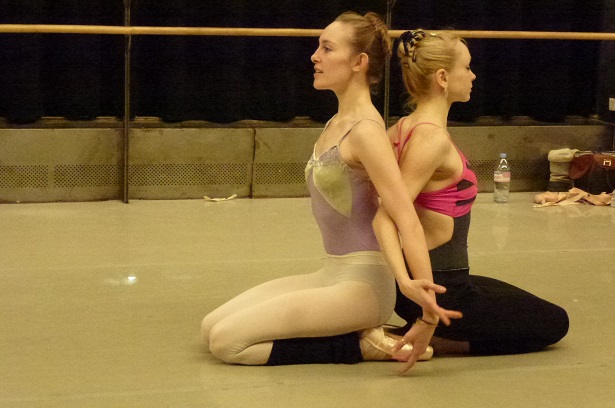
    Gemma Bond, a member of ABT‘s corps de ballet, has created a sisterly duet to Schubert, danced by Amber Neff and Nadia Vostrikov (above). And Craig Salstein has choreographed an arrangement of Beethoven’s Ode to Joy as a pas de trois for Kaitlyn Gilliland, Amber Neff, and Stephen Hanna.

    L1310666

    Nadia

    L1310730

    Amber

    L1310918

    Stephen

    L1310866

    Kaitlyn

    Following the evening at the Y, Intermezzo Dance Company will begin preparations for their upcoming performances at Vassar College.

    Performance dates are March 29th (evening) and 30th (matinee), 2014. Tickets are free. Send an e-mail to [email protected] write “Intermezzo” in the subject line and the number of tickets and which performance date you wish to attend in the body of the e-mail.

    Details of repertory and participating dancers for the Vassar performances will be forthcoming.

  • GrahamDeconstructed: CAVE OF THE HEART

    Light-a-fire

    Thursday January 23rd, 2014 – Tonight Martha Graham’s CAVE OF THE HEART was danced in a studio setting at the Martha Graham Dance Company‘s home space on Bethune Street. Although described as an open rehearsal – the dancers wore practice clothes and the ballet’s Noguchi set pieces had already been shipped out West for the Company’s upcoming tour performances – the work’s power and immediacy provided a vibrant theatrical experience.

    In both her opening remarks and in a Q & A at the end of the evening, the Company’s artistic director Janet Eilber gave us valuable insights into CAVE OF THE HEART. It was interesting to learn, for example, that Graham first approached Aaron Copland to write the music for this work which she was conceiving: Copland demurred. She then turned to the Mexican composer Carlos Chavez who delivered a score that  the choreographer found unsuited to her needs (she eventually set another work, DARK MEADOW, to the Chavez music…and now my curiosity is piqued indeed: I want to see it!). And so it was Samuel Barber who crafted the music that became CAVE OF THE HEART; later Barber excerpted his famed piece Medea’s Dance of Vengeance from the score. 

    Before showing us the work, Janet asked each of the participating dancers to demonstrate a key movement motif from their role; these provide keys to the individual characters. Once the ballet began, the communicative powers of the four dancers – Graham has stripped the Medea story down to the bare essentials – took things beyond the context of a rehearsal: they danced with an expressive clarity that revealed yet again the depth of Graham’s genius.

    Miki Orihara’s Medea moved from the torment of jealousy to final triumph in a performance rich in intimate detail, and Tadej Brdnik’s compelling athleticism as Jason perfectly embodied the character’s masculine vanity. At once majestic and lyrical, Carrie Ellmore-Tallitsch’s appeared as The Chorus with her elegant wingspan and the face of a goddess. Jacquelyn Elder’s princess was lovely in her bridal innocence and terrifying as Medea’s wedding gift – a poisoned crown – began to work its insidious power. Together these generous artists gave us a richly rewarding evening, so inspiring to watch at close range.

    The Martha Graham Dance Company will be at New York’s City Center in March. Details here.