Tag: Thursday March

  • SOLOperas at The Tank

    Tank

    ~ Author: Shoshana Klein

    Thursday March 20th, 2025 – This evening, I went to The Tank in Midtown (close to my office!) for a showing of solo operas in a small black box theater. Two operas were performed, both in impressive solo performances with varied skills and stories compellingly set forth forth. Other than that, they were very different experiences! 

    Shoshana 2


    This is not about Natalie ~ Jason Cady


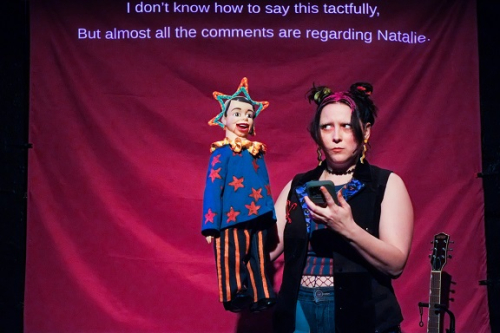
    The first opera followed an unsuccessful musician feeling bad about her ex-music partner who became successful and moved on from their band. The story was told by way of daily vlogs that included conversations with a puppet – performer Sarah Daniels (photo above by Reuben Radding) did a great job, singing varied types of music, sometimes accompanying herself on electric guitar, and interacting with the ventriloquist puppet (whose voice had been pre-recorded, along with some accompaniment music, which was mostly kind of synth-pop). I thought it was interesting and pretty fun that the texture of the music – including songs performed as if they were kind of indie pop or rock – were being sung operatically, which somehow on the whole worked pretty well. The piece was clever, though transparent, and well executed.


    INcomplete Cosmicomics ~ Anna Heflin 


    After intermission, we settled in for a piece twice the length of the first. This piece was different in most ways. Based off of/inspired by/in conversation with Calvino’s Cosmicomics (Which I came in knowing almost nothing about), the character Qwfwq spends the hour in verbal and musical conversation with the audience. There was no operatic style singing – just one performer with a cello, voice, and looper with some effects. The music often made use of the looper, with stories being told intermittently – stories that often felt like folk tales, but sometimes involved ruminations, and other times explanations. Qwfwq was in conversation with his author, and those who have written about him – Ursula K Le Guin, and some others I didn’t know – he responds in a very human way to the criticisms given to him.


    Qwfwq spoke to us as the audience, directly, wearing an altered blue jumpsuit (photo above by  with patches and doodles sewn on, and wool socks. The character often had a kind of self-deprecating self awareness that was very engaging, as well as feeling friendly and approachable, though presented as fragments, or a set of thoughts.


    The music used a lot of looping – including with singing and speaking voice, as well as the cello, sometimes in complicated counterpoint. The piece went through many creative sound worlds that I liked – including making use of a tray of beads with contact microphone, and lots of breathing sounds that molded from the voice to the cello almost seamlessly. 


    Soshana


    I should have known this piece would have been great, since Anna wrote a somewhat similar solo piece for a friend of mine based on Alice and Wonderland – using voice and various effects to create something impressively textured and evocative. Prepared or not, I thoroughly enjoyed the performance, and Aaron Wolff (photo above by Reuben Radding) was an impressive interpreter – as an actor, cellist, and communicator. 

    ~ Shoshana Klein

    (Performance photos by Reuben Radding)

  • In Recital ~ Ema Nikolovska @ Weill Hall

    Ema-Nikolovska-Photo-by-Kaupo-Kikkas jpg

    Above: Ema Nikolovska, photo by Kaupo Kikkas

    Author: Oberon

    Thursday March 28th, 2024 – Earlier this year, I was looking to add a vocal recital – by a singer I had never previously heard, in an intimate setting, including some songs that would be brand new to me – to my late-winter calendar.  Flipping thru the Carnegie Hall brochure, I zeroed in on tonight’s offering at Weill Hall: Macedonian-Canadian mezzo-soprano Ema Nikolovska, with Howard Watkins at the piano. I listened to about ten seconds of her singing on YouTube and requested a ticket. I’m so glad I was there.

    I must say at the start that it was a recital wherein the encore proved the highest highlight of the evening. Ms. Nikolovska announced this work, which she had commissioned, prior to singing it, and now I am casting about, trying to find more information about it, since I did not catch the name of the composer. 

    But to begin at the beginning, the mezzo-soprano and her collaborating pianist offered four songs by Franz Schubert. She chose songs somewhat off the well-trodden Schubert path, some of which were brand new to me.

    Im Frühling” was the most familiar. From its opening phrases, I sensed a large voice that had been tamed and polished. It took a few warm-up measures before things began to flow, but within seconds Ms. Nikolovska was ravishing the ear with her keen sense of nuance, and her expressive diction.

    Howard-watkins

    In “Dass sie hier gewesen” it became clear that Mr. Watkins (above) was so much more than an accompanist: his artistry is deep, and he plays from the heart. Ms. Nikolovska here displayed her gift for introducing straight tone into her singing, and the effect was enchanting. Mr. Watkins opened “Herbst” with a rippling restlessness, and then the music took on a sense of urgency. The song has an Erlkönig feel to it. Ms. Nikolovska’s subtle inflections and Mr. Watkins’ marvelous playing drew us deeper and deeper into the music.

    The Schubert set ended with the longest of the songs, “Der Unglückliche” which felt like an intimate mini-opera. The piano opens with a darkish sense of doom, and the voice moves from pensive to intense. We pass thru many moods in this dramatic and engrossing song.

    Ms. Nikolovska then spoke, rather at length, about the program. When the music resumed, it was Richard Strauss’ very brief “Nichts” that re-established the mood with its big piano intro and its final vocal outburst. A thoughtful atmosphere is established in “Gefunden“, which turns melodic and ends with Ms. Nikolovska on a gorgeously sustained, dreamy final note. We remain in dreamland with the opening of “Das Rosenband“, which soon gives way to rapture. Ms. Nikolovska was simply sublime here, her soft singing so engaging, and so beautifully controlled. The straight tone moments were spine-tingling, with awesome dynamic control, and a high-lying passage near the end which was magical. Mr. Watkins, in the piano postlude, was equally impressive.

    Songs of the Seasons, by Margaret Bonds, sets four poems of Lankston Hughes. A touch of jazz inflects Autumn, while a slow sway and dreamily sustained pianissimi evoke a cozy afternoon before the fire as snow falls outside in Winter. Mr. Watkins sets a music hall mood with sparkling motifs for Spring; this song has a big finish, and leaves it to Ms. Nikolovska to spin out a delectable diminuendo. The pianist introduces Summer with animated playing which becomes an infectious rhythm.

    An over-long intermission threatened to break the spell, but at last we were drawn back into the alternate universe by Debussy’s atmospheric Ariettes oubliées. The first song, “C’est l’extase langoureuse“, is aptly named, as its sense of languor is so finely evoked by the composer…and so perfectly captured by pianist and singer. The sweet sadness of “Il pleure dans mon coeur” was immediately conjured up by our two musicians: Ms. Nikolovska exploring the wide vocal range with uncanny dynamic control, and Mr. Watkins at his most poetic. The pianist was exceptional in “L’ombre des arbres“, while the singing was tinged with a sensual glow.

    In a mighty mood-swing. we are suddenly on a carousel for “Chevaux de Bois“; yet even here, the excitement and energy winds down as the circling horses slow their pace. Ms. Nikolovska followed the pianist’s delicate introduction to “Green” with some of her most delicious singing of the evening, finding heaven in her final phrase. For the concluding “Spleen“, the pianist creates a mysterious mood, and the singer ‘speaks’ on one note before a moody melody emerges, which the Nikolovska voice caresses with uncanny pianisssimi.

    Another treat follows with two songs by Nicolas Medtner: “Twilight” and “Sleeplessness“. The first is a hymn to nature, introduced by descending motifs from the keyboard. The song has a lovely lyrical feel, and Ms. Nikolovska’s sustained tones were again an outstanding feature. “Sleeplessness” has a dirge-like start; the singing grows more urgent, then recedes to resignation and ends with a vocalise.

    In a total change of atmosphere, Ms. Nikolovska introduced Nicolas Slominsky’s Five Advertising Songs: cabaret-type numbers that extol, in turn, bed linens, bran muffins, face powder, Fletcher’s Castoria, and Pepsodent toothpaste – the last two very familiar to me from my childhood in the Little Town. Ms. Nikolovska proved a sporting, lively comedienne, moving about the stage and playing to the crowd like a carnival huckster. It was all in good fun, but the best was yet to come.

    The encore – and I will find out its title and composer as soon as I can – was commissioned by Ms. Novolovska and draws on a Macedonian song. The Sun, The Moon, and The Forest are each evoked in turn. The music has an improvisational air, with melismas and winding melodies for the voice. Meanwhile, Mr. Watkins often reaches into the piano to place glissandi like a harp. The vocal line ranges from the subtlety to powerful passion, and it all ends in a whisper. 

    UPDATE: I now have details of the encore. The song, Zajdi, zajdi, jasno sonce, was composed by Aleksandar Sarievski, and arranged for Ms. Nikolovska by Darija Andovska.

    I also found that Ms. Nikolovska gave a second encore at her recital, after I had slipped out to catch my train, Incredibly, it was the Composer’s aria from Strauss’s ARIADNE AUF NAXOS…my favorite opera. I can’t believe I missed it!

    May I suggest to Ms Nikolovska that she make the arrangement of Zajdi, zajdi, jasno sonce an integral part of her recital programs. Everyone should hear it!

    So now, I am in hopes that Ms. Nikolovska will return to our City before too long, and that we might hear her Wesendonck Lieder.

    ~ Oberon

  • Composer Portraits: Nicole Mitchell

    Nicole-mitchell

    Above: Nicole Mitchell

    Author: Oberon

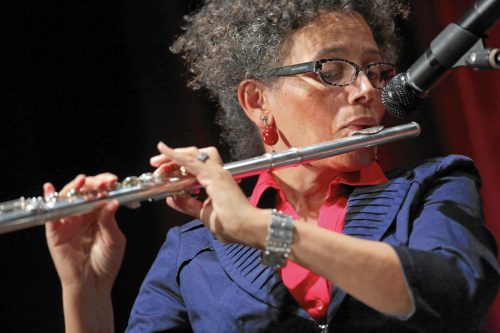
    Thursday March 30th, 2023 – Another adventurous evening in the Miller Theatre’s ongoing Composer Portrait Series as we were introduced to the multi-talented Nicole Mitchell: composer, flautist, bandleader, educator, and the first woman president of Chicago’s Association for the Advancement of Creative Musicians (AACM).

    Ms. Mitchell brought her flute along with her this evening, joining members of the International Contemporary Ensemble, vocalist Lisa E. Harris, and violinist Mazz Swift in works she has composed from 2015 thru 2023.

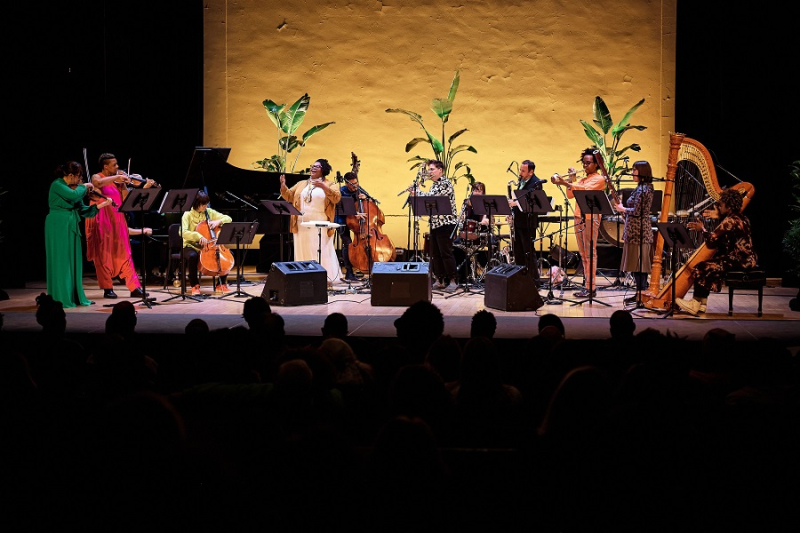
    On the Miller Theatre stage, a magic garden had been created with towering plants and clusters of candles; as the program progressed, the back panel was illuminated in varying hues. The musicians were distinctively dressed, creating the feel of a casual family gathering where every member had an invaluable place in the musical scheme.

    The evening opened with Whispering Flame, co-composed by Nicole Mitchell and Lisa E. Harris in 2017. From a busily insectuous opening instrumental passage, Ms. Harris’s rich, warm tones engaged us in a slow-rising vocal line. Ms. Mitchell’s flute playing was pristine, and she also presided over the electronics. Percussionist Clara Warnaar struck a summoning gong, and the music took on a windswept feeling, with trumpeter Jonathan Finlayson producing sputtering effects, and duetting violinists Mazz Swift and Gabriela Diaz adding a touch of lyricism. This kozmic work made for a perfect introduction to the program.

    SVfhZhko

    Above, playing Procession Time: Cory Smythe, Katinka Kleijn, Isabel Lepanto Gleicher, and Joshua Rubin; photo by Rob Davidson

    Bringing new sounds into the evening’s musical sphere, a quartet of artists played with such a wide range of colours that they created an impression of hearing a larger ensemble for Procession Time (2017). In the work’s first section, “Ritual Conception”, deep violet tones from Katinka Kleijn’s cello were matched by Joshua Rubin’s velvety bass clarinet. The music has a hesitancy about it, with Cory Smythe at the piano joining Isabel Lepanto Gleicher’s purring flute. Ms. Gleicher then takes off on a melodic flight, interrupted by the bass clarinet sounding rather ominous. Flute and standard clarinet harmonize to calming effect.

    The second section of Procession Time, “Carnival at the Cliff”, features quirky piano and cello motifs, and more harmonizing from flute and clarinet. A heavy rhythm develops, with squealing and screeching from the flute and clarinet.

    Transitions Beyond (2021) is a quintet for Ms. Harris (voice), Mr. Rubin (clarinet), and Mlles. Gleicher (flute), Diaz (violin), and Kleijn (cello). Although the program listed five movements, I could only detect four (perhaps I missed a transition along the way); but, at any rate, the work is a finely-woven sound. It starts with wordless vocalizing from Ms. Harris from which a text emerges over the sighs of a drooping cello: “I don’t want to leave you…” A violin solo turns into a dialogue for violin and cello, and soon their sounds begin to ooze, whereupon the winds take over. Ms. Harris sings a vocalise of uncanny sounds and pitches.

    The bass clarinet burbles and stutters, the violin take on a wispy feel, the singer continues to summon an array of colours. Cello and clarinet mingle, the winds sounding whimsical and the singer’s lines turning edgier. Now there is a flow of lyricism from the instruments, and a shimmering quality hovers over the singer’s low-range phrases. There is lots of beauty here, doled out so that each participating artists shines.

    The program’s first half concluded with the big hit of the evening: Building Stuff (2015, rev. 2023). This irresistible music had the whole place jumping, and provided wonderful opportunities for each of the nine players involved to shine. To a jaunty rhythm, Mr. Rubin’s clarinet sings out, followed by Ashley Jackson’s captivating harping and a sparkling xylophone motif from Clara Warnaar.

    A fantastic sway develops, steered by double-bass phenom Brandon Lopez. Mazz Swift reels off a vivid, jazzy violin solo, pianist Cory Smythe and Ms. Warnaar’s drumming combine in high style, and Ms. Mitchell’s flute adds a bright lustre. There are intriguing textures, with Sara Schoenbeck’s vibrant bassoon playing grabbing our attention, and Ms. Kleijn’s cello ever aglow with resonance. Mr. Smythe reaches into the piano to pluck some steely notes, and Ms. Jackson’s harp sounds sweet and sure. As Mr. Lopez’s fascinating rhythm steered the music to its finish, the crowd erupted in a burst of applause and cheering.  

    A6AKo05Y

    Above, the ensemble playing Inescapable Spiral; photo by Rob Davidson

    Following a charming  interview of Ms. Mitchell by The Miller’s Melissa Smey (and beautifully signed by two young people at the edge of the stage), the evening concluded with Inescapable Spiral (2017, rev. 2023) which brought together all the artists save for the composer, who listened from the hall. This long work seemed rather tame and aimless at times, especially after the fabulousness of Building Stuff, but it did let us continue to savour the individual playing of everyone involved.

    ~ Oberon

  • ASO Presents Strauss’s DAPHNE

    Daphne

    Thursday March 23rd, 2023 – The American Symphony Orchestra performing Richard Strauss’s rarely-heard DAPHNE in concert form at Carnegie Hall, with Maestro Leon Botstein on the podium. The Bard Festival Chorale, under the direction of James Bagwell, had a big part to play in the proceedings.

    The one-act opera, written in 1936-1937, comes late in Strauss’s composing career, when ELEKTRA, SALOME, ROSENKAVALIER, DIE FRAU OHNE SCHATTEN and ARIADNE AUF NAXOS were already established in the world’s opera houses. 

    The story of DAPHNE in a nutshell: Shepherds anticipate the feast of Dionysus, with Daphne’s parents, Peneios and Gaea, presiding over the preparations. Daphne, in love with nature, shuns the ways of men. Her childhood playmate, the shepherd Leukippos, tries to embrace her lovingly, but she repels him and renounces the coming festivities. She refuses to don the clothing her mother has lovingly prepared for her, and runs away. Playfully, the women persuade Leukippos to wear the clothes instead. Apollo arrives, in a peasant’s disguise, and is immediately drawn to Daphne, who rebuffs him. The feast begins, and the disguised Leukippos offers Daphne a cup of wine, arousing the jealousy of Apollo. The heavens respond to the god’s anger with rumbles of thunder, which cause the sheep to run away; the shepherds chase after the flock, leaving Apollo, Daphne, and Leukippos alone. Leukippos reveals his true identity, and challenges Apollo to reveal his. Instead, Apollo shoots Leukippos dead with his bow. Apollo begs Daphne’s forgiveness, saying he will grant her wish to join the natural world and will then love her in the form of a laurel tree. Her transformation begins, and her disembodied voice is heard among the rustling leaves.

    About tonight: The evening got off to a rather stodgy start as a large phalanx of choristers slowly filled the stage space to sing An den Baum Daphne, an a cappella choral epilogue to the opera which Strauss composed in 1943. This seemed like a nice idea on paper, but the music overall is not terribly interesting,  consisting of numerous repeats of a five-note theme familiar to me from DIE FRAU OHNE SCHATTEN. It seemed to go on and on, and while there were many appealing individual voices among the chorus, they did not always blend well. There were some pitch issues along the way, and a feeling that the piece was a bit under-rehearsed.

    Then came an intermission, which completely killed the Straussian atmosphere that had been established, with people chatting blithely and wandering up and down the aisles. At last the opera itself commenced, but it took time for the crowd to re-settle.

    DAPHNE is a gorgeous opera: a veritable feast of melody…there is never a dull moment musically. The vocal writing is extremely demanding; a very fine cast had been assembled, but their work was often undermined by over-loud playing from the orchestra. At the climaxes, voices were being forced in order to stay afloat, This has been happening at The Met a lot this season too, where conductors seem to think loud = exciting. Yes, there is a superficial thrill to it, but in the end it doesn’t do anyone any good.

    That being the case, the singers could only be admired for holding steadfast and getting thru these taxing moments…especially when an orchestra is onstage behind you rather than in the pit.

    The opera got off to an excellent start with baritone Kenneth Overton’s handsome singing as the 1st Shepherd. The voice is fresh and warm, and he cuts a fine figure to boot. Later in the opera, a trio of choristers come forward to portray his fellow shepherds: Jack Cottrell, Paul Holmes, and Blake Austin Brooks.

    In the title-role, so ravishingly sung on the esteemed EMI recording by the great Mozartean Lucia Popp, Jana McIntyre displayed a clear, soaring lyrical sound that deftly encompassed the role’s wide range. It is a girlish timbre, perfect for expressing youthful vulnerability and impetuosity, but Ms. McIntyre also summoned considerable power when needed. In one especially lovely passage, her voice entwined with an obbligato from the ASO’s concertmaster, Cyrus Beroukhim. There were a few spots when the orchestra pressured the soprano, but she held her own and emerged unfazed. Daphne is a “big sing” and without a persuasive interpreter, the opera is not worth reviving. Ms. McIntyre not only sang beautifully, but she looked fetching in her pale lime-green frock, and she used her expressive hands with the grace of a ballerina to shape the music and send it out to us.

    As two maids, Marlen Nahhas and Ashley Dixon were much more than supporting players: both have luscious voices, sounding very much at home in the Carnegie Hall space. In solo phrases, they were each truly appealing to hear, and then they duetted to charming effect. Their scene was not mere filler, but a musical treat all on its own. 

    Strauss hated tenors: that is what people say when listening to an otherwise fine tenor struggle with the demands of Bacchus or the Emperor in FRAU OHNE SCHATTEN,  Tonight, both the leading tenors – rivals in the story – fared well, despite the assaults of the orchestra at certain inconvenient moments. Kyle Van Schoonhoven as Apollo (sometimes deemed Strauss’s cruelest tenor role) had the scope of the role, and the testing top notes were successfully attained. A more thoughtful conductor could have made the singer’s job easier but Mr. Van Schoonhoven was always impressive. And, in the more lyrical stretches, he displayed a very appealing timbre…and a sense of poetry. 

    As Daphne’s admiring swain, Leukippos, Aaron Blake made a striking impression. Slender of frame, and intense of presence, the tenor’s lyrical sound contains a vein of metal (aligned to crisp diction) that he can call upon to cut thru when needed. By turns playful and cocky, the character was portrayed to perfection, and the tenor unleashed a laser-beam  sustained note as fate closed in on him.

    Magnificent singing came from contralto Ronnita Miller (Gaea) and basso Stefan Egerstrom (Peneios), as Daphne’s parents. Ms. Miller, whose 1st Norn at The Met simply dazzled me a few seasons back, sings like a goddess with earthy chest tones of unusual richness. Stunning in her every note and word, the contralto looked like a fashion icon gowned all in black, and she shed her blessèd maternal light over the proceedings, even when sitting silently while others sang. Stefan Egerstrom, where have have you been al my life? What a powerful, resonant voice this man commands. He delivered his music with great authority: each note was rounded and true, and everything compellingly phrased. And yet, for all the strength of their voices, even Ms. Miller and Mr. Egerstrom were not immune to the effects of the encroaching orchestra.

    Daphne Matthew Dine 1

    Above, onstage at Carnegie Hall (from left): Stefan Egerstrom, Ronnita Miller, Aaron Blake, Kyle Van Schoonhoven, Jana McIntyre, Leon Botstein (back to camera), and Ashley Dixon. Photo by Matthew Dine.

    ~ Oberon

  • Lori Belilove ~ Isadora Duncan Dance Company

    Wj180622016-website-featured-image-2

    ~ Author: Oberon

    Thursday March 28th, 2019 – A studio performance by The Isadora Dance Company, founded by and under the artistic direction of Lori Belilove (above), presenting an evening of Duncan works in an intimate salon setting. At the piano, New York City Ballet’s Cameron Grant regaled us with his vibrant playing of works by Chopin, Brahms, Schubert, and Scriabin. 

    The room was packed to the bursting point as Lori greeted us, and then the dancing immediately commenced. A set of Duncan works set to music of Franz Schubert opened the evening, starting with dancers Hayley Rose and Faith Kimberling as light-hearted nymphs Moment Musical. Throughout the evening, the women wore classic Grecian-style tunics, iconic elements of the Duncan repertoire, in various hues. Emily D’Angelo, in pale blue, danced Lullabye, with the evocative Isadora motif of raising the arms heavenward. Becky Allen and Caroline Yamada, in pink with flowers in their hair, gave us Classical Duet, and then Lori Beliliove, in dark blue, spoke to us in Duncan’s striking gestural language in the waltz-like Water Study.

    The music by Frederic of Chopin – waltzes, etudes and mazurkas – came next, all of it immaculately played by Mr. Grant (I was seated just behind his right shoulder, and could follow along in his score). Nikki Poulos was the soloist in the joyous Grande Valse Brillante – a feel-good Isadora work to be savoured for its freshness and vitality. Mlles. Yamada, Allen, Kimberling, and Rose were the attractive ensemble here. Emily D’Angelo’s solo opened Prelude, with Becky Allen and Caroline Yamada transforming it into a trio; this very familiar music was most cordially played by Mr. Grant. Faith Kimberling – always such an appealing dancer to watch – then appeared for a second trio, Line Mazurka, with Becky and Caroline.

    In the solo Ballspiel, Hayley Rose used the space to fine advantage, her dancing responding ideally to the music’s shifting changes of pace. In the moody Slow Mazurka, Mlles. D’Angelo, Rose, Poulos, and Yamada took turns striking stylized poses on the floor – classic Isadora, this – whilst their companions danced. Becky Allen’s dancing of the immortal Minute Waltz was perfectly dovetailed to the playing of Mr. Grant: this was one of the evening’s many highlights.

    Hayley Rose, Nikki Poulos, and Faith Kimberling appeared as woodland sprites in Butterfly Etudes, employing scarves in a space-filling dance. Nikki Poulos gave a poignant performance of Death and The Maiden, her gestures indicating longing and then withdrawal, her expressive face beautifully mirroring the sorrowing music.

    Isadora’s suite of Brahms waltzes entitled The Many Faces of Love opened with Caroline Yamada’s cheerful energy in Greeting, followed by Faith Kimberling’s Frolic, with its folkish flavour, so lovely to watch. Lori Belilove performed Scarf Dance, a lilting, provocative piece, followed by Mlles. Rose, Yamada, and Poulos in the unison trio that opens Cymbals, with its accented music. Ms. Rose then gave Flames of The Heart a Romany flair: fast, passionate, with streaks of wildness. The lyrical, lovely Rose Petals was danced by Emily D’Angelo with cherishing grace; at the end of the dance, she slowly scatters the flowers about the floor.
     
    Two of Isadora Duncan’s great Scriabin solos were given exemplary performances by Lori Belilove: the deep melancholy of Mother, in which she comforts her ghostly children, and the madly passionate, red-clad  Revolutionary, with its silent screams.
     
    As a triumphant finale, honoring Women’s History Month and embracing the power of sisterhood, Nikki Poulos led Mlles. Yamada, Allen, Kimberling, and Rose in the bracing Military Polonaise of Chopin, thrillingly played by Cameron Grant. This made our spirits soar.
     
    ~ Oberon

  • CMS: New Music @ The Rose Studio

    Commissions_pintscher_1024px

    Above: composer Matthias Pintscher

    ~ Author: Brad S. Ross

    Thursday March 21st, 2019 – Thursday was a unique night of sounds with the Chamber Music Society of Lincoln Center in the organization’s cozy and intimate Daniel & Joanna S. Rose Studio.  The all-contemporary music program, featuring four works written between 1983 and 2013, ran the gamut of cutting-edge of sonorities, offering its refreshingly engaged audience a small cornucopia of contemporary classical music.  It was also a heavily American program, featuring only a single piece by a European composer—something that can seldom be said of most music programmed at Carnegie Hall or the New York Philharmonic.  Performing that night of the CMS players were the pianist Micheal Brown, violinist Bella Hristova, violist Richard O’Neill, and cellist Mihai Marica.  Their playing was at such a high level of proficiency that one could be forgiven for scarily noticing the ease with which they navigated such technically demanding music.

    The evening began with some academic and mercifully brief opening remarks by the CMS Director of Artistic Planning and Administration Elizabeth Helgeson about the composition of the first two pieces.  Once finished, the players wasted no time diving into the first work of the evening:  Alexandra du Bois’s L’apothéose d’un rêve for Piano, Violin, and Cello.  L’apothéose d’un rêve, translated in English as “The Apotheosis of a Dream,” was originally commissioned by the pianist Menahem Pressler for the Beaux Arts Trio for the trio’s semicentennial in 2005.  The work is cast in five movements played without pause and features a musical voice much befitting its decidedly ambiguous title.

    Its tone is often longing and somber, lingering and dramatic—a stark contrast to the ferocity for which so many contemporary compositions have been known.  Light on extended technique, but rife with developed thematic material, du Bois achieved an almost tragic beauty in L’apothéose d’un rêve, evoking the dreamlike imagery of its name.  The third movement Molto vivo, with its arpeggiating piano lines, seemed almost to harken the swells of some discontented ocean.  The closing movement Misterioso ended with haunting and almost funereal bell tones on the piano as the strings suspended an eternal minor third above them.  Its beauty set a lofty standard for the works to come.

    Next was the revered octogenarian Charles Wuorinen’s Trio for Piano Violin, and Cello.  Composed in the summer of 1983, the piece was originally commissioned and performed by the Arden Trio.  It is cast in a single movement over approximately ten minutes, making it handily the most concise work of the evening.  Compared with the previous piece by du Bois, Wuorinen’s Trio was volatile and ferocious—rich with exquisite colors and textures that brought the most out of the ensemble.  The players had their best work out here and effortlessly demonstrated their expert musicianship on its numerous intricate runs, tightly dissonant intervals, and relentless difficult counterpoint.  It all culminated in an unsettling and richly dramatic ending that, in the best possible sense, left me wanting more.

    Helgeson returned to the stage for a few more brief words about the program and the performers soon launched into the third work of the evening: Matthias Pintscher’s Janusgesicht for Viola and Cello.  The German-born Pintscher, the sole aforementioned non-American on the program, composed Janusgesicht in 2001.  Its title refers to the god of Roman mythology Janus, whose two faces stair simultaneously in opposing directions.  Janusgesicht, as the composer writes, is “less about correspondence or communication among the two voices, but about the dissolution of one’s voice into the other.”  For this piece, the players thus faced away from each other as the lights in the hall were near-completely darkened, minus some ambient blue lighting cast upon the back wall.  Gimmicky as this setup may seem (I indeed had my doubts), it turned out to be one of the more interesting performances of the evening.

    Janusgesicht was understandably the most dissonant and atonal work of the night—no tone center was to be found amidst its eerie scratchings and unholy strikes as these two string players weathered some of the most discordant sonorities of the evening.  The work is characterized by myriad unnerving atmospheres, haunting silences, and arresting sonic textures, none of which ever outstayed their welcome.  Following a lugubrious and tantalizing final decrescendo, the performers froze in place for what must’ve been half a minute before finally lowering their bows to receive a well-earned applause.  Though it required patience and a mind considerably open to challenging music, Janusgesicht was well-worth the effort—the audience knew it, too.

    The fourth and final piece of the night was David Serkin Ludwig’s Aria Fantasy for Piano, Violin, Viola, and Cello.  Written in 2013, this quartet was the most recent composition of the program, though its roots stretched the furthest back of all. It was inspired, as the program indicated, by the opening and closing arias of Johann Sebastian Bach’s Goldberg Variations from 1741, but was pleasantly light on direct quotations.  Ludwig, who was present for the night’s proceedings, was humorously short-winded in a pre-performance talk about the work, quipping that “a composer should never speak for longer than the duration of the piece.”  What unfolded over the next sixteen minutes turned out to be a wild and adventurous combination of musical idea.

    Aria Fantasy began on a lullaby-like piano line accompanied by almost science fiction-like glissandi in the strings.  This unusual combination of pleasantly tonal melodies contrasted with obstinately discordant harmonies and modern musical techniques played like a dream that was equal parts pleasant and frightening.  After this eerie opening came a dramatic and eventful middle section (andanteadagio), followed by a growing momentum that built to a grand final section (con moto).  When the final diminuendo played the piece to its close (tempo di aria), the audience—including yours truly—was left wanting it to continue long after the piano’s final harmonic resolution.

    This was a resounding finale to a night of superb contemporary music—music that should be performed as often and as widely as anything by the late masters.  Other ensembles would do well to take their example and program more works by living composers.  If Thursday night’s enthusiasm was any indication, audiences are itching to hear it.

    ~ Brad S. Ross  

  • Matthias Goerne ~ Adams: The Wound-Dresser

    Goerne

    Above: baritone Matthias Goerne

    ~ Author: Oberon

    Thursday March 21st, 2019 – This long-awaited concert featured The New York Philharmonic‘s Artist-in-Residence Matthias Goerne singing one of my favorite 20th-century vocal works: John Adams’ The Wound-Dresser. Music by Charles Ives and Johannes Brahms was also on the bill, with the orchestra’s Music Director, Jaap van Zweden, on the podium.

    Charles Ives’ mysterious Central Park in the Dark made for a strangely fascinating program-opener. If you’ve ever walked across The Park at night, this atmospheric and slightly creepy music – which at first drifts by like a cool nocturnal mist – perfectly summons up the surreal feeling of being alone in the huge City.

    The sound of Pascual Martínez-Forteza’s clarinet introduces a human element; the trumpet and a pair of pianos come into play, and there is a boisterous, off-kilter rendering of “My Ragtime Gal” and a noisy battering of percussion that makes you want to call 311. Then, slowly, the music fades into a dream. 

    Mr. Goerne then appeared for John Adams’ The Wound-Dresser. This work was composed for and premiered by the late, great American baritone Sanford Sylvan in 1989. The texts are from Walt Whitman’s poem of the same title. The poet took on the task of visiting the sick and dying soldiers in hospitals during the time of the Civil War.

    Composer John Adams said of this poem: “…(it) is the most intimate, most graphic, and most profoundly affecting evocation of the act of nursing the sick and dying that I know of. It is also astonishingly free of any kind of hyperbole or amplified emotion, yet the detail of the imagery is of a precision that could only be attained by one who had been there.”

    Mr. Goerne’s interpretation of this poignant work had an almost operatic feeling. One could say that his English diction had a ‘British accent’; for the most part, his enunciation was admirable, whilst overhead titles filled in any blanks. The sound of a dropped item in the audience at the very outset of the piece was the worst kind of intrusion, but Maestro van Zweden would not be deterred.

    The music at first evokes the tread of the nurse, walking the wards. Mr. Goerne’s voice at the start was deep and dark; the baritone’s great gift of a vast dynamic range meant that he could bring a haunting, unexpected pianissimo into the turning of a phrase, At some moments, feelings of anger rose in the voice: a righteous anger over the death and despair of war.

    The poignant descent of the basses before “I onward go“, the sheer lyric beauty of Goerne’s “One turns to me…”, and the unbearable tenderness of “…to die for you, if that would save you!“: these were but a few of the memorable moments in this moving performance. The singer’s powers of expression as he describes horrific afflictions, his passionate distress – leading to the haunting “Come, sweet death...” – and the miraculous sustained piano at “…in mercy…” draw us deeper and deeper into the poet’s thoughts.

    The lamenting violins, the deep-purple basses, the celesta-like intimations of angel wings, the plaintive high trumpet as the wounds are described – from these the music builds to a flood of anguish, to be overtaken by the high violins and their vision of heavenly rest. Surrounded by suffering, the nurseman sings: “I am faithful. I do not give out.” 

    The music grows huge, the voice now with an almost demented quality. Mindy Kaufman’s flute sounds forth, and the woodwinds take on the aspect of a choir. Mr. Goerne’s singing, so perfectly modulated, is heartbreaking. The gleaming trumpet sounds, the music rises on high.

    In the watches of the night, the poet/nurse sits by the dying men: “Some are so young. Some suffer so much.” And at the end, his story becomes personal: “Many a soldier’s loving arms about this neck have cross’d and rested. Many a soldier’s kiss dwells on these bearded lips.”

    A long silence followed this most moving performance. The composer joined Mr. Goerne and Maestro van Zweden onstage, with Mr. Adams summoning the orchestra’s principal trumpet, Christopher Martin, to rise for a bow. As so often after a memorable musical experience, part of me wanted to leave and hold onto the memory of it.

    But, following the interval, we heard a lustrous performance of Brahms’ Symphony No.1. It took Brahms nearly fifteen years to compose this, his his first symphony. He continually made revisions throughout this time-span, discarding pages, editing, and starting over from scratch. At the time of the premiere, Brahms worried whether anyone would like the finished work. But Hans von Bülow – a composer, conductor and pianist, just like Brahms – referred to the symphony as ‘Beethoven’s Tenth’. High praise indeed: and Brahms, now feeling confident after a positive public reception, wrote a second symphony the following year.

    Another “dropped item” made an unwanted dent in the score as the symphony began; I notice that people are now allowed to bring water bottles into the hall, and possibly these are contributing to what seems to be an increasing annoyance of extraneous sounds spoiling the music we’ve all come to hear.

    The first movement of the Brahms 1st was especially wonderful to experience tonight. Flautist Robert Langevin and clarinetist Anthony McGill were in for the concert’s second half, making beautiful music. The blended sound of the orchestra was so finely integrated, the horns sounded opulent, and the sense of longing in the music as the movement progressed was palpable.

    The Andante sostenuto, with Sherry Sylar’s lovely oboe solo, the satiny sound of the rising violin theme,  Mr. McGill’s pliant phrasing of the clarinet line, and Richard Deane’s velvety horn all highlighted the Autumnal beauty of the music. The ensuing Poco allegretto feels merely pleasant at first, but soon turns livelier. Again, Mr. McGill – and the Philharmonic’s grand bass players – gave much for us to enjoy.

    Sneaky plucking made a delightful impression in the concluding movement, wherein the horn, flute, and a brass choir each have their say before the familiar tune commences, carrying us on to the work’s vibrant finish.

    Under Maestro van Zweden’s leadership, The Philharmonic tonight played the Brahms as magnificently as I have ever heard them play anything – and that is saying a great deal. The sound was rich, profound, and heartfelt. The symphony unfolded naturally, unhurried but always alive, leading to a celebratory ovation at the end.

    ~ Oberon

  • Violinist Simone Lamsma @ Weill Hall

    DSC7528_20
     
    Above: Simone Lamsma, photographed by Otto Van Toorn
     
    {Note: As I continue to cope with a severe lower back episode, please welcome guest-writer Scoresby, who will be covering some events in my absence and – hopefully – will continue to write for this blog in the future so that we may – between the two of us – cover even more concerts.}  
     
    Thursday March 30th, 2017 – The violinist Simone Lamsma performed a well-programmed Carnegie debut at Weill Hall with pianist Robert Kulek.

    While a well-known composer for his orchestral music, this was the first time I have heard a James Macmillan piece. It was a welcome introduction to his sound world. His Sonata for Violin and Piano, “Before the Tryst” is a 15-minute piece in one-movement that cycles through many different moods and colors. At its heart is a setting that Macmillan wrote in the early 1980’s of the Scottish poet William Soutar’s “The Tryst”. Previously, Macmillan used a melody from the setting in a shorter violin and piano work called “After the Tryst”.

    Before the Tryst” initiates with a whisper of violin harmonics and the percussive, almost inaudible, high reaches of the piano. Percussion and rhythm are vital to this piece – it almost feels like dance music. There are many trills (reminiscent of the opening of the Prokofiev sonata), slides, tone clusters, and other well used devices to paint a colorful canvas. While tonal, there are plenty of delicious dissonances.

    There are sections of lyric quiet punctuated with aggressively anxious lines. Fittingly, it reminded me of a young person anxiously falling into an all consuming love, feeling both drawn-in and cut off at the same time. It is certainly a worthwhile entry into the violin repertoire.

    Ms. Lamsma managed to dramatically capture all of the rhythms, particularly near the end. She played with a wonderfully scratchy, Stravinsky-esque tone. Mr. Kulek complemented this with a warm tone. The piece ends with a section of the violin hostilely interjecting long pauses until only the silence remains.

    Prokofiev Sonata No. 1 in F Minor, Op. 80 is one of my favorite pieces of music, so it is always a pleasure to hear a live performance. It is a later Prokofiev piece started in the backdrop of the Great Terror in 1938 and completed in 1946 – David Oistrakh and Samuel Feinberg performed the first and third movements at his funeral seven years later.

    Ms. Lamsma’s crafted a sarcastic edge and raspiness that served the piece well. In the first movement, she did an excellent job of keeping space and quiet within the piece – if played too quickly it can lose its brooding mood. One of the most successful parts of her recital was Ms. Lamsma’s virtuosic playing and fast tempo in the second movement. Mr. Kulek let loose in the fortissimos creating an urgent mood.

    In the third movement, Ms. Lamsma’s mute on the instrument along with her tone, almost made her sound like the ghostly playing of a 1940’s record. This movement is Prokofiev in one of his most impressionist idioms. As I was listening, I could almost imagine the static from an LP and sounds of rain patting a window on a dreary day. The last movement ended the sonata with fast, rhythmic pulses, which finally gave way to one last whispering statement of the first movement.

    Robert Kulek - 220a

    Above: Robert Kulek, photo by Brabander Fotografie

    After the intermission was Strauss’s Violin Sonata in E-flat Major, Op. 18. While I personally have never had an affinity for this piece, this reading did make me see how important the piece was to Strauss’s development for his later symphonic poems. The piece is written in three movements with a dense piano part that the violin soars over.

    Ms. Lamsma gave a muscular performance in all three movements, though managed to have still a spontaneous flair in the second movement. The violin playing had a warmer, fuller tone in the Strauss. At many points, particularly in the first and third movements, I felt as if this piece would work well as a concerto because the piano part has so much bundled in. Nonetheless, Mr. Kulek managed to give a transparent reading, with notably sensitive playing in the second movement.

    The romance of the Strauss balanced the heavier first half of the program well. Clearly this young artist has an eye for thoughtful programming. As an encore, the artists treated the audience to a bonbon in the form of Samuel Dushkin’s “Sicilienne” (after Romanze from Weber’s Violin Sonata, Op. 10, No. 1).

    ~ Scoresby

  • Verdi REQUIEM at St John the Divine

    164572_1653439729885_6792945_n

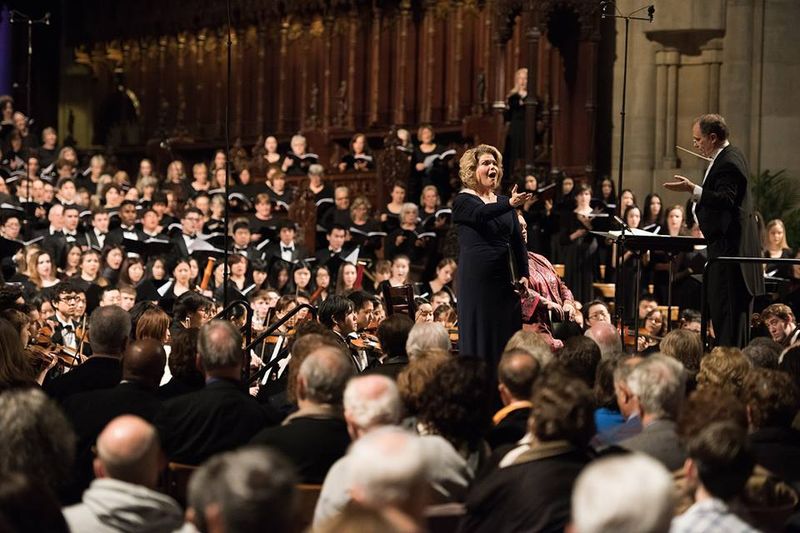
    Thursday March 26th, 2015 – Oratorio Society of New York presenting the Verdi REQUIEM at the Cathedral of St John the Divine. This was my second experience of this magnificent work in a sacred setting: many years ago I attended a performance of it in the Chapel at Trinity College, Hartford CT. On that evening, an organ and a small ensemble of instrumentalists played in lieu of a full orchestra, but the work still made a vivid impression. Tonight we had the admirable young musicians of the Manhattan School of Music Orchestra (and their symphonic chorus) joining the Oratorio Society for a full-force rendering of Verdi’s ‘sacred opera’.

    A huge audience – an overflow crowd, actually – filled the cathedral and (except for one cellphone beeping at a particularly inopportune moment) they listened in reverential silence. It was overall a very fine performance of the REQUIEM but sonically it was problematic in that the reverberant echoing throughout the huge space often turned the music into a blur. Much of the music’s definition was lost, and much detail from the inner orchestral voices vanished in the clouds of echo. There was the illusion of notes being played twice, and the music sometimes seemed to be fighting itself.

    Kent Tritle conducted, and a strong quartet of soloists took part:

    Jennifer Check, soprano
    Sara Murphy, mezzo-soprano
    Alex Richardson, tenor
    Matthew Boehler, bass

    These four singers often seemed to me to be swamped by the sound of the orchestra and chorus flowing over them in both directions. How they managed to pick up their cues, I will never know. Nevertheless, there were many savorable vocal passages. Mr. Boehler, who made a fine impression recently in IOLANTA at The Met, projected the text with vivid dynamic detail, and Mr. Richardson sang musically and with passion.

    Sara Murphy, whose opulent mezzo made a marvelous impact when she sang Ligeti and Schnittke with the American Symphony Orchestra earlier this season, was very impressive tonight both for beauty of tone and clarity of projection. So much music I want to hear her sing! 

    11111962_913591532037896_5248156677226624389_n

    Jennifer Check (above, photo by Brian Hatton), who stepped in to the soprano part rather late in the day, sounded lovely. Her voice has power but also a silvery lyrical quality, and in the Offertorio she produced a spine-tingling sustained piano E-natural (which modulates magically to an E-flat…one of the most felicitous moments in this glorious work). For the great final ‘aria’, Requiem aeternam, Ms. Check closed her score and gave an intense, very personal performance of this prayerful solo; using her right hand in gently expressive gestures, she seemed to send forth a benediction of peace and tranquility.

  • Paul Taylor @ Lincoln Center 2013 #4

    SpeakinginTonguesRobert

    Above: Robert Kleinendorst of Paul Taylor Dance Company in SPEAKING IN TONGUES. Photo by Paul B Goode. Click on the image to enlarge.

    Thursday March 21st, 2013 – Paul Taylor Dance Company have been celebrating Johann Sebastian Bach throughout their current Lincoln Center season: there’s been a Bach ballet on every programme and today – the actual birthdate of the peerless composer – the dancers gave a glorious performance of ESPLANADE, seeming to up their ‘normal’ level of energy, musicality, passion and sheer daring to a breathtaking point.

    The programme opened with SPEAKING IN TONGUES, a complex work which always leaves me with mixed feelings. Matthew Patton’s score does not seem strong enough to sustain a ballet which lasts almost an hour, and to my aging ears the interjections of spoken word no longer have the clarity needed to make a dramatic impact. The work stretches long, but there is no part of it that seems expendable: it is what it is, and perhaps best viewed with a focus on individual dancers.

    Surely there are few dance experiences today to equal the thrill of watching Michael Trusnovec onstage. This dancer with his taut, slender muscularity and singular artistry gave a transfixing rendering of the preacher-man’s opening solo and then moved thru the rest of the ballet with compelling dramatic intensity. Likewise Robert Kleinendorst as the Odd Man Out struck a vibrant note as his open, innocent personality is slowly dismantled by the holier-than-thou congregation; he’s literally beaten into submission, and at last taken into the cult. Also making a strong impact in this work were Amy Young, Laura Halzack, James Samson, Sean Mahoney, Jamie Rae Walker, Aileen Roehl, Heather McGinley, Michael Novak and Michael Apuzzo. Those sumptuous beauties Parisa Khobdeh and Michelle Fleet were outstanding in their prominent solo passages.

    My companion for the evening, choreographer Lydia Johnson, helped me to see this work in a somewhat different light than I had previously, and to understand why the dancers love dancing SPEAKING IN TONGUES.

    Seeing Taylor’s ESPLANADE on Balanchine’s stage made for a joyful experience: the two great masters of modern and ballet choreography each turned to the same Bach music and thus ESPLANADE reminds us of CONCERTO BAROCCO, as different as they are in style and setting. And one of my favorite BAROCCO ballerinas, Teresa Reichlen, was sitting a few rows behind us.

    In ESPLANADE the sense of dynamism and physical risk play high, and the superb collective of Taylor dancers went at it with unfettered vitality: Amy Young, Laura Halzack, Eran Bugge, Parisa Khobdeh, Jamie Rae Walker, Robert Kleinendorst, Francisco Graciano and George Smallwood all looked smashingly beautiful and grand, and if it was Michelle Fleet who ended up stealing our collective hearts, that too was part of Taylor’s plan. The audience, psyched by the fantastic performance, erupted in a massive ovation when the choreographer appeared onstage for a bow.