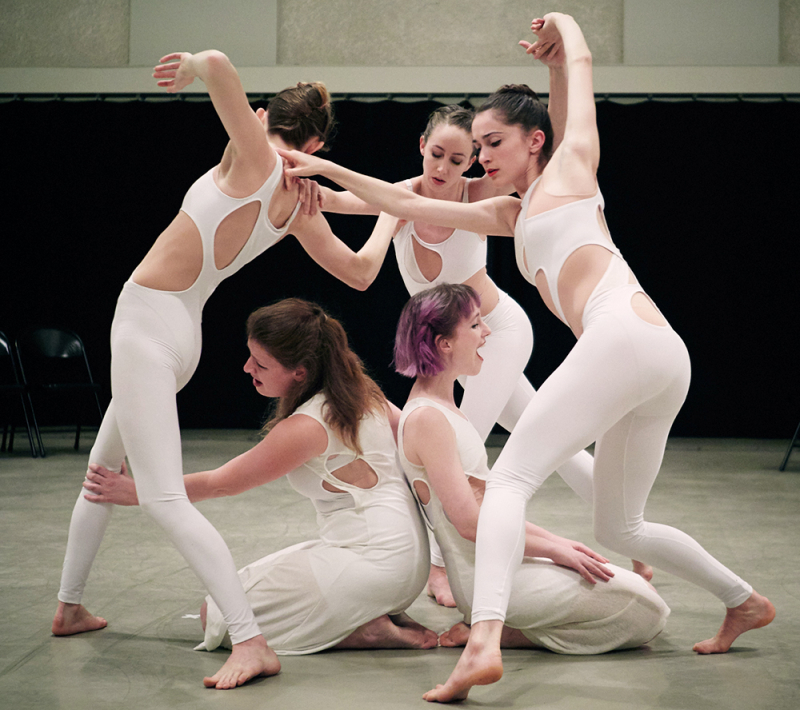
Above: dancers from New Chamber Ballet and singers from Ekmeles in Miro Magloire’s SANCTUM; photo by Tom Schaefer
Author: Oberon
Monday February 18th, 2019 – Miro Magloire’s New Chamber Ballet normally give their performances on weekends, so I was surprised to be invited to see them on a Monday evening. Mondays are often quiet nights for me: neither the Philharmonic nor Chamber Music Society have Monday performances; nor – for that matter – does New York City Ballet. So it was nice to trek down to the City Center Studios on this clear, chilly evening to see Miro’s company, and to hear some incredible music, beautifully played…and sung. I must also say: the 7:30 PM start time was a big plus in my book.
The program opened with MORNING SONG, a solo dancework to music by John Cage that Miro made on his uniquely marvelous dancer, Elizabeth Brown. Doori Na, a violinist who can master the trickiest score and make it mean something, played Cage’s ‘Cheap Imitation‘ (1st movement) to perfection whilst the dancer moved about the space with lyrical authority: a priestess evoking the dawn.
With ecstatic gestures that recall the ground-breaking dances of Isadora Duncan, Elizabeth held the audience under a spell throughout the work’s duration. A very long pause, wherein she remains still, has a power if its own. Elizabeth’s slow circling of the space in calm, weighted/weightless stepping turns, was hypnotic. As dancer and violinist bowed to one another at the close of MORNING SONG, the return to reality was like awakening from a wonderful dream. All that is beautiful in music and dance seems to be distilled into this incredible work.
After only the briefest pause, New Chamber Ballet’s bevy of ballerinas – Sarah Atkins, Kristy Butler, Amber Neff, Rachele Perla, and Madeleine Williams – joined three singers from the Ekmeles vocal ensemble – Charlotte Mundy, Mary Elizabeth Mackenzie, and Elisa Sutherland – and pianist Melody Fader and violinist Doori Na, for the premiere of Miro’s SANCTUM. Vocal music by Kaja Saariaho (Changing Lights and From The Grammar Of Dreams) and Karin Rehnqvist (Davids Nimm) invites the singers to be part of the dance. Melody and Doori perform – luminously – Saariaho’s Nocturne, Calices, Prelude, Tocar, and Ballade, as well as Rehnqvist’s Dans.
SANCTUM has been in-progress for some time, in various guises, and I have seen parts of it in rehearsal or in performance over the past several months. Tonight, with the dancers and singers in Sarah Thea’s bone-white costumes, Miro wove all the elements into a 70-minute ballet.
SANCTUM opens with seated couples (dancers and singers) dreamily dependent on each other, rocking gently. The strikingly clear voice of Charlotte Mundy fills the space: this high, iridescent sound might be the voice we’ve been looking for for Berg’s Lulu. The dancing commences with a duet for two tall women: Kristy Butler and Madeleine Williams. Amber Neff and Rachele Perla, having donned toe shoes, join.
The music is spectacularly beautiful – Saariaho (along with Penderecki) is for me the most fascinating of contemporary composers – and Melody and Doori play it thrillingly: being seated immediately next to these two musicians, every nuance and demi-tint of the scores become tantalizing.
The dance continues to unfold, including Madeleine Williams in a solo that creates a stylistic link to the earlier-seen MORNING SONG. Amber Neff and Ms. Williams dance a duet in Miro’s trademark intense/entangled partnering mode; the music here features vertiginous piano scales which Ms. Fader played with intrinsic flair. Sarah Atkins, Rachele Perla, and Kristy Butler engage in a prancing trio, and Sarah also has a demanding, floor-oriented solo. The singers return, each pairing up with a dancer in a stop-and-start circular promenade. The ending of the ballet is not as powerful as one might hope: the women simply walk away, perhaps to carry on their antique rites in another part of the forest.
Meanwhile, the two musicians have found a path into our subconscious with this other-worldly music. Over the course of the ballet, their playing has created a separate, almost alien, world. And at some point along the way, I realized that this particular work of Miro’s is not best-experienced in a fully-lit, in-the-round studio setting.
As we observe the grace and power of the dancing, we must also face our mere-mortal counterparts seated across from us: fidgeting, reading their programs, even nodding off. The music continuously draws us away from the everyday to a mythic place of feminine mystique and magic; but the ordinariness of the studio setting keeps jarringly pulling us back to reality.
I feel that, in a darkened theater with imaginative lighting, SANCTUM could be as compelling visually as it is musically.
~ Oberon
 Oberon's Glade