Tag: Tuesday April

  • Nelsons/BSO: Mozart/Adès/Sibelius @ Carnegie Hall

    CH11371830_Medium_res

    Above: Maestro Andris Nelsons; photo by Fadi Kheir

    Author: Ben Weaver

    Tuesday April 25th, 2023 – The Boston Symphony Orchestra, under the baton of their music director Andris Nelsons, returned to Carnegie Hall last week. The concert of April 25th, 2023 was a marvelous evening of music by Mozart, Adès, and Sibelius, featuring two outstanding soloist artists. 
    CH11371826_Medium_res

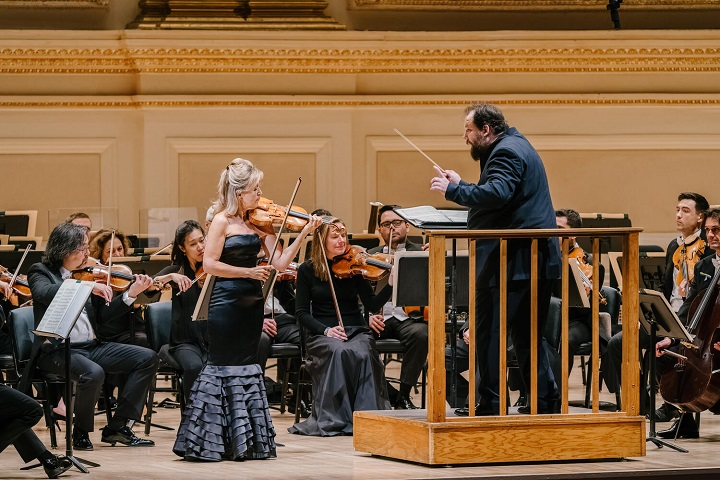
    The great Anne-Sophie Mutter (above, photo by Fadi Kheir) performed two works: Mozart’s Violin Concerto No. 1 in B-flat major, KV 207 and the New York premiere of Thomas Adès’ Air (Homage to Sibelius) for Violin and Orchestra.

    Mozart’s violin concertos have been part of Mutter’s repertoire for her entire career; it’s music she has played and internalized, and performances she has perfected, through the years. The magical performance on Tuesday night of the 1st Concerto, composed in 1773, was essentially perfect. Mutter’s golden, rich, steady tone never wavered; the soulfulness of her playing made the audience lean in. Mozart’s virtuosic writing gave Mutter no difficulties; she dispatched every run, double stop, and trill with absolute ease.

    The new composition by Adès, Air (Homage to Sibelius), is a very different work from Mozart. Composed for Ms. Mutter in 2022, it’s a single-movement, semi-minimalist work (running about 13 mins) that lets the soloist stay in the upper reaches of the instrument for almost its entire run time. While the soloist played a canon – Ms. Mutter’s perfect control and steadiness were wondrous to hear – the orchestra shifted the landscape through orchestration and rhythms. Maestro Nelsons shepherded the forces around Ms. Mutter beautifully, the BSO letting the music ebb and flow. While Mr. Adès explicitly says Air is an homage to Sibelius, I heard more Arvo Pärt and John Adams than Sibelius.
    CH11371825_Medium_res

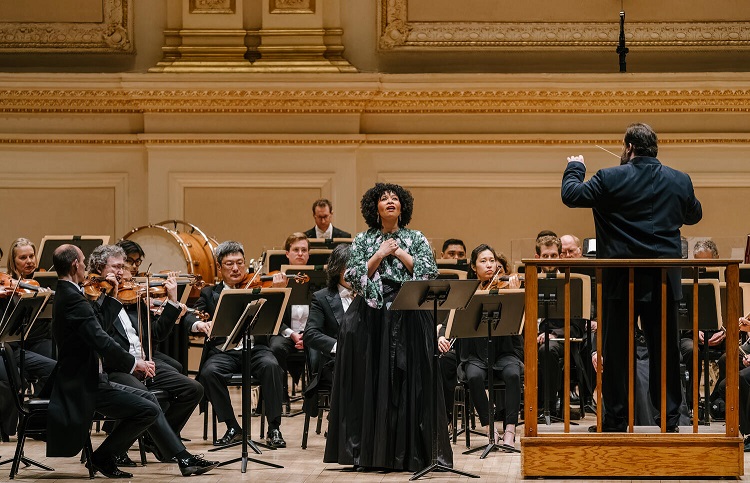
    Above: soprano Golda Schultz sings Sibelius; photo by Fad Kheir

    Two works by Sibelius book-ended the evening’s program. The vocal tone poem Luonnotar, Op. 70, is one of Sibelius’ most mystical and magical works. With text taken from the first “song” of the Finnish epic national poem Kalevala (a work that inspired several other major works from Sibelius), it tells the story of the (non-religious) Creation. The huge leaps and range of the vocal writing makes Luonnotar one of the most demanding works for a soprano, and South African soprano Golda Schultz was mesmerizing. Her rich voice is even throughout the range, even in the uppermost reaches it remains creamy and ravishing. Her breath control ensured she never ran out of air for Sibelius’ long and achingly beautiful melodies. Maestro Nelsons was sensitive to never let the orchestra drown out the singer. This is a work I wish would be performed more often.

    CH11371827_Medium_res

    Above: Maestro Nelsons and the BSO; photo by Fadi Kheir

    The concert ended with an expansive performance of Sibelius’ Symphony No. 5 in E-flat major, Op. 82. Sibelius’ sound-world is really like no other. I don’t think there is another composer who composed music of such surging coldness and brilliant light. You can feel the winds sweeping across the snow and the icy water glistening in the Sun. The episodic nature of Sibelius’ writing, in the hands of lesser conductors, can be difficult to stitch together. Maestro Nelsons managed it beautifully, and the Boston Symphony – which has a long history of playing Sibelius – responded to every nuance. The orchestra’s marvelous brass section deserves special recognition here because the very exposed writing for the horns in the first and third movements was played perfectly by the ensemble. The final movement, one of Sibelius’ most famous compositions, with the majestic tolling of the horns and sweeping melody from the strings, is one of those rare truly breathtaking glories of music. It’s interesting that this overwhelming section – supposedly inspired by a flock of swans he watched passing overhead – is only played in all its Romantic glory once. When it is repeated in the second half of the movement, it changes to a darker, almost sinister tone. And the work ends with 4 chords and 2 unisons – broken by pauses. A stark and startling conclusion.

    The Boston Symphony is second to none playing Sibelius; years ago Sir Colin Davis – one of the great exponents of the Finnish bard’s music – played and recorded his works with the BSO extensively. Andris Nelsons doesn’t miss a beat.

    Performance photos by Fadi Kheir, courtesy of Carnegie Hall

    ~ Ben Weaver
  • Grace Park/Joseph Liccardo @ Merkin Hall

    Park-grace

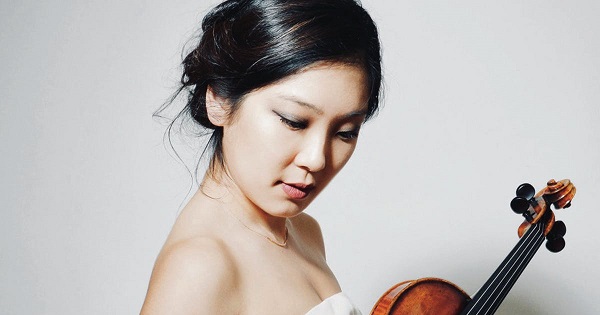
    Tuesday April 26th, 2022 matinee – Violinist Grace Park (above) with pianist Joseph Liccardo in a matinee recital at Merkin Hall. Ms. Park, a elegant beauty, looked chic in flowing white trousers and a fitted white halter-top; she strode onto the stage with the dapper Mr. Liccardo, and they opened their program brilliantly with the Scherzo from Johannes Brahms’ FAE Sonata; this movement was composed as part of a welcoming musical gift created to honor the great violinist Joseph Joachim’s arrival at Düsseldorf. The title FAE Sonata refers to Joachim’s motto: “Frei, aber einsam” (‘Free, but lonely’).

    The Brahms Scherzo made for a perfect introductory piece: it goes thru many changes of mood, from flashy, to sentimental, to passionate. Although there were moments when the piano seemed too loud, Ms. Park and Mr. Liccardo were perfectly in sync, and they brought us delicious subtleties along the way.

    With the blend of voice and piano now perfectly aligned, music of Clara Schumann came next. Written in 1853, these brief works were among the last pieces that Clara ever wrote. After Robert’s death in 1856, she composed almost nothing more herself, instead keeping Robert’s music alive through her touring, and the editing of his works.

    With the blend of voice and piano now perfectly aligned, these Clara Schumann gems glowed. The opening Andante molto had the feeling of an exquisite dream, with the players displaying beautiful phrasing and a keen sense for dynamic variety. A sadness arises with the second Romance, Allegretto Mit zatern vortage, though things turn lighter in time; throughout, the alternating currents of mood were deftly illuminated by the players. The final Romance, Leiderschuaftlich, is the most enchanting, with its flow of violin melody over rolling arpeggios from the keyboard. Ms. Park’s tone was at its sweetest here, with finely-etched trills and staccati, whilst Mr. Liccardo’s playing flourished.

    A change in program brought us Leoš Janáček’s Violin Sonata rather that the originally-announced Mozart KV 454. Composed in 1914, when the world was poised on the edge of war.

    From its passionate con moto start, the first movement is quite dramatic. The violin and piano seem to converse as they pass thru various musical moods: ironic, suspenseful, to a longing lyricism, and a calm finish, The ensuing Ballada brings forth shimmering figurations from the piano and a sustained, poetic theme from the violin. I loved watching Ms. Park’s expressions as the music seemed to draw forth her deepest feelings. Mr. Liccardo’s glistening passages met with Ms. Park’s ascending line for a radiant high ending.

    The following movement, a sort of scherzo – opens with the piano trilling and the violinist slashing the strings; a folk-like dancing song rises up. The sonata moves on, thru staccati and trills that give a restless feeling, to a searing passage from the violin. Near the end, the piano seems dreamy and the violin rather anxious.

    Composer Chris Rogerson introduced his Lullabye, No Bad Dreams, composed in 2009. Drawing upon his childhood fears of bedtime, he wrote a work that tells of a calming ritual his parents devised as they tucked him in for the night. The lullabye has Mr. Liccardo’s piano in the high range whilst Ms. Park’s line is sustained. Suddenly the music turns brisk – not ready for sleep yet – and develops an unusual grandness that speaks of passion and longing. Following a slow fade, there is a fitful agitation – which the composer indicates might be the result of having eaten too many sweets during the day. Sleep comes at last, with Ms. Park sustaining a long, high note. Musicians and composer were well-applauded for this musical memento of childhood; it certainly brought forth memories for me.

    Joseph_Liccardi_500

    Above: pianist Joseph Liccardo

    From J S Bach, we heard the Sonata for Violin and Harpsichord in E-major. This was most impressively played, commencing with a lovely, sustained Adagio, followed by the light and graceful Allegro, which features much animation from the piano. The heart of the sonata – and of the afternoon – came with the achingly beautiful Adagio ma non tanto; as played by Ms. Park and Mr. Liccardo, it felt like a bit of Heaven on Earth…something we so desperately need in these bleak times. In the concluding Allegro, our two musicians regaled us with their dazzling virtuosity, eliciting prolonged applause

    To conclude the program, we heard Schubert’s Rondo Brilliante in B-minor, which opens with contrasting passages that build to the emergence of the Rondo proper. This technically demanding piece was marvelously played by Ms. Park and Mr. Liccardo, but it also seemed endless; the same themes are repeated again and again, with several indications that the end was near only to have the music take another detour. After a while, I found my mind wandering. But eventually the Schubert came to an end, and the musicians were enthusiastically – and deservedly – cheered.

    ~ Oberon

  • Limón Dance Company @ The Joyce

    José+Limón+-++Photo+by++Paul+Draper

    Above: choreographer José Limón, photo by Paul Draper

    Tuesday April 19th, 2022 – The Limón Dance Company celebrating their 75th Anniversary Season with performances at The Joyce Theatre. This evening marked my third experience watching the Limón troupe: the first was in 2008, and more recently in 2019. There have been quite a few changes in the Company’s roster since my last viewing, including the departures of such entrancing dancers as Jacqueline Bulnés and Jesse Obremski. But the current ensemble is a staggeringly beautiful assemblage of forms and faces.

    Each work was prefaced by commentary from an unseen narrator…spoken by my longtime friend, actor Dion Mucciaito. These brief speeches provided us with interesting background material for the works being performed. But I wish Dion had appeared onstage to impart this information, because…he’s such a great-looking guy!

    Doris Humphrey was José Limón‘s inspiration and mentor. Watching Humphrey’s achingly gorgeous AIR FOR THE G-STRING, created in 1928, gives us a sense of the timeless resonance – and the great necessity – of dance in our lives. Bringing to mind the iconic female danced-rituals of Isadora Duncan, AIR FOR THE G-STRING shows us the value of great music as the inspirational springboard for creating danceworks that will endure.

    Limonphotochristopherjonesairforthegstring2022

    Above: from Humphrey’s AIR FOR THE G-STRING; photo by Christopher Jones

    From the curtain-rise – on the dancers in silhouette against a rose-coloured back-panel – to final pose, AIR FOR THE G-STRING held us under its spell. Five women, clad in simple gowns of varied hues and long Renaissance-style golden cloaks with trains, move slowly in processions and circling motifs. Though not in any way religious in feeling, it conveys a depth of spirituality that speaks to me poignantly.

    This evening, Frances Lorraine Samson, a petite woman with a space-filling presence, led the ensemble: Mariah Gravelin, Deepa Liegel, Jessica Sgambelluri, and Lauren Twomley…distinctive beauties all. This Humphrey work is part of that long continuum of dances of sisterhood that spans the centuries from the swans, slyphs, shades, and Wilis of classical ballet, through the more intimate Duncan, to Graham’s epic CHRONICLE, Balanchine’s SERENADE, Robbins’ ANTIQUE EPIGRAPHS, and Lydia Johnson’s CROSSINGS BY RIVER. Watching this spell-binding work tonight gave me an incredible lift of spirit – something so desperately needed in these bleak days as the world sometimes seems to be crumbling around us.

    Two Limón masterpieces were central to this evening’s program. The first of these, PSALM, dates from 1967. The choreographer drew inspiration from the French author Andre Schwarz-Bart’s semi-historical novel, “The Last of the Just,” which traces the martyrdom of the Jews through thirty-six generations of the Levy family, ending at Auschwitz.

    Limonpsalmphotobychristopherjones infrontnicholasruscica

    Above: Nicholas Ruscica in Limón’s PSALM; photo by Christopher Jones

    For PSALM, Limón was unable to obtain the music he wanted to use – Stravinsky’s “Symphony of Psalms” – so he created the work in silence. Nearing the date of the premiere, the choreographer asked composer Eugene Lester to provide a score, based on his “million counts”. Later, Limón disciple Carla Maxwell, feeling the choreography called for something grander, commissioned a score from Jon Magnussen which included a full chorus, ten instruments, and a baritone soloist; it was to the Magnussen score that I saw PSALM performed in 2019. This evening, the Lester score – more intimate and highly personal – was back in place. Lester’s score is percussion-based, features a male singer/speaker, and somehow feels right.

    Superbly lit Al Crawford, PSALM is a story of the triumph of the human spirit over death, created by Limón at a time when his own untimely death from pancreatic cancer loomed before him. The Lester score, while quite spare in contrast to the Magnussen, provides vividly contrasted rhythms which give the dancers an aural roadmap for the movement. 

    Eight dancers appear, seemingly searching for someone…or something. The whole Company then takes the stage, moving in finely-wrought patterns. In one passage, they kneel in a row, reminding me yet again of Robbins’ ANTIQUE EPIGRAPHS. Dancer Nicholas Ruscica was the central figure in tonight’s performance, commencing with a solo to the sound of a baritone voice. We hear the word “Adonai” (Hebrew for ‘God’) which put me in mind of Krzysztof Penderecki‘s monumental SEVEN GATES OF JERUSALEM; with such references, PSALM became more and more meaningful to me as it progressed.

    Mr. Ruscica’s dancing was very subtle and expressively detailed. As the comings and goings of the populace surged around him, the danseur‘s movement took on a hypnotic, other-worldly feeling. He collapses; to delicate music, the women tend to him. He then awakens and begins to dance, first on his knees, and then – gathering strength – he rises. The group swarm about him in a celebratory dance. Circling in a dazzling passage, they lift him aloft. 

    PSALM thrilled me tonight, even more than it did in 2019. To me, it seems a dance very much for our time. All of the dancers are captivating to watch, and each has a distinctive personality. Mariah Gravelin, Savannah Spratt, and Lauren Twomley had featured roles among the women, with the ladies from the opening Bach work all dancing divinely here. Terrence D. M. Diable, B. Woods, Joey Columbus, MJ Edwards, and Johnson Guo are the Company’s wonder-men, and it was great to see Robert M. (‘Buddy’) Valdez again, very tall and handsome, with eyes that dazzle. In this large-scale scale work, dancers from Limón 2 – Erin Hollaman, Nicole Miera, and Sabrina Olivieri – joined the full Company.

    José Limón created the solo CHACONNE in 1942 to the familiar music from Bach’s violin Partita #2. Onstage tonight, standing in separate pools of light, were violinist Johnny Gandelsman and guest-artist dancer Shayla-Vie Jenkins. Ms. Jenkins, a poised beauty with the gift of lyrical grace, wore trousers and a soft, loose-fitted blouse. When Mr. Gandelsman struck up the familiar Bach piece, the dancer began to move in place, her expressive arms and hands speaking to us in dance’s silent language. Later her movement becomes almost balletic, her dancing at once supple and courtly. With the violinist’s subtle nuances tempting the ear, the two made this Limón gem a sheer delight.

    Limononlyonewillrise.photochristopherjones.dancersSavannahSpratt MJEdwards BWoods(jumping)

    Above: Samantha Spratt, MJ Edwards, and B Woods in Tarpaga’s ONLY ONE WILL RISE; photo by Christopher Jones

    In line with the current quest for choreographer-based companies to find new works to provide fresh opportunities for their dancers once the founding choreographer has passed away, tonight we saw ONLY ONE WILL RISE, choreographed by Olivier Tarpaga. This work tells of the ‘dark horse’, the person who unexpectedly triumphs in the end: in this case, it was the the youthful-looking MJ Edwards, who made a very fine impression both in movement and presence, with a poetic face. The choreographer provides brief solos for the other dancers, too, as well as well-constructed ensemble passages. The work is quite dark, and the final illumination of the dancers, with Mr. Edwards having risen in their midst, was a beautiful moment.

    LimononlyonewillrisedancersJohnsonGuo  Nicholas Ruscica  Lauren Twomley

    Above: Johnson Guo, Nicholas Ruscica, and Lauren Twomley in ONLY ONE WILL RISE; photo by Christopher Jones

    What gave ONLY ONE WILL RISE its appeal was the music, composed by the choreographer and guitarist Tim Motzer, and played live onstage by Mr. Motzer, with his fellow musicians Daniel Johnson and Saidou Sangare. They were fantastic.

    It’s not easy to find danceworks that can appear on programs alongside the masterworks of some of the world’s all-time greatest choreographers without being eclipsed. The Balanchine, Graham, and Taylor companies have to work in this current situation, as does Limón. Perhaps though, it’s true that – as Miki Orihara once said – “To find the future of dance, we must look to the past.”

    ~ Oberon

  • Pontus Lidberg’s UNE AUTRE PASSION

    Une_autre_passion_c_gregory_batardon_12

    Photo by Gregory Batardon

    ~ Author: Oberon

    Tuesday April 24th, 2018 – Ballet du Grand Théâtre de Genève have brought Swedish choreographer Pontus Lidberg’s abstract take on Johann Sebastian Bach’s Saint Matthew Passion – UNE AUTRE PASSION – to The Joyce.

    Pontus’s trademark flowing – and fluent – choreography is beautifully executed by the Geneva dancers, and – needless to say – the music is sublime. The audience seemed literally enthralled by the production, in which some stunning underwater film segments add a striking visual dimension.

    Pontus turns to the classic 1959 Karl Richter recording of the Saint Matthew Passion, featuring the legendary Dietrich Fisher-Dieskau and the no less marvelous Hertha Töpper; the choreographer excludes the recitatives, assembling a soundscape of choruses and arias. He does not attempt a narrative of the story of Christ’s final hours, but rather an abstract essay in movement on the theme of the Passion, full of desire, uncertainty, and consolation.

    At curtain-rise, six tall white panels form a wall at the back of the dancing area. Overhead, shadowy clouds hover and moonlight pierces the gloom. The dancers emerge, all in white: their skirts, trousers, shirts, and tank-tops are not gender-specific. They dance en ensemble.

    The moveable panels become part of the choreography as the dancers slide them about the space; illusions are conveyed when one dancer vanishes behind a moving panel to be replaced by another as the panel slips away. The wall re-forms and the dancers crash into it.

    Now the film begins: white mannequins stand under the water as a nude man swims lyrically among them…could the swimmer be the choreographer himself? From time to time, the film continues throughout the ballet. The mannequins get dis-assembled, and later the ‘lamb of god’ appears to float by in the guise of a stuffed creature.

    The panels are transformed into slides, the dancers sliding down while colleagues dance a stylized ritual; solo passages, and a male ensemble, continue the endless fluidity of movement. A luminous passage shows the dancers in silhouette, like a living frieze. This gives way to a walking motif as groups of dancers cross the space – urgently – in regimented order.

    At the heart of UNE AUTRE PASSION is a pas de deux performed to the great aria ‘Erbarme dich, sung by Ms. Töpper. The couple (I’m sorry to say I am not sure of the dancers’ names) move hypnotically; the woman has a solo and then they are reunited, only to part again. Then the man dances alone, seeking among the moving panels until he finds her again. 

    Now one by one the dancers remove their outer garments. The movement is stylized, filled with gestures of supplication. From solo and duet phrases, the dancers slowly assemble, lying in a row upon the floor along the side of the space. The panels are then formed into a wall, enclosing the bodies. A single man now seeks entry into this repository of souls; a second man prevents him, and their duet becomes yet another memorable passage in this deeply moving ballet. 

    The dancers re-assemble in a swaying motion; a male solo follows as the music becomes a hymn. The voice of Dietrich Fisher-Dieskau fills the space as we wait breathlessly to see how this Passion will conclude. The wall now stands along stage left, and the dancers approach it – at first walking, then running, then rushing. They pound on the surface, pray before it, collide with it, collapse at its feet: but the wall remains impenetrable.

    “We are living through a very hard time, our gift is to be alive,” said Pontus Lidberg in an interview during the creation of UNE AUTRE PASSION. In this ballet, Bach’s immortal music and the poetry of the dance that it has evoked feel like an affirmation of life: a refuge of beauty in a darkening world.

    The ballet ends with a naked man standing before the paneled wall. Has he been shut out of heaven, or does his vulnerable presence mark the dawn of a new day, freed of the hypocrisy, hatred, and oppression that have undermined the great religions?

    ~ Oberon

  • Pontus Lidberg’s UNE AUTRE PASSION

    Une_autre_passion_c_gregory_batardon_12

    Photo by Gregory Batardon

    ~ Author: Oberon

    Tuesday April 24th, 2018 – Ballet du Grand Théâtre de Genève have brought Swedish choreographer Pontus Lidberg’s abstract take on Johann Sebastian Bach’s Saint Matthew Passion – UNE AUTRE PASSION – to The Joyce.

    Pontus’s trademark flowing – and fluent – choreography is beautifully executed by the Geneva dancers, and – needless to say – the music is sublime. The audience seemed literally enthralled by the production, in which some stunning underwater film segments add a striking visual dimension.

    Pontus turns to the classic 1959 Karl Richter recording of the Saint Matthew Passion, featuring the legendary Dietrich Fisher-Dieskau and the no less marvelous Hertha Töpper; the choreographer excludes the recitatives, assembling a soundscape of choruses and arias. He does not attempt a narrative of the story of Christ’s final hours, but rather an abstract essay in movement on the theme of the Passion, full of desire, uncertainty, and consolation.

    At curtain-rise, six tall white panels form a wall at the back of the dancing area. Overhead, shadowy clouds hover and moonlight pierces the gloom. The dancers emerge, all in white: their skirts, trousers, shirts, and tank-tops are not gender-specific. They dance en ensemble.

    The moveable panels become part of the choreography as the dancers slide them about the space; illusions are conveyed when one dancer vanishes behind a moving panel to be replaced by another as the panel slips away. The wall re-forms and the dancers crash into it.

    Now the film begins: white mannequins stand under the water as a nude man swims lyrically among them…could the swimmer be the choreographer himself? From time to time, the film continues throughout the ballet. The mannequins get dis-assembled, and later the ‘lamb of god’ appears to float by in the guise of a stuffed creature.

    The panels are transformed into slides, the dancers sliding down while colleagues dance a stylized ritual; solo passages, and a male ensemble, continue the endless fluidity of movement. A luminous passage shows the dancers in silhouette, like a living frieze. This gives way to a walking motif as groups of dancers cross the space – urgently – in regimented order.

    At the heart of UNE AUTRE PASSION is a pas de deux performed to the great aria ‘Erbarme dich, sung by Ms. Töpper. The couple (I’m sorry to say I am not sure of the dancers’ names) move hypnotically; the woman has a solo and then they are reunited, only to part again. Then the man dances alone, seeking among the moving panels until he finds her again. 

    Now one by one the dancers remove their outer garments. The movement is stylized, filled with gestures of supplication. From solo and duet phrases, the dancers slowly assemble, lying in a row upon the floor along the side of the space. The panels are then formed into a wall, enclosing the bodies. A single man now seeks entry into this repository of souls; a second man prevents him, and their duet becomes yet another memorable passage in this deeply moving ballet. 

    The dancers re-assemble in a swaying motion; a male solo follows as the music becomes a hymn. The voice of Dietrich Fisher-Dieskau fills the space as we wait breathlessly to see how this Passion will conclude. The wall now stands along stage left, and the dancers approach it – at first walking, then running, then rushing. They pound on the surface, pray before it, collide with it, collapse at its feet: but the wall remains impenetrable.

    “We are living through a very hard time, our gift is to be alive,” said Pontus Lidberg in an interview during the creation of UNE AUTRE PASSION. In this ballet, Bach’s immortal music and the poetry of the dance that it has evoked feel like an affirmation of life: a refuge of beauty in a darkening world.

    The ballet ends with a naked man standing before the paneled wall. Has he been shut out of heaven, or does his vulnerable presence mark the dawn of a new day, freed of the hypocrisy, hatred, and oppression that have undermined the great religions?

    ~ Oberon

  • Richard Goode @ Alice Tully

    ~Author: Scoresby

    Tuesday April 17 2018 – Oddly, I have never had the chance to hear the pianist Richard Goode before. While a seminal figure in the American piano scene, I always seemed to not be able to make his performances. Thus, I was grateful to hear him live first on Lincoln Center’s Great Performers Series in program that ran in chronological order (spare the encore) over 300 years of music history.

    The program opened with the Second and Third Pavians and Galliardes from Byrd’s My Ladye Nevells Booke of Virginal Music. While stunning music due to Mr. Goode’s pinpoint articulation – I couldn’t help but feel a layer was missing from the music by hearing it on the piano. The many trills and ornaments sound far heavier on a piano. Nonetheless Mr. Goode highlighted the harmonic progressions and layered the voicing so the audience could always hear the melody through those ornaments. In the Second Pavian, Mr. Goode let the large groupings of arpeggios having a flowing sound – he crafted melodic line to be joyous and full of energy. In the Galliarde to the Second Pavian, Mr. Goode loosened some and let the music have a more spontaneous feel, but still captured the dance form.

    The second work on the program was Bach English Suite No.6 in D minor, BWV 811. In the opening Prelude, Mr. Goode seemed to have an improvisatory feel to the music – a lot less structured than the Byrd earlier. As the prelude turned into a fugal section, Mr. Goode seemed to eschew the carefree style for rigid structured and lucidity. It was a wonderful transition that let him highlight the quiet beauty in the inner voices and left hand of this denser section. As the prelude escalated in intensity, he took advantage of the piano’s wide dynamic range to let it boom like an organ. Mr. Goode took a brisker pace for the later movements. This worked particularly well in the charming Gavotte I and II. With the speed of the trills and folk-like allure, the Bach seemed to echo the Byrd from earlier. This seemed quite intentional every part of the program seemed to be strung together with a few different ideas. In the speedy Gigue that ends the suite, Mr. Goode seemed to at once capture the rhythm and get into a more dancelike idiom. His left hand’s clarity is rare in a pianist and he used it to build the intensity in each of the scales, adding drama to this finale. Despite having a light touch to the keys, Mr. Goode seemed to be able to build a large sound without sacrificing clarity.

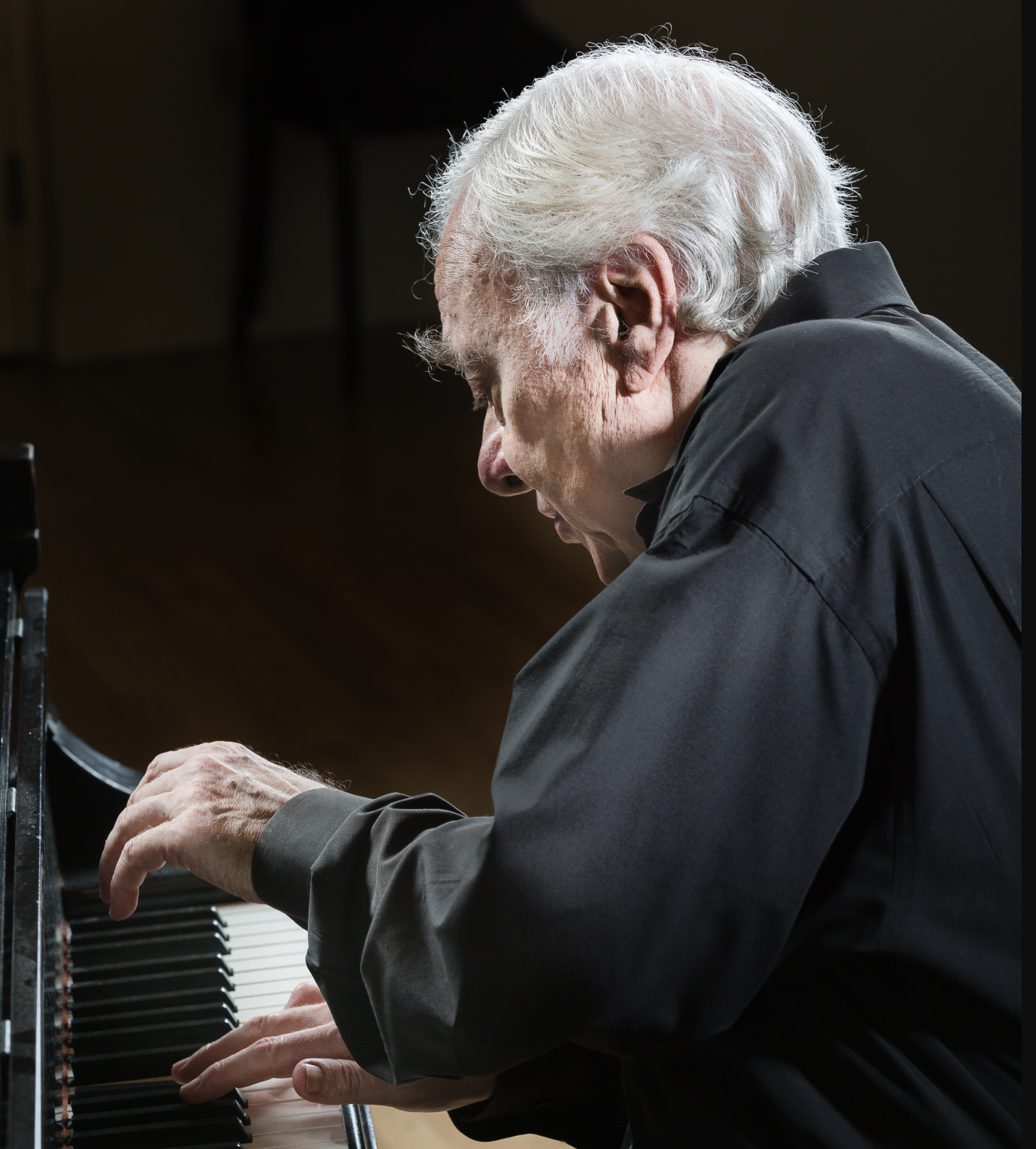
    Screen Shot 2018-04-23 at 4.44.32 PM

    Above: Pianist Richard Goode; photo credit: Steve Riskind

    The highlight of the program was hearing Mr. Goode’s interpretation of Beethoven Sonata No. 28 in A major, Op. 101. Mr. Goode was the first American pianist to record all 32 of Beethoven’s sonatas; his expertise in the music showed this evening. Mr. Goode’s style of playing seems to revolve around painting the exacting structure of the music, so in the Beethoven he eschewed some of the more sentimental elements of the work to do this. While I personally find it sometimes a bit cold, it is interesting to hear a fresh and insightful interpretation.  In the lyrical opening, Mr. Goode seemed to take a straightforward approach that pushed the music along. At first he kept his playing quiet and measured, but he seemed to emphasize the expansions into different registers and bell-like chords that appear littered through the work. While some pianists use these chords as a simple break, Mr. Goode made sure that each time they appeared they were a harmonic feature that drove the piece. Similarly as the first movement unfolded, he let the left hand’s drone sing clearly.

    The second movement is famous for its odd Schumann-esque march. Mr. Goode let the driving rhythmic structures take precedent, echoing the bell-like motif from the first movement. He also made sure all the jazzy riffs had spunk to them, which echoed the Debussy to come. The most fun part of the night was during the giant fugue that ends the work. Mr. Goode managed to make the exciting fugue have pristine clarity, only to be quiet in to the romantic opening of the piece. The humorous coda at the end of the work seemed to have a few audiences members smiling as he finished.

    The final work on the program (after intermission) were the Debussy Préludes, Book 2. Mr. Goode’s interpretation, while beautifully played, felt a little too monotone for my taste. Nonetheless, in the third image La puerta del vino, he managed to capture both the Spanish rhythms and bursts of different colors. The Ondine suited his style of playing well, letting each of the arpeggios ripple through with exacting phrasing. He capture the eccentricity of Hommage à S. Pickwick Esq. P.P.M.P.C., getting an earthier, Rachmaninoff- sort of sound. The tinkling of the folksy dance and humor during the contrasting section of the work harkened back to the Barqoue works earlier. It is clear that Mr. Goode manages to unify his programs by highlighting the common strands between works.

    The audience seems to love Mr. Goode, giving him a hearty ovation following the exciting Feux d’artifice. After all the applause Mr. Goode played an extended encore: Chopin Barcarolle in F-sharp major, Op. 60. While the perfect closing piece for the program (according to Mr. Goode’s remarks the Barcarolle was a favorite of Debussy’s) and a pleasurable indulgence it felt a little long-winded to add on to the end of the performance. Nonetheless, Mr. Goode’s playing was just as thoughtful and free as earlier, closing the recital on a high-note.

  • Season Finale: Score Desk for BALLO IN MASCHERA

    -hvorostovsky-radvanovsky

    Above: Dmitry Hvorostovsky and Sondra Radvanovsky

    Tuesday April 28th, 2015 – For my final Met performance of the current season, Verdi’s BALLO IN MASCHERA with probably the strongest overall cast of any opera produced at the Met this season. I felt no need to see the Met’s mixed-bag, neither-here-nor-there production again, so I was back at my score desk. Of the twenty-plus performances I attended at the Met this season, most were experienced from score desks; there is less and less of a need to actually see what it happening onstage, so why spend the money on a ‘room with a view’? And besides, I hardly ever stay to the end of anything thanks to the slow agony of the Gelb-length intermissions. Tonight, though, my two amusing friends Adi and Craig helped make the long breaks somewhat more tolerable.

    Tonight’s audience was one of the largest I’ve seen at the opera all season. The Met’s always been a ‘singers house’; the box office is voice-driven and has been since the days of de Reszke and Caruso. There was Flagstad, and Birgit and Franco; and there was Pav, and now there’s Netrebko and Kaufmann. People come for the singing because that’s what opera is all about.

    The evening began with an announcement that James Levine would be replaced on the podium by John Keenan. This may have been a rather last-minute decision since Levine’s special wheelchair platform was in place. Keenan is a very fine Wagner conductor, but in the Italian repertoire Joseph Colaneri would be my choice if Levine is ailing. Much of Act I tonight had an unkempt quality; the singers seemed to want different tempi than Keenan was offering them, and they tended to speed ahead, leaving the orchestra to catch up.

    Piotr Beczala – superb in IOLANTA earlier in the season – sounded a bit tired in Act I. His opening aria was not smooth and the climactic top A-sharp was tight and veered above pitch. He began to settle in vocally at Ulrica’s, though the (written) low notes in “Di tu se fedele” were clumsily handled – no one would have cared if he’d sung them up an octave. By the time he reached the great love duet, Beczala was sounding much more like his usual self, and his “Non sai tu che se l’anima mia” was particularly fine. Spurred on by his resplendent soprano, the Polish tenor invested the rest of the duet with vibrant, passionate singing.

    As Ulrica, Dolora Zajick was exciting: the voice has its familiar amplitude and earthy chest notes intact and she also sang some beautiful piani, observing Verdi’s markings. It’s not her fault that the production idiotically calls for amplification of her deep call for “Silenzio!” at the end of her aria. Dolora’s chest tones don’t need artificial enhancement.

    Heidi Stober was a serviceable Oscar; her highest notes could take on a brassy edge and overall she lacked vocal charm. Memories of Reri Grist, Roberta Peters, Judith Blegen, Lyubov Petrova, and Kathleen Kim kept getting in my ear, perhaps unfairly.

    Dmitry Hvorostovsky as Count Anckarström was in splendid voice from note one, and his opening aria “Alla vita che t’arride” was beautifully phrased with a suave legato, the cadenza rising up to a majestically sustained high note. In the scene at the gallows (or rather – as this production places it – “in an abandoned warehouse…”) the baritone was vividly involved, first as a loyal friend urging his king to flee and later as the shamed, betrayed husband.

    Sondra Radvanovsky, who in 2013 gave us a truly impressive Norma at The Met, was – like the baritone – on top form. With a voice utterly distinctive and unlike any other, and with the seemingly innate ability to find the emotional core of any role she takes on, Radvanovsky has a quality of vocal glamour that makes her undoubtedly the most exciting soprano before the public today. What makes her all the more captivating is that, if a random note has a passing huskiness or isn’t quite sounding as she wants it to, she’s able to make pinpoint adjustments and forge ahead. This makes her singing interesting and keeps us on high alert, wondering what she’ll do next. Thus she generates a kind of anticipatory excitement that is rare these days.

    Launching Amelia’s “Consentimi o signore’ in the Act I trio, Sondra shows off the Verdian line of which she alone today seems true mistress. When we next meet her, she is out on her terrified search for the magical herb. Unfurling the grand recitative “Ecco l’orrido campo…” with instinctive dramatic accents, she draws us into Amelia’s plight. The great aria that follows is a marvel of expressiveness (though I do wish she would eliminate the little simpering whimpers during the orchestral bridge…a pointless touch of verismo); and then terror seizes her and she goes momentarily mad before calming herself with the great prayerful ascent to the high-C. The ensuing cadenza was both highly emotional and superbly voiced.

    In the love duet, with Beczala now vocally aflame, Sondra gave some of her most incredibly nuanced, sustained singing at “Ma tu, nobile…”- astounding control –  before the two singers sailed on to the impetuous release of the duet’s celebratory finale and ended on a joint high-C.

    Amelia’s husband unexpectedly appears to warn the king that his enemies are lurking; after Gustavo has fled (has Sondra ever contemplated taking a high-D at the end of the trio here? I’ve heard it done…), soprano and baritone kept the excitement level at fever pitch during the scene with the conspirators: page after page of Verdian drama marvelously voiced, ending with a rich high B-flat from the soprano as she is hauled off to be punished.

    I hate the break in continuity here: ideally we would follow the couple home and the intensity level would suffer no letdown; instead we have another over-long intermission.

    But the mood was quickly re-established when the curtain next rose: Hvorostovsky thundering and growling while Radvanovsky pleads for mercy. Now the evening reached a peak of vocal splendour as the soprano sang her wrenchingly poignant plea “Morro, ma prima in grazia…” Displaying a fascinating command of vocal colour and of dynamics that ranged from ravishing piani to gleaming forte, the soprano was in her greatest glory here, with a spectacular cadenza launched from a sublime piano C-flat before plunging into the heartfelt depths and resolving in a ravishingly sustained note of despair.

    Hvorostovsky then seized the stage. In one of Verdi’s most thrilling soliloquies, the character moves from fury to heartbreak. After the snarling anger of “Eri tu”, Dima came to the heart of the matter: using his peerless legato and vast palette of dynamic shadings, he made “O dolcezze perdute, o memorie…”  so affecting in its tragic lyricism before moving to a state of resignation and finishing on a gorgeously sustained final note. In the scene of the drawing of lots, Hvorostovsky capped his triumph with an exultant “Il mio nome! O giustizia del fato!” – “My name! O the justice of fate: revenge shall be mine!” His revenge will bring only remorse. 

    We left after this scene, taking with us the fresh memory of these two great singers – Radvanovsky and Hvorostovsky – having shown us why opera remains a vital force in our lives.  

    Metropolitan Opera House
    April 28, 2015

    UN BALLO IN MASCHERA
    Giuseppe Verdi

    Amelia.............................Sondra Radvanovsky
    Riccardo (Gustavo III).............Piotr Beczala
    Renato (Count Anckarström).........Dmitri Hvorostovsky
    Ulrica (Madame Ulrica Arvidsson)...Dolora Zajick
    Oscar..............................Heidi Stober
    Samuel (Count Ribbing).............Keith Miller
    Tom (Count Horn)...................David Crawford
    Silvano (Cristiano)................Trevor Scheunemann
    Judge..............................Mark Schowalter
    Servant............................Scott Scully

    Conductor..........................John Keenan

  • Score Desk for I PURITANI

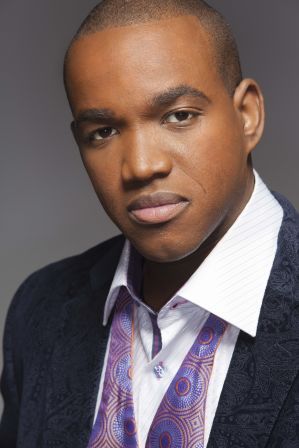
    Lawrencebrownlee

    Above: tenor Lawrence Brownlee

    Tuesday April 22nd, 2014 – This performance of Bellini’s I PURITANI at The Met marked one of the few evenings this season that I have stayed til the end of the opera. It was to hear Lawrence Brownlee in the Act III love duet and Arturo’s aria “Credeasi, misera” that I endured two intermissions – the first over-extended, the second reasonable – and a less-than-memorable Mad Scene from soprano Olga Peretyatko and a mixed-bag rendering of the great baritone-basso duet “Suoni la tromba”. It was Mr. Brownlee – along with the basso Michele Pertusi – who made the evening worthwhile vocally. 

    There were the usual rather alarming number of empty seats at The Met tonight, and the audience had thinned out even further by Act III. The evening started with an announcement that Mariusz Kwiecien was ill and would be replaced as Riccardo by Maksim Aniskin. Mr. Aniskin has a pleasant enough voice but had some passing flat notes in his Act I aria and his coloratura was a bit labored. His verse of “Suoni la tromba” was on the flat side, but he rose to his best work in the duet’s cabaletta. Overall he seemed out of his depth here: he should probably be singing Marcello, Sharpless, and Guglielmo. Still, I don’t regret not hearing Mr. Kwiecien tonight, after experiencing his vocally drab Onegin earlier this season.

    Mr. Pertusi has a real sense of bel canto and his singing all evening was beautifully molded and expressive, most especially in the gentle aria “Cinta di fiori” and later in his flowing passage “Se tra il bujo un fantasma vedrai” in the big duet. Conductor Michele Mariotti did his baritone and basso no favors, his orchestra slugging away at “Suoni la tromba” as if it was NABUCCO.

    The conductor in fact did his wife, Ms. Peretyatko, no favors either, often pushing her at the climaxes where her thinned-out high notes carried no impact in the House. The soprano’s voice is tremulous and despite good musical instincts the sound is simply not particularly attractive, and the voice is a size too small for this iconic role in a big space like The Met. Her coloratura was reasonable, and she did produce some striking piano singing along the way, notably the very sustained high B-flat at the end of her offstage solo with harp in Act III. But the high notes at the end of her duet with Giorgio and to climax “Son vergin vezzosa” were pretty much covered by the orchestra. Her Mad Scene was lacking in vocal colour; there’s nothing really distinctive about her timbre, and her interjection of laughter was lame. The cabaletta “Vien diletto” was reasonably effective but again the conductor over-played his hand while the soprano sustained a rather wan high E-flat. A couple of guys in Family Circle shouted desperate ‘bravas’ after the Mad Scene, but the applause was not prolonged. The warmth of Mr. Brownlee’s voice gave the soprano a nice cushion in the love duet though they really didn’t need to hold the final high-C as if waiting for the cows to come home. The opera concluded with “O sento, o mio bell’angelo”, the ‘lost’ cabaletta discovered by Richard Bonynge, and again Ms. Peretyatko’s thinned out concluding note was covered by the orchestra. (The cabaletta isn’t even in the score; was it ever authenticated?).

    Before lavishing praise on Mr. Brownlee, I must mention Elizabeth Bishop’s excellent performance in the thankless role of Enrichetta. The mezzo made the very most of her brief role, with a real sense of dramatic urgency in her vocalism. Brava!

    Mr. Brownlee’s opening “A te, o cara” was as finely sung as any rendering of this aria I’ve ever heard; it was in fact right up there with my personal favorite: Alfredo Kraus singing it in Chicago in 1969. Mr. Brownlee’s singing was golden, gorgeous and ardent, with a spectacularly sustained high-C-sharp in the second verse. After the second verse, the soprano joins in and the lovers exchange tender declarations of affection. In Chicago, Mr. Kraus had the advantage of the beautifully expressive lyricism of Margherita Rinaldi to further heighten the impact of his singing. Ms. Peretyatko tonight was nowhere near as lovely, but Mr. Brownlee had triumphed anyway.

    Arturo vanishes and is not seen or heard from in Act II; he reappears, having saved Enrichetta from execution, to find himself declared a traitor and his girl-friend transformed into a mad woman. After jolting Elvira back to the reality of their love with his honeyed “Vieni fra queste braccia” and a vibrant, prolonged foray to a top-D, Mr. Brownlee launced the arduous “Credeasi misera” in which he successfully negotiated the treacherous, written high-F: of course this note sounds very un-natural and I generally feel it’s just as well not to include it, but I admired Mr. Brownlee all the more for taking the risk. In the end, it was his vocalism that lifted this PURITANI out of the ordinary and made staying til the end worthwhile.

    Listening to Ms. Peretyatko in Act I, I was reminded of an evening in 1991 when Marina Bolgan was singing a dutiful, rather pallid Elvira. Then suddenly before Act II there was an announcement: the soprano had withdrawn and Martile Rowland would make her Met debut in Act II. The audience was so thrilled by Ms. Rowland’s large-scale singing and her zany assault on the climactic E-flat of “Vien, diletto” that a huge ovation erupted the moment she let go of the note. I was kind of hoping something like that would happen tonight.

    Metropolitan Opera House                                                                         April 22, 2014   

    I PURITANI
    Vincenzo Bellini

    Elvira..................Olga Peretyatko
    Arturo..................Lawrence Brownlee
    Riccardo................Maksim Anishkin
    Giorgio.................Michele Pertusi
    Enrichetta..............Elizabeth Bishop
    Gualtiero...............David Crawford
    Bruno...................Eduardo Valdes

    Conductor...............Michele Mariotti

  • Ballet Hispanico @ The Joyce 2014

    Umbral 1 (c) Paula Lobo

    Above: from Ballet Hispanico‘s production of UMBRAL, photo by Paula Lobo

    Tuesday April 15th, 2014 – Opening night of Ballet Hispanico‘s two-week season at The Joyce. This fantastic Company have quickly made their way to my top echelon of Gotham dance-world favorites: the dancers are sexy and spectacular, the choreography is invariably exciting, the musical range is broad and seductive…what more could one ask?

    Tonight’s program opened with UMBRAL, choreographed by Edgar Zendajes to an original score by Owen Belton. This ballet honors the traditional Mexican celebration of the Dia de los Muertos (‘Day of the Dead’). Dark and evocative, UMBRAL benefits greatly from Joshua Preston’s lighting and the sleek costuming by Diana Ruettiger which displays the dancers’  lithe figures to maximum effect.

    Umbral 7 (c) Paula Lobo

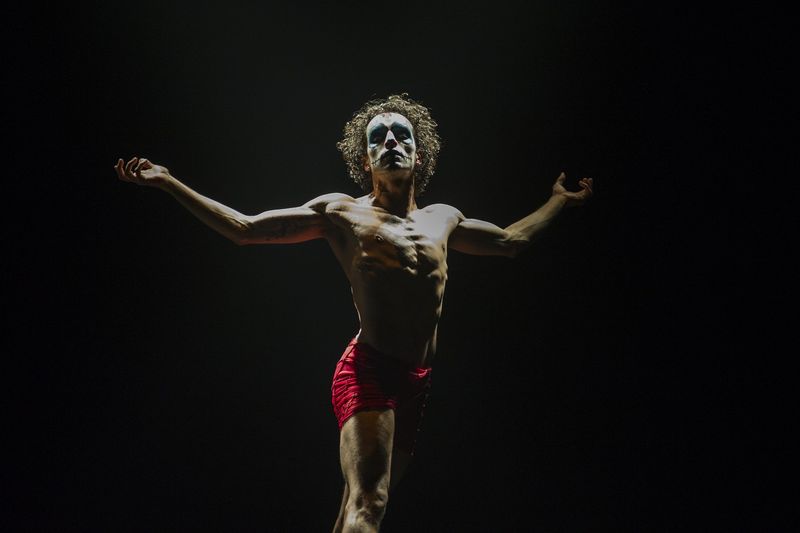
    Light smoke drifts across the landscape as Mario Ismael Espinoza (above, in a Paula Lobo photo) appears in a sleek blood-red leotard, with his face painted deathly white, lips sewn shut: a living corpse. Mario, one of New York’s most alluring dance personalities, moves thru the community – an unseen spectre. His dancing has a remote beauty and mystique so perfectly suited to this role.

    There is a pas de trois for Mario, Vanessa Valecillos, and Jamal Rashann Callender and then a solo for Mario danced in silence. This is interrupted by the ringing of a telephone – a message from the other side? – which the boys attempt to shush. In a passionate duet, Min-Tzu Li and Christopher Bloom display lyrical physicality. Then the six women appear, topless but discreet, as Mario moves subtly among them. The ballet ends with a stylied ensemble for the entire Company; as the dancers withdraw, Mario stands in a pool of shining light as if ascending to heaven. A brilliant piece, and a real tour de force for Mr. Espinoza.

    Sombrerisimo 7 (c) Paula Lobo-1

    Above, from SOMBRERISIMO, photo by Paula Lobo

    Last season’s hit, SOMBRERISIMO, returned in triumph to The Joyce stage. Choreographer Anabelle Lopez Ochoa, using a collage of music that veers from propulsive to sensuous, evokes Magritte’s bowler-hatted men in this vastly pleasing ballet; and again the costumes (Ms. Ruettiger) and lighting (Mr. Preston) show off both the dancers and the dance to perfection.

    Six men – Christopher Bloom, Jamal Rashann Callender, Alexander Duval, Mario Ismael Espinoza, Johan Rivera Mendez, and Marcos Rodriguez – move with vibrant authority thru the sexy, witty ensembles which include some sleight-of-hand passing of the hat and a bit of bowler-Frisbee. The men are jaunty, playful and ironic. Last year Christopher Bloom looked like a rising star, and now he’s shining brightly in the Big Apple’s firmament of dance: a man who moves with a particular energy that keeps our eye on him whenever he’s onstage. Both here and in EL BESO which followed, Chris served notice that he has arrived.

    Ballet Hispanico in fact have a particularly strong contingent of male dancers and in SOMBRERISIMO each man has a chance to shine; the ballet drew a whooping ovation from the packed house as the boys stepped foward for several bows. And now someone needs to make a new and special piece for Hispanico‘s gorgeous women

    Paula_Lobo_BH_EL_Beso-9370

    Above: Ballet Hispanico‘s Kimberly Van Woesik in EL BESO, photo by Paula Lobo

    After watching a studio rehearsal of Gustavo Ramiriez Sansano’s new ballet EL BESO (‘The Kiss’) I was very curious to see how it would look onstage. In contrast to the dazzling colours and stately rhythms of the music (drawn from the enchanting scores of the zarzuela), the setting was much darker than I expected. I had imagined costumes of scarlet and canary yellow, with black lace and golden filagree, but instead designer Angel Sanchez has put the dancers in rather utilitarian outfits of black and dark blue. The stage lighting could be just a notch brighter so that the subtle interplay of the dancers and their many kisses becomes clearer. Some of the intimacy of the work has been lost in the move from studio to stage.

    Once I adjusted to the unexpected black-and-blue setting, there was much to enjoy in this piece, for the choreography has wit and sparkle. EL BESO opens with Johan Rivera Mendez alone onstage, looking a bit shy. He is soon the object of Kimberly Van Woesik’s flirtatious affection. The ballet goes on to explore many variations of relationships and many varieties of kissing, including a passionate smooch for two men (Mssers. Bloom and Callender). A big unison ensemble heralds the finale, but at the last moment everyone rushes away leaving Mr. Mendez alone onstage as at the start.