Tag: Tuesday February

  • Mendelssohn Evening @ CMS

    F m

    Above: Felix Mendelssohn

    ~ Author: Oberon

    Tuesday February 25th, 2025 – Chamber Music Society of Lincoln Center offering an all-Mendelssohn evening featuring a de luxe ensemble of musicians: pianist Anne-Marie McDermott, violinist Arnaud Sussmann, cellist Nicholas Canellakis, and the Escher Quartet.

    This concert was a much-needed lift of my spirits after weeks of unbearably frigid weather and a weekend of unsettling health issues. Just setting foot in Alice Tully Hall made me feel better; and then the music – and the musicians – provided just the right antidote to my malaise. By the end of the program, I was thoroughly rejuvenated. 

    20250225_CMS_Mendelssohn_DressRehearsal__Preview_045

    Mr. Canellakis and Ms. McDermott (above photo by Da Ping Luo) opened the program with the Sonata No. 1 in B-flat major, Op. 45. The sonata’s Allegro vivace commences with a unison passage; a rolling melody emerges, in which he cello’s lower range is explored. Moving into minor mode, the music becomes insistent. Arpeggios from the Canellakis cello turn into long tones sustained over a roaming piano. The music turns passionate, then grand, leading to a brisk finish full of Ms. McDermott’s marvelous playing.

    The winsome piano introduction to the Andante signals the appearance of a familiar theme. Nick’s melodious cello sings over elegant passages from the Steinway; Ms. McDermott then plays a delicate dance accompanied by plucked cello figurations. An increase of passion lasts only moments; the piano resumes its lightness and the music fades away.

    The concluding Allegro assai brings a flow of melody; things get more animated, sweeping forward with lyrical, haunting passages. An energetic ending looms, but Mendelssohn instead provides a peace-filled finish. 

    20250225_CMS_Mendelssohn_DressRehearsal__Preview_063

    Above, the Escher Quartet: Adam Barnett-Hart, Brendan Speltz, Brook Speltz, Pierre Lapointe; photo by Da Ping Luo

    The Eschers then took the stage for the Quartet in F-minor for Strings, Op. 80.

    Fanny Mendelssohn, Felix Mendelssohn’s beloved older sister, had died unexpectedly at the age of 41 in May of 1847. Felix, devastated, was unable to attend the funeral; he went to Switzerland to recover. There, he hiked and painted, and forced himself to compose, managing to compete his F-minor quartet. It would be one of his last completed works; he died on  November 4th at the age of 38.

    The Allegro vivace assai has an agitated feel: fast, fantastical music with sentimental pauses woven in. The Eschers’ trademark blend is at its most persuasive, viola and cello emerging with darker hues. Classic harmonies abound, and then the foursome become speed demons.

    Unison passages open the familiar Scherzo; while energetic, the music abounds in subtleties that hint at deeper underlying thoughts. Viola and cello sing in unison before the scherzo reaches what seems like a delicate finish, only to be extended by a sort of coda.

    Anguish overtakes the mood in the Adagio as Brook Speltz’s velvety cello sings a poignant melody. This is music full of longing. Themes are passed about, each of the four voices distinctively expressive. The quartet’s dynamic range is lovingly in evidence. Almost unbearably beautiful harmonies are set forth, with violist Pierre Lapointe in a lamenting passage before before Adam Barnett-Hart’s violin makes a final, poignant ascent.

    The minor mode feels ominous as the finale commences. The insistent cello carries the musicians to fresh themes, with shifts from major to minor seeming to evoke Mendelssohn’s struggle with his emotions in his mourning state. Mr. Barnett-Hart’s marvelous artistry shines in the work’s concluding measures. The Eschers, ever immaculate in their music-making, were warmly hailed by the packed house.

    Following the interval, the Eschers re-appeared for an Andante and Scherzo culled from Four Pieces for String Quartet, Op. 81, opening with an Andante sostenuto filled with courtly elegance. Mr. Lapointe savors a solo viola melody, and then things speed up. Sweet violin phrases are met by animation from the cello. Mr. Barnett-Hart’s cadenza leads to a da capo, and the music comes to a pretty finish.

    Next on offer was more music from Opus 81: a Scherzo in Midsummer Night’s Dream mode which introduces duetting from Mr. Barnett-Hart and his fellow violinist, Brendan Speltz. This is witty and wonderful music, thoroughly captivating.
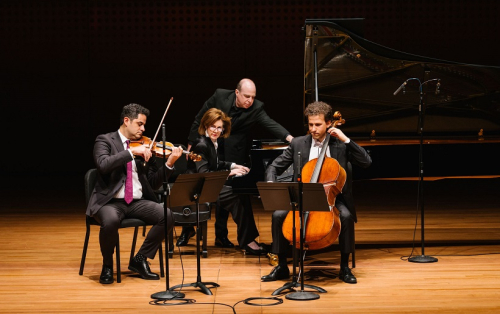
    20250225_CMS_Mendelssohn_DressRehearsal__Preview_006

    Above: Arnaud Sussmann, Anne-Marie McDermott, and Nick Canellakis; photo by Da Ping Luo

    To conclude the evening, the Trio No. 2 in C-minor for piano, violin, and cello, Op. 66, was given a thrilling rendering by Ms. McDermott, joined by violinist Arnaud Sussmann and Mr. Canellakis.

    Rolling piano motifs and restless strings open the main theme of the first movement, in which melodious themes are passed among the three musicians. Ms. McDermott, in some of the most amazing playing I have ever heard from her, set forth cascading keyboard passages – filled with both passion and subtlety – to dazzling effect. The Canellakis cello has a tender melody, taken up by the Sussmann violin, with magical support from Ms. McDermott; her playing was epic, and the trio swept onward with interwoven harmonies from the gentlemen. Bravi, bravi, bravi!!

    The gentle Andante espressivo, with its nostalgic piano introduction, becomes waltz-like as the strings join lovingly. Piano interludes enchant; Mr. Canellakis delights with his poetic playing, while the sheer perfection of Mr. Sussmann’s artistry creates a simply gorgeous atmosphere in which we can linger and dream. Passion rises, only to settle into bliss. 

    Next, music that shows us why Mendelssohn is the King of the Scherzo…it’s swift and sure, the playing dazzling. The musicians seemed to be having a blast here.

    The cello, and then violin, set the mood of the concluding Allegro appassionato…and passion is indeed the byword here. Bending minor-key themes are intriguing; Ms. McDemott is simply sensational at every moment. Crazy fun! But then a reverential interlude suddenly emerges, Mr. Sussmann’s violin singing sweetly over the piano accompaniment. This introspection gives way to thrilling build-up of emotion, with Ms. McDemott’s keyboard on the verge of bursting into flame.

    As the last note sounded, the audience rose to salute the players with a roaring ovation that brought them forth for a second bow, much to everyone’s delight. I literally felt reborn. 

    ~ Oberon

  • CARMINA BURANA @ Carnegie Hall

    Carl-orff

    Above: composer Carl Orff

    ~ Author: Oberon

    Tuesday February 27th, 2024 – This evening at Carnegie Hall, the Orchestra of St Luke’s presented Carl Orff’s CARMINA BURANA. The performance was conducted by Tito Muñoz, with soloists Ying Fang (soprano) Nicholas Phan (tenor), and Norman Garrett (baritone), and the Westminster Symphonic Choir (James Jordan, Director) and the Young People’s Chorus of New York City (Francisco J. Núñez, Artistic Director).

    What an exhilarating evening! The Carnegie stage was jam-packed with music-makers, and they brought the amazing score vividly to life. There is never a dull moment in CARMINA BURANA; every bar of music engages us. Maestro Muñoz had the massed forces under fingertip control, and by keeping his arms poised in the air between the work’s individual movements, he held applause at bay…until the end, when an ovation of tsunami proportions swept thru the venerable Hall, everyone on their feet and cheering with delight.

    The choral singing was truly impressive, ever-alert to the shifting rhythms and the swirls of words. Their dynamic range is vast, down to near whispers at times, and then going full-tilt in the lusty Tavern Song. Likewise, Orff’s keenly judged orchestration was given in its full glory: rich, sweeping strings, clear and enticing winds (a special cheer for the flutes), and the percussionists, who are busy all evening with an array of instruments that includes chimes and castanets. The sounds of piano and celesta add magic to Orff”s imaginative scoring.

    The work is divided into 25 relatively short sections, many of which are assigned to the chorus. There are three solo vocalists; the first to be heard was baritone Norman Garrett, a tall gentleman with an intriguing timbre. He was especially impressive in the Cour d’amours section, where the vocal line took him from falsetto to bass-like depths, and where a high-lying song displayed his lyrical powers. He looked very dapper in his tux.

    By contrast, tenor Nicholas Phan wore an appropriately white nightclub suit in his role of a Roasted Swan. His treacherous aria, which lingers in a super-high tessitura, was cunningly managed, and his droll facial expressions conveyed the bird’s torment.  

    That ravishing soprano, Ying Fang, was the crowning glory of the evening. Clad in an unusual white frock trimmed in black, the soprano’s crystalline purity of timbre was magically projected into the great Hall. She lingered on uncannily sustained pianissimi that hung on the air like an alluring perfume. And on the sensual heights heights of the Dulcissime, Ying Fang’s voice shimmered with an intoxicating glow.

    ~ Oberon

  • Accordion & Saxophone @ The Morgan Library

    Yca

    Above: Steven Banks and Hanzhi Wang

    Tuesday February 22nd 2023 – Young Concert Artists presenting a noontime concert at The Morgan Library featuring the unusual combination of accordion and saxophone. The players – Hanzhi Wang (accordion) and Steven Banks (saxophone) – have both previously appeared at The Morgan in solo recitals; they are brilliant, unique artists, and I was eager to hear them live again. But the afternoon did not turn out as planned.

    We settled into our seats, but after a few minutes we were shivering. We put our coats back on, but the damp chill was pervasive. Looking around, it seemed that everyone in the audience was bundled up, and I was recalling an evening many years ago when the young Frederica von Stade gave a recital in a frigid hall in Syracuse, NY, where the maintenance staff had inadvertently shut off the heat; luckily, someone located a small space heater which was set up onstage to keep the singer somewhat warm.

    This afternoon’s musicians took the stage, Mr. Banks towering over the petite Ms. Wang. They launched their program with an arrangement of Handel’s Recorder sonata in G-minor, HWV 360; it took a moment to adjust to the brighter sound of the saxophone in music we are accustomed to hearing played with the softer timbre of the recorder, but Mr. Banks immediately scaled back his dynamic palette, bringing delicious subtleties to the music. Meanwhile Ms. Wang, looking so lovely in her pleated white frock, transformed her accordion into a compact organ, playing with such cordial tone and bending the phrases with consummate skill. As he music veered from courtly to festive, the players were wonderfully in sync and so attentive to one another, making for a musical treat.

    Three miniatures by Krzysztof Penderecki – the great and sorely missed Polish master-composer – were so fascinating to hear. The first, Allegro, is weirdly spastic; it seems to reach its quirky end in a matter of seconds, with the players wryly relishing the innate humour of the piece. A dark and doleful Andante cantabile followed, the timbres of the two instruments blending to perfection. The concluding Allegro ma non troppo is a bouncy dance, polished off zestfully by Ms. Wang and Mr. Banks.

    Now Ms. Wang offered excerpts from Bach’s Goldberg Variations: the very familiar Aria, played with great depth of feeling, followed by four variations which called for all manner of fanciful fiorature, dispatched with effortless grace and polish by this remarkable virtuoso.

    Virtuosity continued in abundance as Ms. Wang gave us two works by Martin Lohse: Autumn Rain, with its dotty raindrops sparklingly defined, and the more somber Winter’s Tale, in which gentle snowflakes drift down on an overcast wintry afternoon. Ms. Wang’s incredible dexterity was simply mind-boggling to observe, her fingers flying nimbly over the keys as she spun out the music, much to our delight.

    But we were now chilled to the bone, and we silently agreed that we needed to leave and seek some warmth. We slipped up the stairs as the stage was being set for the next piece, and a few other audience members followed us out. I was sorry to miss Mr. Banks’s set, and the anticipated Astor Piazzolla finale.

    ~ Oberon

  • Accordion & Saxophone @ The Morgan Library

    Yca

    Above: Steven Banks and Hanzhi Wang

    Tuesday February 22nd 2023 – Young Concert Artists presenting a noontime concert at The Morgan Library featuring the unusual combination of accordion and saxophone. The players – Hanzhi Wang (accordion) and Steven Banks (saxophone) – have both previously appeared at The Morgan in solo recitals; they are brilliant, unique artists, and I was eager to hear them live again. But the afternoon did not turn out as planned.

    We settled into our seats, but after a few minutes we were shivering. We put our coats back on, but the damp chill was pervasive. Looking around, it seemed that everyone in the audience was bundled up, and I was recalling an evening many years ago when the young Frederica von Stade gave a recital in a frigid hall in Syracuse, NY, where the maintenance staff had inadvertently shut off the heat; luckily, someone located a small space heater which was set up onstage to keep the singer somewhat warm.

    This afternoon’s musicians took the stage, Mr. Banks towering over the petite Ms. Wang. They launched their program with an arrangement of Handel’s Recorder sonata in G-minor, HWV 360; it took a moment to adjust to the brighter sound of the saxophone in music we are accustomed to hearing played with the softer timbre of the recorder, but Mr. Banks immediately scaled back his dynamic palette, bringing delicious subtleties to the music. Meanwhile Ms. Wang, looking so lovely in her pleated white frock, transformed her accordion into a compact organ, playing with such cordial tone and bending the phrases with consummate skill. As he music veered from courtly to festive, the players were wonderfully in sync and so attentive to one another, making for a musical treat.

    Three miniatures by Krzysztof Penderecki – the great and sorely missed Polish master-composer – were so fascinating to hear. The first, Allegro, is weirdly spastic; it seems to reach its quirky end in a matter of seconds, with the players wryly relishing the innate humour of the piece. A dark and doleful Andante cantabile followed, the timbres of the two instruments blending to perfection. The concluding Allegro ma non troppo is a bouncy dance, polished off zestfully by Ms. Wang and Mr. Banks.

    Now Ms. Wang offered excerpts from Bach’s Goldberg Variations: the very familiar Aria, played with great depth of feeling, followed by four variations which called for all manner of fanciful fiorature, dispatched with effortless grace and polish by this remarkable virtuoso.

    Virtuosity continued in abundance as Ms. Wang gave us two works by Martin Lohse: Autumn Rain, with its dotty raindrops sparklingly defined, and the more somber Winter’s Tale, in which gentle snowflakes drift down on an overcast wintry afternoon. Ms. Wang’s incredible dexterity was simply mind-boggling to observe, her fingers flying nimbly over the keys as she spun out the music, much to our delight.

    But we were now chilled to the bone, and we silently agreed that we needed to leave and seek some warmth. We slipped up the stairs as the stage was being set for the next piece, and a few other audience members followed us out. I was sorry to miss Mr. Banks’s set, and the anticipated Astor Piazzolla finale.

    ~ Oberon

  • Ensemble Connect @ Weill Hall

    Connect = Photo-Credit-Fadi-Kheir jpg

    Above: the artists of Ensemble Connect; photo by Fadi Kheir

    Author: Oberon

    Tuesday February 21st 2023 – Ensemble Connect offering a wide-ranging program at Weill Hall this evening, opening with Jennifer Higdon’s Dark Wood, a work for bassoon and piano trio. Nik Hooks, the Ensemble’s excellent bassoonist, kicked off his busy evening here (he played in three of the four works); for the Higdon, he was joined by pianist Joanne Kang, cellist Laura Andrade, and guest violinist Stephanie Zyzak. The piece’s title refers to the lustrous, deep-dark polish of the bassoon. 

    Dark Wood opens with staccati for the bassoon and piano; the plucking violin and cello soon join. The music is jagged, buzzing with trills and big accents, full of nervous energy. A prolonged note for bassoon launches a sprightly, animated passage; then the piano begins to rumble, the bassoon and cello playing deep. Another long, dark bassoon tone leads to slithering strings and a pulsing piano motif.

    CH11325029

    Above: bassoonist Nik Hooks; performance photo by Fadi Kheir

    The violin and cello sigh, and things turn dreamy. Dotty violin notes sound over a wistful bassoon melody and then the cello offers a rich theme; this is all quite beautiful to hear. Things perk up, with the bassoon trilling and the strings sizzling, and then Ms. Kang at the keyboard takes over, with big playing, agitated and insistent. Heartfelt strings and a forlorn song for bassoon and piano follow; Ms. Kang offers plucked notes with a “prepared piano” sound, the others playing poignantly. Now the music rushes forward, somewhat chaotically, to a brisk finish.

    Ms. Kang and Mr. Hooks were soon back onstage for Mozart’s delightful Quintet for Piano and Winds in E-flat Major, K. 452, joined by three more of the Ensemble Connect’s brilliant wind players: Amir Farsi (flute), Jasmina Spiegelberg (clarinet), and Cort Roberts (horn).

    Mozart apparently thought highly of this piece, and he would doubtless have loved this evening’s performance of it. It opens rather hesitantly; Mr. Roberts plushy, golden tone immediately grabbed me,  frustrated high-school horn player that I am. The blend of wind voices was sonorous, and after the piano introduces a new and more animated theme, it is passed about from instrument to instrument.

    CH11325032

    Above: Cort Roberts (horn) and Jasmina Spiegeberg, clarinetist; performance photo by Fadi Kheir

    The Larghetto brings us a gracious, courtly melody, with Ms. Spiegelberg’s lambent tone and persuasive phrasing leading the way; flute, horn, and bassoon take up the line in succession. A bel canto atmosphere  develops, with the piano offering accentuations; Mr. Roberts’ horn cavatina is so stylish, with the others harmonizing expressively.

    The final Rondo/Allegretto rolls along, each player showing a vibrant sense of virtuosity: a sustained flute trill from Mr. Farsi was but one of many decorative delights.

    Wiancko

    Above: composer Michi Wiancko

    Michi Wiancko’s 7 Kinships, a Carnegie Hall commission, was having its New York premiere this evening. The composer charmingly introduced the work; she spoke of how 7ths and 9ths express a feeling of longing. I could not agree more.

    CH11325030

    Above: The evening’s wind players – Mssrs. Farsi, Hooks, and Roberts, and Ms. Spiegelberg – giving a sterling performance of the Wiancho; performance photo by Fadi Kheir

    In the work’s seven brief movements, Ms. Wiancho’s thoughtful craftsmanship gave the players ample opportunity to revel in their artistry. The music ranges from lyrical to animated, with moods veering from  whimsical to lamenting. The sounds of the instruments entwine to delight the ear, sometimes in strange harmonies, whilst rhythmically the composer displays touches of wit. The musicians seemed to genuinely enjoy playing this music.

    Before commencing the program’s final work, Robert Schumann’s Piano Quintet, violist Halam Kim read one of the composer’s letters to his beloved Clara; I admit this outpouring of love brought tears to my eyes. And then to recall that it was Clara who played the quintet’s demanding piano part at the work’s public premiere, making it all the more touching.

    CH11325026

    Above, playing the Schumann: Mr. Rengel, with Mlles. Zyzak, kang, Andrade, and Kim; photo by Fadi Kheir

    The Ensemble Connect’s marvelous violinist, Rubén Rengel, led the ensemble, with Ms. Kang honoring Clara Schumann with her delectable playing, and Mlles. Zyzak, Kim, and Andrade all sounding gorgeous.

    This beloved work is bursting with magical passages: the ‘dialogue’ for cello and viola in the opening movement, a theme to which Mozart frequently returns, is especially endearing, and in the dirge-like second movement, Mr. Rengel ‘s playing is exceptional. Mlles. Zyzak and Kim take ups this calmly funereal theme, and Ms. Abdrade’s sumptuous tone is ever at the heart of the matter.

    In the bustling Scherzo, Mr. Rengel is again in his element, and Ms. Kang has much to do, her rising scales setting the scene for a fast dance, her music-making on the grand scale. It is Ms. Kang who initiates the final Allegro ma non troppo with her scintillating playing. A hymn-like interlude arises, and then low rumblings from the piano develop into a slow sway; this then accelerates, dancing us on to the finish.

    All performance photos by Fadi Kheir, courtesy of Carnegie Hall.

    ~ Oberon

  • L-E-V @ The Joyce

    L-e-v

    Tuesday February 22nd, 2022 – The Brutal Journey of the Heart, the final installment of a trilogy on love by choreographer Sharon Eyal, opened this evening at The Joyce, performed by L-E-V. With a score by Ori Lichtik, costumes by Dior creative director Maria Grazia Chiuri, and superb lighting by Alon Cohen, this dancework  explores the ways we heal from wounds of the heart. As an oft-wounded romantic living in an unromantic world, I have had much experience with these healing processes. And – I am  sorry to have to admit – I have also thoughtlessly inflicted such wounds on people who deserved better. And so, I expected The Brutal Journey of the Heart to speak to me with poignant clarity; what it ended up doing was make me want to go out dancing.

    At curtain rise, a solitary woman on the dramatically lit stage begins to move to a fascinating beat. She is soon joined by her five colleagues who show off witty ways of walking, and pausing to pose. The movement is inventive and everything feels wonderfully fresh and vivid. As one alluring song melds into another, the urge to dance is increasingly difficult to suppress. After about fifteen minutes, though, one begins to wonder what comes next: a change of lighting? Maybe a pas de deux, something slow and heart-achy?

    But, no: the dancers simply draw into a cluster, swaying and writhing in place while their arms and hands weave stylized gestures. Then they spread out again and repeat passages from earlier in the piece. Meanwhile, the music is pretty much relentless, and a feeling of ‘too much of a good thing’ starts to creep in. A male duet and a female solo are briefly eye-catching, but the ensemble keeps giving us recycled moves; it begins to feel like we’re in the purgatory of lost love.

    Maybe this is the brutal thing about the journey of the heart: it never really ends, and there’s no redemption to be found. The dancers continue on to a false ending, and though it seems that the woman who opened the performance alone onstage has now found some kind of peace, we don’t really know how, beyond the notion that dance is wonderfully therapeutic, especially to this music.

    Despite a sense of aimlessness at times, the evening was very much worthwhile for the excellence of the dancing, the atmospheric lighting, and most of all for the score.

    The dancers – Clyde Emmanuel Archer, Keren Lurie Pardes, Darren Devaney, Guido Dutilh, Dana Pajarillaga, and Edit Domoszlai – were hailed at the end with a whooping standing ovation, which they truly deserved.

    ~ Oberon

  • Young Concert Artists: Zlatomir Fung

    Fung_Zlatomir5CreditMattDine-1140x642

    Above: cellist Zlatomir Fung, in a Matt Dine photo

    ~ Author: Oberon

    Tuesday February 19th, 2019 – Young Concert Artists presenting cellist Zlatiomir Fung in his New York debut recital at Merkin Hall. Tengku Irfan was the pianist for this wide-ranging, thrillingly-played program.

    “Young” was the operative word tonight. And both of these musicians disprove the old adage that ‘youth is wasted on the young’; they have spent their teen years developing their talent, and building impressive performance résumés. Now they are ready for anything.

    Mr. Fung, a native of Oregon, reveals a charming personality in this Q & A from the Violin Channel. Of Bulgarian and Chinese heritage, the earnest 19-year-old cellist was greeted by enthusiastic cheers from the packed house when he walked onstage at Merkin Hall tonight. In the course of his opening work – four of the Eleven Capricci for Solo Cello by Joseph Dall’Abaco – Zlatomir Fung established himself as both a poet and virtuoso of the highest order.

    These Dall’Abaco works are a very pleasant alternatives to the Bach cello suites with which cellists so often open their recital programs. Mr. Fung displayed clean, warmly resonant tone, a gift for dynamic finesse, and a depth of feeling that seemed remarkable in one so young. In the first Capriccio, trills and grace notes were deftly etched into the musical line. To end his set of four, Mr. Fung chose the 11th, which includes passages of demented agitato, played with great fervor. As applause engulfed the cellist, he took a spot among my top five players of the instrument…or maybe even…my top three? 

    Pianist Tengku Irfan – slender of frame and looking far younger than his score of years – then joined Mr. Fung for a revelatory performance of Enest Bloch’s Baal Shem. This music was new to me; the passion and tenderness with which the two artists played it made a direct connection to my soul.

    Ernest Bloch, a native of Switzerland, was a young violinist on tour in the USA when, falling short of money, he got stranded in New York City and decided to stay here. Moved by a Hasidic Jewish service he attended in 1919, Bloch wrote the Baal Shem, subtitled “Three Pictures of Hasidic Life.

    During the opening Vidui, I was so mesmerized by the playing of Mssrs. Fung and Tengku that I couldn’t write even the briefest note about the music; all I can say is that it moved me deeply – both the music itself and the playing of it. The piano introduction to the ensuing Nigun – masterfully played by Irfan Tengku – leads to music-making of searing intensity from both players. A series of descending trills for the cello took my breath away. In a complete mood swing, the concluding Simchas Torah has a very optimistic feel: an almost romantic-style passage leads to dancing and ultimately to passion. With a tumult of cheers and applause, the audience saluted the two musicians after this spell-binding performance. 

    In a remarkable display of what a cello can do, Mr. Fung gave a triumphant performance of Luciano Berio’s Sequenza. From his opening tapping, patting, and slapping of his cello, Mr. Fung creates all manner of sound effects – shivering, squeaking, barking, scratching, gliding – as the piece proceeds. Mixed in are brief touches of whispered pianissississimo, including an ultra-quiet ending. This bravura showcase knocked the audience for a loop; Mr. Fung took a bow amid a din of enthusiasm.

    Following the interval, the pianist and cellist gave the premiere performance of Prelude by Katherine Balch, the current YCA Composer-in-Residence. This was my second hearing of music by Ms. Balch, and again it struck me as finely-crafted music from a composer who has perhaps not yet found her own distinctive voice.

    From a turbulent start, we go on a magical mystery tour and – via some strong accents – to noisy music that works both players into a frenzy. The gimmick of having the pianist reach inside the piano to produce isolated sounds has been done before – I never get the point of it – but a mad cello cadenza gives the piece a spark. An amusing sour taste sets in as some intentionally ambivalent pitches crop up. Drifting onward, Prelude leads without pause into the evening’s final work: the Brahms Cello Sonata in E-minor, Opus 38.

    TengkuIrfanpianolad001_1533856206

    Above: pianist Tengku Irfan, photo by Owee Ah Chun

    In the Brahms, the partnership of cellist and pianist showed yet again how finely matched these two musicians are. It’s a bit of an odd sonata, in that there’s really not a ‘slow’ movement per se. But the opening Allegro non troppo (actually very ‘non troppo’) makes up for it: it has a darkish glow with a poignant, wistful melodic line. The pianist here was a marvel, and Mr. Fung summoned incredible depth of tone from his cello. The second movement is a Menuetto that sometimes teasingly has the air of a waltz; the musicians play at times in unison. Mr. Tengku had the Steinway in full flourish for the concluding Allegro, and Mr. Fung sealed his New York debut triumph with spectacular playing.

    As an encore, these two young artists offered a luminous rendering of Gabriel Fauré’s “Après un rêve“. The sheer enthralling beauty of their playing held the audience in a state of breathless awe.

    ~ Oberon

  • Through The Great War @ CMS

    Ww I

    ~ Author: Oberon

    Tuesday February 20th, 2018 – When I was in school, The Great War was rather glossed over by my history teachers; they always seemed to focus on World War II, which had ended just two decades before I graduated from high school. But my sixth grade teacher made us study World War I, which he felt had been a “stupid war” in that it solved nothing in itself but set the stage for Adolf Hitler’s rise. My teacher had served in World War II, and one day he brought in some big picture books which included horrific photos from the liberated concentration camps. This was my introduction to the Holocaust: those images have haunted me ever since as my first encounter with “man’s inhumanity to man”.  My sixth grade teacher teacher eventually committed suicide.

    This article helped me put The Great War in context by relating it to the world situation some 100 years on. For a more personal view of life during the war years, Vera Brittain’s TESTAMENT OF YOUTH – and the deeply moving film based on it – brings the lives (and deaths) of men who served and the women who waited for them vividly to life. 

    The glory and horror of wars thru the centuries have inspired works in all forms of literature and art, from poems to operas to paintings and architectural monuments. Wartime has given rise to great music, much of it painfully beautiful. It was just such music that we heard tonight at Alice Tully Hall as Chamber Music Society of Lincoln Center presented works by Hungarian, French, and English composers written during the time of the Great War. 

    ErnőDohnányi1905

    Above: composer Ernő Dohnányi

    The evening opened with Ernő Dohnányi’s Quintet No. 2 in E-flat minor for Piano, Two Violins, Viola, and Cello, Op. 26 (1914). I admit to being unfamiliar with this composer’s music, but after hearing this sumptuously-played quintet tonight, I agree completely with violinist Alexander Sitkovetsky’s remark in his program note that Dohnányi is seriously underrated. The composer, who passed away in 1960, left a sizeable catalog of works – from operas, symphonies, and concerti to chamber and solo piano pieces. Hopefully the enthusiastic reception of the quintet tonight will prompt the Society to program more of the Hungarian composer’s music in future.

    Mr. Sitkovetsky was joined for this evening’s performance by fellow violinist Cho-Liang Lin, violist Paul Neubauer, cellist Keith Robinson, with Orion Weiss at the Steinway. 

    From its doleful – almost chantlike – opening, the Allegro non troppo moves on the pulsing of Mr. Lin’s violin to an anticipatory piano theme, in which Mr. Weiss reveled, with the strings in rich harmonies. The piano grows rhaosodic, and Mr. Sitkovetsky takes up a wistful melody, then Mssrs Neubauer and Lin carry it forward. The music elevates to the grand scale, full of passion. Blissful piano music is heard, while the sound of Paul Neubauer’s viola kept breaking my heart. Tenderness and mystery entwine towards a gentle ending.

    The viola inaugurates the Intermezzo with a cordial invitation to dance, the music waltz-like with a Viennese lilt. A sprightly dance pops up, led by brilliantly decorative playing from Mr. Weiss; things turn light and witty. Over rolling waves from the piano, the violin and viola sing again. Pulsing strings lead on to a quiet finish.

    The Finale opens with the lamenting song of Mr. Robinson’s cello; in canon, the viola, violin-2 and -1 fall in. The mood is somber, reflective, with dense harmonies. A reverential theme from Mr. Weiss carries us to a sublime string passage. Thru modulations, we return to the opening canon-theme. A rising tempo means rising passion, which expands only to subside into a reunion with the cello’s theme over misterioso piano. The atmosphere becomes achingly beautiful, with sweet sailing on high from the Sitkovetsky violin. Lush, rhapsodic music tears at the heart. Then comes a gentle, descending motif from the piano as the music evaporates into thin air. Magnificent playing from all, with the enraptured audience savoring every moment.

    Maurice Ravel’s Le Tombeau de Couperin was originally composed for solo piano; the composer orchestrated it in 1920, and it was this version that George Balanchine used for his 1975 ballet Le Tombeau de Couperin which I have seen – and loved – countless times over the years. The music was later arranged by for wind quintet by Mason Jones, using four of the original six piano movements. It was this setting for wind instruments that we heard tonight.

    With these pieces, Ravel honored the memory of six friends he’d lost to the war. But rather than convey feelings of doom or despair, the pieces are by turns charming, noble, and even witty: what wonderful people these six friends must have been to inspire such music.

    Chamber Music Society put together yet another first-class ensemble for these Ravel gems: Sooyun Kim, with her flûte enchantée, Romie De Guise-Langlois (clarinet), James Austin Smith (oboe), Marc Goldberg (bassoon), and Eric Reed (horn). To say that they made beautiful music together would be an understatement.

    The Prelude is wonderfully ‘busy’ music, with swirling motifs from the oboe and silvery piping from the flute. Ms. De Guise-Langlois, who gets such glamorous tone from her clarinet, always delights me – I was so happy to hear her again tonight – and the mellow bassoon and dulcet horn bring more colours to the mix. Birdsong hovers as the Fugue begins, again with the fluent playing of Mssrs. Goldberg and Reed varying from rich to subtle as the music flows along. James Austin Smith’s oboe was gracefully prominent in the Springlike Menuet, the theme taken up by the flute. Near the end, Romie’s clarinet sings as the music concludes on a rather jazzy note, with a bassoon trill. Sooyun Kim’s sparkling flute opens the Rigaudon, with Eric Reed’s horn clear and warm-toned. An interlude brings a sinuous oboe passage with a Mideastern feeling, the bassoon in a downward tread, before a brief resumption of the opening rigaudon tune comes to a quick, witty end.

    Edward Elgar’s Quintet in A minor for Piano, Two Violins, Viola, and Cello, Op. 84, dating from 1918-19, begins hesitantly before weeping violins set a mood, gorgeously sustained by Mr. Robinson’s cello. A lovely slow dance develops a sense of irony from Mr. Lin’s violin. Emerging from a big tutti comes the deep voice of the cello in a descending motif: more marvelous playing from Mr. Robinson. Mr. Weiss sets out big piano statements met by agitated strings as passions arise, subsiding for phrases from viola and violin-2 (Mr. Sitkovetsky). Close harmonies and a long, out-of-the-air cello note herald yet another cello highlight, full of longing. The initial hesitancy of the movement returns before a quiet plucking signals an end.

    There’s nothing quite like an Elgar Adagio, and this one finds Paul Neubauer at his most ravishing in a sustained viola theme of heartrending beauty. Continuing gorgeousness as viola, cello, and Steinway exchange phrases; Mr. Lin’s violin passage is lovely hear. The glorious mix of voices becomes overwhelming: this music goes right thru me, it’s so heartfelt as Mr. Weiss’s intoxicating playing propels it along. Turning bittersweet, and then to a hymn of peace, the vibrant, emotional playing of the five artists made this a deeply moving experience.

    In the concluding Moderato-Allegro, with the developing passion of its opening, there’s a forward impetus. The ebb and flow of dynamics and harmonies is magically sustained by the players, carrying us thru a misterioso moment, a violin duet, a tremelo motif from the viola, and an animated yet poignant passage to sustain our emotional involvement. It’s the piano again that urges the music forward; a great restlessness looms up, and then subsides, only to re-bound to a triumphant yet dignified finish.

    A great night of music-making, in terms of both programming and playing: just what we’ve come to expect from Chamber Music Society

    ~ Oberon

  • Dorothea Röschmann @ Zankel Hall

    Dorothea-Roschmann

    Above: soprano Dorothea Röschmann

    ~ Author: Oberon

    Tuesday February 13th, 2018 – Soprano Dorothea Röschmann in recital at Zankel Hall, with Malcolm Martineau at the piano. This was an evening of music-making of the highest order, for both soprano and pianist are masters of their art, and communicators sans pareil.

    Ms. Röschmann made her Metropolitan Opera debut in 2003 as Susanna in NOZZE DI FIGARO and subsequently performed three more Mozart roles there: Pamina, Ilia, and Donna Elvira. She last sang at The Met in 2008. Elsewhere, of late, she has ventured into heavier repertoire including the roles of the Marschallin and Desdemona. I had not heard her live since the Met IDOMENEO, and was very much hoping I would enjoy this re-connection as much as I did hearing her then. She surpassed my highest hopes.

    What I loved most about Ms. Röschmann’s singing this evening was her fascinating employment of her vibrato as a means of expression. Within a given phrase, she could mete out the vibrancy, hone it down to straight tone, or unfurl it to full dramatic effect; this gave her singing a panoramic emotional range, from vulnerable or pensive to unstinting grandeur. It’s a wonderfully feminine voice, and her diction and her shading of the texts drew us deeply into each song.

    Commencing with Schubert, the soprano’s vibrato in “Heiss mich nicht reden” as the very first seemed a bit  prominent; yet by mid-song, Ms. Röschmann’s intuitive manipulation of it was already making its effect. “So lasst mich scheinen” with its gentle start, was lovingly sung. Mr. Martineau’s introduction to “Nur wer die Sehnsucht kennt” set the mood for Ms. Röschmann’s singing: so poignant, with the passing anxiety at separation from her beloved fading back to melancholy. The familiar “Kennst du das Land” was magnificent in every way, expressive of the poem’s varying moods, with delicious lower notes and the words so clear and finely-coloured; and Mr. Martineau here was divine.
     
    Singer and pianist left the stage briefly before returning for the final Schubert, “Nachtstück“. This night-song, sung by an old man wandering the woods as Death hovers about him, took on an operatic aspect with Mr. Martineau’s atmospheric playing of the introduction, and the sense of mystery in the soprano’s haunting – and then expansive – singing. The piano evokes the sound of the old man’s harp as the song winds thru major/minor modulations: such moving music to experience.
     
    1024
    Above: pianist Malcolm Martineau, photographed by Thomas Oliemans 
     
    In Mahler’s Rückert Lieder, Ms. Röschmann’s gifts as a storyteller were abundantly evident. From the playful “Blicke mir nicht in die Lieder” and the gently magical, Springlike joy of “Ich atmet’ einen linden Durftt“, with Mr. Martineau’s sweet postlude, soprano and pianist moved to the drama of “Um mitternacht“. This was  profoundly delivered, Ms. Röschmann summoning rich tone for a great outpouring of sound, all the while keeping us under her spell with varying degrees of vibrato; Mr. Martineau’s playing matched the singing in all its glory.
     
    In “Liebst Du Um Schönheit“, the soprano chose to linger slightly from time to time, giving the song a delicious individuality of expression. Then, with the final Mahler, “Ich bin der Welt abhanden gekommen“, the intrinsic and somewhat unusual beauty of Ms. Röschmann’s voice made this beloved, meaningful poem utterly personal. A touch of lightness here and there was enchanting, her singing so thoughtful and womanly. The end of this song can sometimes be shaded with resignation, but in Ms. Röschmann’s moving singing of the final lines, we instead feel her sense of deep contentment. Mr. Martineau beautifully sustained the poetry with his transportive playing of the postlude.   
     
    The second half of the program was given over to songs with words written by women. Robert Schumann’s Gedichte der Königin Maria Stuart, Op. 135. are settings to texts drawn from the letters of Mary, Queen of Scots, written at significant points in her tragic life. Presage of disaster seems a constant force in the Queen’s story, right from her birth. In these Schumann settings, we move from a wistful farewell to France and a hopeful prayer marking the birth of her son, to a dramatic letter Mary wrote to her cousin, Elizabeth I – the cousin who would eventually betray Mary Stuart to her death. This very dramatic song was vividly rendered by Ms. Röschmann and Mr. Martineau, who then progressed to the scene of Mary’s impending execution: in “Abschied von der Welt” – the Queen’s farewell to the world – the pianist’s colourings of reflection and resignation were ideal. The final “Gebet” is a prayer for her own soul: eighteen years a prisoner, Mary Stuart is at last set free by Death. Ms. Röschmann really lived these songs, so deeply that in the end she truly seemed in a trance.       
     
    To hear Ms. Röschmann and Mr. Martineau performing Richard Wagner’s Wesendonck Lieder was an experience to cherish. At a point in time when the Metropolitan Opera seems to be so stinting with their Wagner offerings (only PARSIFAL this season), we are always eager to hear the Master’s music where- and when-ever possible.
     
    Just now I am reading Judith Cabaud’s lovely/sad biography of Mathilde Wesendonck, the beautiful young poetess whose relationship with Wagner – whether physical or spiritual – hastened the demise of the composer’s first marriage and, in a way, set the stage for Wagner’s finding his soulmate in Cosima Von Bülow.
     
    Whilst Wagner was living in a small house on the Wesendonck’s Swiss estate, the lives of the composer and Fray Wesendonck became entwined. Mathilde was the inspiration for TRISTAN UND ISOLDE; each day, Wagner would send her a page or two of this opera which he was writing with such feverish diligence. This inspired Mathilde to write a series of poems, which she sent to Wagner, one by one, and which he instantaneously set to music. Then one day, a note from Wagner to his muse was intercepted by Minna Wagner’s servant and that was the beginning of the end – of both the Wagners’ marriage and of his living as the Herr Wesendonck’s guest.
     
    And so we are left with this set of five songs, so marvelously moving in their atmosphere of romantic longing. They were eventually orchestrated, and that is how they are most often heard these days. But my very first exposure to the Wesendonck Lieder came in 1970 when I attended a recital by Dame Janet Baker at Syracuse, New York. Martin Isepp was the pianist. It was a performance I’ll never forget, and hearing this music live again tonight had a “full-circle” feeling, nearly fifty years on.  
     
    Ms. Röschmann and Mr. Martineau put us deeply under a Wagnerian spell, commencing with “Der Engel” in which the Röschmann voice entranced with its flickering vibrato, its velvety lower tones, and her expressive power of the poetic. The agitation of “Stehe still!” commenced some sensational playing from Mr. Martineau, and, as the music turned more lyrically yearning, Ms. Röschmann’s singing took on a very personal intimacy, her lower tones having a sensuous smoulder. Mr. Martineau, at the song’s end, was so evocative.
     
    With “Im Triebhaus” we are suddenly borne away to Castle Kareol, the wounded Tristan’s lonely childhood home, where he now awaits his Isolde. The musical introduction to this song was lifted by Wagner directly into the prelude of TRISTAN‘s third act. Here, yet again, the blessings of Ms. Röschmann’s way with words were invaluable. The piano’s harmonic modulations and voice’s gradations of both vibrancy and dynamic created a whole world, with the pianist incredibly poignant. The Röschmann lower notes continued to strike a particularly sensitive spot in my spine, producing tremblings of emotion. And Mr. Martineau’s finishing notes were to die for.
     
    With the passions of “Schmerzen“, Ms. Röschmann’s deeper tones literally tore at the heart, whilst ecstatic playing from Mr. Martineau left the soprano beaming radiantly as the song drew to its close. She lingered in a dreamlike state as the pianist set forth the opening bars of “Träume“. By this point I was breathless, drunk on the sheer beauty of the music, Ms. Röschmann’s heavenly singing, and the tenderness of Mr. Martineau’s playing. Could I not now stay here in their world, in this realm where Wagner and his Mathilde found sanctuary?
     
    My return to reality was blessedly buffered as the deep, very cordial applause of the crowd drew the singer and pianist back for three encores – Liszt, Schumann, and (I believe) Schubert – each lovelier than the last. That we have such music in the world, and such musicians to bring it to us, counts for so much in this day and age.
     
    ~ Oberon

  • Joyous Mendelssohn @ Chamber Music Society

    16729309_10211418741411574_4800437195826780331_n

    In the days leading up to this evening’s concert at Chamber Music Society of Lincoln Center, it was announced that violinist Paul Huang was among the recipients of the 2017 Lincoln Center Awards.   

    Tuesday February 21st, 2017 – In the midst of their season celebrating Mendelssohn, Chamber Music Society of Lincoln Center offer two programs contrasting the joyous and the sorrowful. Today we reveled in the positive, sunny side of chamber music; on Sunday, February 26th, melancholy will prevail.

    The Variations in E-flat major, Op. 44, by Ludwig van Beethoven, is a series of fourteen variations on a theme written for piano, violin and cello. The theme is set forth, plain as day: the musicians play a series of arpeggios at a moderate pace. From thence, the variations proceed in a variety of rhythms, instrumentation, harmony, and embellishment. Orion Weiss (piano), Sean Lee (violin), and Paul Watkins (cello) played deftly, and I greatly enjoyed observing their musical camaraderie and silent communication with one another.

    The evening’s two pianists, Huw Watkins and Orion Weiss, gave us Mendelssohn’s Andante and Allegro brillant for Piano, Four Hands, Op. 92. And “brillant” aptly describes their performance, for they followed up the melodious Andante with a striking virtuoso display in the Allegro. Mr. Watkins took the lower octaves, and Mr. Weiss the upper, but they sometimes invaded each others domain. When things got fast and furious, each player had to lean out of the way to give the other access to the full keyboard in alternating solos. Thus their performance was as appealing to watch as to hear.

    _90769994_prom

    Above: British brothers Huw and Paul Watkins

    Cellist Paul Watkins was joined by his pianist/brother Huw Watkins in a magnificent rendering of Mendelssohn’s Sonata in D-major for Cello and Piano, Op. 58. Their performance was truly engrossing, with the cellist’s soul-reaching depth of tone and the pianist’s perfect blend of elegance and vitality combining for a spell-binding musical experience.

    In the D-major Sonata, Mendelssohn exults in the outer movements, giving the pianist a barrage of arpeggios with which to delight us while the cellist sings felicitous melodic passages.The sonata gets off to a fast start, with a lively pulse; both players bring mellifluous tone which they are able to maintain even in the most rapid phrases. Paul’s cello buzzes while Huw plays melody for a spell; then they seem to reverse roles. The word ‘amazing’ is so over-used these days, but that’s what I wrote as this fabulous Allegro assai vivace carried us along. The playing hones down to great subtlety before re-bounding and sweeping onward.

    The second movement starts with a sprightly piano tune, with the plucking cello commenting, and then humming low. A lovely cello theme leads onto a more boisterous, slightly gritty passage before recurring. This little scherzo ends with a gentle whisper.

    Rhapsodic phrases from the piano herald the Adagio, the heart of the matter. A poignant melody wells up from the cello, Paul Watkins’ glowing tone like a transfusion for the soul. Huw rhapsodizes again, then takes up his own melody over long-sustained tones from the cello. This Adagio seemed all too brief when played so nobly as it was this evening; the brothers then took only the briefest pause before attacking the opening of the final movement.

    In this Molto allegro e vivace, both players flourished in the coloratura passages and in the melodic exchanges that ensue. After a lull, a slithery scale motif from the cello made me think of the moment in Strauss’s ELEKTRA before the murder of Klytemnestra – a far-fetched association to be sure, but there it is. The music ebbs and flows on to the finish, the Watkins brothers rightly hailed with spirited applause for their remarkable performance.

    Orion-WeissB09_credit-Jacob-Blickenstaff

    Mr. Weiss (above, in a Jacob Blickenstaff portrait) returned to the Steinway for Chopin’s Ballade in A-flat major for Piano, Op. 47, a piece long-familiar to me thru its appearance in the Jerome Robbins ballet The Concert. The pianist savoured the music, displaying a vast dynamic spectrum (blissful high pianissimi) and a keen appreciation for the shifting rhythmic patterns. When the music gets grand, Mr. Weiss’s playing is absolutely regal.  

    The Mendelssohn Quintet No. 2 in B-flat major for Two Violins, Two Violas, and Cello, Op. 87, drew together a most impressive string ensemble: Paul Huang and Sean Lee (violins), Paul Neubauer and Matthew Lipman (violas), and Paul Watkins (cello): their performance might be sub-titled ‘The Glory of Mendelssohn‘.

    The players plunged immediately into the music with a vibrant agitato rhythm, from which Paul Huang’s violin soars up to the heavens. Throughout the performance, Mr. Huang’s tone shone with an achingly beautiful polish, his profusion of technique and his uncanny ability to mix refinement and passion in perfect measure defined him an artist of exceptional gifts.

    This ensemble of wonderful musicians created a blend of particular cordiality, and each player took up their solo opportunities with stylish élan. Paul Neubauer’s playing was – as ever – aglow with poetic nuance; Matthew Lipman seconded him handsomely, displaying his trademark love of and commitment to the music, and Sean Lee’s suave phrasing is ever-pleasing to the ear. I found myself wishing that Mendelssohn had given the cello a bit more prominence, simply because I could not get enough of Paul Watkins’s playing.

    The quintet’s Adagio e lento found all the musicians at their most expressive, a reassurance in uncertain times; we so desperately need great music at this point in our lives when the future seems poised on the edge of a knife. With the dedication of such artists as we heard today, the light of hope continues to shine as a testament against the powers of darkness. 

    • Beethoven Variations in E-flat major for Piano, Violin, and Cello, Op. 44 (1804)
    • Mendelssohn Andante and Allegro brillant for Piano, Four Hands, Op. 92 (1841)
    • Mendelssohn Sonata in D major for Cello and Piano, Op. 58 (1843)
    • Chopin Ballade in A-flat major for Piano, Op. 47 (1841)
    • Mendelssohn Quintet No. 2 in B-flat major for Two Violins, Two Violas, and Cello, Op. 87 (1845)