Tag: Tuesday February

  • CAV Without PAG @ The Met

    Mascagni_428

    Above: composer Pietro Mascagni

    Tuesday February 23rd, 2016 – Having looked at photos and video clips of the Met’s current productions of CAV and PAG, I had no desire to see a performance of the famed double bill in such settings. But I do love both operas, and so I opted for a score desk this evening. I knew in advance I would be leaving after CAV. The combination of Barbara Frittoli and Marco Berti in PAG didn’t appeal to me much, and though I would have liked to have heard George Gagnidze’s Prologo, that would have meant enduring a Gelb-intermission. So it was CAV and then a casa, a casa, amici.

    The Met has never felt emptier than it did tonight; I’ve seen some very sparse audiences in the last two or three seasons, but this was really depressing. To be sure, it was a star-less night; and ticket prices are high. But even on middling nights, the ‘affordable’ upper tiers of the House used to be reasonably full. Tonight, only a handful of people were sitting in the Balcony box and Family Circle box sections which are normally fully occupied by hard-core opera lovers. At the end of CAV, there was just barely sufficient applause to get the curtain back up for the bows.

    The reasons for the decline in attendance have been discussed at length on other sites; suffice it to say that The Met seems to be committing a slow suicide, and that no one seems to be doing an intervention.

    Liudmyla Monastyrska sang a good Tosca earlier this season, and it was to hear her Santuzza that I chose to go tonight. Tosca suits her better, or so it seems to me. In Santuzza’s music we are accustomed to an earthier, more chest-resonant sound than Ms. Monastyrska brought to the music of the hapless outcast. But she sang tonight with a fine sense of dynamic variety, and did some really nice lyrical singing in passages like “No, no Turiddu…” in her duet with the tenor and – even more expressively – at “Turiddu mi tolsi…” in the duet with Alfio. Her top notes are bright and house-filling, but with hints of a widening vibrato. In the curse, Ms. Monastyrska was convincing though without the deadly declamatory venom of a Simionato or a Cossotto.

    Brazilian tenor Ricardo Tamura, much maligned last season when he stepped in as Don Carlo for an ailing colleague while himself being under-the-weather, did a reasonable job as Turiddu tonight. He sounded throaty and a bit quavery in the offstage serenade, but once onstage he fared better. The singing is idiomatic, and he kept pace with the soprano in their big duet. Later, as he pleaded with Alfio to consider Santuzza’s fate if he, Turiddu, is killed, Tamura was very persuasive.

    The most idiomatic and vocally satisfying performance tonight came from baritone Ambrogio Maestri; his Alfio has the right vocal swagger and his top notes were full, ripe, and thrilling. My score refers Lola’s little entrance song as “Lola’s Ditty”; Ginger Costa-Jackson did a good job with it, throwing in some nice chesty insinuations along the way as she chided Santuzza. It’s always good to have Jane Bunnell in a cast. I’ve always liked her, and I still do.

    Fabio Luisi’s conducting was the evening’s biggest asset: his pacing was excellent, with an effective build-up to the Easter Hymn, and he refused to over-cook the famous Intermezzo, instead making it a touching musical statement. Throughout the evening, Luisi brought out little nuances in the score that hadn’t previously registered with me, and he maintained an alert balance between voices and orchestra, never swamping his singers.

    Kudos to the Met chorus, who made the Easter Hymn the musical focus of the evening. This great chorale always moves me in its expression of the simple and direct faith of the common folk. Tonight it reminded me yet again of how the great religions have been hi-jacked and politicized in recent years. These days, my own mother’s piety and kind-heartedness would be thought too mushy and weak. I often wonder what she would think of the current situation.     

    Metropolitan Opera House
    February 23rd, 2016

    CAVALLERIA RUSTICANA
    Pietro Mascagni

    Santuzza................Liudmyla Monastryska
    Turiddu.................Ricardo Tamura
    Lola....................Ginger Costa-Jackson
    Alfio...................Ambrogio Maestri
    Mamma Lucia.............Jane Bunnell
    Peasant.................Andrea Coleman

    Conductor...............Fabio Luisi

  • Schubert’s WINTERREISE @ CMS

    Huber-Gerharer

    Above: Gerold Huber and Christian Gerhaher

    Tuesday February 24th, 2014 – Baritone Christian Gerhaher and pianist Gerold Huber performing Schubert’s immortal masterpiece, Winterreise, as part of Chamber Music Society of Lincoln Center‘s Winter Festival, Intimate Expressions. The performance comes to us in the midst of a particularly cold and somber Winter.

    Composed in 1827, when Franz Schubert was 30 years old and had less than two years remaining in his life, the twenty-four songs of Winterreise are set to poems of Wilhelm Müller. The poet, who had earlier provided the texts for the composer’s song cycle, Die schöne Müllerin, was a nearly-exact and equally short-lived contemporary of Schubert. They never met, and Müller died just as Schubert was beginning work on Winterreise.

    Winterreise is not a narrative song cycle, but rather a collection of vocal miniatures on themes of solitude and despair, set against a relentless and unforgiving wintry landscape. Though the subject matter is overall quite gloomy, there is some variety of tempo and rhythm among the songs. But in the final twelve of the Winterreise songs, we experience a feeling of darkness gathering about Schubert, and his sense of impending doom. The last Winterreise songs evoke feelings of great beauty overshadowed by death. The composer died in 1828.

    Tonight’s performance had all the makings of a superb musical experience – which, in fact, it was – yet the overall effect of the cycle was somewhat compromised. In her opening remarks, CMS co-artistic director Wu Han announced that the pianist Gerold Huber was suffering from a heavy cold. He had generously agreed to perform, but we were cautioned that he might be in need of taking a break midway thru the cycle. This was indeed the case; after about a half-hour, pianist and singer walked offstage and the audience took the opportunity to stretch, chat, and check their cellphones. This intrusion of reality broke the spell of the music. When the artists returned, it took a while for the hall to settle in again, and there were further minor disruptions in the second half of the performance, with a corresponding decline in focus.

    Mr. Gerhaher has a wonderful lyric instrument capable of both power and shaded nuance; and yet it was the pianist – Mr. Huber – who most thoroughly entranced me with the subtle delicacy of his playing in the cycle’s most intimate moments. Together the two gave as fine a rendering of Winterreise as one might hope under the circumstances. The great benefit for me was, it sent my estimation of this cycle, which I have never previously appreciated and have in fact avoided, soaring. Perhaps that is one of the gifts of growing older.

    I look forward to hearing Mr. Gerhaher on March 1st singing the Brahms GERMAN REQUIEM at Carnegie Hall. And I will hope to encounter Mr. Huber again at some point for he is an artist of intrinsic expressiveness.

  • YCA Young Composers Concert @ Merkin Hall

    ComposersConcertslideSW_edited_output..fw_1

    Tuesday February 17th, 2015 – Young Concert Artists presenting an evening of chamber music by young composers at Merkin Hall. I invited my choreographer-friend Claudia Schreier to join me, as she is always in quest of music to set dances to.

    It was a cordial and wonderfully satisfying evening of music, the four composers showing an expansive range of styles and influences, and a fine mastery of writing for the chosen instruments. The level of playing was high and mighty, and how lovely to re-encounter Ursula Oppens, who throughout her career has been a champion of new music.

    3f573b6e43ae27169d0dd8cde6c2d7f6

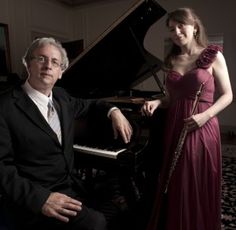
    Things got off to a shining start with BENJAMIN C.S. BOYLE‘s Sonata-Cantilena (NY premiere) performed by pianist Charles Abramovic and flautist Mimi Stillman (above). This four-movement work opens with a Debussyian shimmer; it wends its way thru melodious passages – sometimes doleful and sometimes evoking the warblings of exotic birds – with some sprightly, witty cascades of impetuous coloratura added to the mix. Ms. Stillman, in a fetching pale-violet frock, played beautifully and Mr. Abramovic was a congenially artful partner. 

    Ursula oppens pianist

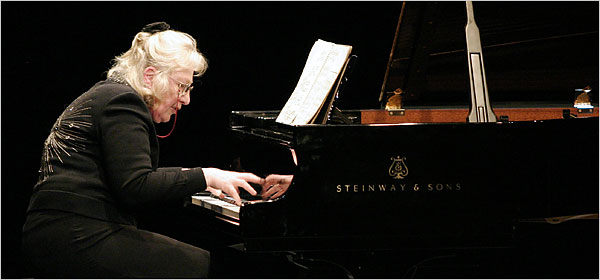
    Ms. Oppens (above) was then joined by violinist Paul Huang and clarinetist Narek Arutyunian for DAVID HERTZBERG‘s Orgie Céleste (Premiere), a fantastical evocation of heavenly delights. Complex and ear-tingling in its textures, much of the music has an ethereal quality as the piano and violin linger in their high registers; meanwhile the clarinet murmurs a two-note motif endlessly, like a subtly pulsing heartbeat. Mr. Huang showed extraordinary technical control as he met all the composer’s demands with alacrity, including some ironic glissandi. The intermingling of the three voices kept everything in a constant state of freshness, Ms. Oppens was wonderfully vivid in her silvery filigree and Mr. Arutyunian seizing melodic opportunities his mellow, expressive tone. The audience responded enthusiastically to both the music and the musicians.

    The only one of tonight’s composers previously familiar to me was KENJI BUNCH, who I had met several years ago while I was working at Tower Records. Since then I have heard quite a bit of his music, but I had not had the pleasure of hearing him play live. He’s a superb violist, with a marvelous mastery of the instrument, making it sing for him is two very contrasted works.

    Bunch (Kenji)--Monica Ohuchi(sm)

    Above: Kenji Bunch and pianist Monica Ohuchi

    In I Dream in Evergreen, Kenji revealed the viola’s depth of lyricism in a poignant reflection on the sundering aspects of death, when mortal friendships end and are transformed into memory. Ms. Ohuchi’s gently shimmering opening theme is soon joined by the viola intoning its poetic recollection of past affection and regret. Together the two musicians provided a reflective interlude, impeccably played.    

    Kenji’s Étude No. 4 (from a set of twelve études he composed for his wife, Ms. Ohuchi, under the title Monica’s Notebook) is a brief and brilliant piece. Lasting all of 90 seconds, it sends the pianist’s hands rippling up and down the keyboard in a delightful display of dexterity. Ms. Ohuchi nailed it, and she was rightly given sustained applause which wouldn’t quit til she returned for a solo bow (personally, I was hoping for an encore of the piece!)

    In Étouffée for solo viola, Kenji’s panoramic exploration of the viola’s possibilities was truly impressive and enjoyable; his playing is mesmerizing – there’s no other word for it. Inspired by a favorite dish from the Cajun culture, the work opens with a hazy, out-of-focus quality as if the viola was drunk on Southern Comfort. This evolves into a big country dance-tune, captivating in its combination of rhythmic drive and sexy rubato. Bravo, Kenji! His entire set was really impressive.

    OpusOne

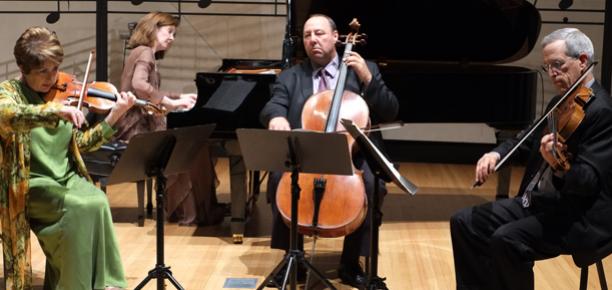
    Having musicians of the caliber of the Opus One quartet (above) play the New York premiere of your work must have given composer CHRIS ROGERSON a thrill. His Summer Night Music for Piano Quartet is full of musical marvels and how superbly it was played tonight by the Opus One artists: Ida Kavafian, violinist; Steven Tenenbom, violist; Peter Wiley, cellist; and Anne-Marie McDermott, pianist.

    In four movements, Summer Night Music opens with a sense of quietude at Twilight. First the cello, then viola, and then the violin introduce themselves in gentle motifs. Ms. McDermott reaches inside the body of the Steinway to pluck the piano’s strings as the cello murmurs plaintively and the violin plays high and pensive. In Fireflies, the piano spins forth with fluttering restlessness and sparkling little interjections. There’s a dense passage from all four players until, until – with a high fade-away from violin and piano – the memory of a Summer night slips away.

    The third movement, Evening Prayers, sounds like a gentle lullabye; the violin lingers on high and the viola and cello blend thru the music in simpatico phrases. The concluding Sleep Music commences with a gently vibrant quality, soft and high; a mellowness of cello and viola evoke deepening night. There is a broad melody for unison strings – and a passionate piano theme – before the music finally vanishes into thin air on Ms. Kavafian’s violin strings.

    10885560_575110625952729_3334037620464024949_n

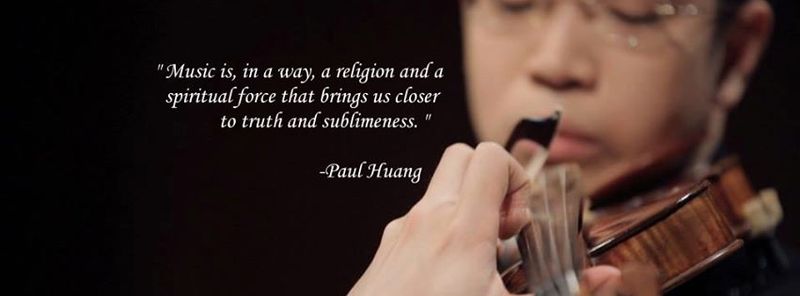
    In researching some of the participating artists, I came upon the above quote from the young violinist Paul Huang. He has expressed something here that I have always felt.

  • WARSAW SERENADE @ Merkin Hall

    Dina-_Kuznetsova

    Above: soprano Dina Kuznetsova

    Tuesday February 18, 2014 – An evening of Polish songs, presented by New York Festival of Song at Merkin Hall, offered an opportunity to hear music I’d never heard before. Michael Barrett and Steven Blier were at the Steinways as tenor Joseph Kaiser opened the evening with “Nakaz niech ozywcze slonko” from Stanislaw Moniuszko’s Verbum Nobile; to a march-like rhythm, Mr. Kaiser poured forth his rich-lyric tone with some strikingly sustained high notes. Soprano Dina Kuznetsova made her first appearance of the evening singing Edward Pallasz’s “Kiszewska” (a ‘lament of the mother of mankind’); intimate and mysterious at first, this song takes on a quality of deep sadness for which the singer employed a smouldering vibrato.

    Four songs by Grazyna Bacewicz represented a wide spectrum of vocal and expressive colours: Ms. Kuznetsova in three of the songs ranged from reflective to chattery, at one point doing some agitated humming as she expressed the numbing horror of having a severe headache. Mr. Kaiser’s rendering of “Oto jest noc”, a song to the moon, was powerfully delivered with some passages of vocalise and a big climactic phrase.

    JosephKaiser-682x1024

    Above: tenor Joseph Kaiser

    Each singer represented a song by Mieczyslaw Karlowicz: the tenor in the touchingly melodic “Mów do mnie jeszcze” (‘Keep speaking to me…’) with its rising passion so marvelously captured by the singer; and then the soprano in the composer’s very first published song “Zasmuconej” (‘To a grieving maiden…’) with its simple, poetic melody showing Ms. Kuznetsova’s communicative gifts with distinction.

    Mieczyslaw Weinberg’s Seven Yiddish Songs were composed in 1943 to texts by the great Yiddish writer, I. L. Peretz. Weinberg, whose life was lived under the dark clouds of anti-Semitism (his entire family destroyed in a concentration camp with the composer having fled to Russia in 1939), is only now experiencing a renaissance with his 1968 opera THE PASSENGER having been recently performed at Bregenz and Houston and due to be seen in New York City this Summer. This evening’s performance of the Seven Yiddish Songs, Opus 13, was my first live encounter with Weinberg’s music.

    The cycle commences with a child-like “la-la-la-la” duet and proceeds with solos for each singer; another duet takes the form of a playful dialogue. Things take a darker turn as Mr. Kaiser sings of an orphaned boy writing a letter to his dead mama; in the closing song “Schluss” the piano punctuates Ms. Kuznetsova’s musings. Both singers excelled in these expressive miniatures.

    Two more Moniuszko songs: a flowingly melodic ‘Evening Song’ with an Italianate feel from the tenor, and a ripplingly-accompanied, minor-key ‘Spinning Song’ delivered with charm by Ms. Kuznetsova.

    Mr. Blier spoke of Karol Szymanowski’s homosexuality and how it coloured much of the composer’s work. In four songs, the two singers alternated – first the soprano in a quiet, sensuous mood and then Mr. Kaiser singing with increasing passion in a Sicilian-flavored ‘”Zuleikha” (sung in German). Ms. Kuznetsova employs her coloristic gifts in one of the Songs of the Infatuated Muezzin, a cycle inspired by Szymanowski’s visit to North Africa. In ‘Neigh, my horse’ from The Kurpian Songs Mr. Kaiser tells of a rider, en route to his beloved, being distracted by another beauty he meets on the journey; the tenor’s voice rose ringingly to a clarion climax which faded as he sent his riderless horse on to reassure his waiting sweetheart.

    The evening ended with an operatically-styled ‘Piper’s Song’ by Ignacy Jan Paderewski where the two voices blended very attractively as the duet moved to its shimmering conclusion.

    Despite a bit too much talking – and an un-cooperative microphone – and some distracting comings and goings, the evening was an enjoyable encounter with rarely-heard music and the pleasing experience of hearing Ms. Kuznetsova and Mr. Kaiser lift their voices in expresive song.


  • Labyrinth Within @ BAC

    1012002

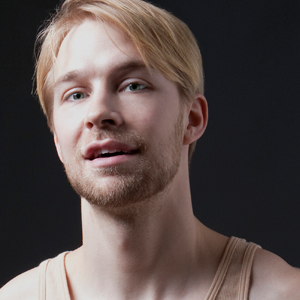
    Tuesday February 21, 2012 – Swedish dancer/choreographer/film-maker Pontus Lidberg (above) created his half-hour film LABYRINTH WITHIN over a four year period; as he revealed at tonight’s showing at Baryshnikov Arts Center, Wendy Whelan was his muse from the start – even before she got involved in the project.

    The movie is a fascinating experience on many levels: as a captivating visual work of art; as a choreographic melding of two contrasting pas de deux; as a poignant musical expression; and in its exploration of relationships where ideas about trust, jealousy, and passions real or imagined provide restless, suspenseful undercurrents right from the opening frame. The film also serves as a spine-tingling introduction of a great ballerina to a new medium: Wendy Whelan on-screen is as thoroughly riveting as Wendy Whelan onstage.

    The dreamlike atmosphere of the film leaves us to ponder whether the romantic triangle we are watching is real or imagined. LABYRINTH WITHIN wraps themes of infidelity, the allure of sexual enticement, and of escape from the everyday into a passionate dreamworld in a veil of mystery. The realms of reality and fantasy overlap; the viewer can only savour the elements of the film and draw his own conclusions.

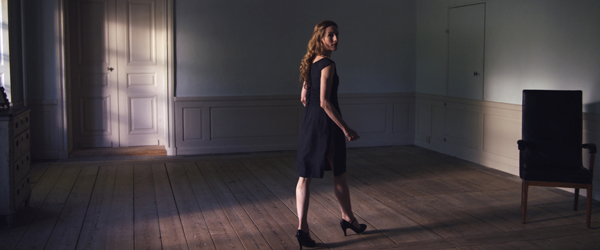
    The three protagonists draw us into their respective worlds: Giovanni Bucchieri is the darkly handsome husband, Wendy Whelan the evasive and enigmatic wife, and Pontus Lidberg the blonde and beautiful lover. Giovanni seems like a pre-occupied workaholic who has neglected his marriage, yet his sensuous mouth indicates a voluptuous nature under the businessman facade. Wendy, the most intriguing person I have ever encountered, doesn’t need to act; by simply being on-screen her character lives and draws us deeply into the mysterious story and into the secret room where her fantasy becomes flesh. Pontus is the idealized lover, the embodiment of masculine grace and tenderness, his torso a landscape of muscle and fair skin.

    In the film’s opening moments, the two men appear to be wrestling with one another in fragmented dream sequences. But once the tale is underway, they meet only fleetingly on a staircase. Wendy dances with both of the men in sharply contrasted styles: with her husband the movement is angluar, cool and detached. Her beautifully-filmed scenes with her beloved are sensuous without being sexual; their passion is urgent yet somehow languid at the same time. Pontus strips down to his black briefs but Wendy keeps her black dress on; the glimpses of thigh, neck, streaming hair and entwined limbs are more evocative than any more blatant sexual scene that might have been crafted.

    At the end, Giovanni breaks into the forbidden room. What does he find there? Ah, you must see the film to find out!

    Pontus spoke of creating the entire work with composer David Lang’s music in mind but without having the actual pieces from the composer (some already written, some specially created for the film) to work with. Amazing how organic the final fusion of film, dance and music turned out. Maya Beiser’s ravishing cello playing gives an added texture of romance, longing and suspicion to the film.

    LABYRINTH WITHIN – both the film and the staged dancework inspired by it – may be seen this Summer at Jacob’s Pillow (details here), followed by a two-week, five-city tour of Sweden as part of Dancenet in October, and then at here in New York City in Autumn 2012.

    Tonight’s showing at BAC drew a packed house and many luminaries: NYCB‘s Janie Taylor and Sebastien Marcovici, the radiant Pauline Golbin, ballerina de luxe Alessandra Ferri, photographer/film-maker David Michalek (husband of Ms. Whelan), MORPHOSES‘s lovely Frances Chaverini, choreographer Laura Ward, and my dear friend writer/artist Monica Wellington.  NYC Ballet soloist Adrain Danchig-Waring makes a brief appearance in the film. 

    Labyrinth_within

    In 2010 as the film was being completed, both Pontus and Wendy generously contibuted to an article about the project for my blog, and Wendy loaned me her evocative images. You will find the story here.