Tag: Tuesday January

  • Les Arts Florissants/Zankel Hall Center Stage

    CH11515039

    Above: William Christie, photo by Richard Termine

    ~ Author: Lane Raffaldini Rubin

    Tuesday January 28th, 2025 – Tonight,  Les Arts Florissants made what has become the rare appearance of an early music ensemble on a Carnegie Hall stage.

    To celebrate the eightieth birthday of its founder and co-musical director William Christie, the group presented selections from the core of its repertory, including scenes from the operas of Marc-Antoine Charpentier (1632-1704), Jean-Baptiste Lully (1632-1687), and Jean-Philippe Rameau (1683-1764). Christie has been a champion of these composers since the 1970s and it was with a 1986-87 production of Lully’s Atys – an opera that had not been staged since 1753 and whose music was excerpted at Tuesday’s performance – that Les Arts Florissants made its first big break.

    Seeing the thirteen players and six vocalists take the stage of Zankel Hall’s intimate in-the-round configuration, one might get the sense that Les Arts Florissants is simply a small group of musicians dedicated to the French Baroque. Back in France, however, this group is just one component of a multifaceted institution that includes early music performance, music pedagogy, professional development for young singers and instrumentalists, a historic country house with fanciful Baroque-style gardens (themselves home to many of the group’s activities), training for gardeners, and a garden studies research center. Christie himself (an American, mind you, who left the States as an objector to the Vietnam War) is the godfather of this musical-cultural web.

    Tuesday’s performance was a testament to the group’s decades-long legacy of learning and teaching, its total grasp of this body of music, and the kinship of its members, who played and sang together like family.

    CH11515040

    The chosen excerpts reveal the dramatic directness and emotional turbulence of French Baroque opera. We heard none of the repetitive music of Italian da capo arias or strophic forms. Instead, we heard through-written works that interweave recitative dialogues and monologues with airs and duets. The transitions between air and recitative were at times fitful and at times seamless, but always served a clear dramatic function. That formal range and psychological charge were on display in the excerpts from Charpentier’s 1693 Médée, where a dialogue between Médée and her confidante Nérine is interrupted by outbursts of jealousy and vengefulness. This all culminated in the aria “Quel prix de mon amour”, sung by mezzo-soprano Rebecca Leggett, a lamentation undergirded by fleeting but searing dissonances in the orchestra.

    Another characteristic of this music is its emphasis on French diction. Lully, the favorite composer of Louis XIV, explicitly sought to differentiate his music from the florid and opaque sounds of Italian opera of the time. In excerpts from the later acts of Atys of 1676, the tenor Bastien Rimondi sang with clarity and shapely elegance as he communicated his character’s yearning and anguish.

    The highlight of the program was Rimondi’s “Règne, Amour” from Rameau’s Pigmalion (1748). Rameau’s opera music, which dominated the evening, was presented simultaneously as a development of Lully’s legacy as well as an innovation upon and a perversion of it. In the Pigmalion excerpts we hear varied instrumental colors, free-spirited use of the recorders and reeds, heavy basso continuo inversions that drive harmonic motion, and a Handelian rhythmic motor. Rimondi sang his part with pure joy. His exquisitely crisp diction permeated ornate passages and more straightforward melodic lines, never hindering a sweet, clear tone and blooming vibrato on sustained notes.

    The program concluded with two scenes from Rameau’s 1735 Les Indes galantes, the flagrantly cancelable opera-ballet featuring unrelated tales of exotic places and their inhabitants. Both scenes were drawn from the act “Les sauvages” depicting North American landscapes and natives. One might think the inclusion of the “Forêts paisibles” chorus to be pandering to the New York audience, but this scene also includes the famous dance of the savages which serves as Les Arts Florissants’s frequent sendoff at the end of their concerts. They tossed off this music with swung beats and confident restraint.

    CH11515089

    As an encore, Christie and Les Arts Florissants offered the quartet “Tendre amour” from the third act of Les Indes galantes (which Rameau cut from the opera after its first performances). Christie described this music as “one of the most beautiful pieces of the eighteenth century” and indeed it was gorgeous and pastoral with vocal lines floating high in the air. It was a birthday gift from Christie to the audience.
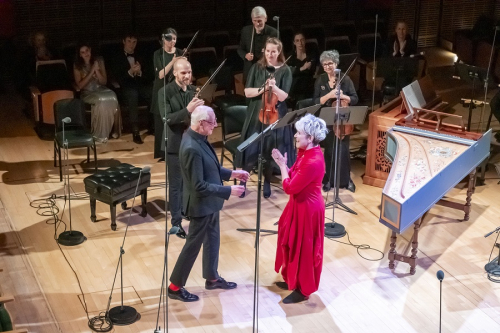
    CH11515067

    Above: Maestro Christie greets Joyce DiDonato; photo by Richard Termine

    But the ensemble members had something else up their sleeve. The star mezzo-soprano Joyce DiDonato emerged onto the stage and lavished praise on Christie, whom she met while rehearsing for his 2004 production of Handel’s English-language opera Hercules. In tribute to Christie, she and the ensemble presented “As with rosy steps the morn” from the oratorio Theodora (why didn’t they choose something from Hercules?). After a full program of Charpentier, Lully, and Rameau, DiDonato’s Handel seemed monumentally scaled, possessing a different species of substance and intensity. The strophic form of this piece (repeating sections of music with new verses of text) set an obvious contrast with the French music of the main program and put the French works’ organic, dramatic, and transparent value into focus.

    The program was, after all, a didactic showcase of French Baroque music and its performance techniques. Among early music groups, Les Arts Florissants is a champion of craft, forgoing the temptations to produce the highly biting, peppery sound that is so en vogue these days. Surrounding the ensemble on all sides, it was as if we the audience could simply enjoy overhearing a reading of this music being shared among friends.

    Performance photos by Richard Termine, courtesy of Carnegie Hall

    ~ Lane Raffaldini Rubin

  • Alisa Weilerstein ~ FRAGMENTS 2

    CH11513997

    Above, Alisa Weilerstein/FRAGMENTS 2 ~ performance photo by Fadi Kheir

    ~ Author: Shoshana Klein

    Tuesday January 21st, 2025 – This evening at Zankel Hall, Alisa Weilerstein’s’ Fragments project continued with its the second installation. You may remember the first one, last April.


    Like last time, there was no program given until the end – a practice I still find interesting, though slightly frustrating. I had a bit of a conclusion that the ideal listener either knows the Bach suites by heart, or doesn’t know them at all; someone like me (knowing them but certainly not well versed on the particular movements, etc) ends up a little stuck on which is which and where we are. 


    For the staging, the same light boxes that were set up for the first installment are set up spread around the stage rather than in a circle around the cellist like they were last time. She entered in full darkness – though during that moment, someone’s phone went off and said clearly “calling emergency services” and everyone laughed, which was a fun communal moment.


    This setting struck me as more theatrical than the last – it started with a bang and bright lights, and Weilerstein was wearing fishnets, a bright fuchsia short dress, and dramatic stage makeup with her hair curled and all over the place. It seemed to evoke a sort of dramatization and maybe a teenage emotionality.


    The way that she played the Bach suite movements were sweeping, very light even though much of the suite is in minor. Her playing of the fast passages is very elegant – bringing out the vocal and conversational qualities of these multi-line pieces written for one instrument.


    CH11513956


    Performance photo by Fadi Kheir


    For the first couple movements there were really smooth transitions and stark lighting changes. The new pieces were lit with green and the Bach was a warmer white/yellow. I wondered if it would continue like that the whole time with the lighting just indicating whether or not we were hearing a new piece, but as it went on the changes became less stark, and the movements had different types of lighting. Maybe adding to this, or reflected by it, particularly in the beginning of the set, the Bach had a more veiled angstyness while the newer pieces had more brash emotionality in the forefront, as if the newer compositions were unearthing the meanings of the Bach and saying them more plainly.


    One standout movement near the end had only pizzicati and required Weilerstein to sing along with her playing. It was simple sounding and also grounding, particularly because this person who is at the highest levels of cello playing was singing like a normal person. Not to say it was bad, it just humanized her in a way that brought reality back in a really sweet way.


    ~ Shoshana Klein

  • Compagnie Hervé KOUBI ~ Sol Invictus

    Abdelghani FERRADJI

    Above: dancer Abdelghani Ferradji; photo by Nathalie Sternalski

    ~ Author: Oberon

    Tuesday January 23rd, 2024 – Compagnie Hervé KOUBI returning to The Joyce with “Sol Invictus,” a dancework which brings elements of breakdance, martial arts, capoeira, and acrobatics together. Named after the all-powerful god of the sun, the theme of the piece is the ideal of love as the basis for peace. The original score is by Mikael Karlsson, interwoven with excerpts by Beethoven, Steve Reich, and Maxime Bodson.

    Hervé Koubi’s dancers are spectacular athletes who are also artists. The dancing all evening was jaw-droppingly sensational: for seventy-five minutes, the dancers flung themselves into the air, spun on their heads, executed daredevil flips and airborne somersaults, and tossed their fellow dancers heavenward with unflagging energy and commitment. The production was splendidly lit by Lionel Buzonie, and the staging was enhanced by a huge, billowing sheet of cloth-of-gold.

    Francesca BAZZUCCHI

    Above: dancer Francesca Mazzucchi; photo by Nathalie Sternalski

    While there was a narrative feeling, I could not discern a story line. In a program note, the choreographer said he wanted to make the stage “a playground of all possibilities” and that was indeed the best way for the large and wonderfully attentive audience to relate to the performance. It is impossible to describe the fantastical moves these dancers make: they have to be seen to be believed.

    At one point, the nurturing light of the sun goes out; the stage is plunged into smoky darkness, and the dancers appear as silhouettes, bereft of their source of energy.  Then, In the ballet’s most stunning moment, the light slowly returns, and emerging from under the golden shroud a beautiful new sun-king is born.

    The community rejoices in the renewed light, and the physical feats this inspires drew gasps from the audience. The dancers cheered each other on which shouts and whoops of joy as insane airborne combinations were daringly executed. 

    When the curtain fell, the audience released their pent-up excitement, hailing the dancers with a vociferous standing ovation. Once again, Hervé Koubi has brought life to Gotham.

    ~ Oberon

  • CMS Winter Festival: All-Schubert Evening

    Gilbert-kalish-header

    Tuesday January 24th, 2023 – This year, Chamber Music Society of Lincoln Center‘s annual Winter Festival is centered on the works of Franz Schubert. Tonight’s program featured the eminent pianist Gilbert Kalish and my beloved Escher String Quartet in three masterworks from the composer’s brilliant – but all too brief – career.

    The single-movement Quartettsatz in C-minor for Strings, D. 703, was composed in 1820. It seems to have been intended to be the first movement of a full quartet, but the composer never composed additional movements.

    From its scurrying start, the Escher Quartet’s performance of the Quartettsatz was a complete delight; their rhythmic attentiveness and tonal appeal were amply on display, their playing full of both vitality and nuance. The silken sheen of Adam Barnett-Hart’s violin made its distinctive mark in solo passages, the music flowing onward to a sudden tempest. This is soon calmed, but Brook Speltz’s restless cello figurations keep things lively. There is a da capo, a sort of coda, which draws on to a full-toned chordal passage; here, the classic Escher blend could be deeply savoured.

    Gilbert Kalish then took the stage for Schubert’s Sonata in B-flat major for Piano, D. 960, composed in 1828. This long and demanding work begins with an Allegro Moderato. Mr. Kalish delivers the theme with a sense of serenity; then a low trill sounds, seeming rather ominous – a trill which later brings music of great tenderness. As things become more intense, so does the playing: modulations are beautifully handled by the pianist. The low trill returns before a final recapitulation.

    Mr. Kalish brought forth the austere calm – and the poignant colours – of the ensuing Andante sostenuto; the music’s steady rhythmic pulse puts us in a trance. The movement’s ending feels like a benediction.

    In a striking volte face, the pianist takes up the boundless animation of the Scherzo. The music breezes along, pausing only for a courtly interlude. The sonata’s concluding Allegro ma non troppo is filled with an uplifting sense of buoyancy and good humor. Passing shadowy clouds momentarily blot out the sun, but by the end, all is bright and fair.

    Mr. Kalish was hugely applauded by the packed house at Alice Tully Hall. If Wikipedia is correct, the pianist is 88 years young…simply remarkable! 

    Escher qt

    Above, the players of the Escher String Quartet: Adam Barnett-Hart, violin; Brendan Speltz, violin; Brook Speltz, cello; and Pierre Lapointe, viola.

    The gentlemen of the Escher Quartet returned after the interval for the G-major quartet, Opus 161, dating from 1826. From the work’s striking beginning, this music – which I first heard ions ago in the Woody Allen film CRIMES AND MISDEMEANORS – always casts a deep spell over me. Incredibly rich and vividly detailed, the opening movement features tremelo effects – introduced  by the Escher’s stellar violist Pierre Lapointe – and achingly beautiful, ethereal themes for Mr. Bernett-Hart’s violin. The music becomes triumphant, reaching a passionate end.

    As the sonata moves on, cellist Brook Speltz’s role takes on increasing prominence. In the Andante, his sublime cello melody sets the tone, with his colleagues providing gorgeous harmonies. The music becomes intensely poignant, and Mr. Speltz’s playing has me thoroughly engrossed…hypnotized, really.

    But suddenly the music stopped; at first, I thought someone had broken a string, but apparently it was a tuning issue; corrections were made, and, after a few moments, the players resumed. It took a while to re-establish the mood; the music becomes hushed, with 2nd violinist Brendan Speltz and Mr. Lapointe sharing a duet passage. Then tremelos again are heard, and the music draws us on to an elegant finish.

    Things had been set to rights following the interruption, and the final Allegro assai should have been the frosting on this delicious cake: a deftly Mendelssohnian affair wherein the cellist has more opportunities to enchant us…which he did. But, a jingling cellphone began to sound. The musicians played on, the music so reminiscent of Mendelssohn’s Italian Symphony. The phone ceased for a bit, then rang again. Could the timing have been any worse?

    The players persevered, and the audience hailed them with a boisterous standing ovation at the end. While the intense connection to the music I was experiencing prior to the unexpected lull was never re-established, it was still a wonderful evening.

    ~ Oberon

  • Strings Only @ Chamber Music Society

    K lee

    Above: violinist Kristin Lee

    Tuesday January 18th, 2022 – Chamber Music Society of Lincoln Center brought together six virtuoso string players from their stellar roster for a program of music by Beethoven, Schulhoff, and Dvořák at Alice Tully Hall.

    Beethoven’s Quintet in C-minor for Two Violins, Two Violas, and Cello, Op. 104, started life as a piano trio composed in 1794–95; the composer arranged the work for string quintet in 1817.

    An almost waltzy feeling springs up for the opening of the Allegro con brio. The music spills forth with contrasting passages of animation and lyricism, which tonight’s five musicians graced with delicious harmonies and finely-judged dynamics. Violist Matthew Lipman’s playing (all evening) was of particular note.

    A gentle flow of melody opens the Andante cantabile. Ensuing variations include a sad interlude and some boisterous passages; Mr. Lipman and cellist Keith Robinson seize on their opportunities. The irresistible magic of Beethoven abounds here. The Menuetto has a courtly feeling, but fabulous flourishes from Kristin Lee’s violin add a spicy touch. Later, some charming echo effects are heard.

    Ms. Lee takes the lead in the quintet’s Finale: Prestissimo. Here I found myself deriving great joy from watching the five musicians reveling in the pleasure of playing such marvelous music. After all that has gone before, Beethoven pulls off a final magic trick: the quintet ends quietly.   

    Erwin-Schulhoff

    Above: composer Erwin Schulhoff

    The centerpiece if this evening’s program was Czech composer Erwin Schulhoff‘s Sextet for Two Violins, Two Violas, and Two Cellos, composed in the early 1920s. This evening was my first hearing of this work, and it was an engrossing, revelatory experience. My only other Schulhoff encounter was a powerful performance of the composer’s 5th symphony by the American Symphony orchestra in 2017.

    Schuhoff’s Sextet opens with an Allegro risoluto, the musicians digging in and then trudging along with numerous dramatic effects. The music calms, with wisps of melody woven in; our two violists (Mssrs. Lipman and Neubauer) have much to do here, with plucking and tremolo passages. The music has hauntingly somber harmonics and brusque accents.

    In the eerie Tranquillo: Andante which follows, the music is spine-tingling: unsettling yet beautiful. Mr. Neubauer and cellist Keith Robinson share an evocative exchange, and Kristin Lee spins a silky violin theme over a rocking motif. A solo from Mr. Robinson sustains the mood, and then a creepy, insectuous theme yields to a hushed atmosphere. The cello sings low, and then, with fantastic control, a final passage for viola and cello. “Wow!” I scrawled in my notes.  

    An agitato movement, marked Burlesca. Allegro molto con spirito brought forth fun, lively rhythms and some fiery playing from Matthew Lipman. The tempo speeds up for a propulsive unison passage at the finish.

    Inbal Segev’s deep, dolorous cello sound opens the concluding Molto adagio; the music has a dense, plaintive quality. Mr. Sussmann and Ms. Lee exchange lamenting themes; and while the violas sustain a tremolo effect, Mr. Robinson joins: his cello imitates the sound of a pendulum clock. An uneasy quietude settles over the hall as the music takes a long fade, and Mr. Robinson’s cello has a last utterance.
     
    This magnificent rendering of the Schulhoff will linger long in my memory.

    Arnaud-Sussmann-Photo-V-Photo-Credit-Carlin-Ma jpg

    Above: violinist Arnaud Sussmann, photographed by Carlin Ma

    To close the evening, Antonin Dvořák’s Sextet in A-major for Two Violins, Two Violas, and Two Cellos, Op. 48 (1878) was gorgeously played by our six artists.

    From the start, this sextet is a veritable font of melody. And the dance rhythms are indeed toe-tappingly appealing. But after a while, it all becomes so very pleasant, and I began to think back to the jarring fascination of the Schulhoff. As time goes by, I find that Dvořák’s music seldom draws a deep response from me.

    Despite such quibbles, I was so glad to stand up and cheer at the end of the concert, joining my fellow music-lovers in a heartfelt homage to these six great musicians. 

    ~ Oberon

  • Brahms & Dvořák @ Chamber Music Society

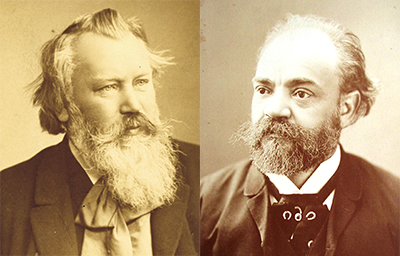
    BrahmsDvorak400px

    Above: Johannes Brahms and Antonín Dvořák

    ~ Author: Oberon

    Tuesday January 30, 2018 – This evening’s highly enjoyable program offered by Chamber Music Society of Lincoln Center brought us works by Johannes Brahms and Antonín Dvořák: music for piano 4-hands by each composer, with a piano trio from Brahms and a piano quintet from Dvořák. Six excellent musicians were on hand to delight an audience who had chosen great music over the SOTU. 

    Pianists Wu Han and Michael Brown shared the Steinway for the opening work: selections from Dvořák’s Slavonic Dances. Wu Han – clad is brilliant red – presided over the lower octaves and Mr. Brown the higher. The chosen Dances, two from opus 46 and two from opus 72, formed a perfect set.

    With the joyous opening of opus 46, #1, the cares and concerns of daily life were swept away; this Presto in C-major moves from exuberance to subtlety and back again. The players clearly enjoyed sharing the keyboard: in his program note, Mr. Brown compared playing 4-hands with playing doubles in tennis. And he further remarked that “…sharing one pedal is as strange as someone else brushing your teeth!” This duo got on like a house afire, vying in technical brilliance and relishing the more thoughtful passages. Opus 46, #2 has a darker, E-minor start, but then turns sprightly; Dvořák alternately accelerates and then pumps the brakes throughout this Allegretto scherzando.

    The dances of opus 72 are in general less extroverted and rambunctious than those of the 46. The pianists kept to E-minor with #2 which has a lyrical sadness and an emotional pull at first but later becomes sparkly and charming. They rounded off this opening Dvořák set with opus 72, #1, Molto vivace in B-major. This commences with a rocking rhythm and shows fresh vitality before it quietens with some lovely upper-range shimmers only to re-ignite as it hastens to its finish.

    For the Piano Trio in C-minor, Op. 101 of Johannes Brahms, Mr. Brown was joined by violinist Paul Huang and cellist Dmitri Atapine. This trio was composed in 1886 while the composer was summering at Hofstetten, Switzerland, and it was premiered in December of that year, with the composer at the piano, Jeno Hubay playing violin, and David Popper as cellist.

    The opening Allegro energico begins passionately, and the strings play often in unison. Following an animated passage, there comes a deep melody; the movement ends almost abruptly. 

    The trio’s second movement starts very quietly, almost hesitantly, the strings are muted and given over to almost sneaky plucking as the piano holds forth. Then violin and cello have a dialogue. The pizzicati recur, and the sotto voce atmosphere of the music is sustained.

    The Andante develops yet another conversation: this time between the duetting strings and the piano. All three musicians showed lovely dynamic gradations throughout. Mr. Brown’s dreamy and evocative playing drew sighing motifs from the violin and cello. A sudden burst of passion ends the Andante

    The rhythmic vitality of the concluding Allegro molto undergoes a mood change in an interlude where Mr. Huang’s polished tone could be savoured. Melodious exchanges lead on to a fervent finish. The three players’ sense of fraternity was evinced as they bowed to the audience’s sincere applause.

    Following the interval, our two pianists played three of Brahms’ Hungarian Dances. Wu Han and Mr. Brown had switched places on the piano bench, giving Mr. Brown the deeper registers whilst Wu Han shone in the soprano range.

    The Poco sostenuto in F-minor commences with a brooding quality, but then speeds up. A witty, almost ‘toy piano’ feeling charms in the central section before a return to the starting point. The music dances on to a fun finale. The Allegretto in A-major has a droll start and some playful hesitations: the two pianists seemed like co-conspirators here. Mr. Brown relished the low melody of the Allegro molto in G-minor whilst Wu Han’s sweetly struck higher notes felt like raindrops. The music then grows lively, with a gypsy lilt.

    A sterling performance of Dvořák’s Piano Quintet in A-major, Op. 81 (dating from 1887) made for the evening’s perfect finale, with violinists Chad Hoopes and Paul Huang, violist Matthew Lipman, and cellist Dmitri Atapine joining Wu Han.  

    Mr. Atapine sets the opening Allegro ma non tanto in motion with a nobly-played cello theme; there follows a warm tutti passage where we’re assured of a beautifully blended performance. Wu Han’s gorgeous playing (throughout) underscores the silken high range of Mr. Hoopes’ violin; then Mr. Lipman takes up a viola theme which is passed to Mr. Hoopes. Pulsing strings lead to an expansive passage; the Hoopes violin sings deliciously. We can revel in the intertwined voices for a few moments before the movement dashes to an ending.  

    The second movement, Andante con moto, was a source of true magic tonight, with Wu Han again displaying her gifts for creating atmosphere. Mr. Lipman has the melody; a tempo increase brings us duetting violins. Then comes an engrossing passage: Mr. Atapine’s cello sings deep as the violinists pluck; then Mssrs. Hoopes and Atapine sound a gentle, rolling motif in support of Wu Han’s luminous playing. Mr. Lipman takes up the main theme with rich lyricism. A sudden animation is calmed by the limpid piano, and then the ‘engrossing passage’ is repeated, with unbelievable subtlety.

    Chad Hoopes sends the Scherzo off with a light touch; Wu Han’s dazzling playing has me under a spell. The viola and cello engage us, Mr. Atapine’s attentiveness and sense of joy in his playing is inspiring to behold. Following a luminous interlude, the cellist propels the Scherzo to a lively finish.

    The Finale: Allegro starts with a petite into, and then embarks on a flowing dance. I absolutely loved watching Wu Han here, ever-alert and eyeing her colleagues with affection, she was clearly having a marvelous time of it. The mood shifts unexpectedly as Mr. Hoopes plays what seems like a hymn…or a prayer. Then the music goes on its lilting way to a jubilant close. 

    ~ Oberon

  • Compagnie Accrorap @ The Joyce

    Kader.attou.02

    ~ Author: Oberon

    Tuesday January 23rd, 2018 – For their Joyce debut, Compagnie Accrorap performed The Roots, a work for eleven men created by the Company’s founder, Kader Attou, that is at once vibrant and thoughtful. For 90 minutes, to an eclectic score, the men astound us with their break-dancing skills whilst also evoking a wide range of masculine feelings: loneliness, bravado, competitiveness, and camaraderie.

    The Roots begins with a man slumped in a brokedown armchair. On an old turntable, a song is playing that summons up memories. He slips the needle off the disc, and music from a ghostly piano sounds as a group of men materialize: are they out of the past, the present, or the future? We never know. But they are soon dancing up a storm. 

    To a musical collage devised by Régis Baillet – from his solo project Diaphane, and a spectrum of other music – the Company dance in full ensemble, in splinter groups, in in-sync trios, duets, and fantastical solos which display by turns their prodigious break-dance skills, acrobatic grace, and poignant artistry. Nadia Genez’s everyday-wear costuming at once unifies the men as a community whilst allowing ample freedom of movement. In a dilapidated living room (Olivier Boune’s design), a coffee table cunningly disguises a trampoline from which the men launch improbable aeriel feats: they are are truly at home in the air. At one point, all the furniture begins gliding about the stage. A major factor in the overall success of The Roots is Fabrice Crouzet’s expertly atmospheric lighting.

    There’s a lot to take in, both sonically and in terms of movement, over the span of The Roots. In terms of risk-taking, pinpoint timing, and musicality, these dancers have everything to offer. Gentle wit keeps the audience charmed, but much of the time exhilaration is the watchword. The furniture often plays a part in the choreography, as in one of the work’s most memorable passages: a terrifically subtle tap-dance routine done on a table top, whilst the lighting makes it a shadow dance.

    6382c6fdcd82465b9e0e087f1611d1da

    Above photo by João Garcia

    The dancers in The Roots are Babacar “Bouba” Cissé, Bruce Chiefare, Virgile Dagneaux,
Erwan Godard, Mabrouk Gouicem, Adrien Goulinet, Kevin Mischel, Artem Orlov, Mehdi Ouachek, Nabil Ouelhadj, and Maxime Vicente. Superstars individually, as a collective they are incomparable. The roar of applause that greeted their curtain calls attests to their achievement.

    Kader2

    Above: choreographer Kader Attou, founder of Compagnie Accrorap.

    This program continues at The Joyce thru Sunday, January 28th; I give it five stars. Get tickets here, or at The Joyce box office.

    ~ Oberon

  • Clarinet Trios @ Chamber Music Society

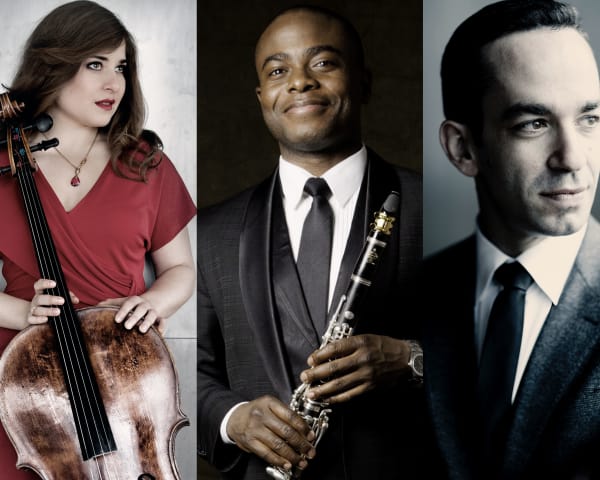
    Clarinettrios

    Tuesday January 24th, 2017 – Cellist Alisa Weilerstein, clarinetist Anthony McGill, and pianist Inon Barnatan sharing the Alice Tully Hall stage in a program of piano trios presented by Chamber Music Society of Lincoln Center. Beloved works by Beethoven and Brahms book-ended the New York premiere of Short Stories for Clarinet, Cello, and Piano by Joseph Hallman. The presence of three such superb artists on the program signaled this as a red-letter event in the current season; I’d been looking forward to this evening for months, and it truly surpassed expectations.

    The three artists took the stage, Ms. Weilerstein in a beautiful deep violet gown, and launched the Beethoven Trio for Clarinet, Cello, and Piano, opus 11; it quickly became evident that we were in for a night of exceptional music-making. In this particular work, exuberance and delicacy alternate in perfect measure, and the three players relished both the propulsive passages and – most enticingly – those moments when nuance is all.

    One of Beethoven’s early masterpieces, this clarinet trio shows the influence of Haydn and Mozart; but once can clearly sense that Beethoven is already finding his own voice. The writing for the three instruments is often conversational, and how lovingly our three musicians this evening spoke to one another.

    The opening Allegro con brio is alive with rhythmic delights, including a touch of syncopated witticism. Mr. Barnatan’s scintillating agility was a constant attraction, and it was a great pleasure to watch the  communication between the three players.

    Ms. Weilerstein opened the Adagio with a cello theme; her heartfelt playing took this simple, straight-forward melody to the heights. She and Mr. McGill duetted tenderly, both playing with great subtlety. The music becomes achingly gorgeous.

    Good humor abounds in the Theme and variations setting of the finale: drawing on an aria wildly popular at the time, “Pria ch’io l’impegno” (“Before I begin, I must eat”) from Joseph Weigl’s opera L’AMOR MARINARO, Beethoven sets up bravura hurdles for the three musicians, all of them joyously over-leapt by our intrepid trio. Mr. Barnatan revels in the cascading piano passages, peaking in a perfect cadenza which ends with king-sized trills. Meanwhile Ms. Weilerstein and Mr. McGill seem to finish each other’s sentences, indulging in an amiable game of “Anything you can play, I can play finer!” Again, the sense of camaraderie, and of the players’ anticipation of the sheer pleasure of playing the next phrase, kept the audience visually engaged.

    Short Stories, the new Hallman work, is a five-movement trio; it might also be called Scenes from a Relationship. One doesn’t, however, need any narrative reference to enjoy this purely as a musical experience, for Mr. Hallman is an excellent craftsman, and a colorist as well. The composer was sitting just a seat away from us; I can only imagine how delighted he must have been to hear his music being played by three such paragons…a veritable dream come true.

    The opening movement, the Break-up, gets off to a stuttering start. The cello shivers before going deep and mournful, whilst the clarinet comments on her predicament. Then they switch roles, like a therapist taking over the couch from his patient. They play in unison, and things turn temporarily witty. But the music ends in the depths.

    familial memories at a funeral opens with Mr. McGill’s clarinet in a whispering, misterioso mood. After briefly perking up, a pensive quality develops with a repeated two-note motif for the piano. The clarinetist’s astounding breath-control and his sustained beauty of tone throughout the dynamic range keep the audience mesmerized.

    back-and-white noir: hardboiled with a heart of gold is the whimsical title of the third story. It begins agitato, developing an off-kilter rhythm. Mr. Barnatan sweeps up to the high register, while the clarinet and cello play a droopy duo. Ms. Weilerstein then descends to her velvety deep range. The music ebbs and flows, both rhythmically and tonally, as the composer explores the coloristic possibilities of the three instruments.

    regret is for the weak is a title that hits home. Mr. Hallman here sets up an eerie, hesitant start. The clarinet percolates briefly, then settles into a very quiet mood whilst the cellist plucks; later, the cello trembles while the piano sounds softly. We seem to be in a moody memory, with Mr. Barnatan drawing forth fleeting surges of melody. Ms. Weilerstein and Mr. McGill sing sadly before the pianist dips down to a punctuating low note.

    In the path of the curve, Mr. Barnatan sometimes reaches inside the piano to manipulate the sound. The music here is very quiet, until the clarinet starts warbling. Fluttering and swirling motifs sneak in, then the music seems to run down and the cello again deepens. The piece ends in a sustained quietude.  

    The only slight reservation I had about Short Stories was that the final movement is perhaps a bit too drawn out; my companion felt the same way. It was unfortunate that, during the work’s quiet closing moments, a cellphone went off directly behind us. At the same time, someone in the from row had a violent coughing fit. Such unfortunate timing. Yet despite these distractions, the Short Stories each cast their own spell, and they were spectacularly played.

    Following the interval, the Brahms trio (opus 114) found the three artists on the heavenly heights of tonal and technical perfection, their playing so generous and emotive. From Ms. Weilerstein’s sublime playing of the yearning opening theme, thru the plaintive entry of Mr. McGill’s clarinet and the ever-expressive beauty Mr. Barnatan drew from keyboard, the music took on an impassioned glow. In my scrawled notes, the word “gorgeous’ appears over a dozen times.

    Mr. McGill’s spellbinding playing of the sweetly serene theme that opens the Adagio was a magical passage, taken up by the soulful spirituality of Ms. Weilerstein’s cello. The luminous qualities of clarinet and cello are set in high relief by the profound tranquillity evoked by Mr. Barnatan. A long-lined clarinet solo leaves one grasping for adjectives to describe the McGill sound, and his ardent tapering of line. One wanted this meditation by the three players to linger on and on.

    A questioning clarinet passage and more marvelous phrasing from Mr. Barnatan set up the waltz-like grace of the Andantino.  After a brief diversion, we dance on towards the movement’s end; unexpectedly, Brahms tucks in a calming coda to make a lovely finish.

    Restraint is cast aside as the trio dig into the concluding Allegro. A tinge of gypsy colour weaves thru this music. Ms. Weilerstein takes up a melody which she passes to Mr. McGill; then they harmonize. Things speed up. “More cello passion!” was my last dashed-off remark; the Brahms sailed on to its joyous conclusion, and the three stellar artists were greeted with immediate shouts of approval. They took a double curtain call, delighting the crowd.

    A thought that recurred to me frequently during the evening was: if Mozart had met McGill, Amadeus would have written DIE ZAUBERKLARINETTE.

    • Beethoven Trio in B-flat major for Clarinet, Cello, and Piano, Op. 11 (1797)
    • Hallman Short Stories for Clarinet, Cello, and Piano (CMS Co-Commission) (New York premiere) (2016)
    • Brahms Trio in A minor for Clarinet, Cello, and Piano, Op. 114 (1891)

  • NYCB: Opening Night|Winter Season 2015

    Balanchine-Stravinsky-1965

    Above: George Balanchine and Igor Stravinsky

    Update: Happy Birthday Mr. B ~ January 22nd!

    Tuesday January 20th, 2015 – An all-Balanchine evening to open the New York City Ballet‘s Winter 2015 season. In the days leading up to the performance there were several changes to the originally-announced casting, and it all turned out very well. Clothilde Otranto was on the podium to bring us the three contrasting scores, and the spirit of Balanchine hovered overall. 

    SERENADE received a performance aglow with lyricism; having recently heard the score played at Carnegie Hall, I was again thinking how Balanchine’s choreography is so intrinsically linked to the music: when you hear it played anywhere you immediately see the dance.

    Sterling Hyltin graced the enchanting melodies with her unique mixture of sophistication and impetousity; I wonder what perfume Mr. B would have chosen for her? There was a wonderful chemistry between Sterling and Robert Fairchild, especially in the passage where he pursues her around the stage: she draws him onward, elusive but always looking back to gently reassure him. This was just one of many such nuanced moments in their partnership tonight. As the ballet seems to take a darker turn, Sterling’s vulnerability came into play…so movingly. During the intermission, we sought superlatives to describe this ballerina’s performance: yet none seemed to suffice, really. So we simply basked in her beautiful glow.

    Erica Pereira could celebrate her birthday a day early with a new role: the Russian Girl, to which she initially brought an airy charm; as the ballet progressed, Erica found deeper hues of feminine resonance in her role. She was especially lovely in the opening of the third movement, dancing with the her four sisterly demi-solistes (Mlles. Adams, Dronova, Mann, and Sell) and later, her lustrous black hair flowing free, Erica rushed into Ask LaCour’s waiting arms with a sense of urgent grace.

    Teresa Reichlen, after swirling thru her elegant pirouettes earlier on, drew sighs of admiration for her sustained supported arabesque in the final movement, always a heart-filling moment. She danced radiantly, whetting the appetite for her upcoming debut in CHACONNE.

    Throughout the ballet, the corps ballerinas provided so many moments to savour, both as individuals and in the ensemble passages which Mr. B wove for them with such an imaginative sense of visual poetry. I wanted to throw roses onstage for all of them.

    AGON tonight was a triumph, with a powerful performance of the central pas de deux by Maria Kowroski and Amar Ramasar. At their charismatic finest, these two dancers displayed the amazing stretch, uncanny pliability, and dynamic counter-balances that Mr. B demands of them. Their bold physicality clearly captivated the crowd who wouldn’t stop applauding until Maria and Amar had bowed three times.

    Andrew Veyette’s wonderfully strong and supple dancing and his brazen high kick put a personal stamp on his solo. The masculine vigor of his presence held our focus whenever he was onstage. Likewise, Megan LeCrone made an excellent impression with her poised, steady balance and authoritative movement. Demi-solistes get to shine in AGON and tonight we had Lauren King, Ashley Laracey, Devin Alberda, and Daniel Applebaum all on peak, opening-night form. The quirky Stravinsky score continues to prick up our ears, no matter how many times we’ve heard it.

    That bountiful ballerina, Ashley Bouder, took command of the opening movement of SYMPHONY IN C. Dancing with her emblematic generosity, technical dazzle, and a touch of playful rubato, she not only illuminated the Allegro Vivo but continued to dance with outstanding clarity and musicality in the ballet’s demanding finale. Chase Finlay kept pace with her and was a handsome-as-ever cavalier. Particular pleasure was derived from watching the two ballerina demis in this opening movement: Claire Kretzschmar and Meagan Mann. They have a lot to do and they did it brillliantly.

    Sara Mearns, dancing with velvety sumptuousness and her own particular mystique, was partnered with gallant grace by Jared Angle. They made the Adagio – one of the wonders of Balanchine’s world – as breath-taking as it should be, with a slow, gorgeous melt into the final pose. Their artistry and lyrical poise made this duet a bulwark of beauty in a darkening world. 

    Further illumination came as Lauren Lovette and Gonzalo Garcia filled the space with swirling vibrancy in the Allegro Vivace. They are a marvelous match-up: a fetching ballerina and a prince of a cavalier. Let’s see them together again soon: so many possibilities.

    Brittany Pollack opened the finale with some sparkling combinations, soon joined by the fascinating Adrian Danchig-Waring, a man who mixes classicism and dynamic strength in perfect measure. The stage then filled with all my beloved NYCB dancers and the evening swept on to its imperial conclusion.

    A word of praise for all the demi-solistes in the Bizet; their role in this ballet is so much more than decorative. So thanks to all: Meagan and Claire (already noted for their excellence), Andrew Scordato, Joshua Thew, Jenelle Manzi, Sarah Villwock, Lars Nelson, Devin Alberda, Mary Elizabeth Sell, Gretchen Smith, Peter Walker, Daniel Applebaum, Alina Dronova, Ralph Ippolito, Troy Schumacher and Kristen Segin (who had also made her mark in SERENADE)…and indeed to everyone who made this a grand night for dancing.

  • NYCB Tchaikovsky Festival 2013 #4

    Tchaikovsky 3

    Tuesday January 22, 2013 – Where better to be on January 22nd than in the house that Philip Johnson built for George Balanchine? Today we celebrate the great choreographer’s birthday and New York City Ballet saluted their founding father with a beautiful evening of Balanchine ballets set to the music of Tchaikovsky.

    Conductor Gerry Cornelius and the NYCB musicians mined all the melodic gold to be found in these three marvel-filled Tchaikovsky scores. Six principal ballerinas appeared (including our newest two) along with four of the Company’s most impressive and unique cavaliers; two handsome boys from the corps de ballet assumed major roles, and two girls who should be soloists led the ensemble passages in SWAN LAKE.

    No one who was there will ever forget the performance of Peter Martins’ SWAN LAKE in 2006 in which Sara Mearns – then a young unknown from the corps de balletstepped into the role of Odette/Odile and took her first leap to stardom. Tonight she re-created her Odette in the Balanchine setting and danced radiantly and with a quiet intensity that was enhanced by the nobly responsive presence of Jared Angle as her cavalier. Both the partnering and the poetry of this pairing made the familiar ballet seem fresh and ever-resonant. Megan LeCrone leading the Pas de Neuf has her own brand of magic – a truly intriguing dancer – while Lauren King, always a pleasure to watch, seemed particularly ravishing tonight as she embraced the full-bodied lyricism of the Valse Bluette. Scanning the ranks of the black-clad corps de ballet, faces and forms both familiar and new to me continually seized my imagination.

    Megan Fairchild’s plush technique finds a perfect expression in ALLEGRO BRILLANTE; she begins in a rather serious mode but as the ballet sweeps onward her smile illuminates the stage just as her silky-smooth pirouettes illuminate the music. Amar Ramasar’s space-filling dance, his deft partnering and sheer magnetism all add up to a top-notch performance in this ballet. The ensemble of King, Laracey, LeCrone, Gretchen Smith, Laurent, Peiffer, Tworzyanski and Andrew Scordato (stepping in unannounced) added nicely to this charming classic-style ballet all underscored by Elaine Chelton’s playing from the pit.

    Rebecca Krohn appeared in the haunted ballroom of TCHAIKOVSKY SUITE #3 to dance the Elegie, which has over the years become one of my great favorites among all of Balanchine’s works. Bare-footed and beauteous, Rebecca seemed so Farrellesque to me tonight. Zachary Catazaro, his pale and handsome face recalling the great matinee-idols of the silver screen era, made a wonderful impression as the lonely lover who momentarily finds his ideal. As Rebecca wafted her gorgeous gown and hair thru the music, Zachary was an ardent dream-cavalier; yet when the moment of their parting came his downcast expression of resignation was so moving: his fingers brushed the spot on his face where her hand had caressed him – did her perfume linger there? – and then he looked at his hands which had held his beloved and which were now empty. A frisson swept thru me at that moment.

    In the Valse Melanconique, Abi Stafford looked so angel-like and lovely with her hair down and clad in diaphanous white; as she swept about the ballroom amidst the bevy of beautiful corps ballerinas, Abi constantly kept us aware of the pulsing nuances of the waltz tempo. Justin Peck was excellent in the cavalier role here. And it’s always a real pleasure to see Faye Arthurs onstage.

    Beauty and brilliance combine in Ana Sophia Scheller’s superb dancing of the Scherzo; she brings a touch of prima ballerina elegance to everything she does and she puts her own gracious signature on every ballet in which she appears. Viva Ana!! Antonio Carmena’s vivid leaps and the handsome polish of his dancing matched up so well with the remarkable Scheller as they flew about the space in high style.

    Costume note: could we get rid of the blouse-like Pagliaccio tops for the men in this ballet’s first three movements?

    Ashley Bouder whipped up a delicious frosting for this evening’s Balanchine birthday cake with her brilliant dancing in Theme and Variations. In total contrast to her wonderfully lyrical performance of SERENADE‘s Russian Girl last week, here was Bouder in full ballerina tutu-and-tiara mode and dancing with regal aplomb. Andrew Veyette’s dynamic series of stupefying air turns won the crowd’s cheers, and his partnering was strong and sincere. The demi-solistes Mlles. Hankes, Sell, Muller and Pollack were finely shown-off by their handsome cavaliers: Devin Alberda (welcome back), Cameron Dieck, Daniel Applebaum and David Prottas. 

    In recent seasons they’ve taken away the lyre and re-branded the Company
    (like cattle?), changed the name on the theater’s facade, carved aisles
    in the seating where Balanchine/Johnson wanted none, arranged an
    alienating ticket-pricing scheme, scattered the faithful of the 4th Ring
    Society, put butt-ugly furniture on the wonderful wide-open space of
    the Promenade – where they have also (currently) piled up a useless
    tower of mediocre MoMA PS-1-type artwork – and all for what? But it
    doesn’t matter in the end because all that really matters is the dancers
    and the dance, the music and the movement. And in those essential
    elements, the Company stays strong.

    There was no Balanchine Birthday Vodka Toast this year but I’d rather be intoxicated by the dancers than by any beverage that might be served up. Happy Birthday Mr. B !!

    SWAN LAKE: Mearns, J. Angle, LeCrone, King, Dieck

    ALLEGRO BRILLANTE: M. Fairchild, Ramasar

    TCHAIKOVSKY SUITE NO. 3: ELEGIE: Krohn, Catazaro; WALTZ: A. Stafford, J. Peck; SCHERZO: Scheller, Carmena; THEME & VARIATIONS: Bouder, Veyette