Tag: Tuesday July

  • CMS Summer Evenings 2025 ~ Concert V

    Anna Geniushene c

    ~ Author: Oberon

    Tuesday July 22nd, 2025 – I wasn’t feeling well but decided to go to this evening’s Chamber Music Society concert because I was especially keen to hear the Arensky quartet that was the closing work on the program. The prevailing heat and humidity had exhausted me, but now we had had a cooler day, and I was glad to get out of the house. In the event, I didn’t make it to the end of the evening.

    Mikhail Glinka’s Variations on a Theme of Mozart, as played by Anna Geniushene (photo above), got the evening off to a dazzling start. From its extraordinarily subtle opening bars,  the music soon turns fanciful. Ms. Geniushene’s technical command made for a fascinating aural experience as her mastery of piano/pianissimo colorations and touches of rubato constantly enticed the ear; her extraordinary delicacy of touch was a testament to her amazing control. Just as she was polishing off the final bar of music, someone sneezed loudly. Yes, I know these things can happen, but really spoiled the atmosphere in the hall. 

    During the ensuing performance of Beethoven’s Variations in G-major for Piano, Violin, and Cello, Op. 121a, “Kakadu”, my evening began to unravel. A couple sitting in front of me began sharing whispers, and even cuddled a bit, whilst two women next to me fanned themselves briskly with their Playbills. I managed to tune these distractions out – at least momentarily – as Ms. Geniushene was joined by violinist Francisco Fullana and cellist Sterling Elliott for the Beethoven.

    After a unison start, the pianist sets a gentle pace; the strings veer between intensity and lyricism, the violin tender, the cello deep. Moments of drama alternate with delicious subtleties as the music turns dancelike.

    Now the variations commence: the first for solo piano, the second for nimble violin & piano, the third for mellow cello & piano. Scale passages from the Steinway underscore themes traded between the string voices in the fourth, The fifth has a lyrical flow, the sixth is witty, with the strings making slashing attacks. Violin and cello are charming in the seventh variation, and Ms. Geniushene plays wistfully in the eighth, soon joined by the strings. Then a merry dance strikes up and the finale is quite grand. The three musicians were warmly cheered. 

    Schubert’s Adagio and rondo concertante in F-major for Piano, Violin, Viola, and Cello, D. 487, commenced with violist Lawrence Dutton and the gorgeous cellist Inbal Segev cellist joining Ms. Geniushene and Mr. Fullana for some sublime music-making. But the chatterboxes in front of me could not sit still, and now the man behind kept whispering to his companion, whilst the two women to my right had fallen asleep. As the Schubert reached its brilliant finish, to hearty applause, I decided to head home, not having heard the Arensky, which is why I was there in the first place.

    ~ Oberon

  • Pilobolus @ The Joyce ~ Summer 2024

    Image-asset

    ~ Author: Oberon

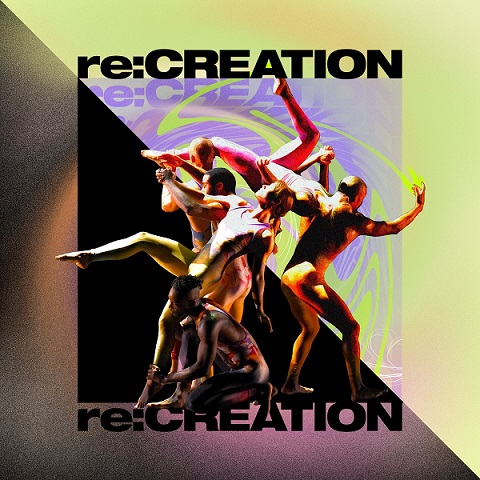
    Tuesday July 23rd, 2024 – It’s been a while since I last saw Pilobolus, and it was truly revelatory reconnecting with this unique, legendary dance company tonight at The Joyce. The season celebrates re:CREATION, a brilliant collection of works – old and new – from Pilobolus’s 50-year history which were offered on two specially-devised programs.

    Tonight’s program, entitled Dreams, featured five works; and while at times things seemed too same-y and certain passages went on too long, the cumulative force of the evening was incredibly powerful and meaningful on a personal level. Six dancers carried the entire evening, their awesome athleticism and boundless energy meshed with an innate sense of poetry and unstinting commitment to the work. 

    The program opened with Thresh|Hold, from Latinx choreographer and designer Javier De Frutos; several other names are listed in the program as collaborators. To shimmering music, the curtain rises on a closed door, which will become the epicenter of the piece. A rather haggard woman (the program tells us it’s either Marlon Feliz or Hannah Klinkman – not very helpful to someone attempting to write a review) opens the door and sits on the stoop; a male body is then thrown out onto the ground, and all hell breaks loose. The four men in the cast might be gestapo or just random trouble-makers. People chase each other about, torment the woman (or one another), whilst the door itself is the main character – spun about the stage, opened and closed at high speeds, allowing light to shine thru from varying angles. All this was handled with pinpoint timing by the dancers,

    As the piece unfolds, we hear a fractured recording of the Casta Diva from Bellini’s NORMA, merged with other noises, sometimes harsh or otherworldly. After the pitch of the aria sags and becomes incoherent, the melody resumes – now voiced by the inimitable Maria Callas, whose version has been used in numerous danceworks over the years…if you’ve never heard it, here it is.

    The dancework, nightmarish and somewhat incoherent, was engrossing to watch; the use of the door was truly clever and impressive. The woman (I believe it was Ms. Feliz) seems desperate to escape but is always thwarted, sometimes in mid-air. A men’s quartet near the end, with lifts, was oddly lyrical. The audience seemed captivated, and applauded heartily, but there were no bows.

    The New York City premiere of the duet Bloodlines followed; an epic love duet that packs a heart-rending wallop. Choreographed by the co-directors of Pilobolus, Renée Jaworski and Matt Kent, in collaboration with Ms. Feliz and Ms. Klinkman, who danced it together. The luminous ‘music-of-the-spheres’ score is attributed to five composers: Andre Heller, Michael Gordon, Elisapie Isaac, Eva Reiter, and Meredith Monk.

    Gorgeously lit by Diane Ferry Williams, Bloodlines was hypnotically danced as red rose petals fell from the sky. The two women, lovers, seem to retell the story of their love; they strike poses and move to jagged rhythms until a partnership is formed.

    To the sentimental sound of an old 78 recording for violin and piano, they become increasingly intimate, one dancer cradling the other. But something is amiss; thru age or illness, one of the women expires, leaving her beloved bereft. The two dancers brought so much beauty and poetry to this duet, making the end unbearably poignant.

    Still recovering from the emotional pull of Bloodlines, the deeply moving male quartet Gnomen sustained my intense involvement in what we were seeing and hearing. A tolling bell signals the opening of Gnomen, wherein we encounter a brotherhood of gnomes: ageless, deformed dwarves out of folklore who live in the earth.

    The four – Connor Chaparro, Quincy Ellis, Sean Langford, and Derion Loman – wear black briefs; they move hesitantly, seemingly in pain, with their bodies disfigured. They seem to be downtrodden victims of fate. Helping one another, their entwined figures struggle to walk. They appear to pray, and now the chime sounds louder: they move spastically, like contorted acrobats.

    The choreography is extremely athletic, strenuous, and demanding, and the dancers took it all in stride. Clockwork music and a dreamy harp are heard as the quartet attempt entwined tumbling. The sounds of the marimba transform to a melodious finish, with a sense of healing for the hapless creatures as the chimes sounds again. The seemingly healed gnomes kneel in prayer.

    After a longish intermission, Symbiosis – choreographed by Michael Tracy in collaboration with Renée Jaworski and Otis Cook – opens with thunder and lightning. To the music – a collage of pieces by Thomas Oboe Lee, George Crumb, Arvo Pärt, and Jack Body, played by the Kronos Quartet – dancers Marlon Fritz and Quincy Ellis, nearly nude, perform a sensuous duet. The elasticity and grace of their bodies develop an intimacy underscored by Mr. Pärt’s languid,  beguiling Spiegel im spiegel wherein the dancers tenderly see-saw in an embrace. The dancers’ athleticism takes on a poetic aspect as we surrender to the tender beauty of their entwined bodies. 

    Closing the program was Rushes, Pilobolus’s first collaboration with Israeli choreographers Inbal Pinto and Avshalom Pollak, and while it was overly-long and rather less engaging than the other works, there was an undercurrent which kept me focused.

    Circus music heralds the rise of the curtain, and we find five dancers – Mlles. Feliz and Klinkman and Mssrs. Chaparro, Ellis, and Langford – seated in wooden chairs in a circle of light. They seem to be waiting for something – a flight, perhaps? To the sound of rushing water, playful renderings of “Mary had a little lamb” and “Oh, they don’t wear pants on the sunny side of France” are fleetingly heard.

    Whimsical partnering, endless bouts of musical chairs, comic vignettes, and walkabouts come into play, but we don’t understand who these people are and what they are hanging about for. One character, played by Quincy Ellis, is an endearing elderly man with a suitcase full of dreams. In the end, the chairs are set in a row and the old man walks along them as the other dancers hastily move the seats so that his path remains endless. At the end. we again hear Arvo Pärt’s Spiegel im spiegelall of itwhich seemed to drag out the end of an otherwise engaging evening.

    ~ Oberon

  • CMS Summer Evenings 2023 ~ Concert 4

    Juho_Lisa-Marie Mazzucco jpg

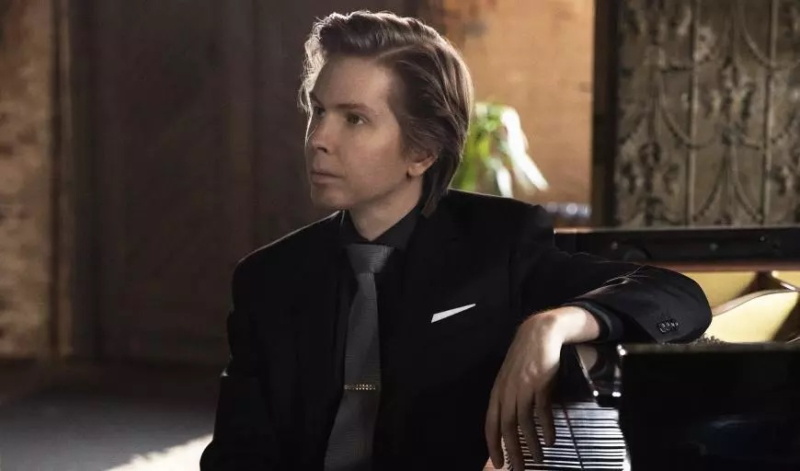
    Above: pianist Juho Pohjonen, photo by Lisa-Marie Mazzucco

    Author: Oberon

    Tuesday July 18th, 2023 – The final concert in Chamber Music Society of Lincoln Center‘s 2023 Summer Evenings series presented a quintet of distinctive artists in music of Haydn, Mozart, and Fauré. The remarkable Finnish pianist Juhi Pohjonen was at the center of this engrossing program, playing in all three works with the combination of passion and subtlety that is his trademark.

    Haydn’s Trio in E-flat major for Violin, Cello and Piano, Hob. XV:29, dating from 1797, made for an elegant start to the evening. The opening Poco allegretto commences with a sustained note from the three artists: violinist Stella Chen, cellist Sihao He, and Mr. Pohjonen. The music then progresses in a ‘theme and variations’ setting, briefly entering the minor mode. The pianist’s rippling florid passages delighted the ear, whilst violin and cello duetted lyrically.

    The pianist opens the Andante with the most delicate of pianissimi, taking up a simple melody in which the three voices blend sweetly. The ebb and flow of passion and restraint leads to a mini-cadenza from the pianist before the Allemande finale kicks off with a burst of energy.  Mr. Pohjonen spins off immaculate fiorature laced with trills, whilst Sihao He offers rapid cello scalework. After pausing for a playful piano passage, the music dances on: winding down, only to re-boot to a zesty finish.

    Mozart’s Concerto No. 12 in A -major for Piano and String Quintet, K. 414, was written in 1782 for the composer himself to perform, with a small ensemble; the string quartet setting was created later. This piece offers a perfect showcase for Mr. Pohjonen’s artistry.

    The opening Allegro features genial strings: violist Beth Guterman Chu has joined violinists Stella Chen and Danbi Um, with Sihao He’s mellow sound enriching the harmonies. Mr. Pohjonen’s marvelous tone and sparkling agility are pure magic. Ms. Guterman Chu, with a gleam in her eye, is a wonderful addition to the ensemble, whilst Sihao He’s rich-toned descending motifs are truly appealing. At last comes a fabulous Pohjonen piano cadenza, so gracefully played.

    The Andante suffered from the intrusion of two dropped objects and a jangling cellphone, but the artists kept their focus, opening with a string quartet. Mr. Pohjonen’s nuanced playing was just sublime, and I must again praise Sihao He’s plush sound. A minor-key piano passage underlined by sighing strings achieves a marvelous blend, and Mr. Pohjonen’s cadenza was offered in a hushed pianissimo, with trills etched in.

    The final Rondeau: Allegretto is lively indeed, with nimble, utterly clear piano phrases and unison string passages, which eventually develop into a fugue. Full stop…and then the pianist’s virtuosity was in full   flourish, pausing only for some enticing delicate measures along the way. Bravo Juho!

    Following a rather longish the interval, Gabriel Fauré’s Quartet in C-minor for Piano, Violin, Viola, and Cello No. 1, Op. 15, was given a luminous performance by Mr. Pohjonen, Danbi Um, Beth Guterman Chu, and Sihao He.

    The opening Allegro molto moderato momentarily has an à la Russe feeling, later becoming quietly rapturous. A piano theme is soon taken up by Danbi Um’s silken violin, then passed on to Ms. Chen and Ms. Guterman Chu. The music becomes overwhelmingly beautiful and passionate, before turning more lyrical. Mr. Pohjonen’s sorcery is again evidenced in the movement’s sustained conclusion.

    Delicate plucking opens the Scherzo, with sprightly motifs from the Steinway: all is lightness and air. Rhythms compete, the music covering a broad dynamic range with shifts of energy. After a false finish, the piano gently resumes. The unison strings then part company, taking up slithering scales. The music dances on, full of fun.

    Sihao He introduces the Adagio with an achingly gorgeous theme; the strings unite, and the pianist is at his most pensive. Danbi Um’s violin sounds radiantly, whilst the violist and cellist, playing in unison, introduce darker hues. These lower voices join Danbi in poignant harmonies. The music is lush and passionate until a sudden mood swing comes from the piano, playing pianissimo.  The the opening cello solo returns, and a feeling of time standing still gave me the chills…so haunting. Then Mr. Pohjonen offers a final benediction.

    In the final Allegro molto, we can simply sit there and savour the vibrant playing that’s on offer. Juho is beyond splendid, and bits of melody are passed about among the string players. After a brief interlude, the music seems to be summoning energy for a big finish, but instead there’s a full stop. From the silence, Danbi Um’s exquisite sound emerges, opening a pathway to a grand and sweeping finish.

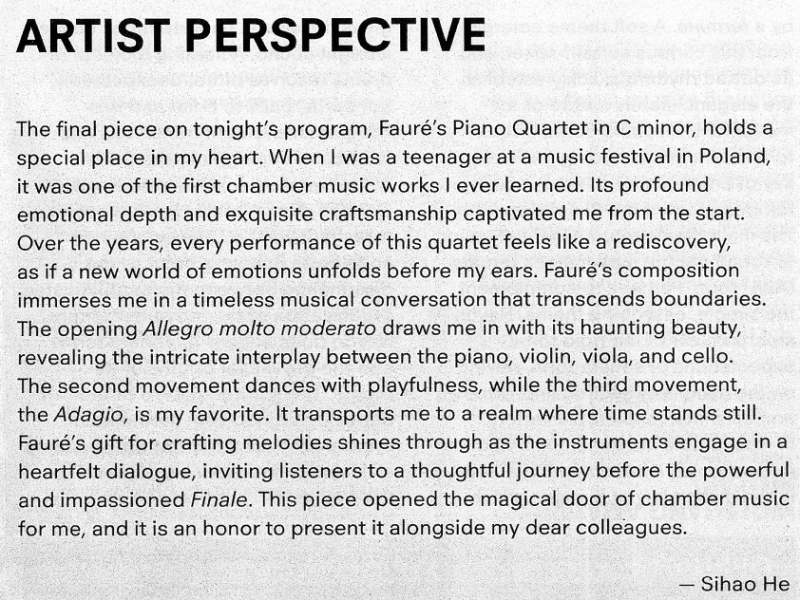
    Cellist Sihao He wrote of his experience learning the Fauré C-minor quartet as a teenager; I wanted to include his thoughts about the work here, as they align perfectly with my own:

    Faure-1 jpg

    ~ Oberon

  • Britten’s Endgame

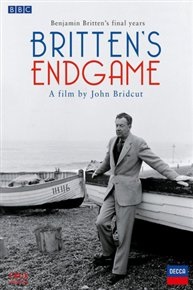
    9007000059671_1

    Tuesday July 19th, 2016 – I pulled this John Bridcut/BBC film off the shelf at the Performing Arts Library at Lincoln Center today, played it immediately on getting home, and found it thoroughly engrossing. The documentary focuses of the final years of the great composer’s life when – despite failing health – he churned out such masterworks as DEATH IN VENICE, the cantata PHAEDRA, and the 3rd String Quartet.

    Archival footage of Britten – conducting, playing the piano, chatting and performing with his life-companion Peter Pears, and greeting Queen Elizabeth II at the Aldeburgh Festival – is interspersed with interviews with both music-world luminaries (Dame Janet Baker, Steuart Bedford, Sir Charles Mackerras, Mark-Anthony Turnage) and people who knew the composer personally or were care-givers (David Hemmings, Sue Phipps, Rosamund Strode, his surgeon Dr. Michael Petch, and the tirelessly dedicated Rita Thomson). Thru their words and the reading of intimate letters, the film gives us a vividly personal portrait of Britten in the last three years of his life. 

    Then there are the superb musical excerpts, seemingly staged in the studio specially for this DVD. Absolutely splendid choral work from the Schola Cantorum of Oxford, including parts of Hymn to the Virgin, written when Britten was 16 years old. Tenor John Graham-Hall is most impressive as Aschenbach in scenes from DEATH IN VENICE; another tenor, Allan Clayton, joins horn player Michael Thompson in some gorgeous passages from the Serenade for Tenor, Horn, and Strings; the Fitzwilliam String Quartet’s ravishing playing of portions of the String Quartet #3 makes us doubly regretful that it was Britten’s last substantial work.

    In a magnificent performance, mezzo-soprano Sarah Connolly is a thrilling Phaedra; her singing is juxtaposed with Dame Janet Baker’s spoken recollections of collaborating with Britten on the cantata’s creation.

    Uk1.31.4

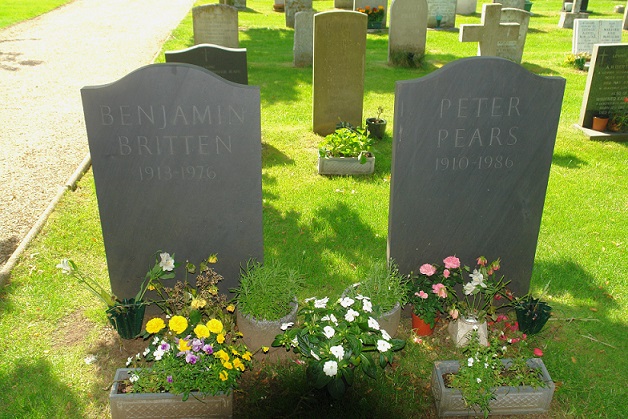
    Britten died of heart disease in 1976 at the age of 63, five years younger than I am now. He is buried next to Peter Pears in the Parish Churchyard, Aldeburgh.