Tag: Tuesday March

  • Joseph Parrish in Recital @ Merkin Hall

    Joseph Parrish

    ~  Author: Oberon

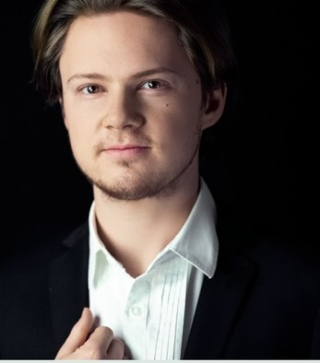
    Tuesday March 25th, 2025 – Young Concert Artists presenting bass-baritone Joseph Parrish (photo above) in recital at Merkin Hall, with Francesco Barfoed at the piano.

    I first heard Mr. Parrish in a performance of Pauline Viardot’s CENDRILLON given by City Lyric Opera in 2021; I was immediately impressed by his singing, acting, and charismatic personality. In 2023, he sang superbly at the Gerda Lissner Winners Concert, having won first prize in the song/lieder division. And in 2024, Mr. Parrish made a most convincing (and beautifully sung) Salieri in Rimsky-Korsakov’s opera MOZART AND SALIERI, performed by Parlando

    Tonight, Mr. Parrish showed that his is a voice that can bring people together. His stage presence is relaxed and cordial, with glimmers of humor along the way; it is a voice with an extensive range and a mastery of dynamics that allows him to veer impressively between hall-filling power and the most gentle of pianissimos. He can turn a phrase like a magician, whilst all the time his body language and expressive face draw listeners to him like a magnet. This is charisma personified.
    Pianist

    For the first half of the program, Mr. Parrish shared the stage with a stellar pianist: Francesco Barfoed (photo above). Francesco is a musician of extraordinary talent, his playing so perfectly aligned with the singer’s vision of the music.

     Mr. Parrish opened the evening with Harry Burleigh’s “Elysium”, and in this single song he set a very high standard for himself: a standard which he would often surpass as the concert progressed. “Elysium” displayed the voice’s sheer power, as well as its sense of control…the last note was simply awesome. More Burleigh next – “You ask me if I love you” – in which the singer details the sensations he experiences when with his beloved…as if to say: “Do you really need to ask?

    Classics from two masters of lieder followed: Mahler’s romantic Liebst du um Schönheit with its poetic words, so lovingly rendered, and Schubert’s immortal Ständchen, in which the pianist plays a major role; the music covers a big vocal range and part of the allure is in the detailing of subtle nuances. The song reached a majestic pinnacle but then ends quietly. Then back to Burleigh for “Her Eyes Twin Pools“; Mr. Barfoed’s playing here is essential to the song’s meaning, whilst the singer’s face, expressive hands, and slender form create a visual poem all their own. 

    Charles Brown’s ‘The Barrier‘ at first seems to sing of an admirer’s shyness in hesitating to approach the object of his desire, but there is another reason for his reluctance, revealed in the song’s final line. Whilst listening to the song, I was thinking: “How lovely…how poetic…” and then the last words sent a chill thru me. 

    Along The Dusty Road” by Hal Johnson seems like a folksong at first; a touch of the blues takes us to a spiritual place; Mr. Parrish sang so many beautiful notes in this song until reaching a whispered final tone that hung on the air.

    Charles Brown’s “Song Without Words” is just that. The singer begins with humming, then switches to what the French call “bouche fermée  which has a slightly different feel from plain old humming. The singer opens his mouth but no words emerge, just sound. Who knew vocalizing could be so expressive? 

    The New York Premiere of Psalm by YCA Composer-in-Residence Alistair Coleman draws on the old German hymn “How a Rose E’er Blooming“. The words “No one…” are repeated endlessly, as Mr. Parrish displays his vast dynamic range. The words change to “We were…we are…” and the music grows more passionate. The piano then introduces the carol itself, creating an air of fragrant softness. Hypnotically, “…the thorn…” now becomes the song’s lyric.

    After the interval, Mssrs. Parrish and Barfoed returned with a Margaret Bonds piece, You Can Tell The World“, a song with a theatrical feel – so alive – and giving the pianist a chance to shine brightly; it reaches a fantastical finish. Three beloved classics came next. First, “Deep River” in which Joseph made such a poignant impression, displaying the strength, range, and awesome breath control at his command. In “A City Called Heaven“, I had that uncanny feeling that he was singing just to me. At last, the triumphant “Ride On, King Jesus” in which his singing moved me so deeply with his range, power, and vitality.
    Children of the gospel choir

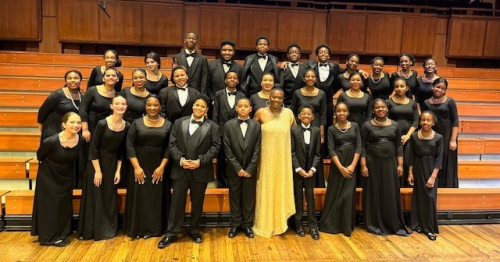
    Now the young singers of the Washington Performing Arts Children of the Gospel Choir (above) took the stage, greeted by a vociferous ovation. Dressed in black gowns and tuxedos, they are just plain gorgeous to behold. And then they sang! Under the elegant and inspiring conducting of the group’s artistic director Michele Fowlin, and accompanied by the delightful pianist Anthony “Tony” Walker, they dazzled Merkin Hall with their young voices, weaving perfect harmonies, gesturing poetically, and swaying to Mr. Walker’s marvelous rhythms. Judging by the perfection their singing achieved, I would guess Ms. Fowlin can be a demanding taskmaster, but also that she has a heart of gold. She seemed to glow with pride for her young prodigies.

    Their Praise Medley encompassed Greg Roberts’ Prelude to Worship, Rodnie Bryant’s We Offer Praise, and Richard Smallwood’s Anthem of Praise. The audience went crazy for these astounding kids, and Ms. Fowlin and Mr. Walker caused screams of joy to erupt as they took their bows. One boy in the choir reminded me so much of mi amor de loin, Brix, in far away Cebu; after one song, the boy fell to his knee and opened his arms as if to embrace the world.

    Mr. Parrish offered three more songs – Bobby McFerrin’s Don’t Worry Be Happy, the profound Let Us Break Bread Together, and Richard Smallwood’s Total Praise (Joseph at the piano himself…!); the last two songs were arrangements by Ms. Fowlin. By then, I’d pocketed my pen and was letting the magic carry me. So much joy filled the hall as the evening came to an end.

    ~ Oberon
  • Decoda ~ Verklärte Nacht

    Schoenberg

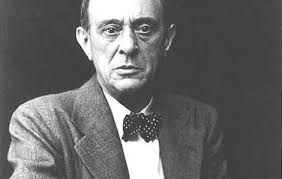
    Above: Arnold Schoenberg

    ~ Author: Oberon

    Tuesday March 11th, 2025 – A rare chance to hear Arnold Schoenberg’s Verklärte Nacht played live drew me to Weill Hall tonight where the work was on a program offered by Decoda, an ensemble of musicians who had first met while playing with Ensemble Connect.

    Songs by two pairs of husband-and-wife composers – the Schumanns and the Mahlers – opened the evening. Pianist Mika Sasaki played Robert Schumann’s “Eintritt” from Waldszenen, a melody that describes entering the forest path. Baritone Thomas Meglioranza and Ms. Sasaki then offered Herr Schumann’s Sehnsucht nach der Waldgegend“; any song with ‘sehnsucht’ (longing or desire) in the title is bound to please me.

    A sextet of string players now joined the pianist for Clara Schumann’s “Geheimes Flüstern“, in an arrangement by Clara Lyon; this brought forth soprano Lucy Fitz Gibbon, her voice light and charming.  

    Mr. Meglioranza stepped forward again for Gustav Mahler’s “Ich ging mit Lust durch einen grünen Wald” (arranged by Brad Balliett), expressively sung.

    Alma Mahler’sLicht in der Nacht” was sung by Ms. Fitz-Gibbon in an arrangement by Terry Cook (could this be the Terry Cook, a popular Met Opera basso who sang nearly 200 performances with the Company from 1983 to 2006?), accompanied by the sextet.

    During this lieder segment of the program, Ms. Fitz-Gibbon and Mr. Meglioranza did not lend an operatic feeling to their singing, but rather sounded like they were performing among friends at the Schumann’s salon.

    [Special note: anyone with an interest in Alma Mahler’s life and work should seek out the film Bride of the Wind.]

    From the concluding Alma Mahler song, the music led directly into the Schoenberg masterpiece, Verklärte Nacht; the players were Anna Elashvili and Clara Lyon (violins), James Thompson and George Meyer (violas), and Hannah Collins and Claire Bryant (cellos).

    The work was inspired by a collection of poems by Richard Dehmel published in 1896. Entitled Weib und Welt (Woman and the World), the saga speaks of a man and a woman as they walk through the moonlit woods on a frigid but clear winter evening. Guilt leads the woman to admit that, craving motherhood, she had become pregnant by another man before meeting and falling in love with her current amour. The woman stumbles miserably on in the silent darkness; but then the man tells her, “Do not let the child you carry burden your soul.” He pledges that he will love and care for the unborn child as if it were his own. They embrace, and they continue their walk on into the night, their love transfigured thru forgiveness.

    Played without break, the score mirrors the five sections of the poem: throughout, Schoenberg continuously transforms themes and motifs into an expressive musical depiction of the poem. The composer travels the road from the opening line of the poem – “Two people walk through bleak, cold woods…” to its marvelous finale: “Two people walk through exalted, shining night….”

    The playing by the Decoda artists was nothing less than sublime; as individual voices, and in their harmonizing and phrasing, the sextet summoned all the magic that the composer packed into his writing. Of special note was cellist Hannah Collins, whose rich-toned playing was both poetic and powerful.

    Despite what seemed to me a riveting performance thus far, audience distractions during the first half of the program were especially annoying, climaxing with a dropped metal water bottle at a particularly poignant moment in the Schoenberg. Although the second half the program certainly sounded interesting –  a work by four composers featuring all the evening’s artists – I decided to head out, taking the memories of the Schoenberg home with me. 

    ~ Oberon

  • Alarm Will Sound @ Zankel Hall

    Alarm will sound


    Above: concert photo by Fadi Kheir


    ~  Author: Shoshana Klein


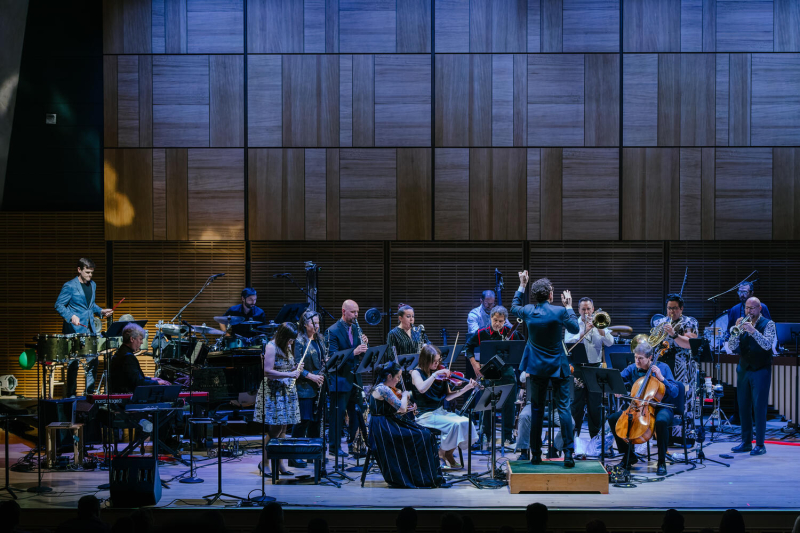
    Tuesday March 26th, 2024 – Though this concert started with slight technical difficulties, after  about 3 minutes, the whole rest of the show went on without a hitch. The pieces were played with minimal breaks and the show could have gone on with no applause, except that everyone was so excited about the pieces that there was a lot of excitement in between.


    There were audio introductions from each composer, and sometimes they even overlapped with the beginnings of the pieces. This created a really good flow that made the concert seem a little more connected and seamless than a normal program. This was actually my first official Alarm Will Sound concert despite being a fan of them for years. I’ve seen them in other contexts but not a fully programmed concert – it was a real treat! 


    The concert started with a piece by Tania León, who curated the concert in her capacity as the Richard and Barbara Debs Composer’s Chair of Carnegie Hall. Her piece was cool, groovy and fun, scored for small ensemble. 


    The second piece, by Chris P. Thompson, had some basis in drum corps, as explained by his introduction. It was really cool to hear about marching band in the context of “classical music”. I think it often gets ignored as an art form or a rigorous type of music when it’s actually pretty difficult in a way that was contextualized really well by the introduction to this piece, which was also really fun. The piece had a lot of rhythmic complexity and was really upbeat. One effect that was used was these tubes that are swung around by various musicians to create a pitch (and the pitch changes based on how quickly you swing the tube). I’ve been seeing this used in new music spaces more often recently and in this particular instance it did evoke the marching band – the coordination and visual aspects, or maybe more specifically the color guard spinning flags around on the field.


    The next piece was by Christian Quiñones (who I worked with a couple of years ago but we’d never met in person!) His piece was really cool and also had lighting effects attached to the electronic sounds, which was an interesting though slightly jarring experience. The sounds were a little glitchy but rhythmic in a way that sounded really cool. The piece was based on the sound of hearing loss – sounds becoming obscured and distorted throughout. 


    The last piece on the first half, in my opinion, was definitely the show stealer. It was an excerpt of an opera by Damon Davis and he called it in his introduction a “black rap space opera”. I had moments of feeling like some of the music was familiar to the point where I wondered if I’d heard it before – but I think it was just that type of music, kind of magical in its familiarity as well as its novelty. It was well orchestrated, interesting in the way it used members of the ensemble as characters or kind of as set pieces. The songs were beautiful but also definitely post-genre, almost more similar to musical theater than anything. The music and the story were optimistic in a mythological way, almost like Disney or Miyazaki. Everybody seemed to want to hear the whole thing. This was a fragment of a larger work that will hopefully be performed soon!


    The second half started with a piece by Elijah Daniel Smith which had a different tone – more subdued and introspective than the first half. It had a lot of really interesting sound worlds accompanying a narration that was interesting and impactful.


    Next was a piece by Texu Kim that was rhythmic and upbeat and ended a frenzy of rhythm that was perhaps intentionally impossible to keep completely together, which was a nicely unconventional end to the piece.


    Next was a five movement piece by Bora Yoon that was eclectic. There were moments of poetry, moments that felt conversational, and really interesting sound worlds including a prepared piano and an instrument she seemed to have made out of bicycle bells. The last movement particularly struck me – it was really really beautiful around an ocean theme. I wish I had more to say about this piece – it was delightful and brought us through many emotional spaces in a short time.


    Tania and alan pierson


    Above: Tania León and Alan Pierson; photo by Fadi Kheir
     
    Before the last piece, we heard a little bit from Ms. León. She, with the help of Alarm Will Sound‘s Alan Pierson, framed the concert within the context of this question that her father had asked her right before he died. In this conversation she showed him some of her music and he’d asked her where she was in it. Every explanation by the composers in this concert told where they as a human were in their music. It really tied the whole thing together in addition to the fact that after this conversation, The ensemble played the León from the beginning but arranged for the full ensemble. Bringing back the piece from the beginning was a really cool effect. Unfortunately, I didn’t really remember it that well but I still liked the symmetry of it. All in all, it was a little bit of a long concert but everything was so good that I don’t know what I would have been able to leave out!
     
    ~ Shoshana Klein

  • Arensky & Brahms @ Chamber Music Society

    Bella2

    Above: violinist Bella Hristova, photographed by Lisa-Marie Mazzucco

    Author: Oberon

    Tuesday March 28th, 2023 – Works by Anton Arensky and Johannes Brahms were on the bill at Chamber Music Society of Lincoln Center this evening as violinist Bella Hristova, cellist Dmitri Atapine, and pianists Wu Qian and Wu Han teamed up for some magical music-making.

    The concert commenced with Arensky’s Six Children’s Pieces for Piano, Four Hands, Op. 34, composed in 1894. These charming miniatures found our two pianists side by side at the Steinway, with Wu Han presiding over the upper octaves and Wu Qian the lower.

    To give the pieces their English titles, we start with Fairy Tale which begins in the minor key, has a folkish feeling, and then becomes quite dramatic. Wu Han plays a series of decorative trills as the music ranges from hesitant to animated. Then, Wu Qian plays the familiar two-note birdcall that signals the delightful Cuckoo bird is nearby. This is a sprightly little piece with a subtle finish. The mood changes for Tears, which has the feel of a lament, with a deep bass line supporting a hymn-like melody. The ending is very quiet.

    Rippling motifs underscore the lovely Waltz, which gets quite bouncy. A passing reverie turns expansive before fading away, as if the dance was continuing in another room. Cradle Song appropriately has a slow, rocking feeling; the melody is that of a gentle lullaby. The concluding Fugue on a Russian Theme is tuneful and jovial. The music turns grand, and the two pianists have a grand time playing it.

    Dmitri-atapine

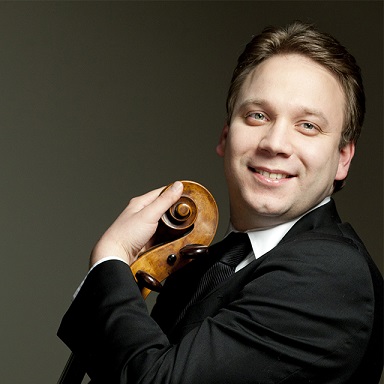
    Listening to Bella Hristova and Dmitri Atapine (above), joined by Wu Qian, play the Arensky Trio No. 1 in D -minor for Piano, Violin, and Cello, Op. 32, makes one wonder why we don’t hear more of this composer’s gorgeous music. He wrote copiously for solo piano, and numerous chamber works as well. And why cannot we hear more of his large orchestral works – which include two symphonies – or his choral pieces?  He also wrote three operas, which must be wonderful to experience.

    At any rate, we must be thankful for any opportunity to hear the music of this pupil of Tchaikovsky, especially when it as a luminously played as this evening. The introductory theme of the opening Allegro moderato, first played by Ms. Hristova and then taken up by Mr. Atapine, is hauntingly beautiful. These virtuosos bring such richness of timbre to everything they play, and this trio – a veritable font of melody – affords them so many opportunities.

    It is restless, passionate music, interrupted by a Springlike interlude in which Wu Qian spins lovely swirling passages from the Steinway. Now a sense of drama takes hold; the opening theme recurs, played – if it’s possible to imagine – even more thrillingly. There is a coda full of lyrical grace before the movement ends quietly.

    The ensuing Scherzo opens with an odd, stuttering quality. There are crisp plucking and jaunty melodies to be savoured, whilst at the keyboard Wu Qian offers cascades of notes decorated with lively trills. Now a swaying feeling takes over, and the music gets grand. After a brief hesitation, the stuttering resumes and the Scherzo comes to its whimsical finish.

    The evocative Elegia is the heart of the trio: Mr. Atapine opens with a pensive theme, then the string voices entwine as Wi Qian introduces poetic phrases from the keyboard. The music seems to evoke the memory of a lost love as the gently rocking strings sound over the quiet rapture evoked by the pianist. Ms. Hristova in her high range, the pianist pulsing quietly, and Mr. Atapine plucking ever so gently give the music an ethereal quality. Ms. Hristova takes up an autumnal melody as Mr. Atapine’s deep resonance sounds and the music fades away on a sustained chord.

    A reverential silence filled the hall, and then the agitated drama of the final Allegro non troppo sprang up. Things cool off, melodic phrases are exchanged, but then restlessness builds and the music becomes impassioned. From a sudden silence, Wu Qian’s shimmering notes are heard as the strings sing softly. The music ascends, and becomes reflective with the poignant violin and the soulful cello sounding. Then, out of the blue, a bustling rush to the finish line springs up. 

    The music of Johannes Brahms took the limelight after the interval: our two pianists returned for selections from the composer’s Hungarian Dances for Piano, Four Hands; Wu Qian was now playing the upper range and Wu Han the lower. These delightful pieces were written between 1868 and 1880, and they are chock full of rhythmic and melodic variety, spiced with a dose of paprika. The two women seemed to be having a blast playing them, much to the audience’s delight.

    Bringing the evening to its close, Wu Han, Ms. Hristova, and Mr. Atapine illuminated the Brahms Trio in C-major Op. 87, with sumptuous playing.

    In the opening Allegro, a unison theme for violin and cello develops int something big ad thrilling. When cal finally settles in, a sense of yearning is felt. The textures created by the three players are rich indeed, each displaying alluring tone that meshes into a persuasive whole. Epic grandeur develops as we relish Wu Han’s superbly polished playing, which takes the movement to a royal finish.

    Unison strings again herald the Andante con moto: a theme with five variations. The music takes on a gypsy air, reflecting Brahms’ interest in Hungarian music, which began in his youth. Here the blend achieved by our three artists was nothing short of remarkable, continually drawing me in to the music, which reaches a touching, quiet ending.

    In the brisk Scherzo, I sensed a Mendelssohnian enchantment. Lush melodies sprang up, and there’s a songful outpouring before a feeling of Puck lurking about returned at the music’s sudden stop.

    From its opening agitato, the concluding Allegro giocoso brings an abundance of delicious melodic and rhythmical treats, and the Mendelssohn mood continued to be felt. The musicians were warmly cheered as they took their bows, and I simply must mention Ms. Hristova’s bejeweled shoes, which added an extra sparkle to an already brilliant evening.

    ~ Oberon

  • Bella Hristova @ Merkin Hall

    Hristova

    Above: violinist Bella Hristova

    ~ Author: Oberon

    Tuesday March 26, 2019 – A thoroughly impressive and enjoyable evening at Merkin Hall, as Young Concert Artists presented violinist Bella Hristova in a recital that mixed the familiar with the rare. A striking Bulgarian-born beauty, Ms. Hristova had a perfect colleague in pianist Anna Polonsky; together, the two women evoked a shouting, standing ovation at the end of their program. 

    Glamorously gowned in black, Ms. Hristova seemed to have stepped off the fashion runway and onto the Merkin stage. The abundant richness of her tone – which maintains its allure throughout the dynamic range and even at speed-of-light tempos – is matched to a mastery of technique and a depth of emotion that makes her a paragon among violinists of the day. 

    Mlles. Hristova and Polonsky opened their imaginative program with Olivier Messiaen’s Theme and Variations, a work which deserves wider exposure. Composed in 1932 – nearly a decade before the composer’s monumental Quartet for the End of Time – the opening Thème has a dreamlike quality, with a sustained violin line and a marvelous role for the piano. The ensuing five variations bring a buildup of speed, tension, and drama which climax with the fourth – marked Vif et passionné – before calm descends in the final Tres modéré, with its sustained ending. At the Steinway, Ms. Polonsky brought a wonderful forward impetus as the first four variations progressed, whilst Ms. Hristova dispatched the swift passages and some lively trills with élan. The Vif et passionné movement found the violinist playing on high over accents from the keyboard: the music reaches a grand passion indeed. The return to a more peaceful mood was finely evoked by the two musicians. Insistent applause drew them back for a bow, the pianist’s red shoes an added delight to the evening’s visual aspects.

    In a violin ‘test piece’ sans pareil, Ms. Hristova dazzled the crowd with Ellen Taafe Zwilich’s Fantasy for solo violin. And a test piece it literally is, having been written by Ms. Zwilich as a compulsory work for the Indianapolis Violin Competition. From a passionate start, Ms. Hristova soars on high; later the music percolates, and there’s a touch of the blues. Stretches of coloratura were effortlessly dispatched, some of them extremely fast…and delicate. The music rises to a shining softness, then morphs into an agitato that develops into a rocking sway. Simmering down, Ms. Hristova plays high and sublime before the Fantasy‘s brilliant ending. The audience went wild for this exciting piece, again summoning Ms. Hristova back to bask in a wave of affection. I was hoping that the composer might be among us, so we could express our admiration. 

    There followed a thrilling rendering of the beloved Partita no. 2 in D-minor, BWV 1004, by J S Bach. Ms. Hristova was not only in total command of every aspect of this music, she brought a distinctive glow to it that made it seem ever fresh and vital. The thoughtful melody of the Allemande showed her radiant tone, pristine articulation, lovely phrasing and dynamics. What more could we ask? In the lively dance of the Courante, Ms. Hristova’s flowing musicality carried us along. The melancholy Sarabande was beautifully played, with exquisite touches, and in the Gigue, the reams of fiorature – played very fast – had true clarity, further enhanced by dynamic nuance. An astonishing display of virtuosity…a real treat!

    In the famous Chaconne which concludes the Partita, Ms. Hristova’s passionate playing – and her inspired control as she shaped her vision of this masterpiece – made me wish it could go on and on. The audience, having been held under her spell throughout, gave the violinist a fervent ovation, so eminently deserved.

    Annapiano

    Above: pianist Anna Polonsky

    Arnold Schönberg’s Phantasy for violin and piano, Op. 47, is a remarkable piece which I’d never heard before. After a jagged start, quiet settles briefly over a misterioso passage for the piano; this peace is broken by slashes from Ms. Hristova’s violin, and her isolated notes, plucked from the air. Music of near violence alternates with moments of gentle, somewhat eerie lyricism.

    With Ms. Polonsky playing twinkling notes in the upper end of the keybord, Ms. Hristova joins on the heights. After a whimsical passage, there’s sudden drama, followed by some sneaky music which then turns quite perky. Again, the lyric and the spiky take turns, becoming intense. A pulsating violin note creates a buzz. The Phantasy ends suddenly. 

    Olde World richness of musicality and grace marked evening’s final offering: Johannes Brahms’ Sonata no. 3 in D-minor, Op. 108. Of this familiar piece, I need only say that both violinist and pianist played with overwhelming tenderness and compelling beauty of sound. The hall felt like a haven for those of us seeking solace in a darkening world; for such moments of hope and contentment – however fleeting – I feel a deep gratitude.

    As the two artists beamingly acknowledged the wildly enthusiastic applause of the standing audience, there was no question that an encore was in demand. With sublimely poised lyricism, the players offered a Bach Largo that felt like a benediction, eliciting murmurs of admiration as the music came to an end.

    ~ Oberon
  • CMS Winter Festival 2018 – #3

    Shanghai-Quartet-Header

    Above: the Shanghai Quartet

    ~ Author: Oberon

    Tuesday March 27th, 2018 – The last concert of Chamber Music Society of Lincoln Center‘s Winter festival, entitled Chamber Music Vienna.

    Ignaz Schuppenzigh (1776-1830) is credited with pioneering the ‘chamber music series’. Schuppenzigh was a violinist and a friend of Beethoven who presented over a hundred chamber music concerts in Vienna between 1823 and 1828. Works of Haydn, Mozart, and Beethoven were prominently featured in the programming, and it is precisely those three composers whose music we heard this evening.

    But tonight’s concert had a deeper significance, for it duplicated exactly the program Schuppenzigh offered in Vienna on March 26th, 1827 – the very day that Beethoven passed away. In fact, it has been determined that the moving Largo con espressione from Beethoven’s Trio in G major, Op. 1, No, 2, was being played the exact time of the great man’s passing. 

    The Shanghai Quartet opened this evening’s concert with Haydn’s Quartet in G major for Strings, Hob. III:81, Op. 77, No. 1 (1799). The Shanghai have their own distinctive sound, cool and concise, suited well to both their Haydn and Mozart offerings on this program.

    The opening movement of the G major quartet, marked Allegro moderato, has a feeling of perpetual motion, somewhere between a march and a dance. There are ingratiating modulations and the writing is quite florid. By contrast, the Adagio, with its unison opening, has an almost operatic feeling. Courtly, and with gracious harmonies, the first violin sings forth and then engages in a duet with the deepening cello. Rising modulations – with the cello ever-prominent – bring a da capo which, with varying harmonics, reaches an emotional level I don’t often feel in Haydn’s music. The Shanghai made much of this movement’s sheer beauty.

    The Minuet has the genuine air of a scherzo; it’s fun, with swirls of notes carrying the violin on high. The swift, unison start of the Finale: Presto brings some very nimble playing from the Shanghai’s 1st violinist, Weigang Li; the music becomes genuinely exhilarating.

    Next came Mozart: his Quartet in D-major for Strings, K. 575, is one of the “Prussian” quartets (dating from 1789) and as such features the cello as a nod to the cello-playing king, Friedrick Wilhelm II. In the opening Allegretto, it is the cello that presents the second theme; here, and throughout the piece, the Shanghai’s Nicholas Tzavaras shone.

    While the Andante clearly showcases the cello, Mozart doesn’t shirk on opportunities for the violist – Honggang Li – or the violins, Weigang Li and Yi-Wen Jiang. Mr. Tzavaras is really in his element with the melodies, and at one point a matched phrase is passed from voice to voice. Quite inventive.

    Following the light, jesting feeling of the Menuetto (Allegretto), the concluding Allegretto‘s theme takes the cello to its high register. A decorative canon pops up before we reach the finale. 

    785535479-ludwig-van-beethoven-central-cemetery-tomb-vienna-austria

    Above: Beethoven’s tomb in Vienna’s Central Cemetary

    The evening ended with Beethoven’s Trio in G major for Piano, Violin, and Cello, Op. 1, No. 2. Pianist Gilbert Kalish, violinist Arnaud Sussmann, and cellist Paul Watkins took the stage for a first-rate performance of this work from a still-young composer.

    Following a slow introduction, in which the lovely blend of the strings and the stylish Steinway work of Mr. Kalish heralded delights to come, the first movement goes Allegro in quite a lively, sometimes folkish manner. The writing has its witty aspects, but the two women in front of us decided they’d never heard anything so hilarious, and they struck up a running conversation, laced with chuckles. Shushing was to no avail.

    Arnaud Sussmann’s absolutely gorgeous tone made a glowing impact in the Largo con espressione, inter-weaving with the bounteous beauty of Mr. Watkins’s cello to irresistible effect as refined romance bloomed from the keyboard. This Largo is considered to be Beethoven’s first great slow movement.

    Following the Scherzo, which bounces from major to minor and back, light-weight agitation marks the Finale: Presto. One violin motif seems like a pre-echo from Rossini’s GUILLAUME TELL overture. With its rhythmic vitality and breezy, devil-may-care lilt, the Presto comes to a vivacious end.

    ~ Oberon

  • CMS Winter Festival 2018 – #3

    Shanghai-Quartet-Header

    Above: the Shanghai Quartet

    ~ Author: Oberon

    Tuesday March 27th, 2018 – The last concert of Chamber Music Society of Lincoln Center‘s Winter festival, entitled Chamber Music Vienna.

    Ignaz Schuppenzigh (1776-1830) is credited with pioneering the ‘chamber music series’. Schuppenzigh was a violinist and a friend of Beethoven who presented over a hundred chamber music concerts in Vienna between 1823 and 1828. Works of Haydn, Mozart, and Beethoven were prominently featured in the programming, and it is precisely those three composers whose music we heard this evening.

    But tonight’s concert had a deeper significance, for it duplicated exactly the program Schuppenzigh offered in Vienna on March 26th, 1827 – the very day that Beethoven passed away. In fact, it has been determined that the moving Largo con espressione from Beethoven’s Trio in G major, Op. 1, No, 2, was being played the exact time of the great man’s passing. 

    The Shanghai Quartet opened this evening’s concert with Haydn’s Quartet in G major for Strings, Hob. III:81, Op. 77, No. 1 (1799). The Shanghai have their own distinctive sound, cool and concise, suited well to both their Haydn and Mozart offerings on this program.

    The opening movement of the G major quartet, marked Allegro moderato, has a feeling of perpetual motion, somewhere between a march and a dance. There are ingratiating modulations and the writing is quite florid. By contrast, the Adagio, with its unison opening, has an almost operatic feeling. Courtly, and with gracious harmonies, the first violin sings forth and then engages in a duet with the deepening cello. Rising modulations – with the cello ever-prominent – bring a da capo which, with varying harmonics, reaches an emotional level I don’t often feel in Haydn’s music. The Shanghai made much of this movement’s sheer beauty.

    The Minuet has the genuine air of a scherzo; it’s fun, with swirls of notes carrying the violin on high. The swift, unison start of the Finale: Presto brings some very nimble playing from the Shanghai’s 1st violinist, Weigang Li; the music becomes genuinely exhilarating.

    Next came Mozart: his Quartet in D-major for Strings, K. 575, is one of the “Prussian” quartets (dating from 1789) and as such features the cello as a nod to the cello-playing king, Friedrick Wilhelm II. In the opening Allegretto, it is the cello that presents the second theme; here, and throughout the piece, the Shanghai’s Nicholas Tzavaras shone.

    While the Andante clearly showcases the cello, Mozart doesn’t shirk on opportunities for the violist – Honggang Li – or the violins, Weigang Li and Yi-Wen Jiang. Mr. Tzavaras is really in his element with the melodies, and at one point a matched phrase is passed from voice to voice. Quite inventive.

    Following the light, jesting feeling of the Menuetto (Allegretto), the concluding Allegretto‘s theme takes the cello to its high register. A decorative canon pops up before we reach the finale. 

    785535479-ludwig-van-beethoven-central-cemetery-tomb-vienna-austria

    Above: Beethoven’s tomb in Vienna’s Central Cemetary

    The evening ended with Beethoven’s Trio in G major for Piano, Violin, and Cello, Op. 1, No. 2. Pianist Gilbert Kalish, violinist Arnaud Sussmann, and cellist Paul Watkins took the stage for a first-rate performance of this work from a still-young composer.

    Following a slow introduction, in which the lovely blend of the strings and the stylish Steinway work of Mr. Kalish heralded delights to come, the first movement goes Allegro in quite a lively, sometimes folkish manner. The writing has its witty aspects, but the two women in front of us decided they’d never heard anything so hilarious, and they struck up a running conversation, laced with chuckles. Shushing was to no avail.

    Arnaud Sussmann’s absolutely gorgeous tone made a glowing impact in the Largo con espressione, inter-weaving with the bounteous beauty of Mr. Watkins’s cello to irresistible effect as refined romance bloomed from the keyboard. This Largo is considered to be Beethoven’s first great slow movement.

    Following the Scherzo, which bounces from major to minor and back, light-weight agitation marks the Finale: Presto. One violin motif seems like a pre-echo from Rossini’s GUILLAUME TELL overture. With its rhythmic vitality and breezy, devil-may-care lilt, the Presto comes to a vivacious end.

    ~ Oberon

  • Paul Taylor @ Lincoln Center 2016 – Part II

    ImageProxy.mvc

    Above, one of the best of the best: Robert Kleinendorst of PTAMD

    Tuesday March 29th, 2016 – This evening’s performance by Paul Taylor’s American Modern Dance in the final week of their Lincoln Center season opened with a classic Taylor ‘white’ ballet, Equinox, set to music of Johannes Brahms which was performed (lovingly) live by a string quintet.

    Two principal couples – Laura Halzack with Robert Kleinendorst and Paris Khobdeh with Michael Apuzzo – perform some of Paul Taylor’s most inventive and pleasing partnering passages with a feeling of lyrical athleticism. A long solo by Ms. Halzack was enchanting to behold. A quartet of dancers – too stellar to be deemed “supporting” – moved with captivating urgency and grace: Michelle Fleet, Eran Bugge, Sean Mahoney, and James Samson. The white costumes evoke Summer, but the Brahms themes hint at the approach of Autumn. Heartfelt dancing and playing from everyone involved.

    The Weight of Smoke (a new Doug Elkins work) was a hot mess. The choreography is loaded with gimmicks and clichés while the fusion of Baroque (here, Handel) with contemporary club beats and noisy effects has been done before and has lost its cleverness. The dancers may have enjoyed the opportunity to cut loose, not having to think too much about technique or precision, but to me (and my choreographer-companion) the work seemed endlessly aimless and mildly embarrassing. Laced with gender-bending elements, with two women in a sustained kiss, and sashaying gay-boy stereotypes, the work ambled on with lots of energy being expended on retro-provocations. In the end, I was thinking: “You have sixteen of the best dancers on the planet to work with, and this is what you came up with?” 

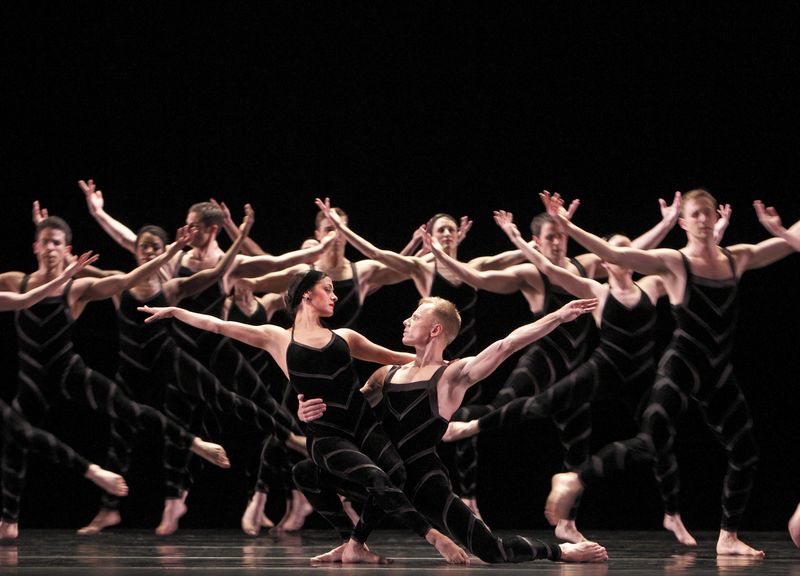
    The evening ended on the highest of possible high notes with Paul Taylor’s Promethean Fire; the same sixteen dancers who slogged their way thru the tedious Elkins now appeared in Santo Loquasto’s incredible black costumes and treated us to a feast of impeccable dancing in this darkly dazzling ballet.

    Paul Taylor’s choreography here gives Mr B a run for his money in terms of musicality and structure…and it looks gorgeous on Mr. B’s own stage. The Leopold Stokowski orchestrations of music by J. S. Bach seem jarring at first but Mr. Taylor was right to choose them as they mesh well with the opulent energy of the dancing.

    The live music (Orchestra of Saint Luke’s under Donald York’s baton) was a wonderful enhancement to the onstage splendour; it’s a great piece for zeroing in on individual dancers as they move with such assurance and beauty of spirit thru choreography that must be a sheer delight to dance.

    Promethean_8456_retouch

    The central passage of Promethean Fire is a pas de deux which was danced tonight by Parisa Khobdeh and Michael Trusnovec (above). Their physical allure and their sense of the importance of the steps and port de bras made this such a richly rewarding experience, both visually and spiritually.

    Production photo © 2015 Paul Taylor’s American Modern Dance

  • Paul Taylor @ Lincoln Center 2016 – Part II

    ImageProxy.mvc

    Above, one of the best of the best: Robert Kleinendorst of PTAMD

    Tuesday March 29th, 2016 – This evening’s performance by Paul Taylor’s American Modern Dance in the final week of their Lincoln Center season opened with a classic Taylor ‘white’ ballet, Equinox, set to music of Johannes Brahms which was performed (lovingly) live by a string quintet.

    Two principal couples – Laura Halzack with Robert Kleinendorst and Paris Khobdeh with Michael Apuzzo – perform some of Paul Taylor’s most inventive and pleasing partnering passages with a feeling of lyrical athleticism. A long solo by Ms. Halzack was enchanting to behold. A quartet of dancers – too stellar to be deemed “supporting” – moved with captivating urgency and grace: Michelle Fleet, Eran Bugge, Sean Mahoney, and James Samson. The white costumes evoke Summer, but the Brahms themes hint at the approach of Autumn. Heartfelt dancing and playing from everyone involved.

    The Weight of Smoke (a new Doug Elkins work) was a hot mess. The choreography is loaded with gimmicks and clichés while the fusion of Baroque (here, Handel) with contemporary club beats and noisy effects has been done before and has lost its cleverness. The dancers may have enjoyed the opportunity to cut loose, not having to think too much about technique or precision, but to me (and my choreographer-companion) the work seemed endlessly aimless and mildly embarrassing. Laced with gender-bending elements, with two women in a sustained kiss, and sashaying gay-boy stereotypes, the work ambled on with lots of energy being expended on retro-provocations. In the end, I was thinking: “You have sixteen of the best dancers on the planet to work with, and this is what you came up with?” 

    The evening ended on the highest of possible high notes with Paul Taylor’s Promethean Fire; the same sixteen dancers who slogged their way thru the tedious Elkins now appeared in Santo Loquasto’s incredible black costumes and treated us to a feast of impeccable dancing in this darkly dazzling ballet.

    Paul Taylor’s choreography here gives Mr B a run for his money in terms of musicality and structure…and it looks gorgeous on Mr. B’s own stage. The Leopold Stokowski orchestrations of music by J. S. Bach seem jarring at first but Mr. Taylor was right to choose them as they mesh well with the opulent energy of the dancing.

    The live music (Orchestra of Saint Luke’s under Donald York’s baton) was a wonderful enhancement to the onstage splendour; it’s a great piece for zeroing in on individual dancers as they move with such assurance and beauty of spirit thru choreography that must be a sheer delight to dance.

    Promethean_8456_retouch

    The central passage of Promethean Fire is a pas de deux which was danced tonight by Parisa Khobdeh and Michael Trusnovec (above). Their physical allure and their sense of the importance of the steps and port de bras made this such a richly rewarding experience, both visually and spiritually.

    Production photo © 2015 Paul Taylor’s American Modern Dance

  • Bewitched? We Bitched! Met MACBETH

    Witch-brew-66170

    Tuesday March 20, 2012 – I have no one to blame but myself, really. When the Met calendar for the current season came out, I skipped easily over MACBETH even though it is an opera I love: “Not with that cast!” But then a few weeks ago I was listening to the Leinsdorf recording and decided it would be good to experience MACBETH in the opera house. Despite the currrent Met trend for unmemorable productions and often brainless casting, I decided to give it a try. 

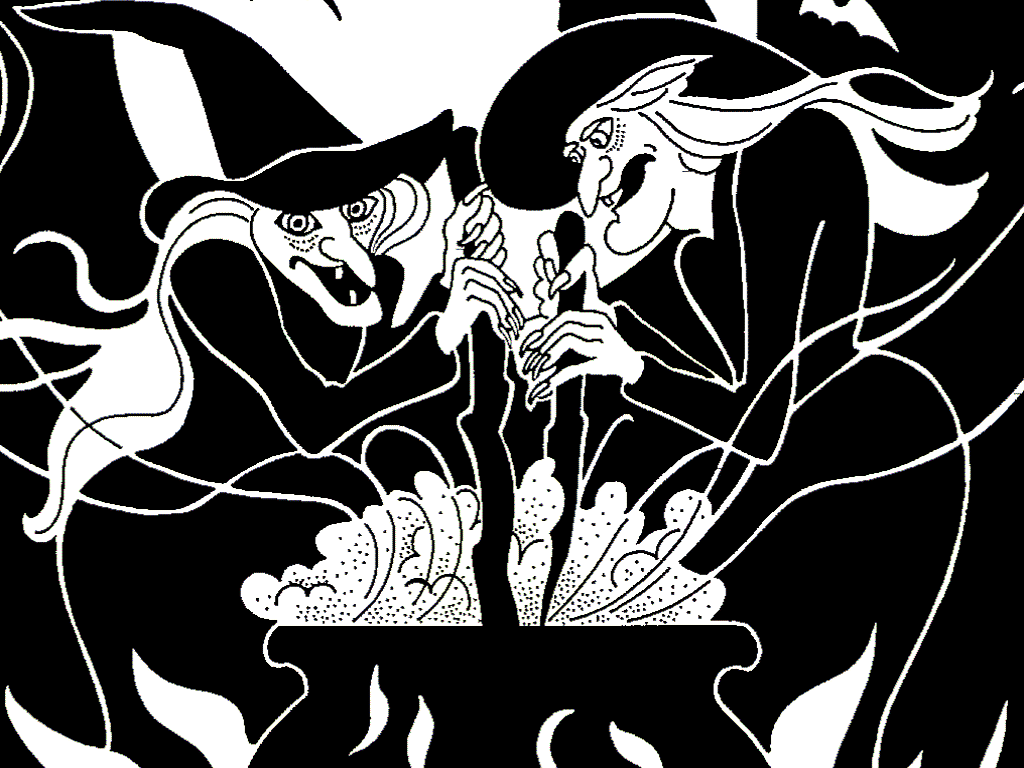
    I’d seen this production before; I love the huge moon with the black, scudding clouds that fills the proscenium as we wait for curtain-rise. But then the opera starts with the trivialized witches in 30s housedresses, coats and purses (each purse contains lightbulbs, how clever!). They are not sinister or even mildly interesting dramatically. And thus the production is off to a ho-hum start, and proceeds on its dreary way with injections of blood and vomit meant to shock us. It doesn’t work.

    Gianandrea Noseda is often a fine helmsman at the opera, but tonight his MACBETH was workaday, and the chorus seemed uninspired. I very much liked the firm and dark-hued basso of Gunther Groissbock as Banquo; to hear his aria would have been the only reason to stay longer than we did. But not reason enough.

    Over the years I have greatly enjoyed Thomas Hampson’s performances at The Met, but although he’s been fine in the more lyrical Verdi roles of Posa and Germont he simply doesn’t have what it takes for the big-guns parts like Boccanegra or Macbeth. It’s a bit like the borderline between a Merrill and a Warren: the former never trespassed into the Nabucco/Boccanegra/Macbeth region which suited (or would have) the latter so well. It’s a matter of amplitude. The sound of the Hampson voice is still fine, steady and more resonant than I expected. But it’s not Italianate in the least, it doesn’t billow and bloom with the turns of phrase or sail grandly on the words. Verbal over-emphasis, a common gimmick for over-parted singers, was a distration in a few places, as was a tendency to be ever-so-slightly sharp pitchwise. Yet still there was a lot to admire in his vocalism.

    I’d heard Nadja Michael about ten years ago singing the mezzo part in the Verdi REQUIEM at Avery Fisher Hall. She sounded awful. Of late her name has cropped up as Salome in a European production that has made it to DVD (so many productions do these days, god knoweth why). I was expecting nothing from her vocally as Lady Macbeth, and that’s what I got. I’ve heard lots of bad, unattractive or hopeless singing in my day but usually it either has to do with a ‘beloved’ singer being past his/her prime, or a perfectly respectable singer attempting a role beyond his/her capabilities, or being indisposed but giving it a go to ‘save’ the evening. In these instances, you can usually still perceive that there is a real instrument at work but just not suited – for whatever reason – to the task at hand. There’s no such excuse to be made for Ms. Michael: this is how she sounds.

    Obviously no one at The Met these days knows or cares enough about singing to have sorted this out in advance.  Would this woman have passed an audition for the East Buttfcuk, Idaho community choir?  I dunno, but somehow she’s entrusted with a great Verdi role at The Met. Her first aria was a mess and wtf is up with giving her a repeat of the cabaletta? Once was more than enough: the voice is shallow, desperate, breathy, wobbly, harsh and grossly unpleasant. Some people have said: “At least she has the high notes!” Yeah, if ill-pitched, desperate screeching counts. Following “Vieni, t’affretta” there was one prominent ‘brava’ (husband? manager? paid goon?) and one boo from a neighboring box, plus tepid applause for an aria that should bring down the house. There was also an oddly rustling sound to be heard which I soon determined to be the joint spinning in their graves of Callas, Rysanek, Nilsson, Dimitrova and Verrett.

    The booer got up and left; I eyed my friend Alan to see if he was ready to leave but the opera was going forward and I didn’t want to cause even a slight disruption for those around us, so we stayed on thru the end of the great ensemble that marks King Duncan’s murder. Luckily no one attempted the traditional top note to crown the choral finale. I would like to have heard Mr. Groissbock’s aria but that meant listening to “La luce langue” first. No way.

    Despite the mess she made, Michael won’t be bought out. The Met can’t afford to do that anymore. So if she shows up, ready to sing, she sings and gets paid leaving the audience with the stick end of the lollipop. One might wish for her to vanish from the scene, but apparently they have her down for BLUEBEARD’S CASTLE two seasons hence. I won’t go to that, regardless of who sings the Duke.

    Alan and I staggered down to the Plaza in disbelief at what we’d just heard. There’s no excuse for it, really. A sad commentary on the state of things at The Met. And then there were all those empty seats…