Tag: Tuesday May

  • Composer Portraits: Suzanne Farrin

    Farrin

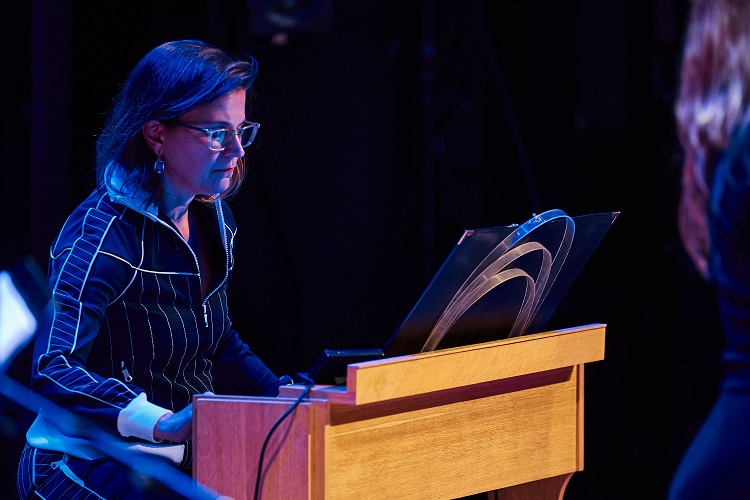
    Above: composer Suzanne Farrin at the ondes Martenot; photo by Rob Davidson

    Tuesday May 23rd, 2023 – The final program of the season in the Miller Theatre’s unique Composer Portraits series featured Suzanne Farrin, who hails from a small town on the Maine coast. It was an incredible musical experience which moved me deeply.

    Two fascinating singers – soprano Alice Teyssier and countertenor Eric Jurenas – joined virtuoso members of the International Contemporary Ensemble for an evening of magical music-making, with conductor Kamna Gupta leading the large ensemble works, and the composer joining in for the program’s world premiere finale, playing the ondes Martenot. Special kudos to audio engineer Caley Monahon-Ward and lighting designer Philip Treviño for their expertise in making it a memorable evening in every possible way.

    I knew nothing about Ms. Farrin’s work until this evening; in the days leading up to the performance, I read her bio but didn’t sample any of her compositions, as I like to be introduced to new music live whenever possible. All day, I felt an odd sense of anticipation for the concert, as if something special was about to happen. This was prophetic: from first note to last, the program mesmerized me.

    Five excerpts from Ms. Farrin’s 2016 opera, dolce la morte, were presented during the evening. I cannot imagine anything that could more perfectly have captivated my imagination than the opening measures of the aria unico spirto, which begins with oboe (Kemp Jernigan) and bassoon (Rebekah Heller) on a sustained tone. Matching the pitch, countertenor Eric Jurenas joins them with a straight tone of unearthly beauty. Mr. Jurenas’s fantastical voice was heard with a subtle halo of echo, evoking an ancient world which lingers only in the imagination.

    Suzanne Farrin Composer Portrait 170

    Above: Kyle Armbrust (viola), Evan Runyon (double bass), conductor Kamma Gupta, and countertenor Eric Jurenas; photo by Rob Davidson

    Odd harmonies from the wind players wrap around the vocal line; the texts are drawn from letters of Michelangelo to the young Italian nobleman Tommaso dei Cavalieri, and Mr. Jurenas voiced them with a spine-tingling air of sensuality. Near the end, Evan Runyon’s double bass introduces tension with a shivering tremolo. The aria ends with the singer’s magical voice fading into thin air.

    The other excerpts from dolce la morte were interspersed thru the concert’s first half. The first of these was come serpe in which Mr. Jurenas’s timbre was almost unbearably gorgeous. Bassoonist Rebekah Heller displayed amazing breath control, whilst double bassist Evan Runyon brought forth tones from the depths. At times, the music seemed to be reaching us from a distant galaxy.

    veggio found the countertenor veering between the ethereal and the dramatic; his is an uncanny sound, delighting me constantly with its kozmic beauty. The ensemble meanwhile sighed, trembled, and groaned, with pulsing notes played pianissimo by the bass, and insistent high notes beaming from Nuiko Wadden’s enchanted harp.

    In an oboe solo from the opera, l’onde della non vostra, Kemp Jernigan summoned squawking, stuttering, twittering sounds, along with trills and sagging tones, before rising to a high finish. From there, Mr. Jurenas took up the oboe’s final note and commenced rendete, the final excerpt from dolce la morte. His voice blended marvelously with the oboe and bassoon, soon joined by violinist Josh Modney, violist Kyle Ambrust, and cellist Clare Monfredo. Ms. Wadden’s harp twinkled in the high range as the singer ventured upward. There were shivering motifs from Mr. Runyon’s bass, leading to a big, grinding sound from the ensemble. Overall, the heavenly voice of Mr. Jurenas sounded with utter clarity.
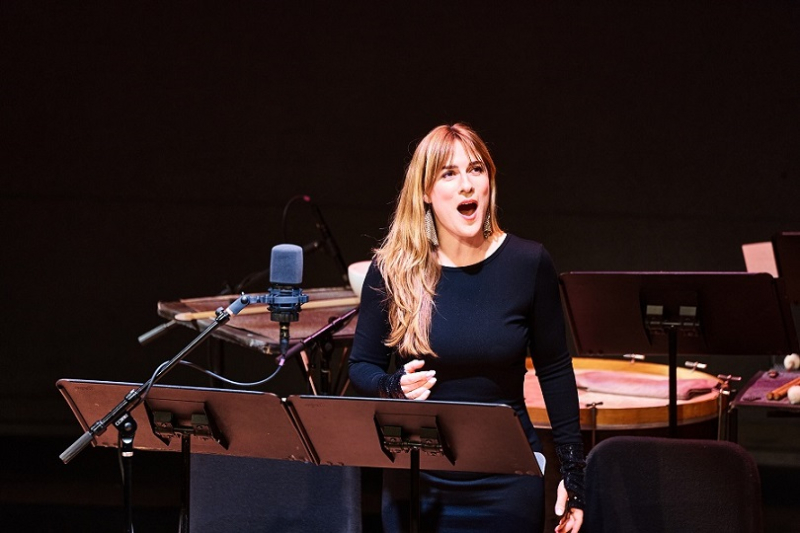
    Suzanne Farrin Composer Portrait 38

    Backtracking, the concert’s first half had offered soprano Alice Teyssier (above, photo by Rob Davidson) in Il Suono (from 2016) in which Ms. Wadden’s harp sounded in skittering passages and entrancing melismatic flourishes whilst Ms.Teyssier’s voice floated dreamily on the air, with straight tones of alluring purity.

    Suzanne Farrin Composer Portrait 101

    Above: Nuiko Wadden; photo by Rob Davidson

    Three works for solo instruments put members of the International Contemporary Ensemble in the spotlight. The first of these was polvere et ombra (2008) for harp, in which Ms. Wadden delivered swirls of notes and cascading glissandi, followed by some crisp plucked notes. The piece ends with the strings being gently brushed, almost a caress.

    Suzanne Farrin Composer Portrait 81

    Above, the evening’s string contingent: John Modney (violin), Clare Monfredo (cello), Kyle Armbrust (viola), and Evan Runyon (double bass); photo by Rob Davidson

    In Time is a Cage (2007), violinist John Modney produced a wide range of sonic motifs: tremolos and trills,  and passages of fluttering, buzzing, slithering sounds. In the piece’s most delicate moments, the music went from being impressive to being spellbinding. 
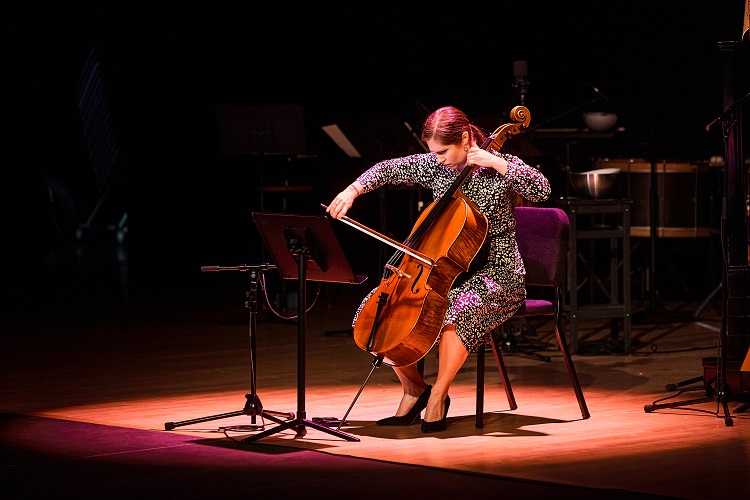
    Suzanne Farrin Composer Portrait 354

    Following the interval, cellist Clare Monfredo (above, photo by Rob Davidson) played corpo di terra (2009). From quietly tapping the strings, trills carried the music to a discordant passage. After rising to quiet, repeated notes, and a feeling of quivering, the cello drops to a drone. A lullaby-like motif turns astringent, and then rather ominous. Calming, the strings are gently brushed. There follows a sort of coda, with an upward rush to a sort of oozing sound, ending in a trembling state. Ms. Monfredo took all of this in stride, making the music feel like a poem that expresses many moods.

    Suzanne Farrin Composer Portrait 500

    Above, Evan Runyon, Nathan Davis, Alice Teyssier, and Suzanne Farrin; photo by Rob Davidson

    Concluding the evening, the world premiere of Ms. Farrin’s Their Hearts are Columns (2020) brought together Mlles. Teyssier and Wadden, Mr. Runyon, percussionist Nathan Davis, and the composer herself, seated at the ondes Martenot. This work, a setting of poems about love and its meaning to the woman’s character, begins with quiet drumming and bass tones, and then the voice of Ms. Teyssier emerged, remote and beckoning. The sound of the ondes Martenot entices the ear, like the soundtrack of a dream. The entwining timbres of this unique instrument with the bass, harp, and percussion made for some extraordinary textures, An unexpected outburst from the singer brings the work to a sudden end.

    In a mid-concert interview with the Miller’s Melissa Smey, Ms. Farrin spoke of the essential elements for  living in our increasingly disquieting world: compassion and empathy. This confirmed what I felt while listening to her music: she and I are on the same wave-length,

    ~ Oberon
  • Brahms|Thorvaldsdottir|Salonen @ NY Phil

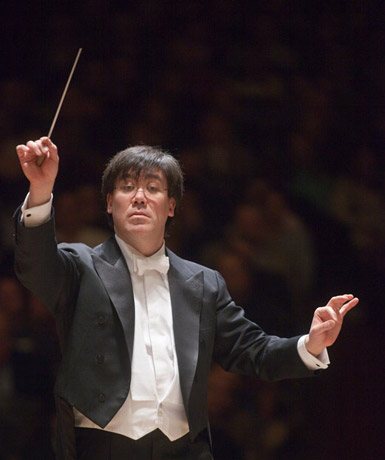
    A gilbert foto michael j lutch

    Above: Alan Gilbert, in a Michael J Lutch photo

    Author: Scoresby

    Tuesday May 23rd 2017 – Now in the final weeks of his tenure as music director, Alan Gilbert led the New York Philharmonic at David Geffen Hall in the last of four concerts of a diverse program. Guest soloists included the respected violinist Leonidas Kavakos, soprano Anu Komsi, and soprano Piia Komsi (both sopranos in their NY Philharmonic Subscription debuts). It also happened to be a night devoted to the retiring members of the NY Philharmonic and such there was a ceremony right after intermission.

    Leonidas-kavakos

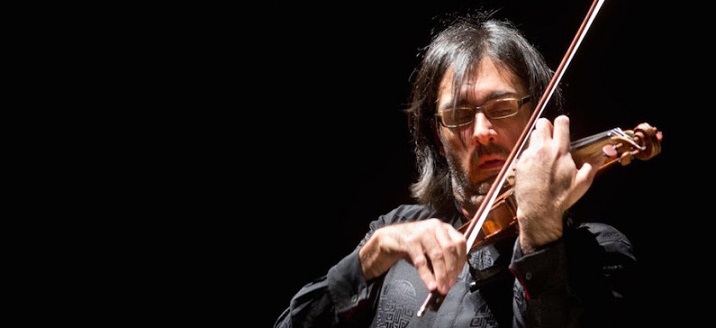
    The program started out with the classic Brahms’s Concerto in D major for Violin and Orchestra, Op. 77. I have heard Mr. Kavakos (above)  a few times before and have always enjoyed his performances. This Brahms was taken at a slow pace in the first movement. Mr. Kavakos seemed to use a style of playing with very light bow pressure and many staccato notes, which emphasized the more modernist elements of the work (particularly in the cadenza). While most players make this into a flashy piece, both the orchestra and Mr. Kavakos seemed to be tempered, bordering on torpid. They did bring transparency and structure, emphasizing each phrase.

    Opening with a sensual organ-like chorale, the second movement seemed more effective at this tempo. It allowed the orchestra to breathe through some of the more beautiful tutti sections and Mr. Kavakos time to care for each line. The finale was Mr. Kavakos at his best, finally managing to fully synchronize with the orchestra and lunging through difficult technical demands.

    After the intermission was the annual New York Philharmonic ceremony honoring both the retiring and retired musicians. This is a time-honored tradition in which retiring musicians give a speech – it is also a nice time for former musicians to come back to the orchestra.

    Dawn_hannay

    As the violist and Chairperson of the Musician’s Orchestra Committee Dawn Hannay (above) pointed out in her memorable speech, the musicians and history of an organization are vital in creating a particular sound. “Without the musicians, the conductor is just waiving their arms around.”

    Photo by Kristinn Ingvarsson

    Above: Anna Thorvaldsdottir; photo by Kristinn Ingvarsson

    The second piece on the program was the New York premiere of Aeriality by the young Icelandic composer Anna Thorvaldsdottir. While this was my first time hearing any of her work live, I have been relishing two recent discs of her music  for the past few years – one released by Deutsche Grammophon and the other recorded by International Contemporary Ensemble. It was a pleasure to hear this rich music live, which is a completely different experience than listening to an album. As with many of Ms. Thorvaldsdottir’s pieces, the sound is huge and immersive.

    In some ways, one might consider this piece as much an ambient soundscape as it is a structured musical piece. The percussion seems the only thing grounding about the music; it otherwise shifts through a variety of textures and colors – almost like moving through space. It is a evokes strong visuals of a primordial landscape in my mind. The clusters, density, and waves of sound all increase until a climactic moment when the music turns into light, feathery texturing. It really felt like the orchestra arrived somewhere it fell silent. The performers drew a big sound and played well. Mr. Gilbert led a slower account that accentuated the many textures, but also felt a little less structured.

    The program closed with the New York premiere of a work by the esteemed composer and conductor Esa-Pekka Salonen. The piece was an older one from his output entitled Wing on Wing, inspired by the completion of Frank Gehry’s Walt Disney Concert Hall. It includes two sopranos who move to different parts of the hall, percussionists who also play from different parts of the hall, the electronic sounds of a fish, and the voice of Frank Gehry himself.

    The sopranos Anna and Pii Komsi did an excellent job through difficult descending and ascending passages that evoked the sounds of a siren. While the orchestra played rivetingly throughout the work, the electronics sounded a little kitschy. The piece has classic Salonen sound of colorful open sounding chords with interesting textures from a variety of instruments. It evoked both Ligeti’s Atmosphères and Debussy’s Jeux, melded with Salonen’s creative rhythms.

    The moment that grabbed the most was the final purely orchestral section, in which the orchestra bursts into a frenetic dance anchored by the percussion. It was lovely to hear the New York Philharmonic present important contemporary composers and a nice reminder of the importance of the musicians in the orchestra.

    ~ Scoresby

  • American Visions @ CMS

    Randall-Scarlata

    Above: baritone Randall Scarlata

    Tuesday May 19th, 2016 –  Chamber Music Society of Lincoln Center offering a diverse program of ‘Americana’. On entering the auditorium at Alice Tully Hall tonight, we found the stage filled with a vast array of percussion instruments; these were set up in four “territories”, each to be managed by a specific musician in the program’s second half: a spectacular performance of a fascinating work by George Crumb. 

    In the midst of all the chimes, gongs, and other percussive paraphernalia, the sleek Steinway was parked. Pianist Michael Brown took the driver’s seat and set the evening on its way with Louis Moreau Gottschalk’s The Union, Concert Paraphrase on National Airs for Piano. Composed in 1862 by the wildly popular Gottschalk, this 9-minute fantasia weaves together arrangements of Hail Columbia, Yankee Doodle Dandy, and The Star-Spangled Banner. The work’s virtuoso demands were a stroll in the park for Mr. Brown, who simply rippled off the composer’s flourishing flights and furbelows with sprightly brilliance. This patriotic little gem sparkled on New York’s Primary Day.

    Mr. Brown returned immediately to perform Antonin Dvorak’s Sonatina in G-major with violinist Chad Hoopes. Written (swiftly) in New York City in 1893, this attractive piece was the composer’s opus 100, and he chose to mark that milestone by writing a work for his two children: Otilie (a 15-year-old pianist) and young Antonin (aged 10, and already a capable violinist); the sonatina was first performed at Dvorak’s home on East 17th Street, right here in Gotham.

    Mssrs. Hoopes and Brown found this Dvorak work most congenial; their performance was finely coordinated and together they gave us a savorable rendering of the folkish elements which are so typically Dvorakian. In the work’s four movements, both lyricism and dexterity are called for, and the two musicians polished off the music with style and flair.

    A group of songs by Charles Ives were then performed by baritoneRandall Scarlata and Gilbert Kalish. These two expert artists have worked together frequently and their rapport is a delight to witness. Randy Scarlata’s wide-ranging voice, his fluency of language, and his natural gift for making it seem like he is singing just to you have always given his performances a special appeal – starting back in his Juilliard days, when I first met him and we began a friendship that has been sustained over the years.

    The six Ives songs Randy programmed tonight showed the many felicities of his vocal and interpretive style, and Mr. Kalish was the ideal collaborator. The soft ending of “The Things Our Father’s Loved” was haunting; the ironic sense of triumph of “In Flanders Field” showed vocal expressiveness at its finest. A music hall feeling is evoked in the narrative “Charlie Rutlage” which covers many moods and at one point erupts in a huge tumult; “The Indians” veers from the dramatic to the pensive. A particularly masterful rendering of “The Housatonic at Stockbridge” opened with Mr. Kalish’s atmospheric piano introduction; the music is then taken up by Randy with finely-inflected phrasing and spine-tingling dynamic control. “The Circus Band”, a jolly tongue-in-cheek affair, calls for a baritone who is also an actor, and it ended the evening’s first half vividly.

    So lovely and pleasant to simply sit in the hall during the interval, watching the percussionists as they made sure everything was in place for the work about to be performed: George Crumb’s American Songbook II: A Journey Beyond Time.

    I can hardly begin to describe the effect of this ingenious and truly splendid work. The composer, with his ever-rich musical imagination, has taken some of the best-beloved spirituals and spun them into a sound tapestry that is nothing less than magical. The work calls for four top-flight percussionists, a pianist of consummate skill who is willing to extend his range beyond the keyboard, and a great communicator as vocal soloist. CMS brought together just such a remarkable ensemble tonight, and the result was both aurally dazzling and rich in spiritual reward.

    Each of the four percussion players – Christopher Froh, Ayano Kataoka, Eduardo Leandro, and Ian David Rosenbaum – had his or her own island kingdom of instruments to preside over. An open-topped piano awaited Gil Kalish, with a pair of small mallets and an odd conch-like horn set out for him: things most pianists have no use for. At the center of it all, Randy Scarlata, ready to pour his heart and soul into the eight timeslessly powerful songs that Mr. Crumb had arranged for this epic work.

    Otherworldly sounds transport us immediately; as the work progresses, the textures developed by the percussion orchestra will chill, delight, and fascinate us. The baritone voice emerges from this soundscape in the haunting melody of “Swing Low, Sweet Chariot” – Randy Scarlata at his expressive best. Mr. Kalish must reach into the piano to pluck the strings, and meanwhile the percussionists are setting up echo effects and rich reverberations. The chimes of midnight sound, uncanny deep resonances glow and fade, ghostly shimmers hang in the air. Randy’s control of finely-honed piano demi-tints gave me goosebumps as the ‘sweet chariot’ vanished into the mists.

    Bizarre rhythms and noisy cacophony signal ‘the walls come tumbling down’ in “Joshua Fit de Battle ob Jerico”; Mr. Kalish’s horn bleats desperately, Randy Scarlata’s voice rages and exhorts. Things fade away before a big bang of an ending. Tremendous!

    Soft chimes lend an air of mystery to Randy’s poignant singing of “Steal Away”. This is followed by the impulsive rhythms of “Rock My Soul” in which Randy sings, speaks, and whispers in turn. An instrumental interlude (“The pregnant earth : a Psalm for Noontide”) brings forth delicate effects. Here Mr. Kalish alternately plays and plucks the strings of the Steinway while the four percussionists seem to vie in a contest to see who can play most quietly. Kozmic softness!

    Marimba and rattles set the rhythmics of “Sit down, Sister!”, in which the pianist also has a say. Randy sings “I just got to heaven and I want to look around!”; the song then teases forward until he shouts “Sit down!” This is punctuated by a sonic boom.

    Soggy chimes make us think of weeping; “Nobody Knows the Trouble I See” laments, with Randy’s voice low and mournful. The stage lights inexplicably dimmed to darkness by mistake midway thru this song; the music halted but light was soon restored and the musicians picked up where they’d left off. Eerie echoes are heard.

    A deep growl…a thudding drum…a welter of gongs and chimes: “Let My people Go!” This is “Go Down, Moses”, robustly declaimed by Randy Scarlata, and it is big singing indeed. The music is ominous but fades to a long, reverberant end.

    Gongs and chimes, chirps, and the sound of tinkling broken glass create a halo of mystery around Randy’s plaintive singing of “Sometimes I feel like a Motherless Child”. After a last percussive power burst, Mr. Kalish brings forth some extremely delicate playing, and some eerie tapping. The singer turns to parlando with “Motherless children have a hard time…a long way from home”: eventually Randy hums wordlessly as the music fades sway into thin air.

    The audience seemed spellbound by the Crumb work; it is not easy music, but instead unsettling, thought-provoking, and richly rewarding in its own way. I was so grateful for this opportunity to experience it, and in such a thoroughly impressive and moving performance.

    The Repertory: 

    The Participating Artists:

  • Ballet Next in Rehearsal

    L1420269

    Tuesday May 27th, 2014 – Michele Wiles (above), artistic director of Ballet Next, invited me to her studio today where she is re-structuring Querencia, a ballet she created earlier this year for Columbia Ballet Collaborative, on her own Ballet Next dancers.

    In this ballet, set to a ‘Passacaglia‘ by Heinrich Ignaz Franz von Biber, a violinist playing live mingles onstage with the dancers.

    L1420185

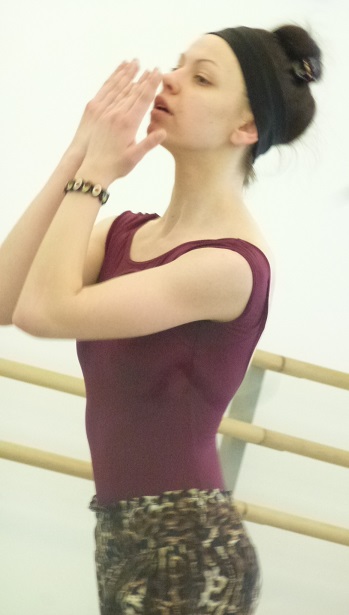
    The ballet opens with the girls – Kaitlyn Gilliland, Tiffany Mangulabnan, and Brittany Cioce – in a cluster. From there the movement becomes expansive and technically quite demanding. The dancers today were concentrating on the nuances of the work, preparing for a studio showing next week.

    L1420380

    Tiffany

    L1420209

    Brittany

    L1420182

    Kaitlyn

    L1420335

    Michele, demonstrating the fine points

    Join Ballet Next for a studio showing of Querenica and Brian Reeder’s Rameau ballet, Strange Flowers:

    ImageProxy.mvc

    And Ballet Next will be at Kaatsbaan June 7th and 8th, 2014. Information here.

  • Somogyi’s Back! @ NYC Ballet

    6a00d8341c4e3853ef0153941ab8d8970b-800wi

    Above: NYCB‘s Jennie Somogyi in a Henry Leutwyler portrait

    Tuesday May 21st, 2013 – Principal dancer Jennie Somogyi has returned to New York City Ballet after being sidelined with an injury for several months. Tonight was my first chance to see her since her return and she gave a super-charged performance in Ulysses Dove’s RED ANGELS. NYCB cognoscenti scatttered throughout the house gave her a hearty cheer when she stepped out for her bows. It’s wonderful to have her back.

    The house was fairly full tonight – including about half of the Fourth Ring – though I know there were people outside who really wanted to come in but who could not afford the available tickets. I’m going far less often myself, because it’s just out of comfortable reach financially.

    Guest conductor Leif Bjaland opened and closed the evening conducting two great scores: Tchaikovsky’s Serenade for Strings and Stravinsky’s Firebird. In the Tchaikovsky, he gave a somewhat more spacious feeling to the music than we’ve heard here in recent seasons: the fast passages were lively but not frantic, and he was adept at bringing out the inner voices that intertwine in the serenade’s melodic arcs.

    Curtain-rise for SERENADE still puts a lump in my throat; despite a couple of tiny faux pas tonight the ballet was beautifully danced, and of course it’s a corps watcher’s paradise. The recent promotion of some of the Company’s loveliest ballerinas to soloist means that we’ll see these girls less frequently onstage; but tonight three of them – Ashley Laracey, Lauren King and Georgina Pazcoguin – retained their familiar places in this Balanchine masterpiece.  The entire ballet was a feast for my opera glasses as one appealing vision after another moved across the stage in their swirling pale plue tulle.

    Sara Mearns danced with silken beauty, handsomely partnered by Jonathan Stafford. Ashley Bouder’s marvelous sense of the music allows her to sail on the score’s melodic ebb and flow, pausing here and rushing forward impetuously there; her peerless technique and expressive face invest the role with many felicitous details. Rebecca Krohn gave a radiant performance, her lyricism at full-flight and so attractive to behold. It seems to me that both Ashley and Rebecca would be ideal in the ‘waltz girl’ role, and I’m hoping they’ll each have the opportunity soon. Adrian Danchig-Waring made a striking impression both in physique and face; his deep immersion in the ballet’s unspoken drama was spell-binding.

    So exciting to see RED ANGELS again; it’s a favorite ballet of my friend Arlene Cooper, and I was glad to spot her from above this evening. Mary Rowell has played every performance of this ballet that I have ever experienced and she’s phenomenal, turning her electric violin into both a percussive and melodic vessel. In sleek physique-defining red body tights, the four dancers appear in introductory solos, then in duets, second solos, and a brief coda for all.

    Amar Ramasar gave a magnificent, stellar performance of expansive and space-filling dance wedded to undeniable sex appeal. Jared Angle has followed in the footsteps of Peter Boal as the Company’s most poetic male dancer; in this case it’s poetry with an edge and Jared reads it with power and clarity. Teresa Reichlen’s long-limbed amplitude and cool allure are perfect here, dancing with sharp attack and soaring extension. Ms. Somogyi, her body in Olympian condition, was intense and keenly aware of the sensual energy that pulses thru the Einhorn score. Throughout, the four dancers communicate in a rich gestural dialect. Mark Stanley’s lighting is a major factor. The audience whooped it up for these exciting dancers and their vivid one-woman rock band.

    Clothilde Otranto took up the baton for a definitive change of pace with the Tchaikovsky Pas de Deux. Andrew Veyette stepped in for Joaquin de Luz and won continuous rounds of applause for his swift and scintillating turns and leaps while the charm and delicacy of Megan Fairchild’s dancing exuded lyric grace, reaching an apex in a set of delicious fouette turns in the coda. The audience loved them, and rightly so.

    Maria Kowroski’s imperial Firebird was the perfect finale for this parade of super-dancers. The elegant ballerina shaped the elusive avian creature into a poetic statement, creating a compelling reverie in the haunting Berceuse. Earlier, her fluttery evasions and eventual taming were finely wrought in gesture and expression and – needless to say – her long legs are an exceptional asset. I love Jon Stafford in this ballet (he replaced Ask LaCour tonight) for his sense of wonderment and almost naive heroism. He and Savannah Lowery as the captive princess gave a charming account of their courtship, surrounded by a bevy of maidens consisting of some of my favorite ballerinas. The girls – I know – take this scene with a tongue-in-cheek quality. For me it’s quite beautiful, as is the Stravinsky score – his finest in my view, and wonderfully played tonight under Mr. Bjaland’s baton.

    SERENADE: Mearns, Bouder, Krohn, J. Stafford, Danchig-Waring [Guest Conductor: Bjaland]
    RED ANGELS: Reichlen, Ramasar, Somogyi, J. Angle  [Solo Violin: Rowell]
    TSCHAIKOVSKY PAS DE DEUX: M. Fairchild, Veyette   [Conductor: Otranto]
    FIREBIRD: Kowroski, J. Stafford, Lowery, Catazaro [Guest Conductor: Bjaland]

  • In the Studio with Jeremy McQueen

    L1080041

    Tuesday May 22, 2012 – Choreographer Jeremy McQueen invited me to a rehearsal of his ensemble work Incandescent Paths today at Battery Dance Studio. The piece will be presented at the Young Choreographer’s Festival, which will be held at Symphony Space on Saturday, June 2nd. Jeremy is one of eleven choreographers whose works will be presented at the festival this year.

    Incandescent Paths is set to the Ahn Trio’s recording of ‘Swing Shift: Prelude & Night Flight’, composed by Kenji Bunch. Jeremy will also present this piece (and other works) on Friday, July 27th as part of Jacob’s Pillow‘s Inside/Out series.

    L1080002

    As the dancers continued working on Incandescent Paths today, I realized it’s much too fast-paced a dancework for me to capture with my limited photographic skill. Most of my images were lovely blurs of action (above). I did manage to catch a few of the dancers in moments of stillness:

    L1070916

    Danielle Schulz

    L1070918

    Amanda Mondoro

    L1070953

    Tina Jackson

    It was really good seeing my dancer/buddies Norbert de la Cruz and Matthew Tiberi again but they were dancing so fast that my camera couldn’t capture them.

    The day after I visited Jeremy’s studio, he received some excellent news: he has been commissioned to  create a full-length ballet for the 2012 Dance Gallery Festival. ‘What Lies Within‘, an ensemble work for seven male dancers, will receive its world premiere on October 14, 2012 at the Ailey Citigroup Theater, as part of the Dance Gallery Festival’s “Level UP” series. Two other choreographers will also be represented, selected along with Jeremy from a field of over 250 applicants.

  • Cedar Lake @ The Joyce: Program B

    Blog-570x380

    Tuesday May 22, 2012 – Three works, all of them new to New York City, held the stage as Cedar Lake Contemporary Ballet started their second week at The Joyce. Above, an image of the Company in Simply Marvel by Regina van Berkel.

    On a stage illuminated by huge hanging parchment-shaded lamps, Ms. van Berkel’s work commences with a solo danced by Oscar Ramos; the music, for solo piano, is ultra-slow and so is the movement. The dancers arrive one-by-one, the women in stylized tutus and toe shoes. Sculptural formations assemble and dissolve in this slow-motion universe.

    The mood then shifts to a brighter, more animated vision as solo violin music by Nicolo Paganini sets off the three women – Acacia Schachte, Ebony Williams and Soojin Choi – in a series of on-pointe vignettes, partnered by the men. Quirky, witty and jagged, the work maintains an odd sense of formality thanks to the music. Impressive dancing from the entire cast brought the work to a close, signaling the first of many ovations during the evening.

    Halfway thru the intermission, the curtain rose on the stagehands preparing for the second work: Tuplet by Alexander Ekman. As the crew busy themselves setting up, Harumi Terayama stands alone in an illuminated square, gesticulating rapidly or conducting an imaginary orchestra. As the house lights dim, five other dancers take up their own squares.

    After an introductory sequence, the work’s highlight comes with a solo brilliantly danced in silhouette by Jon Bond which he – one of Gotham’s most incredible dancers – delivered with astonishing clarity and power. Throughout this ballet, the sounds of the dancers’ movements – and even of their breathing – mesh with the musical score to create a personalized soundscape.

    The audience went wild after a wonderfully inventive passage in which the six dancers lined up across the front of the stage and danced to the sounds of their own names being spoken. This tour de force was so perfectly delivered by the dancers. Performing in Tuplet, in addition to Harumi and Jon, were Jubal Battisti, Oscar Ramos, Joaquim de Santana and Ebony Williams: an all-star cast.

    In the closing work, Necessity, Again by Jo Stromgren (World Premiere) the stage is strewn with sheets of paper; pages hang from clotheslines strung above the space, and periodically the dancers bring in more and more sheaves of pages; occassionally someone flings a fistful of papers into the air. In this messy, cluttered setting the dancers appear alternately bored, bemused or borderline manic. There is a stylized rape scene and at one point the dancers strip down to their underwear (some people go to Cedar Lake just for the bodies). Meanwhile an annoying voice lectures on the meaning of ‘necessity’; this is offset by a series of Charles Aznavour songs. Somehow out of this chaos a dancework is built, and – thanks to the individuality and dramatic capacities of the Cedar Lake dancers – it becomes a necessity to watch.

    The audience – including danceworld luminaries Miki Orihara, Stephen Pier, David Hallberg and Larry Keigwin – gave the Cedar Lakers a rousing reception at the end of the evening.