Tag: Tuesday November

  • An Eric Whitacre Holiday @ Carnegie Hall

    Cms-1 jpg

    ~ Author: Lili Tobias

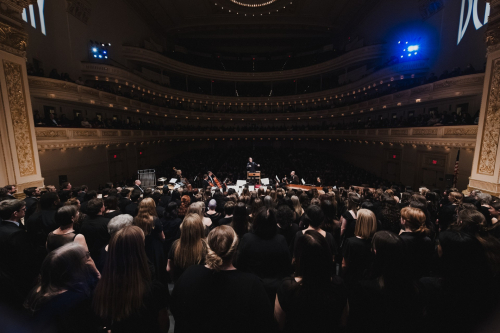
    Tuesday November 26th, 2024 – I don’t celebrate Christmas, but I do love the traditions of music written for the holiday, especially when that music is choral! So this past Tuesday, I attended An Eric Whitacre Holiday at Carnegie Hall. This annual concert is a celebration of Whitacre’s Christmas music, his Christmas-adjacent music, and some other Christmas music by different composers (including Melissa Dunphy who was in the audience!).

    Whitacre himself conducted the Distinguished Concerts Singers International (DCSI), part of Distinguished Concerts International New York (DCINY), which produces concerts around New York that bring together singers from around the globe. This concert featured two different 250-member choirs, accompanied by pianist Kelly Yu-Chieh Lin and the Distinguished Concerts Orchestra. These musicians had only been rehearsing all together for the past two days, but they performed so well together that the short time wasn’t at all apparent. I was impressed with the clarity of the singers’ diction, as well as their ability to reach incredibly low volumes despite how many of them there were. I always enjoy the sound of a really large choir too, since the diverse array of different voices actually enhances the blend of sound.


    Whitacre is best known for the enchanting harmonies he uses in his music, in particular his tone clusters. The majority of the program for this concert was indeed very harmony-focused and, overall, very slow moving. While this aspect of Whitacre’s music is certainly beautiful, I find that his music really shines when it’s faster and more rhythmic. There were a few moments of quick music that I absolutely loved, including in the “An Unexpected Turn” scene from his opera The Gift of the Magi. In particular, Whitacre is really good at utilizing odd time signatures to drive the music forward while still maintaining the flow. These moments were a refreshing change, and I bet the singers had so much fun singing them too!
     

    Thumbnail_image0-48


    As I briefly mentioned earlier, this concert also included Whitacre’s Christmas opera, The Gift of the Magi. This was actually the world premiere of the orchestrated version, orchestrated by Evan L. Snyder and Whitacre. I was impressed with how the staging was done, given that most of the stage was taken up by 250 singers and a small orchestra. The action took place in the areas on either side of the orchestra, so the characters could travel across the stage for the different scenes. The singers also used the conductor’s podium to sit on or lay down props such as gift boxes. I felt that the production was just right for the venue, and the singing was wonderful too!


    This concert had an extremely warm and welcoming atmosphere. It was a family affair all around, as the audience was largely made up of the choir members’ relatives coming to support them. And not only that, but Whitacre’s wife, soprano Laurence Servaes, starred as Della in the opera, and his son (for whom he had written Goodnight Moon) was in the audience. While I won’t be celebrating Christmas this year, I certainly celebrated an Eric Whitacre holiday on Tuesday night!


    The performance photos are by Dan Wright.


    ~ Lili Tobias

  • Dancing With Glass @ The Joyce

    MakiNamekawa_Photo by Steven Pisano

    Above: pianist Maki Namekawa, photo by Steven Pisano

    ~ Author: Oberon

    Tuesday November 28th, 2023 – The long-awaited opening of Dancing With Glass at The Joyce: a program wherein several of Philip Glass’s études were performed by pianist Maki Namekawa; five of the études had been choreographed by prominent artists in the danceworld: Lucinda Childs, Chanon Judson of Urban Bush Women, Justin Peck of the New York City Ballet, Brazilian tap artist Leonardo Sandoval, and Los Angeles-based choreographers Bobbi Jene Smith and Or Schraiber.

    A packed house, which included some luminaries of the NYC dance scene, seemed mesmerized both by the music and the dancing. Ms. Namekawa is a pianist with a special affinity for the works of contemporary composers; she played eleven of the études in the course of the evening, commencing with the spellbinding Etude #1. Her playing was remarkably clear, committed, and soul-filling.
    OrlandoHernandez_LeonardoSandoval_LucasSantana_AnaTomioshi_Photo by Steven Pisano

    The dancing commenced with a fabulous tap-dance setting of the 7th étude, choreographed by Leonardo Sandoval, who was tapping along with his mates Ana Tomioshi, Orlando Hernandez, and Lucas Santana (photo above by Steven Pisano). Noé Kains was onstage with the quartet, and he was dancing along when suddenly he stepped to the edge of the stage and eased his way down to the pit where he took over the keyboard and played the 7th étude to perfection. Meanwhile, his fellow tapsters – such gorgeous humans – continued to dance in sync, with brilliant solo moves etched into the choreography. An exhilarating start to the evening’s dancing.

    BobbiJeneSmith_Photo by Steven Pisano

    Above: Bobbi Jene Smith, photo by Steven Pisano

    Bobbi Jene Smith (co-choreographer of the memorable DEO for the Martha Graham Dance Company in 2019) and her husband Or Schraiber both choreographed and performed the familiar Etude #8. On a dusky, hazy stage, an anxious man and a moody woman take us thru various states of a romantic relationship. Each dressed all in black, with Ms. Smith’s luxuriant hair playing its own role, the dancers are hypnotic movers and shapers of phrase. Passion underscores everything: the wounded man is rejected, but – true to life – within seconds the couple are kissing again. Touches of humor are subtly woven in…and at the end, aggression turns to peace in the twinkling of an eye. The piece, marvelous in every way, made me think of so many evenings spent at home with my partner. 

    ChanonJudson_Photo by Steven Pisano

    Tall, lithe, and elegant in a sky-blue Josie Natori frock, Chanon Judson of Urban Bush Women (above, photo by Steven Pisano) took the stage for Etude #11. John Torres’ lighting – a major contribution to the evening’s pleasures – was especially perfect here. Ms. Judson danced with compelling authority and grace to the vividly dramatic music. Veering from madness to repose, this long-limbed goddess filled the space with her magnetic presence and riveting moves. Overcome by trembling, she is finally becalmed as the pulsating music fades to silence.

    Patricia Delgado_Photo by Steven Pisano

    Justin Peck’s setting of Etude #6 brought a stunning performance from Patricia Delgado (above, photo by Steven Pisano); I had only seen Ms. Delgado once previously, when she appeared in a 2009 gala here in New York featuring many alumni from the School of American Ballet. In her Glass solo tonight, she was fascinating to watch. Clad in a black trouser outfit, she is seated in a chair at curtain-rise. The music’s fast staccati underscore her restlessness. She at times ventures a few steps from her chair, but always returns to this safe haven. As the music turns grand, her mental instability becomes palpable. Ms. Delgado is both a gorgeous mover and a subtle actress. At the end, unable to cope, the woman seeks to hide herself from the world under her chair.

    CaitlinScranton_KyleGerry_Photo by Steven Pisano

    Clad in white and looking like angels, dancers Caitlin Scranton and Kyle Gerry (above, photo by Steven Pisano) reveled in the flow of Lucinda Childs’ luminous choreography in Etude #18. Sometimes dancing side-by-side and at other times moving about the space with a sense of other-worldly beauty, the dancers perfectly embodied the lyricism of this particular Glass piece. 

    Bringing the evening full circle, Ms. Namekawa played the last of the études: #20. This rather long work gave us a chance to reflect on the evening, whilst savouring the pianist’s poised musicality. As the applause commenced, all of the dancers appeared onstage to receive the audience’s wholehearted accolades. Ms. Namekawa then drew Philip Glass from his seat to the side of the piano, while the standing crowd hailed him with a joyous ovation.

    All photos by Steven Pisano.

    ~ Oberon

  • An Act of AIDA

    Screen-Shot-2016-02-27-at-4.31.29-PM

    Above: Latonia Moore

    Tuesday November 22nd, 2016 – It’s an odd feeling to be dreading a night at the opera because of the hyper-extended intermissions. But so many performances at The Met in recent seasons have suffered from a draining of dramatic and musical impetus as intermissions stretch beyond the 30-minute mark that it really is a concern of mine.

    However, I did want to hear at least some of Latonia Moore’s Aida tonight. Latonia was a finalist in the Met Auditions in 2000, the same year my late friend Makiko Narumi participated. I met Latonia a couple of times at patrons events, loved her voice, and her personality. Up to tonight, she had sung a single Aida and a single Butterfly at The Met, whilst having an extensive career elsewhere.

    I knew going in that I would not be able to endure two intermissions; my plan was to leave after the Triumphal Scene. Aside from Ms. Moore, the cast was nearly identical to the one I heard earlier this month.

    Marco Armiliato and the Met musicians again gave a very atmospheric rendering of the prelude.  Marco Berti as Radames was not having a good evening. At the earlier performance, he had been quite impressive in terms of sheer lung-power and some very nice softer singing in the Tomb Scene. Tonight’s “Celeste Aida” was choppily phrased and beset by pitch problems. There was only a trickle of applause after this famous aria. Ekaterina Gubanova, despite some attractive passages (“Vieni, o diletta… appressati” in particular) again seemed slightly under-powered.

    With Latonia Moore’s entrance, things perked up. Her voice is warm, with a sensuous tinge to it, and it  carries well in the big house. She sang with passion and good sense of line, leaning on but not over-working the chest voice. Her “Ritorna vincitor” was vivid both in terms of sound and dramatic inflection, and she sang quite gorgeously in her plaintive “Numi pieta…” Ms. Moore won a hearty round of applause and bravas from the sizeable audience. My only slight concern was that the very highest notes showed a trace of discomfort; the high-B in the trio was not sustained the full count, nor did she linger on the upper notes of the aria. But overall, she gave some extremely satisfying singing.

    I pulled out my copy of Gore Vidal’s KALKI and read for about 15 minutes; and then I thought: “Why am I reading a novel at the opera? Shouldn’t the unfolding of a great score like AIDA sustain me thru the evening? Why is this intermission going to last another 20 minutes?” I packed up and left.

  • Rachmaninoff Finale @ The NY Phil

    Trifonov

    Above: pianist Daniil Trifonov

    Tuesday November 24th, 2015 – The third and final programme of The New York Philharmonic‘s Rachmaninoff Festival brought us Daniil Trifonov’s triumphant performance of the composer’s 3rd piano concerto as well as the ever-popular Symphonic Dances.

    Mr. Trifonov had the audience in the palm of his hand from the moment he walked onstage. He gave a magnificent performance, with terrific support from the orchestra. The 3rd piano concerto is everything the 1st isn’t: both in terms of structure and as a display of the soloist’s technique and artistry, the 3rd readily eclipses the composer’s earlier effort.

    Mr. Trifonov’s fluent – indeed astonishing – command of the keyboard held the audience under a spell. Particularly marvelous was the cadenza (the longer of the two provided by the composer) where the young pianist spun out the music to scintillating effect. With cunning inventiveness, Rachmaninoff has the flute suddenly speak up in the midst of the piano’s long paragraph: this wind theme passes on to the oboe, clarinet, and horn before the focus returns to the piano, which ends on a lovely fade-out.

    The composer paints on a big orchestral canvas in this concerto: a deep ‘Russian’ theme in the first movement impresses, and later there’s a big dance theme. The Philharmonic’s horns were ablaze tonight, the cellos plush, and the various wind voices piped up expressively.

    As the concerto raced to its conclusion, Mr. Trifonov carried the audience along on his dazzling ride. A full-house standing ovation ensued as the young master bowed graciously both to the house and his fellow musicians. I didn’t recognize his encore – and neither did my pianist/friend Ta-Wei – but it was deliciously played.

    Morlot

    Above: conductor Ludovic Morlot

    The piano had hidden Maestro Morlot during the concerto, but after the interval we had sight of him as he led the orchestra in a colourful performance of Symphonic Dances. New York City Ballet-lovers will be familiar with this score from Peter Martins’ 1994 setting of it. It’s a grand piece, with slashing rhythms in the first movement and a wonderful waltz in the second. Rachmaninoff uses the alto saxophone – a sound I always love to hear – to evocative effect, though I could not find a credit for the soloist in the Playbill. The harp also makes some rhapsodic interjections. Overall the orchestra, with Sheryl Staples as concertmaster, sounded superb and they seemed to truly enjoy playing this piece.

    After their rapt attentiveness during the concerto, the audience seemed to lose a bit of focus during the second half of the program. One couple down the row from us feasted on chocolates and Pellegrino whilst texting literally throughout the Symphonic Dances, and the woman on Ta-Wei’s right decided to conduct her own version of the score.

    At the end of the concert I asked Ta-Wei if he thought Rachmaninoff was a great composer or just a very good one. He replied: “Well, he knew what he was doing.” True, amply true.

  • Jennifer Muller’s Stages of Creation

    L1640936

    Striking a pose: the new Warhol piece by Jennifer Muller at a studio preview

    Tuesday November 17th, 2015 – Choreographer Jennifer Muller has been commissioned to create a new dancework for Introdans, the Netherlands-based contemporary dance company. The piece will premiere in February, 2016 on a program entitled Absolutely Amerika. This evening, at her studio on West 24th Street, Ms. Muller presented a sampling of this latest work, along with excerpts from some of the more recent additions to her Company’s repertoire.

    The room was packed with Muller friends and fans, and her lively and distinctive troupe of dancers seemed to ignore the fact that this was a studio showing, instead dancing at performance level. The dance-space is limited but the choreography is spacious and often fast-paced; yet the dancers moved with abandon, often coming within centimeters of the viewers – or of the ceiling, during the many lifts that the Muller repertory calls for.

    L1640814

    Two excerpts from FLOWERS were offered before dancer Michael Tomlinson (above, warming up) demonstrated a signature motif from the new work, which is inspired by quotes from the late Andy Warhol and is danced to a collage of music associated with the Warhol era.

    L1640965

    Above: the opening of MISERERE NOBIS

    I was particularly glad of another opportunity to see some passages from Jennifer’s 2014 masterpiece, MISERERE NOBIS, a compelling piece that has lingered in my mind since first encountering it. Originally danced by an all-female cast, Jennifer has now incorporated the Company’s men into this ritualistic work which is danced to Samuel Barber’s Adagio for Strings, which was inspired by Allegri’s immortal Miserere. The choreographer’s addition of men to the cast changed the flavor of the work slightly but didn’t diminish its power and beauty in the least.

    The evening closed with excerpts from ALCHEMY, an exciting multi-media piece which Ms. Muller premiered at New York Live Arts earlier this year. 

    The dancers were moving too fast most of the time for my camera to catch them, however here are a few images I was able to capture:

    L1640837

    Brittney Bembry, Michelle Tara Lynch

    L1640900

    Brittney Bembry

    L1640950

    Shiho Tanaka

    L1640970

    From MISERERE NOBIS

    L1640977
    Seiko Fujita

    L1640985

    Alexandre Balmain, Elise King

    L1650025

    Sonja Chung

    L1640989

    MISERERE NOBIS

    L1640915

    Jennifer Muller, ever the perfect hostess

    Jennifer Muller/The Works will be at New York Live Arts June 13th – 18th, 2016.

  • Jennifer Muller’s Stages of Creation

    L1640936

    Striking a pose: the new Warhol piece by Jennifer Muller at a studio preview

    Tuesday November 17th, 2015 – Choreographer Jennifer Muller has been commissioned to create a new dancework for Introdans, the Netherlands-based contemporary dance company. The piece will premiere in February, 2016 on a program entitled Absolutely Amerika. This evening, at her studio on West 24th Street, Ms. Muller presented a sampling of this latest work, along with excerpts from some of the more recent additions to her Company’s repertoire.

    The room was packed with Muller friends and fans, and her lively and distinctive troupe of dancers seemed to ignore the fact that this was a studio showing, instead dancing at performance level. The dance-space is limited but the choreography is spacious and often fast-paced; yet the dancers moved with abandon, often coming within centimeters of the viewers – or of the ceiling, during the many lifts that the Muller repertory calls for.

    L1640814

    Two excerpts from FLOWERS were offered before dancer Michael Tomlinson (above, warming up) demonstrated a signature motif from the new work, which is inspired by quotes from the late Andy Warhol and is danced to a collage of music associated with the Warhol era.

    L1640965

    Above: the opening of MISERERE NOBIS

    I was particularly glad of another opportunity to see some passages from Jennifer’s 2014 masterpiece, MISERERE NOBIS, a compelling piece that has lingered in my mind since first encountering it. Originally danced by an all-female cast, Jennifer has now incorporated the Company’s men into this ritualistic work which is danced to Samuel Barber’s Adagio for Strings, which was inspired by Allegri’s immortal Miserere. The choreographer’s addition of men to the cast changed the flavor of the work slightly but didn’t diminish its power and beauty in the least.

    The evening closed with excerpts from ALCHEMY, an exciting multi-media piece which Ms. Muller premiered at New York Live Arts earlier this year. 

    The dancers were moving too fast most of the time for my camera to catch them, however here are a few images I was able to capture:

    L1640837

    Brittney Bembry, Michelle Tara Lynch

    L1640900

    Brittney Bembry

    L1640950

    Shiho Tanaka

    L1640970

    From MISERERE NOBIS

    L1640977
    Seiko Fujita

    L1640985

    Alexandre Balmain, Elise King

    L1650025

    Sonja Chung

    L1640989

    MISERERE NOBIS

    L1640915

    Jennifer Muller, ever the perfect hostess

    Jennifer Muller/The Works will be at New York Live Arts June 13th – 18th, 2016.

  • The Virtuoso Clarinetist @ CMS

    David_shifrin

    Above: clarinet virtuoso David Shifrin

    Tuesday November 19th, 2013 – A delightful programme of music celebrating the clarinet was featured at Chamber Music Society of Lincoln Center. The Society gathered a distinctive ensemble of artists tonight, among them one of my favorite singers, mezzo-soprano Sasha Cooke. This week I have the pleasure of experiencing Sasha’s artistry twice, for she follows up tonight’s chamber evening with performances of Britten’s Spring Symphony with the New York Philharmonic. 

    The Society’s Wu Han greeted us with irrepressible, energetic charm; she explained that she had left the evening’s programming up to Mr. Shifrin and then turned the stage over to the musicians. A packed house seemed eager to hear everything that was offered: again, CMS is the place to be for serious music-lovers.

    The evening commenced with an unusual Mozart adagio for two clarinets and three basset horns (K. 411) which the composer purportedly arranged as a sort of entree for the members of the Masonic lodge which he had joined in 1784. The piece is brief, with organ-like sonorities.   

    Sasha_Cooke_-_profile_-_credit_Rikki_Cooke

    Above: Sasha Cooke, photo by Rikki Cooke 

    In the splendid aria “Parto, parto…” from Mozart’s penultimate opera, LA CLEMENZA DI TITO, Sasha Cooke’s timbre seems to have taken on an added richness since I last heard her. The singer’s expressive qualities were, as ever, to the fore, and the power and beauty of her interpretation made me long to hear her at The Met again where lesser artists hold forth in roles that would suit Ms. Cooke to perfection. Be that as it may, her singing of the aria tonight, graced by Mr. Shifrin’s polished roulades, was a thoroughly engrossing musico-dramatic experience.  The Opus One Piano Quartet’s first-rate playing of this chamber arrangement was an ideal compliment to the singer and clarinetist. 

    Leaping forward from the 18th century to the 21st, Sasha Cooke displayed her versatility in the New York premiere performance of Lowell Liebermann‘s Four Seasons. In setting poems by Edna St. Vincent Millay, the composer seems to me to have crafted a contemporary masterpiece: his highly evocative, coloristic writing summons visions of the changing seasons with spine-tingling textures. There are several remarkable passages – the transition from Spring to Summer was especially marvelous – and the composer set The Death of Autumn twice, with the singer’s poetic response to the text varying in mood between the two. A chilly misterioso motif depicts swirls of snowflakes at the singer intones the beautiful ‘What lips my lips have kissed’ and the work closes with the poignant recollection of lost love: ‘But you were something more than young and sweet and fair – and the long year remenbers you’.

    Sasha Cooke, with her gift for communicating not just words but emotions, gave a sublime performance of this fascinating new work; Mr. Shifrin and the musicians of Opus One – Anne-Marie McDermott, Ida Kavafian, Steven Tenenbom and Peter Wiley – produced a glowing soundscape in which the voice was heard in all its affecting radiance.

    Following the intermission, Stravinsky’s Berceuses du chat were performed by Ms. Cooke and three clarinetists: Mr. Shifrin, Romie De Guise-Langlois, and Ashley William Smith. These wryly charming  lullabies were sung with soulful ‘Russian’ tone by the delightful Sasha.

    The evening’s second New York premiere, Christopher TheofanidisQuasi una fantasia is dedicated to Mr. Shifrin and was performed by him and fellow-clarinetist Chad Burrow, with the Opus One Quartet. Facing one another, the two clarinets engage in a musical conversation and sometimes blend in duet; the ensemble provide commentary and pulsing rhythmic motifs. 

    Sasha Cooke’s lovely rendering of four contrasting Mendelssohn lieder – accompanied by Ms. McDermott – was followed by the composer’s melodious Concertpiece No. #1 which was lovingly played by Mr. Shifrin with Mlles. De Guise-Langlois (on Basset horn) and McDermott at the Steinway.

    A rarity, Ponchielli’s Il Convegno (The Meeting), which featured Mr. Shifrin and Miss De Guise-Langlois in a gentle virtuoso dialogue backed by the ensemble, ended the evening. All was well – and beautifully played, of course – though I did feel that the Mendelssohn and Ponchielli were too similar in mood to be played back-to-back. I think interjecting the Stravinsky songs after the Mendelssohn Concertpiece might have set the two ensemble pieces in higher relief. 

    The Program:

    • Mozart Adagio in B-flat major for Two Clarinets and Three Basset Horns, K. 411 (1782)
    • Mozart “Parto! Ma tu ben mio” from La clemenza di Tito, K. 621 for Mezzo-Soprano, Clarinet, and Piano Quartet (1791)
    • Liebermann Four Seasons for Mezzo-Soprano, Clarinet, and Piano Quartet (2013) (New York Premiere)
    • Stravinsky Berceuses du chat (Cat’s Cradle Songs) for Voice and Three Clarinets (1915)
    • Theofanidis Quasi Una Fantasia for Two Clarinets and String Quartet (2013) (New York Premiere)
    • Mendelssohn Concertpiece No. 1 in F minor for Clarinet, Basset Horn, and Piano, Op. 113 (1832)
    • Mendelssohn Selected Songs for Mezzo-Soprano and Piano
    • Ponchielli Il Convegno (The Meeting), Divertimento for Two Clarinets and Strings (1868)

    The Artists:

  • MADboots Prepare for ACADEMY

    MADboots_rehearsal-9

    Tuesday November 12, 2013 – Photographer Matt Murphy and I dropped in at New York Live Arts today to watch the MADboyz of MADboots working on their latest creation, ACADEMY.

    Jonathan Campbell and Austin Diaz, the founders of MADboots, were joined last season by Eli Bauer; and now the trio have embraced another new dancer, Garth Johnson, and also have a guest artist for this work: David Norsworthy. ACADEMY will be presented at the 92nd Street Y on December 7th and 8th, 2013. Information here.

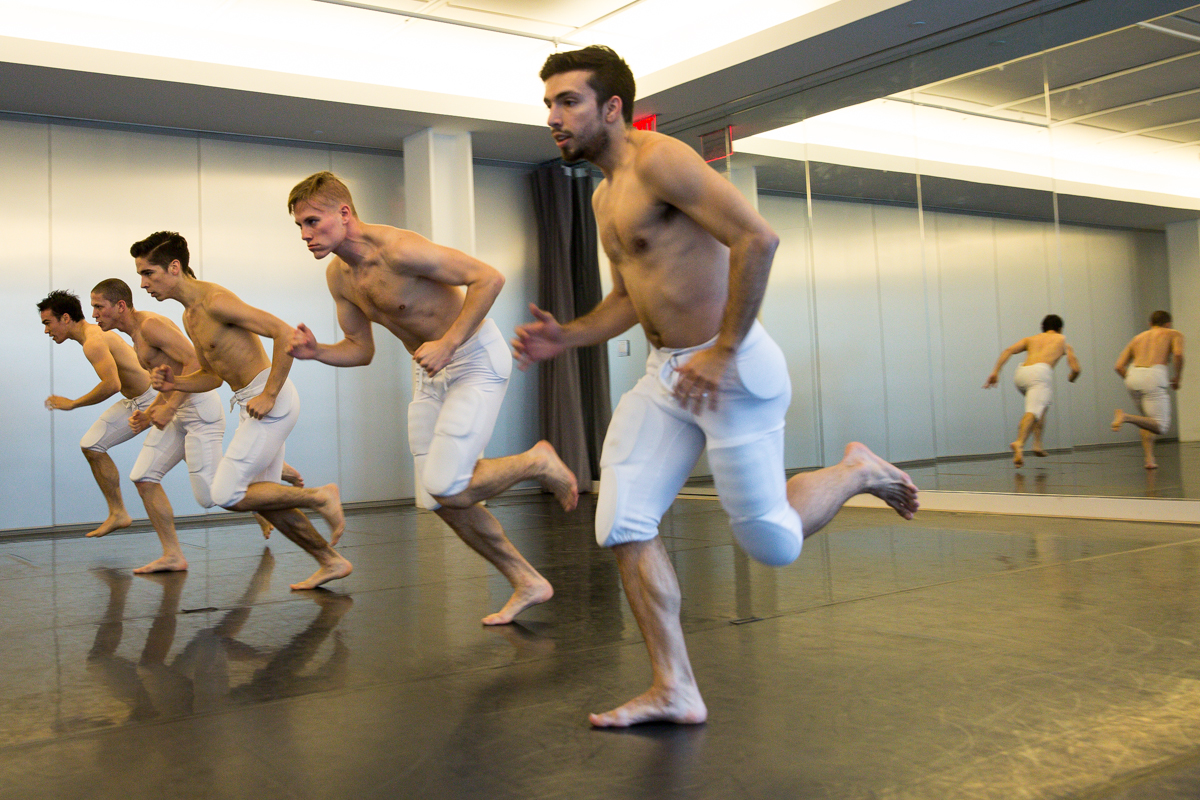
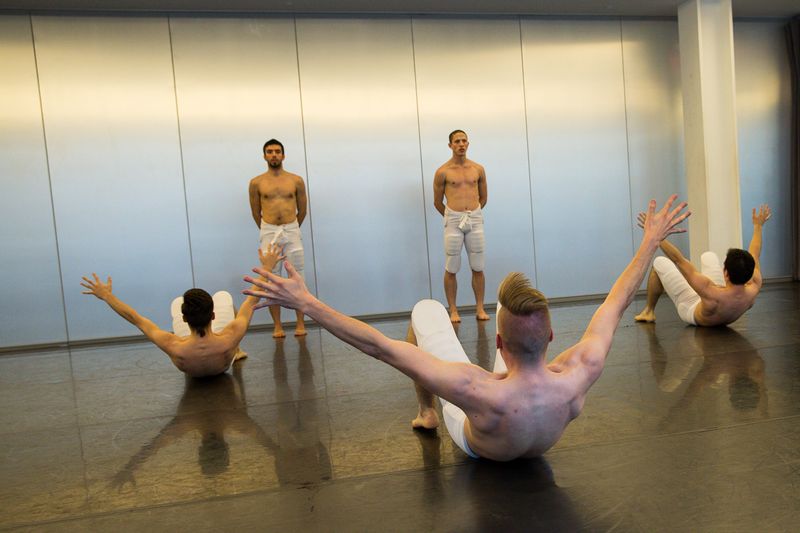
    ACADEMY will stand as a counterpoise to the boys’ most recent previous creation, blue, which will be sharing the bill at the 92nd Street Y. Whereas blue is lyrical and intimate, ACADEMY is dynamic, intense and madly physical.

    My first thought when I heard that the MADboys were creating ACADEMY was that it would be about life at a prep school or first-year college – like something out of Maurice or Another Country – where young men would be experiencing both academic and athletic competition whilst at the same time grappling (sometimes literally) with their awakening sexuality and forming their first relationships. But in fact, it’s more like a military academy or a police training program: rigorous, sweaty, boisterously masculine, and highly competitive. 

    Calisthenics and running dominate the action, laced with poignant or disturbing moments of physical contact in which a transient glimmer of tenderness can be followed by almost violent abuse. The five dancers gave a full-tilt run-thru of the piece for me and Matt, and their generosity was much appreciated.

    Here are some of Matt’s images from the studio:

    MADboots_rehearsal-5

    David, Austin and Eli

    MADboots_rehearsal-11

    Jonathan

    MADboots_rehearsal-12

    MADboots_rehearsal-3

    Austin, David

    MADboots_rehearsal-4

    Garth

    MADboots_rehearsal-13

    Jonathan

    MADboots_rehearsal-15

    MADboots_rehearsal-14

    Garth

    MADboots_rehearsal-7

    David, Austin, Eli

    MADboots_rehearsal-17

    MADboots_rehearsal-18

    David, Eli

    MADboots_rehearsal-16

    David

    MADboots_rehearsal-8

    Garth (foreground)

    My thanks to Austin and Jonathan for giving me a preview of ACADEMY, and to Matt Murphy who managed to find a free hour in his madly busy schedule to come and photograph this rehearsal.

  • CLEMENZA DI TITO @ The Met

    Clemenza.0405.01

    Tuesday November 20, 2012 – The Metropolitan Opera’s current revival of their classic Jean-Pierre Ponnelle production of Mozart’s LA CLEMENZA DI TITO is a joy both to the ear and the eye. Marty Sohl’s production photo (above) illustrates the fantasy mixture of ancient Roman and baroque stylistic elements that give the sets and costumes their timeless visual appeal.

    Tonight, Harry Bicket led a sterling performance, with excellent continuo playing from Bradley Brookshire (harpsichord) and David Heiss (cello) as well as spectacular woodwind solos in two of the opera’s iconic arias: Andrew McGill (clarinet, in “Parto, parto”) and James Ognibene (basset horn, in “Non piu di fiori”). Mr. Bicket’s vivid pacing and his sense of the music’s flow put the singers in high relief; there were three outstanding vocal performances and overall it was one of the most satisfying evenings at The Met in recent seasons.

    Kate lindsey

    To think that I almost skipped this revival! But a chance to hear Kate Lindsey as Annio was not to be missed, and the beauteous young mezzo (above) gave an immaculate performance, her lithe figure and ease of movement onstage enhancing her interpretation at every turn. Like many of her predecessors in this fach, Kate spends a lot of her onstage time in trousers (she’ll debut at Glyndebourne as the Composer in ARIADNE AUF NAXOS in the coming year). Her singing tonight was pristine, with a particularly ravishing piano passage in “Tu fosti tradito” that would melt the coldest heart.  

    Gf

    With his noble and expressive face, Giuseppe Filianoti (above) made a splendid impression as Tito. His singing was clear and mellifluous, the words poetically delivered. The tenor finely delineated the emperor’s dilemma in dealing with his betrayal by his friend Sesto: should friendship trump justice? When I last heard Mr. Filianoti in the house, he was dealing with health issues, so it was really very pleasing to hear him on such beautiful vocal form tonight.

    Garanca

    Somehow I’ve managed not to encounter a live performance by the Latvian mezzo-soprano Elina Garanca (bove) up til now. I first heard her voice on a recording my friend Mollie sent me from the 2001 Cardiff Competition. Garanca has since developed into a world-class artist and after hearing her as Sesto tonight, she’s on my A-list of singers. Both in terms of vocal appeal and technical accomplishment, this was a stunning performance: Garanca’s voice is all of a piece, and she moves it thru the registers seamlessly. After a profoundly expressive rendering of the openng passages of the great aria “Parto, parto” Ms. Garanca sailed through the whirlwind coloratura flourishes of the aria’s later pages with nimble assurance. Later, as she knelt to invoke the strength to carry out her assassination of Tito, she summoned an amazing degree of projection, the voice sailing into the hall with startling force. In her second spectacular aria “Deh per questo istante solo”, the mezzo soprano coloured the voice movingly, reflecting the character’s anguish and also his stalwart refusal to implicate Vitellia in the crime. Ms. Garanca’s entire performance was a revelation.

    Barbara Frittoli, an unforgettable Desdemona at the Met in 1999, has more recently found considerable success in singing Mozart since she did her voice some damage during the first decade of the 21st century by singing music that was too heavy for her. Her canny manipulation of dynamics usually prevents her widening vibrato from becoming too prevelant. But for all her attractive qualities, Vitellia’s great aria “Non piu di fiori” simply lies too low for Ms. Frittoli to make her finest effect in the music. Vitellia in fact can be sung by a mezzo, except for that thorny top-D that Mozart threw into the act I trio, a note that eluded Ms. Frittoli tonight. Nevertheless, the soprano kept up her side of things all evening and the audience enjoyed her sometimes over-the-top dramatic portrayal.

    Lucy Crowe as Servilia is a pretty girl with luminous eyes and a pleasing lyric timbre. In his search for a wife, Tito’s first choice – Servilia – might have made him quite happy, especially with Ms. Crowe’s buxom grace and girlish smile.

    A wonderful Met evening, then, and there was every reason to stay to the end and shout’ bravi’ as the singers took their bows to sustained applause.

    Metropolitan Opera House
    November 20, 2012
    LA CLEMENZA DI TITO
    Mozart

    Tito.......................Giuseppe Filianoti
    Vitellia...................Barbara Frittoli
    Sesto......................Elina Garanca
    Servilia...................Lucy Crowe
    Annio......................Kate Lindsey
    Publio.....................Oren Gradus
    Berenice...................Toni Rubio

    Bradley Brookshire, Harpsichord Continuo
    Anthony McGill, Clarinet Soloist
    James Ognibene, Basset Horn Soloist
    David Heiss, Cello Continuo

    Conductor..................Harry Bicket

  • Lubovitch Rep Class with Attila Joey Csiki

    1106724682_5aApN-XL

    Tuesday November 30, 2010 – At Peridance this week, Attila Joey Csiki is presenting a series of master classes in Lar Lubovitch repertoire. Attila invited me to come and watch one of the sessions. Unfortunately both Kokyat and Brian were working their regular jobs so I didn’t have a photographer with me. However, Attila has sent me some photos by Kevin Thomas Garcia from his recent solo appearance at the Trevor Project Gala at the Church of St. Paul the Apostle on November 22nd so the photos in this article are from that evening.

    The high-ceilinged studio was filled with about two dozen students who came for this second of five classes. Attila told me that about half the dancers present had come the day before and the other half were new faces. There were two guys, both very fine dancers, and several really impressive girls including Emily SoRelle Adams, a dancer I’ve known from her appearances with New Chamber Ballet.

    1106719189_dVdsS-XL

    Many of the students had just taken a ballet class in a studio down the hall; Attila told the dancers he was not going to give them a warm-up per se but that the first piece they would be working on – an excerpt from Lar Lubovitch’s 1976 work MARIMBA – would provide a warm-up in itself. He then began to demonstrate the phrase, without music. The series of counts seemed very complex to me but the dancers jumped right in, picking up the moves and port de bras from Attila; his innate musicality turned the demonstration into something of a performance. While I was sitting there trying to remember the initial arm gesture, the dancers had the entire phrase nearly nailed down. They ran thru it a few times and then Attila played the music, telling the dancers to allow the trance-like repetitions to flow thru their bodies. They moved like waves of tall grass in the breeze. 

    From there he added the second phrase of the excerpt and then the third. In the meantime I had completely forgotten the first phrase. But the dancers didn’t; soon they were all moving in sync thru the extended passage. Attila split them into two groups and they continued running the piece until it was in their muscle-memory. And…they were now thoroughly warmed-up.

    Attila then turned to a very different Lubovitch work, a luminous excerpt from Lubovitch’s 2007 DVORAK SERENADE. Again in demonstrating the phrases Attila’s fluid style was so clear. Turning on the rhapsodic music, he had the whole group work the phrase and then broke them into four smaller groups. “This is classic Lubovitch!” he called out as he let the energy of the music flow thru his limbs: “One step bleeds into the next, the movement never stops.”

    “Easy…easy!” he cautioned one set of dancers who were poised to start moving across the floor in too aggressive a manner. “It’s lyrical!” 

    Outside the windows, another crowd of dancers were waiting for the studio. The class had literally zoomed by and the students came forward to curtsey and bow to Attila. One of the fringe benefits of watching a master class is getting to see world-class dancers in action up close. Thus in recent weeks I’ve seen Wendy Whelan, Matthew Rushing, Attila today and with Alex Wong coming up in January.

    Attila’s classes continue thru Friday at Peridance, with an 11:30 AM start time. You can take an individual class for $20.

    1106702153_vLyiK-XL

    A final photo from the Trevor Project Gala: Attila with pianist Kathy Tagg. Read about the visit Brian Krontz and I made to Attila’s rehearsal for the gala here

    Photos: Kevin Thomas Garcia