Tag: Vienna State Opera

  • Gertrud Rünger

    G runger

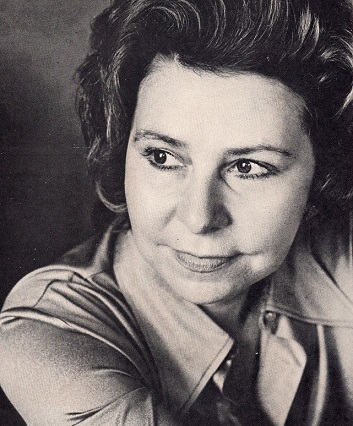
    Gertrud Rünger (1899-1965) sang both mezzo-soprano and dramatic soprano roles during her career. She began as a choral singer, moving on to solo roles in smaller German houses in 1923.

    In 1930, she joined the ensemble of the Vienna State Opera, and in 1934 came to the Berlin Staatsoper. She sang Verdi’s mezzo roles in German, and developed a reputation as a Wagnerian soprano, singing in Paris, London, Amsterdam, Dresden, and Munich.

    Ms. Rünger sang the Nurse in FRAU OHNE SCHATTEN at the Salzburg Festival in 1932-1933, and later appeared there as Klytemnestra and as Beethoven’s Leonore. She sang briefly at The Met in 1937, as the WALKURE and GOTTERDAMMERUNG Brunnhildes, Fricka in RHEINGOLD, and as Ortrud opposite Kirsten Flagstad’s Elsa.

    Designated as Kammersängerin, Gertrud Rünger continued to perform into the 1950s, whilst also teaching voice. She passed away at Berlin in 1965.

    Gertrud Rünger – Sleepwalking Scene ~ MACBETH – in German

    Gertrud Rünger – DON CARLO aria – in German

    And here is Ms. Rünger live in a thrilling rendition of Ortrud’s Invocation.

    ~ Oberon

  • Julia Faulkner ~ Vier Letzte Lieder

    Julia faulkner capriccio

    Above: Julia Faulkner as the Countess in Strauss’s CAPRICCIO

    Soprano Julia Faulkner sings Richard Strauss’s Vier Letzte Lieder with the orchestra of the Vienna State Opera conducted by Michael Halász; the performance took place in 1993. Listen here.

    Ms. Faulkner studied at the Eastman School of Music, and had a major career in both opera and concert. She had a long association with both the Bavarian State Opera and the Vienna State Opera, and she sang with such prestigious orchestras as the Concertgebouw, the Berlin Philharmonic, and the Cleveland Orchestra.

    Julia Faulkner was a Met Auditions winner in 1985, made her Met debut in 1994 as Arabella, and in 2001-2002 sang several performances as Marianne in ROSENKAVALIER and the Voice of the Falcon in FRAU OHNE SCHATTEN with the Company.

    She is currently Director of Vocal Studies at the Chicago Lyric Opera’s Ryan Opera Center. Her beautiful recording of Pergolesi’s STABAT MATER for Naxos is one of my favorites.

  • GIULIO CESARE ~ Vienna 1985

    Snapshot cesare

    Above: Marjana Lipovsek as Cornelia and Ann Murray as Sesto 

    A performance of Handel’s GIULIO CESARE at the Vienna State Opera in 1985

    Watch and listen here.

    CAST:

    Caesar – Benjamin Luxon; Cleopatra – Roberta Alexander;  Cornelia – Marjana Lipovsek;  Sesto – Ann Murray; Curio – Rudolf Katzböck; Tolomeo – Roderick Kennedy; Achilla – Thomas Hampson; Nireno – Anton Scharinger

    Conductor: Nicolas Harnoncourt

  • Christa Ludwig Has Passed Away

    C l

    April 25th, 2021 – Throughout the sixty years that I have been obsessed with opera, I have loved and admired many wonderful singers. But when people ask me, “Who was the greatest singer you ever heard?”, I must answer: “Christa Ludwig.” Today, news has come of her death at the age of 93.

    Christa Ludwig made her Vienna State Opera debut as Cherubino in Mozart’s NOZZE DI FIGARO in 1955. She went on to give 769 performances of 42 roles in Vienna. At the Metropolitan Opera, her 1959 debut (also as Cherubino) marked the start of a 38-year association with The Met, where she sang 119 performances of 15 roles.

    Christa Ludwig was my first Octavian, and also my first Dyer’s Wife in FRAU OHNE SCHATTEN (in a stellar cast with Leonie Rysanek, Irene Dalis, James King, and Christa’s then-husband, Walter Berry, with Dr. Böhm conducting), my first Dido in TROYENS, and my first Klytemnestra. Her other Met roles were Amneris, Brangaene, Ortrud, Fricka, Kundry, Charlotte in WERTHER, and Waltraute; and she gave a single performance as Leonore in FIDELIO.

    My first experience of seeing Christa Ludwig onstage was as the Dyer’s Wife; my first FRAU was part of a thrilling weekend in February 1969 that also included my very first RHEINGOLD (with Herbert von Karajan conducting) and the now legendary Nilsson/Caballe TURANDOT. Christa’s Dyer’s Wife was a blazing creation, her voice spanning the wide range with complete command, the highest notes sailing into the Big House with stunning clarity and power.

    From a commercial recording of the great Act III duet for Barak and his wife:

    FRAU OHNE SCHATTEN ~ scene from Act III – Christa Ludwig – Walter Berry – Sieglinde Wagner – Hollreiser cond
    C l octavian

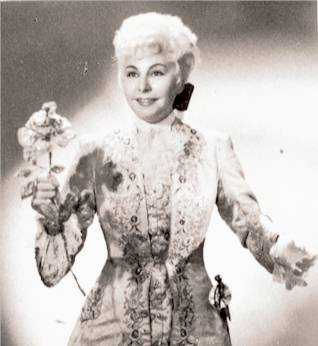
    I next saw Ms. Ludwig onstage on Valentine’s Day, 1970, as Octavian in DER ROSENKAVALIER. Karl Böhm was again on the podium, and the cast further featured Marion Lippert, Reri Grist, and Mr. Berry. The sight of Ms. Ludwig as Octavian entering the hall of the Faninal mansion, bearing the silver rose, left an indelible impression on my romantic heart. Over time, it became for me the iconic image of everything I love about opera.

    TroyensVickers-Ludwig2

    Above: Nuit d’ivresse with Jon Vickers and Christa Ludwig; a Louis Melançon photo

    On October 27th, 1973 – a red-letter day in my personal life – I saw LES TROYENS for the first time. Shirley Verrett and Louis Quilico as Cassandra and Chorebus had given glorious performances in PRISE DE TROIE. Then, as the scene shifts to Carthage, Christa Ludwig and Jon Vickers sang so poetically the quietly rapturous love duet, Nuit d’ivresse.  Inspired by their ecstasy, I spent the night with Z – and I have ever since felt that life really began for me with that encounter.

    More than a decade was to pass before I saw Christa Ludwig on the Met stage again: in 1984, she was a fascinating Klytemnestra in my first-ever ELEKTRA. Ute Vinzing, Johanna Meier, and Simon Estes were her co-stars, with Maestro Levine presiding. Ms. Ludwig’s singing, with an undercurrent of creeping madness, bore the stamp of a great lieder singer; her characterization sometimes veered endearingly to the melodramatic.
    Gotterdammerung

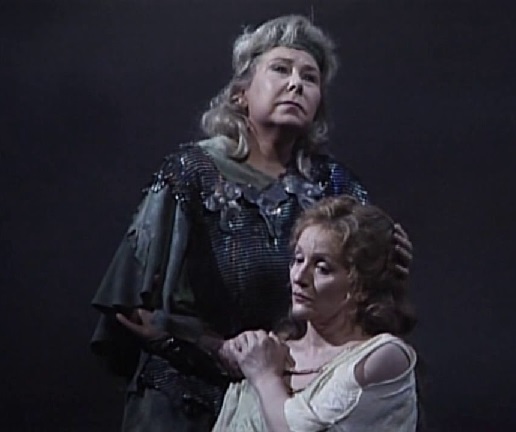
    Above: Ludwig and Behrens in GOTTERDAMMERUNG

    A four-year interval then passed before I saw Christa in opera again: the 1988 opening night of the Schenk/Levine GOTTERDAMMERUNG. This was a spectacular performance in every regard: Levine and his orchestra were on peak form, and Hildegard Behrens and Matti Salminen thrilled me to the core as Brunnhilde and Hagen. Christa, as Waltraute, looked spiffy in her Valkyrie gear – with black trousers and high black boots – and she moved about, restless as a caged panther, as she told her sister of their father’s frightening state of mind. Having failed in her mission, Waltraute rushes away. The curtain calls that night were fantastic: I think Ms. Ludwig truly didn’t expect the massive wave of applause and bravas that greeted her as she stepped out for a solo bow. It was so moving to watch her accept the audience’s loving appreciation.

    I saw Christa Ludwig on the Met stage for the last time in April 1989 as Fricka in WALKURE. It was a cast of titans: Hildegard Behrens, Jessye Norman, Gary Lakes, James Morris, and Kurt Moll were Christa’s colleagues, and again Levine and the Met orchestra were beyond the beyond. The tension in the great argument between Fricka and Wotan was palpable; then Christa – having won – gathered her dignity and took her final parting shot at Brunnhilde with barely disguised contempt.

    Christa Ludwig made her farewell appearance at The Met as Fricka in a Saturday matinee broadcast of WALKURE on April 3, 1993. Here is her scene from that performance, with Dame Gwyneth Jones as Brunnhilde, James Morris as Wotan, and James Levine conducting. I was listening at home, and as Ms. Ludwig exited the stage, I had a sense that the audience wanted desperately to burst into applause. 

    Christa Ludwig as Fricka ~ Met farewell performance with G Jones +J Morris – Levine cond – 4~3~93

    While Vienna and The Met loomed large in the Ludwig career, she also appeared at La Scala, Covent Garden, Chicago Lyric Opera, and at the festivals at Bayreuth and Salzburg. In addition, she sang the great concert works of Bach and Mahler.

    Christa Ludwig was a beloved recitalist; in 1984, I had the great pleasure of hearing her at Avery Fisher Hall with James Levine at the piano. The program of Strauss and Wolf lieder ended with a marvelous encore: the Brahms “Wiegenlied”.
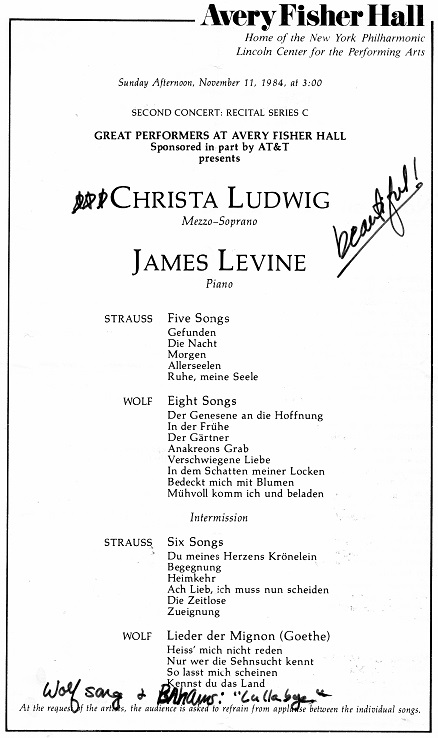
    Ludwig recital-1 jpg

    Ms. Ludwig left us with a large and lovely catalog of recordings; among my favorites are Bartok’s BLUEBEARD’S CASTLE, the Kempe LOHENGRIN, the Solti TANNHAUSER, the Böhm TRISTAN from Bayreuth with Nilsson and Windgassen, scenes from Strauss operas with Walter Berry…and her SAMSON ET DALILA with James King holds a special appeal for me. She created a stir in 1986 by recording Schubert’s Winterreise with James Levine; they had performed the great Schubert cycle together on the Met stage in 1983.
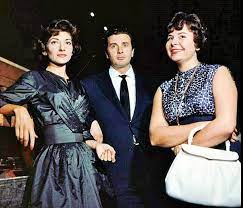
    Norma

    Above: Christa in the recording studio with Maria Callas and Franco Corelli for the EMI NORMA

    Christa Ludwig sings Strauss’s “Morgen” with Charles Spencer at the piano. Watch and listen here.

    Listen to more from Christa Ludwig:

    Christa Ludwig – Es gibt ein reich – ARADNE AUF NAXOS

    Christa Ludwig – MACBETH – Act I scena – Vienna 1970

    Christa Ludwig – Liebestod ~ TRISTAN UND ISOLDE

    Christa Ludwig – Mahler ~ Ich bin der welt abhanden gekommen

    Christa Ludwig – Der Engel from Wagner’s Wesendonck Lieder

    A lovely note I received from Christa Ludwig after I wrote to her on the occasion of her Met farewell in 1993:
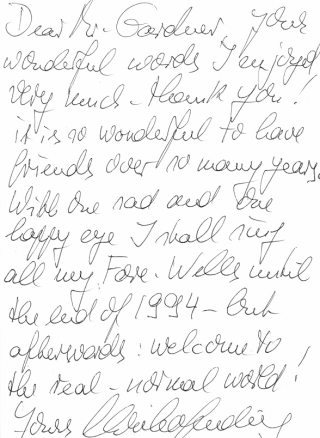
    C l note-1 jpg

    Christa Ludwig ~ An die Musik

    ~ Oberon
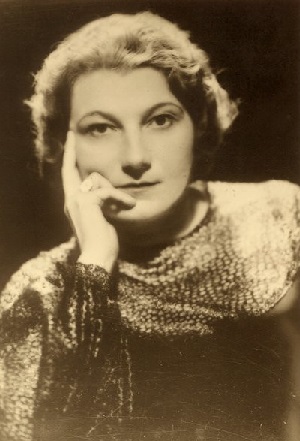
  • Rosette Anday

    Anday-Rosette - Copy

    The Hungarian mezzo-soprano Rosette Anday made her Vienna State Opera debut in 1921 at the age of 18 as Carmen. Franz Schalk, the Company’s director, had first heard the young mezzo-soprano in Budapest, where she studied at the local conservatoire whilst also taking violin lessons. Schalk engaged her immediately, and following her highly successful debut, she went on to become one of Vienna’s most beloved stars. Richard Strauss – no less – was Ms. Anday’s accompanist when she gave her first lieder recital in the Grosse Musikvereinssaal in Vienna soon after her debut.

    Rosette Anday’s roles included Mozart’s Cherubino and Dorabella, Verdi’s Preziosilla, Amneris, and Azucena, Wagner’s Fricka, Erda, Waltraute, Brangane, and Adriano in RIENZI, Laura in GIOCONDA, Dalila, and Klytemnestra. She was one of the youngest singers ever to be named ‘Kammersängerin‘.

    Banned from the stage during the Nazi occupation of Austria, Ms. Anday was able to resume her career immediately after the war, joining the renowned ensemble at the Theater an der Wien. In 1961, she celebrated the 40th anniversary of her debut with a performance of Klytemnestra.

    Also beloved as a concert artist and recitalist, Rosette Anday toured North and South America and appeared in Berlin, Paris, and at the Salzburg Festival. She passed away in 1977.

    Rosette Anday – Erda’s Warning ~ RHEINGOLD – 1948 – with F Frantz

    Rosette Anday – Printemps qui commence ~ SAMSON ET DALILA

    Rosette Anday – Mahler’s Urlicht

  • WALKURE @ Vienna 2016

    Snapshot walkure

    Above: Christopher Ventris and Waltraud Meier winning a huge ovation after Act I of WALKURE

    Adam Fischer conducts a performance of Wagner’s WALKURE at the Vienna State Opera in 2016 with Linda Watson (Brunnhilde), Waltraud Meier (Sieglinde), Michaela Schuster (Fricka), Christopher Ventris (Siegmund), Tomasz Konieczny (Wotan), and Ain Anger (Hunding).

    Watch and listen here.

  • Aase Nordmo-Løvberg & Kolbjørn Høiseth

    Aase-nordmo-lvberg-6d8aba9d-d166-4244-b6c9-58dc451cbbf-resize-750

    Above: soprano Aase Nordmo-Løvberg

    Ms. Nordmo-Løvberg spent most of her career at Oslo and Stockholm. She was a highly-regarded soprano who worked with top conductors (such as Karajan and Solti). She sang at the Vienna State Opera, and gave a dozen performances at The Met in 1959-1960 singing Elsa, Eva, Sieglinde, and Beethoven’s Leonore.

    HOISETH Kolbjorn

    Above: the Norwegian tenor Kolbjørn Høiseth

    Mr. Høiseth’s career took him to London, Berlin, Stockholm, Lyon, and Bordeaux as well as numerous German houses. He specialized in Wagner and Verdi, also appearing in WOZZECK, FIDELIO, and ELEKTRA.

    In 1975, the tenor sang Froh in RHEINGOLD (in which role I saw him twice) at The Metropolitan Opera, where he also appeared as Siegmund in a single performance of WALKURE. His voice had a lyric quality, but also ample power when needed.

    Aase Nordmo Løvberg & Kolbjørn Høiseth – WALKURE – ACT I scene – Stockholm 1963

  • Rudolf Knoll

    A-870624-1523602270-9499.jpeg

    German baritone Rudolf Knoll had an extensive career in Europe, singing at the Vienna State Opera, Zurich, and major German houses. He made several recordings of opera and lieder.

    He was less well-known in America, where his Met career consisted of two roles – Kothner in MEISTERSINGER and Faninal in ROSENKAVALIER – sung over a two-year span. He was in the casts of the first performances of those two operas I ever experienced, the ROSENKAVALIER being particularly stellar: his colleagues were Marion Lippert, Reri Grist, Christa Ludwig, Walter Berry, and George Shirley, with Karl Böhm conducting.

    In Europe, Knoll’s repertoire ranged from Alberich, Beckmesser, Pizarro, and Mandryka to Iago, Count di Luna, and Rigoletto. After retiring from opera, he taught at the Salzburg Mozarteum; among the singers he worked with was the prominent baritone Sir Simon Keenlyside.

    The only photo I am able to find of Mr. Knoll is from his teaching days (above).

    Rudolf Knoll as Donner – Rheingold

    Rudolf Knoll – Cortigiani vil razza dannata ~ RIGOLETTO

    Rudolf Knoll passed away in 2007.

  • Natalia Troitskaya as Adriana Lecouvreur

    00323174

    Natalia Troitskaya, born in Belgrade of Russian descent, had a major career as a lirico-spinto soprano during the 1980s. She sang at many major European houses, having a long association with both the Vienna State Opera and the Staatsoper Hamburg. She sang in South America, and in the USA at Washington DC and Los Angeles.

    Troitskaya seemed to vanish from the operatic world around 1991; later, I learned that she had passed away in 2006 at the age of 55 following a long illness. She left hardly any commercial recordings, but there are some live performances that were preserved from broadcasts.

    Natalia Troitskaya – ADRIANA LECOUVREUR – Adriana’s entrance – Barbican~London 1987