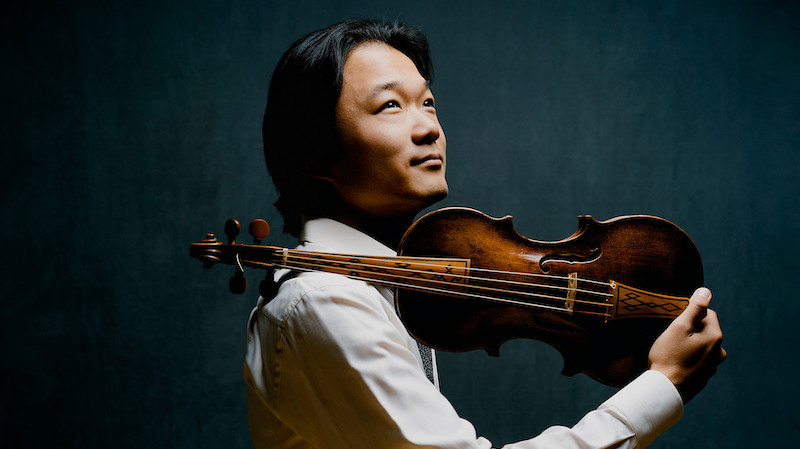
A 2015 performance of Bach’s Violin Concerto in E-major BWV 1042 with soloist Shunske Sato (above) and the Netherlands Bach Society.
Watch and listen here.
A 2015 performance of Bach’s Violin Concerto in E-major BWV 1042 with soloist Shunske Sato (above) and the Netherlands Bach Society.
Watch and listen here.

Thursday October 20th, 2016 – Leonidas Kavakos (above) was both soloist and conductor for this evening’s program at The New York Philharmonic. Mr. Kavakos is the Philharmonic’s current Mary and James G. Wallach Artist-in-Residence, and in this capacity will blessedly be with us frequently in the current season. Tonight, the prodigiously talented violinist played Bach and then moved to the podium to conduct works by Busoni and Schumann.
With the mystique of a Tolkien wizard, Mr. Kavakos worked his magic in a brilliant rendering of J.S. Bach’s Violin Concerto in D minor (reconstructed), BWV 1052; surrounded by an ensemble of the orchestra’s elite string players, and with Paolo Bordignon at the harpsichord, he cast a spell over the hall with his playing. Following a sizzling cadenza midway thru the first movement, the violinist and his colleagues drew us in with the lamenting beauty of the adagio. An unfortunate cellphone intrusion in the very last moments of the movement was brushed aside as Mr. Kavakos sailed forward with stunning virtuoso playing in the allegro, where he summoned up visions of the legendary “mad fiddlers” who played as if possessed by demons.
The whole ensemble went merrily along on the soloist’s swift ride, and I must mention Timothy Cobb’s plush tone and amiable agility on bass. Shouts of ‘bravo‘ rang thru the hall as the concerto ended. Mr. Kavakos and Sheryl Staples, this evening’s concertmaster, clearly form a mutual-admiration-society; after bowing to the audience’s enthusiasm, the soloist signaled Ms. Staples to rise but instead she and all her colleagues remained seated, vigorously applauding Mr. Kavakos. When he finally got the players to stand, the applause re-doubled.
The Geffen Hall stage crew swiftly re-set the space for the next work: I had discovered Ferruccio Busoni’s Berceuse élégiaque earlier this season when the Curtis Symphony Orchestra performed it at Carnegie Hall, and was very glad of an opportunity to experience it again tonight.
This is music wrapped in a somber mystery. The composer wrote these lines as a brief ‘prologue’ to the piece:
“The child’s cradle rocks, the hazard of his fate reels; life’s path fades, fades away into the eternal distance.”
During the ten-minute course of this eerie lullaby, the music rises very slowly from the depths; the subtle interjections from the harp add a dreamlike quality, as does the celesta which joins the darkling ensemble near the end. As a chillingly marvelous finish, a gong sounds and its reverberations fade to nothingness.
The Philharmonic’s Playbills are always loaded with fascinating articles and information; I read them on the train trip homeward after the concerts. One passage in the notes on the Busoni struck a tragic note: Gustav Mahler conducted the Philharmonic premiere of the Berceuse élégiaque on February 21st, 2011. Suffering from heart disease, Mahler was forced to withdraw from a second performance of the work; he sailed back to Europe and died in Vienna in May. The February 21st Philharmonic concert thus marked the last time he ever conducted.
Robert Schumann’s Symphony No. 2 was the evening’s concluding work. Here my companion and I were at a loss: the music is absolutely lovely from start to finish, and it was conducted and played with both steadfastness and genuine affection by Mr. Kavakos and the artists of the Philharmonic. But somehow it is simply too much of a good thing. We were trying to figure out the reasons why this music, so congenial, seems to go in one ear and out the other; there’s no edge to it anywhere, and nothing that reaches the heart. Also, for me, part of the problem is all the tutti playing: there’s a shortage of those passages where solos might lure us in or smaller components of the orchestra might bedevil one another. Only in the adagio, where the oboe, clarinet and horns had chances to step forward, did my interest perk up. For the rest, the music simply washed over us to beautiful but unmemorable effect.
 Oberon's Glade