Tag: Wagner

  • PARSIFAL @ The Met

    Parsifal1213.11

    Above: the Grail revealed: Peter Mattei as Amfortas and Rene Pape as Gurnemanz in Wagner’s PARSIFAL; a Ken Howard/Met Opera photo

    ~ Author: Oberon

    Saturday February 17th, 2018 matinee – A powerful and thoroughly absorbing matinee performance of PARSIFAL, the only Wagner in the Metropolitan Opera’s repertory this season. This dark, barren, and brooding production premiered in 2013, at which time the total absence of a Grail temple from the scenic narrative seemed truly off-putting. All of the action of the outer acts takes place out-of-doors, whilst the second act – as we were told by someone who worked on the production at the time it was new – is set inside Amfortas’s wound.

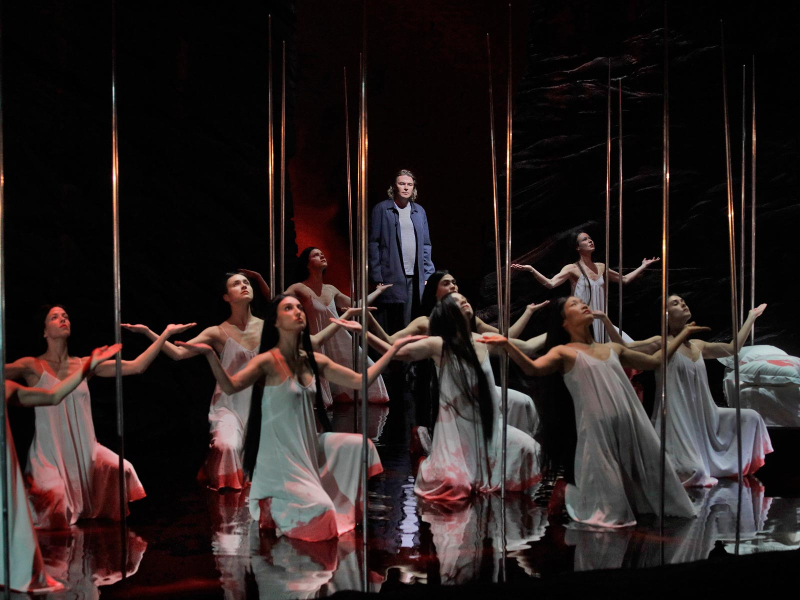
    Not everything in the production works, and the desolate landscape of the final act – with its open graves – is dreary indeed. But the devotional rites of the Grail brothers in Act I and the stylized movements of the Flowermaidens in the blood-drenched ‘magic garden’ of Act II are engrossing – especially today, where I found a personal link to both scenes.

    Musically, it was a potent performance despite a couple of random brass blips. Since the 2013 performances, I’ve been going to a lot of symphonic and chamber music concerts and this has greatly enhanced my appreciation of the orchestra’s work whenever I am at the opera. From our perch directly over the pit today, I greatly enjoyed watching the musicians of the Met Orchestra as they played their way thru this endlessly fascinating score.

    The Met’s soon-to-be music director, Yannick Nézet-Séguin, was on the podium this afternoon, and he seemed to inspire not only the orchestra, but also the principals, chorus, dancers, and supers all of whom worked devotedly to sustain the atmosphere of the long opera. While I did not feel the depth of mystery that I have experienced in past performances of this work conducted by James Levine or Daniele Gatti, in Maestro Nézet-Séguin’s interpretation the humanity of the music seemed to be to the fore. This meshes well with the physical aspects of the production, which strongly and movingly depicts the fraternity of the Grail and the desperate suffering of Amfortas. The orchestra’s poetic playing as Gurnemanz sings of the slaying of the swan was but one passage of many where I felt the music so deeply. And the transformation music of Act I was particularly thrilling to hear today.

    The singing all afternoon was at a very high level, with the unfortunate exception of the Kundry of Evelyn Herlitzius. We’d previously heard her as Marie in WOZZECK, but Kundry’s music – especially in Act II – needs singing that has more seductive beauty than Ms. Herlitzius delivered. The soprano’s one spectacular vocal  moment – “Ich sah Ihn – Ihn – und…lachte!“, where she tells how she had seen Christ on the cross and laughed – was truly thrilling, but not enough to compensate for her tremulous, throaty singing elsewhere.
    1600x1200_parsifal3

    Above: In Klingsor’s Magic Garden, tenor Klaus Florian Vogt as Parsifal; a Met Opera photo

    In 2006, Klaus Florian Vogt made an unforgettable Met debut as Lohengrin, and this afternoon as Parsifal the tenor again sang lyrically in a role that is normally sung by tenors of the more helden- type. The almost juvenile sound Vogt’s voice underscored Parsifal’s innocence; this worked especially well in Act I, and also  brought us some beautiful vocalism in Act II. As Kundry’s efforts to seduce become more urgent, Vogt’s singing took on a more passionate colour. In his struggle between steadfastness and capitulation, the tenor’s cry of “Erlöse, rette mich, aus schuldbefleckten Händen!” (‘Redeem me, rescue me from hands defiled by sin!’) pierced the heart with his dynamic mastery. 

    Kundry’s wiles fail her, and with an upraised hand, Parsifal fends off Klingsor’s spear-wielding assault. Seizing the weapon that wounded Amfortas, the young man cries out “Mit diesem Zeichen bann’ ich deinen Zauber!” (‘With this Sign I banish your magic!’); the bloody back-lighting dissolves to white and Klingsor is cast down. Turning to Kundry, Mr. Vogt’s Parsifal has the act’s final line of premonition: “Du weisst, wo du mich wiederfinden kannst!” (‘You know where you can find me again’) and he strides out into the world  to commence his long, labored journey back to the realm of the Grail. In the final act, Mr. Vogt’s expressive singing was a balm to the ear, lovingly supported by the conductor and orchestra.

    Parsifal

    Above: Rene Pape as Gurnemanz, in a Ken Howard/Met Opera photo

    Repeating the roles they created when this production premiered in 2013, Rene Pape (Gurnemanz) and Peter Mattei (Amfortas) were again superb. Mr. Pape now measures out his singing of this very long part more judiciously than he has in the past, at times allowing the orchestra to cover him rather than attempting to power thru. But in the long Act I monolog, “Titurel, der fromme Held…”, the basso’s tone flowed like honey; and later, at “Vor dem verwaisten Heiligtum, in brünst’gem Beten lag Amfortas...” (‘Before the looted sanctuary, Amfortas lay in fervent prayer’) Mr. Pape’s emotion-filled delivery struck at the heart of the matter. Throughout Act III, leading to the consecrational baptism of Parsifal, Mr. Pape was at his finest.

    Parsifal1213.40

    Peter Mattei’s Amfortas (in a Ken Howard/Met Opera photo above) is truly one of the great operatic interpretations I have ever experienced, for it is not only magnificently sung but acted with matchless physicality and commitment. The guilt and suffering Mr. Mattei conveys both with his voice and his body is almost unbearable to experience in its intensity and sense of reality.

    After a desperate show of resistance to calls for the Grail to be revealed in Act I, Amfortas – in abject anguish – performs the rite; his strength spent, he staggers offstage and as he does so, he locks eyes with Parsifal, the man who will succeed him as keeper of the Grail: one of the production’s most telling moments. And in the final act, Mr. Mattei throws himself into the open grave of his father, Titurel, as he begs for death to release him from his eternal suffering; this horrifies the assembled Grail knights. Such moments make for an unforgettable interpretation, yet in the end it’s the Mattei voice that sets his Amfortas in such a high echelon.

    P015nkzb

    Evgeny Nikitin’s Klingsor (above), creepy and thrilling in 2013, incredibly was even better in this revival. The voice was flung into the House with chilling command, and the bass-baritone’s physical domination of his bloody realm and his hapless female slaves was conveyed with grim authority. His demise was epic.

    Alfred Walker sang splendidly as the unseen Titurel, and I was very glad that he appeared onstage for the bows so I could bravo him for his wonderful outpourings of tone. Another offstage Voice, that of Karolina Pilou – who repeats the prophetic line “Durch Mitleid wissend…der reine Tor!” (‘Enlightened through compassion, the innocent fool…’) to end Act I – had beauty of tone, though the amplification was less successful here.

    The Squires ( Katherine Whyte, Sarah Larsen, Scott Scully, and Ian Koziara) were excellent, especially as they harmonized on the emblematic “Durch Mitleid wissend…” theme, and the Flowermaidens sounded lovely, led with ethereal vocal grace by Haeran Hong. Mark Schowalter and Richard Bernstein were capital Knights, and I must again mention Mr. Bernstein’s terrific voice and physical presence as a singer underutilized by the Met these days. His lines ths afternoon were few, yet always on the mark; and in Act III, helping to bear the shrouded body of his late lord Titurel to its grave, Mr. Bernstein seemed to carry the weight of the world on his shoulder.

    What gave the performance a deep personal dimension for me today was finding two dancers I have known for some time – David Gonsier and Nicole Corea – onstage in Acts I and II respectively. By focusing on them – Mr. Gonsier as a young Grail knight and Ms. Corea as a delicious Blumenmädchen – the ‘choreography’ given to these two groups became wonderfully clear and meaningful.

    I first spotted Mr. Gonsier seated in the circle of knights; my imagination was immediately seized by the rapture evident in his eyes. For long, long stretches of the first act, I could not tear my gaze away from him as his mastery of the reverential gestural language and the deep radiance of his facial expressions spoke truly of what it means to be a knight of the Holy Grail. Amazingly, out of all the men I might have zeroed in on among the brotherhood, Mr. Gonsier was the last of the knights to leave the stage as Act I drew to an end: he received a personal blessing from Gurnemanz and their eyes met ever-so-briefly. So deeply moving.

    Ms. Corea is beloved in the Gotham danceworld for her work with Lar Lubovitch; I ran into her on the Plaza before the performance today and she assured me I’d be seeing her this Spring at The Joyce as Mr. Lubovitch celebrates his 50th anniversary of making dances. Incredibly, within two seconds of the Act II curtain’s rise on the identically clad and be-wigged Flowermaidens standing in a pool of blood, I found Nicole right in my line of vision. Both in her compelling movement and her captivating face, Nicole became the icon of this band of bewitching beauties.

    Whilst hailing some of the unsung cast members of the afternoon, mention must be made of the two heroic supers who literally keep Amfortas alive and mobile, frequently taking the full weight of the ailing man as he struggles to fulfill his dreaded duties as Lord of the Grail. Great work, gentlemen!

    Much of the libretto of PARSIFAL‘s outer acts today seems like religious mumbo-jumbo. It’s the music – especially the ending of Act I – that most clearly speaks to us (and even to an old atheist like me) of the possibility of God’s existence. Perhaps He has simply given up on mankind, as His name – and his word – have been sullied in recent years by those very people who claim to revere him. Wagner may have foreseen all this, as he once wrote: “Where religion becomes artificial, it is reserved for Art to save the spirit of religion.”

    At the end of Act I of today’s PARSIFAL, I momentarily questioned my disbelief. But then the applause – which I’ve always hated to hear after such a spiritual scene – pulled me back to reality. I’d much rather have stayed there, in Montsalvat.

    Metropolitan Opera House
    Saturday February 17th, 2018 matinee

    PARSIFAL
    Richard Wagner

    Parsifal................Klaus Florian Vogt
    Kundry..................Evelyn Herlitzius
    Amfortas................Peter Mattei
    Gurnemanz...............René Pape
    Klingsor................Evgeny Nikitin
    Titurel.................Alfred Walker
    Voice...................Karolina Pilou
    First Esquire...........Katherine Whyte
    Second Esquire..........Sarah Larsen
    Third Esquire...........Scott Scully
    Fourth Esquire..........Ian Koziara
    First Knight............Mark Schowalter
    Second Knight...........Richard Bernstein
    Flower Maidens: Haeran Hong, Deanna Breiwick, Renée Tatum, Disella Lårusdóttir, Katherine Whyte, Augusta Caso

    Conductor...............Yannick Nézet-Séguin

    ~ Oberon
  • WALKURE: Act I @ The New York Philharmonic

    Simon _oneill

    Above: tenor Simon O’Neill

    ~ Author: Oberon

    Thursday February 15th, 2018 – We’ve been starved for Wagner of late, but now – in the course of a single week – we’ve had Dorothea Röschmann singing the Wesendonck Lieder, The New York Philharmonic offering Act I of DIE WALKURE (tonight), and, coming up: a matinee of PARSIFAL at The Met.

    This evening’s Philharmonic program opened with Pulitzer Prize-winner John Luther Adams’s Dark Waves, music which readily brings to mind the opening of Wagner’s DAS RHEINGOLD. Long, deep notes are the sustaining quality throughout the piece’s twelve-minute span. Beyond that, horn calls on fifths and the brief tweeting of the piccolo emerge thru the murky, at times almost mechanical, layers of sound. The volume ebbs and flows, at times becoming massive. This is music that surely casts a spell, though one patron was apparently not pleased and expressed himself with high, hooting boos that became comical after a bit.

    The Philharmonic’s new music director, Jaap van Zweden, yet again proved himself a Wagnerian of great skill and commitment. His presentation of the WALKURE Act I tonight was so alive – right from the rather fast tempo he chose for the score’s opening pages depicting Siegmund being tracked by his enemies – and the orchestra played superbly.

    Six harps are onstage, and, as the Act progressed, we had marvelous solo moments from Carter Brey (cello), Anthony McGill (clarinet), Amy Zoloto (bass clarinet), and Liang Wang (oboe) as well as some noble calls from the horns.

    As Hunding, John Relyea’s dark, menacing tone poured forth, full of irony and vitriol: this courteous host will likely stick a knife in your ribs given the opportunity. As with his magnificent Bartok Bluebeard at Carnegie Hall a year ago, Mr. Relyea proved himself yet again to be a singer of great vocal and physical command. One moment summarized the brilliance of Mr. Relyea’s portrayal: after Siegmund has told his history to Sieglinde, ending tenderly with “Nun weißt du, fragende Frau,warum ich Friedmund nicht heiße!” (‘Now you know, gentle wife, why I can never be called Peaceful.’), Hunding/Relyea interrupts the twins’ mutual attraction, singing venomously: “Ich weiß ein wildes Geschlecht!” (‘I know of your riotous race!’). Hunding’s denunciation of his guest, and his promise to slay him at dawn, drew black-toned vocalism from the basso.

    Ten years have passed since I first heard Simon O’Neill’s Siegmund at a matinee performance at The Met. Both in voice and interpretation, Simon has kept things fresh in this arduous role: his singing – by turns helden or lyrical – is wonderfully present, and his diction and colourings are impressively utilized in the long narrative passages. For Siegmund’s story is a sad tale indeed, and although on this night – when he’s stumbled into Hunding’s hut as a hunted man – he will experience happiness ever so briefly, within hours  he will be betrayed to his death by his own father.

    Mr. O’Neill makes these stories of loneliness and woe truly poignant; both here and in those passages when heroic tones are called for, he shows himself the equal of any Siegmund of my experience. His cries of “Wälse! Wälse!” in the Sword monolog were excitingly sustained. The cresting, poetic beauty of Simon’s “Winterstürme” and his powerful summoning of Nothung from the tree were highlights of the evening. And then, with van Zweden’s orchestra pulsing away with relentless vitality towards the finish line, Simon latched onto a clarion, hall-filling top-A at “Wälsungen blut!…” to cap the evening.

    In 2012, Heidi Melton’s singing of the 3rd Norn in GOTTERDAMMERUNG at The Met gave me reason to believe she could be the next great Wagnerian soprano. But since then, in subsequent encounters, I have found her disappointing. This evening, her physical presence and the voice’s limitations in the upper range drew a blank with me.

    So tonight, it was the excellence of the male singers, the thrilling playing of the orchestra, and Maestro van Zweden’s feel for this music that gave Wagner his due.  

    ~ Oberon

  • Dorothea Röschmann @ Zankel Hall

    Dorothea-Roschmann

    Above: soprano Dorothea Röschmann

    ~ Author: Oberon

    Tuesday February 13th, 2018 – Soprano Dorothea Röschmann in recital at Zankel Hall, with Malcolm Martineau at the piano. This was an evening of music-making of the highest order, for both soprano and pianist are masters of their art, and communicators sans pareil.

    Ms. Röschmann made her Metropolitan Opera debut in 2003 as Susanna in NOZZE DI FIGARO and subsequently performed three more Mozart roles there: Pamina, Ilia, and Donna Elvira. She last sang at The Met in 2008. Elsewhere, of late, she has ventured into heavier repertoire including the roles of the Marschallin and Desdemona. I had not heard her live since the Met IDOMENEO, and was very much hoping I would enjoy this re-connection as much as I did hearing her then. She surpassed my highest hopes.

    What I loved most about Ms. Röschmann’s singing this evening was her fascinating employment of her vibrato as a means of expression. Within a given phrase, she could mete out the vibrancy, hone it down to straight tone, or unfurl it to full dramatic effect; this gave her singing a panoramic emotional range, from vulnerable or pensive to unstinting grandeur. It’s a wonderfully feminine voice, and her diction and her shading of the texts drew us deeply into each song.

    Commencing with Schubert, the soprano’s vibrato in “Heiss mich nicht reden” as the very first seemed a bit  prominent; yet by mid-song, Ms. Röschmann’s intuitive manipulation of it was already making its effect. “So lasst mich scheinen” with its gentle start, was lovingly sung. Mr. Martineau’s introduction to “Nur wer die Sehnsucht kennt” set the mood for Ms. Röschmann’s singing: so poignant, with the passing anxiety at separation from her beloved fading back to melancholy. The familiar “Kennst du das Land” was magnificent in every way, expressive of the poem’s varying moods, with delicious lower notes and the words so clear and finely-coloured; and Mr. Martineau here was divine.
     
    Singer and pianist left the stage briefly before returning for the final Schubert, “Nachtstück“. This night-song, sung by an old man wandering the woods as Death hovers about him, took on an operatic aspect with Mr. Martineau’s atmospheric playing of the introduction, and the sense of mystery in the soprano’s haunting – and then expansive – singing. The piano evokes the sound of the old man’s harp as the song winds thru major/minor modulations: such moving music to experience.
     
    1024
    Above: pianist Malcolm Martineau, photographed by Thomas Oliemans 
     
    In Mahler’s Rückert Lieder, Ms. Röschmann’s gifts as a storyteller were abundantly evident. From the playful “Blicke mir nicht in die Lieder” and the gently magical, Springlike joy of “Ich atmet’ einen linden Durftt“, with Mr. Martineau’s sweet postlude, soprano and pianist moved to the drama of “Um mitternacht“. This was  profoundly delivered, Ms. Röschmann summoning rich tone for a great outpouring of sound, all the while keeping us under her spell with varying degrees of vibrato; Mr. Martineau’s playing matched the singing in all its glory.
     
    In “Liebst Du Um Schönheit“, the soprano chose to linger slightly from time to time, giving the song a delicious individuality of expression. Then, with the final Mahler, “Ich bin der Welt abhanden gekommen“, the intrinsic and somewhat unusual beauty of Ms. Röschmann’s voice made this beloved, meaningful poem utterly personal. A touch of lightness here and there was enchanting, her singing so thoughtful and womanly. The end of this song can sometimes be shaded with resignation, but in Ms. Röschmann’s moving singing of the final lines, we instead feel her sense of deep contentment. Mr. Martineau beautifully sustained the poetry with his transportive playing of the postlude.   
     
    The second half of the program was given over to songs with words written by women. Robert Schumann’s Gedichte der Königin Maria Stuart, Op. 135. are settings to texts drawn from the letters of Mary, Queen of Scots, written at significant points in her tragic life. Presage of disaster seems a constant force in the Queen’s story, right from her birth. In these Schumann settings, we move from a wistful farewell to France and a hopeful prayer marking the birth of her son, to a dramatic letter Mary wrote to her cousin, Elizabeth I – the cousin who would eventually betray Mary Stuart to her death. This very dramatic song was vividly rendered by Ms. Röschmann and Mr. Martineau, who then progressed to the scene of Mary’s impending execution: in “Abschied von der Welt” – the Queen’s farewell to the world – the pianist’s colourings of reflection and resignation were ideal. The final “Gebet” is a prayer for her own soul: eighteen years a prisoner, Mary Stuart is at last set free by Death. Ms. Röschmann really lived these songs, so deeply that in the end she truly seemed in a trance.       
     
    To hear Ms. Röschmann and Mr. Martineau performing Richard Wagner’s Wesendonck Lieder was an experience to cherish. At a point in time when the Metropolitan Opera seems to be so stinting with their Wagner offerings (only PARSIFAL this season), we are always eager to hear the Master’s music where- and when-ever possible.
     
    Just now I am reading Judith Cabaud’s lovely/sad biography of Mathilde Wesendonck, the beautiful young poetess whose relationship with Wagner – whether physical or spiritual – hastened the demise of the composer’s first marriage and, in a way, set the stage for Wagner’s finding his soulmate in Cosima Von Bülow.
     
    Whilst Wagner was living in a small house on the Wesendonck’s Swiss estate, the lives of the composer and Fray Wesendonck became entwined. Mathilde was the inspiration for TRISTAN UND ISOLDE; each day, Wagner would send her a page or two of this opera which he was writing with such feverish diligence. This inspired Mathilde to write a series of poems, which she sent to Wagner, one by one, and which he instantaneously set to music. Then one day, a note from Wagner to his muse was intercepted by Minna Wagner’s servant and that was the beginning of the end – of both the Wagners’ marriage and of his living as the Herr Wesendonck’s guest.
     
    And so we are left with this set of five songs, so marvelously moving in their atmosphere of romantic longing. They were eventually orchestrated, and that is how they are most often heard these days. But my very first exposure to the Wesendonck Lieder came in 1970 when I attended a recital by Dame Janet Baker at Syracuse, New York. Martin Isepp was the pianist. It was a performance I’ll never forget, and hearing this music live again tonight had a “full-circle” feeling, nearly fifty years on.  
     
    Ms. Röschmann and Mr. Martineau put us deeply under a Wagnerian spell, commencing with “Der Engel” in which the Röschmann voice entranced with its flickering vibrato, its velvety lower tones, and her expressive power of the poetic. The agitation of “Stehe still!” commenced some sensational playing from Mr. Martineau, and, as the music turned more lyrically yearning, Ms. Röschmann’s singing took on a very personal intimacy, her lower tones having a sensuous smoulder. Mr. Martineau, at the song’s end, was so evocative.
     
    With “Im Triebhaus” we are suddenly borne away to Castle Kareol, the wounded Tristan’s lonely childhood home, where he now awaits his Isolde. The musical introduction to this song was lifted by Wagner directly into the prelude of TRISTAN‘s third act. Here, yet again, the blessings of Ms. Röschmann’s way with words were invaluable. The piano’s harmonic modulations and voice’s gradations of both vibrancy and dynamic created a whole world, with the pianist incredibly poignant. The Röschmann lower notes continued to strike a particularly sensitive spot in my spine, producing tremblings of emotion. And Mr. Martineau’s finishing notes were to die for.
     
    With the passions of “Schmerzen“, Ms. Röschmann’s deeper tones literally tore at the heart, whilst ecstatic playing from Mr. Martineau left the soprano beaming radiantly as the song drew to its close. She lingered in a dreamlike state as the pianist set forth the opening bars of “Träume“. By this point I was breathless, drunk on the sheer beauty of the music, Ms. Röschmann’s heavenly singing, and the tenderness of Mr. Martineau’s playing. Could I not now stay here in their world, in this realm where Wagner and his Mathilde found sanctuary?
     
    My return to reality was blessedly buffered as the deep, very cordial applause of the crowd drew the singer and pianist back for three encores – Liszt, Schumann, and (I believe) Schubert – each lovelier than the last. That we have such music in the world, and such musicians to bring it to us, counts for so much in this day and age.
     
    ~ Oberon

  • Gatti/Royal Concertgebouw: Wagner & Bruckner

    Daniele Gatti

    Above: conductor Daniele Gatti

    Author: Oberon

    Wednesday January 17th, 2018 – This long-awaited Carnegie Hall concert by the Royal Concertgebouw under the baton of Daniele Gatti paired two of my favorite composers – Wagner and Bruckner – and my expectations for the performance were very high indeed. Wagner-starved as my friend Dmitry and I have been in recent seasons, hearing the Prelude to Act III and Good Friday Spell from PARSIFAL was alone reason to anticipate this concert for months in advance. That Bruckner’s 9th Symphony would complete the program gave reason to feel this was destined to be a thrilling evening. Both works were played magnificently by this great orchestra, and Maestro Gatti again upheld our esteem for him as one of the greatest conductors of our time.

    But in practice – as opposed to in theory – I felt, as the evening progressed, that putting these two masterpieces on the same program didn’t work out nearly as well as I’d expected. About midway thru the Bruckner, I felt my interest waning. In attempting to reason it out, I came to this conclusion: Wagner is a great composer, and Bruckner is a very good one. This certainly does not mean that Bruckner’s music isn’t wonderful, and meaningful. But there’s a depth of feeling in Wagner’s writing that – for me – eludes Bruckner.   

    Wagner’s two ‘Grail’ operas – one about the father (PARSIFAL) and the other about the son (LOHENGRIN) – both contain music of other-worldly beauty. The composer wrote: “It is reserved for Art to save the spirit of religion.” [“Religion and Art” (1880)]. In these two operas, Wagner’s music expresses the inexpressible in ways that make non-believers like myself wonder if we’ve got it right…or not.

    Maestro Gatti’s gift for evoking mythic times and places (his Metropolitan Opera AIDAs in 2009 were fascinating in this regard) meant that the music from PARSIFAL performed tonight was truly transportive. As with his Met performances of the Wagner opera in 2013, Gatti’s pacing seemed ideal. The gorgeously integrated sound of the Concertgebouw, with its velvety-resonant basses, leads us to Monsalvat, where – with Parsifal’s return – the long Winter gives way to Spring. For a blessèd time, we are far from the dismal present, watching the flowers bloom is that legendary realm, as Kundry weeps. Poetry without words.  

    Bruckner’s unfinished 9th symphony impressed me deeply when I first heard it performed live in 2014, and I expected the same reaction tonight. For much of the first movement, I was thoroughly engaged and experiencing the tingles of appreciation that Bruckner’s music usually produces. I confess that I like the ‘purple’ parts of Bruckner’s music best, and perhaps my eventual zone-out began with the Scherzo.

    In the Adagio, I grew restless; the repetitions became tiresome. A few people got up and left, and others had fallen asleep. I continued to attempt to re-engage with the superb playing and Maestro Gatti’s interpretation, but honestly I could not wait for the symphony to end; and I made a mental note to skip an upcoming performance of it.

    The irony of tonight’s situation struck me as I was pondering the experience on the train going home. How is it that Wagner, a non-believer, is able to put us in touch with the divine whereas the pious Bruckner, a devout Catholic who dedicated the 9th symphony “To God”, seems only to be knocking on heaven’s door?

    Now, more than ever, I look forward to the upcoming PARSIFAL performances at The Met.

    ~ Oberon

  • Gatti/Royal Concertgebouw: Wagner & Bruckner

    Daniele Gatti

    Above: conductor Daniele Gatti

    Author: Oberon

    Wednesday January 17th, 2018 – This long-awaited Carnegie Hall concert by the Royal Concertgebouw under the baton of Daniele Gatti paired two of my favorite composers – Wagner and Bruckner – and my expectations for the performance were very high indeed. Wagner-starved as my friend Dmitry and I have been in recent seasons, hearing the Prelude to Act III and Good Friday Spell from PARSIFAL was alone reason to anticipate this concert for months in advance. That Bruckner’s 9th Symphony would complete the program gave reason to feel this was destined to be a thrilling evening. Both works were played magnificently by this great orchestra, and Maestro Gatti again upheld our esteem for him as one of the greatest conductors of our time.

    But in practice – as opposed to in theory – I felt, as the evening progressed, that putting these two masterpieces on the same program didn’t work out nearly as well as I’d expected. About midway thru the Bruckner, I felt my interest waning. In attempting to reason it out, I came to this conclusion: Wagner is a great composer, and Bruckner is a very good one. This certainly does not mean that Bruckner’s music isn’t wonderful, and meaningful. But there’s a depth of feeling in Wagner’s writing that – for me – eludes Bruckner.   

    Wagner’s two ‘Grail’ operas – one about the father (PARSIFAL) and the other about the son (LOHENGRIN) – both contain music of other-worldly beauty. The composer wrote: “It is reserved for Art to save the spirit of religion.” [“Religion and Art” (1880)]. In these two operas, Wagner’s music expresses the inexpressible in ways that make non-believers like myself wonder if we’ve got it right…or not.

    Maestro Gatti’s gift for evoking mythic times and places (his Metropolitan Opera AIDAs in 2009 were fascinating in this regard) meant that the music from PARSIFAL performed tonight was truly transportive. As with his Met performances of the Wagner opera in 2013, Gatti’s pacing seemed ideal. The gorgeously integrated sound of the Concertgebouw, with its velvety-resonant basses, leads us to Monsalvat, where – with Parsifal’s return – the long Winter gives way to Spring. For a blessèd time, we are far from the dismal present, watching the flowers bloom is that legendary realm, as Kundry weeps. Poetry without words.  

    Bruckner’s unfinished 9th symphony impressed me deeply when I first heard it performed live in 2014, and I expected the same reaction tonight. For much of the first movement, I was thoroughly engaged and experiencing the tingles of appreciation that Bruckner’s music usually produces. I confess that I like the ‘purple’ parts of Bruckner’s music best, and perhaps my eventual zone-out began with the Scherzo.

    In the Adagio, I grew restless; the repetitions became tiresome. A few people got up and left, and others had fallen asleep. I continued to attempt to re-engage with the superb playing and Maestro Gatti’s interpretation, but honestly I could not wait for the symphony to end; and I made a mental note to skip an upcoming performance of it.

    The irony of tonight’s situation struck me as I was pondering the experience on the train going home. How is it that Wagner, a non-believer, is able to put us in touch with the divine whereas the pious Bruckner, a devout Catholic who dedicated the 9th symphony “To God”, seems only to be knocking on heaven’s door?

    Now, more than ever, I look forward to the upcoming PARSIFAL performances at The Met.

    ~ Oberon

  • The Orchestra Now: Penderecki & Holst

    Falletta

    Above: conductor JoAnn Falletta, photo by Cheryl Gorski

    ~ Author: Ben Weaver

    Thursday December 14th, 2017 – TŌN (The Orchestra Now) consists of musicians from leading musical conservatoires around the globe, including Julliard, Curtis and Shanghai Conservatory. I’ve heard less impressive and less cohesive playing from big name orchestras. Under the baton of JoAnn Falletta, the concert was a thrilling evening of superb music-making. And filling the entire stage of Alice Tully Hall at Lincoln Center, one was overwhelmed by the sheer impact and presence of their sound. It rather reinforced my belief that David Geffen Hall truly does have dreadful acoustics. Granted, Alice Tully is a much smaller hall, but it’s not the volume alone that impresses. NY Philharmonic can be plenty loud too. It’s feeling the sound envelop you and pins you to your seat that can be truly breathtaking. This does not happen at David Geffen Hall.

    John Adams’ “Short Ride in a Fast Machine” is about five minutes of pure adrenaline. Its percussive opening sets the tone for a repeating loop of fanfares, shrieking woodwinds, and stabbing violins. Adams once described the piece: “You know how it is when someone asks you to ride in a terrific sports car, and then you wish you hadn’t?” Composed in his trademark post-minimalist style, the work constantly shifts, turns, and twists, and the young musicians played it without fear.

    Krzysztof Penderecki is one of the giants of contemporary classical music. His “Concerto Doppio”, completed in 2012, was originally written for violin and viola, but in this TŌN concert the version for violin and cello was performed instead, with soloists Dennis Kim and Roman Mekinulov, respectively.

    Penderecki intended the solo instruments to be adapted to whatever string instruments are needed for the concert, in the style of J.S. Bach perhaps, who allowed arrangements of a lot of his music for different instruments on as-needed basis. This concerto – proving that great music is still being written – begins unusually with an extended duet for the solo instruments. In fact, the entire concerto is something of a conversation between soloists and orchestra. The music alternates from the largely (or entirely) unaccompanied solo instruments back to the orchestra, and so on. The opening minutes had something of Arvo Pärt’s instrumental chanting, and throughout one could grasp influences from Bach and Shostakovich. The concerto’s end reminded me very much of the hushed conclusion of the first movement of Shostakovich’s Symphony No. 4.

    Falletta allowed the excellent soloists, Kim and Mekinulov, to play without conducting them. As so much of their music really is an unaccompanied duet, it allowed the musicians a great deal of flexibility and freedom.

    After the intermission, the orchestra played one of the most popular of all orchestral works: Holst’s “The Planets.” It is appropriate that the concert was given on the day the new Star Wars film, “The Last Jedi,” was released. Hearing the work once again I am struck by how much composer John Williams borrowed from Holst to write the legendary film scores.

    Again, to hear such a great and inventive orchestral work for a large orchestra in a hall like Alice Tully was very exciting. Holst’s endless stream of melodies and remarkable orchestration is a war-horse for a good reason and I do not tire of hearing it. The orchestra played it superbly, relishing every note.

    No doubt many of the musicians were playing it for the first time. I am reminded of a story – perhaps a myth – about Fritz Reiner rehearsing Wagner’s “Die Meistersinger” overture, and one musician kept making a mistake. When Reiner called him out, the musician said: “I am sorry, Maestro, I am playing this for the first time.” Reiner is said to have replied: “Oh, how I envy you.”

    It is not easy to make a work as familiar as “The Planets” sound fresh, but the wonderful young TŌN Orchestra, under JoAnn Falletta’s inspired leadership, not only made it sound fresh, they did it without any noticeable mistakes.

    ~ Ben Weaver

  • The Orchestra Now: Penderecki & Holst

    Falletta

    Above: conductor JoAnn Falletta, photo by Cheryl Gorski

    ~ Author: Ben Weaver

    Thursday December 14th, 2017 – TŌN (The Orchestra Now) consists of musicians from leading musical conservatoires around the globe, including Julliard, Curtis and Shanghai Conservatory. I’ve heard less impressive and less cohesive playing from big name orchestras. Under the baton of JoAnn Falletta, the concert was a thrilling evening of superb music-making. And filling the entire stage of Alice Tully Hall at Lincoln Center, one was overwhelmed by the sheer impact and presence of their sound. It rather reinforced my belief that David Geffen Hall truly does have dreadful acoustics. Granted, Alice Tully is a much smaller hall, but it’s not the volume alone that impresses. NY Philharmonic can be plenty loud too. It’s feeling the sound envelop you and pins you to your seat that can be truly breathtaking. This does not happen at David Geffen Hall.

    John Adams’ “Short Ride in a Fast Machine” is about five minutes of pure adrenaline. Its percussive opening sets the tone for a repeating loop of fanfares, shrieking woodwinds, and stabbing violins. Adams once described the piece: “You know how it is when someone asks you to ride in a terrific sports car, and then you wish you hadn’t?” Composed in his trademark post-minimalist style, the work constantly shifts, turns, and twists, and the young musicians played it without fear.

    Krzysztof Penderecki is one of the giants of contemporary classical music. His “Concerto Doppio”, completed in 2012, was originally written for violin and viola, but in this TŌN concert the version for violin and cello was performed instead, with soloists Dennis Kim and Roman Mekinulov, respectively.

    Penderecki intended the solo instruments to be adapted to whatever string instruments are needed for the concert, in the style of J.S. Bach perhaps, who allowed arrangements of a lot of his music for different instruments on as-needed basis. This concerto – proving that great music is still being written – begins unusually with an extended duet for the solo instruments. In fact, the entire concerto is something of a conversation between soloists and orchestra. The music alternates from the largely (or entirely) unaccompanied solo instruments back to the orchestra, and so on. The opening minutes had something of Arvo Pärt’s instrumental chanting, and throughout one could grasp influences from Bach and Shostakovich. The concerto’s end reminded me very much of the hushed conclusion of the first movement of Shostakovich’s Symphony No. 4.

    Falletta allowed the excellent soloists, Kim and Mekinulov, to play without conducting them. As so much of their music really is an unaccompanied duet, it allowed the musicians a great deal of flexibility and freedom.

    After the intermission, the orchestra played one of the most popular of all orchestral works: Holst’s “The Planets.” It is appropriate that the concert was given on the day the new Star Wars film, “The Last Jedi,” was released. Hearing the work once again I am struck by how much composer John Williams borrowed from Holst to write the legendary film scores.

    Again, to hear such a great and inventive orchestral work for a large orchestra in a hall like Alice Tully was very exciting. Holst’s endless stream of melodies and remarkable orchestration is a war-horse for a good reason and I do not tire of hearing it. The orchestra played it superbly, relishing every note.

    No doubt many of the musicians were playing it for the first time. I am reminded of a story – perhaps a myth – about Fritz Reiner rehearsing Wagner’s “Die Meistersinger” overture, and one musician kept making a mistake. When Reiner called him out, the musician said: “I am sorry, Maestro, I am playing this for the first time.” Reiner is said to have replied: “Oh, how I envy you.”

    It is not easy to make a work as familiar as “The Planets” sound fresh, but the wonderful young TŌN Orchestra, under JoAnn Falletta’s inspired leadership, not only made it sound fresh, they did it without any noticeable mistakes.

    ~ Ben Weaver

  • Vladimir Kastorsky

    65882

    Born in 1870, Vladimir Kastorsky entered the St. Petersburg Conservatory in 1893. A year later he was expelled for “voicelessness and incompetence”. But he persevered, and made his operatic debut at the Opera House of Pskov in 1894; he went on to a career of nearly 50 years.

    Kastorsky was a star of both the Mariinsky and Bolshoi Theatres. He sang all the great Russian basso roles as well as Mozart’s Count Almaviva and Leporello, Nilakantha in LAKME, and Wagner’s Wotan and Wolfram.

    In 1907-1908, Kastorsky participated in Sergei Diaghilev’s Russian seasons in Paris. He also was heard at La Scala, Prague, Berlin, Rome, Munich, London, Kiev, Odessa, and Tiflis. Later in life, he taught at Mariinsky Theatre, Leningrad’s Art Studio and at the Saint Petersburg Conservatory. Kastorsky continued to give recitals of Russian songs and German lieder into his old age. He died on July 2, 1948…one day before I was born.

    Vladimir Kastorsky – Pimen’s Monologue from BORIS GODUNOV

    Vladimir Kastorsky ~ Eugene Onegin – Prince Gremin’s Aria

  • dell’Arte Opera Ensemble: LA CALISTO

    CAVALLI

    ~ Author: Oberon

    Sunday August 20th, 2017 matinee – Francesco Cavalli (above) wrote about 30 operas, and of them LA CALISTO has become a favorite with contemporary audiences. Premiered in 1651, the opera’s brief and richly-varied musical numbers – and its sensuous, lusty characters – seem wonderfully fresh and relevant to us today, especially in a performance such as was offered this afternoon by the enterprising dell’Arte Opera Ensemble down at the La MaMa Theater.

    A brief synopsis of the opera will help sort out the twists of plot and the infatuations and motivations of the various characters:

    THE PROLOGUE
    Nature and Eternity celebrate those mortals who have climbed the path to immortality. Destiny insists that the name of Calisto be added to the list.

    THE OPERA
    A thunderbolt hurled by Giove has gone awry and decimated a portion of the valley of Arcadia. The god comes down with his sidekick Mercurio to inspect the damage They find the nymph Calisto, desperately seeking water. Giove causes a stream to gush up. He then attempts to seduce Calisto, who is a follower of Diana – the goddess of the hunt – and a staunch virgin. She rejects Giove’s advances, but later succumbs when he disguises himself as Diana. Meanwhile, the real Diana, because of her vow of chastity, cannot return the love of the handsome shepherd boy Endimione. Diana relies on the help of her attendant nymph, Linfea, who desires a husband but spurns the advances of a young satyr.

    On Mount Lycaeus, Endimione sings to the moon, the symbol of Diana. As he sleeps, Diana covers him with kisses. He awakes and they sing of their love. Jove’s infidelity is discovered by his wife Juno, while Diana’s secret is found out by Pane, the god of the forest, who has long desired her. Endimione is persecuted by Pane and his satyrs.

    The Furies turn Calisto into a bear at the command of the indignant Juno. Giove sadly confesses all to Calisto: she must live the rest of her life as a bear, but eventually he will raise her to the stars. Diana rescues Endmione and they agree that, while their kissing-fest was enjoyable, they will leave it at that. Giove and Mercurio celebrate Calisto’s ascension to her heavenly home in the constellation Ursa Major

    ~~~~~~~~~~~~~~~~~~~~~~~~~~~~~~~~~~~~~~~~~~~~~~~~~~~~~~~~~~~~~~~~~~~~~~~

    Sung in the original Italian, with English surtitles, the dell’Arte production is directed with wit and affection by Brittany Goodwin, who let the bawdiness of certain scenes play out without lapsing into vulgarity. The costumes by Claire Townsend mix modern-day wear with fantasy elements. The scenic design is by You-Shin Chen, and the atmospheric lighting by Dante Olivia Smith.

    The score was played by an expert period-instrument ensemble led by Charles Weaver, with Mr. Weaver and Adam Cockerham playing lutes, violinists Dongmyung Ahn and Sarah Kenner, cellist Matt Zucker, and Jeffrey Grossman at the harpsichord. Their unfailing grace and perceptive dramatic accents brought Cavalli’s music into our time in all its glory.  

    20768180_10107878883186965_3866968242292011471_n

    Vocally, the afternoon got off to a splendid start as Allison Gish (above, in a backstage portrait) intoned the lines of La Natura with a voice that evoked thoughts of the great contraltos of bygone days.

    In a scene which anticipates Wagner’s GOTTERDAMMERUNG Norns (even down to having a contralto sing first), Ms. Gish’s La Natura is joined by Elyse Kakacek as L’Eternità and Jungje Xu as Il Destino. Ms. Kakacek looked striking as she sang from the mezzanine; the voice is full and wide-ranging, pinging out into the theater space. Jungje Xu’s voice is lyrical, and she sang very well as she pleaded Destiny’s case for giving Calisto a place in the heavens. When these three singers blended voices, the effect was superb. Later in the opera, they portrayed the stream which sprang up to quench Calisto’s thirst, and – later still – were Furies, minions of the goddess Juno, who revel in a scene where they torment Calisto.

    20747980_10154800303580777_7132399321096474619_o

    Above: Emily Hughes as Calisto, with her fellow archers of Diana’s entourage, in a Brian Long photo. Ms. Hughes was the lovely focal-point of the story; with her clear, appealing timbre and a charming streak of vulnerability in her personification of the role, the young soprano made Jupiter’s infatuation entirely understandable. Her long aria in the opera’s second half was particularly pleasing.  

    Mason Jarboe as Giove (Jupiter) – handsome in appearance and authoritative of voice – was an ideal matching of singer to role. My only wish was that he’d had more to sing. The same might be said of tenor Brady DelVecchio as Mercurio; his characterful singing, easy stage demeanor, and pimp-like persona were much appreciated. Both gentlemen savoured their every moment onstage.

    EmilyHughes_AdriaCaffaro

    Above: Emily Hughes as Calisto with Adria Caffaro, who appears both as Diana and as Giove disguised as Diana. Ms. Caffaro was able to subtly differentiate vocally between her two roles; the voice is warm, sizable and pliant, with a touch of earthiness. And she exuded goddess-like confidence. After an episode of heated kissing between Calisto and Giove in his Diana guise, Ms. Caffaro returns as ‘Diana herself’ and is amused – and then annoyed – by Calisto’s description of ‘their’ smooching session and the implication that Diana might have same-sex desires: Ms. Caffaro here turned fiery, making the scene one of the highlights of the afternoon. 

    PadraicCostello

    Above: Padraic Costello as Endimione. Mr. Costello’s honeyed counter-tenor and gift for persuasive phrasing fell graciously on the ear. His portrayal of the shepherd, infatuated with Diana, was as expressive as his singing. As the most human character in the story, and the one for whom love is truly all, Mr. Costello was as moving in his sincerity as in the beauty of sound he produced.   

    JoyceLin

    Above: Joyce Yin as Linfea, one of Diana’s handmaidens who is torn between preserving her chastity and losing it. Satirino, a lusty satyr, offers to solve Linfea’s dilemma for her, but she fends him off. Ms. Yin’s voice is clear and assertive, pealing forth to express her excitement. Stage-wise, she was a bundle of energy, and very amusing when she ‘remembered’ to strike the required archer’s poses.

    RaymondStorms

    Above: Raymond Storms as Pane. This is the opera’s second counter-tenor role and Mr. Storms excelled in the music, which veered from passionate declaration to soft, sweet turns of phrase. His acting was spot-on as yet another frustrated lover of Diana (she’s so popular!).

    Pane’s pals are Shawn Palmer as Satirino (the satyr who tried to have his way with Linfea earlier) and Angky Budiardjono as Silvano. This trio’s scenes recall the rustics in MIDSUMMER NIGHT’S DREAM…and all three are actors who can sing.

    Ms. Palmer looked androgynous with her lithe, long-legged figure and glossy blue bob-wig. Her cantering walk and occasional pawing of the ground revealed her animal nature. Her rather long dramatic aria showed a deeper side to the character, and she sang it so well.

    Mr. Budiardjono’s singing was wide-ranging and ample-toned, a very pleasing sound to be sure. In Part II of the opera, Mssrs. Storms and Budiardjono have a duet that really showed off their talents; Ms. Palmer then joined them in a trio that was sheer fun to see and hear.

    Sophie Delphis as the goddess Giunone, wife of Jove, did not descend from the heavens until the start of Part II. Clad in an elaborate haute couture dress, spike heels, and a flame-red hat, Ms. Delphis’ appearance was as striking as her singing and acting. A complete immersion into the character made her every note, word, and movement vivid. In a vindictive rage upon learning her husband has been unfaithful, Ms. Delphis unleashed her anger like a sylvan Santuzza. The voice has a real bite to it.

    Diana’s archers also served as stagehands, quickly maneuvering floor platforms into different configurations and nimbly transforming swaths of long, hanging sheer-white fabric into clouds, canopies, or pillars.

    The afternoon flew by; all too soon we were hearing what seemed to be a choral finale with all the characters mingling voices as Giove showed Calisto the firmament…her future home. But the voices fade away and the opera ends on a parlando passage from Giove.

    Production photos by Brian Long.

    ~ Oberon

  • Julia Claussen

    Julia_Claussen

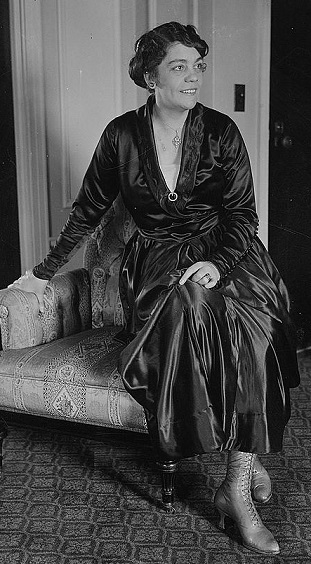
    Swedish mezzo-soprano Julia Claussen studied at the Royal Academies of Stockholm and Berlin, made her operatic debut in Stockholm in 1903, and sang at Paris, London, and Chicago.

    From her debut there as Dalila in 1917 until 1932, Julia Claussen was a mainstay at the Metropolitan Opera in New York City. She sang Azucena, Amneris, Ortrud, Fricka, Brangaene, Kundry, Venus, Marina in BORIS GODUNOV, Laura in LA GIOCONDA, and other roles for a total of nearly 175 performances at the Old House and on tour. She frequently participated in the opera and song concerts that were regular features of Met seasons at that time. 

    An interview with Julia Claussen here. She died at Stockholm in 1949.

    Julia Claussen – Schmerzen from Wagner’s Wesendonck Lieder