Tag: Wednesday April

  • BSO x 2 ~ Mostly Shostakovich

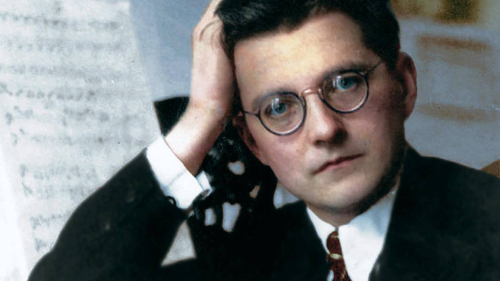
    Dimitri-Shostakovich

    Above: Dimitri Shostakovich

    ~ Author: Ben Weaver

    Wednesday April 23rd and Thursday April 24th, 2025 – Dmitri Shostakovich was the focus of Boston Symphony Orchestra’s two-concert visit to Carnegie Hall this week, under the leadership of its music director Andris Nelsons. Shostakovich’s son Maxim, dedicatee and first performer of the Second Piano Concerto, was in attendance on the second evening.

    Shostakovich died 50 years ago, and his famous struggles living and composing in a totalitarian regime, always one offense away from the gulag, sadly remain relevant today – not just in Russia, but in the United States as well. Cellist Yo-Yo Ma made a brief statement from the stage, quoting Josef Stalin’s famous line: “A single death is a tragedy, a million deaths are a statistic.” Ma pleaded that no death should ever be a statistic, and he wanted to honor anyone suffering loss of life or dignity. Ma did not name any names, but the meaning is loud and clear as our own US government is disappearing human beings into foreign gulags. For anyone who argues that artists should stay out of politics, people like Shostakovich remain an important reminder that art has launched revolutions, and if art was not political, it would never be banned.

    Ma Cello-Concerto-No.-1-Robert-Torres

    Above: Yo-Yo Ma, photo by Robert Torres

    Cello Concerto No. 1 in E-flat major, Op. 107, composed in 1959, was dedicated to Mstislav Rostropovich (as was, incidentally, the 2nd.) Yo-Yo Ma has been performing it for much of his career and his deep affection for it is clear. His warning about tyranny just before the performance was reflected in his approach to the jolly opening tune, which Ma played with a rawness that made it darker and more sinister. Irony and the grotesque are deeply ingrained in Soviet art, a tool for plausible deniability which anyone who wished to survive purges needed to master. The Playbill notes by Harlow Robinson point out that Shostakovich buried in the score a small, distorted fragment from Josef Stalin’s favorite Georgian folk song, “Suliko” – something even Rostropovich did not spot until Shostakovich finally pointed it out. (Stalin died in 1953, six years before the Concerto was composed.) As an encore Ma joined Boston Symphony’s entire cello section and they delivered a jaunty version of a traditional Yiddish tune “Moyshele,” arranged for a cello ensemble by BSO’s principal cellist Blaise Déjardin, who also contributed magnificent solo playing.

    Two late symphonies by Shostakovich received searing performances under Andris Nelson’s leadership. Over the last few years maestro Nelsons performed and recorded all of Shostakovich’s symphonies with the Boston Symphony Orchestra for Deutsche Grammophon. It is an excellent cycle (which also includes the Piano Concertos with Yuja Wang, Violin Concertos with Baiba Skride, Cello Concertos with Mr. Ma, and the opera Lady Macbeth of Mtsensk District. I have found much of these performances excellent.)

    Shosty

    Above: Maestro Nelsons, photo by Chris Lee

    Symphony No. 11 in G minor, Op. 103 (composed in 1956-57) carries the subtitle “The Year 1905.” The work depicts the failed revolution against the Russian monarchy and earned Shostakovich the Lenin prize.

    The opening movement Adagio, subtitled “The Palace Square,” is dark and gloomy, with dull strikes from the timpani foreshadowing events to come. Nelsons’s deliberate tempo set the mood well, building tension to the bloodshed to come. (I also noticed there is a section here John Williams “borrowed” for T-Rex in the score for “Jurassic Park.”) The brutal second movement (Allegro, “The 9th of January”) depicts the “Bloody Sunday” at the Winter Palace where peaceful protesters were massacred by the guard. The pounding march depicting the assault was led by BSO’s excellent percussion section. A mournful “Memory Eternal” and defiant “Tocsin” movements (a celesta taking the place of a tocsin bell) were emotionally shattering under maestro Nelson’s leadership.

    Shostakovich’s last Symphony, No. 15 in A major, Op. 141 (composed in 1970-71) was originally intended to celebrate his own 65th birthday. Several medical emergencies, including a heart attack, delayed its composition and premiere, which finally took place under his son Maxim’s direction in 1972. It’s most unusual aspect is presence of extensive unaltered quotations from Rossini’s William Tell Overture and Wagner’s Götterdämmerung and Tristan und Isolde, composers and works not immediately identified with Shostakovich. The full mystery of why he included these specific quotations remains a matter of speculation. I’ve always found the “Lone Ranger” theme to be especially jarring, but it’s important to note that Shostakovich is highly unlikely to have been familiar with that American TV series, so his point of reference to that music would have been very different from ours. Musically the choices do fit into the fabric of the symphony. The raucous opening movement – which Shostakovich ones called a “toy shop” – is a perfect place for the galloping Rossini tune. And Wagner’s music is a perfect fit for the stillness of the symphony’s latter movements. Shostakovich also quotes some of his own music. The closing percussion – like tickings of a clock – immediately remind one of the ending of the second movement of his Symphony No. 4. Andris Nelsons and his Boston forces delivered a largely superb performance, although I think maestro Nelsons’ lethargic take on the Adagio (second and fourth movements) was a misstep. They dragged and lost focus, no matter how beautifully the orchestra played. But special mention to concertmaster Nathan Cole, principal cellist Blaise Déjardin, and flautist Lorna McGhee for superb solo contributions.

    Bso uchida


    Above: Maestro Nelsons and Mitsuko Uchida take a bow; photo by Chris Lee


    Ludwig van Beethoven’s Piano Concerto No. 4 in G major, Op. 58 opened BSO’s two-night residence at Carnegie, with the always brilliant Mitsuko Uchida as soloist. The concerto has often been interpreted as Orfeo calming the furies (particularly in the magical second movement, where calmness by the soloist is interrupted by angry strings) – and so Ms. Uchida bravely faced a consumptive audience member who began proudly coughing as Ms. Uchida began to play. After a few calming chords, Ms. Uchida stopped and held up her hands in the direction of the patient. The offender took her time exiting the auditorium, coughing non-stop. We could still hear her coughing up a lung from the hallway, but that’s the most we could hope for.


    Finally the performance resumed with Ms. Uchida delivering an deeply moving performance. The work is full of conflict, but – somewhat unusual for Beethoven – if his voice its the soloist, he calms the other side instead of fighting it. Such dignified understatements were presented by Ms. Uchida with unaffected dignity and charm. That stunning second movement, with angry strings being repeatedly silenced by the soothing soloist, is among Beethoven’s most powerful and beautiful statements, and Ms. Uchida is simply second-to-none with sincerity and beauty. The rollicking Rondo: Vivace that closes the concerto is Beethoven’s victory over adversity dance, but one filled with humor. Here, too, Ms. Uchida played with unabashed, contagious joy.
     

    Uchida 2


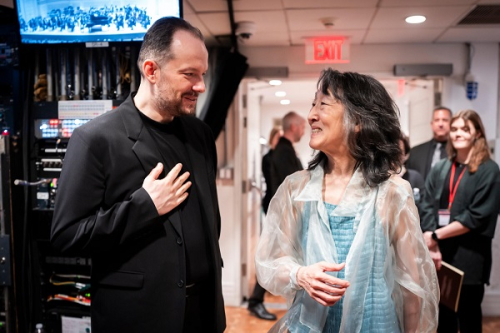
    Backstage: Maestro Nelsons and Ms. Uchida; photo by Chris Lee


    Andris Nelsons is an excellent accompanist, which I’ve had a chance to note many times. His respect for his soloists, keeping the orchestra from burying them, is an admirable trait – one I wish a few other notable conductors would also acquire.

    ~ Ben Weaver

    (Chris Lee’s performance photos courtesy of Carnegie Hall)

  • Violinist Lun Li @ The Morgan Library

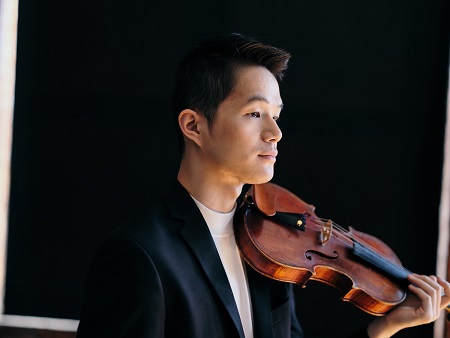
    Lun Li

    ~ Author: Oberon

    Wednesday April 24th, 2024 matinee – This was my third time hearing the Chinese violinist Lun Li. My first encounter was at Merkin Hall when he gave his NY debut as a Young Concert Artist. Soon after, he played the Prokofiev second violin concerto – most impressively – with the Riverside Symphony at Alice Tully Hall.

    This afternoon, Lun Li offered a distinctive program at The Morgan Library, and he played thrillingly from start to finish. I very much liked his idea of having the house lights completely darkened throughout the concert; the only drawback to this was: it was impossible to take anything more than the most rudimentary notes. In the long run, though, notes became superfluous because this was some of the greatest violin playing I have ever heard. After a while, I stopped trying to write anything down and just let the music transfix me.

    Lun Li’s presentation was simple: clad all in black, he stood in a pool of light on the stage, casting a quadruple shadow. The darkness in hall seemed to make the audience more attentive and more focused on the music; there was a resolute stillness in the air, making the charismatic violinist’s extraordinary playing even more compelling.

    The program was devised in three segments followed by a sort of built-in encore. Each segment consisted of a short ‘prelude’, followed by a longer work.

    Music by Henry Eccles – his brief Prelude in A-minor – opened the concert, followed immediately by Nicola Matteis’ Alia Fantasia. The two pieces were written about fifteen years apart and are similar in feeling. Lun Li’s playing was elegant, and technically immaculate.

    Continuing in a Baroque mode, music by Giovanni Bononcini, came next: his Prelude in D-minor led on to the celebrated Chaconne from Partita No. 2 in D-minor, BWV 1004, by Johann Sebastian Bach. This long work offers endless opportunities for brilliant playing, and Lun Li gave as astounding, passionate performance, holding the audience under a spell with his virtuosity. The ensuing ovation was inevitable after such a glorious rendition.

    Following Philip Glass’s Book of Longing, which has a Baroque flavor, but with a tinge of timelessness, Lun Li gave a monumental performance of Béla Bartók’s Sonata for Solo Violin. The sonata was composed in 1944 on a commission from the American violinist Yehudi Menuhin; it was one of the composer’s last works. This solo sonata is in three – or maybe four – movements: Tempo di ciaccona, Fuga, Melodia, and Adagio – the last two being inseparable.

    The sonata places extraordinary demands on the violinist as the music veers from searing, to luminous, to poignant. The sheer number of notes is uncanny, and they were all sewn together in an intense, unforgettable musical experience by our remarkable soloist. If the reaction to the Bach seemed massive, the ovation after the Bartók was simply off the charts.

    Lun Li polished off his program with Tessa Lark’s Jig and Pop, a lively piece with a mile-a-minute swirls of notes. The violinist was called back for numerous bows.

    The near-total darkness in hall today certainly worked in this particular instance, but if it becomes a trend – it’s been that way for years at The Joyce – people like me will be out of a job.

    ~ Oberon

  • YCA Presents Violinist Lun Li ~ Debut Recital

    Lun li

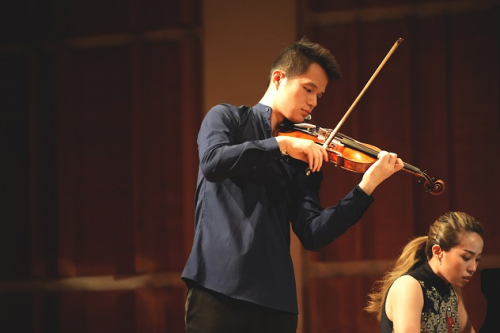
    Wednesday April 26th, 2023 – Young Concert Artists presenting the New York debut recital of violinist Lun Li (above) tonight at Merkin Hall. Pianist Janice Carissa shared the stage with the young violinist in a wide-ranging program which Lun Li described in a program note:

    My debut program explores the interplay between fantasy and reality through the works of Bartók, Messiaen, Schumann and others. I have chosen a set of repertoire that explores this blurred dimension, and more importantly, allows the listener to form sonic connections without needing extensive knowledge and context. I invite you to form your own personal narratives with this program.”

    In the program’s brief opening work, “Don Quixote” from 18 Miniatures by Giya Kancheli, both players showed themselves to be passionate and highly accomplished musicians. The music has a boisterous start, which develops into a strutting dance. Thereafter, extroverted phrases alternate with delicate, witty ones.

    Lun Li then spoke briefly, and asked that we withhold applause during the remainder of the program’s first half. He and Ms. Carissa then commenced on a marvelous performance of Francis Poulenc’s Violin Sonata.

    Poulenc originally wrote this sonata in 1942/1943, for the young French violinist Ginette Neveu, who perished in a plane crash in 1949 at the age of thirty. Thereafter, the composer revised the sonata, making several changes in the last movement. The work recalls the composer’s memories of the great Spanish poet Federico García Lorca (1899-1936); suspected of homosexuality, García Lorca was executed by the Fascists soon after the outbreak the of the civil war.

    The sonata’s opening Allegro con fuoco makes a frantic start before easing into a tango-like mood, which speeds up before halting for a long pause. A tender melody develops with great passion; alternating moods carry us to a fantastic finish.

    Poulenc headlined his second movement, an Intermezzo, with a quotation from García Lorca: “The guitar makes dreams weep,” alluding to the poet’s own guitar arrangements of Spanish songs. The music begins with a lulling piano motif accompanied by plucked violin notes. A subtle melody becomes rapturous, the piano lapses into a dreamlike state. Off-kilter harmonies sound before an upward violin glissando brings a quizzical end.

    The third movement’s title, Presto tragico, foreshadows the death of the poet: fast and urgent passages mesh with dancelike swirls of notes, climaxing with a violent chord. A searing violin theme jolts us, then the music subsides to a tragic, mournful conclusion.

    Honoring Lun Li’s request for “no applause” was difficult after such a thrilling performance, but the mood held and he commenced the high, soft agitato of Salvatore Sciarrino’s Per Mattia, a brief work that flowed seamlessly into the ensuing Schoenberg. 

    Janice carissa.

    Above: pianist Janice Carissa

    Arnold Schoenberg’s Phantasy, Op. 47, began life as a solo violin piece, to which the composer later added a separate piano accompaniment. Lun Li and Ms. Carissa here displayed the wonderful sense of teamwork that underlined their playing all evening. The pianist, whose gown was a work of art in and of itself, is wonderfully subtle, and she deftly handled the rhythmic shifts in which this music abounds. Together, the players veered from the ethereal to the drunken, dancing along thru stuttering, jagged passages which morphed, incredibly, into Fritz Kreisler’s Miniature Viennese March. This was a brilliant ending to the concert’s first half: jaunty, and impeccably played.

    Music of Olivier Messiaen, his Fantaisie, opened the evening’s second half; the composer is perhaps best remembered for his magnificent, poignant Quartet for the End of Time. The Fantaisie opens with Ms. Carissa delivering an emphatic statement from the piano. Dance-like passages are heard, and then Lun Li’s violin soars over gorgeous rippling figurations from the pianist. The music sails along, alternating rapid passages with thoughtful ones: mood swings that are relished by the players. From a high-velocity, tumultuous buildup, the music becomes cinematic. Animated/agitated music gives way to another high-flying, silken violin theme. The climax is reached, with the composer offering a swift, dazzling finish. 

    Robert Schumann’s quirky Bird as Prophet, arranged by Leopold Auer, comes next. Ascending violin phrases have a touch of irony, and then a lyrical song springs up, with a shimmering trill. The music features some wistful hesitations.

    4

    Lun Li and Ms. Carissa polished off the evening with a compelling performance of Béla Bartók‘s Violin Sonata No.2, Sz. 76. Lun Li aptly described this music as being “from a different planet”, and from its big, strange start it is indeed kozmic, weird, and wonderful. Passion and pensiveness send alternating currents thru the hall, sagging violin motifs develop into an epic expressiveness. As things simmered down, Lun Li remained unfazed by the ill-timed sound of a cellphone: he delivered a plucking ‘cadenza’ from which a dance emerged: cascades of notes from the violin over a pounding rhythm from the keyboard. Fabulous playing…they sounded like a whole orchestra! 

    Bartók offers a fantastical sonic variety in this piece in terms of tempi and dynamics: a piano solo of epic power gives way to a spidery violin motif. Lun Li becomes a veritable speed demon, playing fast and furious, and taking things to new heights. The music calms, and slows; the violin sighs, then starts plucking, and the music dances onward.

    2

    The audience hailed the musicians with a fervent ovation at the sonata’s end, and Lun Li graciously thanked us for having accompanied him on this musical journey. He then launched a performance of Schubert’s  Erlkönig that was an astounding demonstration not only of his virtuosity but of his unbounded passion and his heartfelt dedication to music.

    I look forward eagerly to hearing Lun Li again…and soon: on Friday May 5th, he will play the Prokofiev 2nd with the Riverside Symphony at Alice Tully Hall. Tickets and info here

    Performance photos courtesy of Young Concert Artists.

    ~ Oberon.

  • Great Performers: Matthias Goerne

    M Goerne

    Above: Matthias Goerne

    Wednesday April 20th, 2016 – Baritone Matthias Goerne offered a program of songs by Eisler, Schumann, and Wolf, with Alexander Schmalcz at the Steinway. The recital was part our Great Performers at Lincoln Center subscription series.

    In the congenial setting of Alice Tully Hall, we experienced a lieder recital like no other I have ever attended. Rather than singing neat sets of songs by each composer and walking offstage after each group, only to return in a couple of minutes for another segment, Mssrs. Goerne and Schmalcz remained onstage throughout each half of the program. At the end of each group of songs by one of the evening’s composers, applause was forestalled by silent signals from the singer and by the pianist keeping his hands poised over the keyboard. Thus each half of the program flowed seamlessly, coughing and quiet chatter between sets was avoided, and the focus on the music itself, without the distractions of the recitalist’s comings and goings, made for an intense and amply rewarding listening experience. The individual songs became part of a vast sonic canvas of myriad colours. 

    This innovative presentation created an opportunity to experience the Goerne voice and artistry in two long arcs of song. And what a voice it is: in over five decades of listening to singing in the realms of opera and classic song, only two or three voices have been so captivating just as sound. Mr. Goerne is blessed with an enormous vocal range, from the depths of basso-darkness to a secure, blooming, and captivating upper register. His mastery of dynamics is nothing less than awesome: thunderous, hall-shaking phrases can be succeeded by the most delicate of sustained piano effects, whilst at mid-volume, the sound with it’s magically manipulated vibrato is almost unbearably beautiful. 

    Mr. Goerne is a singer who gets physically involved in his songs: gestures and indeed full-body moves seem to flow with utter naturalness from his deep emotional commitment to what’s being sung. Thoroughly lacking in pretense, he allows us into his private world where we can commune with the composers thru the singer’s personal involvement. Goerne’s generosity both of voice and of spirit makes him an artist you want to experience time and again.

    With the Goerne voice ideally partnered by Mr. Schmalcz’s lyrical attentiveness at the piano, the music-making was so totally pleasing that it hardly mattered what was being sung, or that the numerous (and short) Eisler songs are less involving musically than those of Schumann or Wolf. It was just such an immersive pleasure to bask in the heart-healing tone and exquisite expressiveness that filled the blessèd space.

    When it was announced that songs by Wolf would be on the program, I hoped to see that composer’s timelessly touching Anakreons Grab listed – alas, it wasn’t included in the printed program. But it made for a gorgeous encore, sung and played so poetically:

    "Here, where the roses bloom, and the ivy embraces the laurel,
    Where the turtledove murmurs, and the cricket sings -
    What grave is this, that the gods 
    Have so kindly graced with vines and flowers?
    It is Anacreon's resting-place. Spring, Summer, and Autumn did that poet enjoy; And now from Winter, at last, this mound protects him."  

  • Huang/Schwizgebel @ The Morgan Library

    Huangschwizgebel

    Wednesday April 22nd, 2015 – Violinist Paul Huang and pianist Louis Schwizgebel (above) in a noontime recital at the Morgan Library, presented by Young Concert Artists in collaboration with the Morgan Library and Museum.

    Earlier this year I heard Paul Huang playing in a Young Concert Artists Composers Series concert at Merkin Hall. His artistic maturity seemed remarkable in one so young. Shortly after that concert, it was announced that Paul was one of five recipients of an Avery Fisher Career Grant.

    Swiss-Chinese pianist Louis Schwizgebel won the Geneva International Music Competition at the age of seventeen, and two years later, he won the Young Concert Artists International Auditions in New York. In 2012 he was awarded the Arthur Rubenstein Prize in Piano at the Juilliard School, and in 2013 he was announced as a BBC New Generation Artist.

    Franz Schubert’s Rondo brilliant in B Minor, D. 895 (Op. 70) opened the programme, with both the musicians looking dapper in black suits with red silk handkerchiefs in their breast pockets. Gilder Lehrman Hall at The Morgan is a wonderful venue for chamber music, with its comfortable, steeply-raked seating and its fine acoustic which gives the music real immediacy. Displaying ‘Olde World’ warmth of tone and depth of sensitivity, the Huang/Schwizgebel duo gave an exhilarating performance of this demanding Schubert showpiece.

    Thematically rich, with an upward-leaping signature motif, the Rondo (composed 1826) showed the two young musicians in a fine rapport, mining both the dramatic and the virtuosic passages with flair. Shifts of key and pacing were astutely mastered, and Mr. Huang’s technical command was impressive. Incidentally, the manuscript score of this work is housed at The Morgan.

    Arvo Pärt’s Fratres is well-known to Gotham’s ballet lovers since it was used by Christopher Wheeldon for his 2003 ballet LITURGY at New York City Ballet. After a twitchy, nervous passage for solo violin, the piano makes an emphatic entrance. Thereafter we are taken on a musical/spiritual journey that veers from urgency to pensiveness, rises to a passionate cry to heaven, and develops into a soulful hymn. A repeated, rising theme for the violin seems to depict souls ascending to heaven before the work reaches its ethereal finish. Mssrs. Huang and Schwizgebel gave an engrossing performance of this piece which is surely among Pärt’s finest and most memorable compositions.

    Cesar Franck’s Sonata for Violin and Piano in A Major is so poignantly familiar; right from the start we are drawn into its melodic soundscape. Louis Schwizgebel’s playing of the first solo piano passage radiated romantic tenderness, and the piano introduction to the second movement was superbly played. Paul Huang brought intense beauty to each theme that Franck so generously gives to the violin; the clarity and expressiveness of his playing was something uplifting to experience.

    Responding to very warm applause from the large audience, Paul and Louis offered a heartfelt rendition of Robert Schumann’s Träumerei as an encore, thoughtfully dedicating it to Susan Wadsworth, the director of Young Concert Artists, and to everyone involved in the organization. The recital celebrated a beautiful Spring day in high style; I felt so fortunate to have been there.

  • Watching Yuki @ Dixon Place

    549369_3885594357018_791351648_n

    Wednesday April 24th, 2013 – Certain dancers seem to grab our attention no matter what they are dancing. I’ve been following Yuki Ishiguro’s work here in New York City for a few seasons now and he’s a dancer I’ll often go out of my way to see. Tonight he was performing in a piece by Charly Wenzel in a mixed programme at Dixon Place; the evening was part of the NYC10 Festival.

    Yuki began his dance-life break-dancing in Japan. Since coming to New York City, he has danced with isadoraNow (where I first saw him), for Darcy Naganuma, Sunhwa Chung, and Emery LeCrone; he appeared in a witty work with Yoo and Dancers and he’s currently involved in Cori Marquis’ The Nines. Yuki performed his poignant solo ANOTHER WORLD with BalaSole Dance Company, and was photographed by Kokyat while rehearsing a duet with Kentaro Kikuchi.

    What makes Yuki so intrguing – beyond his style of movement – is his enigmatic quality. There’s no other dancer quite like him on the Gotham dance scene. Tonight he appeared in an excerpt from Charly Wenzel’s mysterious Light and Breath and Life and Thought, a work for small ensemble which incorporates hand-held lights and tiny mirror-discs sewn to the costumes which create starry patterns as they catch the light. Yuki danced beautifully in a role that featured elements of break-dancing, a form in which his combination of technical skills and artistry make him a stand-out. 

    My plan this evening was to go, watch the piece that Yuki was in, and leave. It turned out that Yuki was on next-to-last but it didn’t matter because I ended up enjoying the entire programme. Here is a brief commentary on each of the participating companies:

    The Beat Club – a tremendous and diverse large ensemble of gorgeous young people; they closed the evening with a fantastic performance; combining many genres, their energy was unstoppable in this brilliant and often auto-biographical work combining spoken narrative and infectious rhythms.   

    Charly Wenzel & Dancers
    – at once dark and luminous; a mystery-filled excerpt which makes me want to see more.

    NonaLee Dance Theatre
    – four dancers in tightly-hooded body suits dancing excellent moves, with appropriate-energy music. I liked this a lot.

    Sublime Dance Company
    – really inventive, very well-danced, and an interesting ‘script’ actually spoken by the dancers. Nice individual performances; I know dancers don’t like talking as a rule but they handled it very well. 

    SUNPROJECT – fantastic send-up of SWAN LAKE with four black-leather and boldly-sassy swans doing wildly provocative moves to Tchaikovsky; hugely entertaining, and I was smitten with Keiji Kubo.  

    Sunny Nova Dance
    – very fine choreography and super-good dancing, the music was a bit anonymous but the dancers carried it really well.

    MJM Dance
    – the most thought-provoking work, very well-executed; it’s the story of a tragic 1911 sweatshop fire in New York City that killed over 140 workers. Nice ensemble work from the all-female cast.

    DanceSpora
    – four distinctively beautiful women on pointe; really enjoyed this choreography and all the dancers, despite an innocuous musical score. The movement and individual personalities were very pleasing.

    Billy Bell’s Lunge Dance Collective – a powerful, sensuous and violent pas de deux danced magnificently by Billy Bell and McKenna Birmingham; everything here was engrossing except the music, the anonymity of which somewhat undemined the power of the piece. Nevertheless, a fascinating and disturbing work, and Billy Bell is tantalizing
    in his cruelty shaded with guilt while Ms Birmingham gives a courageous performance.

    Yoo and Dancers – a truly original work in which a young woman deconstructs and re-builds a male statue; live piano music enhanced the performances of Mary-Elizabeth Fenn and Sean Hatch, who carried out the choreographer’s idea with a lovely seriousness of intent.

    So, because of a single dancer – Yuki – I met a whole lot of new choreographers and dancers, including some I definitely want to see again. It was a really good evening.

  • Ballet Next: Choreographic Exhibition

    BalletNext_9288

    Above: Michele Wiles and Kristi Boone in Mauro Bigonzetti’s LA FOLLIA, photo by Paul B Goode. Click on the image to enlarge.

    Wednesday April 25, 2012 – “You’ll be close enough to see us sweat and breathe,” said ballerina Michele Wiles in a brief film shown at the start of this evening’s presentation by Ballet Next. She was right, and there’s nothing more beautiful – for me at least – than watching dancers dance, especially at close range. Some dance-goers want to see an effortless sheen of ‘artistry’ which masks the physicality of the dance; myself, I love to see the body working, the minute flickerings of facial expression as the dancer ‘edits’ herself, the sense of stretch as the muscles respond, and the mechanics of delivering a triple pirouette. In a large theatrical setting, you’re at a remove from all of this. Tonight at Manhattan Movement and Arts Center, the dancers exposed themselves to our keenest scrutiny. They looked superb.

    Michele Wiles and Charles Askegard created Ballet Next as a continuation of their top-flight dance careers after they ‘retired’ from ABT and New York City Ballet respectively. They certainly don’t look like any retirees I know; their vitality and their eagerness to share their excitement about Ballet Next with an ever-broadening audience are infectious. Michele and Charles have set forth to bring us classic and new choreography danced by ballet’s greatest talents to live music. So far they’ve been succeeding admirably.

    Tonight’s programme delivered four works, each created especially for Ballet Next. The Company’s music director Elad Kabilio and his troupe of gallant young musicians delivered inspired playing of works by Stravinsky, Shostakovich, Satie and Vivaldi. Setting their musical barre very high gives Ballet Next an added lustre in my view; the better music you use, the better your choreography and dancing will look. It’s that simple. 

    And so we started with Stravinsky, violinist Hajnal Karman Pivnick and pianist Ben Laude treating us to shimmering suite of music from Baiser de la Fee. I have a special love for this music since Balanchine’s gorgeous setting of the score was the first work I ever saw danced by New York City Ballet (by Patricia McBride and Helgi Tomasson, no less…)

    Charles Askegard entitles his duet to this music simply DIVERTIMENTO. Danced with teriffic flair by Charles and NYCB‘s Georgina Pazcoguin, his choreography is witty and wonderful with some very inventive partnering motifs threading thru the music. Physically demanding, the dance evoked genuine enthusiasm from the packed house. Ms Pazcoguin, always a dancer to lure the opera glasses when she’s on the big stage, is a fascinating technician and personality to experience in this more intimate setting. Charles, one of the ballet world’s most valuable partners, doesn’t give himself any easy breaks in his own choreography. DIVERTIMENTO is a pure pleasure in every regard.

    By way of contrast, Brian Reeder’s summer-shadowy PICNIC proved to be a small jewel of a narrative ballet. Drawing inspiration from the film PICNIC AT HANGING ROCK, the choreographer turns to Shostakovich’s Cello Sonata in D Minor with its alternating currents of pensive and slightly ominous feeling, and shows us three schoolgirls in white frocks setting out on that fatal picnic from which two of them never returned. Michele Wiles, Kristi Boone and Misty Copeland comprised a stellar trio, each (like the girls in the film) with her own unique little quirks. Kissing, chaste but inquisitive, delicately projects the Sapphic undercurrents found in the film. Meanwhile, Charles Askegard, perhaps drawing on his incredible portrayal of the death figure in Robbins’ IN MEMORY OF…seems silently to draw Misty and Kristi into his thrall, leaving Michele to awaken, alone and mystified. Cellist Elad Kabilio and pianist Ben Laude supported the dancers with a poetic rendering of the Shostakovitch.

    Following an intermission during which we were up-dated as to the success of the evening’s live- streaming (people tuning in worldwide), Margo Sappington spoke briefly about her creation of ENTWINED for Ballet Next. I’ve seen this ballet evolve from a single, sensuous duet thru the addition of a pas de trois and a solo (for Michele Wiles); Margo revealed she has one more idea up her sleeve, a duet for two women; then ENTWINED will be complete. Or, she might even go on from there.

    What she has crafted to date is an atmospheric piece set to Satie Gnossiennes (played by Ben Laude) which opens with a pas de trois danced by Charles Askegard, Georgina Pazcoguin and Ana Sophia Scheller. The choreography here flows thru a misty setting, as in a dream. Images of sleep and wakefulness drift by. The solo for Michele Wiles (beautifully danced, of course) evolves seamlessly from the pas de trois and this in turn floats into the pas de deux danced by Misty Copeland and Charles Askegard. By turns sculptural and steamy, this duet borders on the erotic, temptingly lush in its signature choreographic entwining of two bodies. Misty looked gorgeous.

    (My only tiny complaint about the evening was that we didn’t get to see more of Ana Sophia Scheller; a ballerina in my super-top echelon of favorites, she danced gloriously in ENTWINED…and we did have the delightful experience of watching her warm up before the performance. Major beauty.)

    Mauro Bigonzetti’s LA FOLLIA is a grand finale for a Ballet Next presentation. I’ve seen this duet now four times and it’s just incredible. The two women – Michele Wiles and ABT‘s fantastic Kristi Boone – nailed the complex in-sync steps and launched their complex solos with real bravado. This is dancing that’s taxing to the max, and the girls gave it a splendid energy. Meanwhile the excellent quartet of musicians (violinist Francesca Anderegg joining Ms. Pivnick and Mssers. Kabilio and Laude) played the dazzling Vivaldi theme and variations for all it was worth. This brought the evening to a truly exciting close.

    So glad I ran into my young dancer-friend Alejandro Herrera whose easy, outgoing personality helped me overcome my innate shyness for once. Chatting with Chuck Askegard,  Amanda Hankes, Rebecca Krohn, Adam Hendrickson, Sterling Hyltin, Gina Pazcoguin and Kristi Boone was a pleasure, while MMAC‘s Erin Fogarty let a couple of cats out of the bag for what is sure to be a grand night of Dancing Against Cancer at MMAC on May 7th (Matt Murphy will photograph that dress rehearsal for me). 

    As for Ballet Next, the future looks bright indeed with a season scheduled for The Joyce this Autumn and plans for growth and development running apace. Michele and Charles are not only great artists but great people who have a real passion for ballet and who have the connections in the dance world to make Ballet Next a truly dynamic force. I look forward to following their every step.